Year: 2019

12 Jul 2019

You can now register for the Minecraft Earth closed beta

Take the real-world exploration of Pokémon GO and mash it up with the building elements of Minecraft, and you get Minecraft Earth.

While there’s no launch date for the game, Mojang has been saying for a while now that a closed Beta would go live sometime “this summer”. If you’re looking to get in there early, good news: they just opened up registration.

You can find the Beta registration page here.

Alas, since it’s a closed Beta, registering doesn’t guarantee you access — but in its FAQ about the Beta, the team notes that they’re planning to open it up to “hundreds of thousands of players” eventually, so your odds of getting in probably aren’t too bad. You’ll need to be over the age of 18, have a device running iOS 10/Android 7 or newer, and a Microsoft or Xbox Live account to get registered.

TechCrunch’s Devin Coldewey got a super early look at the game back in May — you can find his thoughts on it right over here.

Mojang also released a video teaser this afternoon, wrapping up much of what the game will offer in just under 3 minutes:

11 Jul 2019

YouTube is giving creators more ways to make money

YouTube is rolling out more ways for its creators to engage fans and generate revenue, the company announced today the VidCon event in Anaheim, California. Last year, YouTube used the event to launch new products like channel memberships, merchandise shelves, premieres, and more. This time around, it’s expanding several of those existing options with new features, while also introducing new products like Super Stickers and Learning Playlists — the latter which aims to promote the educational use of YouTube.

Super Stickers, meanwhile, is meant to complement the existing monetization tool, Super Chat.

Launched in January 2017, Super Chat lets fans pay to make their message stand out during a YouTuber’s live stream or Premiere. Today, YouTube says Super Chat is now the number one revenue stream across nearly 20,000 channels — a 65% year-over-year increase.

Over 90,000 channels have used Super Chat to date, with some earning more than $400 per minute, thanks to the feature.

Given Super Chat’s traction, YouTube is introducing Super Stickers, which will launch in the next few months. Fans will be able to purchase these new, animated stickers during live streams and Premieres in order to show creators how much they like their content.
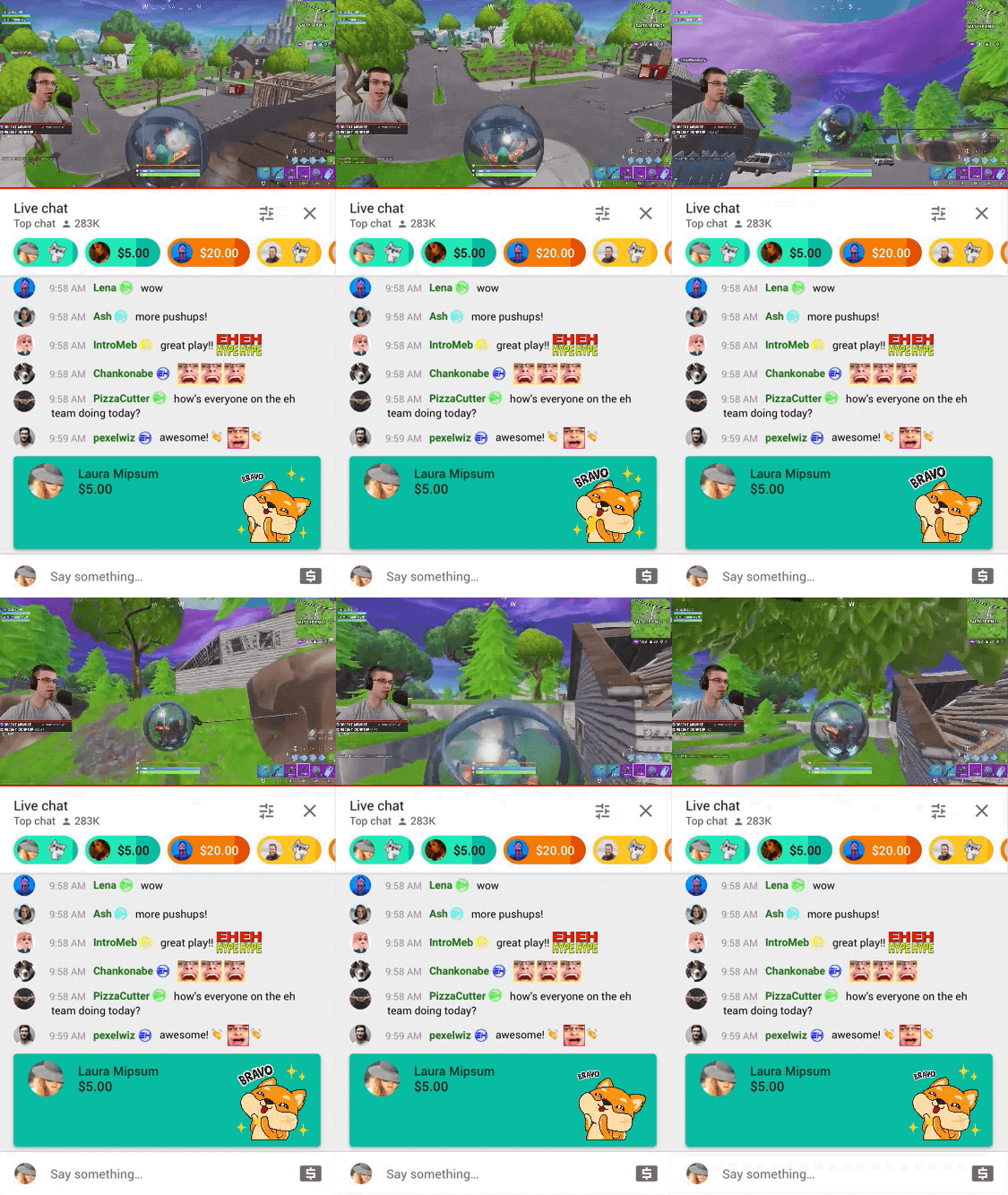
super stickers

The idea for Super Stickers seems to be inspired by gaming site Twitch’s Bits emotes and cheermotes, which also bring animated stickers into chat as a way of supporting video creators. However, YouTube’s Super Stickers will have a different look-and-feel, and will be offered across different languages and categories — including gaming, fashion and beauty, sports, music, food, and more.

At last year’s VidCon, YouTube also introduced Channel Memberships — an expansion of YouTube Gaming’s previous Twitch-like “Sponsorship” model, where fans pay a subscription to gain access to special features associated with a favorite channel.

At present, fans can opt to pay the $4.99 Channel Membership subscription to get unique badges, new emojis and other special perks like access to exclusive live streams, extra videos, or shoutouts. Today, YouTube is introducing a much-requested change to memberships: levels.

With levels, creators can set up to five different price points for memberships, each with their own set of perks. The feature has already been tested by select YouTubers, including the Fine Brothers Entertainment on their REACT channel. Their channel membership revenue increased by 6x after they rolled out two more expensive pricing tiers, YouTube said.

In addition, YouTube is expanding its Merch shelf feature that also launched last year at VidCon. Its debut partner Teespring helped creators to sell merchandise like t-shirts, hats, phone cases, and more. YouTube took a small commission on the sales, but said the majority went to the creator — along with the money made from the merch sales themselves.

Today, the Merch shelf is gaining several more partners, like Crowdmade, DFTBA, Fanjoy, Represent, and Rooster Teeth.

YouTube says “thousands” of channels have more than doubled their revenue thanks to the Merch shelf, Super Chat, and Channel Memberships, since launch.

Beyond the monetization features, YouTube also took time to speak about the educational and inspirational use cases on its site.
LearningPlaylistOverview desktop 1

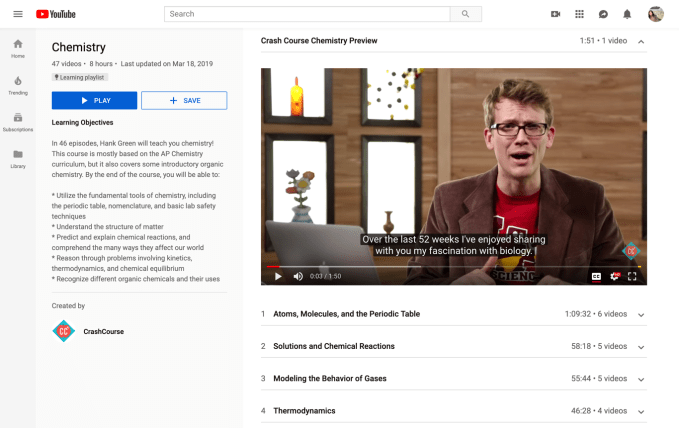
To make it easier for people to use YouTube to learn something new, the company is debuting a new feature called Learning Playlists, which offers more structure than is available with playlists today. The feature allows educational video creators to divide videos into chapters around key concepts, going from more basic to more advanced. And it hides recommendations from the Watch page — a first for YouTube.

Initially, only a handful of trusted partners get to test this feature, including Khan Academy, TED-Ed, The Coding Train, and Crash Course, to name a few.

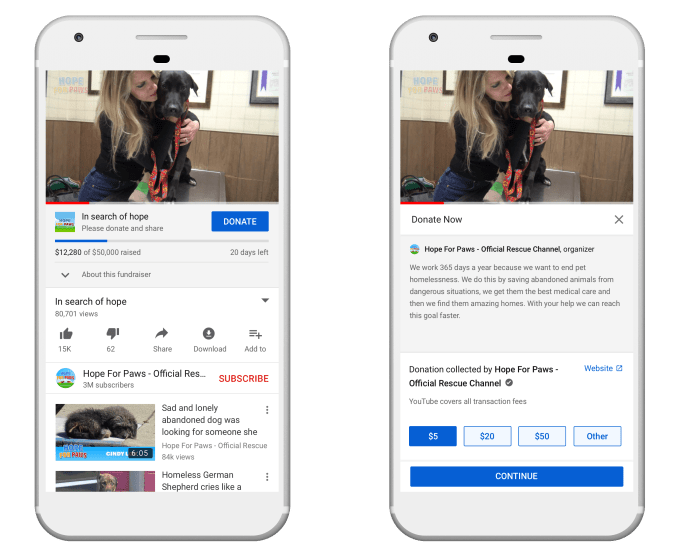
Finally, the site’s fundraising tool, YouTube Giving, is preparing to exit beta after a year of testing. The feature will launch in the months ahead and become available to thousands of U.S. creators. Once live, fans can click a Donate button to give to the nonprofit the creator wants to support.
Giving cropped Final2

Ahead of today’s VidCon keynote from YouTube Chief Product Officer Neal Mohan, the company had announced some well-received changes to the site’s copyright infringement tools.

It said copyright owners now have to specify the timestamp in the video their content appears, while creators will be able to use an updated version of YouTube Creator Studio to easily remove the portion of the content associated with the claim.


This helps to address situations where the Manual Claiming system was being used (or some would say abused) to claim very short — even only one second long — pieces of content, or incidental content — like when a creator walks past a store that’s playing music, for example. The company had said in April it was looking to address this.

The new system lets creators easily mute the sound when the claimed song plays, replace the song with free-to-use tracks, or quickly trim out the infringing content, instead of taking their video down.

Creators generally welcome the changes and new features that help them better engage fans and make money (or at least, not lose money).

That being said, YouTube is still under scrutiny for its bigger missteps and other practices like the gaming of its recommendation system and its role in creating a pedophilia wormhole; its alleged COPPA violations, which the FTC was alerted to; its ability to radicalize viewers as they’re pointed to ever more extreme content; its contribution to a world where parents exploit their kids for cash; and issues around how it policies “free speech” and hate speech, among other things.

In the grand scheme of things, YouTube has a lot on its plate beyond a few stickers and new ways to sell swag. But these are the sorts of tools that lock in creators to the YouTube platform, even amid threats from other large tech companies like Facebook, Instagram, and now Snapchat, which just announced new creator shows.


11 Jul 2019

There’s a tennis game hidden in Google right now. Here’s how to find it

Google loves a good Easter egg. From cutesie Douglas Adams references to the search results for “askew” being just a liiiiittle bit crooked, there’s all sorts of stuff hiding in the search engine if you know the right thing to type or the right buttons to push.

The latest addition is in honor of the Wimbledon tennis tournament, which wraps up this weekend. If you know where to look, Google has hidden a fun little pong-style tennis game within its results page.

It’s not too hard to find, but it’s just tucked away enough that most people probably won’t stumble upon it accidentally.

Here’s how to find it:

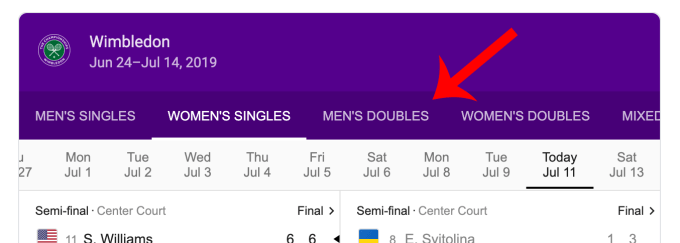
  1. Do a Google search for “wimbledon scores“.
  2. tennis 1

  3. See that purple box that pops up? See the nav bar that says “Men’s Singles”, “Women’s Singles”, etc? Grab that, and drag it all the way to the left to scroll to the end.
  4. tennis 2

  5. At the very end is a little tennis ball icon. Tap that, and the game should fire right up.

tennis 3

Once you’ve got it up, it’s pretty much Pong minus the paddles. Move to serve, then try to get your player in front of the ball to rally it back and forth. I’m not sure if it’s possible to actually get the ball past the computer player — I haven’t seen it happen. But just successfully returning the ball will get you a point. Once you miss a return, it’s game over.

It’ll work on both mobile or desktop, but I’ve found it’s a helluva lot easier to play on the latter.

11 Jul 2019

Twitter will start testing its ‘hide replies’ feature next week, in Canada

Twitter users are getting more control over which comments are visible in the conversations they start.

The company has been testing and talking about this feature since earlier this year, but starting next week, Twitter will actually roll it out to users in Canada.

As you can see in the GIF below, when you’re looking at replies to your tweets, you’ll be able select any of them and hit the “hide reply” option. However, as the name implies, these posts won’t be fully removed from Twitter, just hidden from the default view — everyone will still be able to tap on a gray icon to view hidden replies.

Here’s how Twitter’s Michelle Yasmeen Haq and Brittany Forks explain the feature:

Everyday, people start important conversations on Twitter, from #MeToo and #BlackLivesMatter, to discussions around #NBAFinals or their favorite television shows. These conversations bring people together to debate, learn, and laugh. That said we know that distracting, irrelevant, and offensive replies can derail the discussions that people want to have. We believe people should have some control over the conversations they start.

Twitter Hide Replies

As my colleague Sarah Perez noted previously, the current implementation is open to at least two criticisms — one, that it could allow users to hide critical viewpoints or fact-checking of their tweets (maybe quote-tweeting will be the better strategy moving forward), and two, that it still forces people to wade through potentially trollish or hateful content in order to hide replies.

Haq and Forks emphasize that Twitter is still looking for ways to improve the feature: “By testing in one country we want to get feedback and better understand how this tool can improve before it’s available globally.”

And yes, the timing of the news is a little awkward, coming right after Twitter went down for about an hour.

11 Jul 2019

Making wearables matter: Blood pressure monitoring could be the tipping point

Today’s wearables are still designed for the healthy and wealthy, not those who could benefit the most. Medical wearables offer the potential to collect health data and improve health via a combination of real-time AI and expert human intervention. Apple’s announcement of FDA clearance of its Watch for screening for irregular heart rhythms was meant to be groundbreaking. But its medical value right now remains limited and controversial. What will make the promise into reality?

I believe the application that will make wearables medically matter is automated blood pressure monitoring. Blood pressure may not be sexy, but it’s a universally understood measurement and a clinically central one. Your doctor measures your blood pressure every single time you visit. Even those who don’t pay close attention to their health know that high blood pressure increases risk of heart attack and stroke, and lower blood pressure saves lives.

High blood pressure, or hypertension, affects between 30-50% of adult Americans, or 75-120 million people. It’s the No. 1 risk factor in deaths worldwide, and the No. 1 modifiable risk in heart disease and stroke, the top two worldwide causes of death. Despite this, only half of people with high blood pressure are lowering it enough, even with medications. Why? A big reason is lack of information.

Doctors advise everyone at risk to monitor their blood pressure, but few do it often enough, in large part because inflatable blood pressure cuffs, while universal, are uncomfortable and inconvenient. In fact, current medical guidelines recommend automated blood pressure monitoring to more accurately measure your blood pressure, but hardly anyone is willing to use a motorized cuff that squeezes your arm every 30 minutes while you try to sleep! Cuffless automated monitoring would provide more accurate information, enable timely intervention, lower blood pressure and save lives.

Numerous companies have tried to create a cuffless automated blood pressure monitor, including Apple, Samsung, Google, Microsoft, Amazon, Fitbit and Jawbone, as well as a very long list of startups. No one has yet been successful. As a healthcare investor excited about this area, I have met with many of the startups working on this problem, and I see some common issues.

What’s missing?

Companies in this area should first focus on generating medical-quality data. Teams need experts in FDA regulation and clinical studies and need to listen to them when planning timelines and budgets. Unlike some other areas where VCs invest, this is not a market for moving fast and breaking things. Instead, companies need to collect training data from hundreds of people, especially those with hypertension, to ensure their product meets the FDA’s performance standards.

We can make wearables matter.

But accurate data is just the tip of the iceberg. More complete blood pressure data should enable healthier decisions and lower blood pressures. This could mean a warning that average blood pressure has increased recently, or a proactive text or call from your doctor or a family member. It could include suggested adjustments to medications or healthier behaviors based on patterns through the day and night. User experience plays a critical role in real-world use. Automated monitoring should be no more intrusive than wearing a wristwatch and getting a notification.

On the cusp

The good news is a breakthrough in this space doesn’t seem that far away. Better sensors, algorithms, computing power and battery life are helping companies produce results closer to FDA standards. I expect multiple groups will meet the challenge in the next 18 months. Room exists for multiple winners in this market, given the huge market opportunity and wide range of use cases. Every major wearable platform is under pressure to consider adding FDA-cleared applications, and blood pressure is at or near the top of their “most wanted” lists.

Companies that can connect better data to better blood pressure will be able to create value and win payment from insurers, consumers or both. For example, Medicare has recently significantly improved coverage of remote patient monitoring.

Measure what matters

Cuffless automated blood pressure monitoring will improve how we treat high blood pressure, both through medication and healthy behaviors. Automated monitoring will better support people at highest risk, such as patients recovering from heart failure or stroke, by providing early warnings of potential recurrence. Ultimately, we could even get early warnings of heart attacks, strokes or other events, giving us time to act.

Current wearables measure what comes easily, like steps and heart rate. By instead measuring what matters medically, we can use that data to extend lives. We can make wearables matter.

11 Jul 2019

David Fincher will direct ‘Mank’ biopic for Netflix

David Fincher will be directing his first feature film since 2014, and he’s making it for Netflix .

The director of “Seven” and “The Social Network” already helped kick off Netflix’s original content boom by directing episodes of “House of Cards” and “Mindhunter.” In fact, the popularity of Fincher’s films on Netflix was famously one of the reasons the streamer’s executives felt comfortable spending hundreds of millions of dollars on “House of Cards.”

As reported in Variety, Fincher’s new film is currently titled “Mank.” It will be a biopic starring Gary Oldman as screenwriter Herman Mankiewicz, who shared credit (and the film’s only Academy Award) with director Orson Welles for writing “Citizen Kane.”

While it’s not clear what stance the film will take towards Mankiewicz and Welles, it’s worth noting that some cinephiles (including the critic Pauline Kael) have argued that Mankiewicz deserves more credit for the greatness of “Kane,” which is commonly described as the greatest movie of all time.

This sounds like a passion project for Fincher, particularly since the initial script was written years ago by his father Jack, who died in 2003.

It’s also a vein of film history that Netflix tapped last year by financing the completion of Welles’ final film, “The Other Side of the Wind.”

11 Jul 2019

Three great opportunities for startups in the entertainment space

With over-the-top (OTT) changing the way we consume entertainment across devices, most of the media attention is going to the big players trying to elbow their way into the streaming space with big new subscription services and original programming. Less discussed is the suite of technologies that pave the way for those services to connect to their audience and monetize the content.

Okay, it’s true video compression, identity management, analytics, front-end personalization and device-specific experience optimization are not the sexiest topics in the media world. But without those core features and functions, the OTT revolution would be dead in its tracks. And with the big providers focused on content development, user acquisition and business model optimization, development of those technologies is wide open for innovative startups.

As always, entrepreneurs should look for cracks and gaps in the existing processes to find better solutions. Right now, the biggest systemic pains in the emerging OTT ecosystem are around the complexity of the fragmented user experience – having to sign in and out of multiple systems to get to the content we want to watch – and around adapting old mass-audience advertising models to the new era of multi-device, multi-platform, personalized viewing.

Here are three areas where small, nimble startups could make a real contribution to the industry.

Enabling the Evolving Advertising Model

Currently the streaming market is divided between ad-supported services and premium-fee subscription models, but that hard division is unlikely to survive the next wave of market disruption. Premium services like Netflix will need to introduce a lower-fee ad-based tier to expand their audience and compete with lower-priced offerings like Disney+. More fundamentally, streamers will need additional sources of revenue once they have harvested all the low-hanging fruit in terms of subscriber base growth. And because streamers have access to so much user-specific data, the potential for personalized advertising is vast.

Online ad-tech platforms are already scrambling to retool their marketplaces to serve streamers. Is that the right way to look at the new OTT ecosystem, or does the way we sell, serve and measure ads for streaming services need to evolve to address audiences binge-watching longform content rather than snacking on short-form listicles, GIFs and short videos?

There’s also a blue sky opportunity to monitor and measure the performance of interactive ads that provide click-through transactions for viewers watching on tablets or handheld devices. Early data shows these ads can be extremely effective… or they can be so annoying and intrusive that they risk alienating viewers entirely. Do we trust the big companies to get this balance right? Sounds to me like this is a job for small, focused, innovative startups with a single-minded devotion to solving one facet of this problem for the industry.

Screen Shot 2019 07 11 at 1.26.04 PM 1

Reducing Platform Friction

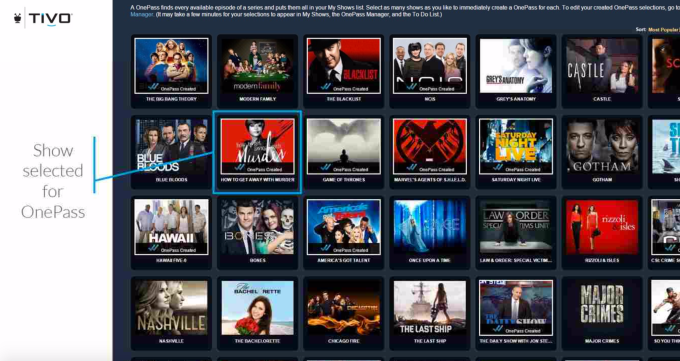
One byproduct of the fragmentation of the old bundled cable viewing experience is the demise of the relatively simply program grid. What we found in the 00’s is that, even with 500+ channels available through some cable systems, you can make that simple and consumable for viewers if you present it intuitively and augment it with a little bit of intelligence.

Now that we’re entering a world which each content provider requires membership in its private OTT service to access original content plus its archive of movies and shows, it’s no longer so simple. In fact, there’s a lot of friction and overhead between the user and their shows.

We see a huge opportunity for startups to address this by creating a meta-layer on top of the fragmented streaming environment that abstracts away the complexity for viewers while preserving the underlying integrity of the individual services. This layer would act like a web browser, passing user access credentials seamlessly to each site to simplify sign in, standardizing the presentation of content and ads, and securely passing user data to each back end system.

The big players have invested specifically in making these platforms closed and proprietary to maximize their own competitive advantage. You can’t count on them to fix a situation that they perceive as being in their individual interests, even if it ends up hurting the industry and the ecosystem as a whole. But there’s a great opportunity for an outside innovator to come in and disrupt this model before it ossifies into a near-monopoly situation for a few carriers.

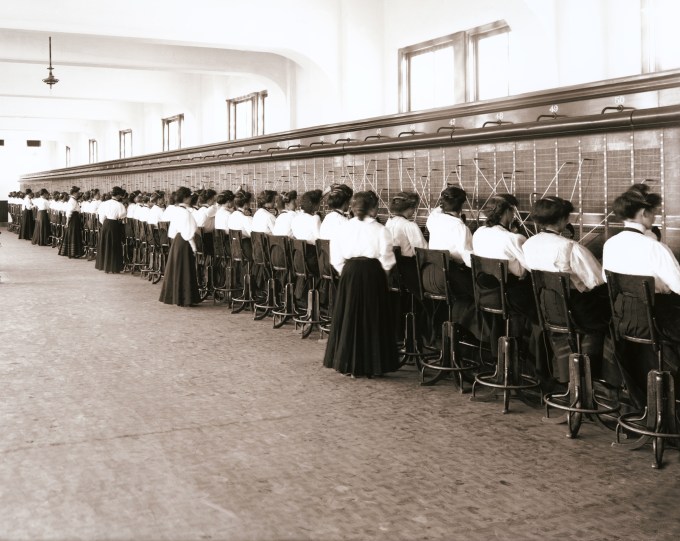
Telephone switchboard operators circa 1914. Photo courtesy Flickr and reynermedia.

Personalizing Content

The third big opportunity also addresses this big consumer pain point of complexity, specifically around having too many content choices and no road map for finding the programs we want to see. Once again, this is a problem we were able to solve in the old bunded cable era with smart collaborative filtering technologies, recommendations, and automation that allowed people to essentially build their own personalized content channels featuring stuff they already liked and might possibly like.

Fragmentation of content across closed services makes that more challenging. Luckily, AI capabilities have evolved as well, to the point that we don’t need to think only in terms of personalizing viewing options, but personalizing the entire viewing experience.

Again, business incentives dictate that each OTT service develop its own UX to differentiate itself from competitors, but those incentives work against the desires of viewers to have a simple way to find and view content that’s standard across whatever services they use. There’s a great opportunity for startups to bring forward all that we’ve learned about UX design, customization and personalization, plus a layer of AI to simplify search and discovery of content users prefer, to make the whole streaming world much simpler.

Open Innovation Starts with IP

These are just a few examples of areas where disruptive innovators can fix problems that the industry leaders can’t or won’t. We believe that an open model for innovation needs to be part of the conversation around the future of entertainment, and that conversation must include small insurgent companies as well as the giant incumbents. But for that model to work, we need to ensure that the IP rights of those companies are protected and respected.

If we can stick by those principles, we can create a more stable foundation for the post-cable world of TV entertainment, bring new solutions to market more quickly and more efficiently, and continue to delight audiences with great content rather than frustrating them with complexity and impossible choices.

11 Jul 2019

Attend TC Sessions: Enterprise and score a free pass to Disrupt SF 2019

We can’t wait to dig into the competitive, high-stakes world of enterprise software at TC Sessions: Enterprise 2019 on September 5 at the Yerba Buena Center for the Arts in San Francisco. We’re channeling the excitement into creating extra ROI for you. How’s that work? Read on.

It starts with the $100 you’ll save when you buy your early-bird ticket. Here comes the extra part. For every ticket you buy to TC Sessions: Enterprise, we’ll register you for a free Expo-only pass to TechCrunch Disrupt SF 2019. Who doesn’t like free?

We expect more than 1,000 attendees — including some of the top minds, makers and investors in enterprise software — for a day-long intensive event focused on the promises and challenges of this massive $500 billion market. You can expect onstage interviews, exhibiting startups, breakout sessions, receptions and more. TechCrunch editors Frederic Lardinois, Ron Miller and Connie Loizos will interview founders from both established and emerging companies about crucial topics, like intelligent marketing automation, AI and the inevitability of the cloud.

Case in point. You can’t talk about enterprise software or its shift to the cloud without talking about the Kubernetes container management system. That’s why we’re thrilled to have the opportunity to sit down with Aparna Sinha, Google’s director of product management for Kubernetes; Tim Hockin, who currently works on Kubernetes and the Google Container Engine; Kubernetes co-founder Craig McLuckie; and Microsoft’s Brendan Burns — the lead engineer for Kubernetes during his time at Google.

These four heavy hitters will discuss the history of Kubernetes, why Google went open source with it and the five-year-old project’s rapid growth. It promises to be a fascinating look at the past, present and future of containers in the enterprise.

That’s just one presentation in a jam-packed day dedicated to all things enterprise. Check out the speakers we have on tap so far. And by all means, if there’s someone you want to hear on the stage, send us your speaker submissions.

TC Sessions Enterprise 2019 takes place September 5. Early-bird tickets cost $249, and student tickets sell for $75. Buy 4+ tickets to get the group rate and save another 20%. And remember, you’ll receive a free Expo-only pass to Disrupt SF 2019 with every TC Sessions: Enterprise ticket.

Get your early-bird tickets now, and we’ll see you in September!

Interested in sponsoring TC Sessions: Enterprise? Fill out this form and a member of our sales team will contact you.

11 Jul 2019

This new autonomous startup has designed its delivery robot to conquer winter

Refraction, a new autonomous delivery robot company that came out of stealth Wednesday at TC Sessions: Mobility, sees opportunity where most AV startups are avoiding: regions with the worst weather.

The company, founded by University of Michigan professors Matthew Johnson-Roberson and Ram Vasudevan, calls its REV-1 delivery robot the “Goldilocks of autonomous vehicles.”

The pair have a long history with autonomous vehicles. Johnson-Roberson got his start by participating in the DARPA Grand Challenge in 2004 and stayed in academia researching and then teaching robotics. Vasudevan’s career had a stint at Ford working on control algorithms for autonomous operations on snow and ice. Both work together at University of Michigan’s Robotics Program.

The REV-1 is lightweight and low cost — there are no expensive lidar sensors on the vehicle — it operates in a bike lane and is designed to travel in rain or snow, Johnson-Roberson, cofounder and CEO of Refraction told TechCrunch.

The robot, which debuted on stage at the California Theater in San Jose during the event, is about the size of an electric bicycle. The REV-1 weighs about 100 pounds and stands about 5 feet tall and is 4.5 feet long. Inside the robot is 16 cubic feet of space, enough room to fit four or five grocery bags.

It’s not particularly fast — top speed is 15 miles per hour. But since it’s designed for a bike lane, it doesn’t need to be. That slower speed and lightweight design allows the vehicle to have a short stopping distance of about five feet.

Refraction has backing from eLab Ventures and Trucks Venture Capital.

Consumers have an appetite and an expectation for on-demand goods that are delivered quickly. But companies are struggling to find consistent, reliable and economical ways to address that need, said Bob Stefanski, managing director of eLab Ventures.

Stefanksi believes Refraction’s sturdy, smaller-sized delivery robots will allow for faster technology development and will be able to cover a larger service area than competitors operating on the sidewalk.

“Their vehicles are also light-weight enough to deploy more safely than a self-driving car or large robot,” Stefanski noted. “The market is huge, especially in densely populated areas.”

The REV-1 uses a system of 12 cameras as its primary sensor system, along with radar and ultrasound sensors for additional safety.

“It doesn’t make sense economically speaking to use a $10,000 lidar to delivery $10 of food,” Johnson-Roberson said. By skipping the more expensive lidar sensor, they’re able to keep the total cost of the vehicle to $5,000.

The company’s first test application is with local restaurant partners. The company hopes to lock in bigger national partnerships in the next six months. But don’t expect those to be in the southwest or California, where so many other autonomous vehicle companies are testing.

“Other companies are not trying to run in the winter here,” Johnson-Roberson said. “It’s a different problem than the one that others are trying to solve, so we hope that gives us some space to breathe and some chance to carve out some opportunity.”

11 Jul 2019

It’s not just you, Twitter is down

Twitter is currently down across the web.

At about 2:45 pm ET, the desktop and mobile site were down, displaying a “Something is technically wrong” error. The app was also not working.

At the time of writing, Twitter’s status page confirmed there was an “active incident,” adding: “We are currently investigating dependencies for Twitter data. Scope of affected APIs is undetermined at this time.”

A spokesperson for Twitter did not immediately comment.

We’ll have more when we get it.

More on Twitter: