Year: 2019

11 Jul 2019

Boosted’s electric scooter is fast, durable, fun and…really heavy

Boosted, the startup that got its beginnings with electric skateboards, has officially taken its first stab at electric scooters with the launch of the Boosted Rev.

I’ve spent the last couple of weeks riding the Rev around the streets of San Francisco and, as I put in the headline, it’s fast, durable, fun and really heavy — 46 pounds to be exact. If this were part of a shared scooter model, the weight wouldn’t matter, but bringing it up and down a few flights of stairs on the daily isn’t ideal.

It weighs so much, Boosted CEO Jeff Russakow told me, because of the power it’s packing.

“But you are giving up about seven or eight pounds to do it,” Russakow said. “But, I mean, you’re getting six times the power and years and years of durability in return for it does have a little more weight.”

It’s worth noting that I don’t have to bring the scooter inside. The Boosted Rev is capable of being locked to a bike rack, but, you know, bolt cutters are things that exist.

Boosted Rev, which retails for $1,599, features all-wheel drive, dual-wheel motors (1500 watts each), is able to travel up to 24 mph with a range of 22 miles, and climb and descend 25%-grade hills. Rev is also designed to handle thousands of miles per year for several years. Thanks to the dual motors, it hauls ass up hills. Seriously, I was busting up the hills of San Francisco at 19 mph.

The Rev has three ride modes that respectively max out at 12, 18 and 24 mph. Unlike many other scooters on the market, Rev features wide air-filled tires to help with shock absorption and traction. The Rev also features three different breaking mechanisms: the hand brake, electric brake and foot brake. In my experience, the electric brake worked well enough to not need any of the other brakes, but it was still nice to have the hand brake for some peace of mind.

[gallery ids="1853728,1854264,1854265"]

“If you look at standing kick scooters today, with no disrespect, they’re more of a toy, or a leisure grade product that was never really intended to be riding over real streets and potholes with a Mack truck behind you,” Russakow said. “So we started out saying if you were to make an electric scooter that was a vehicle, how would you design it. And so that was everything from the amount of power to the type of frame to the range to the type of wheels to the throttle to making it incredibly durable — mechanically, electrically, environmentally. So it’s more similar to a car or a motorcycle, in terms of its vehicle quality. And we always knew from day one, that’s the vehicle we wanted to make. Can it climb hills cannot stop on a dime, can it handle all weather, will go for tens and tens of thousands of miles a year and have very little maintenance?”

It’s true. The scooters out there from the likes of Bird, Lime, Skip, Scoot and others are not in the same arena as Boosted. This becomes clear from the moment you step on the Boosted Rev. The Rev feels sturdy, handles bumps in the road well and makes it easy to keep up with cars.

What’s unique about Boosted’s scooter is its thumb wheel for accelerating and decelerating. The idea is to be able to do everything you need to do with one hand. That way, when you need to signal, you can just use your left hand without having to worry about giving up braking for signaling.

The two main caveats for me come down to the weight of the scooter and safety. The safety bit has more to do with riding any micromobility vehicle on busy city streets and the fear of a car or truck mowing me down. Also, because this scooter goes so fast, the possibility of severely injuring myself if I fly off the scooter drastically increases.

I’d be remiss if I didn’t note a technical, but inconsistent difficulty with the Rev. Sometimes I had to reboot the scooter or fold and stow it and then unfold it to get it to accelerate. Boosted said I had a pre-production unit, so perhaps that’s why.

But the Rev is not the only scooter you can buy. Bird, for example recently got in to selling scooters direct to consumers, and then there are the likes of Ninebot, Xiaomi, Unagi, Jetson and many others.

The market for ownership, Russakow said, is “a different but bigger market.”

“It’s been great to see scooter share because people get exposed to scooters as commute options,” Russakow said. “But we think we’re serving the by-far largest market.”

If I were in the market for an electric scooter (I’m not) and lived somewhere where I didn’t have to lug the scooter up and down the stairs on the daily (I don’t), I would buy the Boosted Rev for its sheer power up hills and top speed.


11 Jul 2019

OneTrust raises $200M at a $1.3B valuation to help organizations navigate online privacy rules

GDPR, and the newer California Consumer Privacy Act, have given a legal bite to ongoing developments in online privacy and data protection: it’s always good practice for companies with an online presence to take measures to safeguard people’s data, but now failing to do so can land them in some serious hot water.

Now — to underscore the urgency and demand in the market — one of the bigger companies helping organizations navigate those rules is announcing a huge round of the funding. OneTrust, which builds tools to help companies navigate data protection and privacy policies both internally and with its customers, has raised $200 million in a Series A round of funding led by Insight that values the company at $1.3 billion.

It’s an outsized round for a Series A, being made at an equally outsized valuation — especially considering that the company is only three years old — but that’s because, according to CEO Kabir Barday, of the wide-ranging nature of the issue, and OneTrust’s early moves and subsequent pole position in tackling it.

“We’re talking about an operational overhaul in a company’s practices,” he said in an interview. “That requires the right technology and reach to be able to deliver that at a low cost.” Notably, it said it wasn’t actually in search of funding — it’s already revenue generating and could have grown off its own balance sheet — although he noted that having the capitalization and backing sends a signal to the market and in particular to larger organizations of its stability and staying power.

Currently, OneTrust says that it has around 3,000 customers across 100 countries, and the plan will be to continue to expand its reach geographically and to more businesses. Funding will also go towards the company’s technology: it already has 50 patents filed and another 50 applications in progress securing its own IP in the area of privacy protection.

The company offers technology and services covering three different aspects of data protection and privacy management.

Its Privacy Management Software helps an organization manage how they collect data as well as generate compliance reports in line with how a site is working relative to different jurisdictions. Then there is the famous (infamous) service that lets internet users set their preferences for how they want their data to be handled on different sites. The third is a larger database and risk management platform that assesses how various third-party services (for example advertising providers) work on a site and where they might pose data protection risks.

These are all provided either as a cloud-based software as a service, or an on-premises solution, depending on the customer in question.

OneTrust has an interesting backstory that sheds some light on how it was founded and how it identified this problem relatively early.

Alan Dabbiere, who is the co-chairman of OneTrust, had been the chairman of Airwatch — the mobile device management company acquired by VMware (Airwatch’s CEO and founder, John Marshall, is OneTrust’s other co-chairman). In an interview, he told me that it was when they were working on Airwatch — where Barday had worked on consulting, integration and engineering services — that they began to see just how a smartphone “could be a quagmire of information.”

“We could capture apps that an employee was using so that we could show them to IT to mitigate security risks,” he said, “but that actually presented a big privacy issue. If you have dyslexia or if you use a dating app, you’ve now shown things to IT that you shouldn’t have.”

He admitted that in the first version of the software, “we weren’t even thinking about whether that was inappropriate, but then we quickly realised that we needed to be thinking about privacy.” He says that it was Barday who first brought that sensibility to light, and “that is something that we have evolved from,” he added. After that, and after the VMware sale, it seemed a no-brainer that he and Marshall would come on to help the new startup grow.

Although, Airwatch made a relatively quick exit, the plan, he added, was to stay the course at OneTrust, with a lot more room for expansion in this market.

Indeed, there is an obvious opportunity to expand not just its funnel of customers, but to add in more services, such as proactive detection of malware that might leak customers’ data (such as in the recently-fined breach at British Airways), as well as tools to help stop that once identified. While there are a million other companies also looking to fix those problems today, what’s interesting is the point from which OneTrust is starting: by providing tools to organizations simply to help them operate in the current regulatory climate as good citizens of the online world.

This is what caught Insight’s eye with this investment. “OneTrust has truly established themselves as leaders in this space in a very short timeframe, and are quickly becoming for privacy professionals what Salesforce became for salespeople,” said Richard Wells of Insight. “They offer such a vast range of modules and tools to help customers keep their businesses compliant with varying regulatory laws, and the tailwinds around GDPR and the upcoming CCPA make this an opportune time for growth. Their leadership team is unparalleled in their ambition and has proven their ability to convert those ambitions into reality.”

He added that while this is a big round for a Series A it’s because it is something of an outlier — not a mark of how Series A rounds will go soon.

“Investors will always be interested in and keen to partner with companies that are providing real solutions, are already established and are led by a strong group of entrepreneurs,” he said in an interview. “This is a company that has the expertise to help solve for what could be one of the greatest challenges of the next decade. That’s the company investors want to partner with and grow, regardless of fund timing.”


11 Jul 2019

N26 launches its challenger bank in the U.S.

European fintech startup N26 is now accepting customers in the U.S. The company is launching a bank account with a debit card that should provide a better experience compared to traditional retail banks.

If you’re familiar with N26, the product that is going live today won’t surprise you much. Customers in the U.S. can download a mobile app and create a bank account from their phone in just a few minutes. It’s a true bank account with ACH payments, routing and account numbers.

A few days later, you receive a debit card that you can control from the mobile app. Every time you make a transaction, you instantly receive a push notification telling you how much money you just paid. You can set up your PIN code, customize limits, turn on and off online payments, ATM withdrawals or payments abroad.

And that’s about all there’s to know. But what about fees? Basic N26 accounts are free. There’s no monthly fee and no minimum balance. There’s no fee on transactions in a foreign currency and you get two free ATM withdrawals per month.

N26 is going to progressively roll out signups over the summer as a sort of beta program. If you’ve signed up to the waitlist, you’ll get an invitation over the coming hours, days and weeks. There are currently 100,000 people on the waitlist. N26 will then open signups to everyone later this summer.

When N26 rolls out its final product in a couple of months, the company says that it plans to automatically find and reimburse fees the ATM operators are charging. N26 cards in the U.S. work on the Visa network instead of Mastercard.

Just like Chime, N26 will also try to let you get paid up to 2 days early if you get paid via direct deposit. Instead of waiting a couple of days to clear those transactions, N26 will go ahead and top up your account.

N26 US 2

White label

Behind the scene, there are a few differences between N26 in Europe and N26 in the U.S. While N26 has a full-fledged banking license in Europe, the company has partnered with Axos Bank who is acting as a white-label partner in the U.S.

Axos Bank essentially manages your money for you, and N26 acts as the interface between customers and their bank accounts. As a result, you get an FDIC-insured account.

N26 first partnered with a third-party company in Europe as well. But it was a costly deal that wasn’t meant to stick around. The startup got a banking license in Germany that was good for Europe at large. In the U.S., it’s a different story as the market is not as unified as in Europe — it’s complicated to get a license to operate in all 50 states.

“We looked at 30 players, we did some due diligence and we're happy to partner with Axos Bank. The deals that you get in the U.S. for white-label banks are much more favorable than in Europe,” N26 co-founder and CEO Valentin Stalf told me. “It’s a setup for the longer term. It’s good for a couple million customers,” Stalf added later in the conversation.

Just a start

N26 is already planning more features for the U.S. The company plans to roll out two premium plans — N26 Metal and then N26 Black.

And it sounds like there will be some changes when it comes to perks for premium users. “We took that to a separate level,” Stalf said.

Another feature, shared Spaces are finally arriving in the coming months. Spaces are sub-accounts designed to put money aside. You can swipe money from one Space to another or you can set up automated rules.

Eventually, you’ll be able to share a Space with other people so that you can save money and spend money together. It’ll work “like a WhatsApp group,” Stalf said.

N26 currently has 3.5 million customers in Europe and has raised over $500 million in total so far. There are now a thousand people working for N26 in Berlin, 60 employees in New York, 80 people in Barcelona and a small team of 5 to 10 people starting soon in Vienna.

“It went from being a small company to being an international company,” Stalf said.

N26 Spaces ENUS

11 Jul 2019

Airbnb competitor Sonder confirms new investment, $1B+ valuation

Sonder, which rents serviced apartments akin to boutique hotels, has raised $225 million at a valuation north of $1 billion, the company announced this morning.

News of the round, which brings Sonder’s total raised to date to more than $400 million, follows an April report from The Wall Street Journal that the business was closing in on its unicorn round. Valor Equity, Westcap and Nicolas Pritzker via Tao Capital Partners have co-led the round with participation from Fidelity, Atreides Capital, ARod Corp, Spark Capital and Greenoaks Capital.

The Airbnb competitor says it tripled the number of rentable units in its online marketplace last year with more than 8,500 spaces in 20 cities around the world available today. San Francisco-based Sonder expects a $400 million revenue run rate by the end of 2019, representing 4x growth year-over-year.

“The future of hospitality will be dynamic,” writes Sonder co-founder and chief executive officer Francis Davidson in a statement. “It will demand flexibility. And that’s what our diverse, unique and adventure-seeking world is like too. That’s why, while our spaces will continue to take on new forms and expand to exciting neighborhoods around the world, a Sonder will always be unforgettable.”

Sonder, founded in 2012 while Davidson was a freshman at McGill University, raised a $135 million round last year. The company, which accommodates stays as short as one night and as long as two years, for example, provides hotel-like amenities in fully furnished apartments.

As Airbnb gears up for an initial public offering or direct listing expected in the next year, investors look to new investment opportunities in the space. Indian hotel startup Oyo recently secured new cash, including a large investment from Airbnb itself. Additionally, boutique hotel company Life House attracted $40 million and Mint House raised $15 million to provide a better hotel experience.

11 Jul 2019

Signavio raises $177M at a $400M valuation for its business process automation solutions

Robotic Process Automation has been the name of the game in enterprise software lately — with organizations using advances in machine learning algorithms and other kinds of AI, alongside big-data analytics to speed up everything from performing mundane tasks to more complex business decisions.

To underscore the opportunity and growth in the market, today a startup in the wider segment of process automation is announcing a significant fundraise. Signavio, a company founded out of Berlin that provides tools for business process management — “providing the ‘P’ in RPA,” as the company describes it — has picked up an investment of $177 million at what we understand is a valuation of $400 million.

This round is large on its own, but even more so considering that before this the company — founded in 2009 — had only raised around $50 million before now, according to data from PitchBook. This latest capital injection is being led by Apax Digital (the growth equity team of Apax Partners), with DTCP. It notes that existing investor Summit Partners is also keeping a stake in the business with this deal.

The company was founded by a team of alums from the Hasso Plattner Institute in Potsdam, Germany, who used research they did there for creating the world’s first web modeller for business process management and analytics as the template for Signavio’s own Process Manager. (The name “Signavio” seems to be a portmanteau of “navigating through signals”, which essentially explains the basics of what BPM aims to do to help a business with its decision-making.)

Partly because it’s raised so little money, Signavio has been somewhat under the radar, but it has seen a huge amount of growth. It says that revenues in the last 12 months have grown by more than 70%, and its software  is used by more than one million users across 1,300 customers — with clients including SAP, DHL, Liberty Mutual, Deloitte, Comcast and Puma. It counts Silicon Valley as its second HQ these days, that trajectory will be followed further with this latest funding: Signavio says the funding in part will be going to international expansion of the business.

“10 years ago, we set out on a journey to tackle the time-consuming practices that limit business productivity,” said Dr. Gero Decker, CEO and co-founder of Signavio, in a statement. “This significant new investment further validates our approach to solve business problems faster and more efficiently, unleashing the power of process through our unique Business Transformation Suite. We are thrilled to welcome Apax Digital as our new lead partner, and look forward to building upon our success to date by leveraging our partners’ operating capabilities and global platforms for our international expansion.”

The other area of investment will be the company’s technology suite. While BPM has been around for years as a concept — and indeed there are a number of other companies that provide tools that are compared sometimes to Signavio’s such from biggies like IBM and Microsoft through to Kissflow and others — what’s interesting is how it’s had a surge of interest more recently as organizations increasingly start to add more automation into their IT infrastructure, in part to reduce the human labor needed for more mundane back-office tasks, and in part to reduce costs and speed up processes.

Robotic process automation companies like UiPath and Blue Prism bring some of the same processing tools to the table as Signavio, although the argument is that the latter — which says it helps to “mine, model, monitor, manage and maintain” customers’ data — provides a more sophisticated level of data crunching that can be used for RPA, or for other ends. (It also works with several of the big RPA players, mainly Blue Prism but also UiPath and Automation Anywhere.)

“As businesses have become more global, and workforces more distributed, business processes have proliferated, and become more complex,” noted Daniel O’Keefe, Managing Partner, and Mark Beith, Managing Director, of Apax Digital, in a joint statement. “Signavio’s cloud-native suite allows employees across an enterprise to collaborate and transform their businesses by digitizing, optimizing and ultimately automating their processes. We are tremendously excited to partner with the Signavio team and to support their vision.” The two will also be joining Signavio’s board with this round.

11 Jul 2019

Presso is piloting dry cleaning vending machines at midwestern hotels

Hotel dry-cleaning is the absolute worst. Seriously. Have you ever attempted to get clothes cleaned on the road? You’ll routinely end up paying $10-15 per shirt. As someone who travels a lot for business, I’ve found myself seeking out local 24 hour cleaners to cut out the middle men.

But Presso, one of a number of startups who took to the stage at the Rise conference in Hong Kong this week, has developed a novel way to put dry cleaning in the hands of hotel guests. The Indiana-based startup is the brainchild Purdue graduates, Nishant Jain and Thibault Corens. The pair have developed a sort of dry cleaning vending machine designed to live in hotel hallways.

Guests looking for a quicker, cheaper clean swipe a card and manually enter the specifics of the garment they need cleaned (future updates will use a combination of AI and computer vision to identify clothes, but for now that’s left up to the user). From there, the system takes overarm cleaning and pressing clothes in around five minutes, using steam and cleaning fluids.

The system is also able to clean clothes with considerably less water and electricity than traditional washing. Though Jain notes that stains are still a blind spot for the system. Presso isn’t designed to remove those — instead, it’s set up for a quick clean and press, ahead of a business meeting.

The kiosk is currently being piloted in 16 Holiday Inns in the midwest. Jain tells TechCrunch that the locations are already looking to move fully to Presso systems for the sake of added convenience — and to cut out the time and difficulty of working with outside dry cleaners to deal with guest laundry.

So far the startup has raised $261,000, primarily from HAX. Its founders will be seeking additional fundraising later this year.

11 Jul 2019

‘Robot umpires’ make independent league baseball debut

Four months after being announced, so-called “robotic umpires” have made their debut in baseball’s Atlantic League. The addition is one of several tweaks currently being piloted in the independent league in an attempt to update some fundamentals of America’s pastime.

The system utilizes TrackMan radar to determine whether a pitch is a ball or strike, a Doppler-based system that’s already in use at 30 Major League Baseball Stadiums and many more minor league parks. Information from the system is relayed to a human umpire via an iPhone and earpiece.

The system isn’t replacing home plate umpires entirely, and for now the human ump is required to monitor pitches as a kind of fail-safe. They can also ultimately override TrackMan’s calls. Among other things, the system isn’t set up to detect checked swings — when the batter stops a swing midway to let the ball pass.

“Until we can trust this system 100 percent,” the game’s umpire Brian deBrauwere told ESPN, “I still have to go back there with the intention of getting a pitch correct because if the system fails, it doesn’t pick a pitch up, or if it registers a pitch that’s a foot-and-a-half off the plate as a strike, I have to be prepared to correct that.”

Robo umps are one of a number of features currently being tested in the Atlantic League, with the intention of potentially bringing them to the majors, should things go well. Other changes include adjusting the mound’s distance from home plate and a three-batter minimum for pitchers.

11 Jul 2019

Buy a Startup Alley Exhibitor Package at Disrupt Berlin 2019

We’re opening the doors for you to showcase your tech and talent to the international startup community at TechCrunch Disrupt Berlin 2019 on 11-12 December.

How? Buy a Startup Alley Exhibitor Package. Disrupt Berlin attracts thousands of attendees from more than 50 countries around the world — including hundreds of investors and international media outlets. Plant your company directly in their path as they explore Startup Alley looking for emerging trends, potential partners, investment possibilities, collaboration and connection.

Check out what some of your peers have to say about exhibiting in Startup Alley.

“Startup Alley gave us the chance to show our technology to the world and have meaningful conversations with investors, accelerators, incubators, solo founders and developers. It was a massively positive experience.” — Vlad Larin, the co-founder of Zeroqode.

“Exhibiting in Startup Alley is the best training ground for early-stage startup founders, and it was a game-changer for us. We received more insight into our product development process, and we engaged with media and potential investors. It’s a tremendous opportunity to grow.” — David Hall, co-founder, Park and Diamond.

It’s super early-bird season, and that means you can score a Startup Alley Exhibitor Package for €745 + VAT. That price covers one exhibition day and three Founder passes.

You’ll get access to everything that Disrupt Berlin offers: all of the stages including the Startup Battlefield competition, speakers, interactive workshops, Q&A Sessions, the complete attendee list via Disrupt Mobile App, CrunchMatch — TechCrunch’s free networking platform — the complete press list, networking parties, exclusive video content access once the conference ends and a slew of other perks.

Speaking of perks. Every startup that exhibits in Startup Alley has a chance to win a Wild Card entry to the Startup Battlefield pitch competition. TechCrunch editors will choose two outstanding startups as Wild Card teams. Both teams will compete head-to-head in Startup Battlefield for $50,000 equity-free cash, the Disrupt Cup — and a metric ton of investor and media attention.

Disrupt Berlin 2019 takes place on 11-12 December, and when Gelegenheit klopft, savvy early-stage startup founders answer. Open the door for opportunity and buy your Startup Alley Exhibitor Package today.

Is your company interested in sponsoring or exhibiting at Disrupt Berlin 2019? Contact TechCrunch’s sponsorship sales team by filling out this form.

11 Jul 2019

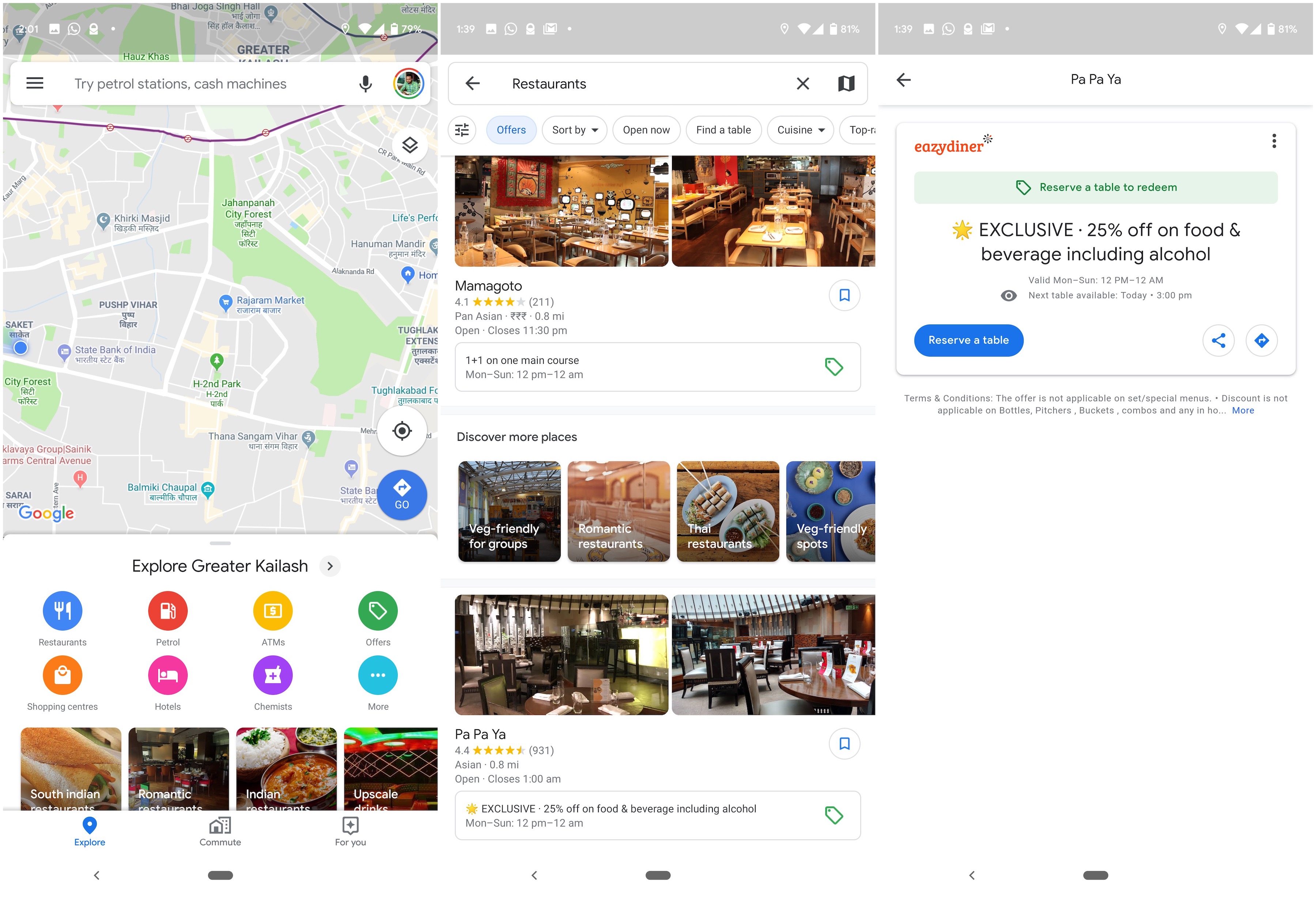
Google Maps now shows users discounts from nearby restaurants in India

Google said today that it has started to display discounts from restaurants in its Maps app in India as the Mountain View giant works to expand its ever growing reach and relevance in one of its key overseas markets.

The company today rolled out an update to add three new features to Google Maps app in India. Users can now see a new ‘offers’ option in the ‘explore tab’ that will display promotional offers from local restaurants. Google said it has partnered with EazyDiner, a table reservation platform, to display offers from over 4,000 restaurants. The feature is live in 11 metro cities in India.

Restaurant offers are just the beginning, as the company plans to ink deals with more partners and expand to more categories in future, it said. Users can also book a table to a restaurant directly from the Maps app. Google did not reveal the financial agreement it had with EazyDiner, a five-year-old New Delhi-based startup that has raised more than $13 million to date.

google maps

The new offering comes as Google explores way to make more money off Google Maps. The company maintains a Google Maps Platform for enterprise customers, and has increased its access price over the years, but it has yet to monetize the consumer-facing part of the service in a significant way.

As part of today’s announcement, the company has also revamped the ‘explore tab’ in India to “reflect the rich diversity of local neighborhoods and communities,” said Krish Vitaldevara and Chandu Thota, Directors of Google Maps, in a blog post. As part of the fresh paint job, Google said it has added seven shortcuts to give users quick navigation to restaurants, ATMs, shopping, hotels, pharmacy, and of course, offers.

Additionally, there is also an option in the explore tab to get directions to top areas in each city. The company said it uses machine learning to identify these areas. “Besides your own city, you can also look up other Indian cities by just searching the city name — an easy way to get up to speed before you travel,” Vitaldevara and Thota wrote.

The third feature, dubbed ‘For You’, displays personalized recommendations for new restaurants and other trending places. Users in India can now also follow a business and get updates and news on events

“This feature also uses the ‘Your Match’ score, which uses machine learning to combine what we know about millions of places with the information you’ve added — restaurants you’ve rated, cuisines you’ve liked, and places you have visited. The first time you use this feature you can select the areas/localities you are interested in, and get more personalized and relevant recommendations over time,” the executives wrote.

Google continues to bulk up its Maps offerings in India. In recent months, it has added the ability to check if a cab goes off the usual route, and look for real-time status of trains and buses, among other features.

The company, which has amassed over 300 million users in India, continues to use the nation as a testbed for many of its services. This approach has helped Google, which operates Android mobile operating system that runs on 98% of smartphones in India, gain wide adoption in the country.

But it has also instilled an antitrust probe on its influence in the nation.

11 Jul 2019

India’s Rivigo raises $65M to expand its freight and logistics platform

Rivigo, a tech startup in India that wants to build a more reliable and safer logistics network, has raised $65 million as major investors continue to place big bet on opportunities in overhauling trucking system in the country.

The Series E round, which has not closed, for the five-year-old startup was led by existing investors Warburg Pincus and SAIF Partners.  The startup, which has raised more than $280 million to date, said it aims to be profitable by March next year.

Rivigo operates a tech platform that tracks and manages shipments and ensures that drivers are available at all times and trucks are as fully loaded as possible. The platform also automatically rotates drivers so that they can get enough rest and see their family while the trucks keep moving. Drivers use an app to navigate maps and accept assignments.

“Relay trucking is now very well established where relay truck pilots lead better life and customers gets exceptional service. With technology and freight marketplace, we now want to bring relay to every truck in the country,” Deepak Garg, founder and CEO of Rivigo, said in a statement.

Rivigo, which competes with heavily-backed startups such as BlackBuck, owns its own fleet of trucks while also operating a freight marketplace. This separates it from competitors that serve purely as an aggregator — or Uber for trucks, if you will.

The startup, which claims to have the largest reach in India, said it would use the capital to further expand its network and tech infrastructure in the country.

“From building algorithmically complex models to accurately predicting the life journey of a consignment to creating a dynamic pricing engine for the freight marketplace, the company is working on hundreds of unique problems at scale,” said Garg.

India’s logistics market, despite being valued at $160 billion, remains one of the most inefficient sectors that continues to drag the economy.

Last month, Rivigo launched National Freight Index that shows live tariff rates for different lanes and vehicles in the country in a bid to bring more transparency to the ecosystem.

More to follow…