Alphabet’s Waymo autonomous driving company announced a new milestone at TechCrunch Sessions: Mobility on Wednesday: 10 billion miles driving in simulation. This is a significant achievement for the company, because all those simulated miles on the road for its self-driving software add up to considerable training experience.
Waymo also probably has the most experience when it comes to actual, physical road miles driven – the company is always quick to point out that it’s been doing this far longer than just about anyone else working in autonomous driving, thanks to its head start as Google’s self-driving car moonshot project.
“At Waymo, we’ve driven more than 10 million miles in the real world, and over 10 billion miles in simulation,” Waymo CTO Dmitri Dolgov told TechCrunch’s Kirsten Korosec on the Sessions: Mobility stage. “And the amount of driving you do in both of those is really a function of the maturity of your system, and the capability of your system. If you’re just getting started, it doesn’t matter – you’re working on the basics, you can drive a few miles or a few thousand or tens of thousands of miles in the real world, and that’s plenty to tell you and give you information that you need to know to improve your system.”
Dolgov’s point is that the more advanced your autonomous driving system becomes, the more miles you actually need to drive to have impact, because you’ve handled the basics and are moving on to edge cases, advanced navigation and ensuring that the software works in any and every scenario it encounters. Plus, your simulation becomes more sophisticated and more accurate as you accumulate real-world driving miles, which means the results of your virtual testing is more reliable for use back in your cars driving on actual roads.
This is what leads Dolgov to the conclusion that Waymo’s simulation is likely better than a lot of comparable simulation training at other autonomous driving companies.
“I think what makes it a good simulator, and what makes it powerful is two things,” Dolgov said on stage. “One [is] fidelity. And by fidelity, I mean, not how good it looks. It’s how well it behaves, and how representative it is of what you will encounter in the real world. And then second is scale.”
In other words, experience isn’t beneficial in terms of volume – it’s about sophistication, maturity and readiness for commercial deployment.
Zoox CTO and co-founder Jesse Levinson revealed a few more details about the company’s autonomous vehicle hardware today, which it’s designing along with its software stack from the ground up. Levinson told us on stage that Zoox’s vehicle will have fully independent active four-wheel suspension — a design detail that will translate to a much smoother ride for passengers on board.
Levinson took us through the Zoox vehicle design at a high level, including covering some of the information he and the company have disclosed previously. The car will have four seats, with sets of two front and back facing inward towards each other. To help accommodate this unique seating arrangement, airbags used in the car will essentially “envelop” passengers, and the absence of both steering wheel and dashboard will actually mean that it’s one of the safest vehicles on the road, in the company’s opinion, since it prioritizes the safety of all passengers in the car equally, rather than weighting the features for driver or front seat passengers like traditional cars.
Levinson also told us after the on-stage interview that the vehicle will be just a bit taller than a BMW i3, but slightly narrower than that electric compact car. That’s a small footprint for a four-passenger vehicle, but inside there will presumably be considerable space savings from the lack of dash, steering wheel and gas and brake pedals. On the subject of the independent, four-corner active steering, Levinson explained that while it incurs an additional cost, that will ultimately be insignificant on a per-trip basis, and the benefits for consumes will be huge.
“If you think about it, you know, when you drive a car, people like to feel connected to the road and feel the bumps, and it’s exciting,” Levinson said. “But if you’re a passenger in the car, you don’t want any of that. So for robotaxis, it’s sort of self-evident, you’d want it to be as smooth and comfortable as possible. Now, cars generally don’t have active suspension on all four wheels, because that’s kind of expensive. And it’s not even something drivers necessarily want. Whereas for Robotaxis, when you get to amortize the cost of that hardware over people using it and paying for it all day long, all of a sudden, the cost of putting an extra suspension is kind of negligible per ride, but it really improves the customer experience.”
The car will also have drive-by-wire steering for both the front and the rear set of wheels, which means that it’ll be able to angle both sets of wheels at once instead of just one. That will make actions like changing lanes or navigating into on-street parking much more efficient, more direct and potentially safer.
As for its sensor equipment, the Zoox car uses four lidar units on each corner of the vehicle instead of one large unit on the top of the car like many others employ today. The input captured from each lidar is combined via sensor fusion with data from radar and optical cameras positioned around the vehicle, and Levinson says the nice thing about their approach is that it has ample redundancy, so that any one of these lidar sensors can fade and you still get a complete picture of the vehicle’s surroundings.
Zoox is already demonstrating its fully electric vehicle for partners and insiders behind closed doors, but it isn’t yet ready to show off the car to press or the general public. Levinson tells us you shouldn’t have too hard a time imagining what the full product will look like, but details like the four-wheel active suspension definitely help fill in the remaining gaps.
In 2017 — for the first time in over a decade — a computer worm ran rampage across the internet, threatening to disrupt businesses, industries, governments and national infrastructure across several continents.
The WannaCry ransomware attack became the biggest threat to the internet since the Mydoom worm in 2004. On May 12, 2017, the worm infected millions of computers, encrypting their files and holding them hostage to a bitcoin payment.
Train stations, government departments, and Fortune 500 companies were hit by the surprise attack. The U.K.’s National Health Service (NHS) was one of the biggest organizations hit, forcing doctors to turn patients away and emergency rooms to close.
Earlier this week we reported a deep-dive story into the 2017 cyberattack that’s never been told before.
British security researchers — Marcus Hutchins and Jamie Hankins — registered a domain name found in WannaCry’s code in order to track the infection. It took them three hours to realize they had inadvertently stopped the attack dead in its tracks. That domain became the now-infamous “kill switch” that instantly stopped the spread of the ransomware.
As long as the kill switch remains online, no computer infected with WannaCry would have its files encrypted.
But the attack was far from over.
In the days following, the researchers were attacked from an angry botnet operator pummeling the domain with junk traffic to try to knock it offline and two of their servers were seized by police in France thinking they were contributing to the spread of the ransomware.
Worse, their exhaustion and lack of sleep threatened to derail the operation. The kill switch was later moved to Cloudflare, which has the technical and infrastructure support to keep it alive.
Hankins described it as the “most stressful thing” he’s ever experienced. “The last thing you need is the idea of the entire NHS on fire,” he told TechCrunch.
Although the kill switch is in good hands, the internet is just one domain failure away from another massive WannaCry outbreak. Just last month two Cloudflare failures threatened to bring the kill switch domain offline. Thankfully, it stayed up without a hitch.
CISOs and CSOs take note: here’s what you need to know.
After generally being the butt of the public market’s jokes since its IPO, Snap is having a killer 2019, with its stock price nearly tripling in value. The successes are perhaps giving the company a moment to pause and think more about generating future value.
Part of that equation is certainly the company’s Yellow accelerator that aims to invest in pre-seed startups that bring mobile users to shared experiences.
We covered Yellow’s inaugural batch back in September, now we’ve got the full rundown on Snap’s second class of bets.
Yellow’s latest accelerator class definitely showcases some similarities to their inaugural group, but you’ll notice more online-to-offline startups aiming to bring users into real-world scenarios and communities like a concert subscription service and workout service reviews. This contrasts a bit to the first class which seemed a bit more focused on camera-based startups that centered around selfies, AR and photos.
From an organizational standpoint, things haven’t shifted too much inside Yellow. The broader company has had a standout 2019, building back a healthy chunk of the market cap value it has lost since debuting publicly. One wonders whether this has enabled the company’s accelerator group to push its investment ambitions beyond Snap’s mobile app focus.
Mike Su, Snap’s director of Yellow, tells me that there haven’t been any top-down directives to shift investment strategies for the accelerator and that the prevalence of offline startups in the class is just more representative of the applicants.
“[The class] continues to be an extension of our values and our thesis,” Su tells me. “Snap has always been about people making connections inside and outside the app.”
ClassPass might toss you in a random workout and say good luck, but Active Spaces is looking to give you more info when searching for your exercising fix. The New York startup is scouring its way through the NYC reviewing gyms and studios one-at-a-time. It’s less about star ratings than it is about giving you a bird’s eye view of what’s there and what’s missing. It’s all really well-done and gives you a ton of info about what you’re in for, and you can book direct from the app.
HQ Trivia might be falling on hard times but Cash Live is looking to take the daily mobile quiz show in a new direction by leaning on the laurels of gaming, some good ole fashioned casino titles. The Vancouver startup is planning to bring a live host to scheduled 15-minute poker, blackjack and bingo tournaments.
Finding local concerts sucks and it’s a process that hasn’t found its startup solution yet. Disko is building a concert subscription service that helps users discover new events in their city with a flat rate $25 per month subscription service which will let users attend up to four concerts per month. The LA startup is starting off in its hometown but has ambitions to expand elsewhere soon.
We’re missing a lot of diversity in the voices and perspectives we see in the media we enjoy. Dose of Society is a London media startup looking to share “real stories from real people.” The group’s videos have had more than 18 million views since launching at the end of 2017.
Snap still has vertical video startups firmly in its purview. Frame is a weekly newsmagazine built for mobile that’s trying to rethink how we get news delivered to us. The NY startup is looking beyond push notifications and is also supporting text updates and calendar updates so that its subscribers can make time to absorb its narrative vertical video journalism.
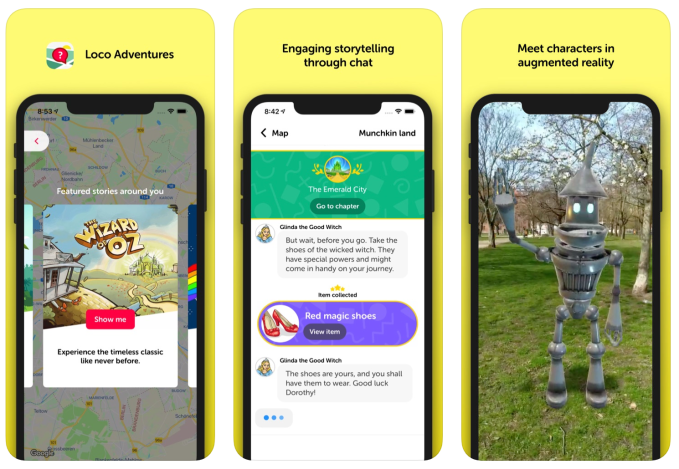
Pokémon GO brought people into physical spaces with its location-based gaming, but other startups are seeing the potential to even further localize AR experiences. Berlin-based Loco Adventures is building games that guide you through local areas with a chat message narrative style.
Muze sees the endless wave of comments on the web and wants to make things a bit noisier, the New York team is working on a way to bring audio commentary “to the always-on stream of internet video” and share it across the web.
The startup has the ambitious goal of building a community for “geeks, gamers and nerds” that’s less toxic to minority groups. The Durham, NC company wants to connect these people with each other and the events they want to check out. Quirktastic says they have 15,000 users since they launched in beta in March.
The sneaker business is a hefty one, but SNKRHUD is betting that it still isn’t as big as it could be. It’s trying to focus on the dormant sneaker heads who are liking shoes on Instagram and searching through online stores but haven’t delved further into communities. The Brooklyn team wants to be the glue between existing platforms.
There’s a lot in the world to get stressed and anxious about, Stop, Breathe & Think is aiming to build a digital wellness platform to help people feel better. The app lets people check-in with how they’re feeling and then the app is able to recommend short activities like meditation, breathing, yoga, acupressure, guided journaling, and more.
It’s Mobility Day at TechCrunch, and we’re hosting our Sessions event today in beautiful San Jose. That’s why we have a couple of related pieces on mobility at Extra Crunch.
First, our automotive editor Matt Burns is back with part two of his market map and analysis of the changing nature of how consumers are buying cars these days. Part one looked at how startups like Carvana, Shift, Vroom, and others are trying to disrupt the car dealership’s monopoly on auto sales in the United States.
Now, Burns takes a look at how startups like Fair and premium automakers like Mercedes are disrupting the very notion of owning a car in the first place. Rather than buying a car or leasing one, users with these new services are asked to subscribe to their cars, giving them the flexibility to get a car when they need it and to get rid of it when they don’t. Fair has raised $1.5 billion in venture capital, so clearly the space has caught the eye of investors.
“In simple terms,” co-founder and then CEO [of Fair] Scott Painter, told TechCrunch following its recent raise, “for every dollar in equity we unlock $10 in debt, and we borrow that cash to buy cars.”
Fair works much like a traditional lease with more options. Users can drive the vehicles as long as they’re paying for them and can switch to a different one whenever. This is different from a traditional lease where the buyer is often locked into the vehicle for two to four years. The model makes Fair an excellent option for Uber and Lyft drivers, and in the last year, Uber sold fair its $400 million leasing business to accelerate this offering.
Meituan, Alibaba, and the new landscape of ride-hailing in China
Meanwhile, on the other side of the world, our China tech reporter Rita Liaotakes a deeper look at the quickly changing tides of the ride-hailing industry in China. It’s a fight between intermediation, disintermediation, and who ultimately owns the ride-hailing consumer. As transit in China and the rest of the world increasingly becomes multi-modal, who owns the gateway to figuring out the best method and paying for it is increasingly in the driver’s seat:
The Daily Crunch is TechCrunch’s roundup of our biggest and most important stories. If you’d like to get this delivered to your inbox every day at around 9am Pacific, you can subscribe here.
Hooray, we don’t have to call it the Untitled WarnerMedia streaming service anymore! Instead, it’s going to be named HBO Max, and it will launch next spring with more than 10,000 hours of content available to subscribers.
The service won’t be limited to HBO content — hence the availability of “Friends” — but the naming indicates how important HBO as a TV brand is to consumers and to parent company AT&T.
Visa and Andreessen Horowitz are betting even bigger on cryptocurrency, funding a big round for fellow Facebook Libra Association member Anchorage’s omnimetric blockchain security system.
Nintendo revealed a new Switch Lite version of its current-generation console today, which attaches the controllers permanently, shrinks the hardware a bit and adds a touch more battery life. It also takes away the “Switch” part of the equation, because you can only use it handheld, instead of attached to a TV or as a unique tabletop gaming experience.
Security researchers have found a vulnerability in a networking protocol used in popular hospital anesthesia and respiratory machines, which they say if exploited could be used to maliciously tamper with the devices.
The shows will begin airing this month. They’re all exclusive to Snapchat, and many of them come from creators who have a substantial following on other platforms
In a conversation with Connie Loizos, Colonna discusses how previously developed standards of success can impact your ability to lead and find fulfillment at work. (Extra Crunch membership required.)
Early-stage startup founders, you’re searching for opportunities to take your company to greater heights, amirite? Then allow me to direct your attention to Disrupt San Francisco 2019, TechCrunch’s flagship event that takes place October 2-4. More specifically to Startup Alley, the exhibition floor where opportunity thrives.
Grab that opportunity by the scruff and buy a Startup Alley Exhibitor Package. There’s simply no better way to place your early-stage startup in front of influential change agents. Yes, we’re biased, but that doesn’t make us wrong. Here are just three of the many reasons why you should exhibit in Startup Alley.
Media exposure
Along with 10,000+ attendees, Disrupt SF draws more than 400 media outlets. And all those journalists spend time prowling Startup Alley hunting for stories about fascinating founders, emerging tech trends or maybe even a future unicorn. Scoring media coverage can work wonders for your bottom line — as Luke Heron, CEO of TestCard, learned when he exhibited in Startup Alley.
“We got a fantastic writeup in Engadget, which was really valuable. Cash at the beginning of the start-up journey is difficult to come by, and an article from a credible organization can help push things in the right direction.”
Last year, TestCard closed a $1.7m funding round.
Investor attention
Journalists aren’t the only influencers perusing the tech and talent on display in Startup Alley. Investors are just as eager to find up-and-coming prospects to add to their portfolios. It’s the perfect place to start conversations and develop relationships. Here’s what David Hall, co-founder of Park and Diamond, had to say about his experience.
“Exhibiting in Startup Alley was a game-changer. The chance to have discussions and potentially form relationships with investors was invaluable. It completely changed our trajectory and made it easier to raise funds and jump to the next stage.”
Last year, Park and Diamond closed its first round of funding, allowing the company to relocate to New York and make its first key hires.
Wild Card shot at Startup Battlefield
Exhibit in Startup Alley for a chance to win a Wild Card entry to the Startup Battlefield pitch competition. TechCrunch editors will select two standout startups as Wild Card teams. Both teams will compete head-to-head in Startup Battlefield for $100,000 equity-free cash, the Disrupt Cup and even more glorious investor and media attention.
Pro Tip: You have until July 19 to apply for our TC Top Picks program. If you make the cut, you’ll receive a free Startup Alley Exhibitor Package and sweet VIP perks.
Is your company interested in sponsoring at Disrupt SF 2019? Contact our sponsorship sales team by filling out this form.
Imitation meat is poised to expand its presence in our diets exponentially, if the success of dueling faux burger companies Impossible and Beyond are any indication — but where’s the chicken? Planted is a brand new Swiss company that claims its ultra-simple meatless poultry is nearly indistinguishable from the real thing, better in other ways, and soon, cheaper.
Made from only pea protein, pea fiber, water, and sunflower oil, the company’s first product, which they call planted.chicken, imitates the texture and flavor (or lack thereof) of chicken meat very closely.
There are no exotic substances or techniques involved, which keeps production simple and vegans happy. It’s created by making a sort of fibrous dough using the ingredients mentioned, then using a carefully configured extrusion machine to essentially recreate the structure of the muscle fibers that make up meat. These are reassembled into larger pieces with a similar texture to a piece of chicken breast.
Of course it has different properties than real chicken — having no fat, collagen, or other complex animal substances, it won’t cook the same and can’t be simply substituted in any recipe. But for the innumerable dishes where something like a simple grilled and/or chopped chicken breast is called for, the Planted product could be a great fit.
Strangely enough, it all began with perhaps the most unpalatable substance conceivable (don’t worry, it doesn’t go in the food): hagfish slime. This strange substance secreted by the deep-dwelling creatures has interesting properties that attracted the attention of Lukas Böni and Erich Windhab in the food sciences labs of ETH Zurich.
“This amazing natural hydrogel and [Lukas’s] biomimetic approaches strongly contribute to our understanding of meat-like structures today and how they can be mimicked and eventually even improved from a biomaterials perspective,” said co-founder Christoph Jenny.
Böni soon connected with his other co-founders, Eric Stirnemann and Pascal Bieri, who shared an interest in reducing the waste and ecological costs associated with meat production. Though they are not opposed to meat-eating fundamentally, they deplore the enormous amounts of land required for it, unethical production methods, and other unhealthy byproducts of the industry. Their hope is to convince meat-eaters to choose less wasteful alternatives without asking them to compromise on the quality of the food.
Planted as a company was only started last week, though the team has been working for a year and a half on their first product. Böni brought the food science and biological materials knowledge, and Stirnemann is an expert in extrustion techniques; together they were able, after much experimentation, to produce a truly chicken-like substance.
From hagfish slime to chicken-like substance — it doesn’t really sound palatable. But leaving aside that little about food production is really table conversation, the proof of the pudding, as they say, is in the tasting, and tests along those lines have gone very well.
At tests in restaurants across Switzerland, reception has been great, with some consumers unable to tell it apart from the real thing. And this isn’t being substituted for ground chicken in a stew or something — it’s front and center.
“We put a lot of research into the product to make it extremely close to chicken,” said Jenny. “Hence we price around a premium chicken at this stage. We do see strong potential to produce our product at a lower cost mid-term, given strong economies of scale.”
Getting to that mid-term is the problem, of course, but given the frenzy of demand around fake meat and growing investment in alternative proteins, it probably won’t be hard to find investors. Though the company declined to detail its current funding, its FAQ says it is at the “seed stage” and although it is independent from ETHZ, it’s hard to imagine Planted will be leaving the nest without a bit of help from the university that spawned it.
Currently Planted’s chicken substitute is only available at a handful of restaurants while they work out the rest of the business and prepare to scale up. The company is planning on expanding its commercial presence next year, so until then keep an eye on the location list and drop by if you’re in Zurich or Bern.
The BMW i8 is a lovely vehicle to drive even though it’s lacking. It hugs the road and commands attention. It’s thrilling in a way that few cars can achieve without speed. Sure, it’s quick, but it won’t set track records or quarter mile times. It just feels great to drive.
By the numbers, there’s little reason to buy a $164,000 BMW i8 Roadster. Want speed? Buy a Porsche 911 Turbo for $161k or Corvette ZR1 for $123k or Nissan GT-R for $112k. Supercar aesthetics? Get an Acura NSX for $157k. Want all electric? Get a Tesla Model S. All are faster and cheaper than the BMW i8.
The BMW i8 is just a stepping stone in BMW’s history. An oddball. It’s a limited edition vehicle to try out new technology. From what I can tell, BMW never positioned the i8 as a top seller or market leader. It was an engineer’s playground. I love it.
BMW released the first i8 in 2014 when the automotive scene looked different. Tesla was still a fledgling startup with only the Model S in its lineup. GM was working on the second generation Chevy Volt. Hybrid powertrains seemed to be the answer, and BMW followed suit with the dual-power in the i8.
In 2015 I took the just-launched i8 from Vegas to LA in an epic, one-day adventure that took me through the Mojave Desert and Joshua Tree National Park. It was a great way to appreciate the i8, and now that the model is on its way out, I wanted another go in the car.
This time, I had an i8 tester for a week. I took my kids to school in it, I got groceries with it, and in between rain storms, I lived my best life with the top down on in this $164,000 droptop.
It’s a lovely car and garners attention like nothing else in its price range. I noted this several years back when driving the i8 down the Vegas strip. The i8 is stunning and always draws a crowd. For my money, there isn’t a car that gets more attention.
The sheet metal flows as if a master glassmaker made it. It’s beautiful. The front end is aggressive and direct. The sides flow with precision to a back-end with some of the most unique tail lights available. The exhaust — remember, this is a hybrid — exits behind the rear window through a metal grate.
Don’t let its go-fast exterior oversell the capabilities though. The i8 is not as fast as it looks.
The i8 isn’t a quarter mile racer. This is a hybrid sports car with the heart of a grand tourer. This isn’t a car you want to take to a drag strip, but it could be fun at a track day. It’s a carver. Its low center of gravity lets it embrace the road. It’s silky through flowing corners.
Behind the wheel, the i8 is easy to love. The hybrid powertrain is smooth and free of drama. Hit the gas and go. Click the transmission to sport mode and its quick, but not fast. And that’s okay with me.
BMW got the inside of the i8 right. For a two-seat exotic, the i8 is comfortable and functional as long as the driver doesn’t need to transport golf clubs. The scissor doors open with little effort and offer enough room to enter and exit the car. The seats are supportive and comfortable. This 2019 version is equipped with BMW’s latest infotainment system which is among the best offered in the industry. There is very little storage available in the Roadster variant that ditches the back seats for the droptop storage. The trunk can hold four six-packs and nothing else.
When I drove the i8 in 2015, I stated that this was a car someone should buy only after they have their Porsche 911. That’s still true. While the i8 is easy to love, there are other vehicles available that offer more thrills and functionality.
The i8 is easy. Drivers shouldn’t fear to push the powertrain. It won’t bite, but it will provide plenty of excitement in the sport mode. The i8 doesn’t require the skill of other vehicles in its price range. If a Porsche 911 Turbo or Corvette ZR-1 is too much car, look at the i8. Or the Audi R8 — another sports car I found easy to boss around.
After a week of living with the i8, its performance was secondary to the experience. I’m convinced that the i8 doesn’t need raw speed to be enjoyable.
In 2014 BMW proclaimed the i8 to be the car of tomorrow, available today. And in some regards it was. The i8 was one of the first mass-production vehicles to pair an electric powertrain to a gas engine in the name of performance. Since then, nearly every exotic automaker is doing the same in various formats.
The i8 still feels like it’s a different type of vehicle than anything else available. It feels green. It feels healthy. But in the end, the i8 still relies on a dirty internal combustion engine while there are faster, better-equipped vehicles available that run on just electric motors.
Rumor is BMW is not making a direct successor to the i8, but the automaker will likely make an all-electric sports car. Eventually. And that would change everything. With just electric motors, a BMW coupe could offer serious speed while being more friendly to the environment. A pure electric i8 could be a game changer and a legitimate speed demon.
The 2019 i8 is a lovely vehicle and could bring serious enjoyment to the right person with its easy powertrain and stunning looks.
You can’t talk about enterprise software without talking about SAP, the German software giant that now has a market cap of more than $172 billion, making it Europe’s most valuable tech company. To talk about his company and leadership in a rapidly changing environment for enterprise software, SAP CEO Bill McDermott will join us for a fireside chat at our TC Sessions: Enterprise event on September 5 in San Francisco.
McDermott joined the company as the CEO of SAP America in 2002. He then joined the executive board in 2008 and became co-CEO in 2010. Since becoming the first American to head the company in 2014, McDermott has continued to increase the company’s annual revenue and, maybe more importantly, expanded the company’s product range.
Chances are you know SAP mostly for its Hana in-memory database offering and CRM and enterprise resource management systems. Hana is important enough that all of the major cloud suppliers offer virtual machines specifically tuned for it, something they don’t do for any other piece of software. But SAP also offers services around data and networks management, IoT, blockchain and HR. Its more than 300,000 customers span virtually every industry and include government agencies around the globe, and the company itself has offices in virtually every country in the world.
We will talk to McDermott about the trends he’s seeing in the industry, including his company’s open data alliance with Microsoft and Adobe, his plans to double his company’s market cap, the role that open source now plays in enterprise software and how owning a Long Island deli prepared him for his current job. And we won’t forget SAP’s giant $8 billion acquisition of Qualtrics last year, which allows SAP to couple operational data with customer experience – matching what customers do with why they do it – one of the hottest areas in enterprise.
Outside of SAP, McDermott also serves on the board of directors of companies like Under Armour, Dell SecureWorks and ANSYS.e
Early Bird tickets are on sale for just $249 when you book here, but hurry prices go up by $100 soon! Students, grab your discounted tickets for just $75 here.












 Of course it has different properties than real chicken — having no fat, collagen, or other complex animal substances, it won’t cook the same and can’t be simply substituted in any recipe. But for the innumerable dishes where something like a simple grilled and/or chopped chicken breast is called for, the Planted product could be a great fit.