Year: 2019

08 Jul 2019

Meituan, Alibaba, and the new landscape of ride-hailing in China

Instead of switching between apps to secure a ride during rush hour, people in China can now hail from different companies using a single app. Some of the country’s largest internet companies — including ride-hailing giant Didi itself — are placing bets on this type of aggregation service.

The nascent model is reminiscent of a feature Google Maps added in early 2017 allowing users to hail Uber, Lyft, Gett and Hailo straight from its navigation app. A few months later, AutoNavi, a maps app owned by Alibaba, debuted a similar feature in China. Other big names like Baidu, Hellobike, Meituan and Didi subsequently joined forces with third-party ride-booking services rather than building their own.

The trend underscores changes in China’s massive ride-hailing industry of 330 million users (in Chinese). The government is tightening rules around vehicle and driver accreditation, leading to a widescale driver shortage. Meanwhile, established carmakers including BMW and state-owned Shouqi are entering the fray, offering premium rides with better-trained fleet drivers, but they face an uphill battle with Didi, which gobbled up Uber China in 2016.

By corraling various ride-booking services, an aggregator can shorten wait time for users. For new ride-hailing players, riding on a billion-user platform like Meituan opens up wider user acquisition channels.

These ride-hailing marketplaces let users request rides from any number of third-party services available. At the end of the trip, users pay directly through the aggregator, which normally takes a commission of about 10%, although none of the players have disclosed how revenue is exactly divided with their mobility partners.

In comparison, a ride-hailing operator such as Didi charges about 20% from each trip since they take care of driver management, customer support and other dirty work which, to a great extent, helps build the moat around their business.

Here’s a look at who the aggregators are.

08 Jul 2019

Meituan, Alibaba, and the new landscape of ride-hailing in China

Instead of switching between apps to secure a ride during rush hour, people in China can now hail from different companies using a single app. Some of the country’s largest internet companies — including ride-hailing giant Didi itself — are placing bets on this type of aggregation service.

The nascent model is reminiscent of a feature Google Maps added in early 2017 allowing users to hail Uber, Lyft, Gett and Hailo straight from its navigation app. A few months later, AutoNavi, a maps app owned by Alibaba, debuted a similar feature in China. Other big names like Baidu, Hellobike, Meituan and Didi subsequently joined forces with third-party ride-booking services rather than building their own.

The trend underscores changes in China’s massive ride-hailing industry of 330 million users (in Chinese). The government is tightening rules around vehicle and driver accreditation, leading to a widescale driver shortage. Meanwhile, established carmakers including BMW and state-owned Shouqi are entering the fray, offering premium rides with better-trained fleet drivers, but they face an uphill battle with Didi, which gobbled up Uber China in 2016.

By corraling various ride-booking services, an aggregator can shorten wait time for users. For new ride-hailing players, riding on a billion-user platform like Meituan opens up wider user acquisition channels.

These ride-hailing marketplaces let users request rides from any number of third-party services available. At the end of the trip, users pay directly through the aggregator, which normally takes a commission of about 10%, although none of the players have disclosed how revenue is exactly divided with their mobility partners.

In comparison, a ride-hailing operator such as Didi charges about 20% from each trip since they take care of driver management, customer support and other dirty work which, to a great extent, helps build the moat around their business.

Here’s a look at who the aggregators are.
08 Jul 2019

Small fire breaks out and is extinguished at SpaceX’s Florida Starship facility

A small fire broke out Monday at SpaceX’s Florida facility focused on development of Starship, the company’s next generation rocket. The facility is one of two SpaceX development centres for Starship, which is intended to be a new, entirely reusable spacecraft that will help the company move closer to its goal of reaching Mars.

“This afternoon, a small fire occurred at a SpaceX facility in Cocoa, Florida,” SpaceX explained in a statement to TechCrunch. “The fire was contained to a sea van on site and extinguished thanks to the Cocoa Fire Department, which responded within minutes. There were no injuries as a result of the fire, and the cause is under investigation.”

In the background, you can see the tip of a sub scale Starship prototype model at the site, as the fire burns at some kind of building in the foreground. Twitch streams broadcast from the site, via Chris Bergin on Twitter, documented the fire on camera. You can also see news crew cameras on site, and emergency responders including police and firefighters.

SpaceX actually just completed a successful test of its StarHopper Starship prototype at its Texas facility on Sunday. The company is holding an internal competition to develop Starship, with two teams at facilities in both Texas and Florida testing to develop prototypes. This kind of ‘bake-off’ is relatively common in tech and aerospace, and helps generate innovative and complementary solutions that often wouldn’t occur with just one team working on its own.

As SpaceX mentioned in its statement, the cause of this fire is still unclear, and the company will investigate, but it definitely doesn’t look likely to impact its progress on Starship development in its companion Texas facility.


08 Jul 2019

Where May Mobility’s self-driving shuttles might show up next

May Mobility might be operating low-speed self-driving shuttles in three U.S. cities, but its founders don’t view this as just another startup racing to deploy autonomous vehicle technology.

They describe the Ann Arbor-based company as a transportation service provider. As May Moblility’s co-founder and COO Alisyn Malek told TechCrunch, they’re in the “business of moving people.” Autonomous vehicle technology is just the “killer feature” to help them do that. 

TechCrunch recently spent the day with May Mobility in Detroit, where it first launched, to get a closer look at its operations, learn where it might be headed next and why companies in the industry are starting to back off previously ambitious timelines.

Malek will elaborate on what markets are most appealing to May Mobility while on stage at TC Sessions: Mobility on July 10 in San Jose. Malek will join Lia Theodosiou-Pisanelli, head of partner product and programs at Aurora, to talk about what product makes the most sense for autonomous vehicle technology.

08 Jul 2019

Google’s Pixel 4 renders surface and all anyone can do is stare at that top bezel

This time last month, Google took the surprise (and anticlimactic) move of tweeting out images of the Pixel 4 well ahead of its October launch. Of course, that glimpse just focused on the rear of the device. Not only was the company looking to nip leaks in the bud, they were almost certainly attempting to show off their camera array before Apple got the jump on them.

New 3D renders from OnLeaks may reveal why Google wasn’t in a rush to show off the front of the phone. The 6.25-inch phone appears to maintain the company’s staunch indifference to the war of notch attrition, forgoing the hole-punch camera from what appears to be a sizable top bezel (forehead).

Perhaps there’s something to be said for the company sitting this out while the competition battles things out with all sorts of solutions, from pop-up cameras to jamming them into displays. Besides, the Pixel XL got dinged for its giant notch, so you’re damned if you do, etc.

As always, take these early renders with a grain of salt, but the source has a pretty good track record with this stuff.

Questionable aesthetics aside, the latest batch of rumors do reveal a fair number of features coming to the phone three or so months out. The handset appears to ditch the rear fingerprint sensor, leading to speculation that the tech has been ditched for face unlock or Google is doing fingerprint readings through the screen, perhaps using Qualcomm tech.

The device its said to sport two selfie cameras and perhaps some matter of gesture detection up top (that last bit seems to be largely speculation), which could account for that additional bezel real estate. On the back is a triple camera array, maintaining the company’s standard camera innovations.

08 Jul 2019

Box CEO Aaron Levie is coming to TC Sessions: Enterprise

Box co-founder, chairman and CEO Aaron Levie took his company from a consumer-oriented online storage service to a publicly-traded enterprise powerhouse. Launched in 2005, Box today has over 41 million users and the vast majority of Fortune 500 companies use its service. Levie will join us at TC Sessions: Enterprise for a fireside chat about the past, present and future of Box, as well as the overall state of the SaaS and cloud space.

Levie, who also occasionally contributes to TechCrunch, was a bit of a serial entrepreneur before he even got to college. Once he got to the University of Southern California, the idea for Box was born. In hindsight, it was obviously the right idea at the right time, but its early iterations focused more on consumers than business users. Like so many other startups, though, the Box team quickly realized that in order to actually make money, selling to the enterprise was the most logical — and profitable — option.

Before going public, Box raised well over $500M from some of the most world’s most prestigious venture capital firms. Box’s market cap today is just under $2.5 billion, but more than four years after going public, the company like many Silicon Valley unicorns both private and public still regularly loses money. 

Early Bird Tickets are on sale today for just $249 – book here before prices go up by $100!

08 Jul 2019

Grasshopper’s Judith Erwin leaps into innovation banking

In the years following the financial crisis, de novo bank activity in the US slowed to a trickle. But as memories fade, the economy expands and the potential of tech-powered financial services marches forward, entrepreneurs have once again been asking the question, “Should I start a bank?”

And by bank, I’m not referring to a neobank, which sits on top of a bank, or a fintech startup that offers an interesting banking-like service of one kind or another. I mean a bank bank.

One of those entrepreneurs is Judith Erwin, a well-known business banking executive who was part of the founding team at Square 1 Bank, which was bought in 2015. Fast forward a few years and Erwin is back, this time as CEO of the cleverly named Grasshopper Bank in New York.

With over $130 million in capital raised from investors including Patriot Financial and T. Rowe Price Associates, Grasshopper has a notable amount of heft for a banking newbie. But as Erwin and her team seek to build share in the innovation banking market, she knows that she’ll need the capital as she navigates a hotly contested niche that has benefited from a robust start-up and venture capital environment.

Gregg Schoenberg: Good to see, Judith. To jump right in, in my opinion, you were a key part of one of the most successful de novo banks in quite some time. You were responsible for VC relationships there, right?

…My background is one where people give me broken things, I fix them and give them back.

Judith Erwin: The VC relationships and the products and services managing the balance sheet around deposits. Those were my two primary roles, but my background is one where people give me broken things, I fix them and give them back.

Schoenberg: Square 1 was purchased for about 22 times earnings and 260% of tangible book, correct?

Erwin: Sounds accurate.

Schoenberg: Plus, the bank had a phenomenal earnings trajectory. Meanwhile, PacWest, which acquired you, was a “perfectly nice bank.” Would that be a fair characterization?

Erwin: Yes.

Schoenberg: Is part of the motivation to start Grasshopper to continue on a journey that maybe ended a little bit prematurely last time?

Erwin: That’s a great insight, and I did feel like we had sold too soon. It was a great deal for the investors — which included me — and so I understood it. But absolutely, a lot of what we’re working to do here are things I had hoped to do at Square 1.

Image via Getty Images / Classen Rafael / EyeEm

Schoenberg: You’re obviously aware of the 800-pound gorilla in the room in the form of Silicon Valley Bank . You’ve also got the megabanks that play in the segment, as well as Signature Bank, First Republic, Bridge Bank and others.

08 Jul 2019

Warframe promotional stunt brings a video game gun to the real streets of New York

To promote the free-to-play console game Warframe, director
Michael Krivicka brought a little taste of video game mayhem to New York City.

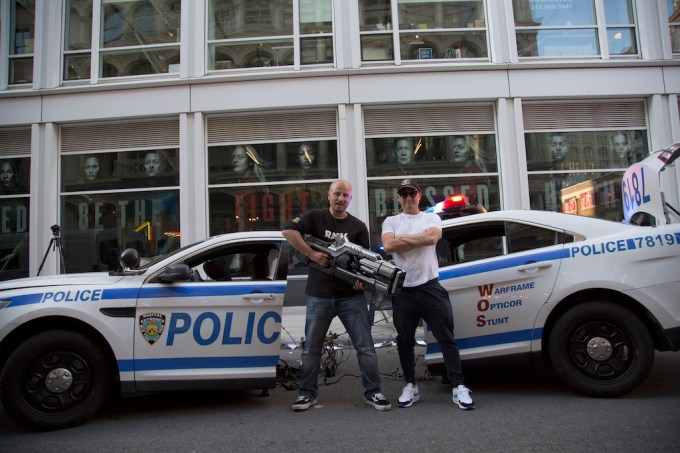
In the video above, you can see bystanders asked to pose for photos with a model of the Opticor, an elaborate gun from the game. They’re warned not to pull the trigger — but what they don’t know is that a nearby police car and mailbox have been rigged to explode. That’s exactly what happens on-camera, leading to shock and embarrassment from participants and bystanders.

I spoke Krivicka earlier this week to learn more about how the video was staged. He explained that the props, created by custom design and fabrication firm A2ZFX, were all synchronized, with a remote control that could set off the gun, car and mailbox at the same time.

The exploding effects use compressed air, with a small team taking about 15 minutes to reset everything between each take — which also provided the time needed for bystanders to move on, so that there’s always a fresh set of eyes who have “no idea what’s going to happen.”

Director Michael Krivicka, Producer Chris Yoon

Director Michael Krivicka, Producer Chris Yoon

He also noted that this was a “very controlled environment,” with New York City police officers off-camera: “I suggest through editing that it was a lot more rogue than it really is.”

Although this is Krivicka’s first game-related video, he’s made a number of other viral marketing videos in the past, including ones where the spooky girl from the “Ring” movies actually crawls out of a TV and a “Cobra Kai” video where casual karate moves can split motorcycles in half. The common goal, he said, is to “always bring the sci-fi to life in the real world.”

This is also the first major video produced by Krivicka’s new agency WhoIsTheBaldGuy, but he said his aims haven’t changed: “I want to really create things where people are going, ‘Oh my God, what the fuck!’ I just want to go bigger and bolder. That’s the stuff that performs really well online.”

08 Jul 2019

ICE mined driver’s license photos from 21 states for facial recognition

U.S. Immigration and Customs Enforcement are using facial recognition software to trawl through millions of driver’s license photos provided by 21 states to search and find suspects.

News broke over the weekend that the FBI and immigration officials access images — often without obtaining a search warrant or court order — in order to identify criminal suspects but also witnesses, victims and innocent bystanders. In some cases agents would simply email the state department of motor vehicles for assistance.

But Congress nor state lawmakers ever authorized the access or the searches. A bipartisan group of congresspeople have criticized the use of facial recognition as dangerous to citizens’ right to privacy.

Several states, like New York, and the District of Columbia, allow undocumented immigrants to obtain driver’s licenses, with other states — like Florida and Texas — working to introduce similar laws.

Documents obtained by a public records request and seen by both The Washington Post and The New York Times reveal the scope of the privacy infraction. Utah alone saw close to 2,000 facial recognition searches from law enforcement agencies in the two years between 2015 and 2017.

Facial recognition remains controversial, not least because it’s been accused of racial bias and plagued with inaccuracies. The FBI’s facial recognition database contains more than 640 million images but a government watchdog reported that the agency has “not taken sufficient action to help ensure accuracy” of its system.

Earlier this year documents revealed 9,000 ICE agents have access to a massive license plate database, containing six billion vehicle detections. The database also includes a “hot list” of more than 1,100 license plates of subjects of interest, which triggers an alert every time the plates are picked up by a license plate reader.

The U.S. has thousands of automatic license plate readers (ALPR) across the country.

08 Jul 2019

Lyft, Aptiv and the National Federation of the Blind partner on self-driving for low vision riders

Lyft and Aptiv are already running autonomous driving trials in Las Vegas, and now they’re expanding that limited pilot to include low vision and blind riders in a new partnership with the National Federation of the Blind. In a blog post dealing the news, Lyft notes that this is a key par of their overall strategy of provision mobility for all, via their other offerings including shared rides, electric bikes and scooters and more.

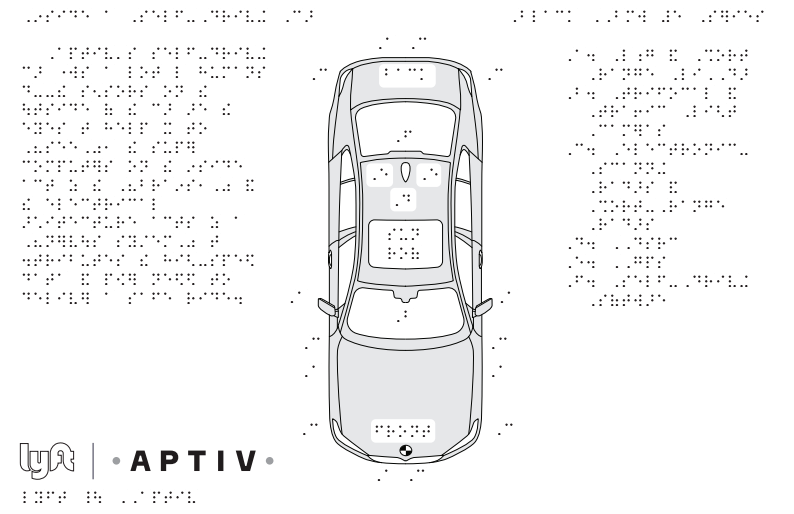
The company has already been working with the National Federation of the Blind to ensure that its core ride-hailing product is accessible to riders who might be blind or have low vision, and this extension of that work now means its pilot fully autonomous ride-hailing network is available as an option to this group of passengers with more accessible features, including Braille guides for riders of the self-driving vehicles, which provide detailed info about the route the autonomous test cars run in Las Vegas, and information about the Aptiv self-driving vehicles themselves. These detail sensors and technology positioned across the car, so riders can be fully informed as they participate.

Screen Shot 2019 07 03 at 6.23.07 PM

One of autonomous driving’s biggest potential benefits is providing access to driving to people who wouldn’t otherwise be able to use that mode of transportation, including people with low vision, people with epilepsy, or older drivers who’ve lost the ability to legally maintain a license and operate a vehicle, among many others.

Aside from the still-immense challenge of getting the autonomous driving technology to a place where it’s ready for broad deployment and consumer use, there are challenges around how the user interface will work for both hailing and accessing the vehicles, and ensuring that people making use of the service are properly informed about what’s going on. Lyft’s plan to work on all these aspects of their service with advocacy and empowerment groups who take this as their central mission seems like a smart one.