
Year: 2019

08 Jul 2019

15Five raises $30.7M to expand its employee development toolkit

Technology has been used to improve many of the processes that we use to get work done. But today, a startup has raised funding to build tech to improve us, the workers.

15Five, which builds software and services to help organisations and their employees evaluate their performance, as well as set and meet goals, has closed a Series B round of $30.7 million, money that it plans to use to continue building out the functionality of its core product — self-evaluations that take “15 minutes to write, 5 minutes to read” — as well as expand into new services that will sit alongside that.

David Hassell, 15Five’s CEO and co-founder, would not elaborate on what those new services might be, but he recently started a podcast with the startups “chief culture officer” Shane Metcalf around the subject of “best-self” management that taps into research on organizational development and positive psychology.

At the same time that 15Five works on productizing these principles into software form, it seems that the secondary idea will be to bring in more services and coaching into the mix alongside 15Five’s existing SaaS model.

This Series B is being led by Next47​, the strategic investment arm of manufacturing giant Siemens. Others in the round included Matrix Partners, PointNine Capital, ​Jason Calacanis’s LAUNCH Fund​, Newground Ventures, Bling Capital, Chaifetz ​Group, and ​Origin Ventures (which had led 15Five’s Series A). It brings the total raised to $42.6 million, but Hassell said that while the valuation is up, the exact number is not being disclosed.

(Previous investors in the company have included David Sacks, 500 Startups and Ben Ling.)

15Five’s growth comes at a time when we are seeing a significant evolution in how companies are run internally. The digital age has made workforces more decentralised — with people using smartphones, video communications and services like Slack to stay in constant contact while otherwise working potentially hundreds of miles from their closest colleagues, or at least not sitting in one office altogether, all the time.

All well and good, but this has also had an inevitable impact on how employees are evaluated by their managers, and also how they are able to gauge how well they are doing versus those with whom they work. So while communication of one kind — getting information across from one person to another across big distances — has seen a big boost through technology, you could argue that another kind of communication — of the human kind — has been lost.

15Five’s approach is to create a focus on building an easy way for employees to think about and set goals for themselves on a regular basis.

Indeed, “regular” is the operative word here, with key thing being frequency. A lot of companies — especially large ones — already use performance management software (other players in this space include BetterWorks, Lattice, and PeopleGoal among many others), but in many cases, it’s based around self-evaluations that you might make annually, or at six-month intervals.

15Five’s focus is on providing a service that people will use much more often than that.  all the time, by way of sending praise to each other when something positive happens (it calls these “High fives” appropriately enough), as well as regular evaluations and goals set by the employees themselves.

Hassell said in an interview that this is in tune with what modern workplaces, and younger employees, expect today, partly fuelled by the rise of social media.

“Most millennials will get feedback on what they eat for breakfast more than what they do at work,” he said. “The rest of our lives exist in a real-time feedback loop, filled with continuous in positive reinforcement, but then you go into work and have an annual or maybe biannual performance review? It’s simply not enough.” He said that he knows some millennial employees who have said that they will not work at a company if it’s not already using or planning to adopt 15Five, and since talent is the cornerstone to a company’s success this could have a significant impact.

The startup was born in San Francisco in more than one sense: it’s based there, but its principles seem to be uniquely a product of the kind of self-reflection and self-care/quality of life emphasis that has been associated with California culture for a while now, even admist the relentless march that comes with being at the epicenter of the tech world.

In that regard, its newest investor, Next47, will help put 15Five to the test, both in terms of how the product will be adopted and used at a company whose holdings are as much manufacturing as technology, and in terms of sheer size: Siemens globally has around 400,000 employees.

Matthew Cowan, a partner at the firm, noted that while Siemens is currently not a 15Five user, the thinking behind the investment was strategic and the idea will be to incorporate it into the company’s practices for helping employees’ progress.

“It’s very representative of how the workplace is transforming,” he said
08 Jul 2019

Google debuts ‘Code with Google’ coding education resource for teachers

Google is offering a new coding resource for educators via ‘Code with Google,’ which collects Google’s own free course curriculum on teaching computer science, and a variety of programs to help students learn to code or build on their existing skills, with stuff for people at all levels of ability.

The ‘Code with Google’ resources extend beyond just learning, however, and include potential scholarships, for instance, was well as summer programs, internships and residencies.

In a blog post, Google VP of Education and University Relations Maggie Johnson noted that while recognition of the importance of computer science across all levels of education is relatively high, the actual availability of courses that include hands-on programming for students is surprisingly low, and generally only accessible to students in more affluent districts with access to more resources.

All of Google’s ‘Code with Google’ resources are free, in keeping with may of its other educational offerings, as it continues to drive its education tech leadership position combined with affordable Chromebooks for schools. Google also announced a $1 million grant to the Computer Science Teachers Association alongside the unveiling of this new resource.

Google is smart to continue to approach its education strategy through free resources and easy-to-use, cloud-based software that is accessible to a broad range of both educators and students at all skill and expertise levels.

08 Jul 2019

The startups creating the future of RegTech and financial services

Technology has been used to manage regulatory risk since the advent of the ledger book (or the Bloomberg terminal, depending on your reference point). However, the cost-consciousness internalized by banks during the 2008 financial crisis combined with more robust methods of analyzing large datasets has spurred innovation and increased efficiency by automating tasks that previously required manual reviews and other labor-intensive efforts.

So even if RegTech wasn’t born during the financial crisis, it was probably old enough to drive a car by 2008. The intervening 11 years have seen RegTech’s scope and influence grow.

RegTech startups targeting financial services, or FinServ for short, require very different growth strategies — even compared to other enterprise software companies. From a practical perspective, everything from the security requirements influencing software architecture and development to the sales process are substantially different for FinServ RegTechs.

The most successful RegTechs are those that draw on expertise from security-minded engineers, FinServ-savvy sales staff as well as legal and compliance professionals from the industry. FinServ RegTechs have emerged in a number of areas due to the increasing directives emanating from financial regulators.

This new crop of startups performs sophisticated background checks and transaction monitoring for anti-money laundering purposes pursuant to the Bank Secrecy Act, the Office of Foreign Asset Control (OFAC) and FINRA rules; tracks supervision requirements and retention for electronic communications under FINRA, SEC, and CFTC regulations; as well as monitors information security and privacy laws from the EU, SEC, and several US state regulators such as the New York Department of Financial Services (“NYDFS”).

In this article, we’ll examine RegTech startups in these three fields to determine how solutions have been structured to meet regulatory demand as well as some of the operational and regulatory challenges they face.

Know Your Customer and Anti-Money Laundering

08 Jul 2019

Rivian’s camp kitchen in action

Rivian doesn’t want to build just another electric vehicle. It’s not aiming to be a Tesla killer either. No, this 10-year-old company that kept a low profile until November when it unveiled an electric pickup truck and SUV, is aiming to be an adventure brand.

Or, as Rivian founder and CEO RJ Scrainge told TechCrunch recently, the company’s technology and products are all meant to “enable people to adventurous, whether it’s carrying their kids or their pets or their gear.”

The world got a glimpse of what Rivian might have in mind earlier this year at the Overland Expo in Flagstaff, Arizona, when the company showed off prototype of a camp kitchen that pulls out of the electric pickup’s gear tunnel.

TechCrunch got an up close and yeah let’s tinker around with it kind of look at the camp kitchen. We discovered a thoughtful product that Scaringe has confirmed will be available when the electric pickup truck comes to market. Here’s the Rivian camp kitchen in action.

08 Jul 2019

Twitter and Facebook reportedly not invited to White House ‘social media summit’

On Thursday, the White House’s social media will reportedly host a who’s who of conservative media pundits. PragerU and Turning Point USA’s Charlie Kirk have apparently received invites to the event. There will, however, be some key names missing from the invite list — including, notably, the social media companies themselves.

Trump’s White House is hosting what it calls “a robust conversation on the opportunities and challenges of today’s online environment” this week. But according to a new report from CNN, neither Facebook nor Twitter qualify as “digital leaders,” as neither platform has received an invite.

The White House hasn’t released an invite list for the event — nor is it commenting on this latest report. Those sites will almost certainly be in the crosshairs, however, as Trump and fellow conservatives discuss their perceived biases. The President recently accused comes of “fighting” him in a recent interview with Fox News’ Tucker Carlson, stating that “what they’re doing is wrong and possibly illegal.”

In recent years, conservatives have accused Twitter, Facebook and Google of “shadow banning” and other perceived slights. Earlier this month, Twitter — which has been the subject of criticism from liberals and conservatives alike — announced a new “abusive behavior” notice aimed at public officials who violate the company’s speech policies.

08 Jul 2019

NASA’s giant mobile Artemis Moon launcher hits the pad for final testing

NASA is in final preparation stages for its Artemis 1 moon mission, which will be the first in its Artemis series of missions which intend to return an American man to the Moon, and bring an American woman to the surface of Earth’s natural satellite for the first time. The 335-ft tall mobile launch tower that will send Artemis 1’s Orion capsule to lunar orbit atop a Space Launch System rocket is now on the pad for its last round fo testing before the real thing.

NASA’s Artemis 1 mission will fly the Orion crew capsule to space, where it’ll spend three weeks, including a six-day lunar orbit. The capsule will be fully equipped with all life support systems it would need to actually support a crew onboard, but there won’t be anyone actually on it for this one since the intent is to prove the safety and effective operation of the system prior to Artemis 2, an intended crewed launch to follow Artemis 1 a few years down the road.

Artemis 1 will take off from Launch Pad 39A at Kennedy Space Center in Florida, with an intended launch timeframe of June 2020. The enter launch system has already undergone a lot of testing, both on-site at the towering Vehicle Assembly Building (VAB) where rocket parts are put together at Kennedy, and prior to that as each component has been built. But this final crucial round of testing will be the last on the pad before the rocket actually launches.

Tue ultimate goal of the current stage of the Artemis program is to land astronauts on the lunar surface, which will happen with the third Artemis mission in 2023 if all goes to current plans. Artemis missions thereafter will aim to establish a more permanent presence for humans in space, including ultimately the establishment of a lunar outpost.

08 Jul 2019

Elon Musk teases possible late July Starship presentation following engine test

Elon Musk was fielding a number of questions from fans on Twitter on Sunday, and revealed that the current target for a full presentation of Starship, SpaceX’s next-generation reusable rocket and a key piece of the company’s plan to reach Mars, could come as soon as “late July.”

The SpaceX CEO also noted that the company’s most recent test of one of its Raptor rocket engines (officially test ‘SN6’) was “overall successful,” despite an abort, since the whole purpose of the test was to test the outward limits of the new engine’s tolerances on fueling mixture ratios.

SpaceX’s official Starship presentation should take place “a few weeks after Hopper hovers,” according to Musk, which refers to the test StarHopper (or ‘Hopper’ for short) quick duration flights, which won’t be fully launches but will instead engage the engines to help prove their viability for eventual launch.  StarHopper completed a tethered hop test back in April, but the next step is to do this untethered, which is closer to reality than ever after last night’s test addressed a key issue with Raptor engine vibration at a specific operating frequency.

Once Hopper is through testing, presumably SpaceX will move on from using the scaled down prototype, which is only designed for testing in low altitudes, to a full-scale test rocket build, but we’ll hear the company’s plans in much more detail whenever this official Starship presentation really does take place.

08 Jul 2019

Uber rival Bolt has closed another tranche of funding at a $1B+ valuation

Uber and Lyft going public may have put closer public scrutiny on the economics of ridesharing, but it hasn’t had a chilling effect on the level of competition in the space. In the latest development, TechCrunch has learned and confirmed that Bolt, the Estonian ride-sharing, scooter and food delivery company that operates across Europe — most recently opening for business in London — and a number of emerging markets, has completed the first tranche of its latest round of funding. The equity injection bumps up the valuation of the company to over $1 billion, money that Bolt plans to use to fuel its international growth.

“We have closed a new funding round, aimed at supporting our recent launch in London and further expansion plans in 2019,” a spokesperson said in a short statement statement to TechCrunch.

The spokesperson would not elaborate on the size of the round, but technically, this would be a Series C. To date, Bolt has raised $185 million with its last big investment valuing it at $1 billion.

We understand that backers in this latest funding include Nordic Ninjas — a new fund out of Sweden backed by a number of Japanese LPs to invest in Northern European startups (Bolt is based out of Tallinn) — as well as Naya Capital (founded by hedge fund investor Masroor Siddiqui), Creandum and G Squared.

We are still trying to see if we can get further investor names and more details on the numbers. Previous investors in Bolt have included Didi (and by association Softbank and Uber), Daimler, Korelya Capital and Spring Capital, although we understand Spring is not in this round.

Bolt has been talking about this funding for a little while now — CEO and founder Markus Villig admitted to me, when asked, four months ago that more funding was on the cards — but according to a short note in PitchBook and a memo sent out to TMT investors (TMT is a shareholder in Bolt), the investment actually only closed this month.

It appears that this is not the final close — there is more dealmaking going on — but so far, the investor list provides some interesting indicators about Bolt.

G Squared has been behind a number of growth rounds for a range of fast-growing and large tech startups, including Pinterest, SoFi, Airbnb, Coursera, Spotify, Postmates and Instacart. It’s also backed some of the biggest names specifically in the category of transportation, including Lyft, Uber, Fair, Getaround, Turo, and Auto1. Its involvement speaks to big sums of money, and confidence in a strong growth story, hedging bets (or suggesting collaborations?) by potentially having stakes simultaneously in would-be competitors.

Nordic Ninjas, meanwhile, includes Honda as a shareholder. Added to Daimler, the owner of Mercedes who invested in Bolt last year when it was still called Taxify, this gives an interesting strategic twist to the investment.

And, it could also give Bolt a springboard to consider how to enter the Japanese market, to mark its first move into East Asia, to complement a footprint that includes a mix of developed and emerging markets in Western Europe, countries in the Arabic world, Africa, Eastern Europe, Western Asia and Australia.

Japan is notable for being one of the only developed countries to have, up to now, prohibited ridesharing businesses — that is, where private owners of vehicles work either individually or in networks to provide paid transportation services to other individuals.

That has led to a couple of different outcomes. First, the likes of Uber must partner with established taxi companies in the country to get entry into the market, rather than follow their usual course of business. And second, established taxi companies in Japan, who own and operate their own fleets, have become the most popular operators of ride-hailing apps in what is a fairly fragmented market.

It’s also a challenge to get operating licenses in the country. Didi, the Chinese ride hailing giant that is also an investor in Bolt, last year launched its own app in the Japan. Didi works with some 10 fleets and provides the logistics and ordering layer on top of those third-party services. Bolt operates a partnership program modelled on the same idea, which helps it build up quickly in the emerging markets where it has gained a lot of ground quickly.

Notably, much of Bolt’s growth seems to have been carefully carved out without much overlap with the likes of Didi and Uber (London, the biggest ride-hailing market in Europe, being a key exception). But as it continues to capitalise and grow, it will be interesting to see how and if that pattern will change.

We’ll update this story as we learn more.

08 Jul 2019

UK’s ICO fines British Airways a record £183M over GDPR breach that leaked data from 500,000 users

The UK’s Information Commissioner is starting off the week with a GDPR bang: this morning, it announced that it has fined British Airways £183.39 million ($230 million) in connection with a data breach that took place last year that affected a whopping 500,000 customers browsing and booking tickets online. In an investigation, the ICO said that it found “that a variety of information was compromised by poor security arrangements at [BA], including log in, payment card, and travel booking details as well name and address information.”

The fine — 1.5% of BA’s total revenues for the year that ended December 31, 2018 — is the highest-ever that the ICO has levelled at a company over a data breach (previous “record holder” Facebook was fined a mere £500,000 last year by comparison). And it is significant for another reason: it shows that data breaches can be not just just a public relations liability, destroying consumer trust in the organization, but a financial liability, too.

Indeed, the degree to which companies are going to be held accountable for these kinds of breaches is also going to be a lot more transparent going forward: the ICO’s announcement is part of a new directive to disclose the details of its fines and investigations to the public.

“People’s personal data is just that – personal,” said Information Commissioner Elizabeth Denham in a statement. “When an organisation fails to protect it from loss, damage or theft it is more than an inconvenience. That’s why the law is clear – when you are entrusted with personal data you must look after it. Those that don’t will face scrutiny from my office to check they have taken appropriate steps to protect fundamental privacy rights.”

The ICO said in a statement this morning that the fine is related to infringements of the General Data Protection Regulation (GDPR), which went into effect last year prior to the breach. More specifically, the incident involved malware on BA.com that diverted user traffic to a fraudulent site, where customer details were subsequently harvested by the malicious hackers.

BA notified the ICO of the incident in September, but the incident was believed to have first started in June. Since then, the ICO said that British Airways “has cooperated with the ICO investigation and has made improvements to its security arrangements since these events came to light.” It should be pointed out that even before this breach, there were other examples of the company treating data protection lightly. (Now, it seems BA has learned its lesson the hard way.)

BA might now choose to try to appeal the fine if it chooses. We have contacted BA and its parent company IAG for a response and will update this article when it responds.

While there are a lot of question marks over how the UK will interface with the rest of Europe over regulatory cases such as this one after it leaves the EU, for now it’s working in concert with the bigger rest. The ICO says it has been “lead supervisory authority on behalf of other EU Member State data protection authorities” in this case, liaising with other regulators in the process. This also means that these authorities where its residents were also affected by the breach will also have a chance to provide input on the ruling before it is completely final.

08 Jul 2019

DigitalBridge raises £3M for its ‘guided design tool’ for kitchens and bathrooms

DigitalBridge, the Manchester, U.K.-based startup using technology to help solve the “imagination gap” when planning home renovations, has picked up £3 million in new backing.

The round is led by Maven Capital Partners via two funds it manages: £1.5 million from Maven’s Venture Capital Trusts (VCTs) and £1.5 million from the NPIF Maven Equity Finance, a regional development fund managed by Maven as part of the U.K. government’s Northern Powerhouse Investment Fund.

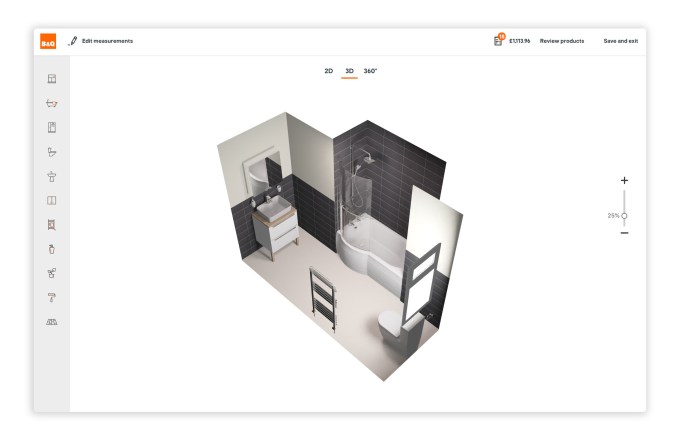
Working with Kingfisher Plc (owners of B&Q and Castorama) for the last couple of years, DigitalBridge has pivoted from its original AR-based home decor planning app to a new product it’s calling a ‘guided design tool’ for kitchens and bathrooms. That’s because, DigitalBridge founder David Levine tells me, home decor visualisation is only a nice-to-have whereas it’s a “must-have” for bathrooms and kitchens.

“Bathrooms and kitchens are much more complex rooms governed by complex design rules,” he explains. “We felt there was a big gap for a guided design tool which actively guides consumers through the entire journey of designing, visualising and buying whilst simplifying the inherent complexity of these rooms”.

There was, perhaps, another factor at play, too: the creation of AR development kits by Apple and Google have made it “really simple” for retailers to build their own home decor and furniture AR solutions, as well as seeing new competitors enter the space.

“Unlike most tools on the market today, DigitalBridge is utterly focused on the consumer and obsessed with creating simple and compelling experiences that enable that consumer to build their dream bathroom or kitchen irrespective of their design experience,” adds Levine. “Crucially, our core skillsets of AI and computer vision are absolutely pivotal to reducing that complexity”.

TechCrunch 01 3dViewer

The DigitalBridge solution resides on a retailer’s website or app — it is already live with B&Q in the U.K. — and guides you through the entire process of creating your new bathroom or kitchen. The the draw for retailers is that by enabling customers to easily design and visualise their new bathroom or kitchen, DigitalBridge can reduce sales cycles, increase conversion rates and average basket sizes, and “drive more engaged customers into store”.

“By using our technology, consumers are now able to visit the B&Q website and design the dream bathroom that will work for them, their family and budget, all without the need for professional assistance,” explains Levine. “Within minutes, they are guided through the process of entering their floor plan, designing the perfect bathroom and bringing it to life in immersive 3D. Once they’re happy with the design, they can buy directly online or go into a store to complete the purchase”.

Meanwhile, with regards to today’s newly disclosed funding round, Jeremy Thompson, Investment Director at Maven, says that DigitalBridge has developed a market-leading AI product which solves a genuine problem for retailers” by helping them engage with customers online. “We are genuinely excited to work with them and support their next stage of growth, as they look to accelerate deployment of the existing product, develop new products and enter new markets, including the U.S.,” he adds.