Year: 2019

08 Jul 2019

Wind Mobility raises additional $50M and unveils new e-scooter hardware designed for rentals

Wind Mobility, the Berlin and Barcelona-based micro-mobility startup that operates e-scooter rentals in Europe, Israel and Asia, is disclosing $50 million in Series A funding. The new round is backed by existing investors. The company last raised $22 million in funding eight months ago from Chinese Source Code Capital and Europe’s HV Holtzbrinck Ventures, after it pivoted away from bike rentals to focus on e-scooters.

Coinciding with the new funding, Wind is unveiling its “third generation” e-scooters, which it says have been designed “from the ground up” for micro-mobility sharing. Eight months in development, the new hardware claims to be significantly more durable and best-in-class for battery life with the ability to drive 65-80km between charges.

The battery is hot swappable, too, meaning that it should be more efficient to run the Wind e-scooter service. That’s because not only can more scooters remain in circulation at any given time, potentially increasing revenue per scooter, but there’s a reduction in the cost of collecting dead batteries for re-charging as they are de-coupled from the scooter itself.

Wind also claims its new scooter has the highest waterproofing with IP67 standard, and that its increased durability should see it last over 12 months when used in the tough sharing environment. That in turn puts the startup on a better unit economic footing since flimsy hardware that needs to be replaced frequently has been a fiscal drag for e-scooter companies using off-the-shelf e-scooters designed primarily for single ownership and not for commercial use.

In the last few months a number of other micro-mobility companies have announced upgrades to their hardware, including European competitors Voi and Tier, although Wind Mobility co-founder and CEO Eric Wang has long talked up the importance of hardware as a differentiator, something he echoed again in a call late last week.

Specifically, Wang argued that it is still “Day One” in the e-scooter rental race and even though Wind hasn’t been as aggressive in its roll out and has deployed less scooters than Lime, Voi and Tier in Europe, he says there is still everything to play for. He said it was a conscious decision not to put too many scooters on the streets until the hardware was good enough to set the company on a path to profitability. Even with the 3rd generation scooter being deployed immediately, the company plans to stagger the launch so that it can gather sufficient data on how the new hardware is performing before hitting the accelerator so to speak.

The early signs look promising, however (in a video Wang sent me via WhatsApp the new Wind scooter survives being plunged into a pond and can be seen driving off after retrival from the water), although the Wind CEO cautions other companies and industry commentators not to underestimate how difficult hardware is. He argues that the detailed design decisions that Wind has made and the resulting improvements aren’t easily replicated any time soon and that there are “no shortcuts” in hardware. This has seen Wind set up its own R&D center in China in order to work as closely with the supply chain as possible.

Meanwhile, I’m told Wind now offers its services in 20 plus cities including operations in Germany, France, Spain, Israel, Austria, Portugal, Demark, Korea and Japan. The company currently employs over 120 people worldwide.
08 Jul 2019

Elon Musk: Tesla will ‘most likely’ begin computer chip upgrades this year

Tesla CEO Elon Musk said the company will “most likely” begin upgrading older electric vehicles with its new custom chip later this year — a lofty task that will involve retrofitting hundreds of thousands of Model S, X and 3s.

Musk tweeted Sunday night that the upgrades will begin most likely at the end of the fourth quarter.

Musk didn’t provide other details. He has previously said the upgrade would be free for owners who purchased the full self-driving feature, a software package that costs $6,000.

Tesla offers two different advanced driver assistance packages to customers: Autopilot and Full Self-Driving or FSD. Autopilot is ADAS that offers a combination of adaptive cruise control and lane steering and is now a standard feature on new cars. FSD includes Summon as well as Navigate on Autopilot, an active guidance system that navigates a car from a highway on-ramp to off-ramp, including interchanges and making lane changes.

While Tesla charges for the FSD software package, the vehicles are not fully autonomous. Musk has promised that the advanced driver assistance capabilities on Tesla vehicles will continue to improve until eventually reaching that full automation high-water mark.

The custom chip unveiled in April has been couched as a necessary hardware upgrade to reach that goal. Since March, new Model X and S vehicles have come equipped with the chip. The Model 3 followed a month later.

The custom chip was a milestone for the company. However, it still faces the considerable challenge of upgrading thousands of so-called “Hardware 2” vehicles, not to mention the continuous development of the software.

Tesla started producing electric vehicles with a more robust suite of sensors, radar, and cameras — called Hardware 2— in October 2016 under the premise and the promise that it had the hardware needed to eventually drive autonomously without human intervention. At that time, the company also began selling the upgraded full self-driving package that Musk said would eventually reach that ambitious target.

08 Jul 2019

Soldo scores $61M Series B for its ‘spend management’ platform for businesses

Soldo, the U.K. fintech that offers a multi-user spending account for businesses, has closed $61 million in Series B funding.

Leading the round is Battery Ventures and Dawn Capital, with participation from previous backers Accel and Connect Ventures. In addition, a small portion is debt financing from Silicon Valley Bank. It brings total raised by the London-based startup to $82 million.

Founded by Carlo Gualandri, who previously helped create Italy’s first online bank, Soldo offers a multi-user spending account for businesses of all sizes — from SMEs to much larger enterprises — that need to deploy and manage expenses across an entire organisation.

It enables departmental and employee spending to be managed in real time by combining a Soldo account, central dashboard, apps for iOS and Android and virtual wallets or physical “pre-paid” MasterCards that can be handed out to employees, departments and even external consultants or contractors.

In addition, Soldo offers granular spending controls that are at the heart of its tech stack. This allows for different expense criteria for each employee, contractor or spending department, with permissions set and all spending trackable centrally. It also lets users capture receipt data, while the whole system integrates with commonly used business accounting packages such as Xero, Quickbooks, Concur, Expensify, NetSuite, Zucchetti and SAP

Asked what the biggest challenge for Soldo has been over the last 12 months, Gualandri says “educating the market,” something that he doesn’t see changing any time soon.

“When you don’t know that a solution exists, you don’t even call it a “problem” but you consider it just a ‘fact of life’,” he says. “Spend management is a new category that replaces many old and outdated processes. [It] allows companies to distribute access to money with control, enabling flatter and more agile organisations. It will take time for the market to fully realise its transformational power”.

To that end, Gualandri says the most gratifying thing over the last year has been the results achieved within the companies that have started adopting Soldo. “We have been recognised by thousands of companies from small to very large as an innovative and reliable provider of financial services,” he tells me. “No small achievement in the traditionally more conservative world of business”.

Soldo isn’t profitable yet, but Gualandri says it could be within one or two years if that was the goal. However, this would mean choosing “slower, more organic growth” and given there is a very large market in front of Soldo it “would not be the right choice”. The majority of companies in Europe are still using “reimbursable expenses, spreadsheets and manual processes to manage the expense management cycle” and Soldo’s competition largely remains the status quo way of doing things (although Denmark’s Pleo, for example, operates in a similar space).

“We are a company with a fixed cost base and good unit economics so the break-even point is dependent on how much we invest and grow the fixed cost base (because most of our investment is people) and the volume of customers and spend managed by our system,” he says. “So by deciding to invest in product and sales we are in effect targeting a larger revenue and profit base but later on”.

Meanwhile, Soldo’s Series B round will be used to further grow in the U.K., where it claims a “leadership position,” and in Italy and Ireland. The company also plans to enter new European markets and double its workforce over the next 12 months. Gualandri says Soldo will continue to invest in its product, too, in order to tackle additional spend management “pain points”.

“Travel expenses is the most common need but procurement, purchasing goods and services, subscriptions, mobility expenses, employees benefits are all areas that can be innovated and are an expression of the concept of company spend management,” he says.

Meanwhile, Soldo recently secured an e-money licence from Ireland’s central bank in addition to the license it holds in the U.K. so that it can continue trading within the European single market post-Brexit and in the event of “no-deal”. “It’s crazy to think we’ve been forced to work for a year and a half on a hugely complex project, mostly duplicating something that we had already, to prepare our business for something that may or may not happen,” Gualandri told TechCrunch at the time of announcing its newly acquired Irish license.

07 Jul 2019

Fish replacement may be the next big wave in alternative protein development

Fish make up 16% of animal protein consumed globally, and demand is set to rise, according to the United Nations’ Food and Agriculture Organization, largely thanks to rising disposable incomes.

But overfishing is hugely problematic – and it’s not sustainable to continue with the way things are. Fish populations are being decimated – including the Pacific bluefin tuna, which is now at four percent of its original size. Industrial fisheries are using large machinery to trawl oceans, which traps and kills many other animals, including whales and dolphins.

In China alone, where demand for seafood dwarfs any other country, demand is rapidly growing. This is partly due to the African Swine Fever outbreak hitting pig farms affecting pork, and causing people to turn to other sources of protein. In addition, the country’s huge long-distance fishing industry continues to expand, depleting fisheries and causing conflicts.

But most of the fish we eat will be farm-raised by 2030. Poorly managed fish farms can cause chemical contamination of water and promote bacteria and diseases that end up in wild ecosystems. Farmed salmon poses a huge risk to the environment when it mixes with wild populations, as this can disturb important ecosystems.

Fish is a hugely important source of protein as we face a growing population and the challenges of food insecurity. But supplying fish sustainably, without depleting natural resources and harming the aquatic environment, is a continuous challenge. Fish is contaminated with plastics, mercury and antibiotics. And fish farming isn’t doing much to tackle food insecurity, as it isn’t reaching the places where it’s most needed.

There is also a long and ongoing debate about fish welfare, and whether fish species are sentient and can feel pain when they’re fished and killed. But research is putting this debate to rest and showing that a number of species demonstrate having long-term memory, social bonding and parenting skills, use tools, learn traditions and cooperate with other species. Most experts agree that fish also have the ability to experience emotions, including pain and fear.

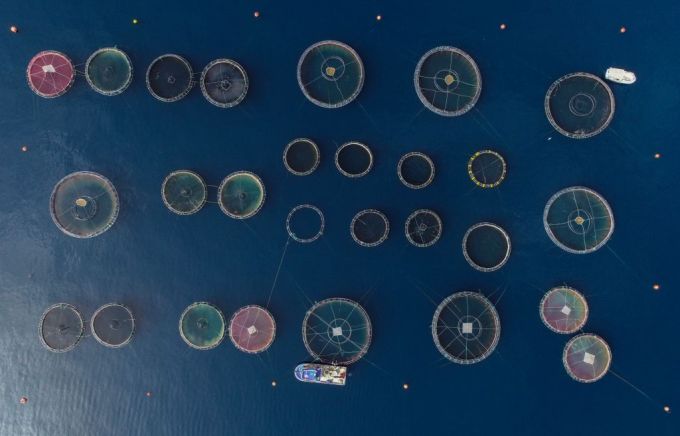
GettyImages 1140243144

IZMIR, TURKEY – APRIL 25 : An aerial view of fish farm, raising a new breed ‘Egeli’ fish, in Izmir’s Karaburun district, Turkey on April 25, 2019. ‘Egeli’ fish, cross breeding of sea bream and dentex, are expected to be put on sale in a year. (Photo by Mahmut Serdar Alakus/Anadolu Agency/Getty Images)

But while fish farms in some countries must follow humane slaughter guidelines, there are no standards for wild fishing. And these guidelines are a far cry from their name. The traditional method for killing farmed fish is letting them asphyxiate in air or on ice, which is a prolonged and distressing processes, and is sometimes followed by a stun. The fish are often crowded into one small space, living in poor conditions and often starving. Overcrowded fish are more prone to disease, stress and aggression, which can cause them to lash out at each other and cause injuries. The pens can be a breeding ground for sea lice and disease, and parasites. And there are so man fish subject to this that we’ve lost count. Estimates suggest up to 120 billion farmed fish are slaughtered for food every year.

Although plant-based alternatives for red meat – like the Impossible Burger and Beyond Burger – and poultry – like The Imposter Burger – have been on the rise, when it comes to fish – we’ve fallen behind. Fish is as much a part of our diets as meat from land animals, so it only makes sense for there to be plant-based seafood options available for those who want to cut back on conventional products.

But the tide is starting to change, and we’re now seeing a promising focus on plant-based fish substitutes. Impossible Foods says plant-based fish alternatives are a ‘high priority’ for the start-up, while other companies are developing a number of fish products that are getting closer to mimicking the real thing. Good Catch offer plant-based tuna, Ocean Hugger Foods have developed a plant-based raw tuna, and New Wave Foods have come up with plant-based shrimp – while restaurants are starting to offer plant-based sushi.

There are also innovations with cell-based meat. Start-up Wild Type has developed lab-grown salmon by taking stem cells from salmon and grown them in lab conditions. The company is hoping to get its price down and start selling to consumers. Singapore-based Shiok Meats is developing cell-based crustaceans, including shrimp, crab and lobster, Blue Nalu is growing cell-based seafood and Finless Foods is focusing on growing bluefin tuna in the lab. The start-up says it was the first to produce a cell-based fish in 2017, and hopes to bring its fish to high-end restaurants this year. It also has the added benefit of being mercury-free.

There’s much work to be done around making fishing more humane and sustainable, but this must go alongside efforts to dampen demand. Plant- and cell-based meat companies continue to encourage and support those looking to reduce their red meat and poultry intake – and now there’s growing attention on doing the same for fish. We must make sure there are alternatives available to catch people who have woken up to the damage caused by our growing demand for fish.

07 Jul 2019

Volkswagen’s ID R electric race car keeps breaking records, this time twice at Goodwood

It took 20 years to break the Goodwood Festival of Speed hill climb record. And it happened twice in the same weekend.

The new record holder is Volkswagen’s ID R electric race car. The vehicle, driven by driver Romain Dumas, broke the record by completing the 1.86-kilometer track at Goodwood in the south of England in 41.18 seconds. Dumas then broke his own record the following day by completing the track in 39.90 seconds.

The previous record at the famous hillclimb was set in 1999 by Nick Heidfeld who was driving a 780-horsepower McLaren-Mercedes MP4/13 with a combustion engine. Heidfeld completed the run in 41.6 seconds.

The Volkswagen ID R (and Dumas) has been on a tear as of late setting records at Nürburgring-Nordschleife and Pikes Peak. The ID R set a new electric vehicle lap record at Nürburgring-Nordschleife by completing the course in 6:05.336 minutes. The previous record was set in 2017 by Peter Dumbreck, who was driving a Nio electric vehicle.

The Volkswagen ID R was modified to best suit the Goodwood hill climb. A vehicle was outfitted with a smaller battery, which helped reduce the weight, and the power output was optimized for the short sprint. A drag reduction system designed for high-speed sections of the Nürburgring.

Why does all of this matter? This race car is a testbed and a flagship for Volkswagen’s ID electric vehicle platform.

Volkswagen has been showing off its ID line of concept electric vehicles for several years. The company is preparing some of them for production, beginning with the ID.3. VW aims to sell 100,000 ID.3 vehicles annually.

The ID.3 hatchback is the first model to be built on the automaker’s new Modular Electric Drive Toolkit, or MEB, electric-car architecture. Introduced in 2016, MEB is a flexible modular system — really a matrix of common parts — for producing electric vehicles that VW says makes it more efficient and cost-effective.

Others will soon follow. VW plans to have a portfolio of more than 20 full-electric models. The automaker’s goal is to sell 1 million electric vehicles annually by 2025.

07 Jul 2019

Y Combinator-backed Project Wren is aiming to make carbon offsets more consumer friendly

When Landon Brand and Benjamin Stansfield graduated from the University of Southern California this year, they already had the plans for Project Wren, their service for selling carbon offsets to a new generation of conscious consumers.

Along with fellow co-founder Mimi Tran Zambetti (who’s still attending USC), Brand and Stansfield aim to make carbon offsets more accessible to people who may feel like there’s nothing they can do on a personal level to reduce their carbon footprint or support projects that reduce carbon emissions. 

It’s not a novel concept. In 2004, TerraPass launched its service to provide carbon offsets for consumers. The company was acquired in 2014 and now operates as a subsidiary of the publicly traded Canadian retail energy company, Just Energy.

Since TerraPass, other organizations have come in with services to offset consumer and corporate carbon emissions. The Swiss non-profit MyClimate is another organization working on offsets for corporations and individuals (as is the German non-profit, Atmosfair) and the North American public benefit corporation, NativeEnergy also has both a retail and corporate offset program.

Project Wren sources its offset investments from Project Drawdown and is trying to choose the projects that the company’s founders consider “most additional”, according to Brand.

Brand, Stansfield and Tran Zambetti met at USC while pursuing a bachelor of science degree in USC’s new Jimmy Iovine and Andre Young Academy. The two men are the co-founders of Beats, which sold to Apple for roughly $3 billion, but perhaps are more famous for their work in the music business as the co-founder of Interscope records and the rapper and producer known as Dr. Dre.

From the outset the three students worked together on side projects and in student organizations, and decided last year to launch a sustainable business that could impact consumers in a positive way. The first idea, and the one that was initially incorporated as Project Wren, was to develop an algorithmically enhanced software service to promote diversity and inclusion in companies.

“The idea was promising, but it’s a hard product to sell. Companies aren’t used to leveraging software to help build their culture,” Brand wrote in an email. “Trying to get people to use the product made us realize how difficult it is to build something that’s useful and good for the world. If we were going to build a company around doing good, it would take a decade or more.”

The group convened earlier this year and decided, after spending a year working on their idea, that the over ten years it would take to build a successful business was too long for them to see the impact they wanted to make in the world. “We felt like the mission of making companies a better place to work was important, but not urgent,” Brand wrote to me in an email. “Climate change is urgent. It’s the biggest challenge humanity has ever faced. That’s why we decided to pivot.”

The group then decided that they would pool their resources on another project — a vegan cloud kitchen that could potentially become a franchise or chain.

“Meat production is responsible for as much as 20% of greenhouse gas emissions,” Brand wrote. “If we could make eating vegan food easier than eating meat, we would have a huge impact.”

The group ran a cloud kitchen out of Brand’s apartment for two weeks before deciding that, too, ultimately was a wash for the three young co-founders.

With that idea behind them, the three began researching carbon offsets, which led them to Project Drawdown, which led them to build their current website and, ultimately, Y Combinator .

Customers who buy offsets using Wren will support projects that the company has selected for their additionality (meaning the projects would not have been done without the support of organizations like Wren). Once the offsets are purchased Project Wren retires them from circulation so they can’t be traded on any exchange after their creation.

The company makes money by taking a 20% commission above the price of the project for operating expenses and marketing, says Brand.

What Brand sees as the young company’s competitive advantage is its ability to communicate more directly with a new audience of offset acquirers — engaging them more in the process by providing updates on the project.

“Photos, and stories too, from people on the ground will add a more human, real, touch,” to the projects and their reporting back to carbon offset buyers, according to Brand. “We just talk to a bunch of potential partners and see which partners would be able to give unique compelling updates to our users.”

07 Jul 2019

Someone is wrong on the Internet

You wake up, and check your phone, and see a new condemnation. Some awful person has said something outrageously insulting. Something actually evil, if you think about it. Something that belittles, dehumanizes, and/or argues against the freedom and agency of a whole category of people.

You add your voice to the furious chorus in response. How can you not? These people may never understand how wrong they are, they’re too ignorant and wedded to their idiocy for that, but they need to know that they are opposed, and their opponents are legion.

We all know what you mean when you say ‘these people.’ The ones who voted for those awful faces on every news site and TV channel, the ones whose names alone cause you to clench with fury. The ones responsible for the awful, unforgivable things happening at the border. The ones responsible for the reports of violence in the streets.

If pushed you’d probably admit that only some of These People are genuinely evil. More than you could have imagined in your worst nightmares five years ago, but still, only some. Others may be prisoners of their upbringing, or their ignorance, or victims of their own hardships, lashing out wildly. But what they all seem to have in common is an incapacity for compassion.

It’s easy to distance yourself from Them. It’s hard not to. The overwhelming majority of the people with whom you actually interact are Us.

You know you should try to feel compassion for Them, as you should for everyone. Not sympathy. Sympathy is very different. But your religion, or your spirituality, or your morality, or simply your belief, teaches you compassion for all. But how can you hold compassion for people who seem incapable of compassion themselves? People who don’t condemn, who actually cheer, what’s happening at the border?

And so every online outrage leaches a little more compassion away, widens and deepens the abyss between Us and Them a little further. You know intellectually that many of these viral outrages stem from bots, programmed by trolls or worse, and each new one does not represent every member of … them.

But you can’t help but grow more certain with each new outrage, in your heart if not your head, that there is a Them. That there are no longer people with whom one can reasonably disagree. That there are now only Us, and Them.

You realize when you think about it that this makes it easier to give people who are notionally Us a pass when they too behave with a flagrant lack of compassion, or judge people’s whole lives by their worst moments, or prioritize the purity of the process they have decreed over any actual results accomplished.

You realize that the growing abyss between Us and Them makes both sides close ranks, makes it harder for people who are Them and yet who have uneasy, even horrified feelings about what’s happening at the border in their name, to at least speak against it. They should anyway. Of course they should. But people are weak. The easier something becomes, the more that people do it.

You understand, on some level, that the online divide is different from the awful things actually happening offline. That the latter matters, deeply, and the former … not so much. That the former distracts both sides from great systemic injustices which have learned to lie hidden in bland terminology, coolly steering clear of the outrage of Us versus Them.

But you slept poorly, you’re exhausted, and you already have so much to do, so many duties to attend to at your frustrating job, so many worries to keep at bay, once you get out of this bed. Maybe all that is because of those systemic injustices, but those are a rot, those are cancer, those are bone-deep, and the evils at the border are an open wound about which something must done immediately. They are responsible for those evils. They must be fought and stopped.

So you add your voice to the furious chorus. And you give more money to those fighting the real fight at the border, because you know that’s what’s actually important. And maybe before you roll out of bed you pause to wonder how much the great online divide represents reality, or how much it prefigures reality; whether They really have all lost their minds and their moral compasses.

And you can’t help but wonder: even if they haven’t, what can now be done?

07 Jul 2019

Week-in-Review: Alexa’s indefinite memory and NASA’s otherworldly plans for GPS

Hello, weekenders. This is Week-in-Review where I give a heavy amount of analysis and/or rambling thoughts on one story while scouring the rest of the hundreds of stories that emerged on TechCrunch this week to surface my favorites for your reading pleasure.

Last week, I talked about the cult of Ive and the degradation of Apple design. On Sunday night, The Wall Street Journal published a report on how Ive had been moving away from the company to the dismay of many on the design team. Tim Cook didn’t like the report very much. Our EIC gave a little breakdown on the whole saga in a nice piece he did.

Apple sans Ive


Amazon Buys Whole Foods For Over 13 Billion

The big story

This week was a tad restrained in its eventfulness, seems like the newsmakers went on 4th of July vacations a little early. Amazon made a bit of news this week when the company confirmed that Alexa request logs are kept indefinitely.

Last week, an Amazon public policy exec answered some questions about Alexa in a letter sent to U.S. Senator Coons. His office published the letter on its site a few days ago and most of the details aren’t all that surprising but the first answer really sets the tone for how Amazon sees Alexa activity.

Q: How long does Amazon store the transcripts of user voice recordings?

A: We retain customers’ voice recordings and transcripts until the customer chooses to delete them.

What’s interesting about this isn’t that we’re only now getting this level of straightforward dialogue from Amazon on how long data is kept if not specifically deleted, but it makes one wonder why it is useful or feasible for them to keep it indefinitely.  (This assumes that they actually are keeping it indefinitely, it seems likely that most of it isn’t and that by saying this they’re protecting themselves legally, but I’m just going off the letter.)

After several years of “Hey Alexa,” the company doesn’t seem all that close to figuring out what it is.

Alexa seems to be a shit solution for commerce, so why does Amazon have 10,000 people working on it, according to a report this week in The Information? All signs are pointing to the voice assistant experiment being a short term failure in terms of the short term ambitions though AI advances will push the utility.

Training data is a big deal across AI teams looking to educate models on datasets of relevant information. The company seems to say as much. “Our speech recognition and natural language understanding systems use machine learning to adapt to customers’ speech patterns and vocabulary, informed by the way customers use Alexa in the real world. To work well, machine learning systems need to be trained using real world data.”

The company says it doesn’t anonymize any of this data because it has to stay associated with a user’s account in order for them to delete it. I’d feel a lot better if Amazon just effectively anonymized the data in the first place and used on-device processing the build a profile on my voice for personalized . What I’m more afraid of is Amazon having such a detailed voiceprint of everyone who has ever used an Alexa device.

If effortless voice-based e-commerce isn’t really the product anymore, what is? The answer is always us, but I don’t like the idea of indefinitely leaving Amazon with my data until they figure out the answer.

Send me feedback
on Twitter @lucasmtny or email
lucas@techcrunch.com

On to the rest of the week’s news.

Trends of the week

Here are a few big news items from big companies, with green links to all the sweet, sweet added context.

  • NASA’s GPS moonshot
    The U.S. government really did us a solid inventing GPS, but NASA has some bigger ideas on the table for the positioning platform, namely, taking it to the moon.It might be a little complicated but unsurprisingly scientists have some ideas here. Read more
  • Apple has your eyes
    Most of the iOS beta updates are bug fixes, but the latest change to iOS13 brought a very strange surprise, changing the way the eyes of users on iPhone XS or XS Max look to people on the other end of the call. Instead of appearing that you’re looking below the camera, some software wizardry will now make it look like you’re staring directly at the camera. Apple hasn’t detailed how this works but here’s what we do know here.
  • Trump is having a Twitter party
    Donald Trump’s administration declared a couple months ago that it was launching an exploratory survey to try and gain a sense of conservative voices that had been silenced on social media, now @realdonaldtrump is having a get together and inviting his friends to chat about the issue. It’s a real who’s who, check out some of the people attending here.

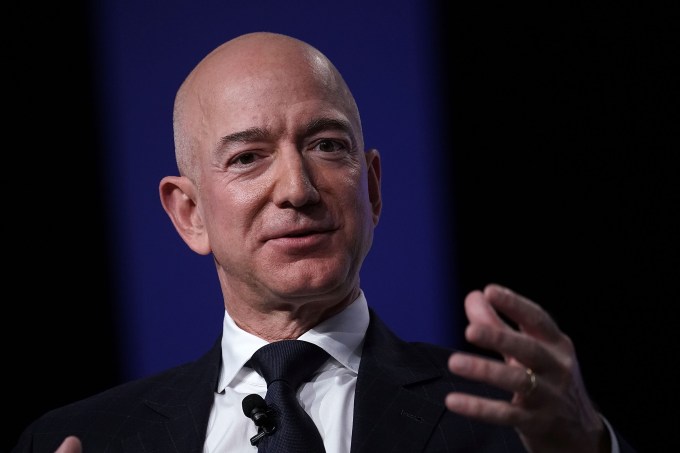
Amazon CEO And Blue Origin Founder Jeff Bezos Speaks At Air Force Association Air, Space And Cyber Conference

(Photo by Alex Wong/Getty Images)

GAFA Gaffes

How did the top tech companies screw up this week? This clearly needs its own section, in order of badness:

  1. Amazon is responsible for what it sells:
    [Appeals court rules Amazon can be held liable for third-party products]
  2. Android co-creator gets additional allegations filed:
    [Newly-unsealed court documents reveal additional allegations against Andy Rubin]

Extra Crunch

Our premium subscription service had another week of interesting deep dives. TechCrunch reporter Kate Clark did a great interview with the ex-Facebook, ex-Venmo founding team behind Fin and how they’re thinking about the consumerization of the enterprise.

Sam Lessin and Andrew Kortina on their voice assistant’s workplace pivot

“…The thing is, developing an AI assistant capable of booking flights, arranging trips, teaching users how to play poker, identifying places to purchase specific items for a birthday party and answering wide-ranging zany questions like “can you look up a place where I can milk a goat?” requires a whole lot more human power than one might think. Capital-intensive and hard-to-scale, an app for “instantly offloading” chores wasn’t the best business. Neither Lessin nor Kortina will admit to failure, but Fin‘s excursion into B2B enterprise software eight months ago suggests the assistant technology wasn’t a billion-dollar idea.…”

Here are some of our other top reads this week for premium subscribers. This week, we talked a bit about asking for money and the future of China’s favorite tech platform.

Want more TechCrunch newsletters? Sign up here.

06 Jul 2019

Equity transcribed: Investing elsewhere with Revolution’s Clara Sieg

Welcome back to the transcribed edition of the popular podcast Equity. Kate Clark had the hosting reins this week and welcomed Revolution’s Clara Sieg to the studio.

They discussed the trend of investors backing companies from “second-tier” markets like Austin, Atlanta, Denver, Philadelphia, Seattle, etc. Just how do cities become tech hubs? It’s a special kind of recipe, Sieg says. A city must have a great university, or a few, nearby to provide a constant flow of talent. They need some big corporations around for the same reason. They need a healthy community of angel investors ready and willing to get things going.

Sieg: Fundamentally in these second and third tier markets, an idea on the back of a napkin doesn’t get funded, so you really have to bootstrap to a certain degree and prove out really economics before you can unlock capital. Typically the companies that we’re investing in at the Series A, Series B level are a little bit farther along than their brethren would be in the Bay Area or New York.

Valuation expectations are just lower so you own more of a company for a smaller check-in. Inherently, if it’s an exit, that is a better outcome for you and it’s just cheaper to scale companies in those markets. Employee retention is better, cost of living is lower, so the capital required to scale these companies and that’s coming in after you and diluting you is less.

Clark: So when Steve Case founded Revolution, was he coming at it from the perspective of like, “This is obviously good business?” Which it is, to invest in these companies, or was it coming from a perspective of like, “It’s not fair that companies in these areas just don’t have access to capital like we do here in the Bay Area?”

Sieg: Neither, really. I think our investing approach in the early days, and what we still focus on today is what is now commonly referred to as disruption, right? Historically, Zipcar was basically disrupting the rental car market, and it was not really thought of as a great venture-backable opportunity in the early days. That’s obviously changed now, transportation is a huge piece of what venture capitalists focus on, but from day one, we focused on sleepy, incumbent markets where technology can be an enabler of a new business model that makes it better, faster, cheaper for the consumer, or the business that it’s serving, and where you can change the margins in the business to create a market leader that incumbents then either have to own or that can be a large standalone company.

Want more Extra Crunch? Need to read this entire transcript? Then become a member. You can learn more and try it for free. 

06 Jul 2019

Original Content podcast: ‘Stranger Things 3’ has more monsters and more nostalgia

While “Stranger Things” is one of Netflix’s biggest hits, we’ve remained immune to some of its charms.

On the latest episode of the Original Content podcast, we review the third season of the series — a.k.a. “Stranger Things 3” — giving us an opportunity to hash out our general feelings about the show.

Darrell, in particular, embraced the first season’s mix of ’80s horror and nostalgia, only to feel that season two was little more than a repeat. (There was an episode that branched out, but we’ve all kind of forgotten about the hour devoted to gang of telekinetic teens.) In many ways, “Stranger Things 3” continues that trend, with the residents of Hawkins  forced once again to confront a malevolent being from another dimension.

To be fair, the villain known as the Mind Flayer isn’t just doing the same stuff this time. He has a whole new evil plan. But “Strange Things 3” feels freshest when it’s less focused on the sci-fi plot, and more when it’s dealing with the rapidly maturing cast, as many of the younger characters find themselves becoming angsty teenagers.

And yes, we enjoyed all those scenes in the town’s new mall. It seems like an obvious ploy for nostalgia, but the nostalgia works.

In addition to our review, we also discussed Netflix’s plans for a big-budget “Sandman” show, and Jordan shared some of her latest TV recommendations.

You can listen in the player below, subscribe using Apple Podcasts or find us in your podcast player of choice. If you like the show, please let us know by leaving a review on Apple. You can also send us feedback directly. (Or suggest shows and movies for us to review!)

If you’d like to skip ahead, here’s how the episode breaks down:
0:00 Intro
0:35 Sandman on Netflix
13:28 Are You The One
22:35 Years and Years
26:29 Stranger Things review
54:19 Stranger Things spoilers