Year: 2019

21 Nov 2019

MontyCloud raises $2.85 million for its cloud management platform

For enterprises that want to move to the cloud, that actual move is often hard enough, but in the long run, being able to manage the lifecycle of their cloud deployments is just as important. MontyCloud, which focuses on these kinds of Day-2 operations, today announced that it has raised a $2.85 million seed round led by Madrona Venture Group, which also included investments from Lytical Ventures and Bob Hammer, former CEO of CommVault.

In addition to the funding, the company also today announced the launch of its multi-cloud management platform in the AWS marketplace, which, among other things, uses some AI-smarts to make management and governance for modern cloud infrastructure — and the applications that run on it — easier. Currently, the service focuses on AWS and will soon add support for Azure and other platforms as well.

The company was co-founded by its CEO Venkat Krishnamachari, whose experience includes opening new Azure data center regions for Microsoft, as well as time at AWS and Commvault. Krishnamachari tells me that the co-founders first bootstrapped the service themselves, up to the point where they had their first paying customers. Currently, the company has about 15 employees in India, in addition to a smaller core team in Seattle.

MontyCloud CEO Venkat Krishnamachari

MontyCloud CEO Venkat Krishnamachari

“It’s been a lot of fun understanding how enterprises consume new services — how they can get the outcome that they desire,” Krishnamachari said. With the proliferation of cloud accounts and policies around them, the large cloud platforms are getting harder to operate for many companies, all while they are also trying to move to a devops model and move faster. To help them, MontyCloud ties all of the accounts together and exposes them in the context of the applications that run on them. All of this, of course, also generates plenty of telemetry, which the company can then use to help these customers monitor their deployments and automate their routine maintenance, but also to optimize their cloud spent and improve MontyCloud’s own AI automation models.

Now, with the new funding, the team plans to build out its technology and onboard more of the customers that it currently has in its pipeline. It also plans to expand its AI ops stack.

As Madrona venture partner Ted Kummert told me, he decided to invest in the company because of the team, which has some obvious experience in this area, but also because he sees the pain point MontyCloud is trying to address. “We see a lot of opportunity and a lot of customer pain for a standalone company to create value,” he said. “There is a lot of value to have a company that’s just completely focused on this problem and ride above the platform agenda others might have.”


21 Nov 2019

Adobe details feature roadmap for Photoshop on the iPad, subject selection coming in 2019

Adobe has taken quite a bit of heat for its release of Photoshop on the iPad, mostly because it’s not as feature-complete as a lot of users were hoping, given that this is meant to be a full version of Photoshop on par with the desktop edition on Apple’s tablet OS for the first time. Adobe has long cautioned that it would essentially be releasing an in-development version of Photoshop for iPad, and adding features as it goes, but now it’s adding some more clarity and specificity to its product roadmap, which might help allay customer criticism.

In the time remaining in 2019, which is not much, Adobe is planning to ship a couple of features that should improve the everyday experience of working with Photoshop on iPad. First, it’s going to offer ‘Select Subject,’ which will hopefully go a long way to address the omission of the so-called ‘Magic Wand’ selection tool. Demoed at Adobe MAX just a few weeks ago, the ‘Select Subject’ feature works with Adobe’s Sensei AI tech to automatically pick out the subject from a selection box. It’s live now in the desktop version of Photoshop and works surprisingly well, and allows you to quickly pick out objects and mask them or move them for manipulation in creating compositions. This single feature, provided it works well on iPad, would go a long way to making it a much more effective tool for creative pros.

The other feature that the team is aiming to ship this year is intruding a speedier, optimized version of the cloud documents system it introduced for Adobe Creative Cloud alongside Photoshop for iPad. These improvements will make upload and download fast for all PSD flies stored as cloud documents, which should make working on the across platforms even better.

Looking ahead to 2020, the list of features coming to the iPad grows longer, and includes key elements like the ‘Refine Edge’ brush that Han help improve selection of fine detailed textural elements like hair or fur. That’s another key feature for anyone looking to do the same kind of creative composition work on the iPad that they currently do on desktop. Also coming in 2020 are Curves for making tonal adjustments, as well as more features for layer-based, non-destructive adjustment tools. Photoshop on iPad will also gain brush sensitivity and canvas rotation, both currently on offer form the company on its Fresco digital painting app.

Another feature that is planned for 2020 that will bring better parity with Adobe’s desktop software is Lightroom integration for Photoshop. That will allow you to edit RAW files in Lightroom and then directly switch over to Photoshop to do further edits within the same workflow.

This probably isn’t an exhaustive list of everything Adobe plans to do with Photoshop on the iPad in the next year, and in fact the company is calling for users to provide feedback about feature additions and improvements via its official user feedback tool.

21 Nov 2019

Twitter rolls out its ‘Hide Replies’ feature to all users worldwide

Twitter’s radical “Hide Replies” feature, one of the biggest changes to how Twitter works since the invention of the Retweet, is now available to Twitter’s global user base. The company says the feature will roll out to all Twitter users across platforms by today, with only one slight tweak since earlier tests.

Designed to balance the conversation on Twitter by putting the original poster back in control of which replies to their tweets remain visible, Hide Replies has been one of Twitter’s more controversial features to date. While no replies are actually deleted from Twitter when a user chooses to hide them, they are placed behind an extra click. That means the trolling, irrelevant, insulting, or otherwise disagreeable comments don’t get to dominate the conversation.

Twitter’s thinking is that if people know that hateful remarks and inappropriate behavior could be hidden from view, it will encourage more online civility.

However, the flip side is that people could use the “Hide Replies” feature to silence their critics or stifle dissent, even when warranted — like someone offering a fact check, for example.

The feature was first tested in Canada in July, then in the U.S. and Japan this September, across both web and mobile platforms.

Since its launch, Twitter found that most people hide the replies they find irrelevant, off-topic, or annoying. It also found people were using this instead of harsher noise reduction controls, like block or mute. In Canada, 27% of surveyed users who had their tweets hidden said they would reconsider how they interacted with others in the future, which is a somewhat promising metric.

The feature is, however, getting a slight change with its global debut. Twitter says some people wanted to take further action after hiding a reply, so now it will check to see if they want to block the replier, too. It also heard from some users that they were afraid of retaliation because the icon remains visible. It’s not making a change on that front at this time, but is still considering how to address this.

Another concern that was often mentioned on Twitter as the new feature first rolled out was the large pop-up notification that appears when users encountered a tweet with hidden replies.

Some people found the notification was so large and disruptive that it actually encouraged people to pay more attention to the hidden replies than they would otherwise.

Twitter says this screen only displays the first time a Twitter user encounters a tweet with hidden replies, however. Afterward, an icon will show people replies are hidden — and those are hidden on another page, not below the tweet.

But even though that’s a one-time notification, the attention it demands from the user outweighs the information it’s trying to convey — essentially, that twitter has launched a new feature and here’s where to find it. And if someone is engaged in trolling, being told that this particular Twitter user is hiding replies could enrage them even more.

In addition to the global rollout, Twitter also says it will soon be launching a new hide replies endpoint in its API so developers can build additional conversation management tools.

And Twitter notes it will be testing other changes to conversations, including more options around who can reply or even see specific conversations, as well as engagement changes designed to encourage healthier conversations.

“Everyone should feel safe and comfortable while talking on Twitter,” writes Suzanne Xie, Twitter’s Director of Product Management, who recently joined by way of an acquisition. “To make this happen, we need to change how conversations work on our service,” she says.

Twitter’s development in this area is interesting because it’s actively experimenting with ways to encourage civility on a platform that’s known for hot takes, sarcasm, snark, and outrage. It’s willing to change and evolve its features over time as it learns what works and scrap changes that don’t. It’s even been running a beta product (twttr) in parallel with Twitter, to try new ideas. If Twitter is ever able to turn things around by way of its feature set, it would be a marvel of product management.

The option to hide replies is rolling out globally on iOS, Android, Twitter Lite, and twitter.com, starting today.


21 Nov 2019

Placement is the much-needed talent agent for jobseekers

“We’re giving away money to strangers on the internet” is a pretty cavalier pitch for a new startup. But the more I learned about Placement, the smarter it sounded. In exchange for 10% of your income for 18 to 36 months, Placement will find you a much higher paying job, prep you for the interview and help you move to your new city of employment.

Actors, athletes and musicians have talent agents. Why shouldn’t office workers? That’s co-founder and CEO Sean Linehan’s vision for Placement. The former VP of product at Flexport thinks he can consistently get people a 30% raise on their cost of living-adjusted income if they’re willing to relocate from either their sleepy hometown or an overpriced metropolis.

“We think you can transform your life without becoming an engineer. You just have to be in the right place,” says Linehan. Not everyone is going to learn to code, and Placement isn’t a school. “We’re not in the business of training people to do jobs. We’re in training people to get jobs.”

Placement sits at the lucrative center of a slew of megatrends. People switching jobs more often. The desperate need to pay off crushing student loan debt. The rise of mid-size cities as rent gets out of control in San Francisco and New York. Social apps keeping people in touch from afar. The search for deeper fulfillment going mainstream.

Placement co-founder and CEO Sean Linehan

Through the normalization of income sharing agreements, Placement has found a way to powerfully monetize these societal shifts. That potential has attracted a $3 million seed round led by Founders Fund and backed by Coatue’s new seed fund, XYZ Ventures, The House Fund, plus angels like Flexport CEO Ryan Petersen, Eventbrite founders Julia and Kevin Hartz, DoorDash CEO Tony Xu, 137 Ventures MD Elizabeth Weil and her husband Facebook Calibra VP of Product Kevin.

With the cash to build out its jobseeker’s software toolkit, Placement could grow far beyond the Jerry Maguire-style boutique talent agency into a scalable way to put millions on a better career track. “The number one problem that I see in the American economy right now is the lack of income mobility,” Linehan says. “There are so many services for making rich people get richer, but what about services to help low-income people to get to the middle, or help those in the middle to improve?”

“If I stayed home, there’s just no way”

The CEO’s own rise was “a tried and true American tale,” he tells me. “I grew up in a pretty low-income neighborhood in San Bernardino . . . below the poverty line.” But a chance to attend UC Berkeley brought him to Silicon Valley, and the economic powerhouse city of San Francisco (before the housing crisis made it so expensive). “I don’t think I could have been as successful if I went to another place. If I had stayed in my home town, there’s just no way.”

Yet after college, when friends moved away and he broke up with his girlfriend, Linehan found himself living in a bunkbed by himself with extra space. “I called a friend back home working a minimum wage job, still living at home, and said ‘Your life kinda sucks. Come crash with me!,’ ” Linehan recalls. “He was super smart — smarter than most of the people I went to Berkeley with, but he never got on the train out of town.”

In the following years, Linehan coached his friend through becoming a professional and navigating interviews. “Now he’s tripled his income on a cost of living adjusted basis. He went from minimum wage to $70,000 to $80,000.” That ignited the idea for Placement. “How do you take that process of tapping people who are special and just need economic opportunity, and bring it to more people?” But Linehan needed a co-founder who could execute on getting these up-and-comers jobs.

That’s where Katie Kent came in. Also from the product team at Flexport, Kent had helped start Zipfian Academy as the first data science bootcamp in America. The 12-week crash course had been placing 93% of graduates into full-time roles when Zipfian was acquired by Galvanize, where Kent became director of outcomes with the mandate to get students great jobs. The right idea, experience and the track record of turning Flexport into a $3.2 billion freight forwarding unicorn led investors to jump at the chance to fund Placement.

Share me the money

So how exactly do Placement’s income sharing agreements work? “They only pay us if they make more money on a cost of living adjusted basis” Linehan explains.

First, the startup recruits through targeted advertising and word of mouth referrals, which the company says 100% of clients have provided. Primarily, it’s seeking business professionals with a skill mismatched to their city, such as sales, human resources or operations in a place without companies competing to hire for those roles. They might have never left their hometown or returned after school at a mid-tier college, suppressing their earning potential. But lack of knowledge about jobseeking, fears of leaving their support network or a lack of funds to finance a move keep them stuck there.

“There are two moments when society puts a gentle hand on your shoulder saying its okay to move away: when you go to college and when you graduate college,” says Linehan. “We’re trying to engineer a third moment. We give people the permission and space to have that conversation with their family by providing that forcing function.” Placement serves the same utility the CEO did for his friend, revealing that if they seize the opportunity of moving to a growing but still affordable city like Denver, Austin, Raleigh or Seattle, “people’s lives would be so much better.”

The other demographic Placement seeks is the 10 million-plus workers who’ve gotten in over their heads in some of the country’s priciest cities. “If you’re ambitious and talented but not an engineer in SF, this is a hard life. The costs are exceeding the benefits at this point.” Placement looks for cheaper cities where their skills are still relevant and they might even earn the same or a little less, but they can fetch a huge increase in income on a cost of living-adjusted basis and they have a path to buying a house. Linehan declares that “Our controversial opinion is that more important than reskilling people is getting them to the right place where the work is happening in the first place.”
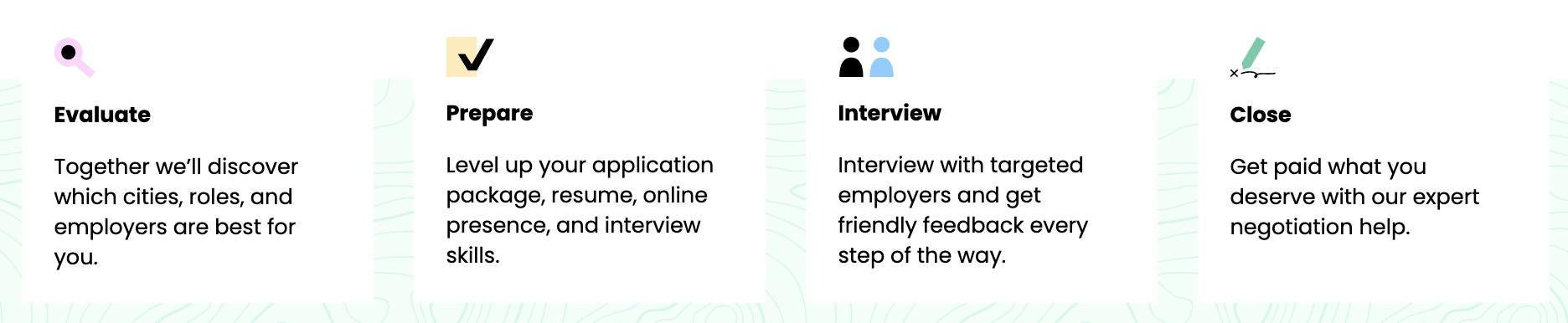
Placement then evaluates the prospective client in what is currently an extremely selective process to determine if they’re undervalued based on their skills, qualifications, shortfalls and redflags. If they’re already being adequately or overpaid, it won’t accept them. Those eligible are offered access to Placement’s research on all the optimal salary and location/hirer pairs for their role, which most people wouldn’t or couldn’t do themselves. Linehan says, “We run their job search for them. We’re kind of like a concierge.”

Once they’ve selected some targets, Placement quarterbacks their preparation process, helping them to improve their LinkedIn and resume, practice telling their story and offering mock interviews with experts in their field. As they progress through interviews Placement sets up and requires hirers offer remotely, it teaches clients to negotiate to get their best possible compensation.

“If you’re a normal person who didn’t go to an elite institution or are a couple years out of school, there’s no resources,” Linehan laments. While some top coding schools and other bootcamps place graduates, and some startups like Pathrise are also working on interview prep, most seeking a new employer end up relying on mediocre job hunting tips they find online. That’s in part because it was hard to get people to fork over significant cash in exchange for instruction that wasn’t guaranteed to help.
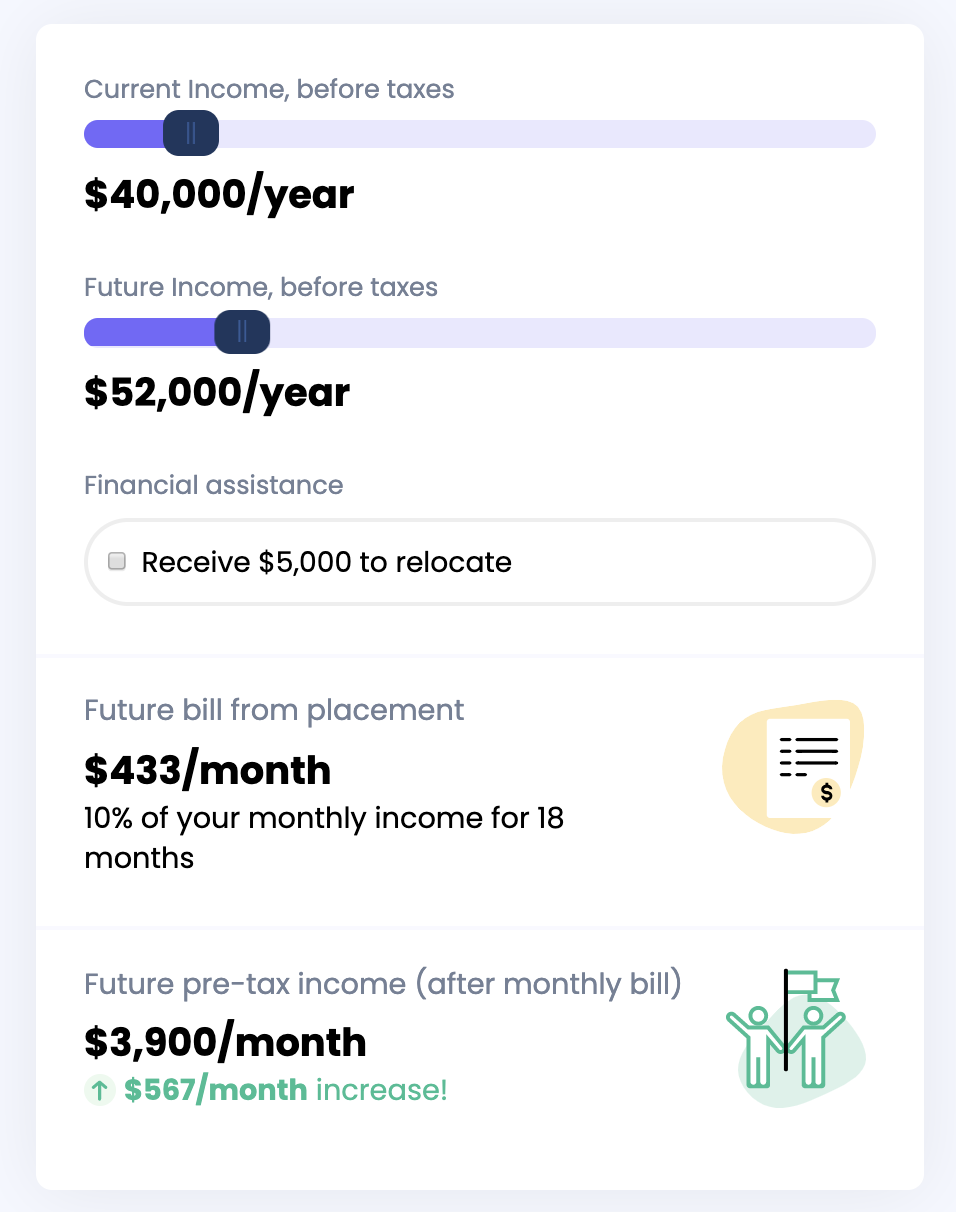
How Placement income sharing agreements work

The Placement income sharing agreement is designed to align incentives, though. It’s vested in getting clients not only the best job and salary, but one they’ll want to stick with. As long as the startup nets them a higher adjusted income, clients pay 10% of their earnings. That lasts for 18 months, or 36 months if they receive Placement’s $5,000 relocation stipend and human support. There are also caps on the total Placement can get paid back, and the agreement dissolves after five years so clients aren’t locked in if things don’t work out.

For example, Placement aims to help someone earning $40,000 per year pre-taxes reach $52,000 on a cost of living adjusted basis. They’d end up paying Placement $7,794 over the course of 18 months, or $433 per month. After the bill, they’d still be earning $3,900 per month, or $567 more than they used to. If they take the $5,000 relocation stipend and extra assistance, their ISA extends to 36 months and they’ll end up paying back $15,588 total, including the stipend.

Clients are likely to keep growing their compensation after their Placement ISA ends, so they’ll start reaping all the added proceeds. The startup has worked with fewer than 1,000 clients to date, but is supposedly growing quickly.

Eventually, Placement could move into working with programmers and designers, but it sees a big gap in assistance for business roles. Linehan notes that “We’re providing an option that will be available to a lot more people than a Lambda School or Galvanize coding bootcamp. Not everyone’s going to be software engineers.”

Making America anti-fragile

The biggest hurdle for Placement will be scaling what can be quite a hands-on, relationship-driven process of matching clients with the right hirers. “It’s one thing to get one person a job. It’s another to get 10,000 people a job,” Linehan admits. But he conquered the same problem at Flexport, which was moving 1,000 shipping containers across the ocean but had to figure out “how the hell do you move 1 million?”

Placement co-founders (from left): Katie Kent and Sean Linehan

That requires Placement to pour product know-how into building tools that equip clients to take more initiative to match themselves with hirers and teach themselves interview skills. It also must automate more of its marketing outreach, client screening and connections to recruiters while retaining a human element worth a four to five-figure price.

Right now, the startup’s team numbers just four, and though it will expand to seven soon, it may need to raise a bunch more to chase this dream. Some investors have been understandably skeptical about the whole “handing out $5,000” model without onerous ISAs.

For comparison, the one-year MissionU school for business and data jobs that was acquired and shut down by WeWork asked for 15% of income for three years without a relocation stipend, or $23,400 on a $52,000 per year job. ISAs for General Assembly’s tech job education cost 10% for 48 months, even if students don’t earn more than in their old job. Pathrise’s slimmer offering costs just 7% for one year. Colleges are jumping on the trend too, with some working with startup Leif to run their ISAs.

Placement has plans to cover prickly edge cases. If someone gets laid off from their new job, the startup will help them find another. “We’re on the hook to make sure they’re successful,” Linehan insists. It only won’t step in if an employee is fired for an ethical problem like sexual harassment or committing fraud. And if someone simply gets lonely in their unfamiliar city, they’re not required to stay, though moving home could hurt their earnings and Placement’s take. That’s why the startup is working to help its clients find community, even amongst each other, so they don’t feel isolated, and prefers sending workers to cities where they know someone.

Meanwhile, Placement must resist the temptation to become a hiring agency paid by employers and instead work fully on behalf of its clients. “When you’re aligned economically with the employer, you’re just chasing dollars from bigger and bigger whales of companies, and at one point you figure out you’re a recruiting firm for the Gap,” Linehan says with a shudder. The complexity of dealing with the U.S. Internal Revenue Service is enough hassle, so Placement doesn’t intend to work with jobseekers abroad or those that need visas, as “it’s not good for startups if you’re at the mercy of the government.”

Luckily, U.S. salaries total $8.6 trillion per year, Linehan claims, so it’s got enough of a domestic market. “The American economy is so huge that I don’t see other people tackling problems like that being competitive.” Placement does have potential to use its data to recommend and teach specific skills. “If you just make this change, if you learn Excel, you could totally get this job in a different industry that pays more and that you’ll like more,” Linehan says. He also dreams of one day improving urban planning by suggesting cities build music venues or parks that jobseekers say would soften the landing of moving there.

Zooming out, there’s also chance for Placement make the country more stable and resistant to strong-man populism promising financial security. “A two-tier society is fragile. I don’t want to live in a democracy where there’s a bunch of hay waiting for a matchstick to set it on fire,” Linehan concludes. “There doesn’t have to be a have and a have-not class, and you don’t need the government to do forced redistribituion to make everything fair. You just need people that care about getting on the right track, and that to me is a worthy cause to dedicate a life to.”


21 Nov 2019

Jeanette Manfra, senior DHS cybersecurity official, to leave government

Jeanette Manfra, one of the most senior and experienced U.S. cybersecurity officials, is leaving government after more than a decade in the public sector.

Manfra, who served as assistant director for cybersecurity at the Cybersecurity and Infrastructure Security Agency (CISA), will join the private sector in the New Year. CISA is Homeland Security’s dedicated civilian cybersecurity unit set up a year ago to respond to help protect against threats to U.S. critical infrastructure and foreign threats.

In an exclusive interview with TechCrunch, Manfra said it was a “really hard time to leave,” but the move will give her successor time to transition into the role ahead of the upcoming 2020 presidential election.

She did not say what her new job will be, only that she will take time off to be with her family in the meantime. She will leave her post at the end of the year.

Manfra’s departure from government will be seen as largely unexpected. At Homeland Security, she has served three presidents and worked on numerous projects to improve relations with the private sector, which are considered crucial partners in defending U.S. cyberspace. She also saw the agency double down on election security, threats to the supply chain, and efforts to protect U.S. critical infrastructure like the power grid and water networks from nefarious attempts by nation states.

At TechCrunch Disrupt SF this year, Manfra also talked candidly about the ongoing threats to U.S. cybersecurity, including a skills shortage and the risks posed by another global “WannaCry-style” cyberattack, which in 2017 saw thousands of computers infected by file-locking malware, causing billions of dollars worth of damage.

Manfra joined Homeland Security in 2007 under then-president George W. Bush, half a decade after the department was founded in the wake of the September 11 terrorist attacks. Manfra described the early years as a time when there weren’t “a lot of people talking about cybersecurity.”

“It definitely was not really on the national stage at the time. It was, you know, there was still a lot of debate as to whether ‘cybersecurity’ was one word or two words,” she said.

But in the years past and as internet access and tech companies continued to grow, she said the U.S. saw several “wake up” calls that brought cybersecurity into the public mainstream. The hack of Sony Pictures in 2016 and the WannaCry global ransomware attack in 2017 were two, and both were blamed on North Korea. Another, she said, was the 2015 data breach of the U.S. Office of Personnel Management (OPM), which saw suspected Chinese hackers steal more than 21 million sensitive background check files of government employees who had sought security clearance.

The department’s cybersecurity presence started out as a “very small, frankly relatively unknown group of people,” she said. A decade later it had become a major force in managing crises like the OPM attack, a breach that she said helped to push government to better prioritize cybersecurity.

“[The OPM breach] forced us to make some changes across the government that’ve been good,” she said.

In the aftermath, the government took steps to bolster its own systems and networks to lower its attack surface by removing Kaspersky from its networks citing fears about Russian intelligence, and taking the lead rolling out HTTPS website encryption and email security protections across the federal domains — an effort still to this day largely neglected by some of the world’s wealthiest companies.

Election security, she said, was another major wake-up call for the government. Russia waged a widescale disinformation — or “fake news” — campaign during the 2016 election to sow discord and exploit divisions in communities across the U.S. But there were also fears that hackers could break in and modify the tallies in voting machines, a concern that never came to fruition but one that security experts say remains a threat. Lawmakers have been pushing for the removal of paperless and electronic-only voting machines to reduce the risk of hackers manipulate the votes in favor of a particular candidate.

“In 2016, it was our best judgment that the Russians were looking to undermine confidence,” Manfra told TechCrunch. “The public confidence is important, and we need to be thinking within the government about the adversaries’ ability and willingness to use those against us,” she said.

Manfra said the department knew it had to work closer with state and local election boards to figure out their needs following the 2016 election. “We had a lot of honest conversations with [election boards] about what they need, what do we do, and how can we help,” she said. “It’s the fastest I’ve ever seen a sector come together.”

Those partnerships with local elections have given Homeland Security unprecedented visibility into the nation’s election infrastructure, she said, going from “some coverage” in 2016 to near-absolute insight across the country.

“If we ever did again get technical indicators that an adversary was trying to do something, we would be able to move more quickly and much more expansively across the country,” she said.

That effort paid off. Last year’s midterm election was remarkably quiet compared to 2016. Both the Justice Department and Homeland Security said there was “no evidence” to support foreign interference during the midterms.

It’s that running theme of public-private collaboration that Manfra looked back on with pride. “We don’t have all the answers and we can’t do it alone.” Those partnerships across the industry verticals — from elections to finance, energy and manufacturing — are “crucial to everything that we do,” she said.

“It’s really easy to say how important it is to have the government in the private sector working together,” she said. “But to do it well, it’s actually really hard.”

Manfra said the government had to be “willing to open itself” to build trust with its partners. “We now have some of the largest companies in the country that we built trusted relationships when they know that they can give us sensitive information — and we can take that and use it to protect other people, but we’re not going to abuse that trust,” she said.

Speaking of her time at Homeland Security, Manfra said she was most proud of her team. “A lot of them have been with me since we started,” she said. “They could be working out in the private sector making a ton of money, but they’re dedicating their lives here,” she said.

But she said she was “forcing” herself to have no regrets during her time in government.

It’s not yet known who will replace Manfra or will take on her responsibilities. But her advice for her eventual successor: “Trust your team, trust your partners, and stay focused,” she said. “It’s such a broad mission. It’s easy to lose focus.”

Related stories:

21 Nov 2019

Amazon launches a Dash Smart Shelf for businesses that automatically restocks supplies

Amazon may have stopped selling its Dash buttons for consumers, but it’s not done with dedicated Dash hardware: The company is launching its new Amazon Dash Smart Shelf today. Aimed at small businesses rather than individuals, the Dash Smart Shelf is also even more automated than the Dash buttons, as it uses a built-in scale to automatically place an order for re-stocking supplies based on weight.

Available in three different sizes (7″x7″, 12″x10″ and 18″x13″), the Dash Smart Shelf is just 1″ tall and can basically be placed under a pile of whatever stock of supplies you commonly run through while operating a business. That could mean printer paper, coffee cups, pens, paper clips, toilet paper, coffee or just about anything, really – and Amazon’s replenishment system can either be set to automatically place an order when it detects that on-hand supply has fallen below a certain weight, or you can just have it send someone in your organization a notification if you’d rather not have the order happen automatically.

The Dash Smart Shelf connects via built-in Wi-Fi, and can be powered either connected by cable to a power outlet, or via four AAA batteries, providing flexibility as to where you want to put it. Using the web or the Amazon app, you then sign in with your Amazon Business account and just pick what product you’re using on the scale that you want to top up. And if you find that your staff doesn’t like the coffee selection, for instance, you can easily change up the brand or product your’e re-ordering from your account, too.

Dash Smart Shelf isn’t available immediately for anyone to purchase directly, but instead Amazon is going to be working with select small businesses in a trial pilot this month, with the plan being to open up general availability to any Amazon Business customers that have a registered U.S. business license beginning next year. If people are keen on getting Smart Shelf into their business, they can sign up directly with Amazon to be noticed about availability.

21 Nov 2019

Alphabet’s Loon signs deal with Telefonica to provide internet to remote parts of the Amazon

Alphabet-owned Loon, the high-altitude balloon company that is using its stratospheric technology to provide internet connectivity on Earth, has signed a new commercial agreement with Telefonica-owned Internet para Todos (IpT). The IpT initiative, which is also backed in part by Facebook and the Development Bank of Latin America, aims to provide internet connectivity to users in remote locations across Latin America, and its deal with Loon will specifically connect users in remote parts fo the Amazon Rainforest in Peru.

Loon will begin providing service in 2020, provided the deal gets all the necessary regulatory approval it requires. This is a first in terms of a commercial deployment of high altitude gallons with the aim of offering connectivity over a continued, sustained period, so there’s some new ground to break in terms of working with the Peru Ministry of Transport and Communications prior to launch, but the partners involved are working with regulators to make sure everything’s signed off before launch.

This isn’t the first time Loon has worked with Telefonica – the two join forces to provide emergency internet connectivity following the 8.0 earthquake that hit Peru in May, and the’ve been collaborating on a number of projects for years. For Loon, this is now the third commercial contract it has secured, including one with Telkom Kenya which is also awaiting final regulatory sign-off, and an arrangement with Canadian company Telecast to develop a coordination system for a future planned low-Earth orbit satellite constellation.

The initial deployment plan for this partnership with IpT will provide connectivity to an area that makes up around 15 percent of the total area of the Loreto Region in Peru, which together accounts for a population of around 200,000 people. Of that 200,000, roughly a quarter have access to connectivity at least that 3G quality, according to Loon. The Loon balloons that will be deployed to provide service essentially act as very high altitude cell towers, receiving LTE connections and redistributing those directly to consumer devices on the ground.

21 Nov 2019

Celonis, a leader in big data process mining for enterprises, nabs $290M on a $2.5B valuation

More than $1 trillion is spent by enterprises annually on “digital transformation” — the investments that organizations make to update their IT systems to get more out of them and reduce costs — and today one of the bigger startups that’s built a platform to help get the ball rolling is announcing a huge round of funding.

Celonis, a leader in the area of process mining — which tracks data produced by a company’s software, as well as how the software works, in order to provide guidance on what a company could and should do to improve it — has raised $290 million in a Series C round of funding, giving the startup a post-money valuation of $2.5 billion.

Celonis was founded in 2011 in Munich — an industrial and economic center in Germany that you could say is a veritable petri dish when it comes to large business in need of digital transformation — and has been cash-flow positive from the start. In fact, Celonis waited until it was nearly six years old to take its first outside funding (prior to this Series C it had picked up less than $80 million, see here and here).

The size and timing of this latest equity injection is due to seizing the moment, and tapping networks of people to do so. It has already been growing at a triple-digit rate, with customers like Siemens, Cisco, L’Oreal, Deutsche Telekom and Vodafone among them. 

“Our tech has become its own category with a lot of successful customers,” Bastian Nominacher, the co-CEO who co-founded the company with Alexander Rinke and Martin Klenk, said in an interview. “It’s a key driver for sustainable business operations, and we felt that we needed to have the right network of people to keep momentum in this market.”

To that end, this latest round’s participants lines up with the company’s strategic goals. It is being led by Arena Holdings — an investment firm led by Feroz Dewan — with Ryan Smith, co-founder and CEO of Qualtrics; and Tooey Courtemanche, founder and CEO of Procore, also included, alongside previous investors 83North and Accel.

Celonis said Smith will be a special advisor, working alongside another strategic board member, Hybris founder Carsten Thoma. Dewan, meanwhile, used to run hedge funds for Tiger Global (among other roles) and currently sits on the board of directors of Kraft Heinz.

“Celonis is the clear market leader in a category with open-ended potential. It has demonstrated an enviable record of growth and value creation for its customers and partners,” said Dewan in a statement. “Celonis helps companies capitalise on two inexorable trends that cut across geography and industry: the use of data to enable faster, better decision-making and the desire for all businesses to operate at their full potential.”

The core of Celonis’ offering is to provide process mining around an organizations’ IT systems. Nominacher said that this could include anything from 5 to over 100 different pieces of software, with the main idea being that Celonis’s platform monitors a company’s whole solar system of apps, so to speak, in order to produce its insights — providing and “X-ray” view of the situation, in the words of Rinke.

Those insights, in turn, are used either by the company itself, or by consultants engaged by the organization, to make further suggestions, whether that’s to implement something like robotic process automation (RPA) to speed up a specific process, or use a different piece of software to crunch data better, or reconfigure how staff is deployed, and so on. This is not a one-off thing: the idea is continuous monitoring to pick up new patterns or problems.

In recent times, the company has started to expand the system into a wider set of use cases, by providing tools to monitor operations and customer experience, and to apply its process mining engine to a wider set of company sizes beyond large enterprises, and by bringing in more AI to its basic techniques.

Interestingly, Nominacher said that there are currently no plans to, say, extend into RPA or other “fixing” tools itself, pointing to a kind of laser strategy that is likely part of what has helped it grow so well up to now.

“It’s important to focus on the relevant parts of what you provide,” he said. “We one layer, one that can give the right guidance.”

21 Nov 2019

Route’s app auto-tracks all your packages, raises $12M

Between Amazon, FedEx, UPS, and indie merchants, it’s easy to lose track of when your online purchases will be delivered. And if you’re buying something pricey or important, a lack of shipping insurance can leave you anxious and constantly checking your porch.

But a fresh startup has found unprecedented growth by letting you monitor all your ecommerce orders in one app thanks to a Gmail extension. Plus, you can buy insurance for just 1% of an item’s cost. Meet Route, emerging from stealth today to become the Find My Friends for packages. By helping merchants handle post-purchase satisfaction while charging consumers for insurance, this year Route has grown to $8.85 million in revenue run rate and from 5 to 100 employees.

Now Route is announcing it’s raised $12 million in total through a quiet $500,00 January pre-seed round from Peak Venture Capital and a new seed round with the rest from Album VC and strategic partner in direct-to-consumer brands Pattern. The cash will help Route keep up with demand and add new features to its app. Route co-founder and CEO Evan Walker tells me consumers “no longer accept the unsatisfying status quo of not knowing exactly where their order is.”

Pizza Tracker But For Everything

Domino’s saw sales skyrocket thanks to its highly visual pizza tracker app that shows live updates as your pie goes in the oven, hits the road, and reaches your door. Route wants to bring that reassuring experience to all of ecommerce.

Route co-founder and CEO Evan Walker

Walker asks “How could I NOT build this company?” The 25-year ecommerce entrepreneur got his start selling video games online in 1994, and has founded seven companies since. The communications gap between customers and merchants always plagued his businesses.

“The big lightbulb moment happened when I was traveling in Italy a few years back” Walker recalls. Talking to a furniture shop owner, he heard about their troubles of shipping vintage trunks. “He mentioned he was having a lot of issues with these items breaking in transit and wished he had a solution for it.” Now there is one.

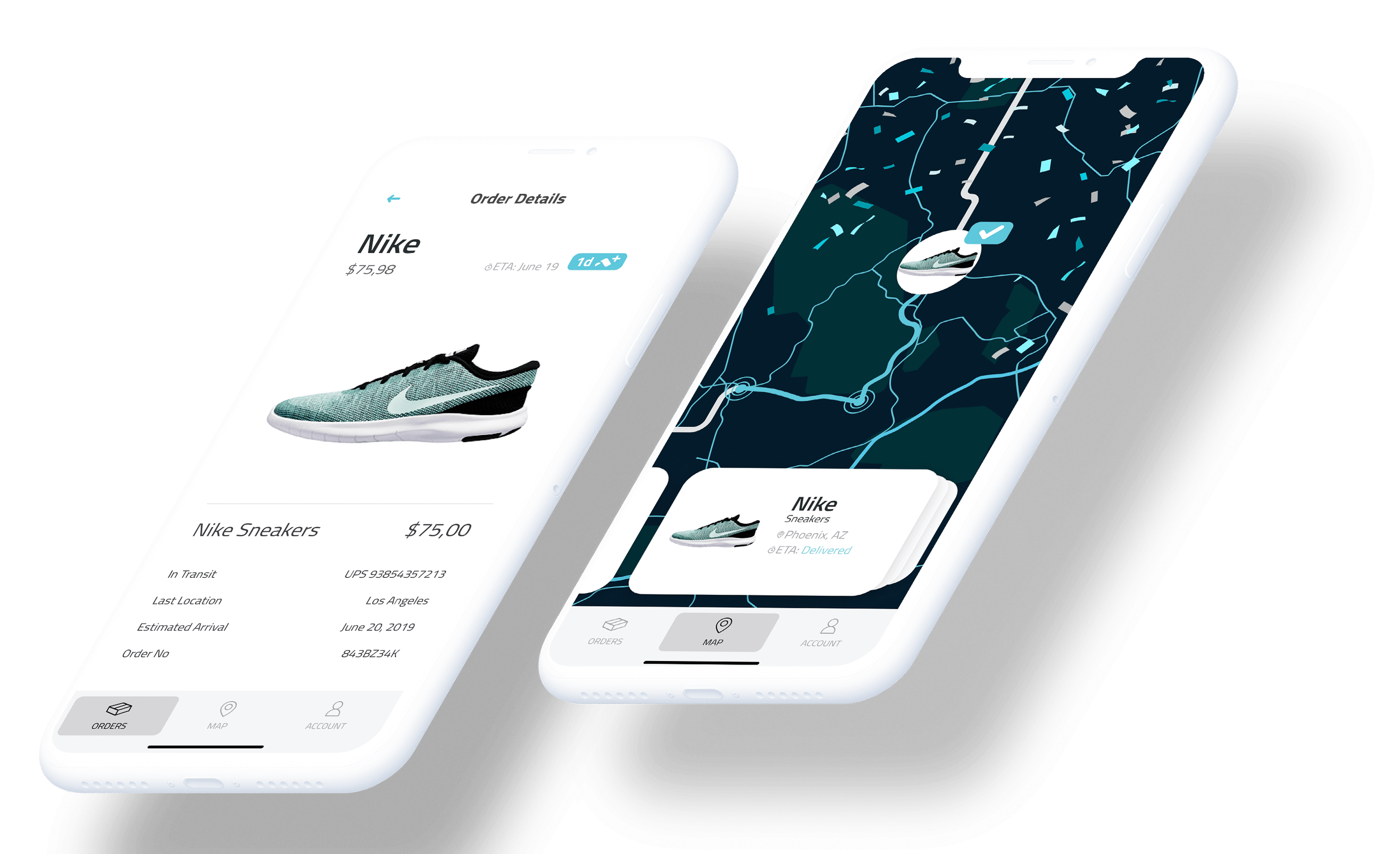
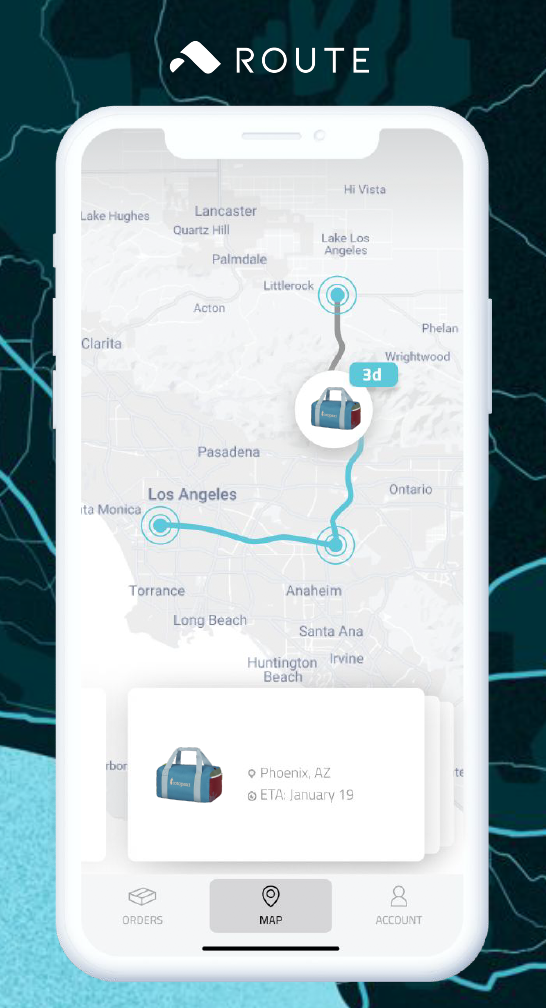
The Route iOS app for visually tracking orders officially launches today. Purchases from partnered merchants instantly show up in the app and its website via API, but all your other buys from Amazon etc can be automatically ingested by authorizing the Route Bot Gmail extension that scans for shipping updates. Route lays out all the orders on a map with immediate access to their latest status changes like when shipping info is received, an item goes out for last mile delivery, or there’s a problem. There’s no need to copy and paste tracking numbers across multiple websites.

The Route+ insurance program that lets customers pay for peace of mind is launching today too. Customers get the option to add it from partnered merchants, file claims for lost / damaged / stolen packages in one tap, and get reimbursement from respected Lloyd’s Of London.

Walker claims that merchants that offer Route+ (which is free for them) “have seen an increase in conversion, decreased spend on customer support teams, and an improved post-purchase customer experience due to Route’s ability to quickly handle customer claims.” Merchants can also opt to pay themselves for Route+ on every order

Route now works with 1600 merchants and 600 carriers and has overseen shipments to 1.3 million customers in 187 countries. John Mayfield from Peak Venture Capital says “Their phenomenal growth of acquiring over 600 clients in the first three months makes them one of the fastest growing companies we have ever seen.”

The Brown Box Wars

The biggest challenge for Route is overcoming the thick, thick crowd of competitors in the market. Rakuten’s Slice can pull orders from your email and also grabs you refunds if an item goes on sale after you buy it. 17Track lets you paste in big lists of tracking numbers in case they’re registered to someone else’s email. Parcel offers a barcode scanner. ‘Deliveries’ will set up calendar appointments for arrivals, and works on Mac and Apple Watch. ParcelTrack lets you forward it emails of purchases to monitor, and a $2.99 premium version offers live locations of your packages plus customizable push notifications.

Route’s strength is that it’s totally free for consumers unless they want to buy insurance, and does email tracking automatically, though it will lack manual tracking number input for a few more weeks. It’s managed a 90 percent customer satisfaction score. Still, the startup could be vulnerable to a major player in ecommerce like Amazon or Shopify barging into the space. There are also platform risks, such as if Gmail blocked its scanning for tracking numbers.

“The better that Amazon gets at providing similar services, the more other merchants need those tools in order to compete outside of Amazon” says Walker. “From the insurance side, we are pretty good at detecting risk before it becomes a major issue and we are insuring on an individual order basis so catastrophic incidences are minimized.” The company also has to keep a watchful eye out for fraudulent insurance claims.

The growing megatrend of purchase behavior shifting online means the once occasional activity of receiving a package has become a constant chore in need of streamlining. Plenty of merchants are meanwhile looking to offload the complexity of keeping impatient buyers happy. If Route conquers its first market, it could move into adjacent spaces ranging from merchant services like freight forwarding and financing to consumer features like physical mail scanning for electronic delivery.

“Ecommerce is in my blood. I feel like I’ve taken 25 years of experience and started to craft a really interesting product in this space” Walker concludes. “With commerce going more digital everyday, there is an opportunity to create a big dent.” Or in Route‘s case, an opportunity to insure your packages against big dents.

21 Nov 2019

Wonderbly launches Wonderbly Studios to let other brands use its personalisation API for printed books

Wonderbly, the personalised book publisher backed by Google Ventures and best known for the breakout hit “Lost My Name,” is unveiling Wonderbly Studios in a bid to make it easier for other brands to offer personalised and bespoke printed books on-demand.

Initially, Wonderfully Studios will work with select partners to provide access to its personalisation API and help create new books using its technology and expertise in the space. However, longer term Wonderbly co-founder and CEO Asi Sharabi tells me the plan is to continuing developing the platform and eventually open up the whole thing so that anybody can offer high-quality and data-infused personalised books via its API.

“Selling high quality personalised products – products that extend beyond the trivial “put my name on a mug” – is no easy task,” he says. “Meaningfully personalised products and businesses are still quite complex to operate at scale. You need a rendering stack, integration with a local print house, couriers, customer support and more. These technical and operational hurdles are a barrier to entry”.

Sharabi adds that although Wonderbly is aware of some “cool” personalised book ideas already on the market, he says that very few are reaching meaningful scale. “We hope to change all that with our personalisation platform and provide a fast, seamless experience with responsive previews and high fidelity physical products for multiple and complex personalisation logics,” he says.

The first project to come out of Wonderbly Studios is an interactive journal from Wizarding World (the Official Harry Potter Fan Club), which is a joint venture between Pottermore Ltd. and Warner Bros.

The “Keys and Curios” journal is described as full of interactive surprises and secrets that can be unlocked using the Wizarding World app. It incorporates a fan’s name, house traits and more to take them on a unique journey through the wizarding year.

The books contents were written and designed by the Wizarding World Digital team, and feature images from across the Wizarding World, artwork by illustrator Jim Kay and specially designed Hogwarts house covers by MinaLima (the graphic designer design team behind some of the visuals from the Harry Potter and Fantastic Beasts films).

Meanwhile, the personalisation technology, e-commerce integration and on-demand printing/logistics is powered by Wonderbly.

“The end customers interact via the partner’s e-commerce stack,” explains Sharabi. These stacks (e.g Shopify or Magento) were not built for personalised products and customisation. Adding this functionality is hard – we know, we’ve been doing it for 5 years. This is why we developed the Wonderbly Personalisation API”.

Products created on the Wonderbly platform can deliver “limitless amount of creativity, constrained only by imagination,” says the Wonderbly CEO. That’s because Wonderbly takes cares of a lot of the remaining heavy-lifting.

“Products are rendered in real-time at scale for customers as part of the shopping experience,” explains Sharabi. “The platform handles the complexities of integrating with e-commerce systems in a developer friendly way, making it a simple task to add a personalised product to a cart. When an order is completed a simple web hook ensures that the products are rendered, printed and shipped to the customer, while feeding into our partner’s systems for progress notification and customer support”.

With regards to what kind of personalised books we might see come to market as Wonderbly Studios opens up further, it is likely impossible to predict. That’s because the full range of potential experiences is likely something that no single person or team could ever imagine, which, of course is the whole point.

As Sharabi previously told TechCrunch, you can’t scale creativity in the same way as tech – you have to allow creativity to come from anywhere.

“What if you can create a customised art, poetry or recipes book at the same ease you make a Spotify playlist?” he asks rhetorically. “What would gaming printed yearbooks look like? What if travel guides and language acquisition become more personalised? What if you can order an ‘I was there’ personalised keepsake for live gigs and festivals? These and more are questions that get us very excited”.