Year: 2019

19 Nov 2019

A 10-point plan to reboot the data industrial complex for the common good

A posthumous manifesto by Giovanni Buttarelli, who until his death this summer was Europe’s chief data protection regulator, seeks to join the dots of surveillance capitalism’s rapacious colonization of human spaces, via increasingly pervasive and intrusive mapping and modelling of our data, with the existential threat posed to life on earth by manmade climate change.

In a dense document rich with insights and ideas around the notion that “data means power” — and therefore that the unequally distributed data-capture capabilities currently enjoyed by a handful of tech platforms sums to power asymmetries and drastic social inequalities — Buttarelli argues there is potential for AI and machine learning to “help monitor degradation and pollution, reduce waste and develop new low-carbon materials”. But only with the right regulatory steerage in place.

“Big data, AI and the internet of things should focus on enabling sustainable development, not on an endless quest to decode and recode the human mind,” he warns. “These technologies should — in a way that can be verified — pursue goals that have a democratic mandate. European champions can be supported to help the EU achieve digital strategic autonomy.”

“The EU’s core values are solidarity, democracy and freedom,” he goes on. “Its conception of data protection has always been the promotion of responsible technological development for the common good. With the growing realisation of the environmental and climatic emergency facing humanity, it is time to focus data processing on pressing social needs. Europe must be at the forefront of this endeavour, just as it has been with regard to individual rights.”

One of his key calls is for regulators to enforce transparency of dominant tech companies — so that “production processes and data flows are traceable and visible for independent scrutiny”.

“Use enforcement powers to prohibit harmful practices, including profiling and behavioural targeting of children and young people and for political purposes,” he also suggests.

Another point in the manifesto urges a moratorium on “dangerous technologies”, citing facial recognition and killer drones as examples, and calling generally for a pivot away from technologies designed for “human manipulation” and toward “European digital champions for sustainable development and the promotion of human rights”.

In an afterword penned by Shoshana Zuboff, the US author and scholar writes in support of the manifesto’s central tenet, warning pithily that: “Global warming is to the planet what surveillance capitalism is to society.”

There’s plenty of overlap between Buttarelli’s ideas and Zuboff’s — who has literally written the book on surveillance capitalism. Data concentration by powerful technology platforms is also resulting in algorithmic control structures that give rise to “a digital underclass… comprising low-wage workers, the unemployed, children, the sick, migrants and refugees who are required to follow the instructions of the machines”, he warns.

“This new instrumentarian power deprives us not only of the right to consent, but also of the right to combat, building a world of no exit in which ignorance is our only alternative to resigned helplessness, rebellion or madness,” she agrees.

There are no less than six afterwords attached to the manifesto — a testament to the store in which Buttarelli’s ideas are held among privacy, digital and human rights campaigners.

The manifesto “goes far beyond data protection”, says writer Maria Farrell in another contribution. “It connects the dots to show how data maximisation exploits power asymmetries to drive global inequality. It spells out how relentless data-processing actually drives climate change. Giovanni’s manifesto calls for us to connect the dots in how we respond, to start from the understanding that sociopathic data-extraction and mindless computation are the acts of a machine that needs to be radically reprogrammed.”

At the core of the document is a 10-point plan for what’s described as “sustainable privacy”, which includes the call for a dovetailing of the EU’s digital priorities with a Green New Deal — to “support a programme for green digital transformation, with explicit common objectives of reducing inequality and safeguarding human rights for all, especially displaced persons in an era of climate emergency”.

Buttarelli also suggests creating a forum for civil liberties advocates, environmental scientists and machine learning experts who can advise on EU funding for R&D to put the focus on technology that “empowers individuals and safeguards the environment”.

Another call is to build a “European digital commons” to support “open-source tools and interoperability between platforms, a right to one’s own identity or identities, unlimited use of digital infrastructure in the EU, encrypted communications, and prohibition of behaviour tracking and censorship by dominant platforms”.

“Digital technology and privacy regulation must become part of a coherent solution for both combating and adapting to climate change,” he suggests in a section dedicated to a digital Green New Deal — even while warning that current applications of powerful AI technologies appear to be contributing to the problem.

“AI’s carbon footprint is growing,” he points out, underlining the environmental wastage of surveillance capitalism. “Industry is investing based on the (flawed) assumption that AI models must be based on mass computation.

“Carbon released into the atmosphere by the accelerating increase in data processing and fossil fuel burning makes climatic events more likely. This will lead to further displacement of peoples and intensification of calls for ‘technological solutions’ of surveillance and border controls, through biometrics and AI systems, thus generating yet more data. Instead, we need to ‘greenjacket’ digital technologies and integrate them into the circular economy.”

Another key call — and one Buttarelli had been making presciently in recent years — is for more joint working between EU regulators towards common sustainable goals.

“All regulators will need to converge in their policy goals — for instance, collusion in safeguarding the environment should be viewed more as an ethical necessity than as a technical breach of cartel rules. In a crisis, we need to double down on our values, not compromise on them,” he argues, going on to voice support for antitrust and privacy regulators to co-operate to effectively tackle data-based power asymmetries.

“Antitrust, democracies’ tool for restraining excessive market power, therefore is becoming again critical. Competition and data protection authorities are realising the need to share information about their investigations and even cooperate in anticipating harmful behaviour and addressing ‘imbalances of power rather than efficiency and consent’.”

On the General Data Protection Regulation (GDPR) specifically — Europe’s current framework for data protection — Buttarelli gives a measured assessment, saying “first impressions indicate big investments in legal compliance but little visible change to data practices”.

He says Europe’s data protection authorities will need to use all the tools at their disposal — and find the necessary courage — to take on the dominant tracking and targeting digital business models fuelling so much exploitation and inequality.

He also warns that GDPR alone “will not change the structure of concentrated markets or in itself provide market incentives that will disrupt or overhaul the standard business model”.

“True privacy by design will not happen spontaneously without incentives in the market,” he adds. “The EU still has the chance to entrench the right to confidentiality of communications in the ePrivacy Regulation under negotiation, but more action will be necessary to prevent further concentration of control of the infrastructure of manipulation.”

Looking ahead, the manifesto paints a bleak picture of where market forces could be headed without regulatory intervention focused on defending human rights. “The next frontier is biometric data, DNA and brainwaves — our thoughts,” he suggests. “Data is routinely gathered in excess of what is needed to provide the service; standard tropes, like ‘improving our service’ and ‘enhancing your user  experience’ serve as decoys for the extraction of monopoly rents.”

There is optimism too, though — that technology in service of society can be part of the solution to existential crises like climate change; and that data, lawfully collected, can support public good and individual self-realization.

“Interference with the right to privacy and personal data can be lawful if it serves ‘pressing social needs’,” he suggests. “These objectives should have a clear basis in law, not in the marketing literature of large companies. There is no more pressing social need than combating environmental degradation” — adding that: “The EU should promote existing and future trusted institutions, professional bodies and ethical codes to govern this exercise.”

In instances where platforms are found to have systematically gathered personal data unlawfully Buttarelli trails the interesting idea of an amnesty for those responsible “to hand over their optimisation assets”– as a means of not only resetting power asymmetries and rebalancing the competitive playing field but enabling societies to reclaim these stolen assets and reapply them for a common good.

While his hope for Europe’s Data Protection Board — the body which offers guidance and coordinates interactions between EU Member States’ data watchdogs — is to be “the driving force supporting the Global Privacy Assembly in developing a common vision and agenda for sustainable privacy”.

The manifesto also calls for European regulators to better reflect the diversity of people whose rights they’re being tasked with safeguarding.

The document, which is entitled Privacy 2030: A vision for Europe, has been published on the website of the International Association of Privacy Professionals ahead of its annual conference this week.

Buttarelli had intended — but was finally unable — to publish his thoughts on the future of privacy this year, hoping to inspire discussion in Europe and beyond. In the event, the manifesto has been compiled posthumously by Christian D’Cunha, head of his private office, who writes that he has drawn on discussions with the data protection supervisor in his final months — with the aim of plotting “a plausible trajectory of his most passionate convictions”.

19 Nov 2019

Perlego raises $9M Series A for its textbook subscription service

Perlego, the textbook subscription service, has raised $9 million in Series A funding.

Backing the round is Charlie Songhurst, Dedicated VC, and Thomas Leysen (Chairman of Mediahuis and Umicore). Perlego’s existing investors including ADV, Simon Franks and Alex Chesterman also reinvested on a pro-rata basis.

London-based Perlego says the additional funding will be used to develop the next generation of Perlego’s “smarter learning platform,” including adding new features that simplify and enhance the learning experience, as well as content libraries in non-English languages to enable further expansion to “strategic” European markets beyond its U.K. roots.

Pitched as akin to a “Spotify for textbooks,” Perlego enables students, and also professionals, who now make up 30% of users, to access textbooks on a subscription basis.

It houses over 300,000 eBooks, from over 2,300 publishers, and the service is cross-device — via the web and iOS and Android apps — and available in multiple languages. Along with U.K. publishers, Perlego now also includes content from key publishers in Germany, the Nordics and Italy.

For the students, the draw is obvious: text books are increasingly expensive to purchase, and public libraries are under resourced. In the U.K., Perlego gives readers access to its entire digital library for £12 per month. As long as the needed text books are available on the service, that is infinitely more affordable.

For publishers, Perlego claims to offer a distribution method that stems revenue losses caused by piracy and the buoyant used text book market — hence the comparison to Spotify’s positioning.

Publishers such as Pearson, Cengage and McGraw Hill are already on board, Perlego says it is seeing a 116% increase in new subscribers month-on-month, though it isn’t breaking out subscriber numbers.

19 Nov 2019

Playbuzz becomes Ex.co and expands its content marketing platform

Playbuzz, a startup that helps publishers to add things like polls and galleries to their articles, has rebranded itself as Ex.co.

Co-founder and CEO Tom Pachys told me the name stands for “the experience company,” and he said it reflects the company’s broader content marketing ambitions. Ex.co will continue working with news publishers, but Pachys said there’s a bigger market for what the company has built.

“We’re seeing businesses wanting to become publishers in a way, to interact with their users in a way that’s very similar to what a publisher does,” Pachys said.

Playbuzz/Ex.co is hardly the first publishing startup realize that there may be more money in content marketing, but Pachys argued that this isn’t just a sudden pivot. After all, the company is already working with clients like Visa, Red Bull and Netflix (as well as our corporate siblings at The Huffington Post).

“The previous name does not reflect the values that we stand for today — not even future values,” he said.

Tom Pachys

Tom Pachys

Pachys also suggested that existing content marketing tools are largely focused on operations and workflow — things like hiring the right freelancer — while Ex.co aims at making it easier to actually create the content.

“We’re the ones innovate within the core — not around it, but the core itself,” he said. “And rather than trying to call them competition, we want to integrate with as much players in the ecosystem as possible.”

In addition to announcing the rebrand, Ex.co is also relaunching its platform as a broader content marketing tool, with new features like content templates, real-time analytics and lead generation.

Pachys, by the way, is new to the CEO role, having served as COO until recently, while previous Playbuzz CEO Shaul Olmert has become the company’s president. Pachys said the move wasn’t “directly correlated” with the other changes, and instead allows the two of them to focus on their strengths — Pachys oversees day-to-day operations, while Olmert focuses on investor relations and strategic deals.

“I co-founded the company with Shaul, who’s a very good friend of mine, we’ve known each other 20 years,” Pachys said. “Shaul is very much involved in the company.”

19 Nov 2019

New York State Attorney General reportedly investigating WeWork

WeWork is reportedly being investigated by the New York State Attorney General. According to Reuters, the NYAG’s questions include if WeWork founder and former CEO Adam Neumann engaged in self-dealing.

A WeWork spokesperson said in an email that “we have received an inquiry from the office of the New York State Attorney General and are cooperating in the matter.” TechCrunch also contacted the New York State Attorney General’s office for comment. WeWork is headquartered in New York City.

This comes less than a week after Bloomberg reported WeWork is the subject of a U.S. Securities and Exchange Commission inquiry into potential rule violations related to its cancelled IPO.

WeWork’s parent company, The We Company, announced on Sept. 30 that it was withdrawing its S-1 filing for an initial public offering, shortly after Neumann stepped down as CEO. In addition to questions about the company’s financial state, red flags for investors included that Neumann had borrowed against his WeWork shares and leased properties he owned back to the company.

An entity Neumann controlled also sold the company the right to use the word “We” for $5.9 million, though he later asked the company to unwind the agreement and returned the money after public criticism.

After receiving a lifeline from investor SoftBank worth up to $8 billion, WeWork is now engaging in major cost-cutting measures, including layoffs at Meetup, which it acquired for $200 million in 2017.

19 Nov 2019

Earth is headed for its second warmest year in recorded history (the record was three years ago)

Data from the U.S. government sure seems to indicate that the Earth is warming (despite what the current leadership may say).

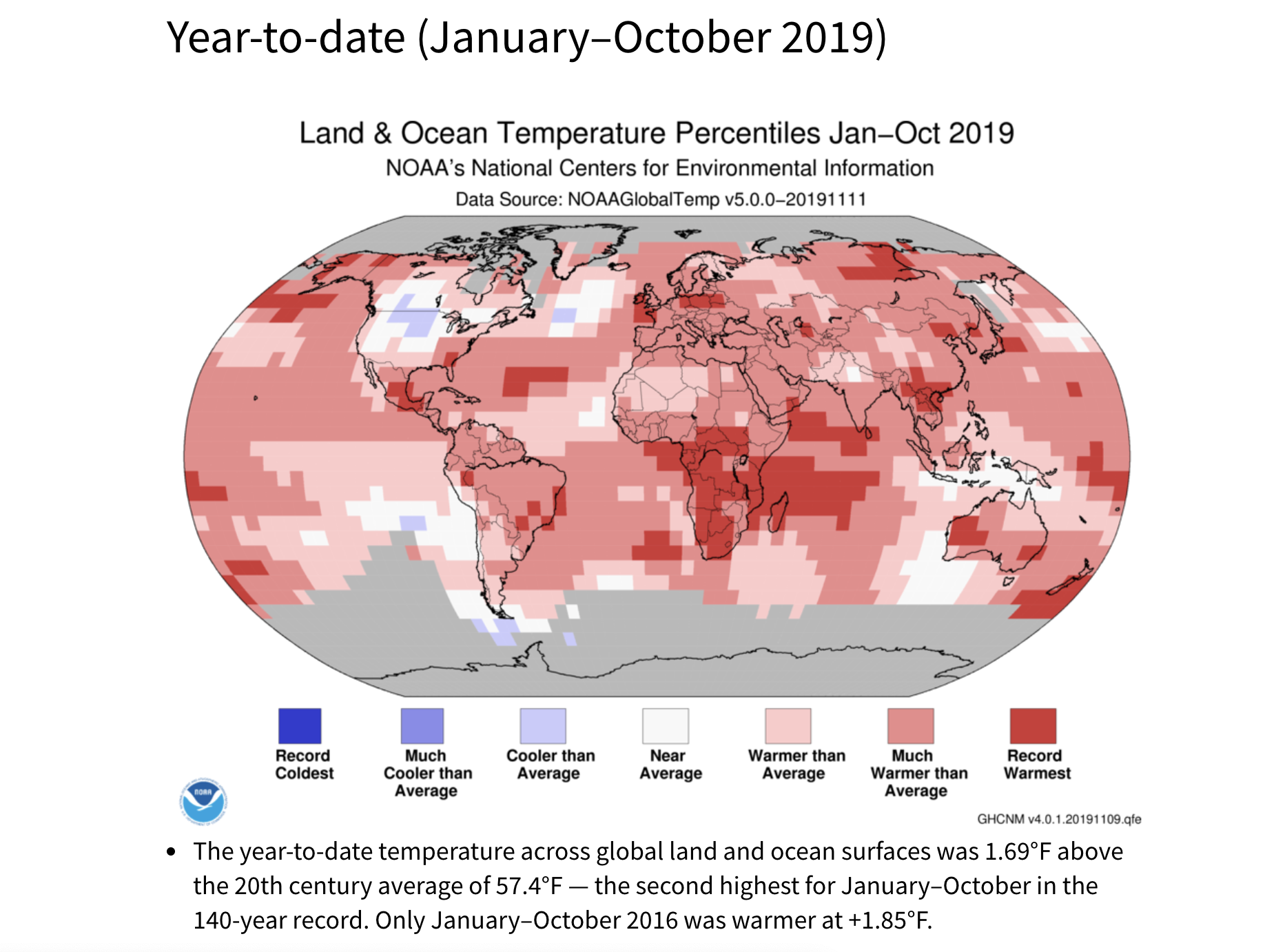
Apparently, the globe just experienced the second-hottest October ever recorded and is on track for the second-hottest year to date on record, according to data from the National Oceanic and Atmospheric Administration.

Not only are we experiencing a run of hot Octobers (this is the tenth year that temperatures have hit recorded-history highs since 2003 and all five of the highest temperature years were in the past five years), but arctic ice has also shrunk to its lowest extent since satellite records began in 1979.

Even as the Trump Administration enacts policies to reverse course on curbing the emissions that seem to be leading to a changing global climate, federal agencies like the NOAA keep releasing reports that reveal exactly how much the planet is changing.

Earlier this month Secretary of State Mike Pompeo began the process of formally withdrawing the U.S. from the Paris Agreement on climate change. As with most momentous events of the Administration, the world was notified via Twitter.

While Secretary Pompeo was praising the nation’s approach to “reducing all emissions”, Europe, Africa, Oceania, the Caribbean and Hawaiian Islands hit historic record-setting temperatures and the world’s average sea surface temperature hit its second-warmest ever-recorded temperature.

Meanwhile, new projections are revising the risk that cities face from rising sea levels that are caused by melting glaciers due to warmer temperatures.

Maps created by the research organization Climate Central, and published in the journal Nature Communications indicate that rising seas could flood land that’s currently home to some 150 million people at high-tide by 2050, if steps aren’t taken to improve the resiliency of cities to flooding or reverse course on climate.

Even the Federal Reserve is waking up to climate change risks. The regulator responsible for U.S. monetary policy convened an event earlier this month to focus on the financial impacts of climate change.

“By participating more actively in climate-related research and practice, the Federal Reserve can be more effective in supporting a strong economy and a stable financial system,” Lael Brainard, a member of the Fed’s board in Washington, said in prepared remarks at the same event, according to a report in The New York Times. 

19 Nov 2019

The coming fight over who controls digital health data

Spending for consumer digital healthcare companies is set to explode in the next few years; the Office of the National Coordinator for Health Information Technology is currently reviewing the requirements for data sharing with the Department of Health and Human Services, and their initiatives will unlock a wave of data access never before seen in the U.S. healthcare system.

Already, startups and large technology companies are jockeying for position over how to leverage this access and take advantage of new sensor technologies that provide unprecedented windows into patient health.

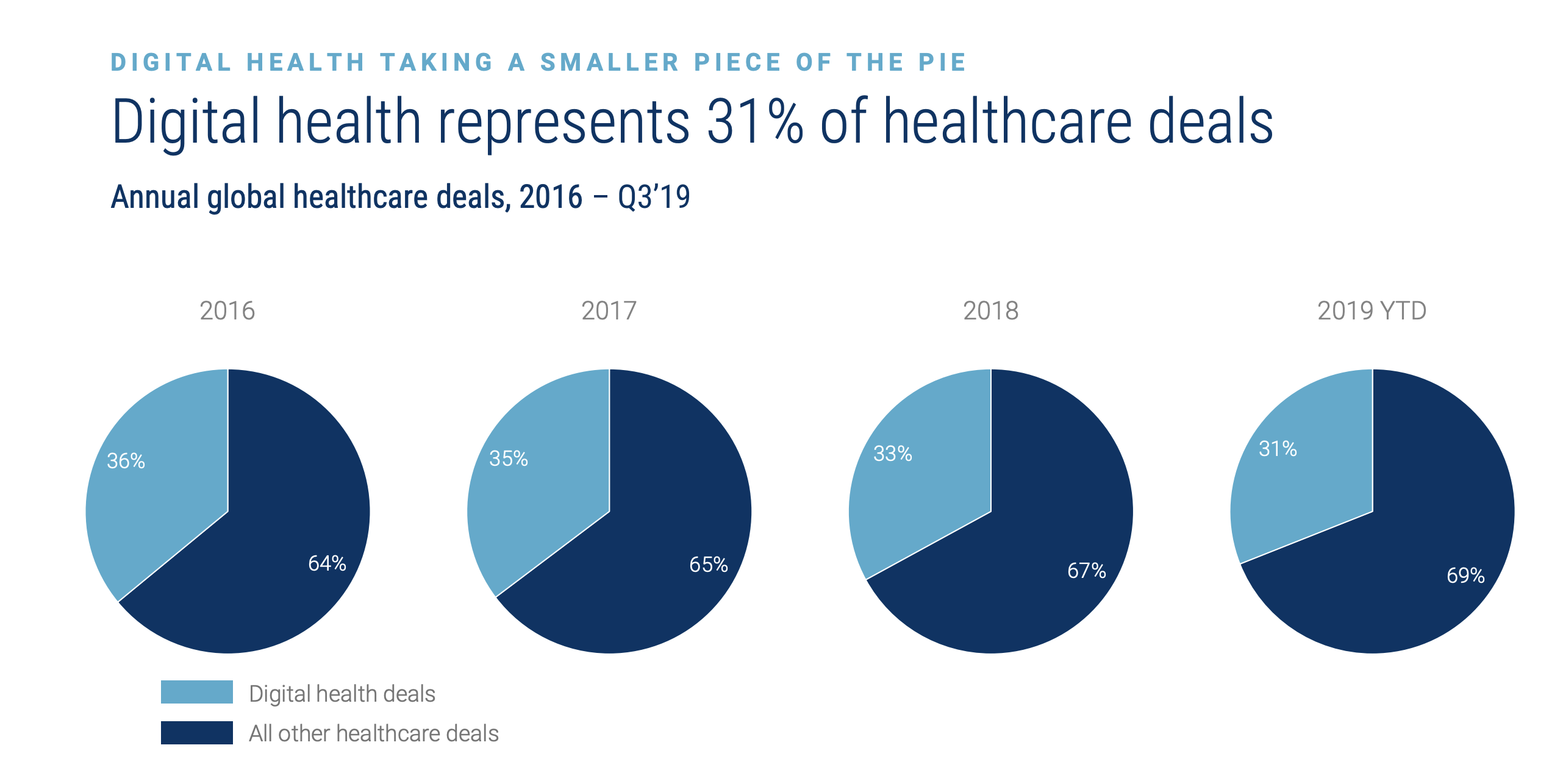
Venture capital investors are expected to invest roughly $50 billion in approximately 4,500 startups in the healthcare industry, according to data from CB Insights. In all, there have been 3,409 investments made in the healthcare market through the third quarter of 2019, with 31% of those deals done in what CB Insights identifies as digital health companies.

The explosion of data is unprecedented and already companies like Apple and Google are jockeying for control over how that data will be served up to healthcare practitioners and patients.

Chart courtesy of CB Insights

Apple and Google are setting out two divergent paths for handling patient data. For patient advocates, there’s a clear winner, and as startups look to play in these emerging ecosystems, it’s what the patient wants that may matter most.

The second that this data hits those shiny Silicon Valley apps, instead of being under HIPAA that’s covered, you become a user and you have no rights,” says one patient advocate. 

Last week, after reports in The Wall Street Journal and The New York Times, Google confirmed the details of a partnership with religiously-affiliated hospital and assisted living network, Ascension, a deal that involved the movement of millions of patient records into Google’s infrastructure.

The Alphabet subsidiary had first announced the agreement in its July earnings call, but the precise details of its work with the hospital records of Ascension patients were undisclosed until a more detailed description of the project was leaked by a whistleblower.

Google was not only moving patient records onto its cloud infrastructure, but was also developing tools to “help Ascension’s doctors and nurses more quickly and easily access relevant patient information, in a consolidated view,” the company confirmed in a blog post.

For the source of the Journal’s reporting, there were too many pieces of information about the project that both the Google engineers who were working on “Nightingale” and the doctors and patients in the Ascension healthcare system were kept in the dark about.

As the whistleblower wrote in a Guardian editorial late last week:

With a deal as sensitive as the transfer of the personal data of more than 50 million Americans to Google the oversight should be extensive. Every aspect needed to be pored over to ensure that it complied with federal rules controlling the confidential handling of protected health information under the 1996 HIPAA legislation.

Working with a team of 150 Google employees and 100 or so Ascension staff was eye-opening. But I kept being struck by how little context and information we were operating within.

What AI algorithms were at work in real time as the data was being transferred across from hospital groups to the search giant? What was Google planning to do with the data they were being given access to? No-one seemed to know.

Above all: why was the information being handed over in a form that had not been “de-identified” – the term the industry uses for removing all personal details so that a patient’s medical record could not be directly linked back to them? And why had no patients and doctors been told what was happening?

I was worried too about the security aspect of placing vast amounts of medical data in the digital cloud. Think about the recent hacks on banks or the 2013 data breach suffered by the retail giant Target – now imagine a similar event was inflicted on the healthcare data of millions.

Google insists that no patient data is being used to sell ads, or being coupled with either its own consumer data or data from other customers it may be working with in healthcare (a list that includes the Cleveland Clinic, Hunterdon Healthcare, and McKesson).

However, Google’s handling of patient data — through its own work with other partners and through DeepMind Health (a division of a Google spinout which the search giant recently acquired) — has been controversial.

In 2018, the search giant’s work with the U.K.’s National Health Service was criticized for not adhering to data governance standards and potentially breaking the law. And, earlier this year, Google was sued for allegedly mishandling patient data by including too much potentially identifiable patient information used in a study conducted by the University of Chicago Medical Center, Google, and the University of Chicago.

In each instance, Google insisted that it followed all appropriate regulations, but the problem that the company faces is growing concern from a new crop of lawmakers and concerned consumers that the regulations which exist on the books are no longer appropriate.

Technology is coming for healthcare data

The news of Google’s work with Ascension and the concerns it has raised among consumers is just one example of the company’s broader efforts to capture more of the multi-trillion dollar healthcare market.

Google kicked off November with a $2.1 billion bid for Fitbit — a deal that would potentially put an incredible amount of currently unregulated consumer health data squarely under the magnifying glass of Google’s mammoth data analysis tools.

19 Nov 2019

Mubi launches streaming service in India

Mubi, a 12-year-old on-demand movie streaming and rental service, has arrived in India. Like other streaming services giants such as Netflix, Amazon Prime Video, Apple TV+ and Disney’s Hotstar, Mubi is offering its service at a slightly lower price in the key overseas entertainment market.

The London-headquartered firm is offering a three-month subscription in India at Rs 199 ($2.8), after which it would charge $7 a month or $67 a year (this way, the monthly cost works out to about $5.5). This is substantially lower than the £9.99 monthly subscription fee it charges to subscribers in the U.K., and the $10.99 it charges in the U.S.

Perhaps the lesser-known streaming service among all the usual names, Mubi has earned a name for itself by offering a selection of critically acclaimed movies. There are about 30 recent and vintage movies, several snagged from art houses, available to a subscriber at any time on the platform, with one new title arriving every day and another vanishing from the platform.

The service, founded in 2007, started with the ambition of becoming just like what Netflix is today. But it became apparent to the company that they couldn’t afford to offer thousands of titles to users, founder and chief executive of the company Efe Cakarel told The New York Times in an interview two years ago.

“In the beginning, we wanted to be like Netflix, but the unit economies of an ‘all-you-can-eat’ site is very capital-intensive,” Cakarel told the Times. “The question becomes, how do you create a compelling experience? If you can’t get 10,000 titles, how about a limited selection?”

He will be speaking at Disrupt Berlin next month.

In an interview last month, Cakarel said most streaming platforms are today focused on the biggest TV series. “We focus on finding gems, often going back decades, that very few people know of. We are giving distribution to such films. You may not like a film, but it is there for a reason,” he said.

In India, Mubi has launched a dedicated page, where Indian movies are being showcased. Additionally, like in other markets, Mubi is offering a rental service to subscribers in India, allowing them to pick any movie from a selection of a few dozen for $3.5.

For its India business, the company has appointed film producer and Academy Award winner Guneet Monga (known for titles such as Gangs of Wasseypur, The Lunchbox and Masaan) as its content advisor. It also maintains a partnership with Times Bridge, the venture arm of Indian content conglomerate Times Internet.

“Monga has the sensibility for great cinema. The kind of films she produces, the kind of films she champions are the type of films more people should see. I cannot be more fortunate that she sees our vision in India,” Cakarel said in an interview.

In a statement, Monga said, “I’m thrilled we have launched a dedicated channel for Indian cinema as it means that film lovers can now watch amazing films like Salaam Bombay and Andaz Apna Apna, alongside globally renowned gems like Moonlight.”

The company has secured deals with local distributors FilmKaravan, NFDC, PVR Pictures, Shemaroo, and Ultra to populate titles on India section every day. Some of the upcoming titles include Kamal Swaroop’s cult film Om Dar-B-Dar, Kanu Behl’s Binnu Ka Sapna, which premiered at Clermont-Ferrand International Short Film Festival this year, and ghost film Duvidha from Indian art-house master Mani Kaul.

Mubi Go, a service available in the U.K. and Ireland, which allows subscribers in those markets to get a movie ticket each week in a local theatre, is not available to customers in India.

19 Nov 2019

This room-sized LED egg captures amazing 3D models of the people inside it

Capturing human performances in high-definition 3D is a complicated proposition, and among the many challenges is getting the lighting right. This impressive new project from Google researchers puts the subject in the center of what can only be described as an prismatic LED egg, but the resulting 3D models are remarkable — and more importantly, relightable.

What’s called volumetric capture uses multiple cameras in a 360-degree setup to capture what can look like a photorealistic representation of a subject, including all the little details like clothing deformation, hair movement, and so on. It has two serious weaknesses: First, it’s more like a 3D movie than a model, since you can’t pose the person or change their attributes or clothing; The second is an extension of the first, in that you can’t change the way the person is lit — whatever lighting they had when you captured them, that’s what you get.

“The Relightables” is an attempt by a team at Google AI to address this second issue, since the first is pretty much baked in. Their system not only produces a highly detailed 3D model of a person in motion, but allows that model to be lit realistically by virtual light sources, making it possible to place it in games, movies, and other situations where lighting can change.

Images from the Google AI paper that show the capture process and resulting 3D model alone and in a lighted virtual environment.

It’s all thanks to the aforementioned prismatic egg (and a couple lines of code, of course). The egg is lined with 331 LED lights that can produce any color, and as the person is being captured, those LEDs shift in a special structured pattern that produces a lighting-agnostic model.

The resulting models can be placed in any virtual environment and will reflect not the lighting they were captured in but the lighting of that little world. The examples in the video below aren’t exactly Hollywood-level quality, but you can see the general idea of what they’re going for.

The limitations of volumetric capture make it unsuitable for many uses in film, but being relightable brings these performances a lot closer to ordinary 3D models than they were before. Of course, you still have to do all your acting inside a giant egg.

“The Relightables” will be presented by the team at SIGGRAPH Asia.

19 Nov 2019

The House Fund closes its second fund with $44 million to pour into UC Berkeley grads, alums, and faculty

In 2016, we profiled a then-24-year-old named Jeremy Fiance who had managed to pool together $6 million for a fund focused on his alma mater, UC Berkeley, where as as student he’d brought to campus Kairos Society, an organization for budding entrepreneurs, as well as created a student accelerator called Free Ventures.

Fiance wasn’t waiting on someone to give him a job in venture; he wanted to create his own vehicle — dubbed The House Fund — with the support of the school to invest in its talented students, alums, and professors, and eventually channel some of its gains back into the university system. To his mind, regional VCs were too focused on Stanford, creating a funding vacuum — and an opportunity. Why not address it himself?

Fast forward two years and it’s apparent that investors give Fiance high marks. To wit, The House Fund is today announcing a second fund with $44 million in capital commitments, including backing from University of California (which oversees a $126 billion endowment) and the Berkeley Endowment Management Company, which provides stewardship of endowment gifts given expressly to UC Berkeley. Other investors include funds of funds, including Ahoy Capital; unnamed family offices; Berkeley alums; and tech execs, says Fiance.

The specific pitch these investors are buying ties partly to the school’s size, says Fiance. UC Berkeley has 500,000 alums in the world and another 60,000 students on campus. Some of those graduates have also built some very valuable, still-private companies, including Flexport, Nextdoor, Warby Parker, Databricks and DoorDash (all are so-called “unicorn” companies). Others have taken their companies public (think Redfin, Coupa, and Cloudera, among others). Naturally, some percentage of UC Berkeley alums have also sold their companies, including Caviar, which was acquire by Square (and then by DoorDash), and Pillpack, which sold to Amazon.

Investors also betting on Fiance’s promising track record. Though the House Fund’s debut vehicle was relatively small, it managed to get checks into the logistics firm Flexport, the email service Superhuman, the teen app Tbh (acquired by Facebook), and Dyndrite, a maker of additive manufacturing software that that we first encountered back in April. The House Fund’s second fund already holds some promising stakes, too. Among its bets so far is the blockchain gaming company Forte, founded by esports veteran Kevin Chou, who previously founded (and sold) Kabam; Oasis Labs, a cryptographic project whose founder previously sold an earlier startup, Ensighta, to FireEye; and Placement.com, a seven-month-old company that aims to help people find better jobs in new cities. (Its cofounders, Sean Linehand and Katie Kent, came out of Flexport.)

Most of all, perhaps, they’re counting on Fiance’s ability to continue growing a network that has already allowed the House Fund to meet with more than 3,000 startups with ties to UC Berkeley. (It has funded 50 in total.)

He has help. Though House Funds remains a capital pool with just one general partner, Fiance is quick to acknowledge the team he has built. Among these members is Cameron Baradar, who was the third engineer at the mapping visualization startup Mapsense before it was acquired by Apple and who is now a partner at the firm; Brett Wilson, who founded the ad tech startup TubeMogul and sold it to Adobe in 2017 and is a venture partner; Annie Tsai, a former CMO at the marketing automation company Demandforce who is a part-time partner; and Arjun Arora, who founded and sold an ad tech startup, worked as an investor for both Expa and 500 Startups, and is now a a part-time partner.

As for the size checks they are writing, Fiance says they “sized the fund in such a way that we were right-sizing to the opportunity in front of us.” What these means: while The House Fund once wrote checks of $50,000 to $100,000, it’s now investing up to $1 million in seed rounds, with an undisclosed amount of money targeted for reserves.

It also dives in before a lot of venture funds will, insists Fiance. “There are actually few very funds that are willing to take a first leap, he says. But we put together pre-seed syndicates. We help companies fundraise by putting together a personalized demo day for them with 20 to 30 investors” who might conceivably be interested in the startup.

“We have a very strong sense of the market and other funds and where and how they’re investing,” adds Fiance. The suggestion, seemingly, is that like the university around which it is centered, the House Fund does its research.

19 Nov 2019

Apple launches a dedicated mobile app for its developer community

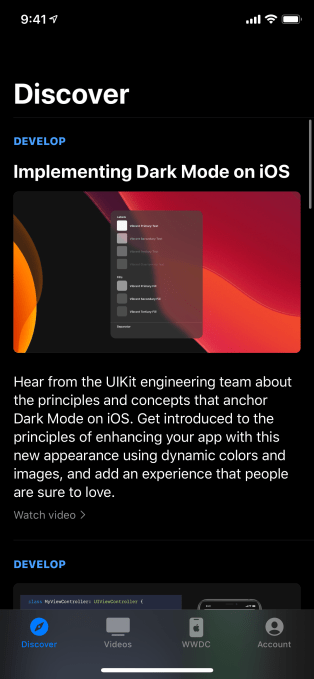
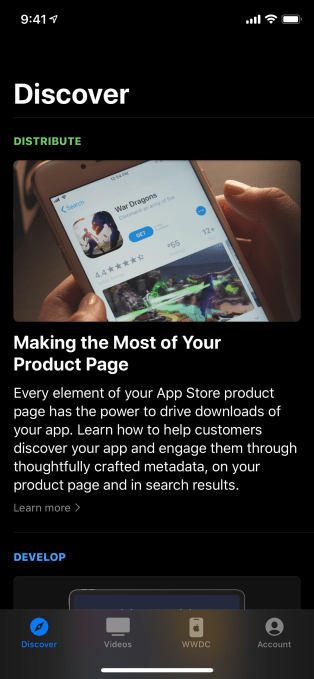
Apple today is introducing a new resource for the over 23 million registered members of its developer community, with the launch of a dedicated Apple Developer mobile app. The new app is an expansion on the existing WWDC app for Apple’s Worldwide Developer Conference, which it will now replace. Instead of only including information about the developer event itself, the app will expand to include other relevant resources — like technical and design articles, developer news and updates, videos, and more. It will also offer a way for developers to enroll in the Apple Developer program and maintain their membership.

Today, developer information is spread out across Apple’s website, and elsewhere. It even arrives in developers’ inbox in the form of email updates from various product teams. Now it will be available in a single, streamlined mobile app experience.

At launch, the Apple Developer app may not have everything you could otherwise find on Apple’s Developer website, but its offerings will grow over time. For example, today you’ll find technical information and over 600 videos, but you won’t find things like the Apple Developer Forums or a way to connect a local Apple Developer program — like Apple’s App Accelerators, Design Labs or Developer Academies.

Instead, the app’s content is organized across four main sections: Discover, for finding developer information, news and updates; Videos, where you’ll find the videos the WWDC app once hosted; WWDC, for event attendees; and Account, where developers can manage their account and program membership.

Apple’s goal is to use the app to get relevant content in front of developers in a timely fashion and to point them to things they may not even realize exist on the Apple Developer website, or even at Apple, overall. And in some cases, the app will include more mobile-friendly content — like articles that attempt to educate in a more digestible, short-form manner.

In other words, it may be the same content as found online in technical papers, but packaged in a slightly different way. Later, the app will also expand to address some of the things that Apple hasn’t yet documented — a topic of increasing concern among developers as of late. (One developer even built a website called “No Overview Available” that helps you find out if an Apple API is missing documentation.)

Elsewhere in the app, developers will continue to be able to watch WWDC session videos and review the WWDC schedule, when available. They’ll also be able to sign up for or renew an Apple Developer program membership, then pay for it using Apple Pay or other payment methods.

The app’s launch comes at a time when Apple has been focused on growing its international community of developers through investments in local developer academies and accelerators — efforts that have been paying off.

For example, over the past year, the developer community in Indonesia grew its membership by 60% after the opening of two Developer Academy facilities in 2019. In Brazil, the original location for an Apple Developer Academy, the community grew by 50% this year. In India, the location of Apple’s first accelerator lab, the community grew by 45%. Other areas that grew their developer base this year included the U.K. (up 40%), France (30%), Italy (28%), and China (17%).

[gallery ids="1913485,1913484,1913483,1913482,1913478,1913477,1913476,1913481,1913480,1913479,1913475,1913474,1913473,1913472"]

In serving these regions, Apple found that some developers are more inclined to open an app than they are an email — which is another reason it wanted to offer a mobile-optimized, mobile-friendly developer resource. Plus, the company discovered it had developer resources that some people didn’t even know about, like its App Store mini site. By centralizing all this content into an app, it’s more accessible.

The Apple Developer app is being soft-launched today in all worldwide markets, but Apple Developer program membership management tools are U.S.-only for now. Apple considers this a version 1, and aims to get developer feedback as it expands.

The Apple Developer app is available on iOS, including Apple Watch and iMessage.