Year: 2019

19 Nov 2019

Eden office management platform raises $25 million Series B

Eden, the workplace management platform that connects office managers with service providers, today announced the close of a $25 million Series B round led by Reshape. Participants in the round also include Fifth Wall Ventures, Mitsui Fudosan, RXR Realty, Thor Equities, Bessemer Venture Partners, Alate Partners, Quiet Capital, S28 Capital, Canvas Ventures, Comcast Ventures, Upshift Partners, Impala Ventures, ENIAC Ventures, and Crystal Towers, among others.

Eden was founded by Joe DuBey back in 2015 and launched out of Y Combinator as an on-demand tech repair and support service, sending IT specialists to consumers’ homes to help set up a printer or repair a cracked phone screen. Within the first year, Eden had pivoted its business entirely to the enterprise, helping B2B clients with their IT issues at much cheaper cost than employing an IT specialist full time.

By 2017, Eden had expanded well beyond IT support into other office management categories, like inventory management around supplies, cleaning, handiwork and more. Indeed, revenue shifted dramatically from Eden’s W2 wizards toward third-party vendors and service providers, with around 75 percent coming from third parties.

Today, 100 percent of Eden’s revenue comes from connecting offices with third-party providers. The company is live in 25 markets, including a few international cities like Berlin and London. Eden now has more than 2,000 service providers on the platform.

The next phase of the company, according to DuBey, is to focus on the full spectrum of property management, zooming out to landlords and property managers.

“The broader vision we have is that everyone in the workplace will use Eden to have a better day at work, from the landlord of the building to the software engineer to the office manager, who is our primary client,” said DuBey. “One thing we’ve learned is that there is a meaningful part of the world you can serve by working directly with the business or the office or facilities manager. But it might be the majority of our category where you really need to build a relationship with the landlord and the property manager to really be successful.”

To that end, Eden is currently in beta with software aimed at landlords and property managers that could facilitate registered guests and check-ins, as well as building-related maintenance and service issues.

Eden has raised just over $40 million in funding since inception.

19 Nov 2019

LA-based Maslo pivots to professional services, launching an AI product for executive coaching

When the Los Angeles-based startup Maslo launched its first product in early 2018, the company was focused on a direct-to-consumer tool designed to encourage mindfulness and self-awareness through a machine learning enabled avatar that would respond to individual’s inputs.

Now the company has reframed its offering, raised a fresh round of financing and is coming to market with a refined vision for a training tool for executive coaching.

Like the original Maslo, the new product is a service for journaling and personal growth, but this time it includes dashboards and visualization tools for the life coaches and training professionals that are molding the minds and leadership habits of tomorrow’s executives.

“Most of the products and experiences today are one dimensional,” said Maslo co-founder Ross Ingram. “They’re pulling information from you, but they’re not really reacting or responding.”

Using natural language processing and other machine learning tools, Maslo’s service will process entries by customers from their voice-activated, recorded journals and visualize data on a dashboard so that clients can see their how language patterns, thematic trends, and emotions recur among their customers.

Image courtesy of Maslo

As part of its go-to-market strategy Maslo is partnering with the International Coaching Federation and any coaches who are currently enrolled in an ICF Accredited Coaching Program can access Maslo’s services at no cost.

The new product launch follows a $1 million capital commitment from Saki Georgiadis, who was an early investor in Calm, and Dr. Ray Muzyka, the founder and former chief executive of Bioware.

“I’m quite excited about the opportunity here to transform technology into products and services that help us become holistically, better humans,” said Muzyka, in a statement. “[Maslo’s] recent focus has validated my original interest, which led me to invest.”

Maslo is also currently collaborating with professors from the University of British Columbia and researchers from the Canadian national research organization focused on social innovation, Mitacs, on a stud to assess the efficacy of “empathetic computing”.

Maslo has also been awarded a grant in partnership with The University of British Columbia and Mitacs, a nonprofit national research organization in Canada focused on industrial and social innovation. The grant focuses on “Assessing the Efficacy of Empathetic Computing,” and will be coordinated with a team within Dr. Alan Kingstone’s Brain, Attention, and Reality (BAR) Lab. The research will look to provide insights on the effects of personification in computing products on people and their relationships.

“We are extraordinarily excited to be partnering with Maslo, and we see this as the start of an exciting exploration into a human centric engagement with technology,” said Dr. Alan Kingstone, the head of the Brain, Attention, and Reality (BAR) Lab at UBC.

19 Nov 2019

Xiaomi integrates earthquake alert system into MIUI OS, unveils Xiao AI 3.0 digital assistant

Xiaomi today unveiled a new iteration of its virtual assistant Xiao Ai and shared a new feature of Android -based MIUI operating system as the publicly listed Chinese technology group pushes to expand its internet services ecosystem. The company also said that it will be launching ten 5G devices next year.

At its annual Mi Developer conference in Beijing, the company said it is integrating an earthquake warning function into MIUI for select users in China, with plans to expand it nationwide soon.

The integration, touted as the first of its kind globally, will enable alerts to be sent to smartphones running MIUI 11 and Mi TV “seconds to tens of seconds” before the quake waves arrive, Xiaomi said.

The feature, which was first trialed in September this year, has been developed in partnership with Institute of Care-life, a Chengdu-based organization focusing on natural disaster warning. Xiaomi said it has activated the feature for the earthquake-prone Sichuan Province and plans to expand it elsewhere in the nation soon.

Wang Tun, head of the institute, said this function, unlike those available through apps in some countries, works more efficiently and does not rely on a working internet connection.

Xiao AI 3.0

The company also unveiled Xiao AI voice assistant 3.0, the latest iteration of its digital assistant. The service, used by 49.9 million users each month, now offers a male voice option and supports a naturally continuous dialogue on smartphones.

Xiaomi founder and chief executive Lei Jun addressing developers at a company’s conference on Tuesday

Xiaomi added that it is launching a new version of MACE, the open-source deep-learning framework that powers Xiao AI. The new MACE-Kit for developers will open its source soon, the company said.

“Xiaomi’s AutoML model now leads the industry by dataset performance; and MiNLP, the company’s natural language processing platform, is activated over 6 billion times on a daily basis, making Xiao AI one of the world’s busiest AI platform,” said Cui Baoqiu, VP and Chairman of Xiaomi’s Technical Committee, in a statement.

On the sidelines of these announcements, Xiaomi added that it is aiming to serve more partners in the manufacturing industry around the globe through its Finance payments service. The company has invested in over 270 ecosystem partners, among which more than 100 are focused on the development of smart hardware and lifestyle products, it said. Overall, more than 400 business partners in the manufacturing chain today are using Xiaomi Finance, it claimed.

At the conference, Lei Jun, founder and chief executive of Xiaomi said the company also plans to market over ten 5G-enabled devices next year as part of its effort “in making 5G + AIoT part of daily life of everyone.”

19 Nov 2019

Four must-haves for the Tesla ‘Cybertruck’ all-electric pickup truck

Tesla is set to unveil its pickup this week and it needs to be widely different from its current lineup. The current line of Tesla vehicles share a lot of parts, and, logically, the Tesla pickup will do the same. However, a truck has different demands than a passenger car or sport utility vehicle. It has to be more robust and able to stand up to more abuse. It has to tow and haul and scale more than a mall flowerbed.

The Tesla pickup is launching as Rivian’s electric pickup is nearing launch. The Rivian R1T looks and feels like an electric pickup. It’s also built off of a purpose-built platform designed to haul and tow. Tesla does not have a similar platform as the Model X SUV is more car than a truck.

Eventually, more automakers will offer electric trucks. Ford has confirmed it’s building an electric F-150 and recently showed it off pulling a train. The upsides are profound. An electric truck will, in theory, offer improved toque (better towing), high payload capacity (due to better weight distribution), and improved performance numbers (electric motors are quick). A truck platform is also, by nature, larger and stronger allowing automakers to stuff more batteries into the frame.

Here’s what we want to see in a pickup from Tesla:

Twice the towing capacity of the Model X

The Tesla Model X is incredible and by most measures, the fastest production SUV available. But it cannot tow much. That’s not because of the powertrain but rather the vehicle platform. A Tesla pickup needs to be able to tow and haul.

According to the Model X owners manual, the vehicle can tow 5,000 pounds. That’s good enough for a couple of jet skis or a tiny trailer, but not much else. For comparison, most Ford F-150 models can tow over 10,000 pounds with some models topping off at 13,000 lbs. Rivian projects its electric pickup can tow over 11,000 pounds. The difference comes from the frame design and vehicle length.

The design of the vehicle often limits towing. The rear suspension needs to be able to support the weight, and the vehicle needs to be long enough to reduce trailer sway. Short vehicles have a hard time towing trailers, and the Model X, built on a version of the Model S, is a compact vehicle. There’s nothing worse than looking out the driver-side window and seeing your trailer racing you down the hill.

In the name of safety alone, a Tesla pickup must have improved towing capacity over the Model X. It should have an integrated trailer brake controller, too — something missing from the Model X.

The Model X platform is not built for hauling either. According to the owner’s manual, when two passengers are in the vehicle, it can only hold an additional 654 lbs. That’s just eight bags of Quickrete cement. To make matters worse, the rear deck of the Model X can only support 285 lbs somewhat saying the rear axle cannot hold that much weight, and the additional weight needs to be spread between the two axles.

A pickup needs to be able to take a load of wood mulch or a couple of major appliances, and Tesla’s current platforms are not designed for such.

Most light-duty pickups, from the Honda Ridgeline to the F-150, can support from 1,500 lbs to 2,000 lbs in the bed. And it’s easy to exceed that rating, too. An open truck bed is an invitation to load it up, but unless you’re using a heavy-duty pickup, don’t get a pallet of landscaping bricks.

Robust Serviceable Parts

Even if a pickup is only used for monthly Home Depot runs, it sustains more abuse than passenger vehicles due to its size. Brakes wear out quicker, and tires need more attention. If it has a light-duty suspension, bushings and joints wear out faster than in cars or SUVs.

Tesla makes it difficult for owners to repair the vehicles they purchased. I don’t expect that to be any different with the Tesla pickup. Tesla is not going to want owners wrenching on the truck. Since that’s the case, the pickup must come with improved parts.

The serviceable parts (brakes, suspension, and tires) that come on the Tesla pickup needs to be more robust and reliable than that used on the Tesla passenger vehicles.

Electric vehicles feature much fewer parts that can go wrong than internal combustion vehicles. It’s great. Owners do not have to change a timing belt or engine oil. But there are still items that will wear out, and most pickup buyers need assurances that they can go the distance.

Off-roading capabilities (or the ability to add off-roading capabilities)

The electric Rivian R1T is currently racing across South America to demonstrate its off-roading chops. Here’s the company’s blog post about it. This excites the truck guy in me. Now that’s a truck, I yell!

I don’t have the data, but I suspect most light-duty pickups are hardly used to their potential. I have a well-equipped F-150 that is used to tow a trailer twice a year.

Trucks are often aspirational purchases where buyers shop for potential lifestyles. Sure, you must have a truck, because one day, you’re going to buy that travel trailer and drive through Yellowstone. To fulfill this dream, a pickup should be able to run the desert or climb rocks.

The Rivian R1T gets a lot of things right, and I hope Tesla is following Rivian’s lead. It’s longer than a Ford Ranger and exceeds the Toyota Tacoma’s bed capacity rating. The wheel wells are large, seemingly saying it can support larger tires than the original from the factory. The R1T has an imposing stance. It looks the part, and the Tesla pickup needs to look the part, too.

Even if the Tesla looks like a weak truck, it’s essential to be able to modify the truck. Add-ons are a big part of the truck culture. My F-150 has become a money pit as I’ve thrown cash into buying accessories. Rivian knows this and has shown off its pickup with a handful of adds-on from tents to kitchens.

Power output

A Tesla pickup could have a unique selling point by allowing owners to use it as a high-output generator.

Right now, a lot of trucks have plenty of power ports, both 12v and 110v. They’re found throughout the cab and bed but cannot power serious tools. The 12v system used in internal combustion vehicles will not power much more than a drill or small saw, let alone a house by acting as a whole house generator.

The functionality would be well received. Homeowners would appreciate the ability to power parts of their homes during blackouts. Campers could use it when taking the pickup on an adventure. Construction works could use it to power and recharge tools.

Right now, there isn’t a way to output the full power of a Tesla vehicle. Owners can use an inverter, but that’s also limited and requires extra parts. Tesla would need to build safeguards and regional power ports into the battery platform to ensure safety and compatibility.

A word about the price.

There’s no way around this. A Tesla pickup will be more expensive than its internal combustion counterparts. It will be an upscale pickup, aimed at those that wear Arc’teryx instead of Carhart.

Rivian is pricing its pickup with a starting price of $69,000 and a Tesla pickup will likely start in the same range. If it’s a new platform built for hauling or towing, Tesla will have a lot of engineering and manufacturing hours to recuperate, which will drive the price north. Until more are available, Tesla and Rivian will be able to set the market price.

It’s a lot for a truck. That’s the price of a fully-spec’d out Ford F-150 that’s more comfortable or capable than it has any right to be. It’s also the same price as a beefy F-350 with Ford’s most potent engine and a towing capacity of 37,000 lbs.

Check back later this week as TechCrunch will be on hand later when Tesla unveils its pickup.

19 Nov 2019

The Cerebras CS-1 computes deep learning AI problems by being bigger, bigger, and bigger than any other chip

Deep learning is all the rage these days in enterprise circles, and it isn’t hard to understand why. Whether it is optimizing ad spend, finding new drugs to cure cancer, or just offering better, more intelligent products to customers, machine learning — and particularly deep learning models — have the potential to massively improve a range of products and applications.

The key word though is ‘potential.’ While we have heard oodles of words sprayed across enterprise conferences the last few years about deep learning, there remain huge roadblocks to making these techniques widely available. Deep learning models are highly networked, with dense graphs of nodes that don’t “fit” well with the traditional ways computers process information. Plus, holding all of the information required for a deep learning model can take petabytes of storage and racks upon racks of processors in order to be usable.

There are lots of approaches underway right now to solve this next-generation compute problem, and Cerebras has to be among the most interesting.

As we talked about in August with the announcement of the company’s “Wafer Scale Engine” — the world’s largest silicon chip according to the company — Cerebras’ theory is that the way forward for deep learning is to essentially just get the entire machine learning model to fit on one massive chip. And so the company aimed to go big — really big.

Today, the company announced the launch of its end-user compute product, the Cerebras CS-1, and also announced its first customer of Argonne National Laboratory.

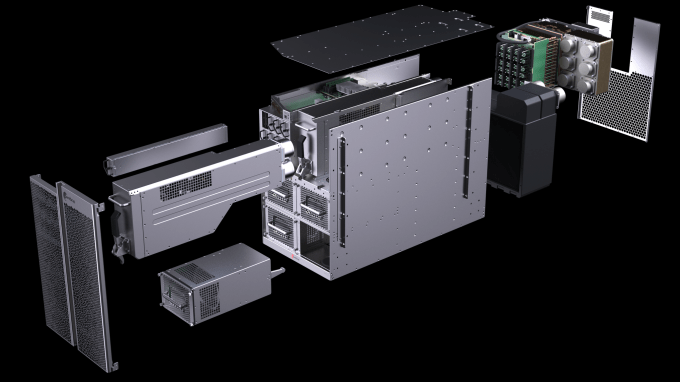
The CS-1 is a “complete solution” product designed to be added to a data center to handle AI workflows. It includes the Wafer Scale Engine (or WSE, i.e. the actual processing core) plus all the cooling, networking, storage, and other equipment required to operate and integrate the processor into the data center. It’s 26.25 inches tall (15 rack units), and includes 400,000 processing cores, 18 gigabytes of on-chip memory, 9 petabytes per second of on-die memory bandwidth, 12 gigabit ethernet connections to move data in and out of the CS-1 system, and sucks just 20 kilowatts of power.

A cross-section look at the CS-1. Photo via Cerebras

Cerebras claims that the CS-1 delivers the performance of more than 1,000 leading GPUs combined — a claim that TechCrunch hasn’t verified, although we are intently waiting for industry-standard benchmarks in the coming months when testers get their hands on these units.

In addition to the hardware itself, Cerebras also announced the release of a comprehensive software platform that allows developers to use popular ML libraries like TensorFlow and PyTorch to integrate their AI workflows with the CS-1 system.

In designing the system, CEO and co-founder Andrew Feldman said that “We’ve talked to more than 100 customers over the past year and a bit,“ in order to determine the needs for a new AI system and the software layer that should go on top of it. “What we’ve learned over the years is that you want to meet the software community where they are rather than asking them to move to you.”

I asked Feldman why the company was rebuilding so much of the hardware to power their system, rather than using already existing components. “If you were to build a Ferrari engine and put it in a Toyota, you cannot make a race car,” Feldman analogized. “Putting fast chips in Dell or [other] servers does not make fast compute. What it does is it moves the bottleneck.” Feldman explained that the CS-1 was meant to take the underlying WSE chip and give it the infrastructure required to allow it to perform to its full capability.

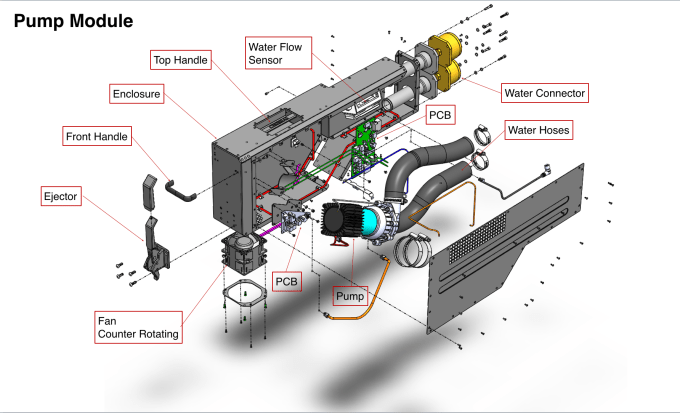
A diagram of the Cerebras CS-1 cooling system. Photo via Cerebras.

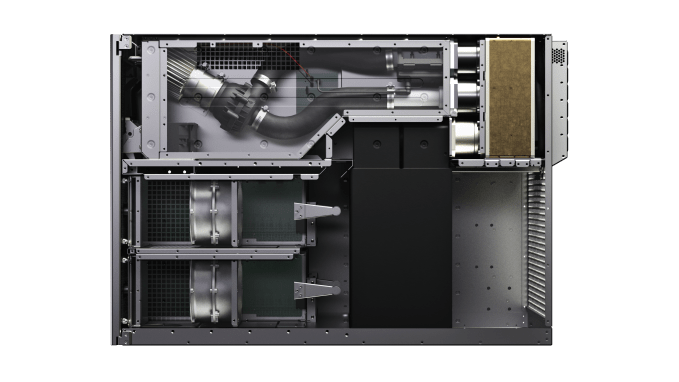
That infrastructure includes a high-performance water cooling system to keep this massive chip and platform operating at the right temperatures. I asked Feldman why Cerebras chose water, given that water cooling has traditionally been complicated in the data center. He said, “We looked at other technologies — freon. We looked at immersive solutions, we looked at phase-change solutions. And what we found was that water is extraordinary at moving heat.”

A side view of the CS-1 with its water and air cooling systems visible. Photo via Cerebras.

Why then make such a massive chip, which as we discussed back in August, has huge engineering requirements to operate compared to smaller chips that have better yield from wafers. Feldman said that “ it massively reduces communication time by using locality.”

In computer science, locality is placing data and compute in the right places within, let’s say a cloud, that minimizes delays and processing friction. By having a chip that can theoretically host an entire ML model on it, there’s no need for data to flow through multiple storage clusters or ethernet cables — everything that the chip needs to work with is available almost immediately.

According to a statement from Cerebras and Argonne National Laboratory, Cerebras is helping to power research in “cancer, traumatic brain injury and many other areas important to society today” at the lab. Feldman said that “It was very satisfying that right away customers were using this for things that are important and not for 17-year-old girls to find each other on Instagram or some shit like that.”

(Of course, one hopes that cancer research pays as well as influencer marketing when it comes to the value of deep learning models).

Cerebras itself has grown rapidly, reaching 181 engineers today according to the company. Feldman says that the company is hands down on customer sales and additional product development.

It has certainly been a busy time for startups in the next-generation artificial intelligence workflow space. Graphcore just announced this weekend that it was being installed in Microsoft’s Azure cloud, while I covered the funding of NUVIA, a startup led by the former lead chip designers from Apple who hope to apply their mobile backgrounds to solve the extreme power requirements these AI chips force on data centers.

Expect ever more announcements and activity in this space as deep learning continues to find new adherents in the enterprise.

19 Nov 2019

Salesforce wants to bring voice to the workplace

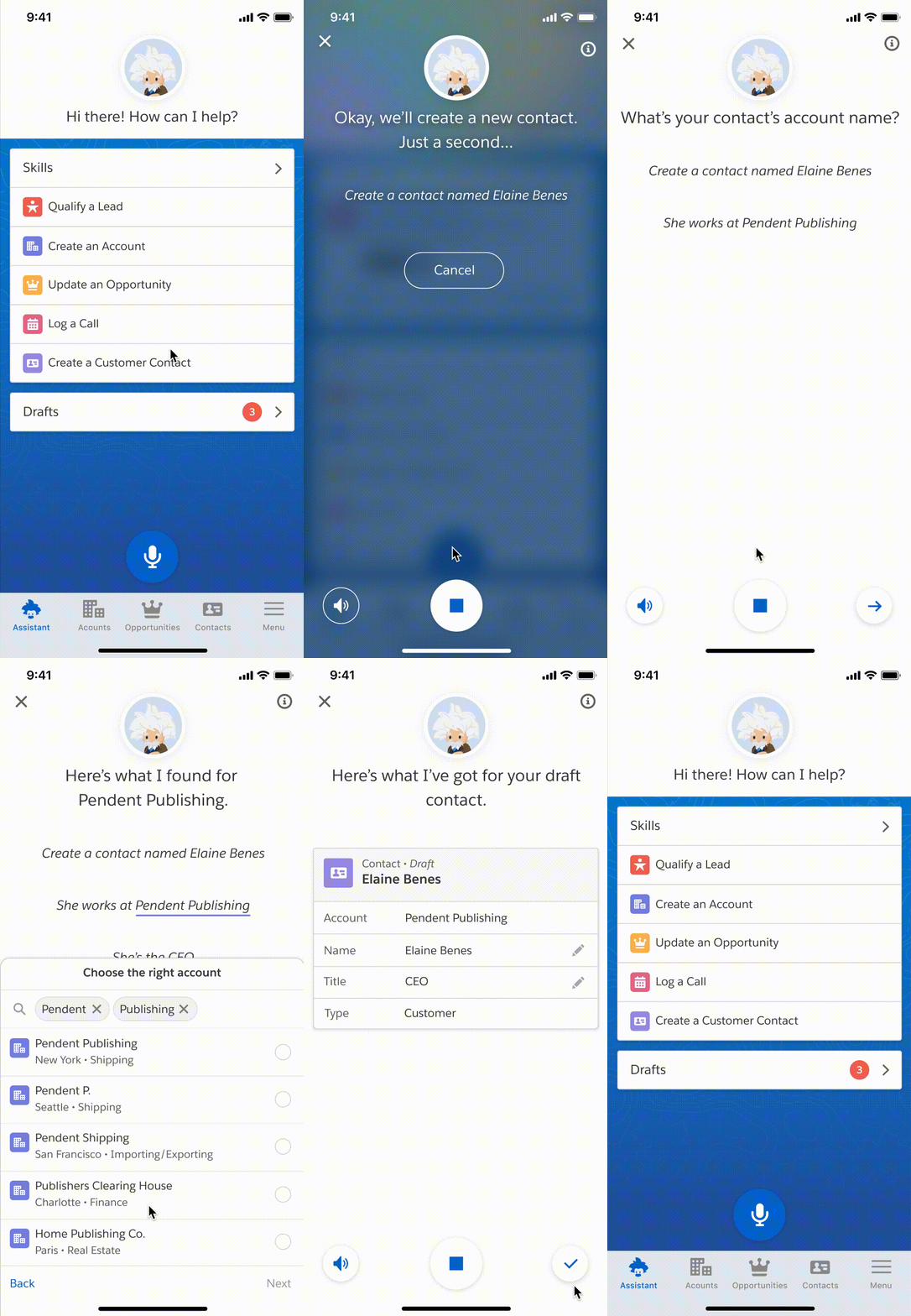
At its annual Dreamforce mega-conference in San Francisco, Salesforce today introduced the next steps in its Einstein Voice project, which it first announced last year. Einstein Voice is the company’s AI voice assistant. You can think of it as Salesforce’s Alexa or Google Assistant, but with a more focused mission.

During a briefing ahead of the event, Salesforce Chief Product Officer Bret Taylor showed off an Einstein and Alexa enabled Einstein speaker (Salesforce chairman and co-CEO Marc Benioff was supposed to be at the meeting, too, but for unknown reasons, he didn’t show) — and yes, it looked like Salesforce’s Einstein cartoon figure and its voluminous white hair lit up when it responded to queries. The company isn’t planning on making these devices available to the public, but it does show off the work the company has done with Amazon to integrate the service (though is by no means an Amazon -exclusive since the company is also working to bring Einstein to Google devices).

The theory here, as Taylor explained, is that having access to Salesforce data through voice will enable salespeople to quickly enter data into Salesforce when they are on the go and to ask the system questions about their data. The company argues that while voice assistants have found a place in the home, there are a lot of upsides to bringing it to businesses as well. That means a system has to account for the security needs of enterprises, too, as well as the fact that there is a wide range of different user personas it has to account for.

“We’re really excited about the idea of voice in businesses — the idea that every business can have an AI guide to their business decisions,” Taylor said. “I view it as part of this progression of technology. Computers and software started in the terminal with a keyboard, thanks to Xerox Parc moved to a mouse and graphic user interface, and then thanks to Steve Jobs, moved to a touchscreen, which I think is probably the dominant form factor for computers nowadays. And voice is really that next step.”

This next step, Taylor argues, will allow companies to rethink how people interact with software and data. With voice, Einstein, which is Salesforce’s catch-all name for its AI products, has a “seat at the table,” he noted because you can simply as the system a question if you need additional data during a conversation. But the real mission here is to bring these tools to every business — not just to Salesforce’s executive meetings.

To enable this, Salesforce is launching a tool that will allow anybody within a company to quickly build basic Einstein skills to pull up data from Salesforce. These skills focus on data input and relatively basic queries, for now. During a demo ahead of the event, the team showed off how easy it would be to enable a manager to ask about the current sales performance of his team, for example. By now means, though, is this tool as rich as products like Google’s DialogFlow or Microsoft’s Azure Bot Service. It’s nowhere near as flexible yet, but the team notes that it’s still early days and that it is working on enabling the ability to have more complex dialogs with Einstein in the future, for example.

To be honest, it’s hard not to look at this as a bit of a gimmick. There are probably real use cases here, that every company will have to define for itself. Maybe there are salespeople who indeed want to use a voice interface to update their CRM system after a customer meeting, for example. Or they may want to ask about the value of an account while they are in the car. In many ways, though, this feels like a technology looking for a problem, despite Salesforce’s protestations that customers are asking for this.

Some of the other uses cases here, which the company didn’t really highlight all that much in its briefing, seem far more compelling. It’s using Einstein Voice to coach call center agents by analyzing calls to pull out insights and trends from sales call transcripts. It’s also launching Service Cloud Voice, which integrates telephony inside the company’s Service Cloud. Using a built-in transcription service, Einstein can listen to the call in real time and proactively provide sales teams and call center agents with relevant information. Those use cases may not be quite as exciting, but in the end, they may generate for more value for companies than having yet another voice assistant for which they have to build their own skills, using what is, at least for the time being, a rather limited tool.

19 Nov 2019

Angell is a smart bike with an integrated display

Meet Angell, a new smart bike from a French startup led by Marc Simoncini who is mostly known for founding Meetic. The company is announcing its first electric-bike today. And the goal is to make an e-bike that is smarter than everything out there.

“We dedicate half of public space to cars even though cars only represent 12% of trips,” Angell founder and CEO Marc Simoncini told me. And according to the company’s data, only 2% of people use bikes to move around a city in France, compared to 31% in the Netherlands and 13% in Germany.

So there’s a market opportunity for a newcomer in the e-bike space in France, and eventually in other major cities around the world. “Our goal is to become the global leader in the smart bike space,” Simoncini said.

When it comes to hardware, the Angell e-bike is a 14kg bike with an aluminum frame, integrated lights and a removable battery. It has a 2.4-inch touch screen to control the bike. The battery should last 70km on a single charge. There are also turn signals that you can activate with a button.

The Angell e-bike comes with everything you’d expect from a connected bike and that you can already find on Cowboy and Vanmoof e-bikes. It connects with your phone using Bluetooth and has an integrated lock and alarm system. If somebody tries to steal your bike, the bike will play a loud sound. If somebody manages to steal your bike, you can track it using an integrated GPS chip and cellular modem.

But Angell wants to go one step further with its integrated display. First, you can select different levels of assistance directly on the bike itself. You can display information on the screen when you’re riding your bike, such as speed, calories, battery level and distance on the screen. You can also set an emergency contact so that they automatically receive a notification if your bike detects a fall.

More interestingly, you can set a destination on your phone and get turn-by-turn directions on your bike. In addition to arrows that tell you when you’re supposed to turn, your handlebar vibrates as well.

“70% of the Angell project is software,” Simoncini said.

The Angell e-bike will be available at some point during the summer of 2020. It’ll cost €2,690 ($2,966) with pre-orders starting a few months earlier. Customers can also choose to pay €74.90 per month for 36 months. Angell will also partner with an insurance company to offer a theft and damage insurance product for €9.90 per month.

The Angell e-bike is just the first step of the company. Eventually, Angell wants to dedicate 5% of its revenue to a smart city fund and incubator, the Angell Lab. The company wants to create an ecosystem of startups that want to reinvent city mobility. Angell is fully funded by Marc Simoncini for now.

19 Nov 2019

BlueVine raises $102.5M more for banking services that target small businesses

When it comes to fintech plays, small and medium businesses are not often the target audience: they’re too small and fragmented compared to big-spending corporates; and they’re too demanding compared to mass-market consumer users. But as a sector, they account for over 99% of all businesses in developed countries like the UK and USA, and that means they cannot be ignored. Today, BlueVine, one of the financial services startups that has built a business specifically catering to SMBs is announcing a big round of funding, underscoring the quiet opportunity and demand that is out there.

“We see a massive gap in the market, with most SMBs still using consumer plus accounts,” said Eyal Lifshitz, Bluevine’s CEO and co-founder. “That is the mission we are on.”

The startup, which offers financing and other banking services to SMBs, today is announcing that it has raised $102.5 million, a Series F round of equity funding that is coming from a mix of financial and notable strategic investors.

Led by ION Crossover Partners, the round also includes existing investors Lightspeed Venture Partners, Menlo Ventures, 83North, SVB Capital, Nationwide (a major financial services player in the UK), Citi Ventures, Microsoft’s venture fund M12, and private investors; as well as new investors MUFG Innovation Partners Co., Ltd, O.G. Tech (the VC connected to Israeli billionaire and property magnate Eyal Ofer), Vintage Investment Partners, ION Group, Maor Investments and additional private investors.

With this latest round, Silicon Valley-based BlueVine has raised between $240 million and $250 million in equity, with another half a billion dollars in debt financing to fuel its loans platform, Lifshitz said in an interview. The company has never disclosed valuation, and it’s not doing so today, but he added that BlueVine is “doing quite well”, with the valuation “up” compared to its Series E.

“We are not profitable yet, but we’ve grown 100% since last year and will do triple digit revenue this year,” Lifshitz said, noting that the company has now originated some $2.5 billions in loans to date to 20,000 small businesses.

While SMBs are not often the first target for fintech startups, that does not mean they are completely ignored. Others that have built big businesses around these users include Kabbage — the SoftBank-backed startup out of Atlanta that also started out with loans before diversifying also into a wider range of banking services. (Kabbage is currently valued at over $1 billion, as a point of comparison.) Another newer player in the space of SMB-focused banking is Mercury, which also recently raised money; its primary target is a narrower subset of the SMB world, startups.

BlueVine’s service is mainly based around its financing products, where it provides both lines of credit and term loans (both up to $250,000) and “factoring,” where customers can arrange for BlueVine to pay up front for invoices that they select to be paid, a service that translates into credit lines of up to $5 million and means that users don’t need to wait for money to come in before paying for bills.

As with Kabbage, BlueVine’s move into a wider array of banking services — sold as BlueVine Business Banking, which includes checking accounts and other services alongside financing — is a newer, still-growing and expanding business. The checking account, for example, only was announced in October this year.

For business customers, the idea is to give them a one-stop shop for all of their financial services, while for BlueVine, the idea is to create a more complete set of offerings to keep users on its platform and to make better margins on them across more services. Interestingly, this sets BlueVine up to compete not as much with startups — the majority of which still offer single-point services or a small collection of them, but with banks that still provide full suites of services, even if they are often more pricey and less efficient than startups.

My real competitors are the 4,600 banks in the US,” Lifshitz said. “It’s a very long tail in the US. But if you dive into that further, historically SMBs haven’t been serviced well by them.”

The fact that the company is attracting a range of financial services investors inevitably raises the question of how BlueVine might partner with them down the line or even become an acquisition target, but one thing that Lifshitz said that it will not be doing is white-label services (something that Kabbage has explored): “We don’t want to give our tech away,” he said. “We are focused on leveraging our tech to be the best in class.”

“BlueVine has demonstrated a track record of success with their multiple financing products and set themselves apart with their vision of a complete platform of innovative banking products for small businesses,” said Jonathan Kolodny, Partner at ION Crossover Partners, in a statement. “We’ve been following the company closely since its early days, and have witnessed the demand, and frankly the economic need, for BlueVine’s banking services. We believe the company is exceptionally well-positioned, thanks to its world-class management team, to change the way small businesses manage their financial needs today and in the future.”

19 Nov 2019

Heliogen’s new tech could unlock renewable energy for industrial manufacturing

Last Monday a group of millionaires and billionaires took a trip to an industrial site in Lancaster, Calif. to witness the achievement of what could represent a giant leap forward in the effort to decarbonize some of the world’s most carbon intensive industries.

For Bill Gross, the founder of Idealab and brains behind the excursion, the unveiling was simply the latest in a string of demonstrations for new technologies commercialized by his nearly three-decade old startup company incubator. However, it may be the most significant.

What Gross is pursuing with his new company, Heliogen, offers a way forward for renewable energy to be applied to manufacturing processes for cement, lime, coke, and steel — some of the most energy intensive and polluting industries that exist in the world today.

“Today, industrial processes like those used to make cement, steel, and other materials are responsible for more than a fifth of all emissions,” said Bill Gates, a Heliogen backer who has committed millions of dollars to the development of new renewable energy technologies. “These materials are everywhere in our lives but we don’t have any proven breakthroughs that will give us affordable, zero-carbon versions of them. If we’re going to get to zero carbon emissions overall, we have a lot of inventing to do. I’m pleased to have been an early backer of Bill Gross’s novel solar concentration technology. Its capacity to achieve the high temperatures required for these processes is a promising development in the quest to one day replace fossil fuel.”

According to Gross, Kittu Kollaru, an investor in Heliogen who is also backing another of Idealab’s incubated companies working on developing an energy storage technology, Energy Vault, said after seeing the demonstration, “Bill… this is even bigger.”

At its core, Heliogen is taking a well-known technology called concentrated solar power, and improving its ability to generate heat with new computer vision, sensing and control technologies, says Gross. \

Four high resolution cameras capture real time video of a field of mirrors that are controlled by sensors to focus the sun’s energy on a particular spot. That spot, either at a transmission pipe used to transport gas, or a tower, is heated to over 1,000 degrees Celsius. Previous commercial concentrating solar thermal systems could only reach temperatures of 565 degrees Celsius, the company said. That’s useful for generating power, but can’t meet the needs of industrial processes. 

Achieving temperatures above 1,000 degrees Celsius gives manufacturing facilities the opportunity to replace the use of fossil fuels in a significant portion of their operations.

A facility hoping to install Heliogen’s technology (Image courtesy of Heliogen)

“They already have a power source/burner that is variable, based on the flow rate of materials, and is servo controlled to have the correct air flow exit temperature,” says Gross of many existing industrial operations. “So when we add heat (when the sun is out) the fossil fuel burner just automatically gets scaled back like a thermostat on a room heater (albeit at much higher temperature).  So it’s a seamless control integration.”

A plant could still operate on a 24-hour production schedule, and could still use fossil fuels, says Gross. But by deploying the Heliogen system, companies could reduce their fossil fuel consumption by up to 60%, according to the serial entrepreneur and investor. Gross believes that Heliogen’s systems will pay for themselves in a two-to-three year timeframe if companies buy the system outright, or Heliogen could manage the installation for a manufacturer and just charge them for the cost of the power.

Gross has been testing smaller versions of Heliogen’s industrial heating technology at a field with an array of 70 mirrors to prove that the super-concentrating technology could work. A full scale facility covers roughly two acres of land with mirrors and a tower where the rays are concentrated. “It’s like a death ray,” Gross said of the concentrated solar beams.

While initial applications for Heliogen’s technology will concentrate on industrial applications, longer term, Gross sees an opportunity to drive down the cost of Hydrogen production at an industrial scale. Long believed to be one of the keys to global decarbonization, Hydrogen’s use as a fuel source has been limited because it’s difficult to make without using fossil fuels.

Hydrogen’s importance to a carbon-free energy future can’t be overstated, according to energy advocates and longtime renewable energy entrepreneurs and investors like Jigar Shah. The founder and former chief executive of solar installation company, SunRun, Shah now invests in renewabel energy projects.

“As we move closer to 100% clean electricity grids, it will be necessary to not just store excess electricity production from the spring and fall, but to turn all of this excess electricity to valuable commodities that can help decarbonize other sectors outside of electricity — transportation, industrial heat, and chemicals,” Shah wrote in an article on LinkedIn. “That’s where hydrogen comes into play.”

Investors in Heliogen include venture capital firm Neotribe and Dr. Patrick Soon-Shiong, the billionaire Los Angeles-based investor and entrepreneur, who owns the Los Angeles Times and an investment conglomerate. THe investmente was made through Dr. Soon-Shiong’s investment firm, Nant Capital.

“For the sake of our future generations we must address the existential danger of climate change with an extreme sense of urgency,” said Dr. Soon-Shiong, in a statement. “I am committed to using my resources to invest in innovative technologies that harness the power of nature and the sun. By significantly reducing greenhouse gas emissions and generating a pure source of energy, Heliogen’s brilliant technology will help us achieve this mission and also meaningfully improve the world we leave our children.”

19 Nov 2019

Cybersecurity startup CyCognito raises $23M in Series A funding

CyCognito, a cybersecurity platform that aims to give visibility into a company’s security weak spots, has raised $23 million in its Series A round of funding.

Lightspeed Partners led the fundraise, putting in $18 million, which included a personal investment from Lightspeed venture partner and former Microsoft chairperson John Thompson, and additional participation from Sorenson Ventures. Another $5 million was brought in from existing investors, including UpWest and Dan Scheinman, who participated during the company’s seed round.

CyCognito says its software-as-a-service platform can “autonomously discover, enumerate, and prioritize each organization’s security risks based upon a global analysis of all external attack surfaces.” In other words, it measures a company’s entire attack surface, looking for holes and flaws, which could be exploited by malicious actors. It does this by maintaining tens of thousands of bots which spiders out across the internet, looking for internet-connected and exposed devices. With that database of digital assets, the company looks for issues that could be used for attacks.

The startup says its platform already in use by “dozens” of corporate customers, across healthcare, hospitality and financial verticals.

With $23 million in the bank, CyCognito says it plans to expand its engineering and sales teams to reach more enterprise clients.

Two years since the company’s founding, its leadership page consisted of only men.

Chief executive Rob Gurzeev said the company was “actively seeking to hire more women and non-binary persons into senior roles” and “actively encourages growth of diversity in its workforce.”

After TechCrunch raised lack of diversity with CyCognito, the company quickly changed its leadership page to include one woman.