Year: 2019

14 Nov 2019

Indian telcos Vodafone Idea and Airtel post $10.3 billion in combined quarterly losses

It’s not a good day for two of the top three telecom operators in India. Vodafone Idea, India’s second largest telecom operator by subscriber count, said its consolidated loss had widened to $7.14 billion in the quarter that ended in September in what is the largest-ever quarterly loss witnessed in the nation on Thursday.

The announcement followed a similar outcry from India’s third-largest telecom operator. Bharti Airtel posted a consolidated net loss of 230.4 billion Indian rupees ($3.23) billion after the telco took charge of a one-time $4.3 billion potential outstanding payments to the government related to a court dispute surrounding 14-year-old adjusted gross revenue.

Vodafone India said its $7.14 billion loss also provides for 256.8 billion Indian rupees ($3.6 billion) in outstanding payments surrounding the aforementioned court case.

In the filing, the Indian unit of British giant Vodafone Group and billionaire Kumar Mangalam’s Idea Cellular said it will file a review petition to India’s apex court to challenge the federal government’s decision.

In recent weeks, executives of UK-headquartered Vodafone, which owns 45% of Vodafone Idea, have said that the group’s telecom business in India could collapse if the government does not offer it any relief. The network’s India unit is already saddled with $14 billion in debt.

Vodafone Idea posted a revenue of Rs 108,440 million Indian rupees ($1.5 billion), down 3.8% since last year. The company’s net loss during the same period last year stood at $687 million. Bharti Airtel’s revenue in the quarter stood at $2.93 billion.

Last month, the Indian Supreme Court ruled that Vodafone Idea and Bharti Airtel and several other operators including some that are no longer operational will have to pay a combined $13 billion in adjusted gross revenue as spectrum usage charges and license fees to the government within 90 days.

The Indian government and telecom operators are disputing over how gross revenue should be calculated. The government has mandated that license and spectrum fee to be paid by operators as a share of their revenue. Telcos have argued that only core income accrued from use of spectrum should be considered for calculation of adjusted gross revenue.

Bharti Airtel has also requested the government for waiver. Through a spokesperson, Gopal Vittal, MD and CEO of Bharti Airtel’s India and South Asia business, said, “We continue to engage with the government and are evaluating various options available to us. We are hopeful that the government will take a considerate view in this matter given the fragile state of the industry.”

Mukesh Ambani, Asia’s richest man who runs telecom network Reliance Jio — which has become the largest operator by subscriber count by starting a price war in the country three and a half years ago — has said that he does not share the view of his rival networks. His telecom network owes the least to the government — $1.8 million.

Carriers Reliance Communications, run by Mukesh’s brother Anil Ambani, and Aircel, run by tycoon T. Ananda Krishnan, also owe the government money. They have been bankrupt for years.

14 Nov 2019

Backed by Serena Williams and Usain Bolt, Let’s Do This raises $15M from EQT

Back in September, endurance events marketplace Let’s Do This (a YC alumni) raised a $5m seed round from a number of US investors, including Olypmic star Usain Bolt and tennis star Serena Williams. As much as I’d like to get excited, this is slightly par for the course for a lot of sports-oriented startups which catch the eye of a celebrity. Not that they are without merit, of course.

Suffice it to say, their sports stars, plus a strong push to get funding from Silicon Valley has landed the startup with a $15m Series A round led by European/US VC EQT, with participation of the previous investors including Trulia founder Pete Flint, YCombinator, alongside, yes, you guessed it, Usain Bolt and Serena Williams .

The platform lists 30,000 races of all distances and disciplines and claims to be the largest marketplace for endurance events in the world, offering key information about the races and exclusive booking perks for members such as free cancellation protection. It recently agreed a partnership with Hearst to power all race listings across Runner’s World, Men’s Health and Women’s Health in the US and the UK.

The startup is set to expand its team of sport enthusiasts across its San Francisco and London offices. The company was founded by University of Cambridge graduates Alex Rose and Sam Browne – both passionate runners and cyclists who had experienced the arduous process of discovering and entering events firsthand.

The Let’s Do This algorithm uses data points from fitness tracking, race history, social connections and more, to personalize race recommendations. Part of the marketing story is that people are 12.5 times more likely to develop a fitness habit after 12 months from signing up to a race than from joining a gym.

Serena Williams, the 22 time Grand Slam Champion, commented: “I’ve seen first-hand the incredible impact these events can have on making people fitter, healthier and happier. I love that Let’s Do This is not only making events like these more accessible but also helping to support athletes of all different fitness levels. Women are especially less likely to participate in marathons and obstacle races, so it’s really important there’s a platform encouraging people to step out of their comfort zones and make a positive difference in their lives.”

Usain Bolt said in a statement: “Throughout my career I’ve been lucky enough to inspire people to follow their dreams, get off the couch and get exercising… It’s a really natural fit with what I care about and what I believe in, so I am very happy to be supporting their mission to inspire more people to have epic experiences.”

Founder Sam Browne says the quick fundraising has come about in part because “The market’s big, affluent and we’re already the dominant marketplace in it.”

14 Nov 2019

Google Search now helps you pronounce ‘quokka’

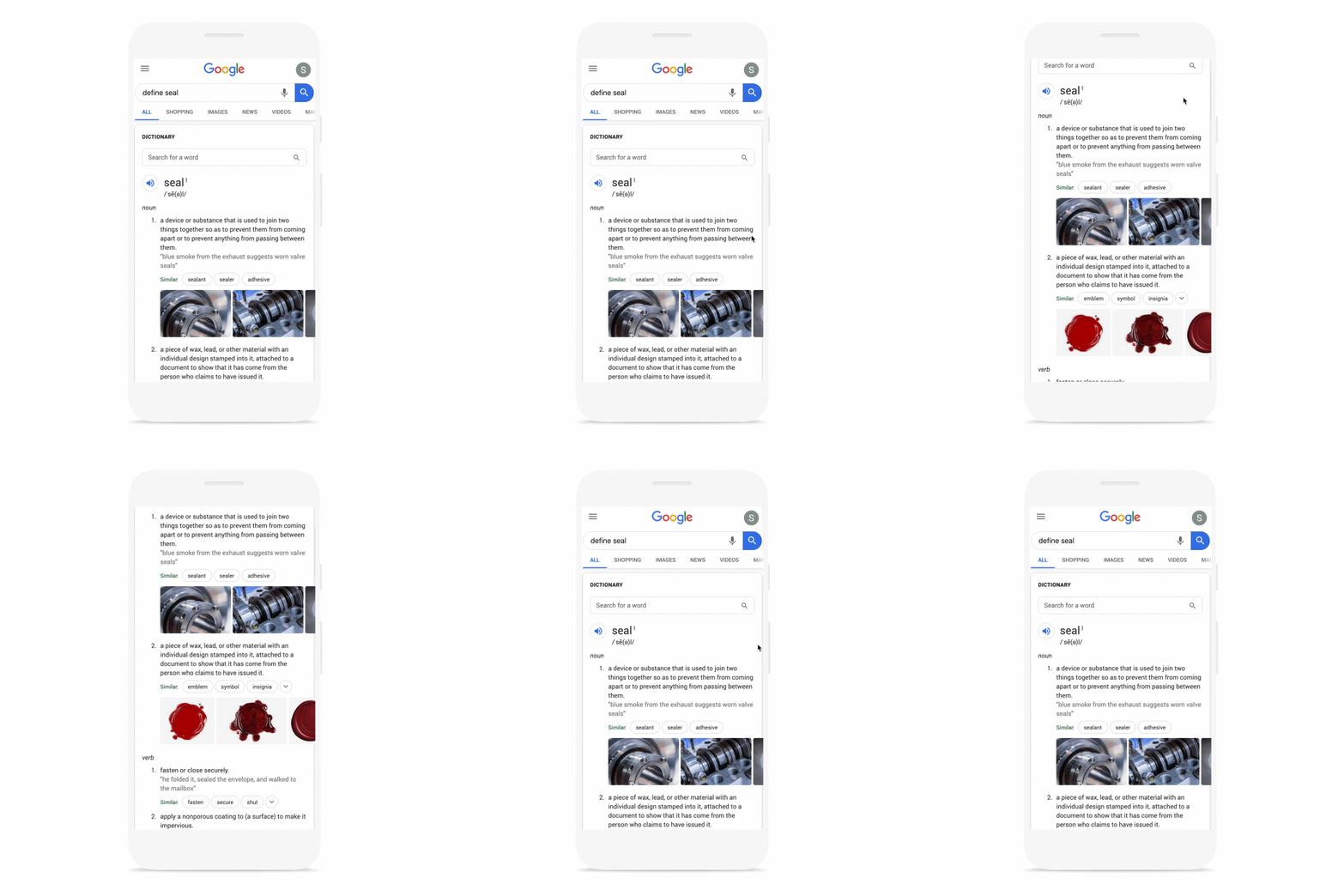
Google is adding a nifty new feature to its search results when you look for the pronunciation of words. You’ll now be able to not just hear the correct pronunciation, but you can also now practice the right way of saying ‘quokka’ and get immediate feedback on the page. While you may not think you need a tool like this, it’s surely a great tool for language learners.

All of this, of course, is powered by machine learning. Google’s speech recognition tools process the recording, separates it into individual sounds, and then compares it to how experts pronounce it.

In addition to this new pronunciation feature, Google is also adding more images to its dictionary and translate features. For now, this is only available in English and only works for nouns. It’s quite a bit harder to find the right image (or GIF) to illustrate verbs, after all, let alone adverbs.

Advances in speech recognition and machine learning can improve the way we learn about languages,” Google says in today’s announcement. “We hope these new features give you a creative, more effective way to practice, visualize and remember new words. We plan to expand these features to more languages, accents and regions in the future.”

Bonus: here is a video with lots of quokkas.


14 Nov 2019

Google brings RCS support in its Android Messages app to the U.S.

Google today announced that it is now rolling out support for Rich Communication Services messages (you can think of it as the next generation of SMS) in the Android Messages app to all of its users in the U.S., after already testing it with a small set of users in recent months. For Google, this push for RCS is also a way for the company to more effectively compete with Apple’s iMessages (though it doesn’t feature end-to-end encryption) and since Google has mostly taken control of this rollout away from carriers, it gets to call the shots on when users get access to this, not the telcos. It already did this in the UK and France earlier this year, so the company already has some experience in managing this service.

It’s also no secret that Google’s messaging strategy, at least for consumers, remains messy, with Hangouts still being a widely used tool. At least on mobile, Google hopes that Messages, which until now was essentially the company’s SMS client, can take over that role. Like other messaging services, RCS support in Messages will allow you to talk to your friends over WiFi or mobile data and send photos and videos. You will also get read receipts, typing notifications and all the usual messaging features you’d expect.

With Google taking control of the rollout, it’s also now responsible for keeping this network running and there are some legitimate concerns about the company owning this over the carriers. On the other hand, though, the carriers didn’t do them any favors by making their own RCS rollouts as messy as possible, up to the point where Google really didn’t have an option but to do this itself. For Android users, though, this is good news, even though they will still show up with a green bubble on iPhones — and will hence be judged by their iPhone-using friends.

14 Nov 2019

Amazon and Google double down on hands-free recipes to help sell their smart displays

Amazon and Google have identified a solid use case for their smart speaker devices, powered by Alexa and Google Assistant, respectively: recipes. The companies this week have both announced new product features that aim to help users cook, hands-free, while guided by the voice assistant. Amazon this week rolled out a new feature integration in partnership with BuzzFeed’s recipe site Tasty, to offer step-by-step voice and video instructions to Alexa users. Meanwhile, Google partnered with entrepreneur and chef Ayesha Curry to bring her recipes to Google Assistant.

Curry’s recipes will also include step-by-step cooking instructions on Google Assistant-powered Smart Displays, like the Nest Hub Max.

Meanwhile, the Tasty recipes are available across Echo devices, but will include cooking videos on the Echo Show devices.

What’s interesting about the new features is that both involve content partnerships, instead of dedicated skills from third-parties. In fact, Curry is even providing her new recipe (Cast Iron Fall Bread Pudding with Brown Butter Apples) exclusively to Google Assistant users.

The growth in voice apps had been growing steadily over the past few years, with Amazon announcing earlier this fall it had surpassed over 100,000 skills. But that momentum may now be slowing, reports say — a possible indication that developer enthusiasm may be waning, as well.

The issue with voice apps is they’re hard to discover by way of voice commands alone, and they require particular syntax to properly launch. Sure, users may find a great weather app or game, but if they can’t remember its name later on, they may not visit again. Another issue is that many of the first voice apps were built by developers, some of whom lack user experience design backgrounds resulting in kludgy, confusing voice experiences.

Finally, it’s not clear that a large number of smart speaker or smart display owners are even regularly using voice apps. After all, Amazon and Google tend to tout the number of skills they have, not the number of people using them.

Content integrations by way of partnerships route around all these problems.

They simplify things and put Amazon and Google back in control of the user experience. And they still give users what they want without requiring them to launch a third-party app.

Recipes are also more straightforward, as far as integrations go. They consist of only a few parts — ingredient lists and cooking instructions, for example. And the commands to launch them are as simple as “Alexa” or “Hey Google,” followed by “show me recipes from…” and then the recipe source.

Navigating recipes can also be easier than other voice apps, thanks to basic commands like “Alexa, ingredients,” “Alexa, next step,” or “Alexa start recipe.”

The smart speakers can aid with general cooking questions, too, like “Hey Google, how many tablespoons in a cup?” or “Hey Google, show me how to brown butter.”

Before the Tasty partnership, Amazon had already tapped into the potential for recipes to boost device sales with the launch of a Guided Cooking feature that allowed Echo Show and Echo Spot customers to get step-by-step instructions from Allrecipes, Epicurious, Food52, TheKitchn, and SideChef while they cook without having to install a skill.

In addition, Alexa more recently was the debut voice platform for Discovery’s new subscription service Food Network Kitchen, which doesn’t just offer recipes and videos, but also live cooking classes with master chefs.

Ayesha Curry isn’t Google’s first recipe partnership, either. It had also indexed recipes from Bon Appetite, The New York Times, Food Network and others for use on Google Home. This year, it said recipe suggestions would be personalized to users with the launch of a “Picks for You” feature for its smart displays.

Both new recipe integrations are live now.

To get started, say “Hey Google, show me recipes from Ayesha Curry,” or ask Alexa for recipes from Tasty based on ingredients, dish name or occasion, like, “Alexa, find chicken recipes from Tasty.”


14 Nov 2019

Norwest closes its 15th fund with $2 billion — its biggest vehicle to date

Norwest Venture Partners, the 58-year-old venture firm backed primarily by Wells Fargo, has closed its 15th fund with $2 billion. The firm closed its last fund with $1.5 billion at the beginning of 2018; the firm now manages $9.5 billion across all of its funds.

We talked with managing partner Jeff Crowe a couple of days ago about the outfit’s seemingly aggressive funding pace. Though venture firms have begun announcing new funds on what’s closer to a two-year cycle than than every three or four years as was long the case in the industry, putting $1.5 billion to work in even less than two years’ time seems notable.

Crow explained that the firm’s growth equity team — which can write checks that range from $50 million to $100 million– has been highly active, writing big checks in recent years to Cority, Vuori, and SmartSign, among others. Cority is a Toronto company that makes environmental, health, safety and quality (EHSQ) software, Vuori is an apparel performance brand, and SmartSign produces custom signs.

That growth equity team often goes after founders who’ve bootstrapped their companies, as might a more traditional private equity firm. It separately makes what it considers “late stage venture” deals, meaning it participates in traditional Series B, C, D, and later rounds.

Other bets from Norwest’s most recent fund include a wide variety of consumer brands, including the personal finance app Dave, the smart home products company Wyze (it makes a home security camera), the home-buying business OpenDoor, and the co-work space company Knotel.

Norwest has meanwhile seen numerous exits over the past couple of years. Health Catalyst, a Salt Lake City-based analytics vendor, went public this past summer, as did Silk Road Medical, a Sunnyvale, Ca., company that’s developing a neuroprotection and stent system used in transcarotid artery revascularization procedures.

Norwest was also an investor in both Uber and Spotify (though Crowe declined to say how much of either stake Norwest has since sold).

The firm has seen some of its portfolio companies acquired in the not-too-distant past, too. For example, in June, publicly traded WorkDay announced it was acquiring  Adaptive Insights. a cloud-based platform for business planning, for $1.5 billion. LinkedIn acquire Glint. Aveta of growh, acquired by Welsh Carson. (see a lot of growth equity world.) Another company, an employee engagement platform called Glint, was separately acquired by LinkedIn roughly a year ago for undisclosed terms.

As for this new fund, the team — to which it added partner Priti Choksi last year — remains the same, says Crowe. So does its mission of backing teams at a wide variety of stages and sectors, including, broadly, consumer, enterprise and healthcare in the U.S., India, and Israel.

14 Nov 2019

Punchh lands $40M to give physical retailers Amazon-style analytics

E-commerce accounts for around 11% of all retail sales in the US, but it’s growing much faster than brick-and-mortar sales, going up 14.8% this year versus a mere 1.9% for physical retail, according to eMarketer. So to better compete today and in the future, retailers are now investing in more advanced tools not just to figure out more about what’s selling best, when and where, but how to serve individuals better — in essence, to provide the same kind of help, recommendations, discounts and communication with shoppers that online portals like Amazon provides.

Punchh, a company that got its start in loyalty cards (hence the name) but has since expanded into a wider world of analytics and customer personalization to tap into that trend, is today announcing that it has raised $40 million to continue expanding its business. The funding is being led by Adams Street Partners and Sapphire Ventures (which also led its previous round of $30 million in April 2018), with AllianceBernstein also participating.

To date, Punchh has raised around $73 million, with its valuation over $300 million. (To be clear, CEO and founder Shyam Rao said the exact number wasn’t being disclosed, but he did say it was “well north” of multiples of its last valuation, which was around $100 million. PitchBook has filled in the blanks: a first close of this round this summer, for just over $35 million, came in at a pre-money valuation of $300 million, which would make this about $340 million.)

Punchh has built most of its business up to now in the restaurant industry. Its customers include companies like Yum Brands (the Pizza Hut, Taco Bell, KFC giant), Denny’s and other big and smaller operations, where it provides not just app-based loyalty card services, but ways to link up people’s payment cards with their purchasing history to better track what they are buying, and the ability to build subsequent discount and other promotional campaigns around that. Altogether, Rao tells me that it has data on some 125 million customers globally, covering some 80,000 locations.

“We get access to 100% of all transactions at those locations, working out to 3 billion transactions per month,” Rao said. That data in turn trains Punchh’s AI models to feed the bigger recommendation and analytics engine.

For the last year, Punchh been slowly expanding into other retail areas such as convenience stores and more: its most recent customer win, a deal with Casey’s General Stores, Inc. with 2,100 stores in 16 states in Midwest, is a sign that the strategy is working.

The opportunity that Punchh is targeting is somewhat ironic: the level of personalization that it’s building into the brick-and-mortar customer experience used to be a cornerstone of what it meant to be a “regular customer” at a local or favorite store, bar or restaurant.

These days — in part because of the decline of the small business, in part because our spending habits have changed, in part because everything has been digitised and retailers are looking for ways to actually downsize human-based customer relations — you don’t typically get that kind of experience anymore.

On the online front, online stores like Amazon have leveraged the model of personalization and seized the opportunity to use data to offer it in their own style: by recommending products to you when you come to their virtual storefronts, based on what you’ve bought or browsed for already online. So while old days of brick-and-mortar personalization have disappeared, they’ve been quickly replaced online, but not so in the physical world.

That’s now slowly changing in part because of innovations from companies like Punchh, which also takes into account cash purchases, since its technology is integrated at the point of sale.

“When you buy something in cash, we may not know who you are but we do know that you come in at, say, 8am and what you bought,” he said. “We can still use that to predict lifetime value and to generate a coupon.” 

Ironically, while the was a model that was pioneered in brick and mortar, it was honed online, and is now again being improved and advanced, Punchh supporters say, back in the physical — not online — world, which is, after all, still accounting for more sales overall.

“Punchh is the undisputed leader in this category. They work with the biggest brands, have the most sophisticated technology, and drive real results for their customers,” said Robin Murray, Partner at Adams Street Partners, in a statement. “While everyone else got distracted by maximizing ecommerce, Punchh took the best technologies and practices from that space and applied them to physical retail. Now the world is coming back around – just look at Amazon’s purchase of Whole Foods – and Punchh is already 10 steps ahead of the game.”

14 Nov 2019

Target integrates Shipt’s same-day delivery service into its mobile app

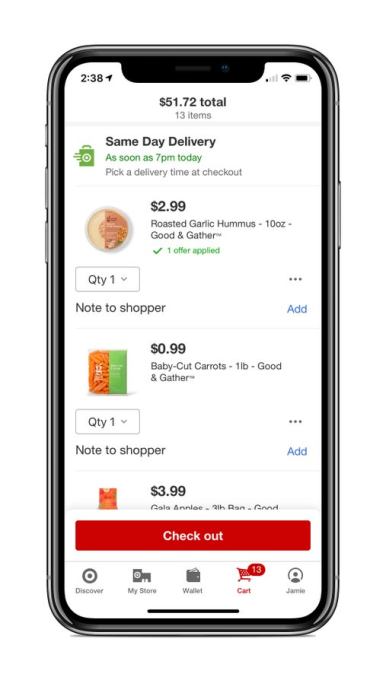
Same-day delivery is coming to Target’s app. The retailer announced this morning that its same-day shopping service Shipt, which Target acquired two years ago for $550 million, will now be integrated directly into the Target mobile application. Though Shipt is widely known as an online grocery service that competes with Instacart and others, Target is putting the service to work to do more than deliver food and various household items.

Instead, Shipt is turning into Target’s own version of Amazon’s Prime Now. Currently, Target shoppers can order 65,000 items from the app for same-day delivery, including not just groceries and essentials, but also toys, baby-care products, kitchenware, and more. For comparison’s sake, Amazon says Prime Now offers “tens of thousands” of products for one or 2-hour delivery. Shipt may not have quite as tight windows, however — just “same-day.”

While Amazon doesn’t disclose how many exact products are available via Prime Now, as it varies by location, a 2018 study indicated that Amazon’s biggest markets offered around 55,000 Prime Now products per city, while many other cities offered 34K-41K SKUs.

Unlike Prime Now, Shipt doesn’t require a membership, though one is available. Instead, shoppers can opt to pay a $9.99 delivery fee per same-day order. This is similar to how Walmart Grocery operates, though it’s now rolling out a subscription option for its more regular customers.

Shipt’s integration with the Target app doesn’t mean the dedicated Shipt app is going away — that’s still a more convenient experience for shopping groceries at this time. However, it is a way for Target to offer Shipt delivery to a wider customer base of mobile consumers.

The mobile integration follows the launch of a dedicated shopping site for same-day delivery on Target.com earlier this year, which had a similar goal.

Target has been steadily modernizing its business to better compete with Amazon and help customers shop however they want — in-store, online or some hybrid of the two, as with Drive Up orders. In less than two years’ time, Drive Up became a top-rated service and it more than doubled the number of 2018 orders by fulfilling more than 5 million orders in the first part of the year, for example. Meanwhile, Target recently said that 1 in 5 customers were placing same-day orders with Target for the first time in Q2, indicating the potential for growth in same-day.

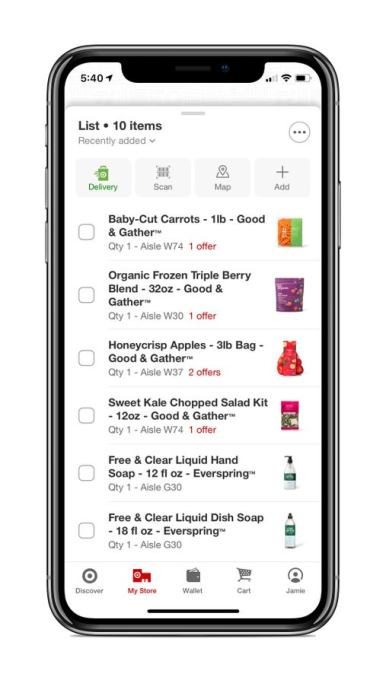
The same-day Shipt integration is rolling out today in the Target app which also includes a new “My Store” tab where shoppers can convert lists to a shopping cart with a “Delivery” button. A “Discover” also helps them to navigate and find other features, like deals and seasonal content.

14 Nov 2019

Instagram tests hiding Like counts globally

Instagram is making Like counts private for some users everywhere. The test is expanding globally after Instagram began hiding Likes in April in Canada and then in Ireland, Italy, Japan, Brazil, Australia and New Zealand in July. Facebook started a similar experiment in Australia in September.

Instagram tells TechCrunch it wants its app to be a place people feel comfortable expressing themselves, and can focus on photos and videos they share rather than how many Likes they get. Users can still see who Liked their own posts by tapping on the Likers list, but they won’t see a count anywhere — they’d have to count the names manually..

Still, there remain concerns about how this could hurt influencers and creators after studies found many of them of various levels of popularity lost 3% to 16% of their Likes in countries where Instagram hid the counts. Instagram tells me it understands Like counts are important to many creators, and it’s actively working on ways that creators will be able to communicate their value to partners. Since Like counts won’t be public, influencer marketing agencies must rely on self-reported screenshots from creators and won’t be able verify a post got enough engagement to warrant payment.

An Instagram spokesperson tells TechCrunch: “Starting today, we’re expanding our test of private like counts to the rest of the world beyond Australia, Brazil, Canada, Ireland, Italy, and New Zealand. If you’re in the test, you’ll no longer see the total number of likes and views on photos and videos posted to Feed unless they’re your own. While the feedback from early testing has been positive, this is a fundamental change to Instagram, and so we’re continuing our test to learn more from our global community.”

14 Nov 2019

Salesforce announces it’s moving Marketing Cloud to Microsoft Azure

In the world of enterprise software, there are often strange bedfellows. Just yesterday, Salesforce announced a significant partnership with AWS around the Cloud Information Model. This morning, it announced it was moving its Marketing Cloud to Microsoft Azure. That’s the way that enterprise partnerships shimmy and shake sometimes.

The companies also announced they were partnering around Microsoft Teams, integrating Teams with Salesforce Sales Cloud and Service Cloud.

Salesforce plans to move Marketing Cloud, which has been running in its own data centers, to Microsoft Azure in the coming months, although the exact migration plan timeline is not clear yet. This is a big deal for Microsoft, which competes fiercely with AWS for customers. AWS is the clear market leader in the space, but Microsoft has been a strong second for some time now, and bringing Salesforce on board as a customer is certainly a quality reference for the company.

Brent Leary, founder at CRM Essentials, who has been watching the market for many years, says the partnership says a lot about Microsoft’s approach to business today, and that it’s willing to partner broadly to achieve its goals. “I think the bigger news is that Salesforce chose to go deeper with Microsoft over Amazon, and that Microsoft doesn’t fear strengthening Salesforce at the potential expense of Dynamics 365 (its CRM tool), mainly because their biggest growth driver is Azure,” Leary told TechCrunch.

Microsoft and Salesforce have always had a complex relationship. In the Steve Ballmer era, they traded dueling lawsuits over their CRM products. Later, Satya Nadella kindled a friendship of sorts by appearing at Dreamforce in 2015. The relationship has ebbed and flowed since, but with this announcement, it appears the frenemies are closer to friends than enemies again.

Let’s not forget though, that it was just yesterday that Salesforce announced a partnership with AWS around the Cloud Information Model, one that competes directly with a different partnership between Adobe, Microsoft and SAP; or that just last year AWS announced a significant partnership with AWS around data integration.

These kinds of conflicting deals are confusing, but they show that in today’s connected cloud world, that companies, who will compete fiercely with one another in one part of the market, may still be willing to partner in other parts when it makes sense for both parties and for customers. That appears to be the case with today’s announcement from these companies.