Year: 2019

14 Nov 2019

Apple Research app arrives on iPhone and Apple Watch with three opt-in health studies

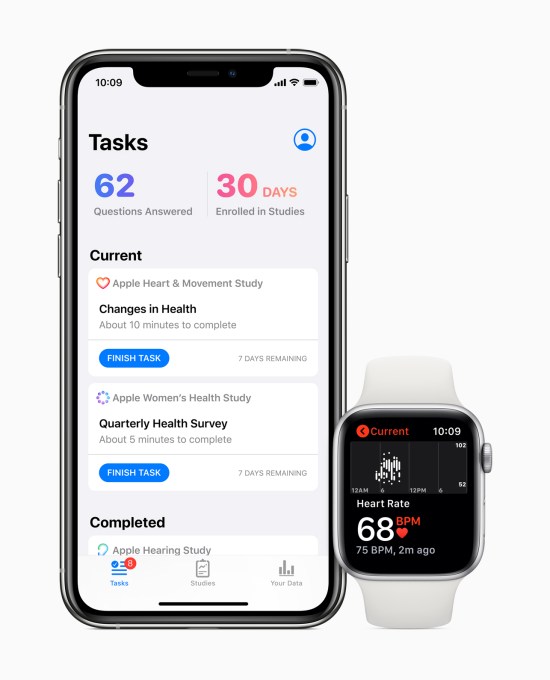
Apple in September announced its plans for a research app that would allow U.S. consumers to participate in health studies from their Apple devices. Today, that app has gone live for both iPhone and Apple Watch for customers in the U.S. From the new app, Apple Research, users can currently opt to participate in three health studies, including a women’s health study, hearing study, and a heart and movement study.

Apple had teamed up with researchers and health organizations on previous studies, but those would require participants to install a dedicated app on their iOS device for each study alone. The new Research app instead offers a dedicated place for this opt-in activity and makes it simpler for people who want to join multiple studies at once.

The data collected from Apple devices (and their numerous sensors) offers researchers the ability to conduct large-scale health studies in a way that hasn’t been possible before. Before, these sorts of studies were expensive and time-consuming, Apple says, but now users can opt into sharing health-related information directly with researchers — like signals from their heart, motion level and activity, and sound exposure.

Apple’s privacy promises come into play here as well, as it puts data-sharing in users’ control, and offers commitments that data will be encrypted, won’t be sold, and that studies have to inform users how your data will support their research. Participants can also withdraw at any time.

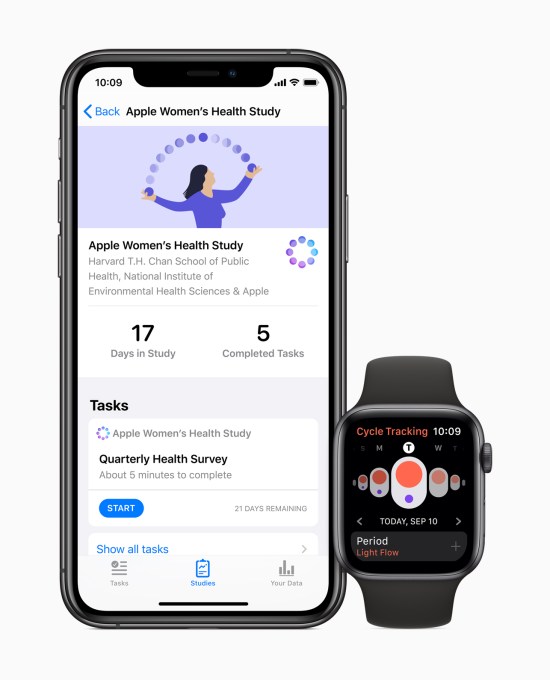
Among the first three studies is a women’s health study in partnership with the Harvard T.H. Chan School of Public Health and National Institute of Environmental Health Sciences. It aims to advance understanding of women’s menstrual cycles and their relationship to infertility, osteoporosis, menopause, and polycystic ovary syndrome (PCOS). This will collect users’ cycle tracking logs from the Health app on the iPhone or the Cycle Tracking app on Apple Watch.

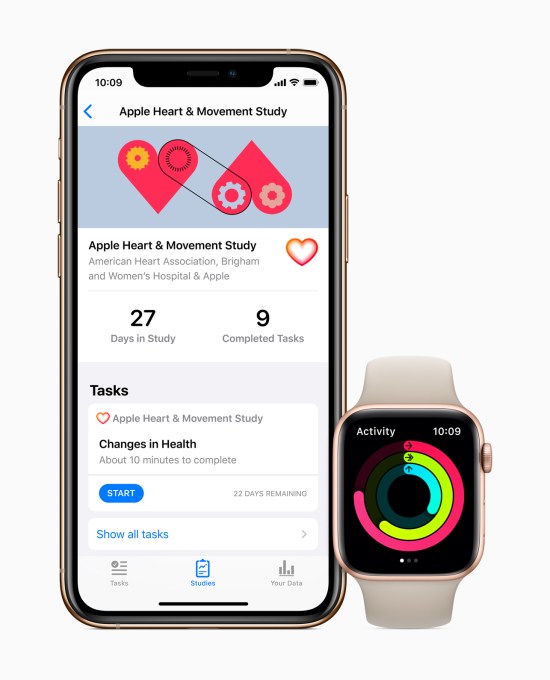
Another heart and movement study is in partnership with the American Heart Association and Brigham and Women’s Hospital, and will use Apple Watch data collected during workouts, plus heart rate and activity data, along with short surveys. This data will be used to understand how certain mobility signals and details about heart rate and rhythm could serve as potential early warning signs of atrial fibrillation (AFib), heart disease or declining mobility, among other things.

The hearing study from the University of Michigan and the World Health Organization collects data about users’ sound exposure from the iPhone and Noise app on Apple Watch, along with surveys and hearing tests. The study will also test if Health app notifications will encourage users to modify their listening behavior, when loud sounds are detected.

“Today marks an important moment as we embark on research initiatives that may offer incredible learnings in areas long sought after by the medical community,” said Jeff Williams, Apple’s chief operating officer, in a statement about the app’s launch. “Participants on the Research app have the opportunity to make a tremendous impact that could lead to new discoveries and help millions lead healthier lives.”

The Research app is rolling out now to iPhone and Apple Watch in the U.S.

14 Nov 2019

Ford’s all-electric SUV is officially the ‘Mustang Mach-E,’ and you can reserve one starting Nov. 17

Ford has revealed the official name of its forthcoming EV SUV, which has a Mustang lineage and which will be officially revealed on November 17 in LA. The new vehicle is called the Mustang Mach-E, and following its official unveiling (hosted by Idris Elba, by the way), you’ll be able to actually sign up online and reserve one by putting down a $500 deposit.

The reservation system will include access to a limited ‘First Edition’ set of cars, which Ford says it will provide details around during the launch event. The deposit is also fully refundable, in case you get cold feet, and people who put down deposits will later get the opportunity to actually configure their vehicle prior to delivery. During the reservation process, you also select your preferred Ford dealer, presumably for eventually picking up the car.

Ford’s teases of the vehicle so far suggest a crossover-style electric SUV, and Ford has put up some collateral on the web with a few additional clues about hat it will offer, including a targeted EPA range rating of “at least” 300 miles, and a charging rate of around 47 miles in just 10 minutes with a 150kW DC fast charger, with two years of free charging across Ford’s EV chaser network included.

Below, you can see all the hints and glimpses of the car we’ve gotten from Ford so far, and you can probably fill in the gaps via imagination and reference to the existing Ford Mustang, but November 17 will finally reveal all, and we’ll definitely have coverage here on TC to satisfy your curiosity.

[gallery ids="1911891,1911892,1911893,1911894"]

14 Nov 2019

Fourteen years after launching 1Password takes a $200M Series A

1Password has been around for 14 years, and the founders grew the company the old-fashioned way without a dime of venture capital. But when it decided to take venture help, it went all in. Today, the company announced a $200 million Series A from Accel, the largest single investment in the firm’s 35-year history.

Dave Teare says he and his co-founder Roustem Karimov were resolving a major pain point for users around password creation and management when they launched in 2005, and that the Toronto company has been profitable from day one. That’s not something you hear from startups all that often.

Today, Jeff Shiner is CEO. He helped grow the company from 20 employees when he came on board in 2012 to 174 today. He says that as he helped foster this growth, he saw a tremendous market opportunity in front of him. That’s when he decided to finally take the plunge into venture investing.

“We’ve got the sophisticated business tooling that we built over the last five years, so that we can really go out there and just double and triple down on what we’ve been doing, and drive that much faster and further into the market, and again that market is honestly from consumers all the way up to enterprises,” Shiner explained.

While he is confident in his company’s ability to build a product people want and support its customers, it needs help with other aspects of the business to grow faster and take advantage of the market potential. “We have far less experience with things like go-to-market programs, with sales, marketing and finance teams — and things like that. And we need to grow and grow aggressively, which is not just hiring people, but also getting the right partners, finding the right leaders to help us with that growth,” he said.

Accel has a history of funding mature companies that haven’t taken funding before, so what it’s doing with this investment isn’t all that unusual for the firm. Arun Mathew, a partner at Accel, says he doesn’t come across companies like 1Password all that often. ““Like Atlassian and Qualtrics, the 1Password team impressed us by building a business that’s not only scaling extremely quickly but also has been profitable since day one — and that’s why today we’re making the biggest single investment in Accel’s 35-year history,” Mathew said in a statement.

The founders actually stumbled onto the idea of 1Password in 2005. They were running a web development consultancy when they decided to resolve a long-standing problem of logging into multiple websites, a particularly acute issue given their day jobs.

They decided to build a tool to help, and when they put it out in the world, they found lots of other people had the same problem. They ended up closing the web consultancy to build 1Password, and the rest, as they say, is history.

14 Nov 2019

Moveworks snags $75M Series B to resolve help desk tickets with AI

Moveworks, a startup using AI to help resolve Help Desk tickets in an automated fashion, announced a $75 million Series B investment today.

The round was led by Iconiq Capital, Kleiner Perkins and Sapphire Ventures. Existing investors Lightspeed Venture Partners, Bain Capital Ventures, and Comerica Bank also participated. The round also included a personal investment from John W. Thompson, who is a partner at LightSpeed Venture Partners and chairman at Microsoft. Today’s investment brings the total raised to $105 million, according to the company.

That’s a lot of money for an early-stage company, but CEO and co-founder Bhavin Shah says his company is solving a common problem using AI. “Moveworks is a machine learning platform that uses natural language understanding to take tickets that are submitted by employees every day to their IT teams for stuff they need, and we understand [the content of the tickets], interpret them, and then we take the actions to resolve them [automatically],” Shah explained.

He said the company decided to focus on help desk tickets because they saw data when they were forming the company that suggested a common set of questions, and that would make it easier to interpret and resolve these issues. In fact, they are currently able to resolve 25-40% of all tickets autonomously.

He says this should lead to greater user satisfaction because some of their problems can be resolved immediately, even when IT personnel aren’t around to help. Instead of filing a ticket and waiting for an answer, Moveworks can provide the answer, at least part of the time, without human intervention.

Aditya Agrawal, a partner at Iconiq, says that the company really captured his attention. “Moveworks is not just transforming IT operations, they are building a more modern and enlightened way to work. They’ve built a platform that simplifies and streamlines every interaction between employees and IT, enabling both to focus on what matters,” he said in a statement.

The company was founded in 2016, and in the early days was only resolving 2% of the tickets autonomously, so it has seen major improvement. It already has 115 employees and dozens of customers (although Shah didn’t want to provide an exact number).

14 Nov 2019

48 hours left to save up to €500 on passes to Disrupt Berlin 2019

Livin’ la vida loca pretty much sums up the early-stage startup life. We understand just how crazy-busy life gets, but we’re here to remind all the last-minute mavens that you have just 48 hours to take advantage of early-bird prices to Disrupt Berlin 2019. Depending on the type of pass you buy, you can save up to €500.

The early-bird pricing ends at 11:59 p.m. (CEST) this Friday, 15 November. Hit the brakes on livin’ la vida loca long enough to beat the deadline, buy your early-bird pass and save.

Now that you’ve saved a tidy sum, why not get a jump on planning your time at Disrupt Berlin? If networking’s your game, you’ll want to take advantage of CrunchMatch. Our free business-matching platform combines the best of two worlds — automation and curation — to help you zero in the people who align with your business goals. Cut through the noise and spend your valuable time talking to the right people. Read about how CrunchMatch works.

Curious about the latest innovations happening across the tech spectrum? Set your GPS for Startup Alley, our exhibition floor where you’ll find hundreds of early-stage startups displaying their products, platforms and services. Whether you’re an investor, founder, developer — or play some other role in the startup world — you’ll find something new and exciting in Startup Alley.

When you’re in Startup Alley, be sure to check out our TC Top Picks. TechCrunch editors chose these early-stage startups because they represent the best of their respective tech categories. Which startups won this coveted designation? Meet our TC Top Picks for Disrupt Berlin 2019.

Want to see top-notch startups in action? Grab a seat for the world-famous, always-epic Startup Battlefield pitch competition. Between 15-20 teams of startup founders will pitch to a tough panel of veteran VCs and technologists. Every competitor has what it takes, but which one will take it all — the Disrupt Cup, $50,000 in equity-free cash and intense investor and media exposure?

There’s more to experience at Disrupt Berlin, including interviews, fireside chats and panel discussions with world-class speakers. You can go deeper on a specific topic by attending Q&A Sessions, and you can check out what some of the world’s best coders created at the Hackathon. The finalists will pitch their products on the Extra Crunch Stage. Don’t miss what matters most to you — check out the Disrupt Berlin agenda.

Disrupt Berlin 2019 takes place on 11-12 December. You have only 48 hours left to get the best possible price on tickets. You can live la vida loca and still beat the deadline. Buy your early-bird pass before Friday, 15 November at11:59 p.m. (CEST).

Is your company interested in sponsoring or exhibiting at Disrupt Berlin 2019? Contact our sponsorship sales team by filling out this form.

14 Nov 2019

Eigen nabs $37M to help banks and others parse huge documents using natural language and ‘small data’

One of the bigger trends in enterprise software has been the emergence of startups building tools to make the benefits of artificial intelligence technology more accessible to non-tech companies. Today, one that has built a platform to apply power of machine learning and natural language processing to massive documents of unstructured data has closed a round of funding as it finds strong demand for its approach.

Eigen Technologies, a London-based startup whose machine learning engine helps banks and other businesses that need to extract information and insights from large and complex documents like contracts, is today announcing that it has raised $37 million in funding, a Series B that values the company at around $150 million – $180 million.

The round was led by Lakestar and Dawn Capital, with Temasek and Goldman Sachs Growth Equity (which co-led its Series A) also participating. Eigen has now raised $55 million in total.

Eigen today is working primarily in the financial sector — its offices are smack in the middle of The City, London’s financial center — but the plan is to use the funding to continue expanding the scope of the platform to cover other verticals such as insurance and healthcare, two other big areas that deal in large, wordy documentation that is often inconsistent in how its presented, full of essential fine print, and is typically a strain on an organisation’s resources to be handled correctly, and is often a disaster if it is not.

The focus up to now on banks and other financial businesses has had a lot of traction. It says its customer base now includes 25% of the world’s G-SIB institutions (that is, the world’s biggest banks), along with others who work closely with them like Allen & Overy and Deloitte. Since June 2018 (when it closed its Series A round), Eigen has seen recurring revenues grow sixfold with headcount — mostly data scientists and engineers — double. While Eigen doesn’t disclose specific financials, you can the growth direction that contributed to the company’s valuation.

The basic idea behind Eigen is that it focuses what co-founder and CEO Lewis Liu describes as “small data”. The company has devised a way to “teach” an AI to read a specific kind of document — say, a loan contract — by looking at a couple of examples and training on these. The whole process is relatively easy to do for a non-technical person: you figure out what you want to look for and analyse, find the examples using basic search in two or three documents, and create the template which can then be used across hundreds or thousands of the same kind of documents (in this case, a loan contract).

Eigen’s work is notable for two reasons. First, typically machine learning and training and AI requires hundreds, thousands, tens of thousands of examples to “teach” a system before it can make decisions that you hope will mimic those of a human. Eigen requires a couple of examples (hence the “small data” approach).

Second, an industry like finance has many pieces of sensitive data (either because its personal data, or because it’s proprietary to a company and its business), and so there is an ongoing issue of working with AI companies that want to “anonymise” and ingest that data. Companies simply don’t want to do that. Eigen’s system essentially only works on what a company provides, and that stays with the company.

Eigen was founded in 2014 by Dr. Lewis Z. Liu (CEO) and Jonathan Feuer (a managing partner at CVC Capital technologies who is the company’s chairman), but its earliest origins go back 15 years earlier, when Liu — a first-generation immigrant who grew up in the US — was working as a “data entry monkey” (his words) at a tire manufacturing plant in New Jersey, where he lived, ahead of starting university at Harvard.

A natural computing whizz who found himself building his own games when his parents refused to buy him a games console, he figured out that the many pages of printouts that he was reading and re-entering into a different computing system could be sped up with a computer program linking up the two. “I put myself out of a job,” he joked.

His educational life epitomises the kind of lateral thinking that often produces the most interesting ideas. Liu went on to Harvard to study not computer science, but physics and art. Doing a double major required working on a thesis that merged the two disciplines together, and Liu built “electrodynamic equations that composed graphical structures on the fly” — basically generating art using algorithms — which he then turned into a “Turing test” to see if people could detect pixelated actual work with that of his program. Distil this, and Liu was still thinking about patterns in analog material that could be re-created using math.

Then came years at McKinsey in London (how he arrived on these shores) during the financial crisis where the results of people either intentionally or mistakenly overlooking crucial text-based data produced stark and catastrophic results. “I would say the problem that we eventually started to solve for at Eigen became for tangible,” Liu said.

Then came a physics PhD at Oxford where Liu worked on X-ray lasers that could be used to bring down the complexity and cost of making microchips, cancer treatments and other applications.

While Eigen doesn’t actually use lasers, some of the mathematical equations that Liu came up with for these have also become a part of Eigen’s approach.

“The whole idea [for my PhD] was, ‘how do we make this cheeper and more scalable?'” he said. “We built a new class of X-ray laser apparatus, and we realised the same equations could be used in pattern matching algorithms, specifically around sequential patterns. And out of that, and my existing corporate relationships, that’s how Eigen started.”

Five years on, Eigen has added a lot more into the platform beyond what came from Liu’s original ideas. There are more data scientists and engineers building the engine around the basic idea, and customising it to work with more sectors beyond finance. 

There are a number of AI companies building tools for non-technical business end-users, and one of the areas that comes close to what Eigen is doing is robotic process automation, or RPA. Liu notes that while this is an important area, it’s more about reading forms more readily and providing insights to those. The focus of Eigen in more on unstructured data, and the ability to parse it quickly and securely using just a few samples.

Liu points to companies like IBM (with Watson) as general competitors, while startups like Luminance is another taking a similar approach to Eigen by addressing the issue of parsing unstructured data in a specific sector (in its case, currently, the legal profession).

Stephen Nundy, a partner and the CTO of Lakestar, said that he first came into contact with Eigen when he was at Goldman Sachs, where he was a managing director overseeing technology, and the bank engaged it for work.

“To see what these guys can deliver, it’s to be applauded,” he said. “They’re just picking out names and addresses. We’re talking deep, semantic understanding. Other vendors are trying to be everything to everybody, but Eigen has found market fit in financial services use cases, and it stands up against the competition. You can see when a winner is breaking away from the pack and it’s a great signal for the future.”


14 Nov 2019

Yodel.io is a digital receptionist for SMBs taking calls

Yodel.io, an Austria-founded startup that’s developed a “digital receptionist” to help SMBs and other small teams handle in and outbound phone-calls, has picked up $1 million in “pre-seed” funding. It brings total funding to just over $1.8 million.

Backing this round is EXF Alpha, the fund of the European Super Angels Club, and various other unnamed European angel investors. This investment will be used to establish a New York office, in addition to the startup’s existing presence in Vienna, London and San Francisco.

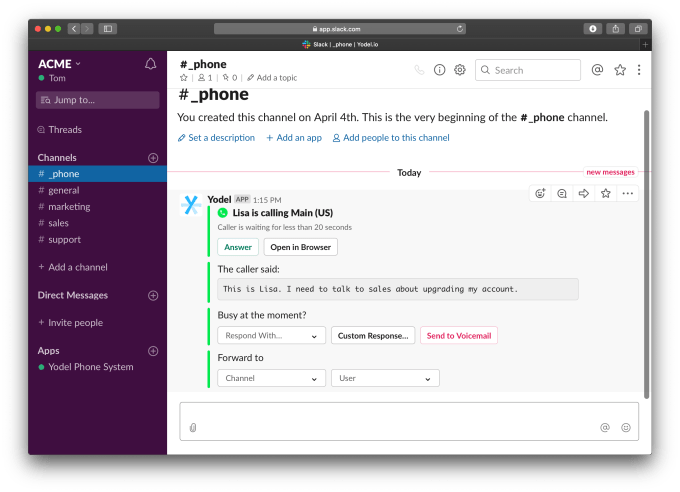
In development since 2016 and a Seedcamp alumni, Yodel’s tech acts as a digital phone receptionist that plugs into popular team chat applications such as Slack, Zapier, and Drift to help SMBs handle calls more efficiently. The idea is to provide these small and medium-sized businesses with call-handling technology more akin to that typically available to larger enterprises but at a price they can afford.

It is similar thinking to Google’s recently launched CallJoy, although Yodel argues its product is better and says it is already used by over 2,000 SMBs in 30 languages across 47 countries.

Yodel and CallJoy both offer the ability to transcribe calls, manage inbounds through “human-like” answering, log calls, tag calls and record calls.

However, in addition, Yodel says its tech also allows for customisable canned responses, and that its AI is able to ask for a reason for the call and then process calls accordingly. Other features include call conferencing, and the ability to send and receive SMS messages.

“SMBs are stuck with old school phone systems that lack flexibility,” explain two of Yodel’s co-founders, Nina Hödlmayr and Mike Heininger, in an email. “At the same time, customers of SMBs don’t receive the support they expect via the phone, they want the processes and systems of the multinationals, without considering the backend costs.

The pair argue that by using Yodel, less well-resourced companies can offer voice calls for customers, which they argue is still the most direct channel. “This is an effective way of increasing sales and having fewer unsatisfied customers,” they tell TechCrunch.

Yodel.io Slack integration: waiting inbound call

“The caller receives a better experience by being greeted from a digital voice assistant and getting forwarded to the right team member. The company views all information in one place without needing to switch tools. This is also a main benefit for distributed and modern teams. Each bit of information is shared and can be collaborated on which improves decisions and overall internal knowledge”.

Operating a typical SaaS model, Yodel charges per “seat” per month. This includes a phone number per user, unlimited inbound minutes and call credit for outbound calls. There are additional fees for more outbound minutes and additional phone numbers. Depending on features the subscription is with $25 per month or $35 per month.

14 Nov 2019

Johannes Reck from GetYourGuide to talk about reaching unicorn status at Disrupt Berlin

Earlier this year, GetYourGuide raised a gigantic $484 million funding round with SoftBank’s Vision Fund leading the round. Now that the German startup has reached a valuation well over the $1 billion mark, it’s time to look back at the company’s impressive trajectory. That’s why I’m excited to announce that GetYourGuide co-founder and CEO Johannes Reck is joining us at TechCrunch Disrupt Berlin.

At first, people started booking flights and train tickets on online platforms. Then, they started booking hotel rooms and Airbnb apartments. But going somewhere is just step one. You also need to figure out what you’re going to do when you arrive in a city you don’t know.

GetYourGuide lets you book experiences, from sightseeing tours to tickets for attractions and others. Behind the scene, the company operates a marketplace that matches third parties with travelers.

But the startup now wants to go one step further and build a catalog of “Originals” tour experiences, such as a ‘GetYourGuide Instagram Tour of Bali’, which is probably a lot more appealing to young travelers compared to traditional travel agencies.

GetYourGuide’s metrics are mindboggling. Back in May, the company offered 50,000 experiences and had sold 25 million tickets in total. And I’m sure those numbers are even higher today.

The startup has a shot at becoming a cultural phenomenon and influence the way we travel — just like Airbnb did with its peer-to-peer rental platform. And I can’t wait to hear Johannes Reck tell us how to grow such a big marketplace with everyone’s best interests in mind.

Buy your ticket to Disrupt Berlin to listen to this discussion — and many others. The conference will take place December 11-12.

In addition to panels and fireside chats, like this one, new startups will participate in the Startup Battlefield to compete for the highly coveted Battlefield Cup.


Johannes Reck is the Chief Executive Officer at GetYourGuide. He leads the company’s long-term vision and strategy.

Johannes co-founded GetYourGuide in 2009 while attending the Swiss Federal Institute of Technology, and has grown the company into the leading booking platform for incredible travel experiences.

Under Johannes’ leadership, over 30 million tickets have been booked to date via the GetYourGuide website, mobile app, and partnership network. GetYourGuide has raised over $650M from investors such as the SoftBank Vision Fund, Battery Ventures and KKR. Johannes leads GetYourGuide’s 550-person global team from its headquarters in Berlin, Germany.

Johannes originally hails from Cologne, Germany and holds an M.Sc. in Biochemistry from the Swiss Federal Institute of Technology.

14 Nov 2019

Disney+ to launch in India, Southeast Asian markets next year

Disney plans to bring its on-demand video streaming service to India and some Southeast Asian markets as soon as the second half of next year, two sources familiar with the company’s plans told TechCrunch.

In India, the company plans to bring Disney+’s catalog to Hotstar, a popular video streaming service it owns, after the end of next year’s IPL cricket tournament in May, the people said.

Soon afterwards, the company plans to expand Hotstar with Disney+ catalog to Indonesia and Malaysia among other Southeast Asian nations, said those people on the condition of anonymity.

A spokesperson for Hotstar declined to comment.

Hotstar leads the Indian video streaming market. The service said it had more than 300 million monthly subscribers during the IPL cricket tournament and ICC World Cup earlier this year. More than 25 million users simultaneously streamed one of these matches, setting a new global record.

The international expansion of Hotstar isn’t a surprise as it has entered the U.S., Canada, and the U.K. in recent years. In an interview with TechCrunch earlier this year, Ipsita Dasgupta, president of Hotstar’s international operations, said so far the company’s international strategy has been to enter markets with “high density of Indians.”

In an earnings call for the quarter that ended in June this year, Disney CEO Robert Iger hinted that the company, which snagged Indian entertainment conglomerate Star India as part of its $71.3 billion deal with 21st Century Fox, would bring Star India-operated Hotstar to Southeast Asian markets, though he did not offer a timeline.

Disney+, currently available in the U.S, Canada, and the Netherlands, will expand to Australia and New Zealand next week, and the U.K., Germany, Italy, France and Spain on March 31, the company announced last week.

Price hike

Disney, which debut its video streaming service in the U.S. this week and has already amassed over 10 million subscribers, plans to raise the tariff of Hotstar in India, where the service currently costs $14 a year, one of the two aforementioned people said.

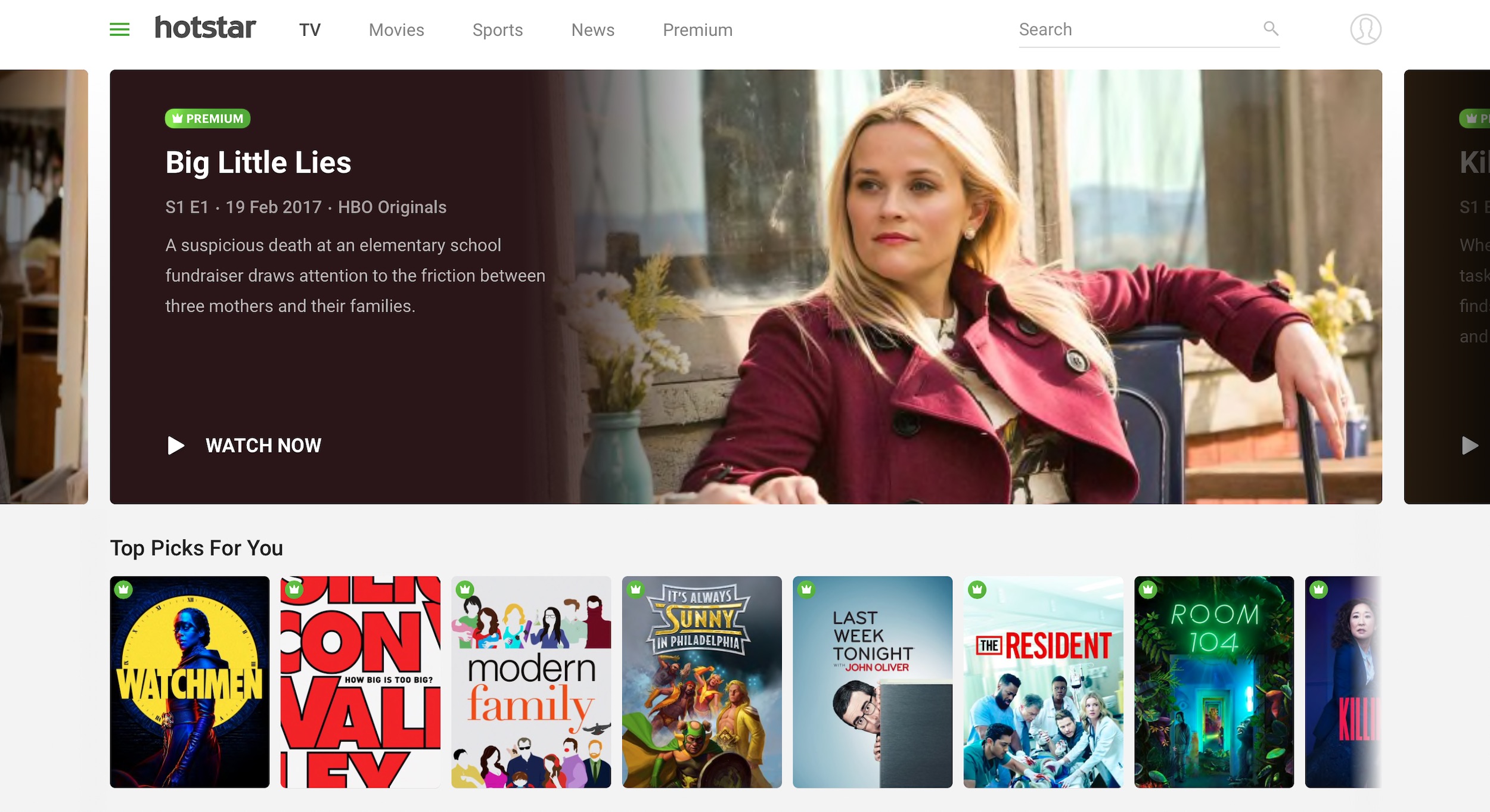
A screenshot of Hotstar’s homepage

The price hike will happen towards the end of the first quarter next year, just ahead of commencement of next IPL cricket tournament season, they said. The company has not decided exactly how much it intends to charge, but one of the people said that it could go as high as $30 a year.

In other Southeast Asian markets, the service is likely to cost above $30 a year as well, both of the sources said. The prices have yet to be finalized, however, they said. Even at those suggested price points, Disney would be able to undercut local rivals on price. Until recently, Netflix charged at least $7 a month in India and other Southeast Asian markets. But this year, the on-demand streaming pioneer introduced a $2.8 monthly tier in India and $4 in Malaysia.

Hotstar offers a large library of local movies and titles syndicated from Showtime, HBO, and ABC (also owned by Disney). In its current international markets, Hotstar’s catalog is limited to some local content and large library of Indian titles.

The arrival of more originals from Disney on Hotstar, which already offers a number of Disney-owned titles in India, could help the service sustain users after cricket seasons. The service’s monthly userbase plummets below 60 million in weeks following IPL tournament, according to people who have seen the internal analytics.

In recent quarters, Hotstar has also set up an office in Tsinghua Science Park in Beijing, China and hired over 60 engineers and researchers as it looks to expand its tech infrastructure to service more future users, according to job recruitment posts and other data sourced from LinkedIn.

14 Nov 2019

Motorola throws back to the future with a foldable Razr reboot

The rebirth of the Razr has been rumored for several months now. And honestly, such a product is a bit of a no-brainer. The Lenovo-owned company is embracing the burgeoning (if sputtering) world of foldables with the return of one of its most iconic models.

While it’s true that Motorola’s kept the Razr name alive in some form or another well into the Android era, everything that’s come since has failed to recapture the magic of the once mighty brand.

From the looks of things, however, the newly announced Razr is a lovely bit of symmetry. The product, which was announced earlier today in Los Angeles, leans into the lackluster criticism that foldables are simply a return of the once-ubiquitous clamshell design.

Motorola Razr

Motorola Razr

According to Motorola, the company has been toying around with flexible technology for some time now. Per a press release: “In 2015, a cross functional team, comprised of engineers and designers from both Motorola and Lenovo, was assembled to start thinking about how we could utilize flexible display technology.”

The device swaps the horizontal design of its best known competitor, the Samsung Galaxy Fold. The vertical form factor looks to be a match made in foldable heaven. Certainly it loses some of the uber-thin design that made the original Razr such a hit so many years back, but makes the ultra-wide (21:9) 6.2-inch screen compact enough to fit in a pocket.

As with the Galaxy Fold, there’s another a small display on the front for getting a glimpse of notifications and the like. It’s another design feature that mirrors the O.G. Razr. Predictably, the device runs Android — Android 9 (for now), to be precise.

For full throwback appeal, there’s also a “Retro Razr” mode, that mimics the original metallic button design for the bottom half of the screen. It’s a skin that does, indeed, double as a number pad, usable with Android messaging app. Motorola clearly put a lot of love into the design and it shows. If nothing else, the new Razr could go a ways toward proving that retro handsets can be more than just nostalgic novelty for bygone tech.

After the whole Samsung kerfuffle, you’d be right to question the device’s durability, though Motorola says it’s less concerned, citing an “average” smartphone timespan for the product. Only one way, to find out, I guess. Also like the Fold, price is a pretty big obstacle to any sort of mainstream adoption for this first-gen product. The Razr will run $1,499 when it launches in January of next year.