
Year: 2019

14 Nov 2019

Social network for motherhood Peanut raises $5M, expands to include women trying to conceive

Peanut, an app that began its life as a match-maker for finding new mom friends but has since evolved into a social network of more than a million women, announced today it has closed on $5 million in new funding and is expanding its focus to reach women who are trying to conceive. The round was led by San Francisco and London-based VC firm Index Ventures, also backers of Dropbox, Facebook and Glossier, among others.

Other Peanut investors include Sweet Capital, Greycroft, Aston Kutcher’s Sound Ventures, Female Founders Fund, Felix Capital and Partech. To date, Peanut has raised $9.8 million.

The idea for Peanut arose from co-founder Michelle Kennedy’s personal understanding of how difficult it was to forge female friendships after motherhood. As the former deputy CEO at dating app Badoo and an inaugural board member at Bumble, she initially saw the potential for Peanut as a friendship-focused matching app with swipe mechanisms similar to popular dating apps.

Over the past couple of years, however, Kennedy realized that what women needed was more of a community space. The team then built out the app’s features accordingly, with the launch of its Q&A forums, Peanut Pages, last year, and more recently, with Peanut Groups. The latter has now become Peanut’s main use case, with 60% of users taking advantage of the app’s community features and just 40% using the friend-finding functions.
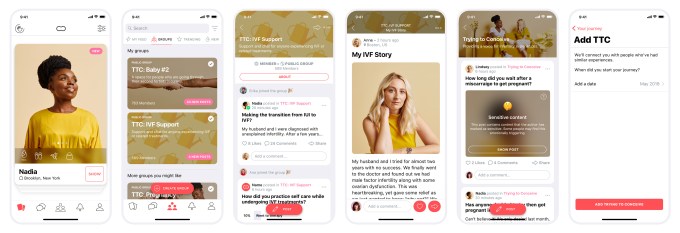
“Community is definitely becoming a very important part of what we do. It’s where we see the users that we deem to be power users — women who are using Peanut for hours every day — they’re very much within the community section,” explains Kennedy. “We see that growth there and it actually guides the product. So we’re taking the behaviors that we see and letting that inform our roadmap,” Kennedy says.

Since around November 2018, Peanut has been growing by 20% month-over-month, as more women discover Peanut’s private and ad-free alternative to Facebook Groups. On Peanut, users are verified (by selfies!), and people have the sorts of discussions that don’t really take place in other social apps.

Even Kennedy admits she was surprised at first by what women were talking about in the app.

“The conversations were much, much more personal and intimate and more related to their lives. So whether that had to do with their sex life or relationships, it was on a deeper level,” she says. “These are conversations that women simply can’t have anywhere else. Of course, they’re not happening in Facebook Groups…these are very intimate and self-reflective moments. And [women] want to do that in a private setting in a private social network,” Kennedy adds.

The new funding, in part, will be used to grow Peanut’s 16-person team to 22 this year, which will then double next year.

In addition, Peanut is expanding access to women who are trying to conceive, with the launch of the Trying To Conceive (TTC) community. This will offer a separate sign-up experience and access to a dedicated network of women, where members can candidly discuss the topic and ask questions. Within TTC, members can also create their own groups — like one for women on their fifth round of IVF, for example — to have conversations with others who are at the same place in their journey.

The community, today, won’t point women to other fertility-focused apps or related health services, Kennedy says, though she sees the potential for strategic partnerships further down the road. In the near-term, however, Peanut plans to generate revenue by way of the freemium model and micropayments.

“We’re incredibly excited to partner with Michelle to grow Peanut from the essential platform for mothers it is today, to a social network for women globally. Peanut is a true companion for women, bringing them together when they need each other the most,” says Hannah Seal, principal at Index Ventures, about the firm’s investment. “We’ve been impressed with the response Peanut has received since launch and look forward to supporting the team as it enters into new areas such as fertility, and expands globally.”

“We want to shine a light on an often silent struggle. What has always been Peanut’s point of difference is enabling conversations women feel unable to have on any other platform. Providing a safe, inclusive space for women to discuss fertility is a natural progression for our brand as we continue to support women throughout each life stage. No woman should ever feel lonely, isolated or muted on such an important issue,” Kennedy says.

14 Nov 2019

Indonesia’s Travelio raises $18M to help tenants rent apartments

More than 50% of residential apartments and other real estate properties in Jakarta are currently vacant, according to official estimates. A startup that is attempting to make it easier for tenants to rent these properties in Jakarta and other places in Indonesia said on Thursday that it has closed a new financing round.

Travelio has raised $18 million in its Series B financing round led by Singapore-based Pavilion Capital and Gobi Partners, the four-year-old startup said. Some existing investors also participated in the round.

The startup works with individual apartment owners and property dealers to allow tenants to find and rent apartments. People can book an apartment for a day to months, Christina Suriadjaja, cofounder and chief strategy officer of Travelio, told TechCrunch in an interview.

Travelio has over 4,000 properties exclusively signed up with the platform, she said. The startup takes between 20% to 35% of the revenue cut from its property owner partners, she explained.

Typically, it would cost a little more than $350 for someone to rent an apartment for a month from Travelio. In Indonesia, currently those looking for an apartment from property dealers and individual owners have to make a down payment of 20% and pay an advanced security deposit for more than a year. Through its pricing structure, Travelio is attempting to address this issue as well.

A number of startups including RedDoorz, Oyo, and Airbnb operate in Indonesia, but because they are focused on providing rooms for a day or two like hotels, this differentiates them from Tavelio. Suriadjaja said Airbnb, which lists properties of Tavelio, is more of a partner than a competitor. “Our competitors are property dealers,” she said.

In addition to offering these fully furnished apartments on rents, Tavelio also takes care of house cleaning and maintenance of these properties.. “In the coming months, we will work on expanding the services we offer,” she said. Some of the services it is exploring include interior design, daily necessities, financing, payments and other logistic-related offerings.

The startup aims to have 20,000 apartments on its platform in one year. “With Indonesia’s rising middle class population, Travelio is well-positioned to serve the growing demand for temporary housing, urbanization and affordable living options,” the startup said.

14 Nov 2019

John Carmack steps down at Oculus to pursue AI passion project ‘before I get too old’

Legendary coder John Carmack is leaving Facebook’s Oculus after 6 years to focus on a personal project — no less than the creation of Artificial General Intelligence, or “Strong AI.” He’ll remain attached to the company in a “Consulting CTO” position, but will be spending all his time working on, perhaps, the AI that finally surpasses and destroys humanity.

AGI or strong AI is the concept of an AI that learns much the way humans do, and as such is not as limited as the extremely narrow machine learning algorithms we refer to as AI today. AGI is the science fiction version of AI — HAL 9000, Replicants, and of course the Terminator. There are some good ones out there, too — Data and R2D2, for instance.

So far AGI has yet to be even defined in any serious way, let alone approached by researchers. It’s an open question whether such a thing is even possible, and if it is, whether we can accomplish it — and if we can, whether we should.

Carmack announced the move on Facebook, where he explained that the uncertainty about such a fascinating and exciting topic is exactly what attracted him to it.

When I think back over everything I have done across games, aerospace, and VR, I have always felt that I had at least a vague “line of sight” to the solutions, even if they were unconventional or unproven. I have sometimes wondered how I would fare with a problem where the solution really isn’t in sight. I decided that I should give it a try before I get too old.

His plan is to pursue it from home, “Victorian Gentleman Scientist” style, and make his kid help. It’s a bit like someone retiring early to dedicate their life full-time to the perpetual motion machine they’ve almost got working… except Carmack may actually have a chance to create something remarkable.

His is the rare combination of a technical mind combined with vision and creativity, leading him to skim the bleeding edge of technology and sometimes give it a serious push in some direction or another.

Unlike his work at Oculus, however, we won’t be able to buy the result of his expert touch, so we’ll just have to wait for whatever comes out of it, if anything. I wish him good luck — but I also wish he’d be careful.

14 Nov 2019

Messaging app Wire confirms $8.2M raise, responds to privacy concerns after moving holding company to the US

Big changes are afoot for Wire, an enterprise-focused end-to-end encrypted messaging app and service that advertises itself as “the most secure collaboration platform”. In February, Wire quietly raised $8.2 million from Morpheus Ventures and others, we’ve confirmed — the first funding amount it has ever disclosed — and alongside that external financing, it moved its holding company in the same month to the US from Luxembourg, a switch that Wire’s CEO Morten Brogger described in an interview as “simple and pragmatic.”

He also said that Wire is planning to introduce a freemium tier to its existing consumer service — which itself has half a million users — while working on a larger round of funding to fuel more growth of its enterprise business — a key reason for moving to the US, he added: There is more money to be raised there.

“We knew we needed this funding and additional to support continued growth. We made the decision that at some point in time it will be easier to get funding in North America, where there’s six times the amount of venture capital,” he said.

While Wire has moved its holding company to the US, it is keeping the rest of its operations as is. Customers are licensed and serviced from Wire Switzerland; the software development team is in Berlin, Germany; and hosting remains in Europe.

The news of Wire’s US move and the basics of its February funding — sans value, date or backers — came out this week via a blog post that raises questions about whether a company that trades on the idea of data privacy should itself be more transparent about its activities.

The changes to Wire’s financing and legal structure had not been communicated to users until news started to leak out, which brings up questions not just about transparency, but about how secure Wire’s privacy policy will play out, given the company’s ownership now being on US soil.

It was an issue picked up and amplified by NSA whistleblower Edward Snowden . Via Twitter, he described the move to the US as “not appropriate for a company claiming to provide a secure messenger — claims a large number of human rights defenders relied on.”

The key question is whether Wire’s shift to the US puts users’ data at risk — a question that Brogger claims is straightforward to answer: “We are in Switzerland, which has the best privacy laws in the world” — it’s subject to Europe’s General Data Protection Regulation framework (GDPR) on top of its own local laws — “and Wire now belongs to a new group holding, but there no change in control.” 

In its blog post published in the wake of blowback from privacy advocates, Wire also claims it “stands by its mission to best protect communication data with state-of-the-art technology and practice” — listing several items in its defence:

  • All source code has been and will be available for inspection on GitHub (github.com/wireapp).
  • All communication through Wire is secured with end-to-end encryption — messages, conference calls, files. The decryption keys are only stored on user devices, not on our servers. It also gives companies the option to deploy their own instances of Wire in their own data centers.
  • Wire has started working on a federated protocol to connect on-premise installations and make messaging and collaboration more ubiquitous.
  • Wire believes that data protection is best achieved through state-of-the-art encryption and continues to innovate in that space with Messaging Layer Security (MLS).

But where data privacy and US law are concerned, it’s complicated. Snowden famously leaked scores of classified documents disclosing the extent of US government mass surveillance programs in 2013, including how data-harvesting was embedded in US-based messaging and technology platforms.

Six years on, the political and legal ramifications of that disclosure are still playing out — with a key judgement pending from Europe’s top court which could yet unseat the current data transfer arrangement between the EU and the US.

Privacy versus security

Wire launched at a time when interest in messaging apps was at a high watermark. The company made its debut in the middle of February 2014, and it was only one week later that Facebook acquired WhatsApp for the princely sum of $19 billion. We described Wire’s primary selling point at the time as a “reimagining of how a communications tool like Skype should operate had it been built today” rather than in in 2003.

That meant encryption and privacy protection, but also better audio tools and file compression and more. It was  a pitch that seemed especially compelling considering the background of the company. Skype co-founder Janus Friis and funds connected to him were the startup’s first backers (and they remain the largest shareholders); Wire was co-founded in by Skype alums Jonathan Christensen and Alan Duric (no longer with the company); and even new investor Morpheus has Skype roots.

Even with the Skype pedigree, the strategy faced a big challenge.

“The consumer messaging market is lost to the Facebooks of the world, which dominate it,” Brogger said today. “However, we made a clear insight, which is the core strength of Wire: security and privacy.”

That, combined with trend around the consumerization of IT that’s brought new tools to business users, is what led Wire to the enterprise market in 2017.

But fast forward to today, and it seems that even as security and privacy are two sides of the same coin, it may not be so simple when deciding what to optimise in terms of features and future development, which is part of the question now and what critics are concerned with.

“Wire was always for profit and planned to follow the typical venture backed route of raising rounds to accelerate growth,” one source familiar with the company told us. “However, it took time to find its niche (B2B, enterprise secure comms).

“It needed money to keep the operations going and growing. [But] the new CEO, who joined late 2017, didn’t really care about the free users, and the way I read it now, the transformation is complete: ‘If Wire works for you, fine, but we don’t really care about what you think about our ownership or funding structure as our corporate clients care about security, not about privacy.'”

And that is the message you get from Brogger, too, who describes individual consumers as “not part of our strategy”, but also not entirely removed from it, either, as the focus shifts to enterprises and their security needs.

Brogger said there are still half a million individuals on the platform, and they will come up with ways to continue to serve them under the same privacy policies and with the same kind of service as the enterprise users. “We want to give them all the same features with no limits,” he added. “We are looking to switch it into a freemium model.”

On the other side, “We are having a lot of inbound requests on how Wire can replace Skype for Business,” he said. “We are the only one who can do that with our level of security. It’s become a very interesting journey and we are super excited.”

Part of the company’s push into enterprise has also seen it make a number of hires. This has included bringing in two former Huddle C-suite execs, Brogger as CEO and Rasmus Holst as chief revenue officer — a bench that Wire expanded this week with three new hires from three other B2B businesses: a VP of EMEA sales from New Relic, a VP of finance from Contentful; and a VP of Americas sales from Xeebi.

Such growth comes with a price-tag attached to it, clearly. Which is why Wire is opening itself to more funding and more exposure in the US, but also more scrutiny and questions from those who counted on its services before the change.

Brogger said inbound interest has been strong and he expects the startup’s next round to close in the next two to three months.

13 Nov 2019

SpaceX completes key Crew Dragon launch system static test fire

SpaceX has confirmed that it ran a static’s fire test of its Crew Dragon astronaut capsule launch escape system. That’s a key step that it needed to run, and one that is under especially high scrutiny since a static fire of its thrusters back in April resulted in an explosion that destroyed that spacecraft. After an investigation, SpaceX and NASA were confident that they identified and corrected the cause of that faulty test, which seems to have worked in their favor with today’s engine fire.

Today’s stick fire appears to have gone much more smoothly, with SpaceX noting that it ran for the full planned duration, and that now its own engineers along with NASA teams will be reviewing the results of this test and the data it provided. So long as what these times find from these test results is within their expected range and criteria for success, that will mean they can move on to an in-flight demonstration of the crew space system – the next and necessary step leading up to the eventual crewed flight of Crew Dragon with NASA astronauts on board.

The in-flight abort test that will be the next key step for Crew Dragon will demonstrate how the SuperDraco crew escape system would behave in the unlikely event of an actual emergency during a crewed mission, albeit with a Crew Dragon spacecraft that doesn’t actually have anyone on board. NASA requires that its commercial crew partners demonstrate this system to ensure the safety of those on board, by showing that they can quickly move the crew capsule to a safe distance away from the spacecraft in case of emergency. Musk has said they’d hope to fly an in-flight abort as early as mid-December, provided this static test shows that everything is behaving as predicted.

If everything goes as planned with that crucial demonstration, NASA and SpaceX are optimistic that a first mission with crew on board could fly as early as the first part of next year. Commercial crew co-contractor Boeing is tracking to a similar timeline with its own Starliner crew capsule program.

13 Nov 2019

AWS, Salesforce join forces with Linux Foundation on Cloud Information Model

Last year Adobe, SAP and Microsoft came together and formed the Open Data Initiative. Not to be outdone, this week AWS, Salesforce and Genesys in partnership with The Linux Foundation announced the Cloud Information Model.

The two competing data models have a lot in common. They are both about bringing together data and applying a common open model to it. The idea is to allow for data interoperability across products in the partnership without a lot of heavy lifting, a common problem for users of these big company’s software.

Jim Zemlin, executive director at The Linux Foundation says this project provides a neutral home for the Cloud Information model, where a community can work on the problem. “This allows for anyone across the community to collaborate and provide contributions under a central governance model. It paves the way for full community-wide engagement in data interoperability efforts and standards development, while rapidly increasing adoption rate of the community,” Zemlin explained in a statement.

Each of the companies in the initial partnership is using the model in different ways. AWS will use it conjunction with its AWS Lake Formation tool to help customers move, catalog, store and clean data from a variety of data sources, while Genesys customers can use its cloud and AI products to communicate across a variety of channels.

Patrick Stokes from Salesforce says his company is using the Cloud Information Model as the underlying data model for his company’s Customer 360 platform of products. “We’re super excited to announce that we’ve joined together with a few partners — AWS, Genesys and The Linux Foundation — to actually open source that data model,” Stokes told TechCrunch.

Of course, now we have two competing “open” data models, and it’s going to create some friction until the two competing projects find a way to come together. The fact is that many companies use tools from each of these companies, and if there continues to be these competing approaches, it’s going to defeat the purpose of creating these initiatives in the first place.

As Satya Nadella said in 2015, “It is incumbent upon us, especially those of us who are platform vendors to partner broadly to solve real pain points our customers have.” If that’s the case having competing models is not really achieving that.

13 Nov 2019

Freshworks raises $150M Series H on $3.5B valuation

Freshworks, a company that makes a variety of business software tools from CRM to help desk software, announced a $150 million Series H investment today from Sequoia Capital, CapitalG (formerly Google Capital) and Accel on a hefty $3.5 billion valuation. The late-stage startup has raised almost $400 million, according to Crunchbase data.

The company has been building an enterprise SaaS platform to give customers a set of integrated business tools, but CEO and co-founder Girish Mathrubootham says they will be investing part of this money in R&D to keep building out the platform.

To that end, the company also announced a new unified data platform today called the “Customer-for-Life Cloud”  that runs across all of its it tools.  “We are actually investing in really bringing all of this together to create the “Customer-for-Life Cloud,” which is how you take marketing, sales, support and customer success — all of the aspects of a customer across the entire lifecycle journey and bring them to a common data model where a business that is using Freshworks can see the entire lifecycle of the customer,” Mathrubootham explained.

While Mathrubootham was not ready to commit to an IPO, he said that they are in the process of hiring a CFO and are looking ahead to one day becoming a public company. “We don’t have a definite timeline. We want to go public at the right time. We are making sure that as a company that we are ready with the right processes and teams and predictability in the business,” he said.

In addition, he says he will continue to look for good acquisition targets, and having this money in the bank will help the company fill in gaps in the product set should the right opportunity arise. “We don’t generally acquire revenue, but we are looking for good technology teams both in terms of talent, as well as technology that would help give us a jumpstart in terms of go-to-market.” It hasn’t been afraid to target small companies in the past, having acquired 12 already.

Freshworks, which launched in 2010,  has almost 2500 employees, a number that’s sure to go up with this new investment. It has 250,00 customers worldwide, including almost 40,000 paying customers. These including Bridgestone Tires, Honda, Hugo Boss, Toshiba and Cisco.

13 Nov 2019

Freshworks raises $150M Series H on $3.5B valuation

Freshworks, a company that makes a variety of business software tools, from CRM to help-desk software, announced a $150 million Series H investment today from Sequoia Capital, CapitalG (formerly Google Capital) and Accel on a hefty $3.5 billion valuation. The late-stage startup has raised almost $400 million, according to Crunchbase data.

The company has been building an enterprise SaaS platform to give customers a set of integrated business tools, but CEO and co-founder Girish Mathrubootham says they will be investing part of this money in R&D to keep building out the platform.

To that end, the company also announced today a new unified data platform called the “Customer-for-Life Cloud” that runs across all of its tools. “We are actually investing in really bringing all of this together to create the “Customer-for-Life Cloud,” which is how you take marketing, sales, support and customer success — all of the aspects of a customer across the entire life cycle journey and bring them to a common data model where a business that is using Freshworks can see the entire life cycle of the customer,” Mathrubootham explained.

While Mathrubootham was not ready to commit to an IPO, he said they are in the process of hiring a CFO and are looking ahead to one day becoming a public company. “We don’t have a definite timeline. We want to go public at the right time. We are making sure that as a company that we are ready with the right processes and teams and predictability in the business,” he said.

In addition, he says he will continue to look for good acquisition targets, and having this money in the bank will help the company fill in gaps in the product set should the right opportunity arise. “We don’t generally acquire revenue, but we are looking for good technology teams both in terms of talent, as well as technology that would help give us a jumpstart in terms of go-to-market.” It hasn’t been afraid to target small companies in the past, having acquired 12 already.

Freshworks, which launched in 2010, has almost 2,500 employees, a number that’s sure to go up with this new investment. It has 250,00 customers worldwide, including almost 40,000 paying customers. These including Bridgestone Tires, Honda, Hugo Boss, Toshiba and Cisco.

13 Nov 2019

Extra Crunch members get free Zendesk for 6 months

We’re excited to announce a new Extra Crunch community perk from Zendesk. Starting today, annual and two-year Extra Crunch members that are new to Zendesk and located within the U.S. or Canada can receive a credit for six months of unlimited licenses for any combination of Zendesk Support, Talk, Chat, Guide and Sell products, for free. Zendesk Talk and Zendesk Sell minutes are not included.

Zendesk is a customer service and engagement platform that creates better experiences for agents, admins and customers. Zendesk’s products are powerful and flexible, and scale to meet the needs of any business. You can learn more about Zendesk here

In order to qualify for the Zendesk community perk from Extra Crunch, you must meet the following criteria:

  • Must be an annual or two-year Extra Crunch member. You can sign up here.
  • Must be located within the U.S. or Canada.
  • Must be a new customer of Zendesk.

The Zendesk community perk from Extra Crunch is inclusive of subscription fees free for six months, after which you will be responsible for payment. Any downgrades to your Zendesk subscription will result in the forfeiture of the promotion, so please check with Zendesk first regarding any changes (startups@zendesk.com). The credit is only available for the Zendesk Support, Talk, Chat, Guide and Sell products.

Extra Crunch is a membership program from TechCrunch that features intelligence on the most disruptive opportunities for startups, how-tos and interviews on company building, an experience on TechCrunch.com that’s free of banner ads, discounts on TechCrunch events and several community perks like the one mentioned in this article. Our goal is to democratize information about startups, and we’d love to have you join our community.

You can sign up for Extra Crunch here.

Here’s how the process works. After signing up for an annual or two-year Extra Crunch membership, you’ll receive a welcome email with a link to apply to the Zendesk perk. Apply for the perk via the provided link in the email. Within 48 hours, the Zendesk team will send an email to you with the promo code.

Start a Zendesk Trial, and from inside your Zendesk trial, click the “Buy Now” button. Select your chosen plan and number of product licenses. Don’t forget to use monthly billing.

Enter the promo code that Zendesk provides you, and complete the checkout process. 

Zendesk offers a free 15-day trial, and if you are interested in purchasing a plan after the trial you can enter the code to get six months free. 

If you are already an annual or two-year Extra Crunch member, you will receive a separate email with the offer at some point in the next 48 hours. If you are currently a monthly Extra Crunch subscriber and want to upgrade to annual in order to claim this deal, head over to the “my account” section on TechCrunch.com and click the “upgrade” button.

This is one of several community perks we’ve launched for annual and two-year Extra Crunch members. Other community perks include a 20% discount on TechCrunch events, 100,000 Brex rewards points upon credit card sign up and an opportunity to claim $1,000 in AWS credits.

If there are other community perks you want to see us add, please let us know by emailing travis@techcrunch.com. Sign up for an annual Extra Crunch membership today to claim this community perk. You can purchase an annual or two-year Extra Crunch membership here.

13 Nov 2019

New NASA app puts you in the pilot’s seat of Boeing’s Starliner or SpaceX’s Crew Dragon

NASA has a new app (or web-based game, if you’re on desktop) that provides a simplified simulation of what it’s like to plan and run a commercial crew mission — meaning one of the planned varieties of mission that will actually take place aboard the SpaceX Crew Dragon and Boeing Starliner once they begin flying crews next year.

The app takes you through each part of the process, from spacecraft choice, to mission type, to crew selection, and then to the actual launch and docking process. It’s mostly about providing some education about each part of the process, rather than offering up an exhaustively realistic flight simulator — but the docking process with the International Space Station can be handled either on full automatic or on manual mode — and manual mode is fairly challenging and fun.

[gallery ids="1911680,1911681,1911682,1911683,1911684"]

NASA has included plenty of great info on both the Crew Dragon and the Starliner, and the respective rockets they will launch atop. It also included great bios for 10 actual astronauts you can select from to staff your mission. The launch assembly stage was a bit buggy when I gave it a try on my iPhone, but still workable, and it also provides key info about each element of the launch spacecraft, from boosters to crew capsules and everything in between.

The ‘Rocket Science: Ride 2 Station’ app is a free download, out now on iOS, and also available on the web.