Year: 2019

12 Nov 2019

Twitch publicly launches its free broadcasting software, Twitch Studio

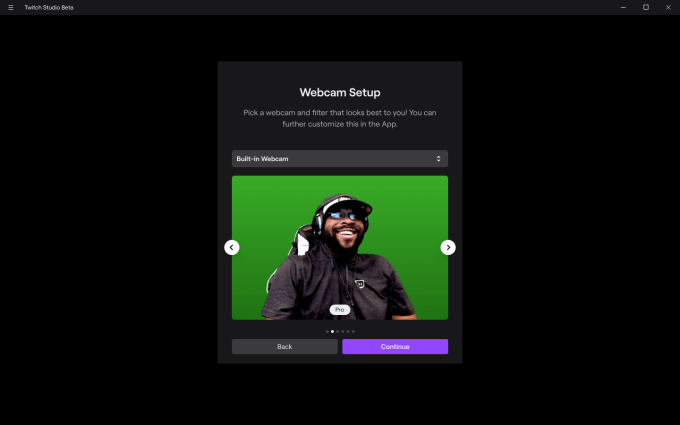
Twitch today publicly launched Twitch Studio, its new software designed to help new streamers get started broadcasting. The idea behind the app is to make it simple for someone new to the space to get started, by offering a quick setup process and other tools to make the stream both look and sound more professional — even if the streamer doesn’t have broadcasting experience.

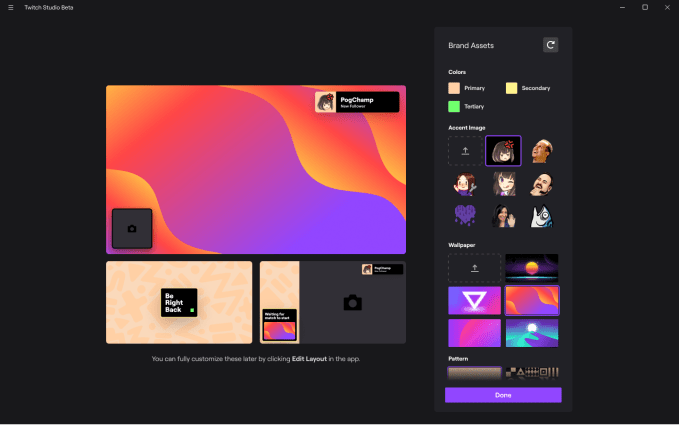
The software, which was only available in closed beta until today, will detect the user’s mic, webcam, monitor resolution, bitrate and more through a guided setup process. Streamers can then choose from a variety of starter layouts and overlays that will help them personalize their stream’s look-and-feel.

Once live on Twitch, the software will also help streamers to interact with the online community and viewers, including by way of built-in alerts, an activity feed, and integrated Twitch chat.

As the company previously explained, many people have thought about streaming but gave up on doing so because the process was too difficult. The new software aims to get them over that hurdle of setting up a stream for the first time.

As the streamer becomes more knowledgable and capable, they may outgrow their need for Twitch Studio — and that would be fine. The goal was to get them involved with Twitch streaming in the first place, not necessarily keep them on the platform longer-term.

Twitch Studio is currently available only on Windows PCs, not Mac, iOS or Android “at this time,” Twitch says — a hint that cross-platform support could come further down the road. However, in the near-term, Twitch is working to better integrate the software with other Twitch functionality as well as roll out tools that make it easier to chat and engage viewers.

The launch timing is notable as Twitch has recently lost its biggest streamer, Tyler “Ninja” Blevins, to Microsoft’s Mixer. The loss was then followed by the exit of Michael “Shroud” Grzesiek, also to Mixer. Meanwhile, Google’s Stadia, which is about to launch on Nov. 19, will make it easy to stream directly to YouTube. 

Twitch says the new Twitch Studio software is available today, in beta, for anyone on Windows 7 or newer.

12 Nov 2019

HBO’s former CEO said to be in talks with Apple TV+ for an exclusive production deal

The man who oversaw the creation of some of HBO’s most highly-praised ‘prestige TV’ could soon be making shows for Apple TV+, according to a new report from the Wall Street Journal. Richard Plepler, who was HBO’s Chairman and CEO up until he parted ways with the company last February following its acquisition by AT&T, is nearing an exclusive production deal with Apple’s new original content streaming service, the report says.

Plepler, who spent almost 30 years at HBO, including six as its CEO during which the media company aired some of its biggest hits, including ‘Game of Thrones,’ would definitely bring some big-name industry influence to Apple’s efforts. Not that Apple TV+ lacks for that in its early offing, either: The premiere slate of original shows include Jennifer Aniston and Reese Witherspoon-led ‘The Morning Show,’ and and a show centred around Oprah’s Book Club, just to name a couple of examples.

The deal, which isn’t yet final but might be signed officially “within the next few weeks,” per the report, would be between Apple and Plepler’s RLP & Co., a production company he established after leaving HBO. There’s nothing yet to indicate what kind of projects he’d be working on for Apple TV+, but it’s a logical target for Apple’s new original content enterprise to pursue, given that its focus thus far appears to be on fewer, big budget and high-profile projects, but critical reception hasn’t been up to par with the kind of TV that HBO has a track record of producing.

12 Nov 2019

HBO’s former CEO said to be in talks with Apple TV+ for an exclusive production deal

The man who oversaw the creation of some of HBO’s most highly-praised ‘prestige TV’ could soon be making shows for Apple TV+, according to a new report from the Wall Street Journal. Richard Plepler, who was HBO’s Chairman and CEO up until he parted ways with the company last February following its acquisition by AT&T, is nearing an exclusive production deal with Apple’s new original content streaming service, the report says.

Plepler, who spent almost 30 years at HBO, including six as its CEO during which the media company aired some of its biggest hits, including ‘Game of Thrones,’ would definitely bring some big-name industry influence to Apple’s efforts. Not that Apple TV+ lacks for that in its early offing, either: The premiere slate of original shows include Jennifer Aniston and Reese Witherspoon-led ‘The Morning Show,’ and and a show centred around Oprah’s Book Club, just to name a couple of examples.

The deal, which isn’t yet final but might be signed officially “within the next few weeks,” per the report, would be between Apple and Plepler’s RLP & Co., a production company he established after leaving HBO. There’s nothing yet to indicate what kind of projects he’d be working on for Apple TV+, but it’s a logical target for Apple’s new original content enterprise to pursue, given that its focus thus far appears to be on fewer, big budget and high-profile projects, but critical reception hasn’t been up to par with the kind of TV that HBO has a track record of producing.

12 Nov 2019

A US federal court finds suspicionless searches of phones at the border is illegal

A federal court in Boston has ruled that the government is not allowed to search travelers’ phones or other electronic devices at the U.S. border without first having reasonable suspicion of a crime.

That’s a significant victory for civil liberties advocates, who say the government’s own rules allowing its border agents to search electronic devices at the border without a warrant are unconstitutional.

The court said that the government’s policies on warrantless searches of devices without reasonable suspicion “violate the Fourth Amendment,” which provides constitutional protections against warrantless searches and seizures.

The case was brought by 11 travelers — ten of which are U.S. citizens — with support from the American Civil Liberties Union and the Electronic Frontier Foundation, who said border agents searched their smartphones and laptops without a warrant or any suspicion of wrongdoing or criminal activity.

The border remains a bizarre legal grey area, where the government asserts powers that it cannot claim against citizens or residents within the United States but citizens and travelers are not afforded all of their rights as if they were on U.S. soil. The government has long said it doesn’t need a warrant to search devices at the border. Any data collected by Customs & Border Protection without a warrant can still be shared with federal, state, local and foreign law enforcement.

Esha Bhandari, staff attorney with the ACLU’s Speech, Privacy, and Technology Project, said the ruling “significantly advances” protections under the Fourth Amendment.

“This is a great day for travelers who now can cross the international border without fear that the government will, in the absence of any suspicion, ransack the extraordinarily sensitive information we all carry in our electronic devices,” said Sophia Cope, a senior staff attorney at the EFF.

Millions of travelers arrive into the U.S. every day. Last year, border officials searched 33,000 travelers’ devices — a fourfold increase since 2015 — without any need for reasonable suspicion. In recent months, travelers have been told to inform the government of any social media handles they have, all of which are subject to search prior to being let in to the United States. But some have been denied entry to the U.S. for content on their phones shared by other people.

A spokesperson for Customs & Border Protection did not immediately comment.

12 Nov 2019

Elon Musk picks Berlin for Tesla’s Europe Gigafactory

Elon Musk said Tuesday during an awards ceremony in Germany that Tesla’s European gigafactory will be built in the Berlin area.

Musk was on stage to receive a Golden Steering Wheel Award given by BILD.

“There’s not enough time tonight to tell all the details,” Musk said while on stage. “But it’s in the Berlin area, and it’s near the new airport.”

Developing …. 

12 Nov 2019

MACLUNKEY! The Han/Greedo scene has an inexplicable change on Disney+ because George Lucas will never stop changing it


Who shot first? Han? Greedo? Who cares. MACLUNKEY!

Disney+ launched this morning, and with it comes a mostly inexplicable change to one of cinema’s most debated scenes — the encounter between Han and Greedo at the Mos Eisley Cantina. For reasons unknown to anyone but George Lucas right now, a super brief but newly inserted clip has Greedo shout what the Internet has decided is “MACLUNKEY!” before taking his failed shot at Han.

The change was first noted by StarWarsVisComp, a wonderful Twitter account that tears apart the countless different editions of Star Wars and highlights their endless (and sometimes quite subtle!) differences.

Before you go and get too mad at Disney for changing things for the sake of changing things: apparently this edit came from George Lucas — the uncontested champion of post-release cinematic change himself — with the new clip purportedly being inserted years ago during a 4K restoration that didn’t see the light of day until now.

Comparison clips have already started hitting YouTube:

And yes, for the curious: the “Maclunkey” line really is in the Disney+ release. If you’ve got Disney+, you can find it at around the 50:52 mark in A New Hope.

So what’s a Maclunkey? No one knows. As Uproxx points out, the rest of the dialog throughout the conversation is captioned. But Maclunkey? That’s left to the viewer’s interpretation.

Until we get further explanation, I like to think that it’s the Rodian/Huttese equivalent of “Eh, screw it.” Found a stain on your shirt ten minutes after getting to work? Maclunkey. Gonna take a cheap shot at the baddest smuggler in the galaxy without bothering to, you know, aim? Maclunkey. Edited a new bit of alien dialogue into your classic film but forgot to come up with a translation before it shipped? Maclunkey!

12 Nov 2019

Review: Samsung’s Space Monitor is handsome and minimal — if you have the desk for it

When Samsung announced the Space Monitor, I knew in an instant that it was going to be something I had to try out in person. Now that I’ve had time to do so, I’m happy to say it’s much as advertised, a streamlined and solid monitor with a smart new design — but not necessarily one for everybody.

Samsung Space Monitor

Pros:

  • Clever space-saving design
  • Quiet, attractive look
  • Solid color out of the box

Cons:

  • Doesn’t rotate and height depends on distance from wall
  • Sub-par viewing angles
  • Doesn’t work with every desk

Price: $400 (27-inch); $500 (32-inch)

We don’t review a lot of monitors at TechCrunch — none, really. This was more of a curiosity to me. I’m interested in design and monitors are usually ugly at best. But I was impressed with Samsung’s approach here and wanted to see if it worked in real life.

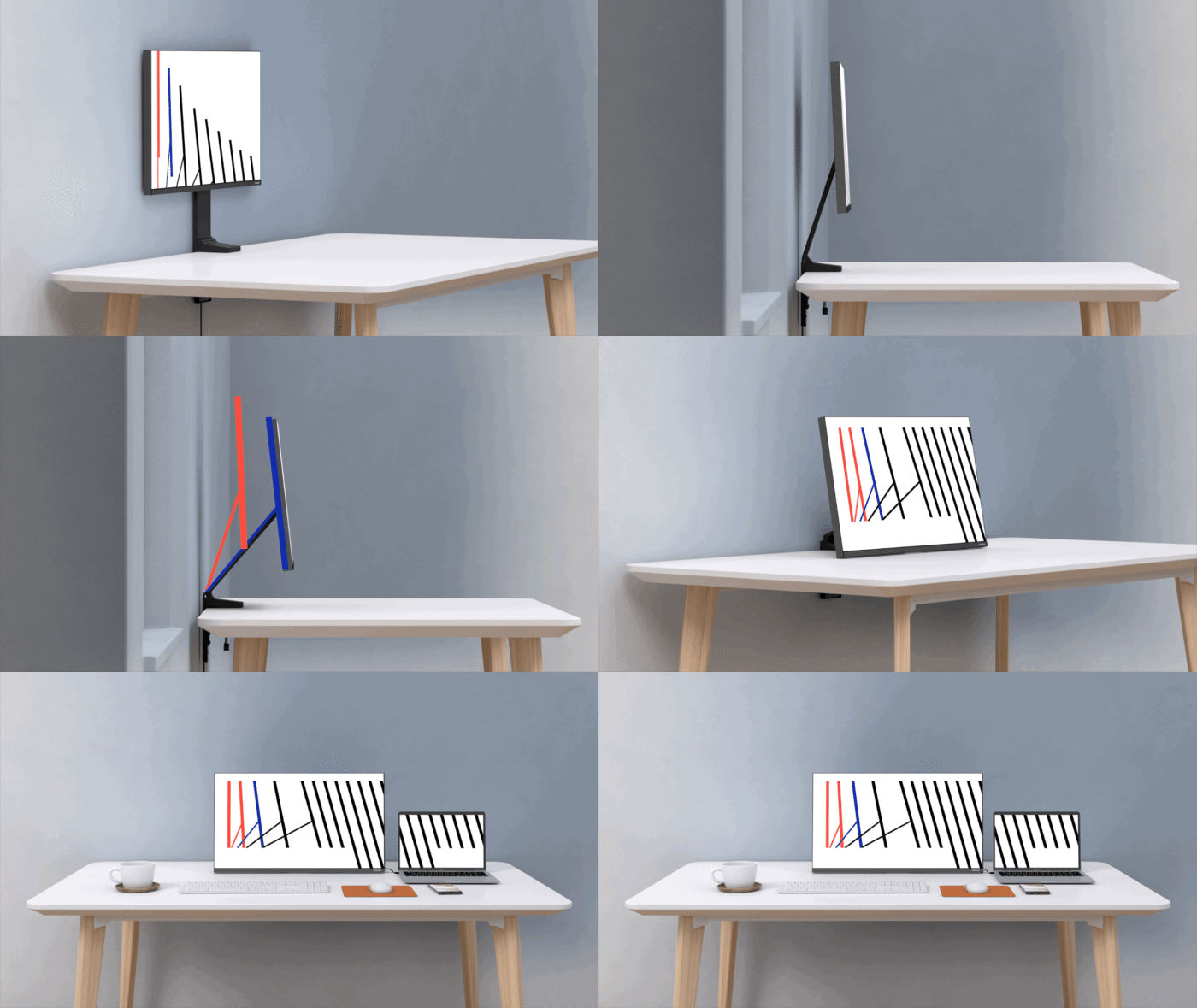
The big advance of the Space Monitor is its very low-profile mount, which grips the edge of your desk on the wall side and can be folded up flat against it. It can rotate up and down, the monitor tilting to taste — not so far as the Surface Studio but with that same general range of motion.
The monitor itself comes in two varieties: a larger 32-inch 4K one and a smaller 27-inch one at 2560×1440. I reviewed the smaller one, as the large one has a lower refresh rate and I really don’t have any use for 4K in my workflow.

The ideal situation for this thing is a relatively small work space where having the monitor actually sitting on your desk kind of invalidates all the space around it. With the Space Monitor, the stand is flush with the wall, clearing up the area below and in front of it even when it’s folded outwards. It’s easier than piercing the wall for a free-floating display

The performance of the monitor, as far as I am able to tell, is good but not great. The colors are vibrant and the default settings are solid, if perhaps a little warm (easily adjusted, of course). The refresh rate goes up to 144 Hz, which is more than enough for gaming, and can easily be tweaked to 120 for those of us who are very picky about video pulldown and other deep frame rate stuff.

One thing that isn’t impressive is the viewing angle. I feel like the sweet spot for this monitor is far narrower than on the Dell Ultrasharp IPS panel I’ve used for years. If you’re not sitting directly in front of it, you’re going to get color and brightness falloff at the edge you’re farthest from.
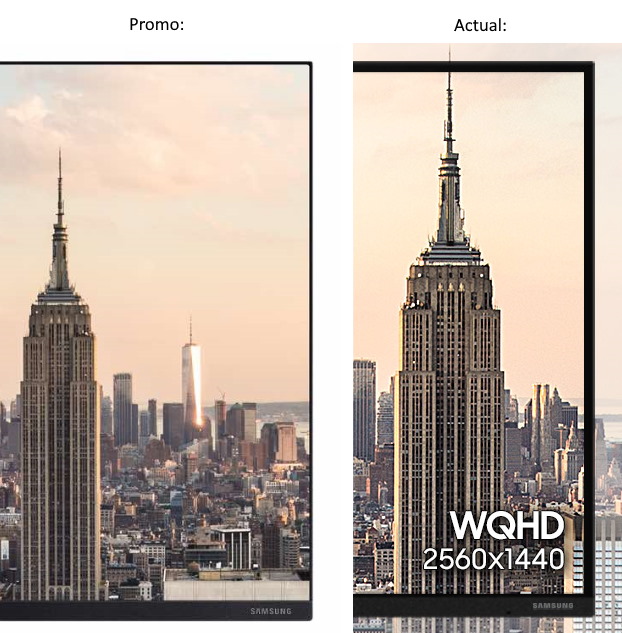
The bezel is narrow, a bit more than a quarter inch, a little thicker on the bottom side. It’s also nearly flush on the top and sides so you don’t feel like the bezels protrude towards you. All in all it’s a very handsome and understated design, as these things go. It’s worth noting that Samsung appears to have fudged the press imagery a bit and the microscopic bezel you see in official images is not actually what you get.

Installation isn’t quite as easy as just setting something down on your desk, but if you have a compatible desk, it’s literally as easy as sliding the clamp on and tightening it. A custom cable (optional, but convenient) combines HDMI and power into one, and fits into a groove on the back of the stand, eliminating clutter.

But you’ll want to take a good look at your desk to make sure it is compatible. I didn’t, and had to jury-rig a solution.

Basically, unless your desk is more or less solid and has a ledge that the clamp can close down on, you might have a problem. My desk is solid and about an inch and a half thick, but has a sort of wall that juts down about two more inches. I removed and reattached the bottom part of the clamp so it could just barely be slipped around the wall, but then the screw wouldn’t reach the bottom surface of the desk, so I had to fill the gap with a book. (It’s okay, I’ve got lots.)
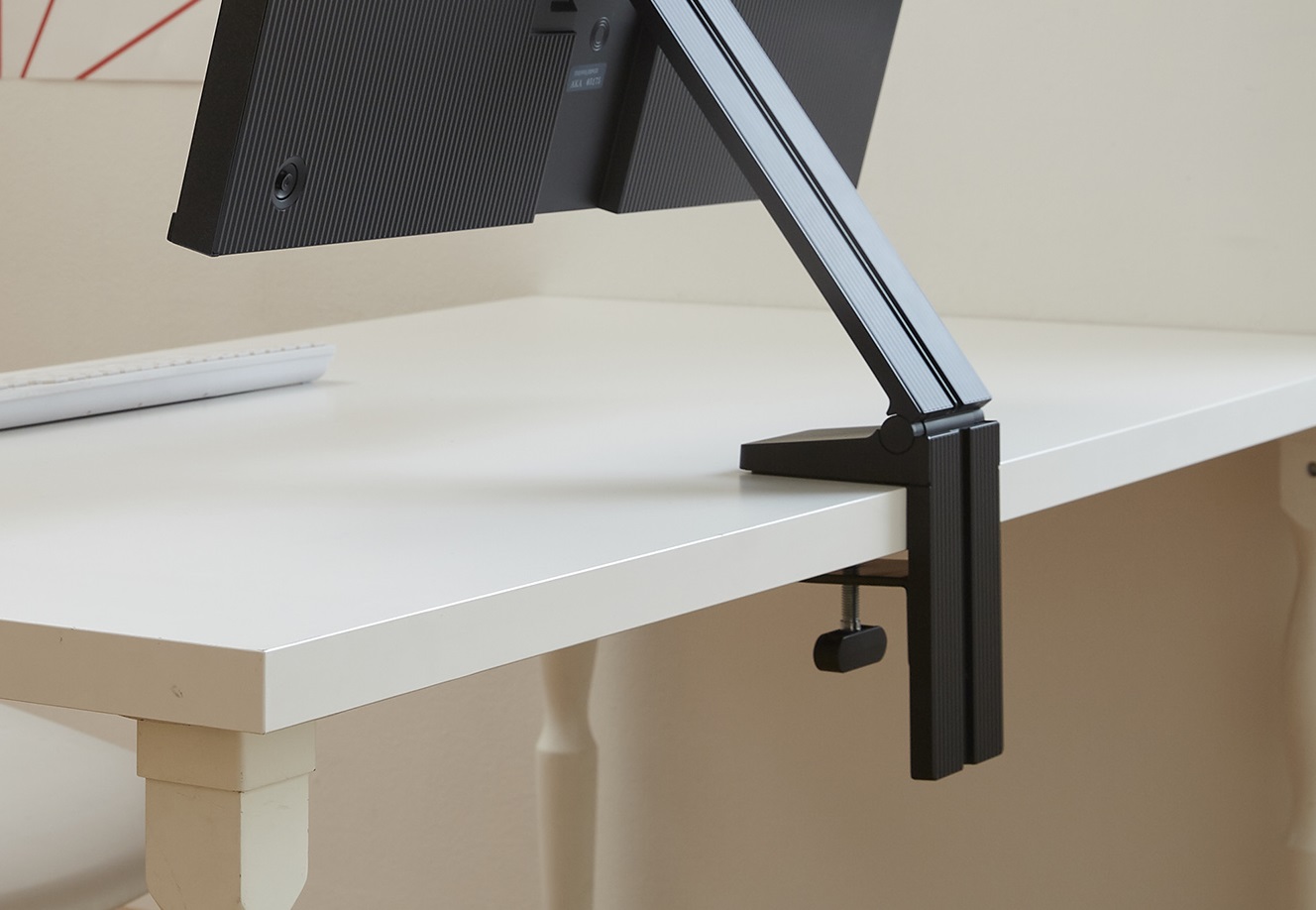
The stand is plenty stiff and the monitor stays exactly where you’ve put it, but it is a little wobbly — understandable given that it sits at the very tip of a 14-inch-long arm. I only really noticed when I was typing very hard or bumped the desk, when I noticed it wobbled more and longer than the Dell on its traditional stand.

Now, if you’ve looked closely at the way this monitor and stand is set up, you may have noticed something else: this thing can’t rotate. Yes, unfortunately, the nature of the Space Monitor means that it must always be parallel to the desk edge it’s attached to, and can only move directly perpendicular to it. There is also no way to slide the monitor up and down, or rather to do so you must also move it towards or away from you.

For some this is unacceptable. And although it’s fine for me as a primary monitor, it would never work as a secondary one, like the Dell I now have angled toward me adjacent to the Samsung.

That does significantly limit its use cases, and the spaces in which it works well. But I still feel it’s a great option for some. If you have limited space and plan to primarily work from the sweet spot directly in front of it, this is a solid monitor big enough for productivity, movies, and games.

For those seeking a low-profile, space-saving alternative to the usual monitors, the Space Monitor is a great option. But for multiple-monitor setups or people who shift the angle a lot, it probably isn’t the best. At $400 it has strong competition from the usual suspects, but for some people the slight increase in image quality or the ability to slide the monitor up and down isn’t worth losing the desk space or having a clunky design. The Space Monitor is available now, at Samsung’s site or your usual electronics retailer.


12 Nov 2019

UCLA now has the first zero-emission, all-electric mobile surgical instrument lab

Electrification in the automotive industry isn’t just about consumer cars: There are plenty of commercial and specialist vehicles that are prime candidates for EVs, including in the healthcare industry. Take the new UCLA mobile surgical lab developed by Winnegbago, for instance – it’s a zero-emission, all-electric vehicle that will move back and forth between two UCLA campuses, collecting, sterilizing and repairing surgical instruments for the medical staff there.

Why is that even needed? The usual process is sending out surgical instruments for this kind of service by a third-party, and it’s handled in a dedicated facility at a significant annual cost. UCLA Health Center estimates that it can save as much as $750,000 per year using the EV lab from Winnebago instead.

The traveling lab can operate for around eight hours, including round-trips between the two hospital campuses, or for a total distance traveled of between 85 and 125 miles on a single charge of its battery, depending on usage. It also offers “the same level of performance, productivity and compliance” as a lab in afixed location building, according to Winnebago.

Aside from annual savings on operating costs, UCLA also got some discounts towards the purchase of the lab from a few grant programs, including the Hybrid and Zero-Emission Truck and and Bus Voucher Incentive Project (an admitted mouthful, but it does have its own acronym luckily – HVIP). These programs all encourage the adoption of electric vehicles through financial incentives that help defray the upfront costs, which is yet another good reason for industries like health care to look at EVs as a way to not only reduce costs long-term, but up-front as well.

12 Nov 2019

The AI stack that’s changing retail personalization

Consumer expectations are higher than ever as a new generation of shoppers look to shop for experiences rather than commodities. They expect instant and highly-tailored (pun intended?) customer service and recommendations across any retail channel.

To be forward-looking, brands and retailers are turning to startups in image recognition and machine learning to know, at a very deep level, what each consumer’s current context and personal preferences are and how they evolve. But while brands and retailers are sitting on enormous amounts of data, only a handful are actually leveraging it to its full potential.

To provide hyper-personalization in real time, a brand needs a deep understanding of its products and customer data. Imagine a case where a shopper is browsing the website for an edgy dress and the brand can recognize the shopper’s context and preference in other features like style, fit, occasion, color etc., then use this information implicitly while fetching similar dresses for the user.

Another situation is where the shopper searches for clothes inspired by their favorite fashion bloggers or Instagram influencers using images in place of text search. This would shorten product discovery time and help the brand build a hyper-personalized experience which the customer then rewards with loyalty.

With the sheer amount of products being sold online, shoppers primarily discover products through category or search-based navigation. However, inconsistencies in product metadata created by vendors or merchandisers lead to poor recall of products and broken search experiences. This is where image recognition and machine learning can deeply analyze enormous data sets and a vast assortment of visual features that exist in a product to automatically extract labels from the product images and improve the accuracy of search results. 

Why is image recognition better than ever before?

retail and artificial intelligence


While computer vision has been around for decades, it has recently become more powerful, thanks to the rise of deep neural networks. Traditional vision techniques laid the foundation for learning edges, corners, colors and objects from input images but it required human engineering of the features to be looked at in the images. Also, the traditional algorithms found it difficult to cope up with the changes in illumination, viewpoint, scale, image quality, etc.

Deep learning, on the other hand, takes in massive training data and more computation power and delivers the horsepower to extract features from unstructured data sets and learn without human intervention. Inspired by the biological structure of the human brain, deep learning uses neural networks to analyze patterns and find correlations in unstructured data such as images, audio, video and text. DNNs are at the heart of today’s AI resurgence as they allow more complex problems to be tackled and solved with higher accuracy and less cumbersome fine-tuning.

How much training data do you need?

12 Nov 2019

A new ‘Zombieload’ flaw hits Intel’s newest Cascade Lake chips

Time to reset your “days since last major chip vulnerability” counter back to zero.

Security researchers have found another flaw in Intel processors — this time it’s a new variant of the Zombieload attack they discovered earlier this year, but targeting Intel’s latest family of chips, Cascade Lake.

Intel calls the vulnerability Transactional Asynchronous Abort, or TAA. It’s similar to the microarchitectural data sampling vulnerabilities that were the focus of earlier chip-based side-channel attacks, but TAA applies only to newer chips.

The new variant of the Zombieload attack allows hackers with physical access to a device the ability to read occasionally sensitive data stored in the processor. The vulnerability is found in how the processor tries to predict the outcome of future commands. This technique, known as speculative execution, makes the processor run faster, but its flawed design makes it possible for attackers to extract potentially sensitive data.

Zombieload was discovered by the same researchers who found Meltdown and Spectre, a set of flaws that could be used to pick out secrets — like passwords — from the processor. It was believed later chip architectures, like Cascade Lake, were toughened against speculative execution attacks, while Intel rolled out software patches to reduce the attack surface.

Neither of the other vulnerabilities in the same family as Zombieload — notably Fallout and RIDL — work on Cascade Lake, they added.

But the researchers said that Intel’s efforts to change the chip design in Cascade Lake are “not sufficient” to protect against these kinds of side-channel attacks.

The same researchers warned Intel about the vulnerability in April — as it did with the other flaws they discovered that were patched a month later. Intel took until this month to investigate, the researchers said.

Intel released patches again for its vulnerable chips on Tuesday, acknowledging that its newest chips are vulnerable to the newest Zombieload variant. But the chip making giant recognizes that the mitigations “may not completely prevent the inference of data through a side channel using these techniques.”

The chip maker said there have been “no reports” of real-world exploits of the vulnerabilities.