Year: 2020

16 Nov 2020

Undock raises $1.6M to help solve your group scheduling nightmares

Over the past decade, many startups have tried (and many have failed) to rethink the way we schedule our meetings and calls. But we seem to be in a calendrical renaissance, with incumbents like Google and Outlook getting smarter and smarter and newcomers like Calendly growing significantly.

Undock, an Entrepreneurs Roundtable Accelerator-backed startup, is looking to enter the space.

The startup recently closed a $1.6 million seed round with investors that include Lightship Capital, Bessemer Venture Partners, Lerer Hippeau, Alumni Ventures Group, Active Capital, Arlan Hamilton of Backstage Capital, Sarah Impach of Paypal/LinkedIn, and several other angel investors.

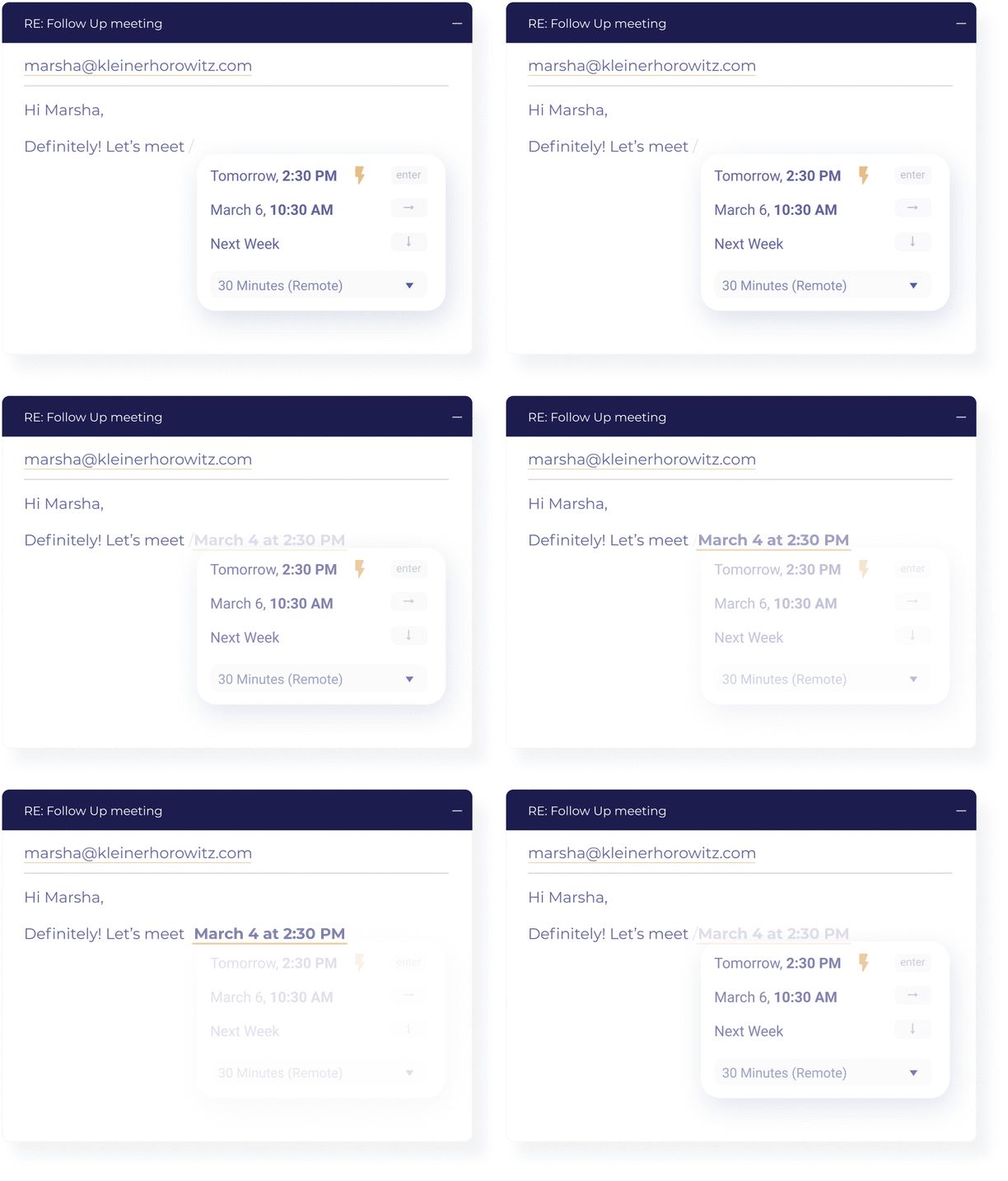
For now, Undock is a Chrome extension that allows users to seamlessly see mutual availability across a group, whether or not all users in the group have Undock, all from within their email. Founder and CEO Nash Ahmed wouldn’t go into too much detail about the technology that allows Undock to accomplish this. But, on the surface, users who don’t yet have Undock can temporarily link their calendar to the individual meeting request to automatically find times that work for everyone in the group. Otherwise, they can see the suggested times of the rest of the group and mark the ones that work for them.

This is just the beginning of the journey for Undock. The company plans to launch a full-featured calendar in Q1 of 2021, that would include collaborative editing right within calendar events, and embedded video conferencing.

According to Ahmed, the most important differentiating features of Undock are that it focuses on mutual availability (not just singular availability) and that it does so right within the email client.

Image Credits: undock

Scheduling will always be free within Undock, but the full calendar (when it’s released publicly) will have a variety of tiers starting at $10/month per user. Undock will also borrow from the Slack model and charge more for retention of information.

“The greatest challenge is definitely customer education,” said Ahmed, explaining that early on some users were confused by the product’s simplicity. “We messaged it by saying it’s like autocomplete. And early users would get into their email and then ask what to do next, or if they had to go back to Undock or to the Chrome extension. And we’d have to say ‘no, just keep typing.'”

The Undock team, which is Black- and female-founded, numbers 18 people. Twenty-eight percent of the team is female, 22 percent are Black, and 11 percent are LGBTQ, and the diversity of the leadership team is even higher.

16 Nov 2020

A report card for the SEC’s new equity crowdfunding rules

This month, the Securities Exchange Commission approved major updates to rules enacted via the 2012 JOBS Act. Their stated goal was to “harmonize” the guidelines that establish exemptions for equity crowdfunding, Reg D and Reg A+ offerings. These changes are a powerful step forward for both startups and investors alike.

This is a space I’ve watched closely since we launched Indiegogo in 2008 and Vincent earlier this year. I spent four years working with the Obama administration, the SEC and FINRA to help pass the JOBS Act in 2012. After that, it took another four years of rule refining with the SEC and FINRA before finally seeing equity crowdfunding go live in May 2016. At Indiegogo, we worked with several great partners, helping fund nearly 150 businesses via equity crowdfunding in just a couple of years.

For those who worked behind the scenes, we knew that the initial 2016 rules for equity crowdfunding were baby steps. We were balancing unknown risks with legacy rules, aiming toward broader democratization for both investors and entrepreneurs. Now, crowdfunding’s day has come, and I commend all involved including the regulators, politicians, startups and investors who all worked together to push the ecosystem forward to the next step.

That said, even today equity crowdfunding isn’t perfect. There are limits to how much you can raise, how you can communicate and how much documentation you need to provide. In reality, it’s not much different than raising from a pre-seed or seed investor, or far removed from a traditional product crowdfund. In short, it works.

The SEC made some important changes to the rules, and it’s valuable to explore them one by one. Rather than look at them on a macro scale, here are some of the bullet points that are important to entrepreneurs.

  • Regulation Crowdfunding (Reg CF) is the basic equity crowdfunding raise for companies. Now, companies can raise up to $5 million from investors, up from the current $1.07 million cap. Any investor can participate.
  • Regulation D, Rule 504 (Reg D) is another type of equity crowdfunding, but exclusively for accredited investors. With the new rules, its maximum funding cap raises to $10 million from $5 million.
  • Regulation A+, Tier II (Reg A+), which is for more established companies, can now raise $75 million via equity crowdfunding, up from the current $50 million. This is a huge move, enabling established companies to gain millions of dry powder. Any investor can participate.
  • Thanks to a “test the waters” provision, companies can build Indiegogo-like crowdfunding pages that allow companies to share information with investors prior to fundraising. This is new for Reg CF, but was previously allowed for Reg A+.
  • Demo day communications, in general, will no longer be considered general solicitation.
  • Reg CF and A+ offerings can use special purpose vehicles (SPVs) to consolidate their investor base into a single line item on a cap table.
  • Reg CF fundraisers can be done every 30 days, down from every 180 days.

Now for a report card. In hopes of clarifying these changes a bit, I looked at each specific point and gave it a letter grade depending on how important it will be to up-and-coming entrepreneurs. While many of the rules got an A or better, some are still lagging and, as we move into a new administration and new year, the difference between crowdfunding success and failure could be spelled out in these simple changes.

1. Regulation Crowdfunding (Reg CF) limit increase

Grade Previous rules (2016) Updated rules (2020)
A Maximum allowed fundraise of $1.07 million Increase in maximum fundraise to $5 million

This change is significant. One of the main complaints we heard from entrepreneurs exploring Reg CF were the actual costs associated with the raise. Between financial, legal and platform fees, companies could be looking at setup costs of $100,000 or more. Combined with time, effort and additional marketing expenses, it adds up to a lot of money just to be capped at $1 million. When compared to finding a few angel investors, the costs often don’t justify the effort. But at a $5 million cap, the cost-of-capital economics drastically improve. Also $5 million is real money, not something a few angels can match.

2. Regulation A+ Tier II limit increase

Grade Previous rules (2016) Updated rules (2020)
C Maximum allowed fundraise of $50 million Increase in maximum fundraise to $75 million

In this case, it’s nice that the cap has gone up, but this isn’t a game-changer. Rarely do Reg A+ offerings even hit the $50 million cap, and those considering Reg+ rarely cite the cap as a key deciding factor. It’s always nice to see the number go up, but this doesn’t change much.

16 Nov 2020

Computer vision startup Chooch.ai scores $20M Series A

Chooch.ai, a startup that hopes to bring computer vision more broadly to companies to help them identify and tag elements at high speed, announced a $20 million Series A today.

Vickers Venture Partners led the round with participation from 212, Streamlined Ventures, Alumni Ventures Group, Waterman Ventures and several other unnamed investors. Today’s investment brings the total raised to $25.8 million, according to the company.

“Basically we set out to copy human visual intelligence in machines. That’s really what this whole journey is about,” CEO and co-founder Emrah Gultekin explained. As the company describes it, “Chooch Al can rapidly ingest and process visual data from any spectrum, generating AI models in hours that can detect objects, actions, processes, coordinates, states, and more.”

Chooch is trying to differentiate itself from other AI startups by taking a broader approach that could work in any setting, rather than concentrating on specific vertical applications. Using the pandemic as an example, Gultekin says you could use his company’s software to identify everyone who is not wearing a mask in the building or everyone who is not wearing a hard hat at construction site.


With 22 employees spread across the U.S., India and Turkey, Chooch is building a diverse company just by virtue of its geography, but as it doubles the workforce in the coming year, it wants to continue to build on that.

“We’re immigrants. We’ve been through a lot of different things, and we recognize some of the issues and are very sensitive to them. One of our senior members is a person of color and we
are very cognizant of the fact that we need to develop that part of our company,” he said. At a recent company meeting, he said that they were discussing how to build diversity into the policies and values of the company as they move forward.

The company currently has 18 enterprise clients and hopes to use the money to add engineers, data scientists and begin to build out a worldwide sales team to continue to build the product and expand its go-to-market effort.

Gultekin says that the company’s unusual name comes from a mix of the words choose and search. He says that it is also an old Italian insult. “It means dummy or idiot, which is what artificial intelligence is today. It’s a poor reflection of humanity or human intelligence in humans,” he said. His startup aims to change that.

16 Nov 2020

‘Resident Evil’ game maker Capcom confirms data breach after ransomware attack

Capcom, the Japanese game maker behind the Resident Evil and Street Fighter franchises, has confirmed that hackers stole customer data and files from its internal network following a ransomware attack earlier in the month.

That’s an about-turn from the days immediately following the cyberattack, in which Capcom said it had no evidence that customer data had been accessed.

In a statement, the company said data on as many as 350,000 customers may have been stolen, including names, addresses, phone numbers, and in some cases dates of birth. Capcom said the hackers also stole its own internal financial data and human resources files on current and former employees, which included names, addresses, dates of birth, and photos. The attackers also took “confidential corporate information,” the company said, including documents on business partners, sales, and development.

Capcom said that no credit card information was taken, as payments are handled by a third-party company.

But the company warned that the overall amount of data stolen “cannot specifically be ascertained” due to losing its own internal logs in the cyberattack.

Capcom apologized for the breach. “Capcom offers its sincerest apologies for any complications and concerns that this may bring to its potentially impacted customers as well as to its many stakeholders,” the statement read.

The video games maker was hit by the Ragnar Locker ransomware on November 2, prompting the company to shut down its network. Ragnar Locker is a data-stealing ransomware, which exfiltrates data from a victim before encrypting its network, and then threatens to publish the stolen files unless a ransom is paid. In doing so, ransomware groups can still demand a company pays the ransom even if the victim restores their files and systems from backups.

Ragnar Locker’s website now lists data allegedly stolen from Capcom, with a message implying that the company did not pay the ransom.

Capcom said it had informed data protection regulators in Japan and the United Kingdom, as required under European GDPR data breach notification rules. Companies can be fined up to 4% of their annual revenue for falling foul of GDPR rules.

16 Nov 2020

Equity Monday: C3.AI files to go public and Vision Fund 2 leads $100M round

Hello and welcome back to Equity, TechCrunch’s venture capital-focused podcast where we unpack the numbers behind the headlines.

This is Equity Monday, our weekly kickoff that tracks the latest big news, chats about the coming week, digs into some recent funding rounds and mulls over a larger theme or narrative from the private markets. You can follow the show on Twitter here and myself here — and don’t forget to check out last Friday’s episode that we wound up titling Th O’s r ptinal, th dllrs r mndtry, a joke that if we observe the weekend’s podcast analytics, was a mistake.

Lesson learned!

But in better news there was lots to get to this morning, so here’s a digest of what we talked about:

Do not sleep on the fact that our own Chris Gates is posting Equity videos from every main episode over on YouTube. He does a great job and it’s fun to be on video, as well as audio platforms.

We hope you are rested and ready to go for the rest of the week. Chat as soon as Airbnb files.

Equity drops every Monday at 7:00 a.m. PDT and Thursday afternoon as fast as we can get it out, so subscribe to us on Apple PodcastsOvercastSpotify and all the casts.

16 Nov 2020

HBO Max arrives on Amazon Fire TV devices

WarnerMedia’s streaming service HBO Max is finally coming to Amazon’s Fire TV, nearly half a year after it first launched. The service, which combines HBO content with an expanded selection from WarnerMedia’s library and a slate of originals, debuted without support for two of the largest streaming platforms in the U.S.: Amazon Fire TV and Roku.

As a part of the new deal, existing HBO subscribers on Amazon will be able to use the HBO Max app at no additional cost.

The delay to get the HBO Max app on Amazon Fire TV wasn’t technical in nature, but rather a result of failed negotiations between the companies. Amazon wanted to be able to sell access to HBO Max through its existing Prime Video Channels platform, as it did for HBO. This was complicated by the fact that HBO didn’t exactly release HBO Max as a brand-new service, but was updating its HBO Now app to become HBO Max. That seemingly left the door open for a similar upgrade to other existing HBO subscribers, Amazon believed.

WarnerMedia, on the other hand, wanted to distribute HBO Max as a new streaming service, not as a premium channel add-on, like HBO. When asked about its failure to offer apps for Roku and Amazon Fire TV, the company explained in May it was looking forward to “reaching agreements with the few outstanding distribution partners left, including with Amazon and on par with how they provide customers access to Netflix, Disney+ and Hulu on Fire devices.”

At last, that deal got done. The companies announced this morning HBO Max would begin to roll out to Amazon Fire TV streaming devices, Fire TV Edition smart TVs, and Fire tablets on Tuesday, November 17. This will expand HBO Max’s potential reach to “tens of millions” of Amazon device customers, WarnerMedia said.

The company tells TechCrunch that, as a result of the deal, HBO content will continue to be available on Prime Video Channels with a subscription. Meanwhile, customers who have a subscription to HBO through Prime Video Channels now also have access to HBO Max for no additional cost.

To access HBO Max, customers can log into the HBO Max app using their Amazon credentials, a spokesperson said.

“We are very excited that Amazon customers will now be able to enjoy the best-in-class content that lives within HBO Max,” said Tony Goncalves, Head of Sales and Distribution for WarnerMedia, in a statement about the deal. “Our continued goal is to make HBO Max and its unparalleled content available to customers across all the devices they love. Fire TV is a favorite among customers and we look forward to working with the Amazon team to engage and grow our existing subscriber base by showcasing all that HBO Max has to offer.”

The Fire TV integrations will also allow Amazon customers to launch and navigate HBO Max by voice, using Alexa commands like “Alexa, find HBO Max,” or “Alexa, find Game of Thrones,” and more.

Last month, WarnerMedia reported that HBO Max had grown to reach 28.7 million total subscribers, but few of these customers were “over the top” — meaning, coming in through standalone subscriptions to the HBO Max app, like what will be available on Amazon Fire TV. Instead, most customers were coming in from  “wholesale” agreements — that is, a pay TV provider of some kind. Only 3.6 million were considered direct retail subscribers.

Those numbers may increase now that HBO Max is addressing at least one of the two key streaming device markets for distribution. Roku, however, has not yet announced a similar deal.


16 Nov 2020

NASA sends Baby Yoda to space aboard SpaceX Dragon alongside astronauts

NASA added a surprise fifth passenger to the Crew-1 mission currently en route to the International Space Station – a plush The Child (aka Baby Yoda) from The Mandalorian. The doll is what’s known as the “zero-gravity indicator” – typically a soft, small object that is allowed to float free in the spacecraft cabin to provide a simple, but effective confirmation of when it passes into the phase of a spaceflight where Earth’s gravity no longer holds significant sway.

Crew-1’s other four passengers are all actual people – NASA astronauts Michael Hopkins, Victor Glover and Shannon Walker, along with JAXA astronaut Soichi Noguchi. They’re on their way to the ISS to staff it for the next half a year, on NASA’s first operational commercial crew mission, courtesy of partner SpaceX, which certified its Falcon 9 rocket and Crew Dragon spacecraft for human flight earlier this year.

Baby Yoda won hearts with its debut on Disney’s original streaming show The Mandalorian last year, and continues to woo audiences with this year’s second season. It earned its colloquial nickname because it’s a juvenile version of whatever the heck the original Yoda from the Star Wars saga is. In the new series, the youngster regularly earns reprimands from the series’ titular bounty hunter for messing around with his spacecraft controls.

The Child merch is already white hot, but zero-G indicators of past have also notably become hot ticket items following their trips to space. On SpaceX’s first human spaceflight mission, the Demo-2 test flight that took place earlier this year, a Ty Flippable dinosaur called ‘Tremor’ quickly flew off shelves following its own free-floating antics.

16 Nov 2020

Zilliz raises $43 million as investors rush to China’s open source software

For years, founders and investors in China had little interest in open source software because it did not seem like the most viable business model. Zilliz‘s latest financing round shows that attitude is changing. The three-year-old Chinese startup, which builds open source software for processing unstructured data, recently closed a Series B round of $43 million.

The investment, which catapults Zilliz’s to-date raise to over $53 million, is a sizable amount for any open source business around the world. Storied private equity firm Hillhouse Capital led the round joined by Trustbridge Partners, Pavilion Capital, and existing investors 5Y Capital (formerly Morningside) and Yunqi Partners.

Investors are going after Zilliz as they increasingly recognize open source as an effective software development strategy, Charles Xie, founder and CEO of Zilliz, told TechCrunch at an open source meetup in Shenzhen where he spoke as the first Chinese board chairperson for Linux Foundation’s AI umbrella, LF AI.

“Investors are seeing very good exits for open source companies around the world in recent years, from Elastic to MongoDB,” he added.

“When Starlord [Xie’s nickname] first told us his vision for data processing in the future digital age, we thought it was a crazy idea, but we chose to believe,” said 5Y Capital’s partner Liu Kai.

There’s one caveat for investing in the area: don’t expect to make money in the first 3 to 5 years. “But if you’re looking at an 8 to 10-year cycle, these [open source] companies can gain valuation at tens of billions of dollars,” Xie reckoned.

After six years as a software engineer at Oracle, Xie left the U.S. and headed home to start Zilliz in China. Like many Chinese entrepreneurs these days, Xie named his startup in English to mark the firm’s vision to be “global from day one.” While Zilliz set out in Shanghai, the goal is to relocate its headquarters to Silicon Valley when the firm delivers “robust technology and products” in the next 12 months, Xie said. China is an ideal starting point both for the cheaper engineering talents and the explosive growth of unstructured data — anything from molecular structure, people’s shopping behavior, audio information to video content.

“The amount of unstructured data in a region is in proportion to the size of its population and the level of its economic activity, so it’s easy to see why China is the biggest data source,” Xie observed.

On the other hand, China has seen rapid development in mobile internet and AI, especially in terms of real-life applications, which Xie argued makes China a suitable testing ground for data processing software.

So far Zilliz’s open source product Milvus has been “starred” over 4,440 times on GitHub and attracted some 120 contributors and 400 enterprise users around the world, half of whom are outside China. It’s done so without spending a penny on advertising; rather, user acquisition has come from its active participation on GitHub, Reddit, and other online developer communities.

Going forward, Zilliz plans to deploy its fresh capital in overseas recruitment, expanding its open source ecosystem, as well as research and development in its cloud-based products and services, which will eventually become a revenue driver as it starts monetizing in the second half of 2021.

16 Nov 2020

Zeotap raises $18.5M for a customer ID platform it says was built with privacy in mind

As the online world slowly moves to a more privacy-focused environment free of cookies, startups building alternative ways to help businesses manage customer identity and build marketing around that are getting attention. Zeotap, a customer identity platform built around a company’s own (first-party) data that combines this with other data sources to create more complete pictures of users and what they do, is today announcing that it has raised a further $18.5 million.

This is an extension of a Series C round for the firm coming from a single investor, SignalFire, from its Breakout Fund, reserved for growth-stage investments. Founded in Berlin with operations now out of New York, Bengaluru in India and the UK, Zeotap has now raised $60.5 million for the round, with other investors including the likes of SingTel (via Innov8), Here (the mapping company), Iris Capital, the European Investment Bank, and a number of others participating.

Zeotap is not disclosing its valuation, but PitchBook notes it was close to $158 million post-money in the first close.

Zeotap started life initially as a platform aimed at mobile usage, specifically helping carriers broker deals with third parties that wanted their customer data. Over the years this has widened and evolved to a bigger opportunity not just to exchange data, but a place to draw it all together to build more useful customer profiles.

Projjol Banerjea, founder and CPO of Zeotap, said in an interview that the opportunity Zeotap is targeting has become especially urgent this year, in the wake of the global health pandemic.

“You have two companies right now,” he said. “Those that are using the current market as an opportunity to reassess marketing and drive efficiencies, and double down on streamlining their business. And those that are more resilient and seeing the current time as an opportunity to scale. Whichever category you fall in, customer data is important.”

The company is currently active in 14 markets, he said, with products aimed at publishers, brands, and data partners. Zeotap’s platform essentially covers a few key areas. First, a customer data platform based around an organization’s first party data about its own customers, which provides a unified customer view for an organization based on what it already has. “This is much harder to do than you’d expect,” Banerjea said. “Managing consent is top of mind here, while making the most of first-party assets.”

Second comes ID resolution. Zeotap claims that it hosts the largest marketing identity graph in the world, with a “network of identifiers that can locate a customer across different channels.” This can include offline phone numbers, email and home addresses, alongside browsing activity. “We can provide a bridge to the digital world for offline names,” he said, adding that Zeotap works with some 112 providers to pool data into a single, unified customer view.

These then come together in Zeotap’s universal ID+ product, which he said is “fully consent based and tokenized, with no data leakage.” This essentially is sold to clients whose marketers can then help their efforts “transit across the ecosystem without any exposure for the customer but also for any of our partners.”

A lot of the regulations that have emerged, and the reasons cookies are being depreciated, are to provide better protection for consumers, to give them better transparency around how and where their data is being used. Approaches like Zeotap’s may not completely eradicate that bigger issue — and some might argue that for the foreseeable future advertising and marketing will remain a cornerstone of how the web works — so much as create a system that makes marketing, and the big data profiling that underpins it, more secure, Banerjea explained.

“ID+ is designed for us to be able to connect the dots without exposure,” he said.

Zeotap essentially has two types of competitors at the moment, he said. Larger marketing clouds that have grown by acquisition, where a number of activities sit in silos but under one bigger umbrella; and those that have grown big businesses around the managing of customer identity, such as Liveramp (the company formerly known as Acxiom) and The Trade Desk.

But in an $87 billion industry, and at a time when having an online strategy is a do-or-die imperative, there is perhaps room for another.

“COVID-19 has catalyzed a transformation in the marketing mix as brands invest in their data and learnings to redirect traditional TV budgets to more effective channels,” said Chris Scoggins, venture partner at SignalFire, in a statement. “Our investment in Zeotap is testament to our belief in the company’s leadership, vision, and its rapidly evolving customer intelligence platform (CIP) with a built-in identity solution for the future of marketing named ID+ .”

16 Nov 2020

Apple’s IDFA gets targeted in strategic EU privacy complaints

A unique device identifier that Apple assigns to each iPhone for third parties to track users for ad targeting — aka the IDFA (Identifier for Advertisers) — is itself now the target of two new complaints filed by European privacy campaign not-for-profit, noyb.

The complaints, lodged with German and Spanish data protection authorities, contend that Apple’s setting of the IDFA breaches regional privacy laws on digital tracking because iOS users are not asked for their consent for the initial storage of the identifier.

noyb is also objecting to others’ being able to access the IDFA without prior consent — with one of its complainants writing that they were never asked for consent for third party access yet found several apps had shared their IDFA with Facebook (per their off-Facebook activity page).

We’ve reached out to the data protection agencies in question for comment.

While Apple isn’t the typical target for digital privacy campaigners, given it makes most of its money selling hardware and software instead of profiling users for ad targeting, as adtech giants like Facebook and Google do, its marketing rhetoric around taking special care over user privacy can look awkward when set against the existence of an Identifier for Advertisers baked into its hardware.

In the European Union there’s a specific legal dimension to this awkwardness — as existing laws require explicit consent from users to (non-essential) tracking. noyb’s complaints cite Article 5(3) of the EU’s ePrivacy Directive which mandates that users must be asked for consent to the storage of ad tracking technologies such as cookies. (And noyb argues the IDFA is just like a tracking cookie but for iPhones.)

Europe’s top court further strengthened the requirement last year when it made it clear that consent for non-essential tracking must be obtained prior to storing or accessing the trackers. The CJEU also ruled that such consent cannot be implied or assumed — such as by the use of pre-checked ‘consent’ boxes.

In a press release about the complaints, noyb’s Stefano Rossetti, a privacy lawyer, writes: “EU law protects our devices from external tracking. Tracking is only allowed if users explicitly consent to it. This very simple rule applies regardless of the tracking technology used. While Apple introduced functions in their browser to block cookies, it places similar codes in its phones, without any consent by the user. This is a clear breach of EU privacy laws.”

Apple has long controlled how third parties serving apps on its iOS platform can use the IDFA, wielding the stick of ejection from its App Store to drive their compliance with its rules.

Recently, though, it has gone further — telling advertisers this summer they will soon have to offer users an opt-out from ad tracking in a move billed as increasing privacy controls for iOS users — although Apple delayed implementation of the policy until early next year after facing anger from advertisers over the plan. But the idea is there will be a toggle in iOS 14 that users need to flip on before a third party app gets to access the IDFA to track iPhone users’ in-app activity for ad targeting.

However noyb’s complaint focuses on Apple’s setting of the IDFA in the first place — arguing that since the pseudonymised identifier constitutes private (personal) data under EU law they need to get permission before creating and storing it on their device.

“The IDFA is like a ‘digital license plate’. Every action of the user can be linked to the ‘license plate’ and used to build a rich profile about the user. Such profile can later be used to target personalised advertisements, in-app purchases, promotions etc. When compared to traditional internet tracking IDs, the IDFA is simply a ‘tracking ID in a mobile phone’ instead of a tracking ID in a browser cookie,” noyb writes in one complaint, noting that Apple’s privacy policy does not specify the legal basis it uses to “place and process” the IDFA.

noyb also argues that Apple’s planned changes to how the IDFA gets accessed — trailed as incoming in early 2021 — don’t go far enough.

“These changes seem to restrict the use of the IDFA for third parties (but not for Apple itself),” it writes. “Just like when an app requests access to the camera or microphone, the plans foresee a new dialog that asks the user if an app should be able to access the IDFA. However, the initial storage of the IDFA and Apple’s use of it will still be done without the users’ consent and therefore in breach of EU law. It is unclear when and if these changes will be implemented by the company.”

We reached out to Apple for comment on noyb’s complaints but at the time of writing an Apple spokesman said it did not have an on-the-record statement. The spokesman did tell us that Apple itself does not use unique customer identifiers for advertising.

In a separate but related recent development, last month publishers and advertisers in France filed an antitrust complaint against the iPhone maker over its plan to require opt-in consent for accessing the IDFA — with the coalition contending the move amounts to an abuse of market power.

Apple responded to the antitrust complaint in a statement that said: “With iOS 14, we’re giving users the choice whether or not they want to allow apps to track them by linking their information with data from third parties for the purpose of advertising, or sharing their information with data brokers.”

We believe privacy is a fundamental human right and support the European Union’s leadership in protecting privacy with strong laws such as the GDPR (General Data Protection Regulation),” Apple added then.

That antitrust complaint may explain why noyb has decided to file its own strategic complaints against Apple’s IDFA. Simply put, if no tracker ID can be created — because an iOS user refuses to give consent — there’s less surface area for advertisers to try to litigate against privacy by claiming tracking is a competitive right.

“We believe that Apple violated the law before, now and after these changes,” said Rossetti in another statement. “With our complaints we want to enforce a simple principle: trackers are illegal, unless a user freely consents. The IDFA should not only be restricted, but permanently deleted. Smartphones are the most intimate device for most people and they must be tracker-free by default.”

Another interesting component of the noyb complaints is they’re being filed under the ePrivacy Directive, rather than under Europe’s (newer) General Data Protection Regulation. This means noyb is able to target them to specific EU data protection agencies, rather than having complaints funnelled back to Ireland’s DPC — under the GDPR’s one-stop-shop mechanism for handling cross-border cases.

Its hope is this route will result in swifter regulatory action. These cases are based on the ‘old’ cookie law and do not trigger the cooperation mechanism of the GDPR. In other words, we are trying to avoid endless procedures like the ones we are facing in Ireland,” added Rossetti.