Year: 2020

16 Nov 2020

A court decision in favor of startup UpCodes may help shape open access to the law

For the past three years, UpCodes and its founders have been entangled in a copyright lawsuit filed by the International Code Council (ICC). Though both focus on the building industry (specifically, the codes architects and builders need to follow), the lawsuit deals with an issue that has wider ramifications: is it possible to copyright the law, or text that carries the weight of the law?

Founded in 2016 and backed by investors including Y Combinator, UpCodes offers two main products, a database of state building codes that is available on a freemium basis, and UpCodes AI, which scans 3D building models for potential code violations. UpCodes’ building code database is at the center of the lawsuit, because it contains material the ICC claims copyright on. UpCodes says its software simplifies the complex and to make revenue and continue authoring new code.

In May, UpCodes won a major decision in the case when United States District Judge Victor Marrero ruled that its posting of building codes was covered by public domain and fair use (a copy of Marrero’s ruling is embedded below).

The lawsuit will proceed because both parties’ motions for dismissal were not granted, but Scott Reynolds, who founded UpCodes with his brother Garrett, called the ruling “a huge advance for us in terms of what we’re doing and making sure UpCodes continues in the future.”

Nine days after Judge Marrero’s ruling on May 27, however, the ICC filed another lawsuit against UpCodes and the Reynolds brothers. This time, the ICC is suing UpCodes for false advertising and unfair competition, claiming that the startup’s copies of building codes are “incomplete and riddled with errors.” UpCodes maintains that the second lawsuit is an attempt to find another way to shut down its business.

The ruling’s wider implications

Marrero’s decision in the first lawsuit is noteworthy because it is one of the first to cite the Supreme Court’s ruling earlier this year in Georgia v. Public.Resource.org, which stemmed from another case involving copyright and the law.

In 2015, the State of Georgia’s Code Revision Committee sued Public.Resource.org, a non-profit that shares public domain materials, to stop it from publishing the Official Code of Georgia Annotated (OCGA), a compilation of all laws in the state. The Code Revision Committee argued that annotations made to the OCGA placed it under state copyright, but the Supreme Court ultimately ruled in April that Georgia does not have copyright over the annotated legal code.

The Supreme Court ruling was watched closely by building professionals and open access advocates. As Architect’s Newspaper wrote in an article published last month, “the Georgia precedent helps clarify the border between private property and the public domain, with implications for architects using or considering such products as well as advocates of nonmonetized availability of code information.”

In an email to TechCrunch, lawyer Joseph Gratz, who represents UpCodes and the Reynolds brothers, said the UpCodes lawsuit’s relevancy extends beyond the building industry because “obviously, it deals with a key question about how we govern ourselves as a society. The ruling confirms that the law belongs to the people, and nobody owns it. You can’t make a business model out of owning the legal rules that citizens have to follow; you have to find some other way to support your business which ICC has done, by getting revenue from program services.”

He added, “It’s a model of how open government data can drive new innovations and successful startups. Law isn’t the only kind of information created by the government that can be leveraged in new ways. Property data, statistics and other kinds of government data can also support new businesses. And in all those cases, big old incumbents like ICC will try to find ways to slow down their new competitors.”

UpCodes was founded by Scott, an architect, and Garrett, a software engineer who previously worked at PlanGrid. The brothers wanted to create a more efficient way to reference building codes, which are so complex that many architecture and building firms hire code consultants to help them navigate regulations. Headquartered in San Francisco, the company currently has about 400,000 monthly active users, mostly industry professionals like architects and engineers, but also home owners and rental tenants.

ICC’s first lawsuit against UpCodes claims the startup violated its copyright on forty International Codes (I-Codes), the set of model building codes that have been adopted by all 50 states. The ICC argues that this impedes their ability to generate revenue from selling copies of its model codes, therefore making it harder for the organization to develop new building codes.

But UpCodes’ stance, supported by Marrero’s ruling, is that the I-Codes are either in the public domain or protected by fair use because they have been adopted into law by federal, state and local governments. (After the ICC filed its copyright infringement lawsuit in August 2017, UpCodes’ site was redesigned to include only enacted state and local building codes, instead of the ICC’s model codes).

Does the government edicts doctrine apply?

Despite being opponents in two ongoing lawsuits now, both UpCodes and the ICC view the Supreme Court’s ruling in Georgia v. Public.Resource.org positively.

“What was really interesting for our case is that no matter if they were in the majority or dissenting, Supreme Court justices on both sides had really incredible quotes that said if it is in the law, of course it’s in the public domain,” said Scott Reynolds.

ICC’s general counsel Melike Oncu, however, said that the ruling “confirmed that [the ICC] is the owner of the model codes it publishes” because of what it said about the governments edicts doctrine. As defined by the U.S. Copyright Office, the doctrine states “edicts of government, such as judicial opinions, administrative rulings, legislative enactments, public ordinances, and similar official legal documents are not copyrightable for reasons of public policy. This applies to such works whether they are Federal, State, or local as well as to those of foreign governments.”

Oncu told TechCrunch in an email that the Supreme Court “confirmed that the government edicts doctrine is ‘a straightforward rule based on the identity of the author… assessed by asking ‘whether the author of the work is a judge or legislator’ acting in ‘the course of his judicial or legislative duties and not ‘whether given material carries ‘the force of law.'”

In other words, Oncu said “this means that the government edicts doctrine does not apply to the Code Council’s I-Codes and that they retain copyright protection regardless of whether or not they are later adopted into law.”

In his decision, Marrero wrote that “because ICC is a private party that lacks the authority to make or interpret the law, the Government Edicts doctrine is clearly not dispositive of this case.” But he also noted that ICC encourages adoption of its model codes into law, so that “even if adoption into law is not the sole reason ICC produces the I-Codes, it is clearly one of the most significant reasons, if not the most significant reason, that the ICC does so,” and that “a private party cannot exercise its copyrights to restrict the public’s access to the law.”

The ICC disagrees with Marrero’s ruling, Oncu told TechCrunch. The organization “believes that his decision was wrong because it held that codes that have the force of law are not copyrightable even if they are authored by a private party. As such, the decision is directly contradicted by the Supreme Court decision’s in Georgia.”

But Gratz said that “building codes are the law, and the Supreme Court ruled that ‘no one can own the law.’ That’s exactly what Judge Marrero ruled.”

Gratz added that “even if the government edicts doctrine doesn’t apply, UpCodes wins for two other separate reasons: because there’s only one way to express the law accurately, so UpCodes had to express it the same way ICC wrote it; and because UpCodes was using the material solely for the purpose of informing the public about what the law is, which the court has found to be fair use.”

In his decision, Marrero cited two other previous rulings involving two of the three groups that merged to form the ICC in 1994: the Building Officials and Code Administration (BOCA) and the Southern Building Code Congress International (SBCCI).

In 1980, BOCA sued private publisher Code Technology for publishing and selling its own edition of building code that was adopted by Massachusetts. The First Circuit court ruled in Code Technology’s favor. Then in 2002, the SBCCI sued Peter Veeck for posting a model building code adopted by local governments on his website, which gave free information about North Texas. SBCCI initially won the case in district court, but lost the appeal when the Fifth Circuit ruled in Veeck’s favor.

“Though the Government Edicts doctrine does not address government adoption of model building codes, two circuit courts have considered the issue,” Marrero wrote. “Their holdings are broadly consistent with each other and reaffirm the principle that no one can own the law. Moreever, both cases concern the model codes of ICC’s predecessors, SBCCI and BOCA, on which at least some of the I-Codes are based. These cases strongly suggest that Defendants do not infringe ICC’s copyrights insofar as they accurately post the I-Codes as adopted.”

The second lawsuit

After Marerro’s ruling, the Reynolds brother said they thought ICC might want to reach a settlement to avoid the chance of setting another precedent in Circuit Court. Instead, the ICC filed its second lawsuit on June 5, claiming that UpCodes and the Reynolds brothers “falsely have claimed and still claim that the copies of the codes they offer are, e.g. accurate, completed and up-to-date.”

In the suit, ICC cites a section in Marrero’s ruling where the judge explained why he was denying UpCodes’ motion for dismissal. “ICC has still raised genuine factual disputes that at least some of the codes posted on Current UpCodes [referring to the version of the site after the initial lawsuit was filed] have ‘indiscriminately mingled’ enacted text with unadopted model text.”

UpCodes corrected the errors when notified by the ICC. The Reynolds brothers said that the second lawsuit pointed out less than two dozen errors on UpCodes’ site, but they have now documented more than 400 sections on ICC’s site that either have an error or out-of-date code that they will use in their response.

Gratz said, “ICC appears to have filed the second lawsuit as a back-up plan to misuse unfair competition law to shut down a superior competitor, since ICC’s first attempt to shut down UpCodes failed. Instead of competing in the marketplace, ICC is wasting time with litigation over marketing copy.”

Both ICC and UpCodes told TechCrunch that they collaborate closely with jurisdictions to make sure codes are up-to-date.

Oncu said that ICC “works hand-in-hand with jurisdictions to publish custom codes. The Code Council receives approval from government officials from each jurisdiction that the code it posts is accurate before publishing a new or revised code.”

She added that a pre-motion letter by Gratz “misleadingly identified as ‘errors’ instances where the Code Council correctly published the custom code with the approval of the jurisdiction and then the identified provision was later amended.”

The Reynolds brothers said UpCodes uses a combination of tech and collaborating with building departments to find mistakes in the codes posted to their database. The startup’s algorithms identify potential errors in the code and the company has worked with building departments in California, Utah, North Dakota and New York City to modify and update codes in their database. For example, UpCodes worked with the California Building Standards Commission to identify missing or duplicated sections and printing errors.

“We have over a million sections of code. When someone points out an error, we can fix it immediately,” said Garrett. “It sounds obvious, but having a system and a team that can fix an error within hours and deploy that to the site, across one system, is a lot better than it was historically, when you got an update and had to print it out and staple it into a book.”

“Putting these codes together is an incredibly complicated process and we’re happy to help by leveraging our tech,” he added. “On the other hand, ICC would rather be a gatekeeper to the law rather than explore innovations in the industry. Codes only get more complex over time. We need new technology and innovations to keep up with the growing demands of these regulations.”

ICC vs UpCodes DecisionandOrder by TechCrunch on Scribd

16 Nov 2020

Techfugees non-profit brings on new CEO to engage tech industry with refugee issues

Techfugees, the global non-profit which advocates the use of technology to aid refugees and displaced people, has appointed tech entrepreneur and Raj Burman as its new CEO. Burman succeeds Josephine Goube, who will continue as executive director of the adjacent Techfugees Charity in order to concentrate on scaling its country-based programs for refugees.

Burman has previously been an Ambassador to the UN Global Poverty Project; led an accelerator program for the European Commission; co-founded a philanthropic venture for WPP Group; mentored with TERN (The Entrepreneurial Refugee Network); and is a board member of the Refugee Youth Service. Burman is also a Fellow of the Institute of Enterprise and Entrepreneurship.

Burman’s appointment comes as Techfugees ramps up its international program. It’s now signed a three-year partnership with the Fondation L’Oréal, the charitable arm of L’Oreal to accelerate its program (#TF4Women) aiding refugee women employment in the tech industry, and will expand it to Italy and Greece. In October, #TF4Women gathered over 60 recruiters to watch 16 women refugees pitch in France, with many being successfully placed in jobs. And the Techfugees membership chapter in Kenya recently developed an app to improve the diagnosis and treatment of refugee patients inside displacement camps.

Raj Burman, CEO Techfugees

Raj Burman, CEO Techfugees

In a statement, Burman said: “I am thrilled to be joining Techfugees at such an exciting time and look forward to working with the team, partners and the global community, to curate innovative humanitarian solutions and accelerate scale-up of next-generation technology to meet human displacement challenges.”

Goube said: “Raj’s unique experience working in the social enterprise sector and business skills are a true gift to our young organization… This is a pivotal moment for Techfugees, which has grown rapidly over the past year and has witnessed an increasing number of displaced persons.”

Natural disasters caused by the effects of climate change are predicted to drastically increase the numbers of refugees and displaced people over the next decade if little or no action is taken. Currently, 1% of humanity (79.5 million people) are displaced, and most observers say that figure is rising.

Founded in 2015, Techfugees now spans 10 countries, including Canada, Kenya and Lebanon, and deploys its projects, programs and events across all five continents. Over 4,000 people have been involved in Techfugees programs to date.

16 Nov 2020

Moderna reports its COVID-19 vaccine is 94.5% effective in first data from Phase 3 trial

Following fast on the heels of Pfizer’s announcement of its COVID-19 vaccine efficacy, Moderna is also sharing positive results from its Phase 3 trial on Monday. The biotech company says that its COVID-19 vaccine candidate has shown efficacy of 94.5% in its first interim data analysis, which covers 95 confirmed COVID cases among its study participants, of which 90 were given the placebo, and only 5 received Moderna’s mRNA-based vaccine. Further, of 11 severe cases of COVID-19, none were found among those who received the actual vaccine candidate.

This is another very promising sign for the potential of having effective vaccines available to the public in some kind of significant volume at some point next year. As mentioned, it’s worth pointing out that this is just a first interim report, but it is data that comes from the safety board overseeing the trial appointed by the National Institutes of Health, which is an independent body not affiliated with Moderna, so it’s a reliable result that provides hope for continued and final analysis.

Moderna says that it will be submitting for an Emergency Use Authorization of its vaccine candidate based on the results within the coming weeks, looking to get approval from the FDA to use it in emergency circumstances ahead of a full and final approval. That EUA, should it be granted, will be based on data from 151 confirmed cases among the Phase 3 participant group (which included 30,000 participants in total), and data from follow-ups extending on average over two months after case confirmation.

All final data will also be submitted to the scientific community for independent peer review, which is a standard part of the ultimate vaccine trial and approval process.

Both these and Pfizer’s vaccine candidate, which it developed in partnership with BioNTech, are mRNA-based vaccines. These are relatively new in terms of human use, and differ from traditional vaccines in that they use messenger RNA to instruct a recipient’s cells to generate effective antibodies, without actually exposing them to any virus, whereas more traditional vaccines in general use typically use either small, safe doses of active or inactive virus in order to trigger a patient’s immune system to generate their own antibodies.

16 Nov 2020

Harbr raises $38.5M to help enterprises exchange and share big data troves securely

Organizations today are sitting on mountains of data that they amass and use in their own businesses, but many are also looking to share those troves with other parties to expand their business — a model that comes with challenges (privacy and data protection being two key ones); and these days (due to Covid-19 and the push to more digital transformation) with urgency; but also big rewards if you can pull it off well.

Today, a new London startup called Harbr, which has built a secure platform to enable big data exchange, is announcing a big round of funding to tap into that demand. The company has raised $38.5 million in a Series A round of funding, just six months since emerging from stealth mode. It plans to use the money to hire more people to meet the demand of serving more enterprise customers, and for R&D.

Led jointly by new backers Dawn Capital and Tiger Global Management, the round also had participation from past investors Mike Chalfen, Boldstart Ventures, Crane Venture Partners, Backed and Seedcamp, alongside UiPath’s founder and CEO Daniel Dines and head of strategy Brandon Deer. Harbr has now raised over $50 million, and it’s not disclosing its valuation.

Harbr has been around since 2017, but it only came out of stealth mode earlier this year, in May. Its approach has mirrored that of a lot of other enterprise startups that spend a long time building their product under wraps. Identifying the market opportunity when it was still nascent, Harbr then worked directly (and quietly) with enterprises to figure out what they needed and build it, before launching it as a commercial product (with customers already in hand).

“Back in 2017 no one was talking about enterprise data exchanges,” Harbr’s CSO Anthony Cosgrove (who co-founded the company with Gary Butler, the CEO)  me in an interview. “So we worked with big companies to understand their needs and built Harbr based on that.”

Customers include those in financial and enterprise services such as Moody’s Analytics and WinterCorp, as well as governments. Cosgrove noted that nearly 100% of Harbr’s clients are in the US, where the startup’s chairman Leo Spiegel (also an investor, and with an extensive enterprise data services resume to his name) is based.

“This is a team that has worked together for a long time,” Spiegel said in an interview. “Gary [the CEO] and I have worked together for 20 years before Harbr. I have been in data a very long time, and we have a lot of relationships with US companies.” (That is one sign of why this enterprise startup has raised a substantial amount of funding so early in its public life.)

Cosgrove, an MBE, himself has a background in banking and before that UK government.

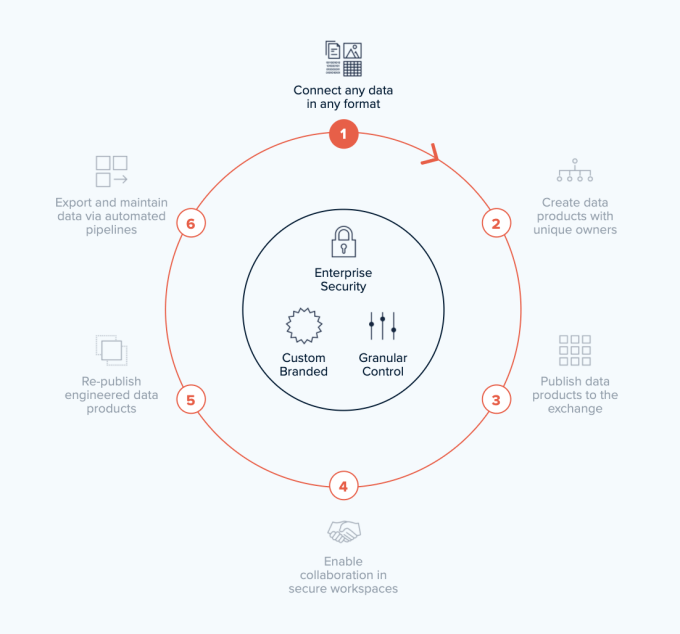
The platform today provides enterprises with a way to tap into data that an organization may already have in data lakes and warehouses that and already uses for analytics and business intelligence. The idea is to make that data ready and secure for enterprise data exchange, either with other parts of your own large organization, or with third parties. The involves creating a “clean room”, providing tools for making it accessible by third parties, and potentially turning it into a data marketplace if that is your goal.

Image Credits: Harbr

The challenges that Harbr addresses come from a couple of different angles. The first of these is technical: putting data troves from disparate sources into a format that can be usable by others. The second of these is commercial: creating something that you can then provide to others, but also making that marketplace findable and usable. The third of these is security.

Cosgrove said that he doesn’t think of Harbr as a security company first, but he points out that these days this has become as much of a concern (if not more) than simply making a data product usable. Being able to protect your data as valuable IP is important, but on top of that, you have the role of privacy and data protection.

These have moved from being fringe concerns to a priority for many users, and, in an increasing number of cases, a legal requirement. So, as companies look for ways to tap into the big data opportunity while keeping those principles in mind, they are looking for companies built with privacy and data protection in mind.

“We’re really focused on helping people to treat data as a product. They bring assets into a platform and turn them into data products that are easy to consume, use and merge,” said Cosgrove. “We see security as a by-product of that: you have to consider security as part of the product.” Harbr the name is a play on Harbor, which itself is a reference to safe harbor principles and regulations.

Harbr is not the only company looking at this opportunity. InfoSum, also out of the UK, is also tackling the concept of a privacy-first approach to federated data, providing a way to share data across organizations without compromising data protection in any way. DataFleets out of the Bay Area is also another startup also building a platform and tools to help enterprises with this challenge and opportunity.

“For data to become truly powerful, we need more automation and collaboration. Today, human efforts are consumed by finding and preparing data, rather than focused on high-value activities that drive real productivity gains,” said Evgenia Plotnikova, partner at Dawn Capital, in a statement. “Harbr is in the vanguard of companies changing this reality, and we are incredibly excited to be partnering with them. Customers we’ve spoken to find Harbr’s enterprise data exchange transformative, and their engagement across Fortune 1000 companies substantiates this.”


16 Nov 2020

Apple responds to Gatekeeper issue with upcoming fixes

Apple has updated a documentation page detailing the company’s next steps to prevent last week’s Gatekeeper bug from happening again, as Rene Ritchie spotted. The company plans to implement the fixes over the next year.

Apple had a difficult launch day last week. The company released macOS Big Sur, a major update for macOS. Apple then suffered from server-side issues.

Third-party apps failed to launch as your Mac couldn't check the developer certificate of the app. That feature, called Gatekeeper, makes sure that you didn't download a malware app that disguises itself as a legit app. If the certificate doesn’t match, macOS prevents the app launch.

Many have been concerned about the privacy implications of the security feature. Does Apple log every app you launch on your Mac to gain competitive insights on app usage?

It turns out it's easy to answer that question as the server doesn't mandate encryption. Jacopo Jannone intercepted an unencrypted network request and found out that Apple is not secretly spying on you. Gatekeeper really does what it says it does.

“We have never combined data from these checks with information about Apple users or their devices. We do not use data from these checks to learn what individual users are launching or running on their devices,” the company wrote.

But Apple is going one step further and communicating on the company's next steps. The company has stopped logging IP addresses on its servers since last week. It doesn't have to store this data for Gatekeeper .

“These security checks have never included the user’s Apple ID or the identity of their device. To further protect privacy, we have stopped logging IP addresses associated with Developer ID certificate checks, and we will ensure that any collected IP addresses are removed from logs” Apple writes.

Finally, Apple is overhauling the design of the network request and adding a user-facing opt-out option.

“In addition, over the the next year we will introduce several changes to our security checks:

  • A new encrypted protocol for Developer ID certificate revocation checks
  • Strong protections against server failure
  • A new preference for users to opt out of these security protections”
16 Nov 2020

KKR, Rakuten to acquire most of Walmart’s stake in Japanese supermarket chain Seiyu

Walmart announced today it will sell most of its shares in Seiyu, the Japanese supermarket chain it acquired 12 years ago, to KKR and Rakuten. The deal values Seiyu at about $1.6 billion and means Walmart will almost completely exit its operations in Japan.

Under the agreement, investment firm KKR will buy a 65% stake in Seiyu, while Rakuten, Japan’s largest e-commerce company, will take a 20% stake through a newly created subsidiary called Rakuten DX. Walmart will retain a 15% stake in Seiyu.

After struggling with strong competition in Japan and low margins, Walmart reportedly considered relisting Seiyu or its holding company, Walmart Japan Holdings last year.

Rakuten is already familiar with Seiyu’s business because it formed a strategic alliance with Walmart in 2018 that included launching an online grocery delivery service in Japan. Called Rakuten Seiyu Netsuper, the online delivery service includes a dedicated fulfilment center, in addition to inventory picked up from Seiyu’s supermarkets.

After the deal, Seiyu will be part of Rakuten DX, which is intended to bring more brick-and-mortar stores online through Rakuten’s e-commerce and cashless payment channels.

Japan’s online grocery delivery market has trailed behind other countries, due in part to the reluctance of shoppers to purchase fresh food online. But the COVID-19 pandemic prompted a rapid shift in consumer habits. According to a July 4 report from the Japan Times, internet sales accounted for about 5% of total grocery sales, compared to 2.5% before the pandemic.

Rivals to Rakuten include grocery delivery services run by Aeon (in partnership with Ocado), Amazon and Ito-Yokado.

16 Nov 2020

Former WeWork China exec launches a ‘startup studio’ for real estate

The real estate industry has been slow to adopt technology compared to many other sectors. So when Dominic Penaloza left his job at WeWork China as the head of innovation and technology this spring, he decided to focus on proptech in Asia.

Instead of building a startup himself or investing in one, Penaloza combines both objectives by launching a “startup studio” called REinvent (“RE” short for “real estate”). The industry jargon refers to an organization that builds startups with an in-house team, hence it’s also referred to as a “startup factory” or “venture builder.” A famous example is Rocket Internet, which is credited for building Lazada in Southeast Asia and Jumia in Africa.

Penaloza, a serial entrepreneur who exited his co-working startup Naked Hub to WeWork China in 2018, now runs a team of 45 across Shanghai, Taipei and Singapore, most of whom he has worked with at WeWork and Naked Hub. The studio is organized into what the chief executive calls product “squads” consisting of the likes of product managers, designers, engineers, and artificial intelligence experts, and has the capacity to work on four projects at one time.

The founder also brought onboard heavyweight investors to help the startup studio tackle a sector with deeply entrenched players. Among REinvent’s backers are JustCo, a major co-working company in the Asia Pacific backed by some of Asia’s biggest property owners, such as the Singaporen sovereign wealth fund GIC; multi-national property developer Frasers Property; and one of Japan’s leading real estate firms Daito Trust.

REinvent has full ownership in the ventures it launches, while the three investors own equity in it. The company declined to disclose how much it has raised from its investors so far.

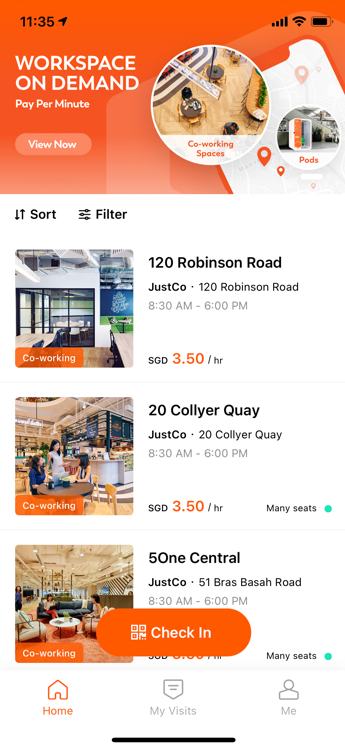
The financiers also importantly contribute strategic resources, Penaloza told TechCrunch in an interview. Started in May, REinvent has already launched two ventures, including one called Switch that lets individuals and enterprises book workspace and pay per minute, similar to how bike-sharing works. The difference is that Switch is a marketplace with third-party landlords like JustCo and Frasers, while bike-share companies often supply and operate the bikes themselves.

Screenshot of the Switch app

The marketplace today has a growing network of 2,500 desks at over 20 locations across Singapore, including small office booths that have sprung up across malls. It’s proposing on-demand workspace at a time when the whole world is forced by the coronavirus pandemic to rethink where to work physically.

“Real estate companies are all figuring out how to react to COVID, how to help organizations survive COVID and to prepare for the next pandemic so the impact on business would not be as big as this time,” said Penaloza.

Meanwhile, flexible work pods are an attractive proposition for mall owners, especially those in China looking for new tenants as e-commerce encroaches into offline retail.

“E-commerce was eating up the traditional retail model even before COVID. Developers in China are trying to repurpose some of their malls… There are now a lot of F&B, experiential stores, cafes, and even co-working space inside malls,” observed Penaloza.

Penaloza tested an early version of his on-demand workspace vision back at WeWork China where he made the firm’s public space available to customers without a membership, capturing professionals who use Starbucks for meetings and remote working but providing a quieter environment and better WiFi.

The other product REinvent has introduced is SixSense, software for spatial analytics and social distance detection.

“Real estate is something not many people think about, but it’s one of the biggest industries on earth,” noted Penaloza. “Proptech in Asia and China is very early-stage but it is picking up.”

16 Nov 2020

SpaceX and NASA successfully launch four astronauts to space for first operational Dragon crew mission

SpaceX has become the first private company to launch astronauts to the International Space Station, marking the culmination of years of work in partnership with NASA on developing human spaceflight capabilities. At 7:27 PM EST (4:27 PM PST), NASA astronauts Shannon Walker, Victor Glover, and Michael Hopkins, and JAXA astronaut Soichi Noguchi left launch pad 39-A at Kennedy Space Center in Florida bound for the ISS.

SpaceX’s human launch program was developed under the Commercial Crew program, which saw NASA select two private companies to build astronaut launch systems for carrying astronauts to the ISS from U.S. soil. SpaceX was chosen alongside Boeing by NASA in 2014 to create their respective systems, and SpaceX’s Dragon capsule and Falcon 9 rocket became the first to achieve actual human flight certification from NASA earlier this year with the successful completion of its final, Demo-2 test mission, which flew to the ISS with two U.S. astronauts on board.

To get to this point, SpaceX had to complete a number of milestones successfully, including a fully automated uncrewed ISS rendez-vous mission, and a demonstration of both a launch pad abort and post-launch abort emergency safety system for the protection of the crew. During the Demo-1 mission, while all actual launch, docking and landing was handled by SpaceX’s fully autonomous software and navigation, astronauts also took over manual control briefly to demonstrate that this human-piloted backup would operate as intended, if required.

So far, Crew-1 is proceeding as expected, with a picture-perfect takeoff from Florida, and a successful recovery of the first-stage booster used on the Falcon 9 rocket used to launch Dragon. Crew Dragon ‘Resilience’ also departed from the second-stage of the Falcon 9 as planned at just after 10 minutes after liftoff, and there will be a 27 hour trip in orbit before the Dragon meets up with the ISS for its docking, which is scheduled to take place at around 11 PM EST (8 PM PST) on Monday night. Once fully docked, the astronauts will disembark and go over to the station to begin their active duty stay, which is set to last until next June.

From left, the crew of Crew-1: NASA’s Shannon Walker, Victor Glover and Michael Hopkins; JAXA’s Soichi Noguchi Image Credits: SpaceX

Three of the four astronauts on this mission have been to space previously, but for pilot Victor Glover, it’s his first time. These four will join NASA’s Kate Rubins, and Roscosmos cosmonauts Sergey Ryzhikov and Sergey Kud-Sverchkov on the station, bringing the total staff complement to seven (an increase from its usual six that NASA says will free up more time for the astronauts to perform experiments, as opposed to their tasks related to regular daily maintenance of the station).

This is the first time that astronauts have launched to space during a regular operational NASA mission since the end of the Shuttle program in 2011. It marks an official return of U.S. human spaceflight capabilities, and should hopefully become the first in many human flight missions undertaken by SpaceX and Dragon – across both NASA flights, and those organized by commercial customers.

16 Nov 2020

Sales readiness platform MindTickle raises $100 million led by SoftBank Vision Fund 2

MindTickle, a startup that is helping hundreds of small and large firms improve their sales through its eponymous sales readiness platform, said on Monday it has raised $100 million in a new financing round.

The Pune and San Francisco-headquartered startup’s new financing round was led by SoftBank Vision Fund 2. The round is a combination of debt and equity, the startup said. Existing investors Norwest Venture Partners, Accel Partners, Canaan, NEA, NewView Capital, and Qualcomm Ventures also participated in the round, which according to a person familiar with the matter, valued the eight-year-old startup at roughly $500 million, up from about $250 million last year.

The vast majority of this $100 million fund is equity investment, said Krishna Depura, co-founder and chief executive of MindTickle, in an interview with TechCrunch. He declined to disclose the specific amount, however, or comment on the valuation.

We used to live in a seller’s world, where buyers had a small selection of choices from which they could pick their products. “You wanted to buy a car, there would be only one new car model every four years. Things have changed,” said Depura, noting that customers today have no shortage of companies trying to sell them similar lines of products.

While that’s great for customers, it means that companies have to put more effort to make a sale. A decade ago, as Depura watched Facebook and gaming firms like Zynga develop addictive products and services, he wondered if some of these learnings could be baked directly into modern age sales efforts.

That was the inception of MindTickle, which now helps companies guide their customer-facing teams. Regardless of what these firms are attempting to sell, they are competing with dozens of firms, if not more, and customers have ever-so-declining patience to hear them.

MindTickle, whose name is inspired from the idea of gamifying mindsets, allows companies to train and upskill their salespeople at scale, and uses role playing methods to help them practice their pitch, and how to handle a customer’s queries.

Depura said the platform helps salespeople measure their improvement in revenue metrics and offers feedback on the calls they made. The platform utilizes machine learning engines to serve personalized remediations and reinforcements to salespeople, he said.

More than 200 enterprises, including more than 40 of the Fortune 500 and Forbes Global 2000 firms, are among MindTickle’s clients today — though, citing confidential agreements, the firm said it can’t disclose several names. Some of the names it did share include MongoDB, Nutanix, Qualtrics, Procore, Square, Janssen, Cloudera, Dexcom, Merck & Co., and Benetton Group.

As of this writing, MindTickle was ranked the fifth best product for sales on G2, a popular marketplace for software and services.

“MindTickle’s track record of growth, quality of product and marquee customer base highlights their strengths,” said Sumer Juneja, Partner at SoftBank Investment Advisers, in a statement. “By delivering engaging and personalized training to users, MindTickle is uniquely placed to support businesses to increase revenue generation and extend critical capabilities within their existing workforce.” The Japanese investment group, which began conversations with MindTickle about three months ago, is exploring more investments in SaaS categories.

The new funding capital will allow MindTickle, which employs about 400 people in the U.S., Europe, and India, to further establish this new category, said Depura. The startup is developing new product features and will deploy the new funds to further grow in Europe, and the U.S., which is already one of its key markets.

More to follow…

15 Nov 2020

Original Content podcast: ‘The Vow’ offers a muddled look at the NXIVM cult

“The Vow” is a fascinating documentary, but we can’t quite recommend it whole-heartedly.

As we discuss on the latest episode of the Original Content podcast, HBO’s new docuseries tells the story of NXIVM (pronounced nex-ee-um), a self-improvement company that was subsequently revealed as a sex cult, with its leader Keith Raniere sentenced to 120 years in prison.

The core story is both compelling and horrifying. And “The Vow” features an astonishing amount of footage showing Raniere and other high-level NXIVM members at work — for that reason alone, the series is worth watching for anyone interested in the NXIVM story.

However, it’s also hampered by some unfortunate storytelling choices. For one thing, by parceling the story out over nine hour-long episode, the series often feels unnecessarily drawn out and repetitive.

And by focusing on a handful of high-ranking NXIVM members who subsequently became important whistleblowers and critics (including Mark Vicente, the filmmaker responsible for a great deal of that behind-the-scenes footage), “The Vow” has also opened itself up to criticism that it downplays the stories of Raniere’s true victims and obscures the extent of his crimes (unlike the Starz documentary “Seduced”) .

In addition to reviewing the series, we also discuss the latest Disney+ growth numbers and the new season of “The Bachelorette.”

You can listen to our review in the player below, subscribe using Apple Podcasts or find us in your podcast player of choice. If you like the show, please let us know by leaving a review on Apple. You can also follow us on Twitter or send us feedback directly. (Or suggest shows and movies for us to review!)

If you’d like to skip ahead, here’s how the episode breaks down:
0:00 Introduction
0:45 Disney+ discussion
7:40 “The Bachelorette” discussion
30:48 “The Vow” review