Year: 2020

28 Oct 2020

Daily Crunch: Apple seems pretty interested in search

Apple might be building a Google competitor, Audible adds more podcasts and an ad measurement company raises $350 million. This is your Daily Crunch for October 28, 2020.

The big story: Apple seems pretty interested in search

Apple has a growing interest in search technology and might even be working on a product to compete with Google, according to The Financial Times.

The most visible change is the fact that in iOS 14, Apple is now showing its own results when you type queries in the home screen. In addition, there seems to be an increase in activity from Apple’s web crawler.

There may be more of an opportunity here as the U.S. Justice Department has sued Google over what it claims are anticompetitive behaviors around search. However, this doesn’t necessarily mean Apple and Google will soon be going head-to-head in search — it could just be a sign that Apple’s Siri voice assistant is getting more search queries.

The tech giants

Joe Rogan, Alex Jones and Spotify’s illusion of neutrality — Spotify is facing criticism after Joe Rogan brought Alex Jones of InfoWars onto his show.

Audible further expands into podcasts — Audible is adding approximately 100,000 podcasts.

Apple eyes the TikTok generation with an updated version of Clips — The update brings much-needed support for vertical videos, allowing for sharing to TikTok and the “Stories” feature in other social apps.

Startups, funding and venture capital

DoubleVerify, a specialist in brand safety, ad fraud and ad quality, raises $350M — DoubleVerify’s technology can detect fraud, viewability and brand safety.

Outrider raises $65M to bring its autonomous tech to distribution yards — The startup has built a three-part system that includes an autonomous electric yard truck, software to manage the operations and site infrastructure.

Lunchbox raises $20M to help restaurants build their own ordering experiences — CEO Nabeel Alamgir said that if restaurants can handle more online orders themselves (rather than just relying on delivery apps), they’ll make more money while also maintaining a direct relationship with their most loyal customers.

Advice and analysis from Extra Crunch

As venture capital rebounds, what’s going on with venture debt? — While venture capital is back setting new records, it appears that its lesser-known sibling won’t be able to match the past few years’ results.

Current and upcoming trends in Latin America’s mobile growth — Latin America is home to one of the fastest-growing mobile markets in the world.

Dear Sophie: Any upgrade options for E-2 visa holders interested in changing jobs? — Another edition of Sophie Alcorn’s column answering immigration questions about working at technology companies.

(Reminder: Extra Crunch is our membership program, which aims to democratize information about startups. You can sign up here.)

Everything else

Qualtrics CEO Ryan Smith is buying majority stake in the Utah Jazz for $1.6B — Smith sold Qualtrics to SAP for $8 billion in 2018.

US online holiday sales to reach $189B this year, up 33% from 2019 — That’s according to a new forecast from Adobe Analytics.

The Daily Crunch is TechCrunch’s roundup of our biggest and most important stories. If you’d like to get this delivered to your inbox every day at around 3pm Pacific, you can subscribe here.

28 Oct 2020

We need new business models to burst old media filter bubbles

Access to information in the United States is fragmenting along social lines. This goes beyond the fuzzy, qualitative feeling many of us have that people can’t agree on key issues anymore — data show that people are increasingly breaking into disconnected ideological camps. While this is commonly viewed as a left/right issue, the reality is much more pernicious: It is a rich/poor issue.

Americans today are exposed to fundamentally different facts based on their news sources. Data are often arranged to fit narratives rather than the other way around. This effect spans the political spectrum: It is as relevant to The New York Times as it is to Fox News. One of the contributors to this information split is the rise of site-wide paywalls, which divide access to information along socio-economic lines.

As one magazine editor eloquently puts it, “The truth is paywalled but the lies are free.”

It’s time for us to think critically about how we can build business models that reunite information bubbles, so that people consistently get access to all sides of the story.

Ringing the division bell

Media polarization is not a new phenomenon. Studies have shown for over a decade that, when it comes to news, people have been dividing themselves into information camps. Social media platforms — quickly replacing publishers as the “front end” of news — act as an accelerant, using likes and reads to pattern-match content to readers. However, these studies often address the left-right split; little is said about the more fundamental difference in beliefs driven by a difference in ability and willingness to pay for news.

The pivot by major publishers to erect site-wide paywalls is a recent phenomenon, an answer to the “grand ad-supported content bargain.” These paywalls have grown in popularity, driving people to subscriptions as an alternative to ads revenue. In doing so, they have undoubtedly helped stem (and maybe reverse?) the decline in news revenues driven by the internet.

How bad has this decline been? Just see this OECD visualization of how circulation, titles and revenues have dropped over time.

As Rupert Murdoch said, “… sometimes rivers dry up.” From 2007-2009 alone, the U.S. saw a 30% decline in newspaper publishing. Staff layoffs have become the norm for smaller and midmarket news services, which find themselves driven to consolidate into larger news orgs in order to bring down prices and expand the reach necessary to attract ad spend.

The message is clear: If people want to continue consuming news, they and media companies need to work together to develop a business model that can support it. Yet, as news bookmarking service favor.it notes, “There is now a real cost to the user associated with acquiring accurate, insightful and well-produced news. [ … ] Exacerbating the problem is the fact that there is now serious competition to real news. Free, less-reliable news sources and aggregators that can push articles into a [F]acebook Newstream that go viral in a matter of seconds whether they are completely true, or properly researched, or not.” The data bear this out: an MIT study across 126,000 stories found that fake stories proliferate on average 6x quicker than true ones.

The new iron curtains

Across six European countries and the United States, the average price for paywalled news is about $15.75 per month. In a time where half of Americans are working low-wage jobs and many are experiencing a severe savings crisis, most don’t have the available funds to shell out for a $15 monthly news subscription — much less a subscription for each outlet they want to access. Free news and clickbait headlines on social media, much like fast food, are the easiest and most freely available options to a swathe of people who have neither the resources nor the energy to do the fact-checking for themselves.

A perennial suggestion is that outlets syndicate their content into a “Netflix for news” bundle. Indeed, aggregator initiatives like Apple News have grown to over 100 million users. Yet this still doesn’t solve a fundamental problem, which is that, in an age of instantly available free online media, most people are not willing to pay even for bundled news.

As Don Richard, senior PM at Shopify, puts it, “I just don’t think the mass appeal for a text-content bundle is as high as many tech folks believe it is [ … ] most people view text content as a less-valuable medium than TV and music  —  valuable being defined as worth paying for based on your personal needs and preferences. And when people have other expenses they have to pay for, paying for a text-content bundle will be hard to justify. Since a text-content bundle doesn’t exist today, the money for a text-content bundle has to come from somewhere else in the monthly budget for most people. That means the bundle price has to take share-of-wallet over something else. Basic needs (food, shelter, utilities) aren’t being reduced for a text-content bundle.”

So we end up with two fundamentally different types of media: On the one hand, free media, supported by independent journalists, freelancers and threadbare content teams; on the other, paywalled media, supported by more robust fact-checking teams and editors. As Robinson puts it, “It costs time and money to access a lot of true and important information, while a lot of bullshit is completely free.”

Coming back to the accelerating polarization of the American public, this media divide is not without consequence. People can always reasonably disagree about beliefs and ideas, so long as they have the shared context of facts. They cannot have productive debates if the facts are in-question.

This is where claims of “fake news” originate: Dividing the world into free facts versus paywalled facts means we are increasingly talking past each other. As favor.it puts it, we’re “moving toward a situation where there will be haves and have-nots in the very critical area of having basic, accurate information about what is going on in the world.”

Where do we go from here?

It is clear that the internet media model predicated on paywalls needs to be revisited due to these shortcomings. But what are the alternatives? Targeted ads have been shown to have their own disadvantages and provoke reader ire.

While this is not a comprehensive answer, here are a few suggestions:

Free facts, upsold details. Pull the key facts out of news stories and make them freely available to people, upselling the deeper and richer storylines. TechCrunch has found an elegant middle-ground of this format: The core news stories on the website are free, while the value-added analysis, investigative deep-dives and richer opinion content are available to subscribers.

The New Paper is another, newer service experimenting with a condensed version of news headlines to combat newsletter and information fatigue (albeit one that still plans to charge $5 monthly). This is something being spearheaded by the rise of platforms like Substack today for independent journalists; content producers with a good following or smart coverage can create self-sustaining businesses.

Could newspapers take a page from Scandinavian ticketing practices and charge based on income? A tiered subscription price adjusted to payroll could allow wealthier readers to create a public good for poorer ones.

Yet, when people pay for news, they should not just be paying for stories — they should be paying for the knowledge that an army of editors, fact-checkers and investigative journalists uncovered the truth behind a story. That is a good that Substack likely cannot provide.

Develop a publicly available, consensus-driven score for fact-based news outlets and prioritize this score in algorithms. The way we access information has changed; aggregators now sit at the top of the news funnel. This has created a significant user surplus — people are able to locate information by story, without being constrained by outlet. However, it has also created an ad-revenue-driven model that prioritizes unique views, which are in turn driven by people’s search for sensationalism and confirmation bias in media. Search engines, social media platforms, and aggregators should come together to develop a public, transparent scoring mechanism for information quality in news and implement that to drive more viewers to more trustworthy sources. An independent rating for factuality that becomes a key input into search and social rankings could significantly help curb the virality of fake news stories, but it would need to take into account the sometimes long half-life of the truth.

Public initiatives. The government needs to re-enter the business of protecting the quality of journalism.

One step is for the FCC to reintroduce the Fairness Doctrine, which required journalists to represent both sides of a given story.

Another is to increase funding for public news sources of all stripes: liberal, conservative, etc., and for those sources to submit to routine information quality audits. Every area in which we’ve taken public institutions and allowed people to pay their way out of the default option — healthcare, education — has led to wild underinvestment in the public option; news is no different.

The library model is surprisingly effective for those who select it as an option: well-funded and maintained public libraries still provide an amazing, information-rich resource to those who avail of their services. Digitizing library resources and allocating partial budget to make information not just available, but also surfaced at the right contextual moment could combat misinformation.

A last option would be to implement information quality scores, similar to public health and safety standards. A score could be as simple as an A-F grade on a restaurant or a calorie count on a fast food menu.

Micropayments and stories a la carte. As long as news media has been dealing with internet-related pressure, technologists have proposed micropayments as the answer. The desire to read an individual news story is stochastic, while media subscriptions are continuous. Few people, myself included, have the willingness to submit to a monthly or annual news subscription just to access the content in one article. Publishers should offer individual stories, sold in exchange for micropayments of, for example, $0.10 per story (10x the payout of some publishers to their content creators). Digital wallets embedded into browsers (see Metamask and Brave Browser as examples) can support these micropayments fluidly, either with opt-ins for each story or working in the background, to allow readers to move seamlessly around the internet, so that readers aren’t asked to pay for each story. As futurist Jaron Lanier noted 10 years ago, “Digital technology … unsettled the so-called ‘creative class’ — journalists, musicians, photographers” when access to information became free; micropayments (and royalties) could help rebuild that class of jobs. With that said, there’s a discrepancy between the amount that periodicals spend to publish a story (e.g., $100) and people’s propensity to pay (e.g., $0.10); unlike songs and movies, people only consume news stories once.

Alternative revenue streams. Media companies should again explore whether events, classifieds, paid editorials, in-depth research and other information-related services could allow them to offer “just the facts” as a loss leader. The New York Times, famously, launched The Daily podcast and spun off its cooking and crossword products into standalones. Publications should reinvest in hyperlocal journalism with local sponsorship.

The truth is that, as site-wide paywalls continue to be erected, there will be a real divide of news into haves and have-nots. There is no silver bullet solution to this problem. The public benefits from open news; factual reporting creates positive externalities. Yet we have not found a commercial structure to support these organizations. The answer is probably a combination of the above along with other revenue streams (including, yes, ads). But it is paramount to the strength of our social fabric that we continue to search for that answer.

We should ask ourselves what surplus is created by good news coverage, by deep investigative research and honest reporting? Who benefits? At this critical juncture when the stress fractures in our fragile democracy are beginning to show, it is obvious that all of us benefit from that surplus as a society. So let’s work together to support it, for the sake of society.

Thank you to Danny Crichton, Danny Zuckerman, Jason Wardy and Orion de Nevers for reviewing this piece.


28 Oct 2020

Fiat Chrysler plans to bring an Ram electric pickup truck to market

Fiat Chrysler Automobiles CEO Mike Manley confirmed Wednesday the automaker’s Ram brand will bring an electric pickup truck to market.

The remarks, made in response to an analyst question during the company third-quarter earnings call, puts to rest rampant speculation, which was fueled by previous comments from Manley, that the automaker was planning to join what promises to become a crowded new category. The Detroit Free-Press was the first to report the comments.

“I do see that there will be an electrified Ram pickup in the marketplace, and I would ask you just to stay tuned for a little while and we’ll tell you exactly when that will be,” Manley said without providing additional details.

Fiat Chrysler reported Wednesday adjusted earnings of 2.28 billion euros ($2.7 billion) on 25.8 billion euros of revenue in the third quarter, driven by strong sales in North America and putting the company back in the black after struggles earlier this year due to the COVID-19 pandemic.

Electric pickup trucks aren’t available to consumers today. That will change in the next 18 months as a number of startups and legacy automakers such as GM and Ford begin to produce and deliver electric trucks to consumers. Rivian, the electric automaker backed by Amazon, BlackRock, Cox Automotive, T. Rowe Price Associates Inc., is aiming to become the first to bring an EV pickup truck to market. The company started in July to run a pilot production line at its factory in Normal, Illinois, in preparation to bring its pickup truck and SUV to market in summer 2021. Rivian has said deliveries of its R1T electric pickup truck will begin in June 2021. Deliveries of the R1S electric SUV will start in August 2021.

Meanwhile, legacy automaker Ford is going to produce an electric version of its top-selling F-150 at a new $700 million plant at the Rouge complex. Startup Lordstown Motors, which went public through its merger with special-purpose acquisition company DiamondPeak Holdings Corp., revealed a pickup truck prototype in June.

Electric pickups from GM and Tesla won’t arrive until 2022. GM revealed in October an electric GMC Hummer pickup truck that will be available for pre-ordering in 2021. The GMC Hummer pickup will be available for delivery in 2022. The futuristic-looking electric Tesla Cybertruck, which was unveiled in November at the Tesla Design Center in Hawthorne, California, isn’t expected to go into production until late 2022.


28 Oct 2020

US online holiday sales to reach $189B this year, up 33% from 2019

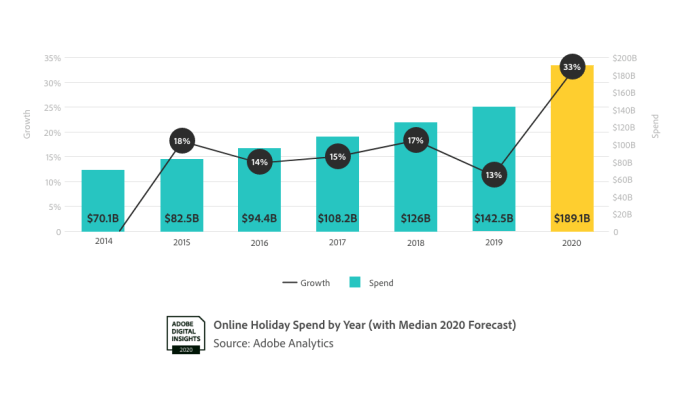
The accelerated shift to e-commerce due to the pandemic will have a significant impact on U.S. online holiday sales, according to a new forecast from Adobe Analytics. Adobe Analytics predicts that U.S. online sales for the months of November and December 2020 will reach $189 billion, representing a 33% year-over-year increase and setting a new record.

The forecast is also equal to two years of growth in one season, Adobe says, noting that the increase in 2019 was just 13%.

Image Credits: Adobe Analytics

If consumers receive another round of stimulus checks and physical stores are again shut down in large parts of the country to address further coronavirus outbreaks, the figures could go even higher. In that case, consumers would then be expected to spend an additional $11 billion online, bringing total sales to more than $200 billion, or a 47% year-over-year increase.

Image Credits: Adobe Analytics

The way consumers shop this season may look different too.

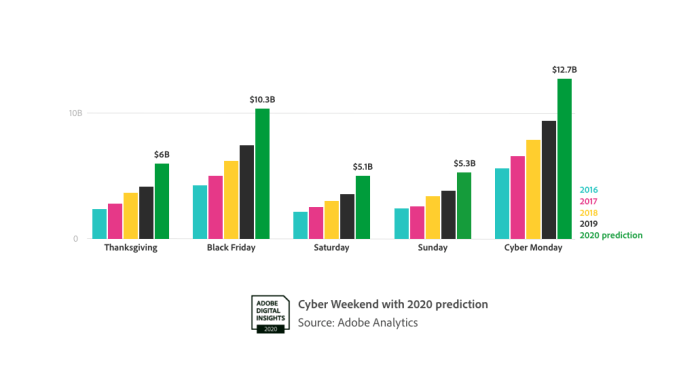
Typically, the online shopping season began with Black Friday sales — a digital counterpart to the offline sales events taking place in physical stores. This would then bleed into Cyber Monday sales, as consumers looked online for the items they couldn’t find deals on when shopping in person.

Over the years, the lines between the individual sales events began to blur. Online shopping shifted to Thanksgiving Day, for example, and then stretched past Cyber Monday.

This year, Adobe Analytics expects the so-called “Cyber Week” (Thanksgiving through Cyber Monday) to turn into “Cyber Months.”

Image Credits: Adobe Analytics

This will be driven, in part, by significant holiday discounting that begins the first two weeks of November, building up to the deepest price cuts over the Black Friday holiday weekend and Cyber Monday.

Adobe Analytics also predicts online sales will surpass $2 billion every day from November 1 through November 21, and will then increase to $3 billion per day from November 22 through December 3.

Black Friday online sales are projected to climb 39% year-over-year, to $10 billion, while Cyber Monday becomes the biggest online shopping day of the year, with $12.7 billion in sales, a 35% year-over-year jump.

Image Credits: Adobe Analytics

The best deals for TVs and appliances will continue to be on Black Friday, while the best deals for toys and furniture will arrive on Sunday, November 29 — the day before Cyber Monday. Sporting goods will see their best deals on December 13 and electronics on December 18, Adobe says.

As in previous years, mobile will claim an ever-larger contributor chunk of e-commerce spending, with U.S. consumers spending $28.1 billion more on their smartphones in 2020 than in 2019, a 55% year-over-year increase.

Smaller retailers ($10 million-$50 million in annual online revenue) will also benefit from the increased online activity. They’ll see a larger (107% increase) boost to their online revenue than larger retailers with $1 billion-plus in revenue, which will see an 84% increase.

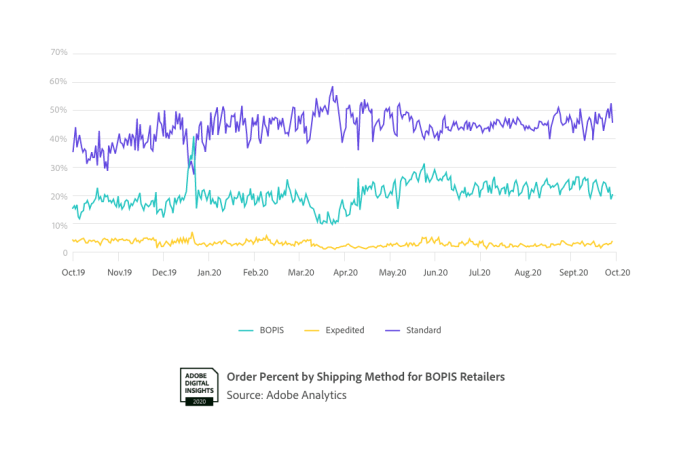
As some U.S. consumers may not be traveling to see family this year, compared with pre-pandemic years, Adobe Analytics predicts Americans will spend 18% more on gifts that are directly delivered from the retailer to people they would have otherwise seen in person. But consumers are not interested in paying more for expedited shipping — 64% said they won’t pay for a speedier service. That means retailers will need to continue to clearly communicate about their free shipping cut-off dates.

Image Credits: Adobe Analytics

The trend toward buying online and picking up in store (BOPIS) will surge, too. With the addition of curbside pickup options from many retailers, BOPIS will see 40% more orders than last year and will grow to represent 50% of all orders from retailers offering the option in the week before Christmas.

Due to the pandemic, Adobe Analytics expects 9% of all holiday customers to be net new online shoppers. Conversion rates will increase as well, at +13%, while revenue will increase +33%. Average order value, however, will remain flat.

One factor that could complicate these predictions is the U.S. election. In previous election years, online sales were impacted after the outcome was known. They dropped 14% the day after the 2016 election, and 6% the day after the 2018 midterms. According to Adobe Analytics, 26% of consumers said the election’s outcome would impact their holiday spending.

The data used to make these predictions is sourced from Adobe Analytics, which today analyzes one trillion visits to U.S. retail sites. This includes 100 million SKUs and 80 of the 100 largest retailers in the U.S., the company says.

28 Oct 2020

True, the social networking app that promises to ‘protect your privacy,’ exposed private messages and user locations

True bills itself as the social networking app that will “protect your privacy.” But a security lapse left one of its servers exposed — and spilling private user data to the internet for anyone to find.

The app was launched in 2017 by Hello Mobile, a little-known virtual cell carrier that piggybacks off T-Mobile’s network. True’s website says it has raised $14 million in seed funding, and claimed more than half a million users shortly after its launch.

But a dashboard for one of the app’s databases was exposed to the internet without a password, allowing anyone to read, browse and search the database — including private user data.

Mossab Hussein, chief security officer at Dubai-based cybersecurity firm SpiderSilk, found the exposed dashboard and provided details to TechCrunch. Data provided by BinaryEdge, a search engine for exposed databases and devices, showed the dashboard was exposed since at least early September.

More on Extra Crunch

After we reached out, True pulled the dashboard offline.

Bret Cox, chief executive at True, confirmed the security lapse but did not answer our specific questions, including if the company planned to inform users of the security lapse or if it planned to disclose the incident to regulators under state data breach notification laws.

The dashboard contained daily server logs dating back to February, and included the user’s registered email address or phone number, the contents of private posts and messages between users, and the user’s last known geolocation, which could identify where a user was or had been. The dashboard also exposed the email and phone contacts uploaded by the user, which True uses to match with known friends in the app.

None of the data was encrypted.

TechCrunch confirmed the dashboard was returning real user data by creating a test account and asking Hussein to provide data that only we would know, such as the phone number used to register the account.

Hussein said that the dashboard was also leaking account access tokens, which could be used to hack into and hijack any user’s account. These account access tokens look like a line of random letters and numbers, but keep the user logged into the app without having to enter their login details every time. Using our test account, Hussein found our access token from the dashboard, and used it to access our account and post a message on our feed.

The dashboard also exposed one-time login codes, which True sends to an account’s associated email address or phone number instead of storing passwords.

True says deleting an account “will immediately remove all of your content from our servers,” but deleting our test account did not remove our private messages, posts and photos, and could still be searched from the dashboard.

“This is another example of how mistakes can happen at any organization, even those that are privacy-centric,” Hussein told TechCrunch. “It highlights the importance of not only building secure applications and websites, but also ensuring that proper data security measures are embedded within their internal procedures.”

A spokesperson for Hello Mobile could not be reached.

Last year, Hussein found an exposed database dashboard belonging to Blind, the “anonymous social network,” favored by employees to publicly disclose malfeasance and wrongdoing at their companies.


You can contact the author with tips securely using Signal and WhatsApp to: +1 646-755-8849.

28 Oct 2020

Dear Sophie: Any upgrade options for E-2 visa holders interested in changing jobs?

Here’s another edition of “Dear Sophie,” the advice column from a practicing attorney that answers immigration questions about working at technology companies.

“Your questions are vital to the spread of knowledge that allows people all over the world to rise above borders and pursue their dreams,” says Sophie Alcorn, a Silicon Valley immigration attorney. “Whether you’re in people ops, a founder or seeking a job in Silicon Valley, I would love to answer your questions in my next column.”

Extra Crunch members receive access to weekly “Dear Sophie” columns; use promo code ALCORN to purchase a one- or two-year subscription for 50% off.


Dear Sophie:

I’m currently here in the U.S. on an E-2 visa.

My employer, a company based in Slovakia, moved me to the U.S. to help establish our U.S. operations. What are my options if I want to look for other job opportunities here in the U.S. with a different company? Is there a feasible process to upgrade my E-2 visa to another type, like an L? Thank you!

—Restless in Redwood City

Dear Restless,

Thanks for your questions. Nonimmigrant (temporary) visas that allow you to work in the U.S. require an employer to sponsor you for the visa, and those visas remain tied to the employer sponsor and the position for which you were hired. We recently launched the Extraordinary Ability Bootcamp (promo code DEARSOPHIE for 20% off enrollment) — this is a class that can help you strengthen your credentials if you end up pursuing an O-1A visa, which I’ll discuss more about below.

There are a few visa options available if you find a U.S. company willing to sponsor you such as J-1, O-1A and H-1B, and various green card pathways. You had asked about an L Visa, but this would only be an option if you had worked for the new company abroad for at least one year during the past three years. Both the L-1A visa and the L-1B visa enable multinational companies to transfer a manager, executive or specialized knowledge employee from an office abroad to a U.S. office — or to open an office in the U.S. — from an office abroad. The L-1A visa for intracompany executive or manager transferees is similar to the E-2 visa in that both allow the visa holder to come to the U.S. to set up a new office for the sponsoring company.

28 Oct 2020

Apple search crawler activity could signal a Google competitor, or a bid to make Siri a one-stop-shop

Encouraged by the spate of antitrust activity brewing in both the Justice Department and on Capitol Hill, Apple may be developing a search competitor to Google, according to a report in the Financial Times.

That would be a move ripe with irony as the push for an end to anti-competitive practices is seemingly creating greater competition among the largest companies which already dominate the technology industry rather than between those established companies and more nimble upstarts.

Signs of Apple’s resurgent interest search technologies can be found in both a subtle but significant change to the latest version of the iOS 14 iPhone operating system and increasing activity from Apple’s spidering tools that are used to scour the web and refine search functionality, the Financial Times reported.

Apple is now showing its own search results and linking directly to websites when users type queries from its home screen in iOS 14. For context, this is a behavior that has been known for a while as people have seen the feature pop up in beta versions of iOS. And the search volume being up on Apple’s crawler is something that Jon Henshaw of Coywolf had noted back in August.

Sources cited by the Financial Times said that the change marked a significant step-change in Apple’s in-house search development and could be the basis for a broader push into search.

The Cupertino, Calif.-based company certainly has the expertise. A little less than three years ago it nabbed Google’s head of search, John Giannandrea in what was widely seen as an attempt to shore up Apple’s foundations in artificial intelligence and voice search via Siri. Because of the way that Apple is organized internally, it’s unlikely that Giannandrea will be devoting full-time effort to both a potential “search product” and Siri . But it’s within the realm of possibility that he could be lending his expertise to a team working on a separate feature.

Any development of a search tool would be a third way for Apple, which now uses Google as its default search service thanks to a lucrative contract between the two (one that’s also at the heart of a Justice Department inquiry into Google’s purported anti-competitive activities around search). The only other major search services on the market rely on Microsoft’s Bing to power their results.

While the signs do point to an actual uptick in activity, there could be an explanation for Apple’s crawler activity that’s less heavy on corporate skunkworks skulduggery and more in line with goals that Apple’s stated pretty clearly.

While the story about Apple getting into direct competition with Google on search makes for a great headline, the uptick in activity could be explained equally as rationally by Siri getting more search queries and being more of an interlocutor between Apple and search services like Google or Microsoft’s Bing. This disintermediation is something that Google began years ago and has even modified and expanded over the years to combat the same kind of behavior from Siri.

Some of this comes down to semantics. By “search engine” do we mean “a web site that people type queries into” or do we mean a voice assistant that steps in to white-label web results with its own sourcing. Cutting down on the brand presence of a monster like Google on your own platform is a powerful motivator for any competitor, no matter the space.

Making Siri a one-stop-shop could inoculate Apple in the scenario where they are forced to enable a search provider choice in the iOS onboarding flow by regulation. It won’t do anything to help Google though, who pays Apple billions because iOS users are worth way more than any other mobile web users to its business. Google, for its part, says that when people have a choice they still pick Google anyway. Perhaps another reason why making Siri the search equivalent of an overtalker is the strong play for Apple.

TechCrunch has reached out to Apple for comment and will update when we hear back.


28 Oct 2020

Joe Rogan, Alex Jones and Spotify’s illusion of neutrality

Social media platforms like Facebook and Twitter have taken a messy beating from critics unhappy with how they handle questionable content on their platform, with some complaining they don’t do enough to rein in misinformation, and others decrying censorship. But what about Spotify? The company is never mentioned in this context, and with its traditional business couched in streaming recorded music, you might understand why its biggest controversies over the last few years have been over how little musicians get paid.

That position, however, is being jolted into quite different territory now with its move into podcasting, which is raising lots of questions over what role Spotify should and could play in overseeing the content on its platform. Now people are in an uproar of who, essentially, gets a platform on its platform.

That issue was highlighted in the last day, when Joe Rogan — the highly paid podcaster with a libertarian bent — brought on Alex Jones (of InfoWars fame, whose own podcast was removed from Spotify, along with YouTube and others, in 2018) on to his show for a meandering three hours, leading to an uproar over how Spotify is giving a spotlight and microphone to an infamous purveyor of misinformation.

The conversation, which also featured comedian Tim Dillon, covered a pretty wide range of topics, with the common themes being today’s most controversial topics, unproven (or disproven) stories behind them presented as fact, and of course the dastardly Dems.

Rogan made a few attempts at refuting or standing up some of the stories and claims that they covered. Early on, for example, when Jones started to talk about how the Democrats are in the pocket of the lobbyists (while Trump was not, according to him), Rogan called up web links in real time, showing that this isn’t quite so clear, with AT&T admitting to paying Trump’s former lawyer Michael Cohen fees, to help advance its own position with Trump and his administration.

“I was just trying to give you a Gestalt analysis,” Jones growled in response… He then went into a defense of Jared Kushner. “Everything he touches he turns to gold.” (Except, it seems, this, this, and well, maybe many other things, actually.)

The conversation veered on to a number of other topics, such as how the Democrats were intentionally trying to crash the economy to make Trump look bad, and a discussion, very the foggy on details, of the effectiveness of vaccines (foggy, but probably enough strands of which, in the hands of a person already skeptical, may well be the tipping point to dismissing Covid-19 public health initiatives altogether).

For now, Spotify is not saying anything in response to this publicly. We’ve tried to reach out to the company to get a response to questions about the show, and we will update if we hear back. We’ve had nothing for hours, and a colleague who asked the same questions months ago never heard back either. So we’re not holding our breath.

Notably, while Spotify has detailed how to report illegal musical tracks or explicit lyrics on its platform, it has never outlined its content policies when it comes to podcasting.

And from the looks of it, the company has been using some delaying tactics in facing up to the problem more directly.

BuzzFeed today has published a leaked memo from the company’s legal officer Horacio Gutierrez, from today, which appears to defend the company’s position on publishing controversial podcasts (not this one in particular), giving hosts the freedom to have whichever guests they want, and not responding to public outcry but to refer issues to Trust & Safety to investigate.

“If a team member has concerns about any piece of content on our platform, you should encourage them to report it to Trust & Safety because they are the experts on our team charged with reviewing content,” he wrote. “However, it’s important that they aren’t simply flagging a piece of content just because of something they’ve read online. It’s all too common that things are taken out of context.”

Bulleted talking points about controversial content seem to underscore how Spotify is sticking to a position of being a neutral platform, not a proactive curator: “Spotify has always been a place for creative expressions,” Gutierrez wrote. “It’s important to have diverse voices and points of view on our platform.”

He then noted that if a podcast complies with Spotify’s content policies — it doesn’t make clear what those are — then guests are not banned: “We are not going to ban specific individuals from being guests on other people’s shows, as the episode/show complies with our content policies.”

He noted in closing that “we appreciate that not all of you will agree with every piece of content on our platform. However, we do expect you to help your teams understand our role as a platform and the care we take in making decisions.”

People were upset back when Rogan came to Spotify in an exclusive, reportedly $100 million, deal earlier this summer — an event that first introduced the question of how Spotify would handle content controversies. No surprise there, since Rogan was already courting controversy over, for example, how he uses slurs considered to be transphobic by members of the LGBQT community (an issue that has not gone away). Now those questions are coming up again, along with boycotting threats.

Whether this actually makes a dent in its user base, it does raise lots of questions about how the profile of the company is changing, and that Spotify has been given a relatively easy break when it comes to content on its platform up to now. It’s been optimising for exclusive names and speed to market in getting them (and paying big bucks for the bragging rights), over considering what those names are actually doing, and what impact that could have.

One interesting angle to ponder is whether other high-profile hosts might bail if they feel strongly about Spotify’s editorial position. Another is whether (or when) this will catch the eye of the Powers That Be.

Just today, executives from Facebook, Twitter and Google are being brought before the Senate with questions about bias on their platform and how their staff approaches content moderation, and whether they are liable for that content. I don’t know how effective or impactful today’s testimony will be, but for a start, maybe it’s time they start including Spotify in that list, too.

28 Oct 2020

App management startup AppFollow raises $5M Series A round led by Nauta Capital

AppFollow, an app management startup, has raised a $5 million Series A round led by Barcelona’s Nauta Capital, alongside existing investors Vendep Capital and RTP Global participating.

The Helsinki-headquartered company says benefitted during the pandemic and even in April 2020 as the desire for automation and apps exploded. It says it now has 70,000 clients on its platform globally including McDonald’s, Disney, Expedia, PicsArt, Flo, Jam City and Discord.

CEO Anatoly Sharifulin said in a statement: “AppFollow helps teams understand sentiment, both for your users and competitor’s, figure out how your potential customers search for apps and use this knowledge to make your app more visible and, of course, follow on your KPIs like downloads and revenues to be sure that all is under control.”

Eugene Kruglov of Nauta Capital said: “We are extremely delighted to partner with Nauta Capital on this round. And having both of current investors and as well some of our customers to participate in the round proves that we are on the right direction to become the market standard for effective app management.”

The company, which employs 65 people across 9 countries, all working remotely, will use the investment to strengthen its presence in the US and Europe, hire VP-level executives in sales, marketing and diversify their platform.

28 Oct 2020

Outrider raises $65 million to bring its autonomous tech to distribution yards

Outrider, a startup aiming to bring its autonomous technology to the nerve center of the supply chain, has raised $65 million in funding just eight months after coming out of stealth. The Series B round was led by Koch Disruptive Technologies and brings its total funding raised to $118 million.

Other existing investors increased their investments, including NEA, 8VC, and Prologis Ventures, according to the company. New investors included Henry Crown and Company and Evolv Ventures.

The company’s aim to automate distribution yards doesn’t get the same kind of attention as the more public-facing robotaxis that other companies are pursuing. But it could be as impactful and potentially lucrative to the company that pulls it off. Distribution yards are where goods make the transition from long-haul trucks to warehouses, and eventually the consumer. These hubs of economic activity rely on humans to make repetitive, manual tasks using diesel-powered yard trucks. There are some 400,000 distribution yards located in the United States, a number that provides an idea of the potential size of the opportunity.

Outrider electric autonomous yard truck

Image Credits: Outrider

The Golden, Colo. startup previously known as Azevtec developed a three-part system that includes an autonomous electric yard truck, software to manage the operations and site infrastructure. The total system automates the manual aspect of yard operations, including moving trailers around the yard as well as to and from loading docks. The system can also hitch and unhitch trailers, connect and disconnect trailer brake lines, and monitor trailer locations.

Outrider touts the dual benefits of its electric and autonomous system. The company notes that its electric yard trucks are ideal for autonomy due to their reduced maintenance, lower operating costs and reliable clean power. Andrew Smith, the company’s founder and CEO, says disruptions caused by COVID-19 has highlighted the need for this kind of automated distribution yard technology.

Outrider, which now employs 110 employees, has completed “multiple” pilot programs, including one with Georgia-Pacific and expanded its customer base since coming out of stealth in February.