Year: 2020

15 Oct 2020

Nanoleaf adds large and small triangles to its revamped Shape product line

Nanoleaf launched the next generation of its light panels in July. Called Shape, this new product looks like the company’s original offering, but sports better connectors, a simpler mounting solution, and most importantly, these panels can work with different shapes.

Today, Nanoleaf announced triangle panels, which join the hexagon shape that launched in July.

This is the first product line from Nanoleaf that can use two different shapes at the same time. The triangles are available in large and small sizes, and feature all of the functions found on other Nanoleaf panels including mirroring a screen, and syncing to music. The panels also Google Assistant, Amazon Alexa, Apple Homekit and Samsung Smartthings.

Unlike past Nanoleaf products, the panels in the Shape line connect using a rigid connector that snaps into place. The mounting solution is also improved, allowing users to install panels without having to screw each panel to the wall.

Here’s what we concluded when reviewing the hexagon panels in the new Shape line.

The Nanoleaf Hexagons are a terrific addition to the Nanoleaf lineup, and I think they’re the model that’s mostly likely to appeal to a much broader customer base when compared to the company’s existing options. I personally didn’t expect to be that big a fan of Nanoleaf in general — I’d never been more than mildly interested in their offerings before. But as soon as I powered on the Hexagon, I was amazed at how much I felt like they improved the aesthetics of the space.

The complete kits cost $199 for the full size triangles and $119 for the mini triangles. Expansion packs are $59 and $119, respectively.

15 Oct 2020

Google will let everyone migrate from Hangouts to Chat for free in 2021

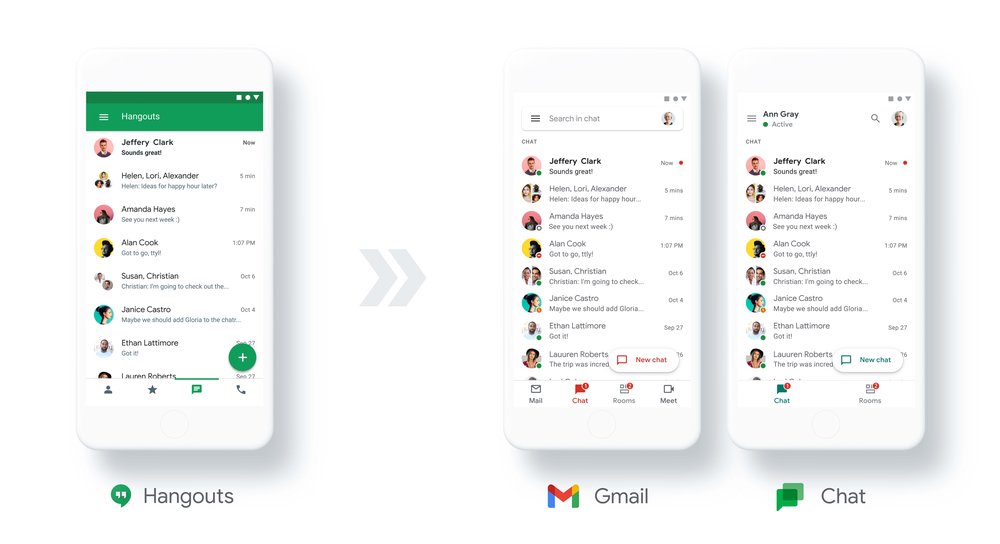
Google’s strategy around its messaging apps is nothing if not messy right now (hello Hangouts, Meet, Chat, Duo and Co.), but it looks like things will get a bit easier come next year. We already knew that Hangouts’ time was coming to an end and as Google announced today, the company will allow all current Hangouts users to migrate to Chat — which was originally meant to only be its Slack-like messaging service for business users — in the first half of 2021.

One interesting wrinkle here: Chat will now also become free to use for consumers. Currently, you have to be a paying G Suite/Workspace user to access the service (though somehow it’s enabled on my free personal account).

While Chat isn’t an exact 1-to-1 replacement of Hangouts, it actually offers a bunch of additional features for group chats and collaboration around files and tasks, as well as new security tools. Chat, together with Rooms and Meet, will also be integrated deeply into the Gmail app as part of Google’s Workspace migration.

Image Credits: Google

Google says it will automatically migrate all Hangouts conversations, contacts and history to Chat, but it’s not providing details about this yet. Final timing, Google says, may still shift. It’s not clear, though, when Google will force everyone to migrate and shut down the Hangouts servers for good.

There are a few more details here: if you use Hangouts with Google Fi, Hangouts support will go away ‘early next year.’ Traditionally, Fi users were able to make calls and manage their text messages from Hangouts. That experience will migrate to Google’s Messages app.

If you’re a Google Voice user, there’s a similar transition happening. For voice calls and text messages, Hangouts users will now be directed to the Voice app and early next year, your Voice support will be removed from Hangouts.

And for all users in the U.S. and Europe, the ability to call phones from Hangouts will disappear at the beginning of next year — and group video calls in Hangouts will transition to Meet in November.

Yeah — that all sounds complicated, but it’s a problem of Google’s own making. A few years ago, the idea was to move Hangouts users to its Allo and Duo apps and business users to Chat and Meet (or whatever they were called back then). Allo flopped (and few people use Duo), leaving Google with the unenviable task of keeping the aging Hangouts platform around for the foreseeable future and making the overall transition harder and more complicated, to the point where I’m not sure that consumers really understand what’s happening.


15 Oct 2020

New Oxford machine learning-based COVID-19 test can provide results in under 5 minutes

Oxford scientists working out of the school’s Department of Physics have developed a new type of COVID-19 test that can detect SARS-CoV-2 with a high degree of accuracy, directly in samples taken from patients, using a machine learning-based approach that could help sidestep test supply limitations, and that also offers advantages when it comes to detecting actual virus particles, instead of antibodies or other signs of the presence of the virus which don’t necessarily correlate to an active, transmissible case.

The test created by the Oxford researchers also offer significant advantages in terms of speed, providing results in under five minutes, without any sample preparation required. That means it could be among the technologies that unlock mass testing – a crucial need not only for getting a handle on the current COVID-19 pandemic, but also on helping us deal with potential future global viral outbreaks, too. Oxford’s method is actually well-designed for that, too, since it can potentially be configured relatively easily to detect a number of viral threats.

The technology that makes this possible works by labelling any virus particles found in a sample collected by a patient using short, fluorescent DNA strands that act as markers. A microscope images the sample and the labelled viruses present, and then machine learning software takes over using algorithmic analysis developed by the team to automatically identify the virus, using differences that each one produces in terms of its fluorescent light emitted owing to their different physical surface makeup, size and individual chemical composition.

This technology, including the sample collection equipment, the microscopic imager and the flourescence insertion tools, as well as the compute capabilities, can be miniaturized to the point where it’s possible to be used just about anywhere, according to the researchers – including “businesses, music venues, airports,” and more. The focus now is to create a spinout company for the purposes of commercializing the device in a format that integrates all the components together.

The researchers anticipate being able to form the company, and start product development by early next year, with the potentially of having a device approved for use and ready for distribution around six months after that. It’s a tight timeline for development of a new diagnostic device, but timelines have changed already amply in the face of this pandemic, and will continue to do so as we’re unlikely to see if fade away anytime in the near future.

15 Oct 2020

Emerging companies thrive on data. Shouldn’t they use it to improve hiring decisions?

While emerging companies are often started by technically minded founders and funded by VCs for their data-driven approaches to product and growth, the irony is that these companies are often using less data and rigor when it comes to hiring talent than more traditional, less data-focused companies. The truth is, the way in which tech companies hire has been relatively untouched by disruption, with most still relying on resumes and conversational interviews for its highest-stake decisions.

The consequences of this is not only detrimental to building teams, but to the overall diversity of the startup space.

Data-driven hiring isn’t just about having the right funnel metrics in place to determine efficiency of process, it extends to the information we choose to collect (or not collect) and measure to determine if someone is a fit for a role. There’s a science to building teams, and therefore selecting talent to join teams. So, why is hiring in early-stage companies still not regarded as a data-driven activity?

Some argue that by nature, talent selection involves people and so can’t truly be scientific. People are unique, complex, emotional and unpredictable. Additionally, few people think they’re a bad judge of character and talent, most overconfidently hold the belief that they’ve got a superior instinct and “nose” for talent. Hiring talent is one of the few operational activities in business where formal training or decades of experience isn’t expected in order to be better than average.

Move away from gut-based evaluations

The impact of this outdated way of thinking is felt across the board — first and foremost when it comes to team dynamics. To first know if someone is qualified, you need to know what you’re assessing for. Companies that operate with a shallow understanding of what drives success in a role lack the vital information needed to build a strong system of selection. The output is a weak hiring process that is heavy on unstructured interviewing, light on predictive signals and relies on gut-based evaluations.

Chemistry, confidence and charisma are more likely to determine whether a candidate lands a role versus competence to do the job. As a result, almost half of new hires are estimated to fail and be ineffective, and weak teams are built. The lack of reliable data also means most companies suffer from a broken feedback loop between hiring and team performance, which stunts learning and improvement. How do you know if your selection process is efficiently assessing for the skills, traits and behaviors that drive top performance if you’re not connecting the dots?

The dangers of subjective approaches

More dangerously, a hiring process that’s not designed to collect and evaluate based on evidence almost always results in a lack of team diversity, which as we know stunts innovation and therefore limits company success.

Subjective approaches to talent selection and development create a revolving door of unconscious biases and exclusion, with a resounding impact on what now makes up the homogenous tech ecosystem. This is not helped by natural overreliance on networks as means to fill hiring pipelines in early-stage company building.

Lastly, for talent operators and people practitioners, it does no favors for the credibility of their profession. Recruiting and selecting talent will continue to be branded an unsophisticated, lesser back-office function, or as a “dark art” that is about as data-informed as looking into a crystal ball.

Taking an evidence-based approach

In bringing more objectivity to the hiring process, founders and their teams are served best when starting with a clear, evidence-based definition of what success markers look like in a role, and then putting structure around each stage of selection to assess for a specific skill or behavioral trait: What and when will you assess? What criteria will you evaluate the data based on? In other words, the objective is to get as close as possible to unearthing signals that are reliable enough to accurately predict that someone will perform in a role.

Up until recently, science-based talent assessment tools, which help hiring managers make more objective evaluations, have been largely used by bigger, more established firms that suffer from high-volumes of job applications — the luxury “Google” problem. However, three recent shifts suggest we’re about to see a trend in their adoption by earlier-stage startups as they scale their teams:

  1. Pressure to build diverse and inclusive teams. 2020 has pushed diversity and inclusion to the top of the agenda for most companies. Assessment tools used as part of team-building can help groups better identify where specific cognitive, personality and skill gaps exist, and therefore focus hiring for those missing ingredients. Candidate assessment also helps reduce unconscious bias that might creep into interviews by showing more objective information about someone’s strengths and weaknesses.

  2. The sharp rise in job applicants. The COVID-19 pandemic has had two significant effects on recruiting. First, companies have been forced to embrace hiring talent in remote roles, which has increased the size of the global talent pool for most jobs inside a tech firm. Second, the increase in available talent has meant that the average number of job applications has risen dramatically. This shift from a candidate-driven market to an employer-driven one means that selecting signal from noise is increasingly becoming a challenge even for early companies with a less-established talent brand.

  3. Better designed, more affordable products on the market. For a long time, talent assessment software has been largely inaccessible to noncorporate clients. Academic user interfaces and off-putting candidate experiences has meant that many scientifically robust tools simply haven’t been able to capture the attention of tech and product-obsessed buyers. Additionally, many tools that require add-on consultancy or specialist training to administer and interpret are simply out of range of early-stage budgets. With new entrants to the assessment market that have automation, product design and compliance at their core, scale-ups will be able to justify spending in this area and perceptions will change as they become essential SaaS products in their team’s operating toolkits.

As these outside factors continue to push hiring toward a more evidence-based approach, businesses must prioritize making these changes to their hiring practices. While unstructured interviews might feel most natural, they’re perilous for accurate talent selection and while the conversation might be nice, they create noise that does nothing for making smart, accurate decisions based on what really matters.

Instinctive feelings and “going with your gut” in hiring should be treated with caution and decisions should always be based on role-relevant evidence you pinpoint. Emerging companies looking to set a strong team foundation shouldn’t risk the redundancies and biases created by subjective hiring decisions.

15 Oct 2020

Nabis raises $5m Series A to grow its cannabis distribution platform

The cannabis industry is quickly growing up, and companies like Nabis play a critical role. Today, the company is announcing it raised $5 million in Series A funding, which will help it grow and expand its offering.

Nabis is a business to business distributor, handling logistics, payment, and warehousing. Instead of being a distributor for beer, snacks, or pet supplies, Nabis is a cannabis distributor. The company acts as a middleman between cultivators and retail establishments, providing both parties’ unique services. Since it’s illegal to ship cannabis through traditional means, most cannabis operators turn to private operations to transport goods.

Founded in 2107, Nabis says it ships a quarter of a billion dollars of cannabis each year to just the California market. With additional funding, the company expects to grow its business to reach 25% of the state’s legal cannabis. And to hit this goal, the company is building a business to business online marketplace where manufacturers and growers can sell their wares directly to retailers in bulk.

Nabis CEO and co-founder Vince Ning spoke to TechCrunch about the company’s funding round and future plans.

Nabis provides essential services to the California cannabis business. For the growers and cultivators, Nabis helps them reach storefronts and retailers while maintaining their own brand identity. For retailers, Nabis simplifies ordering, delivery logistics, and cash remittance — a key feature given the banking industry’s limitations on credit card transactions around cannabis.

The product is collected from manufacturing facilities and stored and tested in secure warehouses until a retailer places an order. Delivery is made to these retailers within 36 hours of the order. When dropping off cannabis products, Nabis can also pick up cash and deposit it for retailers.

“Apart from fulfilling products, we also double up and collect payments upon redelivery of new orders,” Ning said. “We offer a sort of Amazon Prime shipping experience where we ship everything in a 36 hour turnaround time basis. We often revisit the same dispensary multiple times a week, and it gives us a chance to collect payments as soon as invoices are due. We’ll collect cash, cheque, or electronic wire. And on our end, we have a really solid banking relationship that handles cash deposits.

“[The cash deposit service] has a pretty large fee,” Ning said, adding, “but for the cannabis industry, it’s much more palatable. We’ll deposit the cash, and then we remit payments back to the brand in an electronic form.”

Right now, Nabis is focused on the California market. The state accounts for one-third of all legal weed sales in the United States and is growing rapidly. Ning believes he can build Nabis into a billion-dollar company with just this market.

“California’s current market size is around $4 billion by retail value,” Ning says. “Every year it’s been growing by $1 to $2 billion in size, so we can be in California alone and build a billion-dollar distribution business without going out of the state. We plan to become a national distributor. California is a crown jewel centerpiece of the cannabis market given the cachet of California cannabis. [Its] products have the same credibility and reputation in the same way as Napa Valley wine. California cannabis is the homeland of a lot of the best cannabis grown in the US.

Eventually, Nabis hopes to operate nationwide though legal roadblocks stand in its way. Nationally, United States’ regulations prevent interstate cannabis commerce, and each state has its own set of regulations and licenses. Ning says its software is “copy and paste,” but the company would need to build new warehouses and distribution has to serve the customers in these new states.

The $5 million Series A included Y Combinator, Doordash co-founder Stanley Tang, Gmail creator Paul Buchheit, Twitch co-founder Justin Kan, Babel Ventures, Liquid 2 Ventures, and Soma Capital. With this round, the company raised $10M since its founding in 2017.

The company raised its first cash following its graduation from Y Combinator in March 2019. Right now, the company says it handles 7% of California’s legal cannabis and sees an opportunity to capture 25% with additional funding. The company intends to invest the $5 million Series A into expanding its software offering and beefing up its financial services to provide cannabis operators capital.

Currently, Nabis works with 1000 dispensaries and 200 delivery services in the state of California. Its future plans include an online distributor ordering system that would let these retailers order directly from manufacturers. This would upend the traditional system where retailers work with sales teams to source and order products. Ning sees this platform as giving brands more control over their storytelling.

“Right now, [sales teams] have to go to each store, or do Zoom calls, just to place an order,” said Ning. “Then they have to punch it into our system. This marketplace flips the communication process on its head, and retailers come directly to us to place orders with each brand. We offer them, not just the ability to place orders, but to communicate through a chat function and get exposed to different marketing from brands.”

These channels have never existed before in the cannabis space, Ning claimed. He likens the system to that from McKesson, an online pharmaceutical ordering platform with its own fulfillment and delivery system, and operates in a heavily regulated space.

Safety is a huge concern, because to recap, the company collects, stores, and distributes a mass amount of cannabis and cash.

Ning tells me Nabis is licensed in California to ship cannabis and abides by regulations mandating specific requirements around its delivery vehicles. Everything is insured, he says. Each delivery van is outfitted with multiple cameras, floor-mounted safes, and GPS locators. What’s more, van operators can only deposit cash while a second warehouse team can only withdraw the cash.

The company beefed up security following the increase in civil unrest in America.

Operations like Nabis are quickly scaling to address the growing challenges of retail cannabis. As these young players scale and navigate ever-changing regulations, they’re quickly becoming major players with significant market share. But growth is hampered by a federal government that’s caught up in political dealings leaving many companies stuck at state lines. It seems most cannabis operators believe change is coming, but no one is sure when.


15 Oct 2020

Brazil’s Black Silicon Valley could be an epicenter of innovation in Latin America

Over the last five years, Brazil has witnessed a startup boom.

The main startups hubs in the country have traditionally been São Paulo and Belo Horizonte, but now a new wave of cities are building their own thriving local startup ecosystems, including Recife with Porto Digital hub and Florianópolis with Acate. More recently, a “Black Silicon Valley” is beginning to take shape in Salvador da Bahia.

While finance and media are typically concentrated in São Paulo and Rio de Janeiro, Salvador, a city of three million in the state of Bahia, is considered one of Brazil’s cultural capitals.

With an 84% Afro-Brazilian population, there are deep, rich and visible roots of Africa in the city’s history, music, cuisine and culture. The state of Bahia is almost the size of France and has 15 million people. Bahia’s creative legacy is quite clear, given that almost all the big Brazilian cultural patrimonies have their roots here, from samba and capoeira to various regional delicacies.

Many people are unaware that Brazil has the largest Black population in any country outside of Africa. Like counterparts in the U.S. and across the Americas, Afro-Brazilians have long struggled for socio-economic equity. As with counterparts in the United States, Brazil’s Black founders have less access to capital.

According to research by professor Marcelo Paixão for the Inter-American Development Bank, Afro-Brazilians are three times more likely to have their credit denied than their white counterparts. Afro-Brazilians also have over twice the poverty rates of white Brazilians and only a handful of Afro-Brazilians have held legislative positions, despite comprising more than 50% of the population. Not to mention, they make up less than 5% of the top level of the top 500 companies. Compared with countries like the United States or the United Kingdom, the racial funding gap is even more stark as more than 50% of  Brazil’s population is classified as Afro-Brazilian.

Bahia could be an epicenter of innovation in Latin America

Salvador (Bahia’s capital) is the natural birthplace of Brazil’s Black Silicon Valley, which largely centers around a local ecosystem hub, Vale do Dendê.

Vale do Dendê coordinates with local startups, investors and government agencies to support entrepreneurship and innovation and runs startup acceleration programs specifically focusing on supporting Afro-Brazilian founders. The Vale do Dendê Accelerator organization has already been in the spotlight at international and national publications because of its innovative work in bringing startup and tech education from mainstream to traditionally underserved communities.

In almost three years, the accelerator has supported 90 companies directly that cut across various industries, with high representation from the creative and social impact sectors. Almost all of the companies have achieved double-digit growth and various companies have gone on to raise further funding or corporate backing. One of the first portfolio companies, TrazFavela, a delivery app that focuses on linking customers and goods from traditionally marginalized communities, was supported by the accelerator in 2019. Despite the lockdown, the business grew 230% between the period of March and May after incubation and recently signed an agreement for further support and investment from Google Brasil.

There is a clear recognition of the business case for Afro-Brazilian businesses. Another company supported in the beginning with mentoring by Vale do Dendê is Diaspora Black (which focuses on Black culture in the tourism sectors). It attracted backing from Facebook Brasil and grew 770% in 2020.

The same is true for AfroSaúde, a health tech company focused on low-income communities with a new service to prevent COVID-19 in favelas (urban slums, which incidentally have high Black representation). The app now has more than 1,000 Black health professionals on its platform, creating jobs while addressing a health crisis that had been tremendously racialized.

We’re at the brink of a renaissance here in Bahia

Despite Brazil’s challenging economic situation, large national and global companies and investors are taking notice of this startup boom. Major IT company Qintess has come on board as a major sponsor to help Salvador become the leading Black tech hub in Latin America.

The company announced an investment of around 10 million reais (nearly $2 million USD) over the next five years in Black startups, including a collaboration with Vale do Dendê to train around 2,000 people in tech and accelerate more than 500 startups led by Black founders. Also, in September, Google launched a 5 million reais (around $1 million USD) Black Founders Fund with the support of Vale do Dendê to boost the Afro-Brazilian startup ecosystem.

There is no doubt that the new wave of innovation will come from the emerging markets, and the African Diaspora can play an important role. With the world’s largest African diaspora population in the hemisphere, Brazil can be a major leader on this. Vale do Dendê is keen to build partnerships to make Brazil and Latin America a more representative startup and creative economy ecosystem.

15 Oct 2020

Temporal raises $18.75M for its microservices orchestration platform

Temporal, a Seattle-based startup that is building an open-source, stateful microservices orchestration platform, today announced that it has raised an $18.75 million Series A round led by Sequoia Ventures. Existing investors Addition Ventures and Amplify Partners also joined, together with new investor Madrona Venture Group. With this, the company has now raised a total of $25.5 million.

Founded by Maxim Fateev (CEO) and Samar Abbas (CTO), who created the open-source Cadence orchestration engine during their time at Uber, Temporal aims to make it easier for developers and operators to run microservices in production. Current users include the likes of Box and Snap.

“Before microservices, coding applications was much simpler,” Temporal’s Fateev told me. “Resources were always located in the same place — the monolith server with a single DB — which meant developers didn’t have to codify a bunch of guessing about where things were. Microservices, on the other hand, are highly distributed, which means developers need to coordinate changes across a number of servers in different physical locations.”

Those servers could go down at any time, so engineers often spend a lot of time building custom reliability code to make calls to these services. As Fateev argues, that’s table stakes and doesn’t help these developers create something that builds real business value. Temporal gives these developers access to a set of what the team calls ‘reliability primitives’ that handle these use cases. “This means developers spend far more time writing differentiated code for their business and end up with a more reliable application than they could have built themselves,” said Fateev.

Temporal’s target use is virtually any developer who works with microservices — and wants them to be reliable. Because of this, the company’s tool — despite offering a read-only web-based user interface for administering and monitoring the system — isn’t the main focus here. The company also doesn’t have any plans to create a no-code/low-code workflow builder, Fateev tells me. However, since it is open-source, quite a few Temporal users build their own solutions on top of it.

The company itself plans to offer a cloud-based Temporal-as-a-Service offering soon. Interestingly, Fateev tells me that the team isn’t looking at offering enterprise support or licensing in the near future, though. “After spending a lot of time thinking it over, we decided a hosted offering was best for the open-source community and long term growth of the business,” he said.

Unsurprisingly, the company plans to use the new funding to improve its existing tool and build out this cloud service, with plans to launch it into general availability next year. At the same time, the team plans to say true to its open-source roots and host events and provide more resources to its community.

“Temporal enables Snapchat to focus on building the business logic of a robust asynchronous API system without requiring a complex state management infrastructure,” said Steven Sun, Snap Tech Lead, Staff Software Engineer. “This has improved the efficiency of launching our services for the Snapchat community.”

15 Oct 2020

Whisper announces $35M Series B to change hearing aids with AI and subscription model

A few years ago, Whisper president and co-founder Andrew Song was talking to his grandfather about his hearing aids. Even though he spent thousands of dollars on a medical device designed to improve his hearing, and in the process his quality of life, he wasn’t wearing them. Song’s co-founders had had similar experiences with grandparents, and as engineers and entrepreneurs, they decided to do something about it, to try and build a better, more modern hearing aid.

Today, the company emerged from stealth with a new hearing aid built from the ground up. It uses artificial intelligence to learn and adjust in an automated way to different hearing situations like a noisy restaurant or watching TV. And you don’t pay thousands of dollars up front, you pay a monthly fee on a three year subscription, and you get free software updates along the way.

While it was at it, the company also announced a $35 million Series B investment led by Quiet Ventures with participation from previous investors Sequoia Capital and First Round Capital. The startup has raised a total of $53 million to build the hearing aid system that it is announcing today.

Those discussions with his grandfather prior to starting the company led Song to wonder why he wasn’t wearing those hearing aids, what were the challenges he was having and why that wasn’t working for him — and that led to eventually forming launching a startup.

“That really inspired us to build, I think, a new kind of product, one that could get better over time and better support the needs of people who use hearing aids, and be a hearing aid that gets better, but also one that could use artificial intelligence to actually improve the sound that somebody gets,” Song explained.

While the founding team had a background in technology and engineering, they did not have expertise in hearing science, so they brought on Dr. Robert Sweetow from the UCSF audiology department to help them.

The technology they’ve built consists of three main components. For starters you have the hearing aids themselves that fit on the ear along with a pocket-sized external box that they call the Whisper Brain, which the company says, “works wirelessly with the earpieces to enable a proprietary AI-based Sound Separation Engine,” and finally there is a smart phone app to update the software on the system.

[gallery ids="2061352,2061353,2061354"]

It is this AI that Song says separates them from other hearing aids. “In the day-to-day rough and tumble when you encounter a more challenging experience, what we call our sound separation engine, which is the kind of AI model that we’ve built to help with that, and that’s what’s going to be there to help do that signal processing — and we think that’s really unique,” he said.

What’s more, just like a self-driving car learns over time and benefits from the data being fed back to the company from all drivers, Song says that the same dynamic is at work with the hearing aid, which learns how to process signals better over time, based on an individual’s experience, but also all of the other Whisper hearing aid users.

The company is offering these hearing aids through a network of hearing aid professionals, rather than over the counter, because Song said that the company recognized that these are complex instruments and it is important to keep audiologists in the loop to help fit and support the hearing aids and work with Whisper customers over the life of the product.

Whisper offers these hearing aids on a subscription basis for $179 per month on a three-year contract, which includes all of the hardware, the software updates, on-going support from the hearing care pro, a 3-year loss and damage insurance and an industry-standard equipment warranty. They are offering an introductory price of $139 per month for a limited time.

At $179 per month, it comes to a total of $6444 over the three year period to essentially rent the aids. At the end of the subscription, customers can renew and get updated hardware or give the hardware back. They do not own the hearing aids.

It’s worth noting that other hearing aid companies also use AI in their hearing aids including Widex and Starkey, neither of which require an external hub. Many hearing aid companies also offer a variety of payment and subscription plans, but Whisper is an attempt to offer a different approach to hearing aids.

15 Oct 2020

Stellar blockchain will soon support USDC stablecoin

USDC, the stablecoin co-founded by Circle and Coinbase, first started as an Ethereum-based token. After adding support for the Algorand blockchain, Centre, the consortium that manages USDC, is announcing that Stellar will be the third blockchain that supports USDC. The rollout should happen at some point during Q1 2021.

USDC is a cryptocurrency that follows the value of USD. One USDC is always worth one USD — hence the name stablecoin. When new USDC are issued, USDC partners keep some USD aside on bank accounts.

Those accounts are regularly audited to prove that there are as many USDC in circulation as there are USD in those accounts. There are currently 2.8 billion USDC in circulation.

Stablecoins present some flexibility when it comes to storing value as you don’t need a bank account. But Ethereum-based stablecoins suffer from the same issues that Ethereum users are currently facing — slow transaction speed and high transaction fees.

By letting you choose to send USDC on the Stellar blockchain, transactions should be faster and cheaper. Basically, you’ll have to choose the channel that you use to send USDC — Ethereum, Stellar or Algorand. If you’re sending from one exchange to another, or from one wallet provider to another, you have to make sure that both support USDC on that specific blockchain.

Circle has also developed a multichain USDC swap API. Authorized developers can leverage this API for cross-chain swaps in case there are some liquidity issues for instance.

If enough developers adopt this swap API, it should improve the experience for the end user. You won’t have to pay as much attention to the blockchain you’re using to send and receive USDC.

So this is still a workin in progress. Some products could choose to focus on one blockchain in particular, others could let you choose between USDC on top of Ethereum, USDC on top of Algorand or USDC on top of Stellar. And others might use an abstraction layer so that you can transparently send USDC from an Ethereum wallet to a Stellar wallet. There will be some swapping happening behind the scene.

15 Oct 2020

Nvidia will power world’s fastest AI supercomputer, to be located in Europe

Nvidia is is going to be powering the world’s fastest AI supercomputer, a new system dubbed ‘Leonardo’ that’s being built by the Italian multi-university consortium CINECA, a global supercomutin leader. The Leonardo system will offer as much as 10 exaflops of FP16 AI performance capabilities, and be made up of more than 14,000 Nvidia Ampere-based GPUS once completed.

Leonardo will be one of four new supercomputers supported by a cross-European effort to advance high-performance computing capabilities in the region, that will eventually offer advanced AI capabilities for processing applications across both science and industry. Nvidia will also be supplying its Mellanox HDR InfiniBand networks to the project in order to enable performance across the clusters with low-latency broadband connections.

The other computes in the cluster include MeluXina in Luxembourg and Vega in Solvevnia, as well as a new supercooling coming online in the Czech Republic. The pan-European consortium also plans four more Supercomputers for Bulgaria, Finland, Portugal and Spain, though those will follow later and specifics around their performance and locations aren’t yet available.

Some applications that CINECA and the other supercomputers will be used for include analyzing genomes and discovering new therapeutic pathways; tackling data from multiple different sources for space exploration and extraterrestrial planetary research; and modelling weather patterns, including extreme weather events.