Year: 2020

21 Aug 2020

Medical imaging startup Nanox raises $165.2M as it prepares to list today on Nasdaq

Less than a month after the Israeli medical imaging startup Nanox raised $59 million in funding and said it was close to going public, the company has now bitten the bullet. Today the company announced that it has raised $165.2 million in an initial public offering. And its shares are have been priced at $18 for its debut on the Nasdaq Global Market later today, under the NNOX ticker.

The $18-per-share price is at the higher end of the range that Nanox had originally set in its F-1 form of between $16 and $18, and it gives Nanox a valuation of about $1 billion.

Nanox’s business is based around a vertical model: it has designed a cutting-edge, downsized scanner that aims to compete against larger and more expensive existing x-ray machines, with the first model called the Nanox.ARC. Nanox says the ARC comes in at 70 kg versus 2,000 kg for the average CT scanner, and production costs are around $10,000 compared to $1-3 million for the CT scanner. The technology, size of the system and price also mean that it can be used for more regular scanning as part of wider research efforts or clinical and diagnostic strategies.

Alongside this, it has built a suite of cloud-based services based around charging for scans, and subsequently handling and evaluating the images that are made on these, sold as Nanox.CLOUD. The hardware is made in partnership with large manufacturers like Foxconn (which invests in Nanox), while the services are sold to doctors and other clinicians and researchers.

Nanox noted in its F-1 filing that it plans to use the proceeds, along with existing cash, to manufacture “the initial wave of Nanox.ARC units planned for global deployment and investment in manufacturing capacities, shipping, installation and deployment costs of the Nanox System, and continued research and development of the Nanox.ARC, the development of the Nanox.CLOUD and regulatory clearance in various regions and sales and marketing expenses, general and administrative expenses and other general corporate purposes.”

Nanox is working on something very cutting edge, and potentially disruptive, with a lot of big companies already supporting that effort. (In addition to Foxconn, the company counts the likes of imaging giant FujiFilm and SK Telecom among its investors.)

But it’s also something of a gamble that it will all come together. The company has yet to get regulatory approval for its imaging machines in any market and it posted a net loss of  $13.8 million for the first six months of 2020, up from $1.7 million in the same period a year before.

In its F-1 the company did not post any historical data on its revenues to date, but in July, Nanox CEO and founder Ran Poliakine told TechCrunch that the startup makes the majority of its revenues from licensing deals, providing IP to manufacturers like Foxconn, SK and FujiFilm to build devices based on its concepts.

Nanox noted in its F-1 that it introduced a working prototype of its Nanox.ARC scanner in February 2020 and, “if cleared, we plan to deploy the first Nanox.ARC in the first half of 2021,” it wrote. If cleared, it targets a minimum installed base of at least 1,000 Nanox Systems (which combines the scanners themselves and the various imaging services) for the second half of 2021, and a longer-term goal of 15,000 Nanox Systems by 2024.

But it also acknowledged that the spread of the coronavirus pandemic — one reason why there has been so much more interest in general in medical technology companies — has also been the cause of some of its delays in getting regulatory clearance.

We’ll watch for the stock to start trading and will update this post with more information then.


21 Aug 2020

Unicorn rodeo: 6 high-flying startups that are set to go public

This week Airbnb announced that it has privately filed to go public, putting the famous unicorn on a path to a quick IPO if it wants. The recent move matches reporting indicating that the home-sharing upstart could yet go public in 2020 despite the collapse of the travel industry.


The Exchange explores startups, markets and money. You can read it every morning on Extra Crunch, or get The Exchange newsletter every Saturday.


But Airbnb is not the only venture-backed company of note that is looking to go public at the moment, or that has privately filed to go public. Indeed, so many unicorns are looking to get out the door in the next quarter or two, I’ve started to lose track of their status.

So, this morning, let’s gather a digest of each unicorn that has filed privately, is expected to debut shortly, or may go public in the next year or two. We’re talking Airbnb, Asana, ThredUp, Qualtrics, Palantir and Ant first, and then more loosely about the huge cadre of companies that could go public before the end of 2022, like UIPath, Intercom, and, sure, Robinhood as well.

Today is Friday, which means we can afford to take a minute, center ourselves and make sure that we’re ready for the news that next week will inevitably bring. So let’s repine and have a little fun.

Upcoming unicorn IPOs

In order to keep this digestible, we’ll proceed in bulleted-list format. Starting with the biggest news, let’s remind ourselves of Airbnb’s decline and recovery, starting with revenue numbers:

  • Airbnb has filed to go public and is expected to raise capital in its debut. While its filing is currently private, the company likely wouldn’t kickstart the process this early in its recovery from COVID-19-related issues if it didn’t mean to follow through. So, we can anticipate a somewhat-speedy offering provided that things don’t change again. Airbnb’s Q2 revenue fell by at least 67% from $1 billion or more to $335 million in the period, per Bloomberg. So, the late-Q2 and Q3 rebound story are likely the strength that Airbnb intends to lean on when it does debut.
21 Aug 2020

Trump’s official campaign app had to reset its rating after being trolled by TikTokers

An effort by TikTok users to troll President Trump’s official campaign app with thousands of 1-star reviews appears to have had an impact — if not the impact the pranksters had wanted. In July, Bloomberg reported TikTok activists were flocking to the Official Trump 2020 app on the U.S. App Store to fill it with negative reviews. The prank’s goal was to get the app removed from the App Store by lowering its star rating. The plan was misguided, however, as it’s a common misconception that an app will be pulled from the App Store for having bad reviews. But the trolling has now led the Trump campaign to reset the app’s rating using the infrequently-used “reset rating” feature Apple offers app developers.

The prank against the app had begun in retaliation to the Trump Administration’s threat to ban TikTok from the U.S. market. Bloomberg reported a TikTok user, Juan Booker, posted a video for his 750,000 followers asking them to go leave 1-star ratings on the Trump app to get it booted from the App Store. That post, and then many others like it, began to circulate on TikTok.

But the TikTok users were mistaken. The idea that you can downrate an app to get it removed from the App Store has become a popular urban myth. Apple confirmed to TechCrunch this is not how the App Store works, in reality. It said will not pull down a 1-star app because of its rating.

That doesn’t seem to deter the kids, though. In China, Wuhan schoolkids downrated a remote learning app on the App Store by leaving bad reviews, hoping to avoid virtual school during coronavirus lockdowns. U.S. schoolkids tried the same more recently with Google Classroom, also thanks to a TikTok meme.

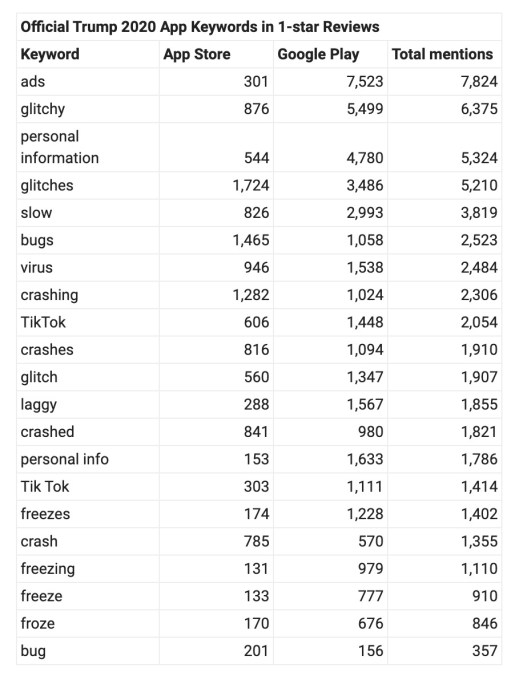
In the case of the Trump app, the pranksters left reviews saying the app was glitchy and buggy or stole their personal information. They sometimes shouted out to TikTok in their reviews, as well.

Image Credits: Data via Sensor Tower

At the time of Bloomberg’s report, the Trump Campaign said the TikTok users’ trolling effort hadn’t had any impact on the Trump app. “TikTok users don’t affect anything we do. What we do know is that the Chinese use TikTok to spy on its users,” a Trump Campaign director, Tim Murtaugh, told the news outlet.

In reality, the extent of the trolling lowered the Trump app’s rating to the point where the Trump Campaign made the decision to wipe out its rating history and start fresh.

Just before Bloomberg’s news report was published, data from app store intelligence firm Sensor Tower shows that the number of ratings for the app had jumped sharply from July 7 to July 9, 2020.

The app had about 20,500 1-star ratings on July 7 which spiked to 216,500 1-star ratings on July 9. The timing of that seems to coincide with Pompeo’s initial comments around potentially blocking TikTok.

The Trump app’s bad reviews peaked during the week of July 13 when it received  5,383 1-star reviews compared with 896 5-star reviews. The app saw its lowest star rating on July 11, at 1.2-stars.

It appears the trolling picked up again in August, as news of Trump’s executive order to ban TikTok made headlines. On August 10 and 11, the app received 490 1-star reviews versus 59 5-star reviews, for example.

The firm says the Trump app had never before wiped out its rating history. But it did so on August 14, 2020 on the U.S. App Store when it updated to its latest version.

The day before the ratings reset, the app was rated approximately 1.5 stars.

The ratings reset hasn’t seemed to stop the trolling. But as a result of the reset, the trolling no longer has as significant an impact now that all the older negative reviews aren’t being factored into the app’s summary rating.

On August 15 and 16, the app received 172 1-star reviews and 130 5-star reviews. Then on August 17 and 18, it received 161 1-star reviews and 162 5-star reviews.

As of the time of writing, the app has pulled itself up to a 3.9 rating, across 3,330+ reviews.

Typically, app publishers don’t want to reset their app’s summary rating because it means having to remove their app’s lifelong rating history and starting over from scratch. It means even the app’s prior good reviews can no longer contribute the summary rating the app displays on the App Store. The move is considered something of a last resort. It’s what a developer would use if it, for example, had released a buggy update and got slammed with 1-star reviews for having a broken app and wanted a second chance with users after the bug was fixed.

Even Apple warns against using the feature unnecessarily. On the Apple Developer website, Apple explains how an app’s summary rating can be reset and when to use it.

“…We recommend using this feature sparingly,” Apple writes. “While resetting the summary rating can ensure that it reflects the most current version of your app — useful if an update addresses users’ previous concerns — having few ratings may discourage potential users from downloading your app. In addition, keep in mind that resetting your summary rating does not reset your app’s written reviews. Past reviews will continue to display on your product page,” Apple website says.

Of course, the Trump Campaign isn’t likely concerned its official app won’t have enough ratings to confer legitimacy. It doesn’t have other apps also pretending to be the “real” version — a problem some other App Store publishers face. App publishers who are typically concerned with retaining their rating history are those aiming to give potential users an assurance that their app has been around for a long time and that it has a large user base, based on the number of reviews.

When the rating is reset, the ratings count starts at zero. This can sometimes be seen as a popularity metric, however, so Trump’s Campaign probably didn’t pull the kill switch without some consideration.

This isn’t the first time TikTok users have tried to prank the Trump Campaign. Thousands of TikTok users, along with K-pop fans, registered for tickets to Trump’s Tulsa rally in an effort to take away seats from Trump supporters. When it appeared the rally was under-attended, TikTok users and other online activists claimed credit. The Trump Campaign disputed this, saying it had already weeded out tens of thousands of bogus phone numbers that were used for fake registrations.

While the results of these online pranks may not have the effect they intend, it’s worth noting what TikTok users are capable of achieving when their ideas go viral in the very app Trump is looking to ban. One wonders, though, if the TikTok pranksters of age will take their activism to the polls later this year.

The Trump Campaign didn’t reply to requests for comment.

21 Aug 2020

As the pandemic creates supply chain chaos, Craft raises $10M to apply some intelligence

During the COVID-19 pandemic supply chains have suddenly become hot. Who knew that would ever happen? The race to secure PPE, ventilators, minor things like food, was and still is, an enormous issue. But perhaps, predictably, the world of ‘supply chain software’ could use some updating. Most of the platforms are deployed ‘empty’ and require the client to populate them with their own data or ‘bring their own data’. The UIs can be outdated and still have to be juggled with manual and offline workflows. So startups working in this space are now attracting some timely attention.

Thus, Craft, the enterprise intelligence company, today announces that it has closed a $10 million Series A financing to build what it characterizes as a ‘supply chain intelligence platform’. With the new funding, Craft will expand its offices in San Francisco, London, and Minsk, and grow remote teams across engineering, sales, marketing and operations in North America and Europe.

It competes with some large incumbents such as Dun & Bradstreet, Bureau van Dijk, Thomson Reuters . These are traditional data providers focused primarily on providing financial data about public companies, rather than real-time data from data sources such as operating metrics, human capital, and risk metrics.

The idea is to allow companies to monitor and optimize their supply chain and enterprise systems. The financing was led by High Alpha Capital, alongside Greycroft. Craft also has some high-flying Angel investors including Sam Palmisano, chairman of the Center for Global Enterprise and former CEO and chairman of IBM; Jim Moffatt, former CEO of Deloitte Consulting; Frederic Kerrest, executive vice-chairman, COO and co-founder of Okta; and Uncork Capital which previously led Craft’s Seed financing. High Alpha Partner, Kristian Andersen, is joining Craft’s Board of Directors.

The problem Craft is attacking is a lack of visibility into complex global supply chains. For obvious reasons, COVID-19 disrupted global supply chains which tended to reveal a lot of risks, structural weaknesses across industries and a lack of intelligence about how it’s all holding together. Craft’s solution is a proprietary data platform, API, and portal that integrates into existing enterprise workflows.

While many business intelligence products require clients to bring their own data, Craft’s data platform comes pre-deployed with data from thousands of financial and alternative sources, such as 300+ data points that are refreshed using both Machine Learning and human validation. It’s open-to-the-web company profiles appear in 50 million search results, for instance.

Ilya Levtov, co-founder and CEO of Craft said in a statement: “Today, we are focused on providing powerful tracking and visibility to enterprise supply chains, while our ultimate vision is to build the intelligence layer of the enterprise technology stack.”

Kristian Andersen, partner with High Alpha commented: “We have a deep conviction that supply chain management remains an underinvested and under-innovated category in enterprise software.”

In the first half of 2020, Craft claims its revenues have grown nearly threefold, with Fortune 100 companies, government and military agencies, and SMEs among its clients.

21 Aug 2020

No parties allowed at the Airbnb IPO

Hello and welcome back to Equity, TechCrunch’s venture capital-focused podcast (now on Twitter!), where we unpack the numbers behind the headlines.

What happens when the entire podcast crew is a bit tired from, you know, everything, and does its very best? This episode, apparently. A big thanks to Chris Gates for helping us trim the fat and make something good for you.

Before we get into the topics of the week, don’t forget that Equity is not back on YouTube most weeks, so if you wanted to see us do the talking with some fun extra from the production team, you can do so here. More to come once I get my new external camera to work.

That done, here’s what Natasha and Danny and I got into this week:

Whew! We’re doing a lot over at TechCrunch.com, so, stay tuned and know that if we were a bit frazzled this week it’s because we’re working our backends off to bring you neat things. You will dig ’em.

Ok, chat Monday, a show that we’re already planning. Stay cool!

Equity drops every Monday at 7:00 a.m. PT and Friday at 6:00 a.m. PT, so subscribe to us on Apple PodcastsOvercastSpotify and all the casts.

21 Aug 2020

Lambda School raises $74M for its virtual coding school where you pay tuition only after you get a job

In the world of technology, online learning has been one of the bigger beneficiaries of the last several months, with people staying home and away from their normal routines because of the coronavirus pandemic and using that time to expand their knowledge, or more critically, figure out what to do next if they want to change careers, or have found themselves without a job.

Now, one of the startups building a business around virtual computer science education — teaching people sitting at home before it became a mandate — is announcing a large round of funding to capitalise on that demand.

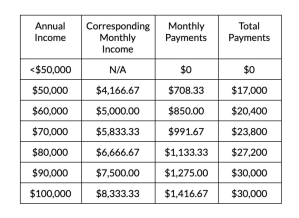
Lambda School, which runs virtual nine- and 18-month (part time) computer science courses for $30,000 — currently covering data science and full-stack web development — with payments for the course based on a sliding scale that only kicks in after you land a job that makes at least $50,000, has raised $74 million in equity in a Series C round.

The investment is largely coming from Gigafund, the VC started by ex-Founders Fund partners in 2017 originally to put more money into SpaceX, with Tandem Fund and Y Combinator (where Lambda School was incubated) also participating. Its list of other backers include GV, GGV, and Stripe. (Tommy Collison, the head of business development at Lambda, is the younger brother of the two Collison brothers who co-founded Stripe.)

Lambda School is not disclosing its valuation but CEO Austen Allred (who co-founded the company with Ben Nelson) confirmed that it is higher than the $150 million that Lambda had reached in its $30 million Series B in January 2019. He also said that he hopes that this will be the last funding that Lambda raises, not because it’s planning an IPO but because it’s aiming to become profitable. Allred confirmed that is not the case yet.

Allred added that the plan will be to use the funds to help the startup meet a surge in demand for its courses.

“There is more demand than we can handle right now, even with the fundraise,” he said. “I don’t know if that’s a good or bad thing.” Currently there are about 3,000 students enrolled, all taking live (not on-demand) classes according to timetables programmed for different timezones.

The money will specifically be used to continue expanding the range of what Lambda School offers, both in terms of content but potentially also in terms of developing its business model.

Case in point: just yesterday, the startup got approved by California’s Bureau for Private Postsecondary Education, after a prolonged period of difficulties with the bureau that saw Lambda cease teaching in the state and get fined.

But part of the deal for approval involved Lambda no longer offering Income Share Agreements to students, for the moment at least. With ISAs a cornerstone of how the company presents its deferred-payment model, Allred said Lambda is still working on making ISAs available but is also looking at “student-friendly substitutes” in the interim.

To be clear, getting approved by that board is not the same as accreditation: Lambda School doesn’t offer official degrees but certificates when students complete the courses. Currently there is no plan to get accreditation to offer degrees, Allred said.

“From a regulatory standpoint we could receive accreditation and grant degrees but [boards] require you to submit changes to curriculum a year in advance and our students can’t afford that. Things like that are a nonstarter until the accrediting bodies change their requirements,” he said, and added that schools that have accreditation are not always better than this.

“There are thousands of schools fully accredited that have a 20% graduation rate,” he said. “It doesn’t make you good. We have to prove our worth to students in other ways, usually through outcomes.”

Lambda School’s funding may be coming amid a surge of demand for its courses, but that doesn’t mean it hasn’t also been a tricky time for the startup.

In April, Lambda cut 19 staff and executives took a 15% pay cut amid market uncertainty due to the coronavirus pandemic (and maybe also to sharpen up its accounts, something that regularly happens when startups are in the process of raising money). The company currently has a team of around 150, which includes both operational and support staff as well as course teachers and team leads (which are essentially teaching assistants). All of them are working remotely at the moment, Allred said.

But even before April, Lambda has faced a lot of negative opinion around how it applies the deferred payment business model. Critics have described the process of paying back fees based on your income as indentured servitude and predatory. And they claim the business model is impractical because of how Lambda itself has to the risk when students don’t make their expected salaries, since the ISA model gives paybacks on a sliding scale based not just on salary, but also on a limit of 24 months to pay back the fees, which means that some students will pay back the full $30,000 and some will not:

Allred didn’t disclose how many default on payments but said that about 15% of students drop out before the end of the first month, which means they pay nothing at all.

These may be sticking points for some people, but not enough to curtail the startup’s growth, or interest among investors.

“We were attracted to Austen as a CEO,” said Stephen Oskoui, a Gigafund partner who is joining Lambda School’s board, in an interview. “Gigafund is very focused on the strength of those that we think will build for multiple decades, and the model for how Lambda School is operating has the potential for tremendous impact.”

21 Aug 2020

Facebook trails expanding portability tools ahead of FTC hearing

Facebook is considering expanding the types of data its users are able to port directly to alternative platforms.

In comments on portability sent to US regulators ahead of an FTC hearing on the topic next month, Facebook says it intends to expand the scope of its data portability offerings “in the coming months”.

It also offers some “possible examples” of how it could build on the photo portability tool it began rolling out last year — suggesting it could in future allow users to transfer media they’ve produced or shared on Facebook to a rival platform or take a copy of their “most meaningful posts” elsewhere.

Allowing Facebook-based events to be shared to third party cloud-based calendar services is another example cited in Facebook’s paper.

It suggests expanding portability in such ways could help content creators build their brands on other platforms or help event organizers by enabling them to track Facebook events using calendar based tools.

However there are no firm commitments from Facebook to any specific portability product launches or expansions of what it offers currently.

For now the tech giant only lets Facebook users directly send copies of their photos to Google’s eponymous photo storage service — a transfer tool it switched on for all users this June.

“We remain committed to ensuring the current product remains stable and performant for people and we are also exploring how we might extend this tool, mindful of the need to preserve the privacy of our users and the integrity of our services,” Facebook writes of its photo transfer tool.

On whether it will expand support for porting photos to other rival services (i.e. not just Google Photos) Facebook has this non-committal line to offer regulators: “Supporting these additional use cases will mean finding more destinations to which people can transfer their data. In the short term, we’ll pursue these destination partnerships through bilateral agreements informed by user interest and expressions of interest from potential partners.”

Beyond allowing photo porting to Google Photos, Facebook users have long been able to download a copy of some of the information it holds on them.

But the kind of portability regulators are increasingly interested in is about going much further than that — meaning offering mechanisms that enable easy and secure data transfers to other services in a way that could encourage and support fast-moving competition to attention-monopolizing tech giants.

The Federal Trade Commission is due to host a public workshop on September 22, 2020, which it says will  “examine the potential benefits and challenges to consumers and competition raised by data portability”.

The regulator notes that the topic has gained interest following the implementation of major privacy laws that include data portability requirements — such as the European Union’s General Data Protection Regulation (GDPR) and the California Consumer Privacy Act (CCPA).

It asked for comment submissions by August 21, which is what Facebook’s paper is responding to.

In comments to the Reuters news agency, Facebook’s privacy and public policy manager, Bijan Madhani, said the company wants to see “dedicated portability legislation” coming out of any post-workshop recommendations.

It reports that Facebook supports a portability bill that’s doing the rounds in Congress — called the Access Act, which is sponsored by Democratic Senators Richard Blumenthal and Mark Warner, and Republican senator Josh Hawley — which would require large tech platforms to let their users easily move their data to other services.

Albeit Madhani dubs it a good first step, adding that the company will continue to engage with the lawmakers on shaping its contents.

“Although some laws already guarantee the right to portability, our experience suggests that companies and people would benefit from additional guidance about what it means to put those rules into practice,” Facebook also writes in its comments to the FTC .

Ahead of dipping its toe into portability via the photo transfer tool, Facebook released a white paper on portability last year, seeking to shape the debate and influence regulatory thinking around any tighter or more narrowly defined portability requirements.

In recent months Mark Zuckerberg has also put in facetime to lobby EU lawmakers on the topic, as they work on updating regulations around digital services.

The Facebook founder pushed the European Commission to narrow the types of data that should fall under portability rules. In the public discussion with commissioner Thierry Breton, in May, he raised the example of the Cambridge Analytica Facebook data misuse scandal, claiming the episode illustrated the risks of too much platform “openness” — and arguing that there are “direct trade-offs about openness and privacy”.

Zuckerberg went on to press for regulation that helps industry “balance these two important values around openness and privacy”. So it’s clear the company is hoping to shape the conversation about what portability should mean in practice.

Or, to put it another way, Facebook wants to be able to define which data can flow to rivals and which can’t.

“Our position is that portability obligations should not mandate the inclusion of observed and inferred data types,” Facebook writes in further comments to the FTC — lobbying to put broad limits on how much insight rivals would be able to gain into Facebook users who wish to take their data elsewhere.

Both its white paper and comments to the FTC plough this preferred furrow of making portability into a ‘hard problem’ for regulators, by digging up downsides and fleshing out conundrums — such as how to tackle social graph data.

On portability requests that wrap up data on what Facebook refers to as “non-requesting users”, its comments to the FTC work to sew doubt about the use of consent mechanisms to allow people to grant each other permission to have their data exported from a particular service — with the company questioning whether services “could offer meaningful choice and control to non-requesting users”.

“Would requiring consent inappropriately restrict portability? If not, how could consent be obtained? Should, for example, non-requesting users have the ability to choose whether their data is exported each time one of their friends wants to share it with an app? Could an approach offering this level of granularity or frequency of notice could lead to notice fatigue?” Facebook writes, skipping lightly over the irony given the levels of fatigue its own apps’ default notifications can generate for users.

Facebook also appears to be advocating for an independent body or regulator to focus on policy questions and liability issues tied to portability, writing in a blog post announcing its FTC submission: “In our comments, we encourage the FTC to examine portability in practice. We also ask it to recommend dedicated federal portability legislation and provide advice to industry on the policy and regulatory tensions we highlight, so that companies implementing data portability have the clear rules and certainty necessary to build privacy-protective products that enhance people’s choice and control online.”

In its FTC submission the company goes on to suggest that “an independent mechanism or body” could “collaboratively set privacy and security standards to ensure data portability partnerships or participation in a portability ecosystem that are transparent and consistent with the broader goals of data portability”.

Facebook then further floats the idea of an accreditation model under which recipients of user data “could demonstrate, through certification to an independent body, that they meet the data protection and processing standards found in a particular regulation, such as the [EU’s] GDPR or associated code of conduct”.

“Accredited entities could then be identified with a seal and would be eligible to receive data from transferring service providers. The independent body (potentially in consultation with relevant regulators) could work to assess compliance of certifying entities, revoking accreditation where appropriate,” it further suggests.

However its paper also notes the risk that requiring accreditation might present a barrier to entry for the small businesses and startups that might otherwise be best positioned to benefit from portability.


21 Aug 2020

China is building a GitHub alternative called Gitee

The technological decoupling between the U.S. and China has been a boon to Chinese firms from chipmakers for smartphones and electric vehicles through to software that are the backbones of millions of businesses’ daily operations.

Chinese companies might have established a firm grip on internet services for consumers, but many fundamental technologies undergirding hardware and enterprise software remain in the hands of Western companies. As tech businesses become increasingly entangled in broader geopolitical disputes, their users and clients are feeling the heat. Huawei’s plan to unshackle imported chips is just one oft-cited example of the vulnerability of Chinese firms dependent on foreign tech.

Another area that has made the tech community restless is source code hosting. Chinese developers rely heavily on GitHub, as evident from an apparent government ban of the site in 2013 that prompted former Google China head Kaifu Lee to speak out. Now the China is wary that political conflict may inflict GitHub.

The scenario is not without precedent. Last July, Microsoft-owned GitHub cut off certain services from users in U.S.-sanctioned countries including Iran, Syria and Crimea, causing outrage and panic in the global developer community.

Seven-year-old Gitee is at the center of China’s push to localize businesses’ source codes. The Ministry of Industry and Information Technology (MIIT), one of China’s top tech policymakers, recently picked (in Chinese) Gitee to construct an “independent, open-source code hosting platform for China.”

The project will be carried out by a consortium led by Open Source China, the Shenzhen-based firm behind its namesake open-source community and Gitee. The hosting service appears to be a government-led effort with support from research universities and participation from the private sector — a group of 10 organizations including Huawei,  who is itself suffering from supply chain disruption amid the political storm.

“If China does not have its own open-source community to maintain and manage source codes, our domestic software industry will be very vulnerable to uncontrollable factors,” said Huawei executive Wang Chenglu at an event last August, shortly after GitHub acted to comply with U.S. sanctions laws.

Gitee claims to have hosted over 10 million open-source repositories and provided services to over 5 million developers so far. For comparison, GitHub reported having 100 million repositories and around 31 million developers worldwide last November.

The question is whether Gitee’s platform can convince Chinese developers to migrate from GitHub — or its Tencent-backed local rival Coding.net — now that industry titans are onboard to help. It’s also unclear whether GitHub will act to preempt export restrictions, as it hinted at the possibility when its executive told the Financial Times that it’s ‘keen’ to open a subsidiary in China.

Gitee is clearly confident that there is space for a ‘Chinese alternative’ to GitHub.

“The world should be one where a hundred flowers bloom. The foreign market has GitHub and other kinds of foundations. In China, there are various organizations dedicated to evangelizing open source software, as well as Gitee,” wrote (in Chinese) Open Source China founder who goes by the nickname ‘Hongshu’, or ‘Sweet Potato’.

“An open-source ecosystem can’t be built overnight. It’s a process of building a tower with sand. We have faith in the innovative power of Chinese developers. We also believe in our perseverance and strength to strive.”

21 Aug 2020

Indian logistics SaaS startup FarEye bags $13 million

More than 150 e-commerce and delivery companies globally use an Indian logistics startup’s service to work out the optimum way to ship items to their customers.

That startup, Noida-based FarEye, said today it has raised an additional $13 million to close its Series D financing round at $37.5 million.

FarEye first unveiled its Series D round in April this year when it raised from Microsoft’s venture fund M12, Eight Roads Ventures, Honeywell Ventures, and SAIF Partners.

The startup said today industry veterans Nandan Nilekani and Sanjeev Aggarwal’s Fundamentum Partnership led the extended round, with participation from KB Global Platform Fund.

FarEye helps companies orchestrate, track, and optimize their logistics operations. Say you order a pizza from Domino’s, the eatery uses FarEye’s service, which integrates into the system it is using, to quickly inform the customer how long they need to wait for the food to reach them.

Behind the scenes, FarEye is helping Domino’s evaluate a plethora of moving pieces. How many delivery people are in the vicinity? Can it bundle a few orders? What’s the maximum number of items one can carry? How experienced is the delivery person? What’s the best route to reach the customer? And, would the restaurant need the same number of delivery people the following day?, explained Kushal Nahata, co-founder and chief executive of FarEye.

Logistics firms have made minimal investment in digitisation. So, “the amount of visibility they have over their own delivery network is minimal. Forget what a customer should expect,” said Nahata, explaining the challenges the industry faces.


More to follow…

21 Aug 2020

Exo raised $40 million for its handheld medical imaging device

Exo, a developer of new diagnostic hardware for the medical industry, has raised $40 million in a new round of funding as investors continue to back new companies that are reducing the cost and complexity of medical devices.

Cost, portability, image quality and the inability to image dense body compositions have all limited the impact that diagnostic tools like ultrasounds can have on patient care around the world, according to a statement from the company.

Exo solves that problem by building on a patented piezoelectric micromachined ultrasound transducer, the company said.

Its device improves image quality, while an accompanying software toolkit boosts the diagnostic capabilities of the device.

Exo predicts that the worldwide point of care ultrasound market will reach $1.5 billion in 2024 and grow at nearly 10 percent a year.

“Emergency room phyisicians around the world are often tasked with solving some of the most urgent healthcare problems — COVID-19 diagnosis and complications, cardiac emergencies, internal bleeding — without being able to see clearly into a patient they only have minutes to diagnose and treat,” said Exo chief executive Sandeep Akkaraju, in a statement.

The new $40 million round to back the company’s technology follows a $35 million investment in 2019 and brings the company’s total capital raised to nearly $100 million, according to a statement. The funding was led by Fiscus Ventures, Reimagined Ventures (both affiliates of Magnetar Capital) and Action Potential Ventures, with additional participation from TDK Ventures, Solasta Ventures and all previous investors, including Intel Capital and Applied Ventures.

Exo’s team comes from consumer tech giants like Apple and Google and leading medical device companies like GE, Johnson & Johnson, Maxim, Medtronic, and Siemens.

“As both an emergency room phyisician and a venture capitalist, I know firsthand the transformative potential of the products that Exo is bringing to market,” said Dr. Ted Koutouzis of Fiscus and Reimagined Ventures, in a statement. “The Exo team is focused on a building a device that works seamlessly within the often chaotic and urgent environment of a hospital, and delivers the image quality, clean interface, and diagnostic tool sthat doctors have dreamed about having in the palm of our hands.”

The Exo hardware comes with a suite of software tools that have been designed to integrate with existing workflows. And the company has plans to use its initial foray into medical imaging as a way to land and expand into a broader suite of tools for the hospital or urgent care environment. The company envisions a multi-functional device that can perform a number of different diagnoses.

“Exo is creating a platform technology that can drive true adoption of point of care imaging in emergency rooms and critical care units, can facilitate advanced surgical robotics and endoscopic procedures, and could enable therapeutic modalities in non-invasive neuromodulation and drug-delivery,” said Juan Pablo Mas, of Action Potential Venture Capital (the corporate venture arm of GlaxoSmithKline focused on bioelectronic technologies).