Year: 2020

20 Aug 2020

Triller threatened to sue over report suggesting it inflated its downloads

A new report disputing the validity of Triller’s recently announced download figures led Triller to respond with the threat of a lawsuit. Triller, a newly litigious TikTok rival that could potentially benefit from a TikTok ban in the U.S., has been pushing to capitalize on the recent turn of events regarding its chief competitor. Earlier this month, Triller issued a press release claiming it saw surge of new downloads following the news of a possible TikTok ban, bringing Triller’s app to a total of 250 million global downloads across iOS and Android. The company also separately reported 65 million monthly active users. Estimates from third-party mobile data and analytics firms call these figures into question, however.

Initially, the app store intelligence firm Apptopia crunched the numbers around Triller’s downloads and found the claim of 250 million downloads to be inflated. According to its analysis, Apptopia had estimated Triller’s app has been downloaded 52 million times since launch across both iOS and Google Play worldwide, not 250 million times, as Triller had said.

TechCrunch reached out to Triller comment on Apptopia’s findings. Triller and Apptopia then ended up independently getting in touch with one another, through a shared investor. After some back-and-forth between the two, Apptopia decided to pull its report.

During this time, Triller also threatened to sue Apptopia for providing false information, in a comment provided to TechCrunch.

Triller CEO Mike Lu told TechCrunch, via an emailed statement, that Apptopia “clearly have allowed themselves to become a pawn of these giant conglomerates, especially those like TikTok who we are in active litigation with for stealing our patents.” (Lu was referring to the recent lawsuit Triller filed against TikTok over patent infringement.)

“We would have welcomed Apptopia with open arms had they just reached out to us and helped them understand our numbers, and now they have just made themselves part of our TikTok litigation,” Lu threatened. “We will be pursuing a claim against them for spreading harmful, false and knowingly damaging information,” he said.

This is a fairly aggressive response over a dispute about app store downloads. Industry insiders understand that none of the app store analytics firms have perfectly accurate figures. Meanwhile, regular consumers can get a sense of how popular an app is just by looking at the app store’s top charts, which are public.

For further context around the now heavily disputed download number, we asked mobile data and analytics firm App Annie and app store intelligence firm Sensor Tower for their own Triller data. App Annie declined to share downloads, but shared ranking data. Sensor Tower’s data, meanwhile, indicated Triller had reached 45.6 million total global installs across iOS and Android since its launch. That’s even lower than the 52 million figure Triller had vehemently disputed.

Sensor Tower suggested the discrepancies between third-party estimates and Triller’s own numbers could have to do with how Triller counted its installs. Some publishers count other forms of installs, like re-installs, updates, and direct installs of Android APKs (meaning, installs outside of Google Play). Third-party firms don’t see these figures. Third-party firms also don’t count things like re-installs because that’s effectively counting the same user twice. Sensor Tower, of course, doesn’t know how Triller was counting installs internally.

Though Apptopia is no longer standing behind its original report and estimate of 52 million installs, its report contained some other interesting insights that are still worth looking at, as they don’t rely on its forecasting technology.

For instance, Triller recently told CNBC it had 65 million monthly active users (MAUs). Counting an app’s MAUs is a way to measure its current usage and popularity. This tends to be much smaller figure than an app’s total downloads as not everyone who tries out an app sticks with it as a regular user.

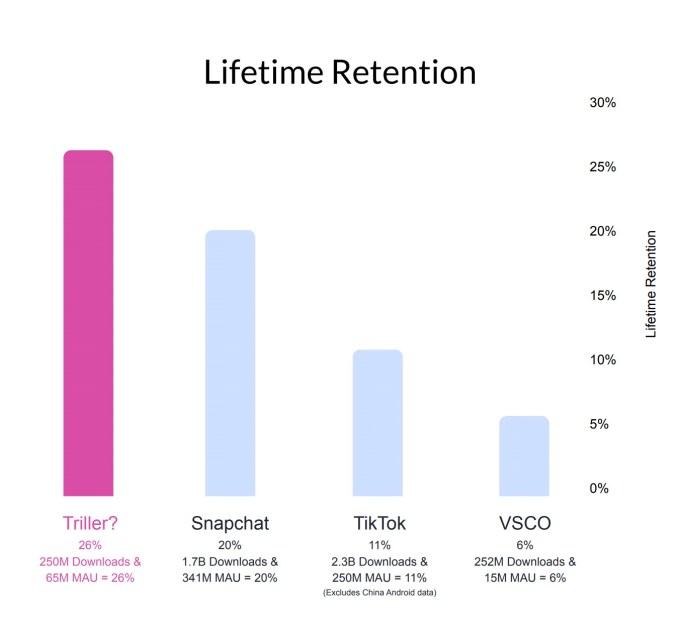
Using Triller’s own download figure of 250 million and its own 65 million MAU figure, it’s claiming a lifetime retention rate of 26%. (The lifetime retention rate is determining the percentage of the app’s total downloads the current MAU number represents.) Triller’s rate is well above what the best apps in the industry are able to achieve.

Snapchat has a lifetime retention rate of 20%, for example. TikTok has an 11% lifetime retention rate. Triller’s is higher, based on its own figures.

Triller’s response to this part of the claim is that its app has changed a lot since its 2015 launch. It didn’t become a social media platform, for example, until 2018. It says if you look at the 90-120 day retention figures for TikTok or Snap, they would be above 30%, which is how its numbers should be compared.
Apptopia’s report also pointed to Triller’s App Store and Google Play chart rankings as another data point in questioning Triller’s download claims.

For those unfamiliar, the app store chart rankings are driven by downloads combined with other factors, like velocity of downloads, ratings, user retention and more.
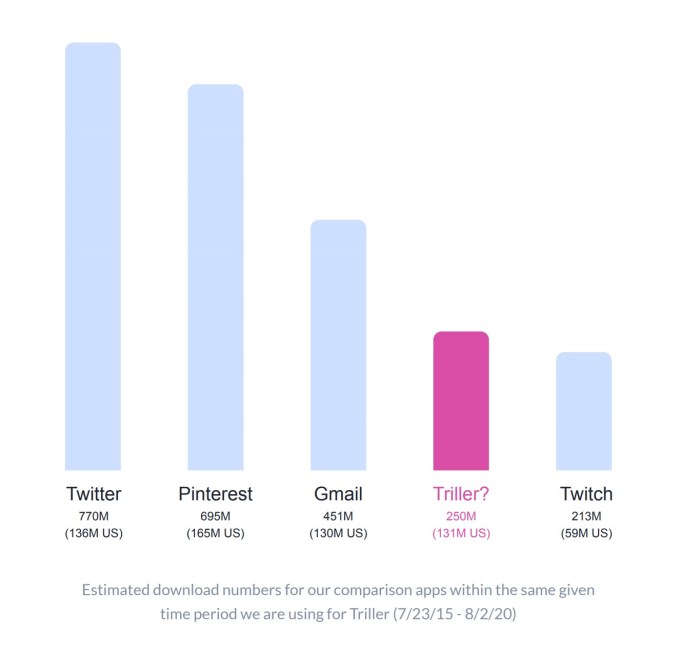
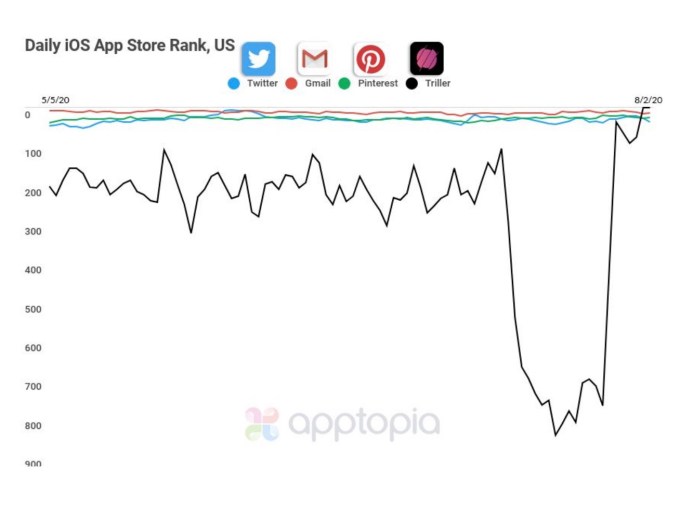
To analyze Triller’s claim in the context of its chart rankings, Apptopia examined several other popular U.S. apps for comparison’s sake, including Twitter, Pinterest, Gmail and Twitch.

These apps were selected because they had a similar number of U.S. downloads to Triller for the time period Apptopia used to analyze Triller’s claim: July 23, 2015-August 2, 2020. The former is the date of Triller’s launch and the latter is when it issued a press release stating its 250 million download figure.
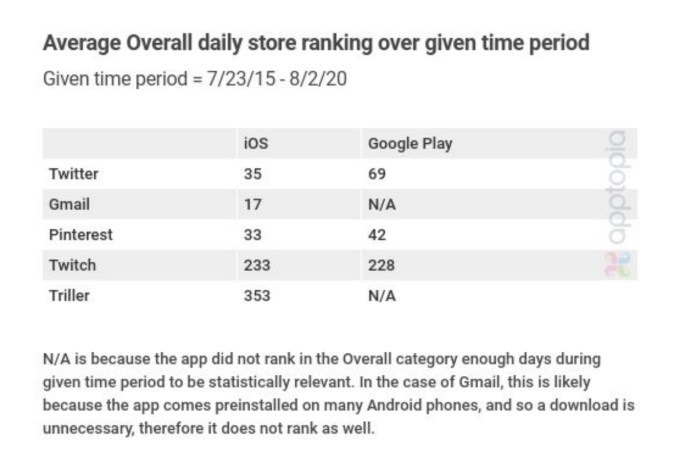
Simply put, if Triller’s 250 million figure was correct, then the app would seemingly appear much higher on the U.S. App Store and Google Play charts than it does.

On iOS, the average overall ranking for Gmail during this time period was No. 17, Twitter was No. 35, Pinterest was No. 33, and Twitch was No. 233. Triller, meanwhile, was No. 353. (Twitch is lower than the others because its a less-used app, because chart rankings aren’t entirely download-dependent, and because many Twitch users stream on the desktop, not mobile. But even it ranks higher than Triller.)

You can see that Triller consistently trends well below the others in the U.S. charts. This trend is even clearer when zoomed into the last 90 days. (See below).

Apptopia’s estimate here is also in line with App Annie’s data. Though App Annie couldn’t pull a lifetime average rank, as Apptopia did, it was able to pull Triller’s average U.S. iPhone App Store Overall rank for the past 90 days, which was No. 303.
A similar trend can be seen on Google Play, where Triller doesn’t even rank in the Overall category enough days during the given time frame to be statistically relevant. (Gmail didn’t either but that’s because the app is preinstalled on many Android phones, so users don’t need to download it.)

Triller’s response to this claim is that it, again, it was a different app before 2018 and it has hit No. 1 in many non-U.S. markets, including Korea where it’s currently No. 1. In the last 10 days, it has been No. 1 in Pakistan, Indonesia, Brazil, Mexico, Italy, France, and in the last 30 days India, US, South Africa, Nigeria and dozens of others.

“Our growth and numbers are very fresh and very new so taking anything long term or just the U.S. is neither relevant nor applicable to us,” said Triller CEO Mike Lu.
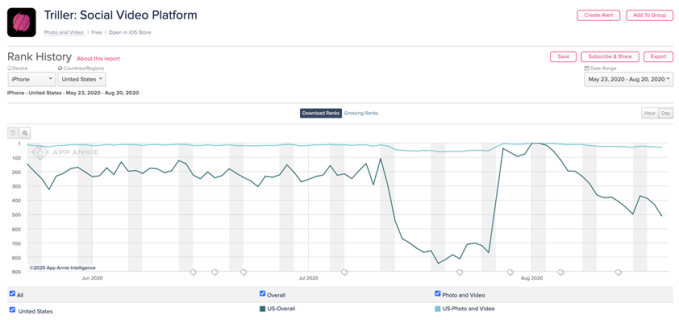
Image Credits: App Annie

The timing of Triller’s claim of 250 million downloads follows reports that said the startup is raising hundreds of millions in new funding. Fox Business recently reported Triller has “commitments from investors of $200 million to $300 million.” Pegasus Tech Ventures, a Triller investor, emailed journalists in early August to pitch Triller coverage, saying the app was “now raising around $250m at a $1B valuation.”

Triller also recently made news for suing TikTok over patent infringement, verified in court filings TechCrunch pulled from PACER. 

None of this is coincidental. Triller has been angling to become the TikTok alternative that wins the U.S. market in the event TikTok can’t get a deal done in time allotted by Trump’s executive order requiring TikTok to sell its U.S. operations or be banned in the country.

Mr. Lu disputed claims made by third-party mobile data firms, when reached for comment. The company stands by its numbers.

“No app intelligence firm has been provided our data,” Lu said. “Any numbers they provide have no relevance or accuracy to our numbers. We are able to validate each and every one of our users. They should also disclose which of our competitors are paying them hundreds of thousands of dollars such as TikTok,” he added.

Lu also openly wondered if a Triller competitor was feeding false information. His full statement is below.

The biggest app intelligence firms have less than 1M total users/customers and less than a few hundred large companies actually providing them real data, any numbers they present are based solely on guessing based on a very small sample group and are far from accurate. The terms of service of all app intelligence firms state that any numbers they provide come from their own guesstimates. While certain companies pay upwards of a few hundred thousand dollars to these firms and give them access to their numbers, we have not provided such access. Any numbers provided by them are wholly inaccurate and they themselves state they have no actual way of validating without us providing them access. These is clearly just a transparent attack by one of our competitors who pays them handsomely to disseminate this false information. It’s sad to see firms that are supposed to be neutral and claim to be pro entrepreneurial and pro American allow themselves to become a pawn of these giant conglomerates, especially those like TikTok who we are in active litigation with for them stealing our patents.”

Following their conversation with Triller, Apptopia tells us it will soon have access to more accurate figures for Triller and will release those at a later time. The companies seem to be working things out.

Apptopia says:

We are working closely with Triller who has been very transparent and is opening up all of their analytics accounts to Apptopia. We are working on internal reports and working with Triller to create the most accurate and up to date data over the short term. Between their tremendous success in emerging mobile markets, which are typically hard to model, (i.e. India, Africa, etc.) and the fact that Triller’s growth is very recent, it is especially hard to compare to peers who have years of growth and history. We feel strongly about publishing the most accurate estimates, and the best way for us to do that is to work hand in hand with Triller and authenticate their real data. We plan to do this over the coming weeks and do our best to be the source of truth on the matter.
20 Aug 2020

Sony WH-1000XM4 headphone review

There was a mixed reaction among the TechCrunch staff when Sony’s WH-1000XM4 were announced the other week. There was excitement among those looking for new headphones and disappointment for those who’d recently purchased a different pair. The product’s predecessor are pretty universally regarded as some of the best over-ear headphones you can get for the price point, so the biggest question, really, was what the new ones bring to the table.

So let me just say this off the bat. If you own the WH-1000XM3, congrats. You purchased a very good pair of headphones — ones that rightfully helped unmoor Bose from its long-standing position as the default frequent traveler purchase. And no, you don’t need to rush out and upgrade if yours are still hanging in there.

The original headphones entered the world pretty fully formed, and after two years, this refresh is more of a refinement of an excellent product. But the additions do go a long ways toward maintaining Sony’s spot as the reigning champion of noise-canceling, over-ear Bluetooth headphones. The 1000XM4 are hard to beat.

The new headphones more or less look exactly the same as their predecessors. They’re not the most striking pair of over-ear headphones for your money (that award may well go to Sennheiser or Bang & Olufsen). I appreciate the relative simplicity versus the comparable Bose Quiet Comfort model. Honestly, when it comes to things like long-haul flights, the less flashy, the better.

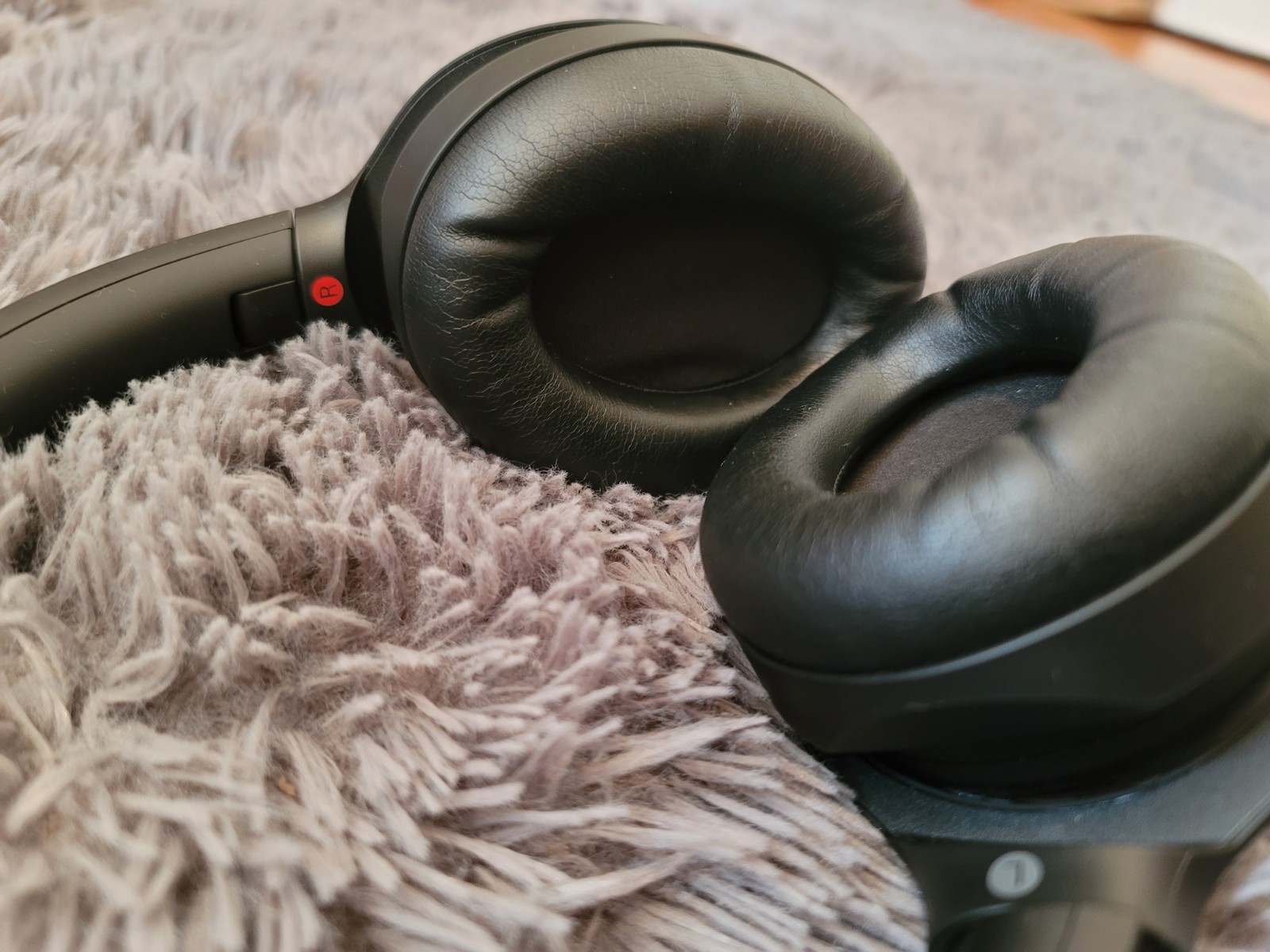
The headphones are surprisingly light — something I noticed the first time I had the opportunity to try the M3 during a meeting in some board room with Sony execs a couple of years back. The new units have a bit more padding and are extremely comfortable. I say that as someone who has a tough time with over-ear headphones for whatever reason. As I write this, I’ve been wearing the headphones for the better part of four days.

Image Credits: Brian Heater

There have been breaks in the marathon, of course. The nature of the form factor means they’re not really ideal for, say, going for a walk or falling asleep. The former is especially the case of late here in New York, where it has routinely hit temperatures in the 90s. For noise canceling all of the annoyances of home, however, they’re terrific. And when we all start flying in planes again, they’ll be excellent for that, too (thanks in no small part to the inclusion of a 3.5mm headphone jack for that seat-back entertainment).

The other element that has allowed for nearly uninterrupted usage is the ability to pair the system with two devices simultaneously. This has, frankly, been a big pain point for a number of headphones I’ve been using of late, requiring the user to get into the device settings and manually select the headphones. Using the iOS app, I paired the M4 to my phone and desktop top, and I’m able to switch seamlessly between sources. You’d be surprised by how liberating that feels. Just make sure your sound level is comparable on each device or you’ll be in for an unfortunate blast.

Like the M3, the sound quality is excellent, offering a full audio picture, regardless of genre. The sound is honestly pretty comparable to the previous model, and that’s perfectly fine. Nura’s truly excellent sound profile technology retains the top spot for me, but these new Sonys offer excellent audio for a pair of everyday headphones.

Once again, the real centerpiece, however, is Sony’s truly excellent noise canceling. The feature was the M3’s real secret weapon against Bose dominance in the category. The new models take things up a notch by detecting ambient sound some 700 times per second via the system-on-a-chip and actively adapting to counteract this. The system also features the addition of Noise Canceling Optimizer. On the face of it, the feature works similarly to noise optimization on other systems. Hold the button down and it sends an audio signal into your ear, meowing things like seal quality and atmospheric pressure (for planes, primarily) to offer up a more customized found profile. It adds up to some truly excellent noise canceling and an overall great audio experience.

There are a bunch of other nice features throughout that may or may not be helpful in your specific scenario. For instance, I found myself  immediately disabling Speak to Chat, which pauses playback when you speak. A nice feature in theory, but I live alone, so the only time it would trigger is if I coughed, laughed or unconsciously found myself singing along to the music. More useful for my own needs however is a feature that lets in ambient sound when you cover the right ear cup with your hand. Ambient sound fed into headphones through a mic still sounds a bit unnatural, but it does the trick.

Image Credits: Brian Heater

I also found myself turning off location tracking, because, quite frankly, enough of my gadgets already know where I am. Also, the addition of noise that adapts based on familiar locations is nice, but not really worth the trouble for me — especially these days when I’m leaving my apartment significantly less than I’d care to admit. And besides, I just really don’t like seeing that location tracking icon in the corner of iOS 11.

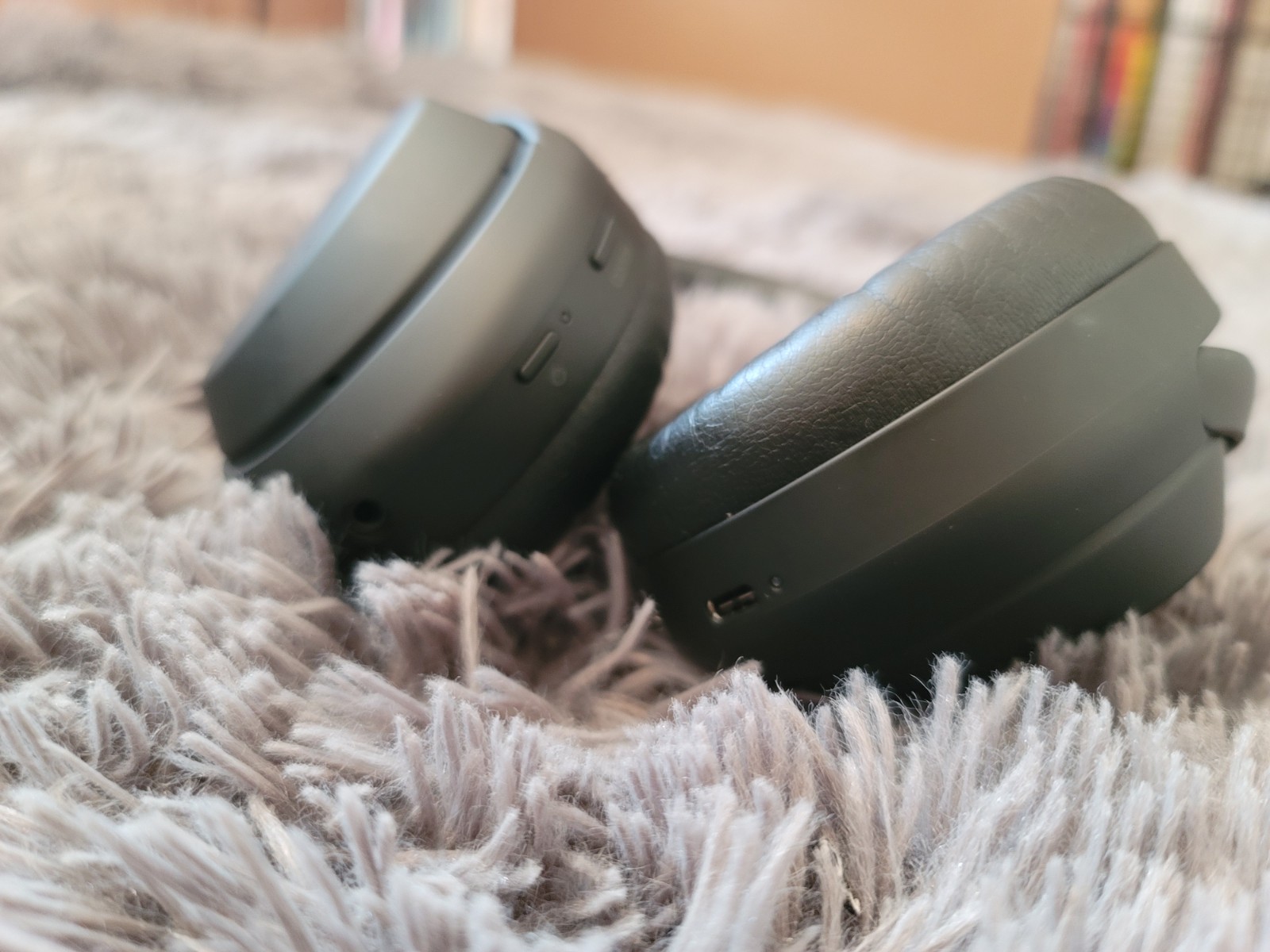
Google Assistant and Alexa are built in, as well, but again, not features I tend to use much in a pair of headphones. I’d say I shut them off to save battery, too, but with a stated life of 30 hours, I’ve honestly been fine on that front. Charging via USB-C, meanwhile, will get you an impressive five hours of playback in around 10 minutes.

At $350, they’re priced the same as their predecessors — which is to say, they’re not cheap. But you’d be hard pressed to find a better pair of wireless over-ear headphones in their class.

20 Aug 2020

Daily Crunch: Lyft and Uber win legal victory

Uber and Lyft may not be pausing operations in California after all, Google releases new emergency alert tools and Airbnb bans all parties. This is your Daily Crunch for August 20, 2020.

The big story: Uber and Lyft win legal victory

Earlier today, Lyft announced that it would suspend operations in California tonight as a result of a preliminary injunction forcing Lyft and Uber to reclassify their drivers as employees.

Then, in a head-spinning change of fortune, an appeals court judge granted the companies a temporary stay. They now have until early September to outline their plans for how to manage the transition, with oral arguments in the court case coming in mid-October.

Meanwhile, Uber, Lyft and DoorDash are backing Proposition 22, a state ballot measure that they’re pitching as an alternative approach to classifying gig workers.

The tech giants

Google brings emergency alert tools to Search and Maps as fires rage in Northern California — Google will display a red border that encircles a rough approximation of the active blaze.

Report: Apple quietly acquired Israel’s Camerai, formerly Tipit, a specialist in AR and camera tech — The acquisition was reported by Calcalist.

Startups, funding and venture capital

Airbnb declares all parties over indefinitely at its listings — The company notes that “unauthorized parties” have always been against its rules, even though it previously allowed hosts on its platform to selectively approve small gatherings.

DoorDash expands with on-demand grocery delivery — In contrast to many other grocery services, the company promises to deliver within an hour of your order.

China’s Waterdrop nabs $230M for its crowdfunded, mutual aid insurance platform — Waterdrop pays out when its members fall into medical dire straits.

Advice and analysis from Extra Crunch

Figma CEO Dylan Field discusses fundraising, hiring and marketing in stealth mode — The company behind the largely browser-based design tool has made a huge splash in the past few years, building a massive war chest with more than $130 million.

Zoom UX teardown: 5 fails and how to fix them — Zoom’s user experience is far from perfect.

Eric Hippeau discusses D2C growth, brand value and advice for early-stage founders — Lerer Hippeau’s portfolio companies include Axios, BuzzFeed, Casper, Warby Parker, Allbirds, DocSend, Fundera, Everlane, Giphy, Genius and the recently acquired fitness company Mirror.

(Reminder: Extra Crunch is our subscription membership program, which aims to democratize information about startups. You can sign up here.)

Everything else

Border wall crowdfunding scheme leads to Trump ally Steve Bannon’s arrest — Bannon faces charges for conspiracy to commit money laundering and conspiracy to commit wire fraud.

The founders of Blavity and The Shade Room are coming to Disrupt 2020 — Morgan DeBaun and Angie Nwandu have been building a more diverse digital media landscape for years.

The Daily Crunch is TechCrunch’s roundup of our biggest and most important stories. If you’d like to get this delivered to your inbox every day at around 3pm Pacific, you can subscribe here.

20 Aug 2020

Sign up to interview with accelerators before Disrupt 2020

Startup founders, brace yourself for a phenomenal opportunity. TechCrunch, in partnership with cela, will host eleven — count ‘em eleven — accelerators in Digital Startup Alley at Disrupt 2020. It gets better: they’re accepting applications for their upcoming virtual accelerator programs, and this is your chance to interview with them.

Do you want in on this potentially life-changing speed networking opportunity? There’s only one requirement: you must be an exhibitor in Digital Startup Alley. If you don’t have one yet, go buy your Digital Startup Alley Package right now.

Not familiar with cela or its mission? The New York City-based company matches early-stage startups to world-class accelerators and incubators — within its global network — that align with a startup’s vertical and business goals.

cela already connected winners of our ongoing Pitchers and Pitches mini pitch-off competitions (register to attend the next one on September 2nd — it’s free) with an appropriate accelerator. Here’s what pitch-off winner Hannah Webb, CEO of Findster Technologies, said about her experience.

“Disrupt and Digital Start Up Alley haven’t even officially started yet, and we’ve already seen great benefits. cela introduced us to multiple accelerators in the NYC area and one is a perfect fit for our company’s situation.”

A good accelerator can give founders an enormous boost. Finding the right one for your startup is crucial, and it can be tricky. That’s where cela’s guidance — and its extensive network — can help.

“During these speed networking events, we will match selected founders to curated, 1:1 meetings with the Managing Directors of some of the world’s most respected accelerator programs. Founders that apply can discuss investment, sales, team building, product development, marketing and any other challenge or opportunity their startup is pursuing.” — John Lynn, co-founder, cela.

Speed networking sessions take place over three days during the week prior to Disrupt 2020. Here’s the schedule, so mark your calendars now and get ready to impress.

Date: September 8

Time: 1 p.m. – 4 p.m. PT

Accelerators: NUMA, Techstars, Entrepreneurs Roundtable Accelerator

Date: September 9

Time: 1 p.m. – 4 p.m. PT

Accelerators: She Gets Sh!t Done, Halo Incubator, Startup Boost Pre- Accelerator, Plug and Play

Date:  September 10

Time: 1 p.m. – 4 p.m. PT

Accelerators: Backstage Capital, Global Startup Ecosystem, StartEd Accelerator, Quake Capital

In a classic “but wait, there’s more” moment, don’t forget to sign up for these other webinars exclusively for Digital Startup Alley exhibitors.

  • August 26 — Fundraising and Hiring Best Practices with panelists Sarah Kunst of Cleo Capital and Brett Berson of First Round Capital.
  • September 2—Leveraging Online Fundraising for Your Business with IFundWomen.

All of this happens before the full week of Disrupt (starting September 14th). That’s a ton of opportunity waiting for you. Don’t wait — buy your Digital Startup Alley Package now, join us for speed networking and get ready to accelerate your success.

Is your company interested in sponsoring or exhibiting at Disrupt 2020? Contact our sponsorship sales team by filling out this form.

20 Aug 2020

Investors Reilly Brennan, Amy Gu and Olaf Sakkers coming to TC Sessions: Mobility 2020

The mobility sector has been abuzz with activity in the past decade from the rise of ride-hailing and the sudden explosion of shared electric scooters and bikes to the pursuit to commercialize moonshots like automated vehicles and flying cars.

At the center of this evolving industry are the investors, who are tapped into a range of startups from early to growth stages. TechCrunch simply couldn’t hold an event on mobility without hearing from the people who are hunting for the best opportunities in the industry and tracking all of its changes.

That’s why we’re happy to announce investors Reilly Brennan, Amy Gu and Olaf Sakkers, all of whom have expertise in mobility, are joining us on our virtual stage at TC Sessions: Mobility 2020. The virtual edition of TechCrunch Sessions: Mobility will occur over two days, October 6-7 and feature the best and brightest minds in the world of mobility, including Argo AI founder and CEO Bryan Salesky, Waymo COO Tekedra Mawakana, Spin co-founder Euwyn Poon and Uber director of Policy, Cities and Transportation, Shin-pei Tsay.

Brennan, Gu and Sakkers will come together to debate the uncertain future of mobility tech and whether VC dollars are enough to push the industry forward.

Brennan is the founding general partner of Trucks VC, a seed-stage venture capital fund for entrepreneurs changing the future of transportation. Brennan is known as much for his popular FoT newsletter as his investments, which include May Mobility, Nauto, nuTonomy, Joby Aviation, Skip and Roadster. He is a board director at Zohr and SEEVA.

Brennan also holds a teaching appointment at Stanford University, where he teaches every year in the School of Engineering and the d.school. His classes bridge the fields of transportation, design and entrepreneurship. Prior to Trucks, he was executive director for Stanford’s automotive research program, Revs.

Gu is the founder and managing partner of Hemi Ventures, a VC firm that invests in early-stage companies in emerging technology sectors like AI, biotech and autonomous vehicles.  Prior to her experience as an investor, Gu was an executive and adviser at companies including Evernote, Robinhood and Udacity. Fast Company named Gu among its “Most Creative People of 2015,” “40 under 40 of 2018” by Silicon Valley Business Journal and “Rising Stars in VC” by National Venture Capital Association.

Sakkers is a founding partner at Maniv Mobility, a global fund investing in the leading mobility startups. The fund has invested in Aurora Labs, Intuition Robotics, Nexar, Revel, Ridecell, Turo and Upstream. Sakkers sits on the board of Autofleet and Clair Labs and is a board observer at Cognata.

In 2019, the Israel-based VC firm closed a $100 million fund backed by 12 corporations, including the venture arms of Aptiv, BMW, Hyundai, Lear Corp., LG Electronics, the Renault-Nissan-Mitsubishi Alliance, Shell and Valeo.

Get your tickets for TC Sessions: Mobility to hear from Bryan Salesky, along with several other fantastic speakers from Porsche, Waymo, Lyft and more. Tickets are just $145 for a limited time, with discounts for groups, students and exhibiting startups. We hope to see you there!


20 Aug 2020

Energy offset and renewable power developer Arcadia pitches clean power as an employee benefit

Arcadia, the company that gives homeowners and renters a way to offset their carbon footprints through renewable energy credits and clean power developments, is now pitching its services to businesses as an employee benefit.

Companies can offset their employees carbon footprints or subsidize their power bills using Arcadia’s services, the company said. It’s a response to the millions of Americans who are now working from home rather than going in to an office and an acknowledgement that office perks look different when the office is a living room couch, dining room table, or bed.

Since commuter benefits and office amenities like free coffee, snacks, sodas or whatever have become as nonexistent as a competent US government response to a global pandemic, companies are trying to come up with new ways to make employees happy (even though folks are lucky to be employed right now).

Energy usage that spikes in offices in the summer have now been distributed to homes around the country, according to data cited by Arcadia, which means that workers will be eating the cost of increased cooling bills that would have been borne by their corporate offices.

For workplaces that opt in to the new potential benefit for employees, Arcadia can either buy renewable energy credits to offset an employee’s emissions or it can take pay for that employee’s energy usage by acquiring blocks of renewable power from energy markets around the country.

The company has already signed up a few marquee customers, including McDonald’s, which is using the service to offset employee’s emissions (but not paying for their power).  

“We’re thrilled to partner with Arcadia on this new initiative,” said Emma Cox, Manager of North America Sustainability at McDonald’s, in a statement. “Getting the program up and running is incredibly easy and enables us to empower our employees that are no longer in the office, and is consistent with McDonald’s goals in reducing carbon emissions.”


20 Aug 2020

Palantir moves its HQ from Palo Alto to Denver as plans to go public percolate

Between the IPO buzz and a raft of new federal contracts for COVID-19 work, it’s been a year of big moves for Palantir. Now, the company is making a more literal one: decamping from its Palo Alto headquarters to Denver, Colorado.

The decision to relocate its Palo Alto headquarters, first reported by the Denver Business Journal, comes after the company filed SEC paperwork last month to take the company public. The most recent whispers say Palantir is aiming for a direct listing in late September rather than a traditional IPO.

While its chief executive’s vocal complaints about a cultural mismatch played a role in Palantir’s decision to relocate its main office away from the Bay Area, cost of living improvements and a proximity to clients in the center of the country also factored into the decision.

For a company with around 2,500 employees, Palantir maintains a surprising array of office locations, both in the U.S. and internationally. Palantir’s Palo Alto office will likely remain a hub for its developers and software engineers. The company’s New York and London offices currently house a large portion of its product development work.

Palantir CEO Alex Karp announced plans to move the company’s headquarters away from California in an Axios interview back in May.

“We haven’t picked a place yet, but it’s going to be closer to the East Coast than the West Coast,” Karp said, adding that Colorado would be his guess for where the headquarters would land.

In the same interview, Karp railed against what he called Silicon Valley’s “monoculture,” a reference to left-leaning views that generally characterize both Bay Area culture and the company’s vocal critics.

While Silicon Valley is far from monocultural by any traditional measure, Karp cites an “increasing intolerance” in the region — particularly for the company’s own federal defense work. Palantir continued to seek contracts with federal law enforcement agencies, even as some tech companies dropped or declined to pursue them.

Palantir’s work supplying software for ICE’s deportation efforts is a particular nexus of controversy. “… It’s a de minimis part of our work, finding people in our country who are undocumented, but it’s a legitimate, complex issue,” Karp told CNBC in Davos earlier this year.

Google famously declined to renew a Pentagon contract known as Project Maven in 2018 after an internal backlash. Peter Thiel, the co-founder of Palantir and one of the Trump administration’s closest allies in tech, slammed Google’s decision as “very problematic.”

All Palantir employees not currently working with customers in the field are working from home with no set plan to return to the office at this time. Karp, a frequent critic of Silicon Valley’s regional myopia, currently runs the company from his home in the libertarian enclave of New Hampshire.

“I’m pretty happy outside the monoculture in New Hampshire and I like living free here,” Karp told Axios, referencing the state’s motto “Live free or die.”

20 Aug 2020

Judge grants Uber and Lyft temporary stay in driver reclassification case

A California appeals court judge has granted Uber and Lyft’s emergency stay. This means the preliminary injunction that sought to force companies to reclassify their drivers as employees will not go into effect this Friday. Instead, this emergency stay extends that Friday deadline to at least mid-October, when the court will hear oral arguments.

Companies have until early September to outline their plans about how they will make drivers employees if they lose the appeal and/or Prop 22 doesn’t pass in California.

Earlier today, Lyft penned a blog post saying it will shutdown tonight. Clearly, Lyft jumped the gun on this one. This month, both Uber and Lyft argued in court that they should be able to continue classifying their drivers as independent contractors. A judge disagreed, and granted a preliminary injunction to force both companies to reclassify their drivers as employees beginning Friday. In response, both Uber and Lyft said they would be forced to temporarily pause operations in California.

Yesterday, Uber CEO Dara Khosrowshahi said on a podcast that the company can’t simply hire all 50,000 of its drivers overnight.

“All of our model, everything that we have built is based on this platform that brings earners and brings people who want transportation or delivery together,” he said on a Vox Media podcast yesterday. “You can’t flip that stuff overnight. It’ll take time, and we will figure out a way to be in California. We want to be in California. But if the court case comes in, then we’ll have to shut down, and we’ve got the best engineers in the world figuring out how we can rebuild this thing. If we do have to go to employment model, what’s going to happen is that we will then have to underwrite driver productivity. There will be far fewer drivers employed, so my guess is 70-80% of users who use Uber for flexibility, they drove 5 to 10 hours, etc., they will not be able to earn. The prices are going to go up. They’re going to go up less in city centers. So I think SF prices will go up by 20%. Smaller cities prices will go way up.”

What Uber is proposing with Prop 22 is essentially a third way of classifying gig workers, but co-founder of Gig Workers Collective Vanessa Bain says a third way “is bullshit,” she said on the same Vox Media podcast yesterday.

“It’s categorically less than what we’re entitled to under current law,” she said.

Below is a timeline of what’s led to this moment.

January 1, 2020: Assembly Bill 5 becomes law. The bill, first introduced in December 2018, codified the ruling established in Dynamex Operations West, Inc. v Superior Court of Los Angeles. In that case, the court applied the ABC test and decided Dynamex wrongfully classified its workers as independent contractors. According to the ABC test, in order for a hiring entity to legally classify a worker as an independent contractor, it must prove (A) the worker is free from the control and direction of the hiring entity, (B) performs work outside the scope of the entity’s business and (C) is regularly engaged in an “independently established trade, occupation, or business of the same nature as the work performed.”

May 2020California Attorney General Xavier Becerra, along with city attorneys from Los Angeles, San Diego and San Francisco, filed a lawsuit asserting Uber and Lyft gain an unfair and unlawful competitive advantage by misclassifying workers as independent contractors.

The suit argues Uber and Lyft are depriving workers the right to minimum wage, overtime, access to paid sick leave, disability insurance and unemployment insurance. The lawsuit, filed in the Superior Court of San Francisco, seeks $2,500 in penalties for each violation, possibly per driver, under the California Unfair Competition Law, and another $2,500 for violations against senior citizens or people with disabilities.

June 2020: Becerra and others file a motion for a preliminary injunction seeking to force Uber and Lyft to immediately classify their drivers as employees.

August 6, 2020: California Superior Court Judge Ethan P. Schulman hears arguments pertaining to the preliminary injunction. At the hearing, Uber and Lyft maintained that an injunction would require them to restructure their businesses in such a material way that it would prevent them from being able to employ many drivers on either a full-time or part-time basis. Uber and Lyft’s argument, effectively, is that classifying drivers as employees would result in job loss.

“The proposed injunction would cause irreparable injury to Lyft and Uber, and would actually cause massive harm to drivers and harm to riders,” Rohit Singla, counsel for Lyft, said at the hearing.

For example, Lyft estimates it would cost hundreds of millions of dollars simply to process the I-9 forms, which verify employment eligibility. It doesn’t cost anything to file that form, but it would require Uber and Lyft to further invest in their human resources and payroll processes.

August 9, 2020: Judge Schulman grants the preliminary injunction, which goes into effect on August 20, 2020.

“The Court is under no illusion that implementation of its injunction will be costly,” Judge Schulman wrote in the order. “There can be no question that in order for Defendants to comply with A.B. 5, they will have to change the nature of their business practices in significant ways, such as by hiring human resources staff to hire and manage their driver workforces.”

Meanwhile, Uber and Lyft made clear their respective plans to file emergency appeals.

August 12, 2020: Uber CEO Dara Khosrowshahi says Uber will have to temporarily shut down in California if the court doesn’t overturn the preliminary injunction. Lyft says it, too, will be forced to temporarily cease operations in California.

August 13, 2020: Judge Schulman denies Uber and Lyft’s appeal. Uber says it plans to file another appeal, while Lyft says it will seek a further stay from the state’s appellate court.

August 14, 2020: Lyft files a request for an immediate stay in California’s appeals court.

August 17, 2020: Uber files an emergency stay request in California’s appeals court.

August 19, 2020: San Diego and San Jose mayors call for the Court of Appeal to grant Uber and Lyft’s motions and stay the injunction.

Looking ahead

November 2020: Californians will vote on Prop 22, a ballot measure majorly funded by Uber, Lyft and DoorDash. Prop 22 aims to keep gig workers classified as independent contractors. The measure, if passed, would make drivers and delivery workers for said companies exempt from a new state law that classifies them as W-2 employees.

The ballot measure looks to implement an earnings guarantee of at least 120% of minimum wage while on the job, 30 cents per mile for expenses, a healthcare stipend, occupational accident insurance for on-the-job injuries, protection against discrimination and sexual harassment and automobile accident and liability insurance.

20 Aug 2020

There’s no frontrunner to be found among the TikTok alternatives

The U.S. market has no real frontrunner poised to claim TikTok’s throne if the app is banned in the country. According to Trump’s executive order, TikTok’s owner ByteDance has to divest of TikTok’s U.S. operations or the app will be banned from the U.S. market on November 12. A number of companies have considered the TikTok deal, including front-runner Microsoft, Twitter, Google, and even Oracle, for some reason. But if a deal doesn’t get done, it’s unclear what app — if any — will be able to take TikTok’s place.

Instagram, of course, is clearly vying for TikTok users with the launch of its latest short-form video feature called “Reels.” But the addition has so far seen mixed reviews. Though it’s still early days for Reels, The New York Times rushed to call it a “dud” on arrival. Engadget, meanwhile, said the feature was actually a “worthy rival,” but it gets lost in Instagram’s bloat. Instagram also is not a direct TikTok clone. It’s become an all-purpose social network for photo-sharing, viewing Stories, online shopping, live video content, long-form video (IGTV), private messaging, and more.

It’s unclear if TikTok users will truly consider Instagram an alternative in the event that TikTok disappears.

There are a number of other apps that are more direct competitors to TikTok, as they also employ a similar vertical video feed format, focus on short-form video, and offer a combination of editing tools and music that made TikTok so popular. The lineup today includes Likee, Byte, Triller, Dubsmash, and Zynn, among other smaller players. But among these apps, each with their own strengths and weaknesses, there’s no clear leader.

According to data provided by app store intelligence firm App Annie, Singapore-based Likee had the largest number of weekly active users in the U.S. for the week ending August 8. (For context, Trump’s executive order was signed on August 6.)

Likee is very much a TikTok clone, unfortunately with ripped content aplenty, no less. App Annie reports it had 1.9 million weekly active users across iPhone and Android combined in the U.S. during the week of August 2-8, 2020. Likee has also steadily grown its weekly active users numbers and hit a high of No. 71 in overall downloads on iPhone back on May 27.

(Photo by Nasir Kachroo/NurPhoto via Getty Images)

The next two largest apps were Byte and Triller with 1.1 million weekly active users apiece, during the same time period of Aug. 2-8. Both also briefly flirted with the top of the App Store charts as news of a potential ban made the headlines. This allowed Byte to reach No. 1 in overall downloads on iPhone on July 8. Triller then followed, briefly reaching No. 1 in overall downloads on iPhone on August 1.

Dubsmash trailed, App Annie said, with 800,000 weekly active users during Aug. 2-8. It got as high as No. 10 in overall downloads on iPhone on July 9.

Meanwhile, despite reports of being filled with stolen content, TikTok clone Zynn had a decent showing. The app had 600,000 weekly active users during the week ending Aug. 8. It hit No. 1 in overall downloads on iPhone on May 27, after seeing a bust of downloads and active users in late May.

However, Zynn doesn’t present a solution to the TikTok problem as it, too, is operated by a Chinese tech giant. The app was created by Owlii, owned by a billion-dollar Chinese company Kuaishou, which is the second-most popular video platform in China after Douyin (ByteDance’s name for China’s version of TikTok).

There are a number of lesser-known TikTok alternatives as well, including Lomotif, Funimate, Kwai, Firework, and others. And there are video apps that focus on some aspect of TikTok, such as the live-streaming apps like Live.Me, Twitch, and Caffeine, as well as social video chat apps like Squad, Houseparty, Murge, and others. But none of these could be considered a TikTok competitor.

Snapchat is another big name vying for TikTok’s users, but it doesn’t yet have TikTok-like features launched publicly.

TechCrunch reported in July the app was testing TikTok-style navigation. Earlier this month, Snap announced it would soon test a feature that lets users set their Snaps to music, similar to TikTok, and had music licensing deals lineup up to that effect. Given the overlap with TikTok’s Gen Z user base, Snapchat could do well here but it seems in no rush to get this feature out, unlike Instagram. The company said it would begin the test the feature later this fall.

What could happen, instead, if TikTok were to entirely disappear, would be a fracturing of its user base across a range of competitive apps.

Already, there are signs of this happening. On news of the possible TikTok ban, a community of TikTok users who call themselves “alt TikTok” — a group that includes those known for their absurdist humor as well as gay TikTok, BuzzFeed reported — stormed Byte. The brief app store chart ranking bumps seen by other apps like Triller and Dubsmash also indicate the TikTok community was hedging its bets by setting up shop on competitive apps just in case.

Of course, losing TikTok for good is a worst-case scenario. The hope for many fans of the short-form app is that the company sells the U.S. operations in order remain in this market.

20 Aug 2020

Eric Hippeau discusses D2C growth, brand value and advice for early-stage founders

Eric Hippeau is the founding partner at Lerer Hippeau Ventures, whose portfolio companies include the likes of Axios, BuzzFeed, Casper, Warby Parker, Allbirds, DocSend, Fundera, Everlane, Giphy, Genius and the recently acquired fitness company Mirror.

It would not be an overstatement to say that Hippeau is well-positioned to discuss startups across a wide spectrum of industries, from media to D2C to telehealth to edtech. We spoke with Hippeau for a full hour on a recent episode of Extra Crunch Live to discuss all of the above and get his tactical advice for early-stage startups looking to catch their break.

Below, you’ll find a video of the entire episode and highlights from our conversation. Enjoy!

Advice for super-early-stage founders

As much as you can, in terms of timing and resources, build something. Don’t just talk about building something. Build it. It’s not gonna be perfect, and it might not work the way you might do, but build it because that will give me, as a VC, an indication of what you’re trying to accomplish. It also tells me a lot about you, and that that this is something that you really care about. You’re going to ask your family, and even ask your friends, and you’re going to get resources any way you can because it’s that important to you. And, the product that you build, while not perfect by any of stretch of the imagination, will go a long way for us to figure out what it is.

On the growth of direct-to-consumer