Year: 2020

20 Aug 2020

Eric Hippeau discusses D2C growth, brand value and advice for early-stage founders

Eric Hippeau is the founding partner at Lerer Hippeau Ventures, whose portfolio companies include the likes of Axios, BuzzFeed, Casper, Warby Parker, Allbirds, DocSend, Fundera, Everlane, Giphy, Genius and the recently acquired fitness company Mirror.

It would not be an overstatement to say that Hippeau is well-positioned to discuss startups across a wide spectrum of industries, from media to D2C to telehealth to edtech. We spoke with Hippeau for a full hour on a recent episode of Extra Crunch Live to discuss all of the above and get his tactical advice for early-stage startups looking to catch their break.

Below, you’ll find a video of the entire episode and highlights from our conversation. Enjoy!

Advice for super-early-stage founders

As much as you can, in terms of timing and resources, build something. Don’t just talk about building something. Build it. It’s not gonna be perfect, and it might not work the way you might do, but build it because that will give me, as a VC, an indication of what you’re trying to accomplish. It also tells me a lot about you, and that that this is something that you really care about. You’re going to ask your family, and even ask your friends, and you’re going to get resources any way you can because it’s that important to you. And, the product that you build, while not perfect by any of stretch of the imagination, will go a long way for us to figure out what it is.

On the growth of direct-to-consumer

20 Aug 2020

Microsoft’s Seeing AI founder Saqib Shaikh is speaking at Sight Tech Global

When Microsoft CEO Satya Nadella introduced Saqib Shaikh on stage at BUILD in 2016, he was obviously moved by the engineer’s “passion and empathy,” which Nadella said, “is going to change the world.”

That assessment was on the mark because Shaikh went on to co-found the mobile app Seeing AI, which is a showcase for the power of AI applied to the needs of people who are blind or visually impaired. Using the camera on a phone, the Seeing AI app can describe a physical scene, identify persons and their demeanor, read documents (including handwritten ones), read currency values, and tell colors. The latest version uses haptic technology to help the user discover the position of objects and people in an image. The app has been used 20 million times since launch nearly three years ago, and today it works in eight  languages.

It’s exciting to announce that Shaikh will be speaking at Sight Tech Global, a virtual, global event that addresses how rapid advances in technology, many of them AI-related, will influence the development of accessibility and assistive technology for people who are blind or visually impaired. The show, which is a project for the Vista Center for the Blind and Visually Impaired Silicon Valley, launched recently on TechCrunch. The virtual event is Dec. 2-3 and free to the public. Pre-register here. 

Shaikh lost his vision at the age of 7, and attended a school for blind students, where he was intrigued by computers that could “talk” to students. He went on to study computer science at the UK’s University of Sussex. “One of the things I had always dreamt of since university,” he says, “was something that could tell you at any moment who and what’s going on around you.”  That dream turned into his destiny.

After he joined Microsoft in 2006, Shaikh participated in Microsoft’s annual, week-long hackathons in 2014 and 2015 to develop the idea of applying AI in ways that could help people who are blind or visually impaired. Not long after, Seeing AI became an official project and Shaikh’s full time job at Microsoft. The company’s Cognitive Services APIs have been critical to his work, and he now leads a team of engineers who are leveraging emerging technology to empower people who are blind.

“When it comes to AI,” says Shaikh, “I consider disabled people to be really good early adopters. We can point to history where  blind people have been using talking books for decades and so on, all the way through to OCR text to speech, which is early AI. Today, this idea that a computer can look at an image and turn it into a sentence has many use cases but probably the most compelling is to describe that image to a blind person. For blind people this is incredibly empowering.” Below is a video Microsoft released in 2016 about Shaikh and the Seeing AI project. 

The Seeing AI project is an early example of a tool that taps various AI technologies in ways that produce an almost “intelligent” experience. Seeing AI doesn’t just read the text, for example, it also tells the user how to move the phone so the document is in the viewfinder. It doesn’t just tell you there are people in front of you, it tells you something about them, including who they are (if you have named them in the past) and their general appearance.

At Sight Tech Global, Shaikh will speak about the future of Seeing AI and his views on how accessibility will unfold in a world more richly enabled by cloud compute, low latency networks, and ever more sophisticated AI algorithms and data sets. 

To pre-register for a free pass, please visit Sight Tech Global.

Please follow the event on Twitter @Globalsight.

Sponsors are welcome, and there are opportunities available ranging from branding support to content integration. Please email sponsor@sighttechglobal.com for more information.

20 Aug 2020

Zoom UX teardown: 5 fails and how to fix them

Valued at over $60 billion and used by millions each day for work and staying in touch with friends and family, the COVID-19 pandemic has helped make Zoom one of the most popular and relevant enterprise applications.

On one level, its surge to the top can be summed up in three words: “It just works.” However, that doesn’t mean Zoom’s user experience is perfect — in fact, far from it.

With the help of Built for Mars founder and UX expert Peter Ramsey, we dive deeper into the user experience of Zoom on Mac, highlighting five UX fails and how to fix them. More broadly, we discuss how to design for “empty states,” why asking “copy to clipboard” requests are problematic and other issues.

Always point to the next action

This is an incredibly simple rule, yet you’d be surprised how often software and websites leave users scratching their heads trying to figure what they’re expected to do next. Clear signposting and contextual user prompts are key.

The fail: In Zoom, as soon as you create a meeting, you’re sat in an empty meeting room on your own. This sucks, because obviously you want to invite people in. Otherwise, why are you using Zoom? Another problem here is that the next action is hidden in a busy menu with other actions you probably never or rarely use.

The fix: Once you’ve created a meeting (not joined, but created), Zoom should prompt and signpost you how to add people. Sure, have a skip option. But it needs some way of saying “Okay, do this next.”

Steve O’Hear: Not pointing to the next action seems to be quite a common fail, why do you think this is? If I had to guess, product developers become too close to a product and develop a mindset that assumes too much prior knowledge and where the obvious blurs with the nonobvious?

20 Aug 2020

Tech Is Not Neutral campaign urges companies to stop working with law enforcement agencies

There are a number of tech companies that either directly work with law enforcement agencies, or supply their tech to them. Amazon’s doorbell camera company Ring has partnered with more than 1,300 police departments and Amazon Web Services sells its product to U.S. Immigration and Customers Enforcement. Meanwhile, Google sells its G Suite tools to police departments, Microsoft has contracts in place with Seattle police and Microsoft -owned GitHub also has partnerships in place with ICE. There’s also Nextdoor, which partners with police departments through its Agencies app.

It’s partnerships like those that have prompted the creation of the Tech Is Not Neutral campaign, which is spearheaded by Kairos Fellowship in partnership with The Movement for Black Lives, Media Justice and others.

“Seeing how tech companies were responding to the uprising for Black liberation and the Black Lives Matter movement — there were a bunch of CEOs saying Black Lives Matter or making whatever statement, but we have seen how tech companies interplay with our lives and our democracy,” Kairos Fellowship campaign manager Jelani Drew-Davi told TechCrunch. “Tech companies’ products have real-life consequences for people, and for Black and people of color, we are the ones most affected by technology when it doesn’t work for us. This campaign’s aim is to make it work for us.”

The campaign kicked off in early July with an open letter written to big tech CEOs. The letter, addressed to leaders at Amazon, Microsoft, Nextdoor and Google, urges them to take action for Black lives. But the campaign’s main focus right now is on Nextdoor and Microsoft, Drew-Davi said. In June, Nextdoor turned off its feature that allows people to forward information to police, but the folks at the Tech Is Not Neutral campaign say more needs to be done.

“Nextdoor connects thousands of people in neighborhoods and they’ve had a super well-documented racism problem for years,” Drew-Davi said. “That, combined with partnerships with police, gives people this one-way street for reporting Black people to police. That’s a problem. The response from Nextdoor has been we’ll train moderators, but they have not said we’ll cut ties with police, which is the number one thing they could do to protect Black people on their platform.”

With Microsoft, in addition to contracts with Seattle’s police department, the company is also battling for a $10 billion contract with the U.S. Department of Defense. Meanwhile, Microsoft has had more than 5,000 subcontracts with the DoD and other law enforcement agencies since 2016.

“Microsoft has been so deeply intertwined with our government and policing around the country on local state and federal levels and they’re quiet about it,” Drew-Davi said. “And we didn’t know about it until that article came out. Microsoft is an important company to watch. The more we can uncover this and shine a spotlight on Microsoft, the more people recognize what these household names are doing that harm us.”

The immediate next steps for the campaign are to pursue conversations with these companies, come up with specific demands and escalate them, if companies don’t agree to them, Kairos Fellowship executive director Mariana Ruiz Firmat told TechCrunch.

“This feels so important to us because it’s often the idea of neutral that tech company’s hide behind to allow racism and their platforms to be used in ways that spread authoritarianism or disrupt our democracy,” Firmat said. “It’s a long-term battle but we want to change the way in which we understand the role of tech companies and change the idea of neutral to being biased.”

Microsoft declined to comment for this story, and Nextdoor, Google and Amazon did not respond to our request for comment.

20 Aug 2020

The founders of Blavity and The Shade Room are coming to Disrupt 2020

Although the media industry is currently in the midst of a long-overdue reckoning over diversity, representation and racism, Morgan DeBaun and Angie Nwandu have been building a more diverse digital media landscape for years. And we’re excited to welcome them to Disrupt 2020 this September.

DeBaun co-founded Blavity, a digital media company focused on Black millennials, back in 2014, responding to what she said was a need for more information and connection in the aftermath of Michael Brown’s death. The company has since raised funding from GV, Comcast Ventures and Plexo Capital, and DeBaun is still its CEO.

Nwandu, meanwhile, is no-stranger to Disrupt. I had a chance to speak to The Shade Room’s founder on-stage in 2017 about building a huge social media audience for Black celebrity news. Back then, The Shade Room had more than 8.9 million Instagram followers, a number that has more than doubled to 19.9 million.

This time, we’ll be hearing from both DeBaun and Nwandu. I’ve got a lot that I want to ask them, so I’ll do my best to squeeze it all in: How they built their companies, the challenges they currently face with a pandemic roiling the ad industry, how media companies (including TechCrunch) should be responding to the current political/cultural moment and much more.

Learn where digital media goes from here at Disrupt 2020, which runs from September 14-18. Get a front-row seat with your Digital Pro Pass for just $245 or with a Digital Startup Alley Exhibitor Package.


20 Aug 2020

Border wall crowdfunding scheme leads to Trump ally Steve Bannon’s arrest

One of President Trump’s former top political advisors was arrested in connection with a crowdfunding scheme to build a U.S. border wall, according to charges unsealed by federal prosecutors Thursday. Steve Bannon is one of four individuals named in the indictment who now face charges for conspiracy to commit money laundering and conspiracy to commit wire fraud for their work on a campaign known as “We Build the Wall.”

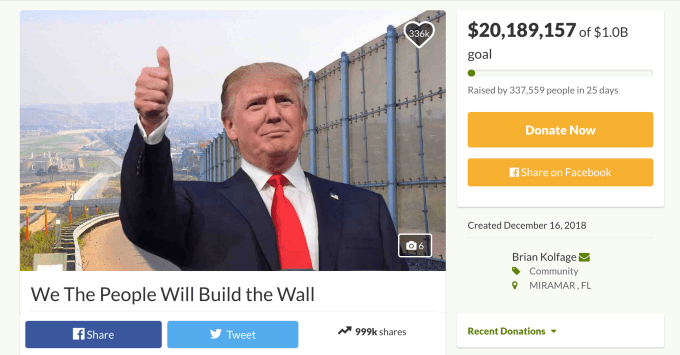
We Build the Wall began in late 2018 as a GoFundMe campaign launched by U.S. Air Force veteran Brian Kolfage. The ill-fated effort to privately fund a border wall with Mexico quickly attracted many high-profile Trump allies, including Bannon, Kansas Secretary of State Kris Kobach, former Boston Red Sox pitcher Curt Schilling and Erik Prince, a defense contractor and the brother of Education Secretary Betsy DeVos.

gofundme webuildthewall

Original GoFundMe campaign

While those names don’t appear in the indictment, Bannon and Kolfage are now on the hook for what happened to the more than $25 million the campaign raised. The campaign’s website and team page remain online.

“As alleged, the defendants defrauded hundreds of thousands of donors, capitalizing on their interest in funding a border wall to raise millions of dollars, under the false pretense that all of that money would be spent on construction,” Acting U.S. Attorney for Southern District of New York Audrey Strauss said in a statement.

“While repeatedly assuring donors that Brian Kolfage, the founder and public face of We Build the Wall, would not be paid a cent, the defendants secretly schemed to pass hundreds of thousands of dollars to Kolfage, which he used to fund his lavish lifestyle.”

The indictment details how Bannon and the other men allegedly took in hundreds of thousands of dollars while representing the We Build the Wall campaign as a volunteer effort that in no way would benefit them. Kolfage made repeated claims that he would “not take a penny in salary or compensation.”

Bannon allegedly siphoned off more than a million dollars from the $25 million the scheme drummed up, using hundreds of thousands for personal use. Kolfage is accused of putting $350,000 from the campaign toward his own personal expenses. The men attempted to conceal their payouts through a nonprofit, shell companies and a series of falsified invoices and fake vendor relationships.

In a timely twist, the U.S. Attorney’s office named the United States Postal Inspection Service, the law enforcement arm of the USPS, as a key player in the investigation.

“We thank the USPIS for their partnership in investigating this case, and we remain dedicated to rooting out and prosecuting fraud wherever we find it,” Strauss said.

20 Aug 2020

Figma CEO Dylan Field discusses fundraising, hiring and marketing in stealth mode

You’d be hard pressed to hang out with a designer and not hear the name Figma .

The company behind the largely browser-based design tool has made a huge splash in the past few years, building a massive war chest with more than $130 million from investors like A16Z, Sequoia, Greylock, Kleiner Perkins and Index.

The company was founded in 2012 and spent several years in stealth, raising both its seed and Series A without having any public product or user metrics.

At Early Stage, we spoke with co-founder and CEO Dylan Field about the process of hiring and fundraising while in stealth and how life at the company changed following its launch in 2016. Field, who was 20 when he founded the company, also touched on the lessons he’s learned from his team about leadership. Chief among them: the importance of empowering the people you hire.

You can check out the full conversation in the video embedded below, as well as a lightly edited transcript.

Raising a Series A a year behind schedule while still in stealth

I actually had approached John Lilly from Greylock in our seed round. For those who don’t know, John Lilly was the CEO of Mozilla and an amazing guy. He’s on a lot of really cool boards and has a bunch of interesting experience for Figma, with very deep roots in design. I had approached him for the seed round, and he basically said to us, “You know, I don’t think you guys know what you’re doing, but I’m very intrigued, so let’s keep in touch.” This is the famous line that you hear from every investor ever. It’s like “Yeah, let’s keep in touch, let me know if I can be helpful.” Sometimes, they actually mean it. In John’s case, he actually would follow up every few months or I would follow up with him. We’d grab coffee, and he helped me develop the strategy to a point that got us to what we are today. And that was a collaboration. I could really learn a lot from him on that one.

When we started off the idea was: Let’s have this global community around design, and you’ll be able to use the tool to post to the community and someday we’ll think about how people can pay us. Talking with John got me to the point where I realized we need to start with a business tool. We’ll build the community later. Now, we’re starting to work toward that.

At some point, John told me, “Hey, if you ever think about raising again, let me know.” A few weeks later, I told him maybe we would raise because I just wanted to work with him. We talked to a few other investors. I think it’s pretty important that there’s always a competitive dynamic in the round. But really, it was just him that we were really considering for that round. He really did us a solid. He really believed in us. At the time, it wasn’t like there were metrics to look at. He had conviction in the space, a conviction in the attack, and he had conviction in me and Evan, which I feel very, very honored by. He’s a dear mentor to this day, and he’s on our board. And it’s been a really deep relationship.

How to recruit while in stealth mode

20 Aug 2020

VW kicks off production of its all-electric SUV, the ID. 4

Volkswagen has started series production of the ID. 4, an all-electric SUV and the first under the automaker’s new ID label to be headed to the United States.

Series production of the ID.4 kicked off Thursday at the company’s Zwickau factory in Germany ahead of the vehicle’s world premiere that is scheduled for September. The ID.4 follows the ID.3, the first model in Volkswagen’s all-electric ID brand and the beginning of the automaker’s ambitious plan to sell 1 million EVs annually by 2025. A production version of the ID. 3 was unveiled in September 2019. Deliveries for the ID.3 1st will begin in September.

The ID. 4 is also the second electric vehicle to use the German automaker’s MEB platform, a flexible modular system — really a matrix of common parts — for producing electric vehicles that VW says make it more efficient and cost-effective. The ID.3, an electric hatchback that will only be sold in Europe, is the first vehicle to be based on the MEB platform.

Unlike the ID.3, this SUV will be produced and sold in China, Europe and the U.S. Production is beginning at the Zwickau manufacturing plant, which VW has invested some €1.2 billion ($1.4 billion) to convert it to a facility that will only produce electric vehicles. By next year, the Zwickau will be producing 300,000 electric vehicles annually.

Two factories in China will begin production of the ID.4 this year, according to Thomas Ulbrich, a VW Group board member responsible for e-mobility. The company’s factory in Chattanooga, Tennessee will start the ID.4 production in 2022.

20 Aug 2020

Lyft is suspending rideshare operations in California

Lyft has decided to suspend its ridesharing operations in California beginning tonight at 11:59 pm PT.

“We don’t want to suspend operations,” Lyft wrote in a blog post. “We are going to keep up the fight for a benefits model that works for all drivers and our riders.”

This month, both Uber and Lyft argued in court that they should be able to continue classifying their drivers as independent contractors. A judge disagreed, and granted a preliminary injunction to force both companies to reclassify their drivers as employees beginning Friday. In response, both Uber and Lyft said they would be forced to temporarily pause operations in California.

Yesterday, Uber CEO Dara Khosrowshahi said on a podcast that the company can’t simply hire all 50,000 of its drivers overnight.

“All of our model, everything that we have built is based on this platform that brings earners and brings people who want transportation or delivery together,” he said on a Vox Media podcast yesterday. “You can’t flip that stuff overnight. It’ll take time, and we will figure out a way to be in California. We want to be in California. But if the court case comes in, then we’ll have to shut down, and we’ve got the best engineers in the world figuring out how we can rebuild this thing. If we do have to go to employment model, what’s going to happen is that we will then have to underwrite driver productivity. There will be far fewer drivers employed, so my guess is 70-80% of users who use Uber for flexibility, they drove 5 to 10 hours, etc., they will not be able to earn. The prices are going to go up. They’re going to go up less in city centers. So I think SF prices will go up by 20%. Smaller cities prices will go way up.”

What Uber is proposing with Prop 22 is essentially a third way of classifying gig workers, but co-founder of Gig Workers Collective Vanessa Bain says a third way “is bullshit,” she said on the same Vox Media podcast yesterday.

“It’s categorically less than what we’re entitled to under current law,” she said.

Below is a timeline of what’s led to this moment.

January 1, 2020: Assembly Bill 5 becomes law. The bill, first introduced in December 2018, codified the ruling established in Dynamex Operations West, Inc. v Superior Court of Los Angeles. In that case, the court applied the ABC test and decided Dynamex wrongfully classified its workers as independent contractors. According to the ABC test, in order for a hiring entity to legally classify a worker as an independent contractor, it must prove (A) the worker is free from the control and direction of the hiring entity, (B) performs work outside the scope of the entity’s business and (C) is regularly engaged in an “independently established trade, occupation, or business of the same nature as the work performed.”

May 2020California Attorney General Xavier Becerra, along with city attorneys from Los Angeles, San Diego and San Francisco, filed a lawsuit asserting Uber and Lyft gain an unfair and unlawful competitive advantage by misclassifying workers as independent contractors.

The suit argues Uber and Lyft are depriving workers the right to minimum wage, overtime, access to paid sick leave, disability insurance and unemployment insurance. The lawsuit, filed in the Superior Court of San Francisco, seeks $2,500 in penalties for each violation, possibly per driver, under the California Unfair Competition Law, and another $2,500 for violations against senior citizens or people with disabilities.

June 2020: Becerra and others file a motion for a preliminary injunction seeking to force Uber and Lyft to immediately classify their drivers as employees.

August 6, 2020: California Superior Court Judge Ethan P. Schulman hears arguments pertaining to the preliminary injunction. At the hearing, Uber and Lyft maintained that an injunction would require them to restructure their businesses in such a material way that it would prevent them from being able to employ many drivers on either a full-time or part-time basis. Uber and Lyft’s argument, effectively, is that classifying drivers as employees would result in job loss.

“The proposed injunction would cause irreparable injury to Lyft and Uber, and would actually cause massive harm to drivers and harm to riders,” Rohit Singla, counsel for Lyft, said at the hearing.

For example, Lyft estimates it would cost hundreds of millions of dollars simply to process the I-9 forms, which verify employment eligibility. It doesn’t cost anything to file that form, but it would require Uber and Lyft to further invest in their human resources and payroll processes.

August 9, 2020: Judge Schulman grants the preliminary injunction, which goes into effect on August 20, 2020.

“The Court is under no illusion that implementation of its injunction will be costly,” Judge Schulman wrote in the order. “There can be no question that in order for Defendants to comply with A.B. 5, they will have to change the nature of their business practices in significant ways, such as by hiring human resources staff to hire and manage their driver workforces.”

Meanwhile, Uber and Lyft made clear their respective plans to file emergency appeals.

August 12, 2020: Uber CEO Dara Khosrowshahi says Uber will have to temporarily shut down in California if the court doesn’t overturn the preliminary injunction. Lyft says it, too, will be forced to temporarily cease operations in California.

August 13, 2020: Judge Schulman denies Uber and Lyft’s appeal. Uber says it plans to file another appeal, while Lyft says it will seek a further stay from the state’s appellate court.

August 14, 2020: Lyft files a request for an immediate stay in California’s appeals court.

August 17, 2020: Uber files an emergency stay request in California’s appeals court.

August 19, 2020: San Diego and San Jose mayors call for the Court of Appeal to grant Uber and Lyft’s motions and stay the injunction.

Looking ahead

November 2020: Californians will vote on Prop 22, a ballot measure majorly funded by Uber, Lyft and DoorDash. Prop 22 aims to keep gig workers classified as independent contractors. The measure, if passed, would make drivers and delivery workers for said companies exempt from a new state law that classifies them as W-2 employees.

The ballot measure looks to implement an earnings guarantee of at least 120% of minimum wage while on the job, 30 cents per mile for expenses, a healthcare stipend, occupational accident insurance for on-the-job injuries, protection against discrimination and sexual harassment and automobile accident and liability insurance.

Developing…

20 Aug 2020

Join Female Founders Fund’s Anu Duggal for a live Q&A today at 11am PT/2pm ET

Startups are rebounding. Venture capitalists are open for business. And during the pandemic, the pace of dealmaking has not slowed down.

But how is this new era of uncertainty impacting underrepresented founders? Has startup-land become more inclusive, or do warm intros still dictate who gets a meeting and the way a deal closes?

To talk about all this and more, we’re bringing on the woman behind Female Founders Fund, Anu Duggal, to the virtual Extra Crunch Live stage today.

Join us at 11 a.m. PT/2 p.m. EST/6 p.m. GMT for tips, tricks and advice from Duggal. Those tuning in and taking notes are encouraged to ask questions, but you have to be an Extra Crunch member to access the chat. If you still haven’t signed up, now’s your chance! With the subscription, you’ll also be able to check out all of our stellar previous guests on-demand (watch those episodes here).

Female Founders Fund has provided seed institutional capital to entrepreneurs with more than $3 billion in enterprise value. The firm has cut checks into women-led companies such as Rent the Runway, Billie, Tala, Peanut, Thrive Global and Zola . The fund has also attracted limited partners like Melinda Gates and Girls Who Code founder Reshma Saujani.

Duggal herself has a fascinating trajectory into technology investing: at 25, she started The Tasting Room, a wine bar in Bombay. She went on to get an MBA from London Business School and co-founded Exclusively.in, an e-commerce company acquired by Indian fashion e-commerce company Myntra in 2011.

Hear from Duggal about how the investment landscape has changed for female founders, what she thinks of as a success story and if 2020 feels different than 2014. And Extra Crunch fam, make sure to bring your thoughtful questions for me to ask her live on air.

You can find the full details of the conversation below the jump.