Year: 2020

18 Aug 2020

Bluetooth SIG works to include wearables in COVID-19 exposure notification systems

Current smartphone-based exposure notification systems (ENS) like the one created jointly by Apple and Google are a clever way of leveraging modern technology to support comprehensive contact tracing efforts by health agencies worldwide. But the COVID-19 pandemic is not what anyone had in mind when the Bluetooth standard was created, so the Bluetooth Special Interest Group (SIG) is working to create a new specification that would allow wearable devices to work in tandem with smartphones to expand the reach of ENS tech.

That would mean that devices like wristworn smartwatches and activity/health trackers could also participate in systems that track potential exposure and provide notifications about potential COVID-19 contact events. It may seem like a small tweak if you assume that most smartphone users are seldom without those devices, but Bluetooth SIG points out that expanding to wearables could help include groups of people who aren’t typically smartphone users – including young, school-aged children, and older adults in care facilities – in ENS efforts.

You could easily see how that would be useful, once this new spec is completed and incorporated into deployed Bluetooth standards. Schools could potential mandate use of simple, cheap Bluetooth-enabled wearables to track potential exposure as they return to physical classroom education, for instance.

It’s too early to say exactly how and when this will be deployed – the Bluetooth SIG says that it plans to have an initial draft of the new spec available “in the next few months” for its members to review. But the group has powerful members including Apple, Microsoft, Intel and others, and the technology proposed would allow Apple and Google to incorporate wearables into their existing exposure notification platform, while preserving the privacy-protecting aspects of the tech, as illustrated in the infographic below.

18 Aug 2020

Skyrora launches its small demonstration rocket from mobile launch site in Iceland

Launch startup Skyrora had a successful test launch of its Skylark Micro rocket from Iceland on Sunday, with the rocket achieving its highest ever altitude at a height of 26.86 km (just under 17 miles). The four meter (13 foot) sub-orbital rocket took off from a mobile launch site at Iceland’s Langanes Peninsula that was set up in just a few days prior to the flight.

Skylark Micro is a vehicle that Skyrora is using to prepare the way for its eventual orbital small payload launch vehicle Skyrora XL, which it hopes to begin flying sometime in 2023. The purpose of this launch in Iceland, aside from demonstrating the flexibility of the company’s mobile launching model, was to test the electronics and communications on board the Skylark Micro, which will eventually be used for the company’s larger operational launch craft as well.

Skyrora flew a similar rocket earlier this year, with a launch from a small island off the coast of Scotland in June. That rocket only climbed to around 6 km (3.7 miles), however, making this its highest flight attempt by a wide margin. This attempt also included a recover attempt for both stages of the two-stage Skylark Micro rocket, which separated and deployed parachutes to return to an ocean splashdown, but the startup says that they haven’t been able to find either stage yet, though the search continues.

The ability to stand up and launch from another site so quickly is another key demonstration of this test. That could be a significant advantage – one that’s being pursued by a number of small payload launch startups. It’s a key capability that government and military customers are looking for in responsive launch services providers, though of course it’ll need to scale up significantly to support larger vehicles like the planned Skyrora XL rocket this company hopes to eventually field.

18 Aug 2020

Skyrora launches its small demonstration rocket from mobile launch site in Iceland

Launch startup Skyrora had a successful test launch of its Skylark Micro rocket from Iceland on Sunday, with the rocket achieving its highest ever altitude at a height of 26.86 km (just under 17 miles). The four meter (13 foot) sub-orbital rocket took off from a mobile launch site at Iceland’s Langanes Peninsula that was set up in just a few days prior to the flight.

Skylark Micro is a vehicle that Skyrora is using to prepare the way for its eventual orbital small payload launch vehicle Skyrora XL, which it hopes to begin flying sometime in 2023. The purpose of this launch in Iceland, aside from demonstrating the flexibility of the company’s mobile launching model, was to test the electronics and communications on board the Skylark Micro, which will eventually be used for the company’s larger operational launch craft as well.

Skyrora flew a similar rocket earlier this year, with a launch from a small island off the coast of Scotland in June. That rocket only climbed to around 6 km (3.7 miles), however, making this its highest flight attempt by a wide margin. This attempt also included a recover attempt for both stages of the two-stage Skylark Micro rocket, which separated and deployed parachutes to return to an ocean splashdown, but the startup says that they haven’t been able to find either stage yet, though the search continues.

The ability to stand up and launch from another site so quickly is another key demonstration of this test. That could be a significant advantage – one that’s being pursued by a number of small payload launch startups. It’s a key capability that government and military customers are looking for in responsive launch services providers, though of course it’ll need to scale up significantly to support larger vehicles like the planned Skyrora XL rocket this company hopes to eventually field.

18 Aug 2020

Quell’s resistance-based workout can get you in shape by boxing virtual enemies

Quell is positioning itself as a kind of low-cost take on Peloton (less than 1/10th the price, it notes). You might too, if you were in the London-based startup’s place. With the stationary bike-maker’s value skyrocketing amid COVID-19 lockdowns, fitness startups are all the rage — heck, just look at Lululemon’s recent Mirror acquisition.

A more apt comparison, however, is probably Ring Fit Adventure. The Switch-based peripheral is closer to Quell in terms of pricing, scale and experience. The startup is taking a similar game-based approach to the fitness experience.

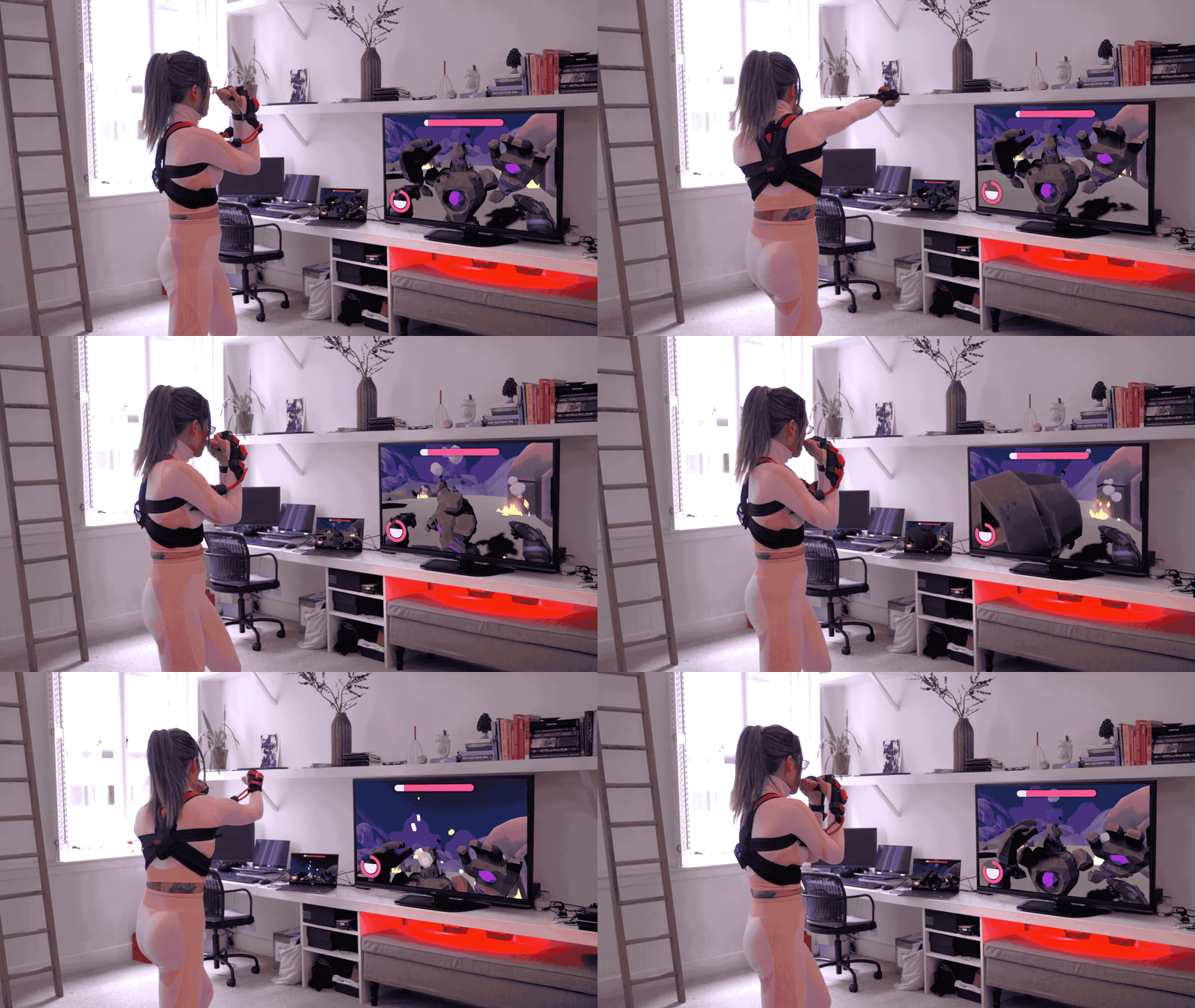
At launch, it plans to offer a first-person boxing-style game that pits you against a series of monsters on the PC, Mac and iOS (with Android compatibility down the road). What sets Quell’s approach apart, however, is the wearable resistance system. It’s basically an adjustable system of resistance bands that both simulate impact and track the wearer’s movements through a series of on-board sensors, including a gyroscope and accelerometers.

Image Credits: Quell

It’s still pretty early stages here. In fact, today marks the launch of the product’s Kickstarter campaign, which will be seeking a bit over $30,000 in funding, with the system going for as low as ~$182 a pop. That’s down from around $200 for the final unit — and, more importantly, includes lifetime access to all of the product’s software updates for free. Future buyers may well be subjected to a $10 a month fee for premium content.

Like a lot about the system, the subscription model is still being hammered out. “There will be a narrative story mode and quick fight mode that you’ll have,” the company tells TechCrunch. “And the subscription fee will expand the possibilities to things like local and online multiplayer, along with new expansion content over time. And there will probably be cosmetic and other upgrades to your character.”

Image Credits: Quell

Down the road, the system will likely expand to further gaming experiences in order to keep it fresh. Quell is also exploring the possibility of opening things up to third-party developers to create their own content for the system.

A lot of this is still hypothetical, as Quell is still an extremely small team, with four people currently working out of one of the founders’ London flat. In fact, the team only really came together in earnest in February and went full-time two months back. In spite of those humble and recent beginnings, however, the company already has the backing of Y Combinator and $10,000 in pre-orders since launching its website last month. It’s amazing how much interest in home fitness something like COVID-19 can generate.

Quell expects to start shipping the product to backers in December. Perhaps by then people will have returned to the gym. But at this rate, who knows?

18 Aug 2020

Quell’s resistance-based workout can get you in shape by boxing virtual enemies

Quell is positioning itself as a kind of low-cost take on Peloton (less than 1/10th the price, it notes). You might too, if you were in the London-based startup’s place. With the stationary bike-maker’s value skyrocketing amid COVID-19 lockdowns, fitness startups are all the rage — heck, just look at Lululemon’s recent Mirror acquisition.

A more apt comparison, however, is probably Ring Fit Adventure. The Switch-based peripheral is closer to Quell in terms of pricing, scale and experience. The startup is taking a similar game-based approach to the fitness experience.

At launch, it plans to offer a first-person boxing-style game that pits you against a series of monsters on the PC, Mac and iOS (with Android compatibility down the road). What sets Quell’s approach apart, however, is the wearable resistance system. It’s basically an adjustable system of resistance bands that both simulate impact and track the wearer’s movements through a series of on-board sensors, including a gyroscope and accelerometers.

Image Credits: Quell

It’s still pretty early stages here. In fact, today marks the launch of the product’s Kickstarter campaign, which will be seeking a bit over $30,000 in funding, with the system going for as low as ~$182 a pop. That’s down from around $200 for the final unit — and, more importantly, includes lifetime access to all of the product’s software updates for free. Future buyers may well be subjected to a $10 a month fee for premium content.

Like a lot about the system, the subscription model is still being hammered out. “There will be a narrative story mode and quick fight mode that you’ll have,” the company tells TechCrunch. “And the subscription fee will expand the possibilities to things like local and online multiplayer, along with new expansion content over time. And there will probably be cosmetic and other upgrades to your character.”

Image Credits: Quell

Down the road, the system will likely expand to further gaming experiences in order to keep it fresh. Quell is also exploring the possibility of opening things up to third-party developers to create their own content for the system.

A lot of this is still hypothetical, as Quell is still an extremely small team, with four people currently working out of one of the founders’ London flat. In fact, the team only really came together in earnest in February and went full-time two months back. In spite of those humble and recent beginnings, however, the company already has the backing of Y Combinator and $10,000 in pre-orders since launching its website last month. It’s amazing how much interest in home fitness something like COVID-19 can generate.

Quell expects to start shipping the product to backers in December. Perhaps by then people will have returned to the gym. But at this rate, who knows?

18 Aug 2020

Attabotics raises a $50M Series C for its warehouse fulfillment robots

The uptick in robotics funding continues this week with a big round for Calgary, Alberta’s Attabotics. The warehouse fulfillment startup announced a $50 million Series C, led — interestingly enough — by the Ontario Teachers’ Pension Plan Board, Canada’s largest pension plan.

It’s a pretty hot moment for robotics and automation investing, as more industries turn to technology to replace and augment workers amid the COVID-19 pandemic. Warehouse fulfillment in particular has been a huge potential growth industry. Amazon’s persistence during the shutdown points to a number of ways in which robotics can help an industry keep its lights on even as a highly contagious virus has a profound impact on the human population.

Image Credits: Attabotics

Founder and CEO/CTO Scott Gravelle acknowledged as much in a press release tied to the news, noting, “Attabotics has seen a significant uptick in interest from retailers and brands because we have created an innovative way for commerce companies to modernize their supply chain. COVID-19 has drastically accelerated commerce growth and demand for warehouse space, making supply chain efficiency a critical issue for all.”

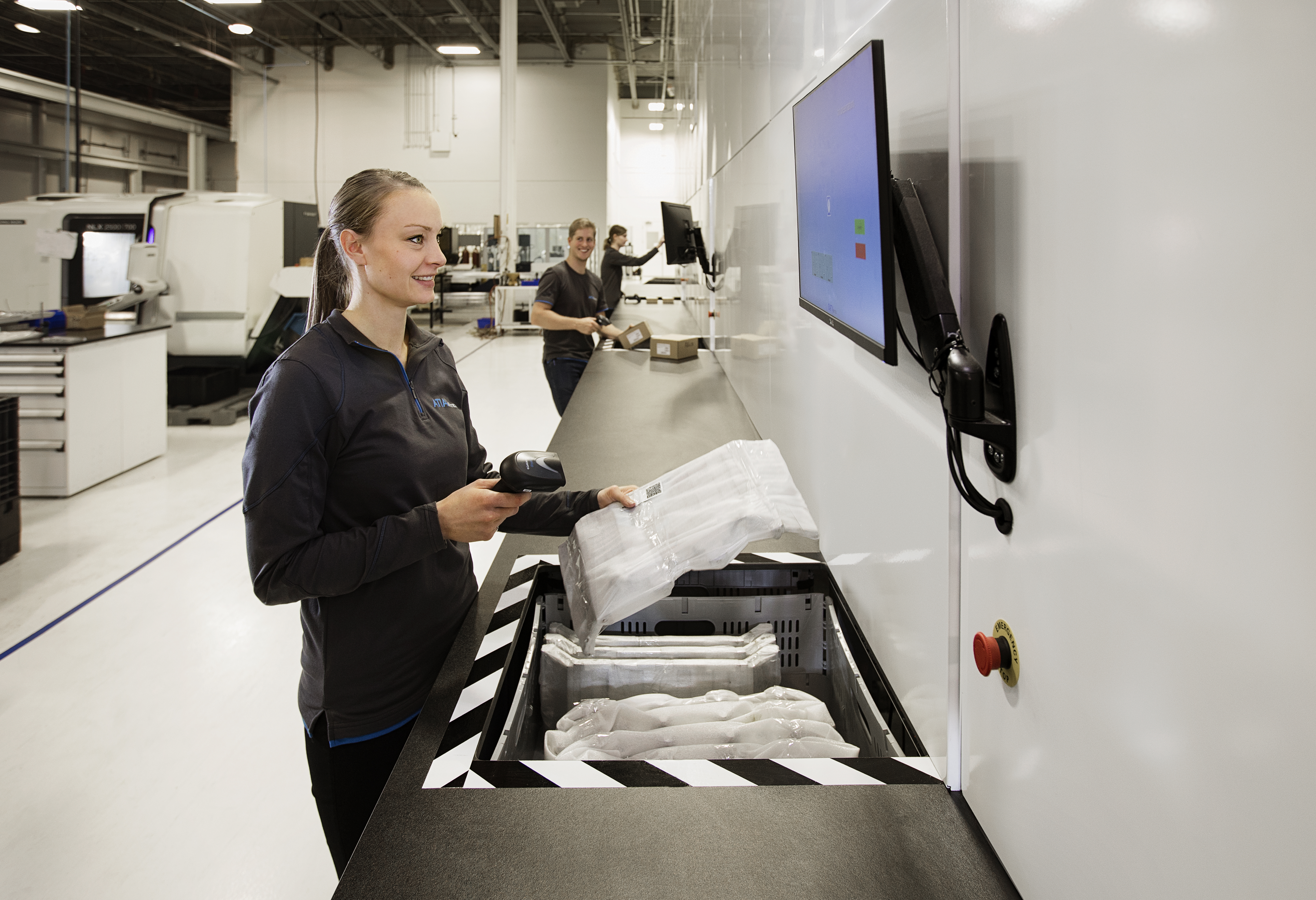
Attabotics is most notable for its “3D” storage system, with wheeled carts capable of moving on an X, Y or Z axis. It’s a system the Canadian startup says was influenced by the three-dimension movements of ant colonies. From there, human workers can pick, place and ship the contents. It’s a system not dissimilar to those deployed by Amazon Robotics, which relies on a kind of symbiotic relationship between human and robot workers.

Image Credits: Attabotics

The Series C brings Attabotics’ total funding up to $82.7 million, following a $25 million raise last July. Effectively doubling the previous amount this round certainly points to increased interest in an uncertain environment. The company says it will be using this round to speed up commercial deployment and invest in the creation of new technologies.

Attabotics’ tech is currently deployed in six locations in North America. The company says its robotics are being used by the food, B2B and retail sectors, including a deal with Nordstrom.

18 Aug 2020

Samsung Pay Card launches in UK, powered by fintech Curve

Samsung Pay Card, a new Mastercard debit card from the mobile handset giant, has launched in the U.K. today.

Powered by London-based fintech Curve, it lets you consolidate all of your other existing bank cards into a single card and digital wallet, making it easy to manage your money and, of course, use Samsung Pay more universally.

Unsurprisingly, Samsung Pay Card users will also get access to other Curve features. They include a single view of your card spending that is entirely agnostic to where your money is stored, as well as instant spend notifications, cheaper FX fees than your bank typically charges, peer-to-peer payments from any linked bank account and the ability to switch payment sources retroactively.

The latter — dubbed “Go Back in Time” — lets you move transactions from one card to another after they’ve been made, meaning that you have more flexibility and control of your spending. For example, perhaps you made a large purchase from one of your linked debit cards but for cashflow purposes decide it would be better charged to your credit card. That’s possible to do using Curve and now Samsung Pay Card.

In addition, as an introductory offer, Samsung Pay Card users get 1% cashback at selected merchants, and exclusive to the Samsung Pay Card, can also earn 5% on all purchases at Samsung.com.

Comments Conor Pierce, Corporate Vice-President of Samsung UK & Ireland: “At Samsung we believe in the power of innovation and, through our partnership with Curve, the Samsung Pay Card brings a series of pioneering features that will change the way that our customers manage their spending, with their Samsung smartphone and smartwatch at the heart of it. This is the future of banking and we look forward to continuing this journey with our customers.”

18 Aug 2020

Samsung Pay Card launches in UK, powered by fintech Curve

Samsung Pay Card, a new Mastercard debit card from the mobile handset giant, has launched in the U.K. today.

Powered by London-based fintech Curve, it lets you consolidate all of your other existing bank cards into a single card and digital wallet, making it easy to manage your money and, of course, use Samsung Pay more universally.

Unsurprisingly, Samsung Pay Card users will also get access to other Curve features. They include a single view of your card spending that is entirely agnostic to where your money is stored, as well as instant spend notifications, cheaper FX fees than your bank typically charges, peer-to-peer payments from any linked bank account and the ability to switch payment sources retroactively.

The latter — dubbed “Go Back in Time” — lets you move transactions from one card to another after they’ve been made, meaning that you have more flexibility and control of your spending. For example, perhaps you made a large purchase from one of your linked debit cards but for cashflow purposes decide it would be better charged to your credit card. That’s possible to do using Curve and now Samsung Pay Card.

In addition, as an introductory offer, Samsung Pay Card users get 1% cashback at selected merchants, and exclusive to the Samsung Pay Card, can also earn 5% on all purchases at Samsung.com.

Comments Conor Pierce, Corporate Vice-President of Samsung UK & Ireland: “At Samsung we believe in the power of innovation and, through our partnership with Curve, the Samsung Pay Card brings a series of pioneering features that will change the way that our customers manage their spending, with their Samsung smartphone and smartwatch at the heart of it. This is the future of banking and we look forward to continuing this journey with our customers.”

18 Aug 2020

Watch SpaceX attempt a Falcon 9 rocket re-use record with today’s Starlink launch

SpaceX is set to launch is latest batch of Starlink satellites on Tuesday at 10:31 AM EDT (7:31 AM PDT). This is the 11th of SpaceX Starlink missions so far, and will include 58 of the company’s broadband internet satellites, as well as three of customer Planet’s SkySats spacecraft.

This mission is important as SpaceX continues to work towards launching its Starlink service, which will offer low-latency, high-speed internet connections to customers in areas that have traditionally had little or poor service. But it’s also significant because it involves SpaceX’s most advanced realization of its rocket reusability program to date.

The first stage booster for the Falcon 9 flying today’s mission has flown a total of five times, including once in 2018, twice in 2019 and twice already earlier this year. This will be the sixth launch for the booster – a record for SpaceX, and for reusable rocketry in general – and it will also attempt to land the rocket stage once again using its ‘Of Course I Still Love You’ drone landing ship in the Atlantic Ocean.

Three of the missions that this Falcon 9 booster flew previously were Starlink flights, which demonstrates how important reusability is for SpaceX in particular when it’s flying its own missions. The shared payload with Planet will somewhat offset its operating costs, but this (and all Starlink launches) are mostly just cost that SpaceX has to absorb for now – until Starlink actually launches a paid service for customers and starts to generate revenue.

Today’s mission also includes reuse of a Falcon 9 fairing (the cone that protects the payload at the top of the rocket) that was used on a previous mission – SpaceX’s fourth Starlink launch. Re-using the fairing is another way that SpaceX can mitigate costs for these missions, and the company has been making progress in its recovery process for this part, which costs around $6 million new for each launch.

The broadcast for the launch will begin at around 15 minutes prior to the actual launch window – so at around 10:16 AM EDT (7:16 AM PDT).

18 Aug 2020

Electric vehicle startup Canoo to go public via SPAC

Canoo, the Los Angeles-based electric vehicle startup, has struck a deal to merge with special-purpose acquisition company Hennessy Capital Acquisition Corp., with a market valuation of $2.4 billion.

The announcement Tuesday marks the fourth time this summer that an electric vehicle company has skipped the traditional IPO path and instead taken the company public through a merger agreement with a SPAC, also known as blank check companies. Nikola Corp., Fisker Inc. and Lordstown Motors have also gone public — or announced the agreement to — via a SPAC.

Canoo said it was able to raise $300 million in private investment in public equity, or PIPE, including investments from funds and accounts managed by BlackRock. Through the transaction, Canoo said it will have about $600 million that will go towards the production and launch of electric vehicles built off of its underlying skateboard technology.

Once the transaction closes, the combined operating company will be named Canoo Inc. and will continue to be listed on the Nasdaq Stock Market under the ticker symbol “CNOO.”

HCAC Chairman and CEO Daniel Hennessy is betting on Canoo’s business model and its skateboard architecture and technology, which he noted in a statement has already been validated by key partnerships such as with Hyundai Motor Group.

Canoo started as Evelozcity in 2017, founded by former Faraday Future executives Stefan Krause and Ulrich Kranz. The company rebranded as Canoo in spring 2019 and debuted its first vehicle last September. The first Canoo vehicles, which will be offered only as a subscription, were expected to appear on the road by 2021. That timeline appears to have slipped to 2022, according to information shared alongside Tuesday’s announcement.

The heart of Canoo’s first vehicle, which looks more like a microbus than a traditional electric SUV, is the “skateboard” architecture that houses the batteries and the electric drivetrain in a chassis underneath the vehicle’s cabin. That architecture caught Hyundai’s interest earlier this year. The Korean automaker announced in February plans to jointly develop an electric vehicle platform with Canoo, based on the startup’s proprietary skateboard design. The platform will be used for future Hyundai and Kia electric vehicles as well as the automaker group’s so-called “purpose built vehicles.” The PBV, which Hyundai showcased at CES 2020, is a pod-like vehicle that the company says can be used for various functions in transit, such as a restaurant or clinic.

Canoo isn’t just focused on products for consumers. It also aims to offer business-to-business (B2B) vehicle configurations as well. All of Canoo’s EVs will share the same skateboard and use different cabins or “top hats” that can be paired on top to create unique vehicles, the company said. The company is aiming to produce its first B2B vehicle designed for delivery in 2023. This B2B vehicle will be designed to operate in dense urban environments and focus on last-mile delivery.