Year: 2020

18 Aug 2020

EU websites’ use of Google Analytics and Facebook Connect targeted by post-Schrems II privacy complaints

A month after Europe’s top court struck down a flagship data transfer arrangement between the EU and the US as unsafe, European privacy campaign group, noyb, has filed complaints against 101 websites with regional operators which it’s identified as still sending data to the US via Google Analytics and/or Facebook Connect integrations.

Among the entities listed in its complaint are ecommerce companies, publishers & broadcasters, telcos & ISPs, banks and universities — including Airbnb Ireland, Allied Irish Banks, Danske Bank, Fastweb, MTV Internet, Sky Deutschland, Takeaway.com and Tele2, to name a few.

“A quick analysis of the HTML source code of major EU webpages shows that many companies still use Google Analytics or Facebook Connect one month after a major judgment by the Court of Justice of the European Union (CJEU) — despite both companies clearly falling under US surveillance laws, such as FISA 702,” the campaign group writes on its website.

“Neither Facebook nor Google seem to have a legal basis for the data transfers. Google still claims to rely on the ‘Privacy Shield’ a month after it was invalidated, while Facebook continues to use the ‘SCCs’ [Standard Contractual Clauses], despite the Court finding that US surveillance laws violate the essence of EU fundamental rights.”

We’ve reached out to Facebook and Google with questions about their legal bases for such transfers — and will update this report with any response.

Privacy watchers will know that noyb’s founder, Max Schrems, was responsible for the original legal challenge that took down an anterior EU-US data arrangement, Safe Harbor, all the way back in 2015. His updated complaint ended up taking down the EU-US Privacy Shield last month — although he’d actually targeted Facebook’s use of a separate data transfer mechanism (SCCs), urging its data supervisor, Ireland’s DPC, to step in and suspend its use of that tool.

The regulator chose to go to court instead, raising wider concerns about the legality of EU-US data transfer arrangements — which resulted in the CJEU concluding that the Commission should not have granted the US a so-called ‘adequacy agreement’, thus pulling the rug out from under Privacy Shield.

The decision means the US is now what’s considered a ‘third country’ in data protection terms, with no special arrangement to enable it to process EU users’ information.

More than that, the court’s ruling also made it clear EU data watchdogs have a responsibility to intervene where they suspect there are risks to EU people’s data if it’s being transferred to a third country via SCCs.

European data watchdogs swiftly warned there would be no grace period for entities still illegally relying on Privacy Shield — so anyone listed in the above complaint that’s still referencing the defunct mechanism in their privacy policy won’t even have a proverbial figleaf to hide their legal blushes.

noyb’s contention with this latest clutch of complaints is that none of the aforementioned 101 websites has a valid legal basis to keep transferring visitor data to the US via the embedded Google Analytics and/or Facebook Connect integrations.

“We have done a quick search on major websites in each EU member state for code from Facebook and Google. These code snippets forward data on each visitor to Google or Facebook. Both companies admit that they transfer data of Europeans to the US for processing, where these companies are under a legal obligation to make such data available to US agencies like the NSA. Neither Google Analytics nor Facebook Connect are essential to run these webpages and are services that could have been replaced or at least deactivated by now,” said Schrems, honorary chair of noyb.eu, in a statement.

Since the CJEU’s Schrems II ruling, and indeed since the Safe Harbor strike down, the US Department of Commerce and European Commission have stuck their heads in the sand — signalling they intend to try cobbling together another data pact to replace the defunct Privacy Shield (which replaced the blasted-to-smithereens (un)Safe Harbor. So, er… ).

Yet without root-and-branch reform of US surveillance law, any third pop by respective lawmakers at papering over the legal schism of US national security priorities vs EU privacy rights is just as surely doomed to fail.

The more cynical among you might say the high level administrative manoeuvers around this topic are, in fact, simply intended to buy more time — for the data to keep flowing and ‘business as usual’ to continue.

But there is now substantial legal risk attached to a strategy of trying to pretend US surveillance law doesn’t exist.

Here’s Schrems again, on last month’s CJEU ruling, suggesting that Facebook and Google could be in the frame for legal liability if they don’t proactively warn EU customers of their data responsibilities: “The Court was explicit that you cannot use the SCCs when the recipient in the US falls under these mass surveillance laws. It seems US companies are still trying to convince their EU customers of the opposite. This is more than shady. Under the SCCs the US data importer would instead have to inform the EU data sender of these laws and warn them. If this is not done, then these US companies are actually liable for any financial damage caused.”

And as noyb’s press release notes, GDPR’s penalties regime can scale as high as 4% of the worldwide turnover of the EU sender and the US recipient of personal data. So, again, hi Facebook, hi Google…

The crowdfunded campaign group has pledged to continue dialling up the pressure on EU regulators to act and on EU data processors to review any US data transfer arrangements — and “adapt to the clear ruling by the EU’s supreme court”, as it puts it.

Other types of legal action are also starting to draw on Europe’s General Data Protection Regulation (GDPR) framework — and, importantly, attract funding — such as two class action style suits filed against Oracle and Salesforce’s use of tracking cookies earlier this month. (As we said when GDPR came into force back in 2018, the lawsuits are coming.)

Now, with two clear strikes from the CJEU on the issue of US surveillance law vs EU data protection, it looks like it’ll be diminishing returns for US tech giants hoping to pretend everything’s okay on the data processing front.

noyb is also putting its money where its mouth is — offering free guidelines and model requests for EU entities to use to help them get their data affairs in prompt legal order. 

“While we understand that some things may need some time to rearrange, it is unacceptable that some players seem to simply ignore Europe’s top court,” Schrems added, in further comments on the latest flotilla of complaints. “This is also unfair towards competitors that comply with these rules. We will gradually take steps against controllers and processors that violate the GDPR and against authorities that do not enforce the Court’s ruling, like the Irish DPC that stays dormant.”

We’ve reached out to Ireland’s Data Protection Commission to ask what steps it will be taking in light of the latest noyb complaints, a number of which target websites that appear to be operated by an Ireland-based legal entity.

Schrems original 2013 complaint against Facebook’s use of SCCs also ended up in Ireland, where the tech giant — and many others — locates its EU EQ. Schrem’s request that the DPC order Facebook to suspend its use of SCCs still hasn’t been fulfilled, some seven years and five complaints later. And the regulator continues to face accusations of inaction, given the growing backlog of cross-border GDPR complaints against tech giants like Facebook and Google.

Ireland’s DPC has still yet to issue a single final decision on any of these major GDPR complaints. But the legal pressure for it and all EU regulators to get a move on and enforce the bloc’s law will only increase, even as class action style lawsuits are filed to try to do what regulators have failed to.

Earlier this summer the Commission acknowledged a lack of uniformly “vigorous” enforcement of GDPR in a review of the mechanism’s first two years of operation.

“The European Data Protection Board [EDPB] and the data protection authorities have to step up their work to create a truly common European culture — providing more coherent and more practical guidance, and work on vigorous but uniform enforcement,” said Věra Jourová, Commission VP for values and transparency then, giving the Commission’s first public assessment of whether GDPR is working.

We’ve also reached out to France’s CNIL to ask what action it will be taking in light of the noyb complaints.

Following the judgement in July the French regulator said it was “conducting a precise analysis”, along with the EDPB, with a view to “drawing conclusions as soon as possible on the consequences of the ruling for data transfers from the European Union to the United States”.

Since then the EDPB guidance has come out — inking the obvious: That transfers on the basis of Privacy Shield “are illegal”. And while the CJEU ruling did not invalidate the use of SCCs it gave only a very qualified green light to continued use.

As we reported last month, the ability to use SCCs to transfer data to the U.S. hinges on a data controller being able to offer a legal guarantee that “U.S. law does not impinge on the adequate level of protection” for the transferred data.

“Whether or not you can transfer personal data on the basis of SCCs will depend on the result of your assessment, taking into account the circumstances of the transfers, and supplementary measures you could put in place,” the EDPB added.

18 Aug 2020

India’s OneCard credit card-maker FPL Technologies lands $10 million

A 20-month-old startup in India founded by a group of banking veterans that has built a mobile-first credit card and is improving the experience users have with credit cards has secured $10 million in a new financing round.

Pune-based FPL Technologies’ $10 million Series A financing round was funded by Matrix Partners India, Sequoia Capital India and Hummingbird Ventures, Anurag Sinha, co-founder and chief executive of the startup, said in an interview with TechCrunch.

We wrote about FPL Technologies last year when the startup had closed a $4.5 million Seed financing round. At the time, the startup had developed an app called OneScore that was helping people find and understand their credit score.

At the time, Sinha had said that FPL Technologies was working on a credit card. In June this year, the startup launched its credit card, called OneCard.

More than 5,000 people across the country are currently using this metal-made credit card, which has been certified by Visa and a number of security firms, and over 75,000 people are on a waiting list to get it.

fpl team

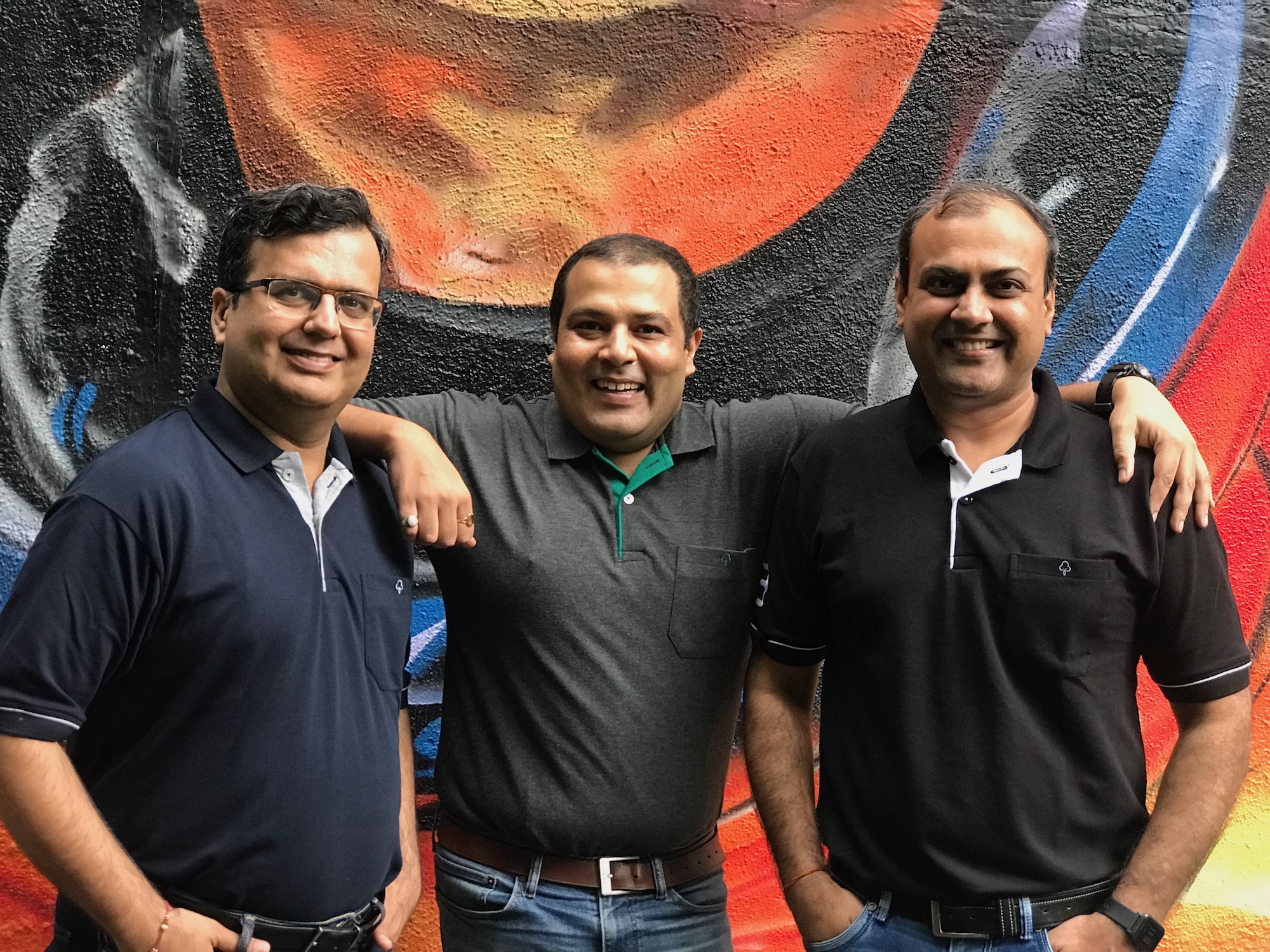
Banking veterans Vibhav Hathi, Anurag Sinha, and Rupesh Kumar co-founded FPL Technologies last year

Its app, OneScore, has amassed over 2 million users. Scores of firms in India offer users with the ability to find their credit score at no charge. But in return, they sell their customers’ info to other parties, which sets off a chain of events that ends up these users getting more than a dozen calls each month from firms — usually their middlemen partners — that offer credit cards and loans.

OneScore does not share its users’ data with anyone. Why it chooses not to do that explains what this startup is attempting to achieve: Make customers’ experience with their credit card more delightful — a concept that is almost unheard of for most credit card holders in India.

The startup has built a technology stack that makes common sense features such as transparency on transactions, the due date to pay the credit card bill, and rewards more easily accessible.

“Their powerful, proprietary in-house tech-stack will define the future of digital consumer credit in India and this conviction has led to Sequoia India increasing its commitment in FPL,” said Shailesh Lakhani, Managing Director at Sequoia Capital India, in a statement.

The OneCard also does not charge customers any joining fee or annual fee. It allows customers to control the rewards they wish to avail. For instance, if your spendings largely entails purchasing gadgets and ordering coffee online, you can set your OneCard to get 5X rewards on those two categories.

These categories are controlled by the customers and can be changed by switching a toggle on the mobile app. The app also lets users quickly lock their card, and disable online or offline transactions with a few taps.

FPL Technologies plans to use the fresh capital to bring its credit card to more users, said Sinha, and also expand its product offerings.

One product that he is exploring is making it possible for users to track all their subscriptions. Once that is live, the startup will work on creating bundles for some of these services that helps users save money. He is hopeful that several companies, looking to aggressively expand into India, will be interested in it.

18 Aug 2020

Lightspeed raises $275 million fund for India

Lightspeed India Partners on Tuesday announced it has closed $275 million from LPs for its third fund as the top American venture firm looks to ramp up its investments in the world’s second-largest internet market.

The new fund, its biggest for India, will enable Lightspeed India Partners to make early stage bets on more than two dozen startups in the region, said Hemant Mohapatra, a partner at the firm, in an interview with TechCrunch.

The announcement comes as the firm, which began investing in India in 2007, has made two high-profile partial exits in the past year from budget-lodging startup Oyo and edtech giant Byju’s that delivered returns of more than $900 million.

Some of its other major bets including backing business-to-business marketplace Udaan, which was valued at more than $2.75 billion last year, local social media platform ShareChat, which is in advanced stages of discussions to raise capital at more than $1 billion valuation, and SaaS startups DarwinBox, Yellow Messenger, and OkCredit.

The firm, which has six partners in the region, closed its first dedicated fund for India, of $135 million, in 2015. In 2018, it closed its second fund for the region, which was $175 million in size. But the venture firm has invested more than $750 million to date.

The Indian arm, which typically invests at early stages of a startup, continues to work with its global mothership for writing bigger checks to support some portfolio startups at later phases. (More than 80% of its investments have been committed to firms at Seed or Series A stages in India.)

“That’s one of the strongest points of differentiation we have. There are not many venture firms that have such a global presence. Our synergy with the global fund will continue,” said Mohapatra.

Lightspeed partners in India. From left: Bejul Somaia, Akshay Bhushan, Harsha Kumar, Dev Khare, Vaibhav Agrawal, and Hemant Mohapatra. (Photo credit: Lightspeed)

Lightspeed, which earlier this year closed a $4 billion fund globally, is one of the handful American venture firms that aggressively scouts for deals in India. Sequoia, its global peer, announced two venture funds, of $1.35 billion in size, last month for India and Southeast Asia. 11 of its early-stage bets have grown to become unicorns in the last 14 years in this region.

Mohapatra said the Indian startup ecosystem has matured in recent years, demonstrating high-scale growth and delivering big outcomes. It’s also seeing more exits than ever before. Earlier this month, Byju’s acquired WhiteHat Jr., an 18-month-old startup that teaches coding to children, for $300 million in an all-cash deal.

Indian startups raised more than $14.5 billion last year — a record for the local community. The coronavirus has decelerated the funding spree in India, like in any other market. Mohapatra said a fraction of the firm’s portfolio startups has been disrupted by the virus, but noted that most startups are marching forward unfazed and some have accelerated in recent months.

More to follow…

17 Aug 2020

Hear how Covid-19 has disrupted the startup world

What early-stage startup founder wouldn’t love to have a crystal ball? Especially now with a pandemic wreaking economic uncertainty across industries in every corner of the world.

We don’t have mystical powers, but we do have the next best thing, and it’s available exclusively to early-stage founders exhibiting in Digital Startup Alley at Disrupt 2020. Sign up today for our interactive webinar, COVID-19’s Impact on the Startup World scheduled for August 19 at 1pm PT/ 4pm ET.

What does the future of work look like? In what ways will startups need to adapt, and how can they course-correct both during and after COVID-19? These are some of the challenging topics our expert panel will address, and they’ll take questions from the viewing audience, too.

Which brilliant minds will offer their perspective, tips and advice? None other than Nicola Corzine, executive director of the Nasdaq Entrepreneurship Center and Cameron Stanfill, a VC analyst at PitchBook. Jon Shieber, a TechCrunch writer who covers Venture Capital and Private Equity investments will moderate the conversation. It’s an interactive webinar, folks, so don’t be shy — bring your questions, comments and ideas to the table.

If you haven’t purchased a Disrupt Digital Startup Alley Package, go grab yours now. You’ll be able to attend this webinar and the next one, too (more on that in a minute). But here’s the most important part — you’ll showcase your tech, talent and products to thousands of Disrupt attendees from around the world. Boost your brand recognition, connect with potential customers, partners, investors, media and other influencers across the startup ecosystem. You never know who you’ll meet exhibiting in the Alley or where a chance connection might lead.

“Exhibiting in Startup Alley gave our company and technology invaluable exposure to potential customers and partners that we would not have met otherwise. A company that does 15 billion in annual sales thinks our tech is a fit for their ecosystem, and we’re excited to continue building that relationship.” — Joel Neidig, founder of SIMBA Chain.

Now that you’re all set with you Digital Startup Alley exhibitor pass, circle August 26 on your calendar for the final webinar we scheduled for exhibitors’ edification.

August 26 — Fundraising and Hiring Best Practices

Moderated by TC’s Natasha Mascarenhas, panelists Sarah Kunst (Cleo Capital) and Brett Berson (First Round Capital) discuss two essential topics for startup success. Securing funding may feel like the hardest part of growing a startup but hiring the right people ain’t no walk in the park either. You need to get a handle on both areas, and these folks can help you do just that.

Exhibitors, sign up for the August 19 webinar, COVID-19’s Impact on the Startup World. And to the rest of the early-stage startup founders out there —don’t miss your chance to be an exhibitor at Disrupt 2020 — buy a Disrupt Digital Startup Alley Package today.

Is your company interested in sponsoring or exhibiting at Disrupt 2020? Contact our sponsorship sales team by filling out this form.

17 Aug 2020

Daily Crunch: Epic Games escalates legal battle with Apple

The battle between Epic Games and Apple continues, Facebook faces criticism in India and Pinterest appoints its first Black board member. This is your Daily Crunch for August 17, 2020.

The big story: Epic Games files injunction against Apple

Epic’s legal and PR fight with Apple and its App Store policies seems to be escalating. The Fortnite-maker has filed an injunction in U.S. District Court, saying it was notified by Apple that all of its developer accounts and access to developer tools will be cut off at the end of next week.

“[Apple] told Epic that by August 28, Apple will cut off Epic’s access to all development tools necessary to create software for Apple’s platforms — including for the Unreal Engine Epic offers to third-party developers, which Apple has never claimed violated any Apple policy,” Epic’s lawyers said in their court filing.

Fortnite was removed from Apple’s App Store (and the Google Play Store) last week after Epic introduced direct payments. Apple said at the time that it would “make every effort to work with Epic to resolve these violations.”

The tech giants

Facebook faces heat in India after report on hate speech posts — The debate was sparked by a Wall Street Journal report claiming that Facebook’s top public-policy executive in India had opposed applying the company’s hate-speech rules to a member of Indian Prime Minister Narendra Modi’s party.

Pinterest announces first Black board member — Pinterest has appointed Andrea Wishom, president of real estate company Skywalker Holdings and former Harpo Studios executive, to its board of directors.

Google warns users in Australia free services are at risk if it’s forced to share ad revenue with ‘big media’ — Google has fired a lobbying pot-shot at a looming change to the law in Australia that will force it to share ad revenue with local media businesses.

Startups, funding and venture capital

Deepfake video app Reface is just getting started on shapeshifting selfie culture — Reface (previously Doublicat) is an app that uses AI-powered deepfake technology to let users try on another face/form for size.

DST Global pumps $35 million into Asian e-grocer Weee! — The delightfully named startup delivers groceries, like fresh kimchi and Japanese desserts, to major cities across the U.S.

Amex acquires SoftBank-backed Kabbage after tough 2020 for the SMB lender — Amex’s acquisition will include employees, technology and financial data, but “Kabbage’s pre-existing loan portfolio is not included in the purchase agreement.”

Advice and analysis from Extra Crunch

Founders can raise funding before launching a product — I spoke to Precursor Ventures’ Charles Hudson about how to pitch VCs before you’ve built a real product.

Robinhood raises $200M more at $11.2B valuation as its revenue scales — Robinhood already raised capital multiple times this year, including an initial $280 million round at an $8.3 billion valuation, and a later $320 million addition that brought its valuation to $8.6 billion.

How tech can build more resilient supply chains — Coatue’s Caryn Marooney recently made the jump into venture capital.

(Reminder: Extra Crunch is our subscription membership program, which aims to democratize information about startups. You can sign up here.)

Everything else

SpaceX will attempt to break a rocket reusability record with a launch this week — SpaceX is preparing for yet another launch of Starlink satellites on Tuesday.

US Commerce Department updates rules to further limit Huawei’s chip access — The new restrictions follow a similar decree announced in May.

The Daily Crunch is TechCrunch’s roundup of our biggest and most important stories. If you’d like to get this delivered to your inbox every day at around 3pm Pacific, you can subscribe here.

17 Aug 2020

A requiem for The Creamery

Editor’s note: Ryan Lawler is a writer and editor based in Philadelphia. After working as a journalist for publications like TechCrunch and Gigaom, he currently leads content strategy for Samsung Next.

I don’t remember the first time I went to The Creamery, probably sometime in early 2012.

I don’t remember the last time, either, although undoubtedly it was sometime last year, on a day when I had an extra five minutes to spare before boarding the Caltrain for my morning commute.

And I barely remember any of the other hundreds of times I stopped in to grab a coffee, have lunch with a friend or meet a possible source during my years at TechCrunch, which conveniently had an office just over a block away.

The Creamery was not a place you went for the memories. It was located firmly at the apex of convenience and comfort — which is why, for a certain period of about five years from the early to mid-teens of the third millennium, it was the perfect place for the SF technorati to see and be seen.

It’s also why, after 12 years of operating from one global recession to another, it’s shutting its doors for good.


I learned of The Creamery’s imminent demise through a friend, who forwarded me a connection’s Facebook post. “Hey I’ve got some sad news,” wrote John S. Boyd, CEO of Monolith Technologies. “The Creamery is closing this weekend.”

I was a little less nostalgic in sharing the news via a screenshot to Twitter.

What followed was a little surprising, though it probably shouldn’t have been. Dozens of people replied or quote-tweeted with their own condolences, memories and anecdotes of their time at the little coffee shop on the corner of Fourth and Townsend.

“Ugh! Institution,” wrote Redpoint’s Ryan Sarver.

“Got my first SF angel backer over coffee there. Sad stuff,” wrote Haven Coliving’s Ben Katz.

“Oh no where will techcrunch writers get their stories,” wrote Breather founder Julien Smith.

As a former TechCrunch writer, it was this last point that resonated with me — although like most things, the legend of The Creamery as a place to get scoops far outpaced its actual utility.

From the perspective of someone who found himself visiting The Creamery several times a week (sometimes multiple times a day), those concerns were probably overblown. That’s not to say there weren’t deals happening at the cafe’s wobbly wooden tables, but just that there really wasn’t much worth overhearing if you actually sat there and listened.

For all the outpouring of condolences that The Creamery has received since the news of its closing, I don’t recall that many people who actually loved going there. The coffee was terrible, the food was just okay and, as one Twitter user wrote, it was “chock full of VC assholes constantly.”

And yet, for a period of time, it was its own little social club, a place where you could go and reliably see at least one or two people you knew (and often a person who said they knew you but you didn’t remember).

As fintech investor and Justin Bieber music video star Sheel Mohnot notes, “Right [across] from Caltrain, it was a legendary spot – for a time most startups were in the city but investors still down south, so The Creamery was a great spot to meet VC’s, increasingly less important as VC’s moved offices to SF.”

To understand how all that changed, it’s probably worth noting that The Creamery was unpretentious at its core.

It was the type of place where Alex could order two shots of espresso over ice and no one would bat an eye or where you could find a couple of dudes drinking beers on the front patio at 8:00 a.m. The cafe had food, but it was all counter service, and if you weren’t an asshole you would bus your own table.

The food was better at the attached Iron Cactus, and there was more room to spread out, particularly if you planned to meet more than one person. If you actually wanted to have a discreet conversation, you sat at the back patio, which was frequently empty, barring the occasional lunch rush.

But you didn’t go to The Creamery for the food. You didn’t go there to have quiet conversations that couldn’t be overheard. You went for the serendipity, for the chance of running into a friend or acquaintance and catching up for five minutes before promising to schedule a longer meeting that never happened.


COVID-19 might have killed The Creamery, but its long-term health was compromised long before the novel coronavirus came into our lives. Changing times, changing tastes and growing professionalism around the industry that made it a destination all meant The Creamery was not long for this world.

As multithousandaires became multimillionaires and billionaires, the same comfort, convenience and unpretentiousness that defined the young tech industry evolved. Many techies outgrew their T-shirts and hoodies, decided they wanted something better than terrible coffee, and were no longer constrained by having to meet at the coffee shop closest to Caltrain.

After all, most of the people they were meeting now also lived and worked in the city.

This was accelerated by growing competition as both Philz and Reveille opened cafes just a few blocks away from The Creamery, with better coffee — and in the case of Reveille, much better food. Meanwhile, the new hotspot for being seen talking to investors was the South Park Blue Bottle, which was attached to General Catalyst’s SF office and just a few steps away from VCs like Redpoint and Kleiner Perkins.

And for the folks who wanted the benefit of being able to have discreet conversations while also being seen among the tech elite, there was The Battery, which came to define the industry’s transition to excess.

At the same time, the idea of a one-story cafe sitting on a plot of mostly empty land seemed verboten in a city in desperate need of new housing. And building that housing across the street from the main access point to the South Bay made nothing but sense. As a result, developers had eyes on The Creamery lot as early as 2014, and plans to develop the corner of 4th & Townsend accelerated last summer.

Some have pointed out that before closing its doors, the owners were “partnering with Tishman Speyer to return to the new site.” But a Creamery with no front or back patio is no Creamery at all.


It’s a tale as old as time: Quaint neighborhood spot loved by locals gets swallowed up and destroyed as the city changes around it.

I’m not ready to say, “Bit by bit, the bohemian culture that has been the hallmark of the City by the Bay since 1945 is disappearing. San Francisco is becoming Manhattan West,” like some people are. After all, this sentiment ignores the fact that The Creamery was founded in 2008 and was fewer than five years old when the Chronicle named it “deal central.”

But I do think there’s something to the fact that, now that the industry has no need for it, the no-frills coffee shop will be bulldozed to make way for a gleaming high-rise.

Perhaps the best take I’ve seen on its closing comes from Can Durukwho wrote:

“Kind of emblematic of the time when the early stage VCs are frolicking in the froth, the one meatspace small business most associated with it is going under.”

I couldn’t have said it better.

17 Aug 2020

Microsoft’s new Flight Simulator was worth the wait

It’s been 14 years since the launch of Flight Simulator X, which long seemed like it would be the final release in the long-running series. When the company announced it would re-launch the franchise just over a year ago, using a new graphics engine and satellite data from Bing Maps, it sure created a lot of hype among both old fans and those who had never played the older version but were drawn to the next-gen graphics the company showed off in its trailer. The good news is, the new Microsoft Flight Simulator was worth the wait and, starting August 18, you’ll be able to see for yourself.

Pricing starts at $59.99 for the standard version of Flight Simulator on both the Microsoft Store and Steam. If you want access to more planes and hand-crafted airports, you will need to buy either the $89.99 deluxe version or, for even more of those, the $119.99 premium version. You can find the details of which airports and planes are included in each version here.

Rest assured, though, especially if this is your first outing in Flight Simulator, with the base version you can still land at the same 36,000 airports as the others, and there are more than enough planes to keep you occupied — you’ll just miss out on a few extras (and if you really want to, you can buy upgrades to the more premium versions later).

The cheapest way to give the game a spin is to subscribe to the Xbox Game Pass for a month, because the standard edition is now part of Microsoft’s subscription program, and if you’re a new subscriber, the first month only costs $1.

I already dove pretty deeply into the beta a few weeks ago, but Microsoft provided me with an early review copy of the final release of the premium version, so it’s worth taking a second look at what you’ll get.

The first thing everybody I showed the new sim to told me was how beautiful it looks. That’s true for the scenery, which includes a mix of cities reconstructed in every detail thanks to the photogrammetry data in Bing Maps and those Microsoft partner Blackshark.ai reconstructed from the 2D maps (for more on how that works, here is our interview with Blackshark). What makes this work is not just the realistic cities and towns, but also that they feel pretty alive, with traffic zipping down highways and local streets and street lights and even the windows of houses lighting up at night.

And then there’s the weather model. Flight Simulator features the prettiest clouds you’ve ever seen in a game. Rain clouds in the distance look just like in real life. Wind acts realistically on your plane. If you fly in winter, snow covers the ground — and you can play around with all of those settings in real time without having to reload the game with every change.

Image Credits: TechCrunch

But since Microsoft and Asobo Studios decided to almost build a digital twin of our planet in Flight Simulator — and because the only way to do that is to use machine learning instead of placing every object by hand — you’ll still find plenty of oddness in the world, too. I had hoped that the team would fix more of these between the beta and final release, but I haven’t seen a lot of changes here. That means you’ll find bridges that look more like dams, roads that go under water and a few misplaced buildings and trees — there are so many trees where they don’t belong.

The way I look at this is that Flight Simulator is still a work in progress, and that hasn’t changed in the final release. I’m okay with that because even when there are mistakes, the cities and towns still usually look better than in any paid add-on for other flight simulators. Because a lot of this data is streamed from the Azure cloud and the team will continue to tweak its algorithms, I also expect that we’ll see fewer and fewer of these issues over time. Early on, I got hung up on this, but after a while, I realized that it doesn’t take away from enjoying the game — but it’s something to be aware of.

One area where I really hoped Microsoft would have improved the game, though, is air traffic control. This was always an area where Microsoft (and to be fair, all of its competitors) struggled. This was a problem during the alpha and beta, and it still is, which is really a shame, but what we have now just doesn’t feel very realistic.

Air traffic controllers don’t use standard phraseology (no real-life controller will ever tell you that he will contact you next when you leave his airspace, for example), don’t hand you off from tower to departure and constantly tell everybody to go around. I’m pretty sure I’ve done more go-arounds in three days with the final version of Flight Simulator than during the entire training for my pilot’s license. That feels like something that could be easily improved in the next update because, maybe even more so than the occasional graphics hiccup, it breaks the immersion for those looking for a simulator experience.

I also just wish that the controllers would call airlines by their real names. Microsoft has partnered with FlightAware to show real-life flights in the game, which depart and land on time, but somehow there are no liveries for them (except for the occasional stray United plane, which hints that we’ll see more of these over time) and only a limited set of models. Again, that’s something we’ll probably see more of in future updates.

Speaking of those flight models, Microsoft tweaked some of them a bit since the beta and, while I’ve never been in the cockpit of a 787, the single-engine Cessnas that I’ve flown still behave like I would expect them to in the sim (though I find the rudder is still pretty twitchy and needs some tweaking). I can’t vouch for the other aircraft in the game, but I expect real live pilots will find they are similarly realistic.

I still found some bugs with the flight instruments here and there and the GPS systems sometimes won’t let me activate a course, for example. I also wish the simulation of the G1000 and G3X glass cockpits would go just a little bit further. I can’t help but wonder if Microsoft and Asobo specifically held back here a bit to leave more room for add-on developers.

Image Credits: Microsoft

Performance hasn’t really changed since the beta, but I’m typically getting around 40 frames per second with the 2070 Super and i7-9700K, even when barely skimming over the roofs of cities like Barcelona or Berlin.

The only time I’ve seen real dips down into the 20s is when flying low over some of the hand-crafted airports like Frankfurt, and even then, after turning around and flying over the airport again, those numbers shot back up to the 40s.

You’ll notice that I used the words “simulator” and “game” interchangeably in this post. That’s because I think, in many ways, Flight Simulator is what you want it to be. There are plenty of game elements here, with flight training, landing challenges and bush-flying exercises. And in this age of COVID-19, there’s also something about it that just feels very relaxing when you’re flying around the planet low and slow, looking at the gorgeous scenery and forgetting about everything else for a while. I do worry, though, that most casual players will get bored after a short time.

For simmers, the new Flight Simulator is a godsend and provides a great basis for their hobby for years to come, especially given that Microsoft will continue to update it and because a lot of companies will develop all kinds of add-ons for it — and thanks to the inherent flaws in the game, there’s still room for somebody to not just build additional aircraft but also handcrafted versions of smaller airports, for example.

As I said in my preview, Flight Simulator is a technical marvel. Is it perfect? No. But I can forgive those imperfections because it does so much right.

17 Aug 2020

Tesla shares rally for no reason

Tesla shares surpassed $1,800 for the first time today, the latest in an eye-popping run up of the stock that has propelled the company’s valuation to more than $341 billion.

Let’s put these numbers in perspective. Tesla, an automaker that delivered 367,500 vehicles in 2019 and is aiming to exceed the 500,000-mark in 2020, is worth more than the combined market valuations of America’s Big Three automakers: GM, Ford and Fiat Chrysler. Strike that, Tesla is now worth more than those companies combined by a factor of three and a half.

And while Tesla expects to deliver more than a half-million cars in 2020 — not a number to scoff at, mind, it’s material — Ford managed 2019 sales of 2.41 million in the U.S. alone. Fiat Chrysler sold 2.2 million cars in the U.S. during the same year, and GM managed 2.89 million. And Tesla is worth a multiple of their aggregate.

Why the gains?

There doesn’t appear to be any fundamental reason why Tesla’s shares rose more than 11.2% today to close at $1,835.64. Wedbush analyst Dan Ives apparently had a positive call today about Tesla, according to MarketWatch, but that’s only worth so much. Surely not a few dozen billion dollars.

The story here is valuation momentum at the well-known EV company that started this spring and has accelerated since Tesla recently announced plans for a 5 for 1 stock split.

Like a tiny snowball that has turned into an avalanche, the change is proving stunning. Consider where Tesla was two years ago. CEO Elon Musk had just tweeted that he had “funding secured” and was considering taking Tesla private at $420 a share.

Musk would later backtrack and Tesla would remain public. But the tweets and leaked emails that followed got the attention of the U.S. Securities and Exchange Commission, which later accused Musk of securities fraud. The parties reached a settlement without admitting wrongdoing. Under the settlement, Tesla agreed to add two independent directors and Musk would step down as chairman for three years.

The shares bopped along — spiking and then dropping, as volatile stocks are want to do. Tesla shares reached a 52-week low of $211 in August 2019. The stock has risen around 770% since.

Valuing Tesla

It’s a running finance joke that whenever a company’s share price does something odd and inexplicable that the move was certainly based on the changing present value of its future cash flows. Such is the case today, when Tesla shares jumped sharply sans material news.

Surely the move was based on the changing present value of its future cash flows.

Jokes aside, Tesla shares are not comically overbought, measured using any normal financial metric you prefer. On a price/sales basis, for example, Tesla is trading at a multiple of around 13.7x its revenue, according to YCharts data. GM? A 0.38x revenue multiple. Toyota is worth much more than GM in price/sales terms, managing a 0.77x multiple, or about double.

But that’s a single-digit percentage of the revenue multiple that Tesla commands. Toyota’s price/book ratio of 0.98x. Tesla’s is 34.6x, again leaning on YCharts data.

It may be the case that Tesla is set to race past its rivals, secure the top position in the electric car market, run the EV show for a decade and shower its shareholders in dividends and buybacks. That’s how its stock priced today, at least. If it falls short of that investor expectation, expect some pullback at some point. And perhaps some more days when it just adds 10% for no reason.

You know, when the present value of its future cash flows appreciate by a tenth, sans news.

For fun, this is what Kirsten and Alex looked like today, trying to uncover why Tesla shares rallied:

17 Aug 2020

Datasembly’s real time pricing tool for consumer goods raises $10.3 million

Washington-based Datasembly aims to take the guesswork out of the pricing for consumer goods.

The company founded by Ben Reich and Dan Gallagher initially started as a project the two men developed after working at a retail analytics firm in the DC area.

What they observed while trying to collect information on pricing for goods and services for large consumer brands and national retailers was that there were so many things in the data collection that were flat out wrong, according to Reich.

“Companies are making multi-million dollar decisions on data that is incomplete… They’re trying to track the competition and understand their own place in the market,” said Reich. But without the proper tools, they just can’t, he said.

The problem becomes even more acute as retailers move to address consumers’ shifting tastes with regional, local, and hyperlocal specificity, Reich said. Datasembly boasts that its software can provide real-time data on availability and pricing to its customers anywhere in the country.

Datasembly solves the problem by scraping data on a massive scale, Reich said. The company, which went through the 500 Startups accelerator and had previously raised a small seed round had just closed on a $10.3 million series A round led by Craft Ventures with participation from Valor Siren Ventures.

The company counts three of the nation’s largest consumer packaged goods brands and two of the top five regional and national retailers among its customers already, according to a statement.

With the new money, Datasembly plans to expand its sales and marketing and product development efforts. As a result of the round, David Sacks, the founding COO of PayPal, founder of the messaging service Yammer, and co-founder fo Craft Ventures, will take a seat on the Datasembly board.

“For the last 20 years, retail industry data sets have remained largely unchanged. Now, Datasembly is leveraging technology to transform what companies can see, share, and do in a way that wasn’t practical or even possible before,” said Sacks, co-founder and general partner of Craft Ventures, in a statement. “Ben and the Datasembly team are changing the industry’s expectations of what’s possible when it comes to competitive pricing information. I can’t imagine a retail or CPG brand that wouldn’t want to take advantage of this data.”


17 Aug 2020

Pinterest announces first Black board member

Pinterest has appointed Andrea Wishom, President of trampoline company Skywalker Holdings and former Harpo Studios executive, to its board of directors. The appointment makes her Pinterest’s first Black board member and third female board member.

Pinterest added its first female board member in 2016, when it appointed Michelle Wilson, a former Amazon executive. Wilson was also the company’s first outside board member.

“I’ve spent my entire career inspired to take on challenges both creatively and culturally,” Wishom said in a statement. “I’m particularly interested in Pinterest’s expansion into content and media. I’m equally interested in Ben’s vision of having a new type of conversation between employees and the board itself. Part of meeting this moment is looking outside the expected and bringing different perspectives to the table. There are real challenges to address, and that responsibility is not lost on me. I’m committed to listening and sharing my perspective and providing guidance as Pinterest continues to make positive strides forward.”

Wishom’s appointment came following months of meetings with candidates, Pinterest CEO Ben Silbermann said in a statement. He said Wishom stood out for several reasons.

“She’s an expert in creating positive and inspirational content for global audiences, and a passionate advocate for building a company culture of respect, integrity, inclusion and support — areas in which we must innovate and improve,” Silbermann said. “Andrea has spent her career outside of Silicon Valley and has a vision for reimagining the board/employee relationship.”

This announcement comes a couple of days after Pinterest employees staged a virtual walkout to demand systemic change as it relates to gender and racial discrimination. The walkout was a direct response to former Pinterest employees speaking out against gender and racial discrimination. Last week, former Pinterest COO Françoise Brougher sued the company, alleging gender discrimination, retaliation and wrongful termination. Prior to that, Aerica Shimizu Banks and Ifeoma Ozoma also accused Pinterest of discrimination.

“These are not isolated cases,” workers wrote in a petition. “Instead, they are representative of an organizational culture that hurts all Pinterest workers, and keeps us from achieving our mission of bringing everyone the inspiration to create a life they love. We recognize that Pinterest has been a leader in diversity and inclusive hiring, with the diversity goals for new hires. It’s become clear that this is not enough, and that the diversity goals need to apply from the top down, not just the bottom up. Not only will diverse and inclusive leadership prevent discrimination and harassment among workers, it will help us build a product that is relevant on a global scale.”

Employees are demanding full transparency about promotion levels and retention, total compensation package transparency, the people within two layers of reporting to the CEO to be at least 25% women and 8% underrepresented employees, and a commitment to a diversity goal for the third layer reporting to the CEO.