Year: 2020

14 Aug 2020

Birmingham-based Help Lightning raises $8 million for its remote training and support tools

In the four years since Help Lightning first began pitching its services out of its Birmingham, Ala. headquarters, the company has managed to sign up 100 customers including some large Fortune 500 companies like Cox Communications, Siemens, and Boston Scientific.

Now, with an additional $8 million in financing from Resolve Growth Partners, the company is hoping to expand its sales and marketing efforts and continue to refine its product.

The technology was initially invented by Bart Guthrie, a neurosurgeon at the University of Alabama at Birmingham, who wanted a way to improve telepresence technologies so he could assist with remote surgeries.

What Guthrie developed was a technology that could merge video streams to that experts could remotely monitor, manage, and assist in everything from service repairs to surgery.

“Think of it as a video call on steroids,” says Gary York, the company’s chief executive officer. A serial entrepreneur, York was brought on board by Guthrie to help commercialize the technology four years ago.

The technology works on any android or iOS device and is accessed through a mobile browser. The company now boasts over 100 customers including Cox, Canon, Unisys, and Boston Scientific. And its usage has soared since the advent of the pandemic, according to York.

“We saw call volume quadruple,” he said.

For instance, Cox Communications uses the technology to provide virtual trouble shooting to replace in-home service visits for customers. At Siemens, service technicians who fix medical imaging and lab diagnostic equipment can use the Help Lightning to link up with experts to troubleshoot fixes in real time. York would not comment on pricing, but said that the company provides custom quotes based on usage.

“After evaluating the virtual expertise software market for over a year, our diligence is clear that Help Lightning has built a highly differentiated solution that is valued by its customers” said Jit Sinha, co-founder and Managing Director from Resolve, in a statement earlier this week. “Help Lightning has a tremendous opportunity to power the success of this rapidly emerging market. We’re thrilled to be partnering with Gary York and his talented team.”


14 Aug 2020

Extra Crunch Live: Join Anu Duggal for a live Q&A on August 20 at 11am PT/2pm ET

Rent the Runway and Glossier became unicorns within the same week in June 2019. That same year, only 2.7% of venture capital dollars went toward female-founded companies.

Silicon Valley’s disconnect between the monetary success of female-founded companies and funding them in the first place is disheartening. The conversation is there, but the dollar sign momentum remains missing.

Anu Duggal founded the Female Founders Fund before both were even a tangible reality. In 2014, the entrepreneur launched her first fund to invest in female-led startups. It took her 700 meetings over two years to make that first close, she said. Years later, venture capital has slightly taken note. But the Female Founders Fund, or “F Cubed,” has tracked female-led wins and bet big on the underestimated asset class.

Her early focus on female founders hasn’t evolved, but the landscape has. And in an unprecedented world of remote deals and democratization of venture capital, we’re even more excited to have Duggal join us on Extra Crunch Live this upcoming Thursday at 11 a.m. PT/2 p.m. EST/6 p.m. GMT

Those tuning in and taking notes are encouraged to ask questions, but you have to be an Extra Crunch member to access the chat. If you still haven’t signed up, now’s your chance! With the subscription, you’ll also be able to check out all of our stellar previous guests on-demand (watch those episodes here).

Female Founders Fund has provided seed institutional capital to entrepreneurs with over $3 billion in enterprise value. The firm has cut checks into women-led companies such as Rent the Runway, Billie, Tala, Peanut, Thrive Global and Zola. The fund has also attracted limited partners like Melinda Gates and Girls Who Code founder Reshma Saujani.

Duggal herself has a fascinating trajectory into technology investing. At 25, she started a wine bar in Bombay called The Tasting Room. She went on to get an MBA from London Business School, and co-founded Exclusively.in, an e-commerce company that got acquired by Indian fashion e-commerce company Myntra in 2011.

Hear from Duggal on August 20 about how the investment landscape has changed for female founders, what she thinks of as a success story and if 2020 feels different than 2014. And Extra Crunch fam, make sure to bring your thoughtful questions for me to ask her live on air.

You can find the full details of the conversation below the jump.

14 Aug 2020

Facebook’s former PR chief explains why no one is paying attention to your startup

At TechCrunch Early Stage, I spoke with Coatue Management GP Caryn Marooney about startup branding and how founders can get people to pay attention to what they’re building.

Marooney recently made the jump into venture capital; previously she was co-founder and CEO of The Outcast Agency, one of Silicon Valley’s best-regarded public relations firms, which she left to become VP of Global Communications at Facebook, where she led comms for eight years.

While founders often may think of PR as a way to get messaging across to reporters, Marooney says that making someone care about what you’re working on — whether that’s customers, investors or journalists — requires many of the same skills.

One of the biggest insights she shared: at a base level, no one really cares about what you have to say.

Describing something as newsworthy or a great value isn’t the same as demonstrating it, and while big companies like Amazon can get people to pay attention to anything they say, smaller startups have to be even more strategic with their messaging, Marooney says. “People just fundamentally aren’t walking around caring about this new startup — actually, nobody does.”

Getting someone to care first depends on proving your relevance. When founders are forming their messaging to address this, they should ask themselves three questions about their strategy, she recommends:

  • Why should anyone care?
  • Is there a purchase order existing for this?
  • Who loses if you win?
14 Aug 2020

Sequoia Capital has internal crash courses for its founders — here’s how they work

No matter what you think of Sequoia Capital, the firm doesn’t rest on its laurels. Though it’s now managing ungodly amounts of money and has for decades been considered among the top venture firms in the world, it routinely finds new ways to stay relevant and to ensure that it gets a first look at the most promising founders.

It was the first firm to employee scouts, for example. Recently, to create more room between itself and its ever-growing number of competitors, the firm has also begun fine-tuning a curriculum for the founders of both the pre-seed and seed-stage startups it has funded, as well as its Series A- and B-stage founders.

According to Roelof Botha — the U.S. head of the venture firm since 2017 — and Jess Lee, a partner at Sequoia for nearly four years, the idea is to arm the individuals it backs with Sequoia’s vast “tribal knowledge” so they can not only compete with their rivals but, hopefully, outperform them. “We were already delivering this on an on-demand basis,” says Botha, “so we figured why not [institutionalize it]?”

How do they work? Much as you might imagine. The pre-seed and seed-stage program is shorter but more intensive than the later-stage program — think three weeks of between three to six hours of programming a day, versus up to 10 weeks of more occasional programming for founders whose companies are more mature and who maybe can’t drop in for quite as much hands-on education. The content differs meaningfully, too. The seed-stage modules are really about creating a foundation that can stand the test of time, whereas the later-stage sessions center more around metrics, building out a sales organization, and so forth.

Both programs entirely opt-in, and so far, over the last three years, 100 founders have participated, with another 20 engaged in a seed-stage program that kicked off virtually last week. Both are highly interactive and involve enough workshopping that founders are “walking out with deliverables,” says Lee. “Everyone does show-and-tell demos. You see sausage making that you wouldn’t typically get to see.”

Lee happens to lead programming around storytelling with Sequoia’s in-house design partner, James Buckhouse. (They presented one small part of that module at our recent Extra Crunch event, which you can watch below.) But many of the firm’s partners are involved in the program.

Longtime partner Alfred Lee, who was formerly the COO and chairman of Zappos, teaches a module on culture, for example. Partner Bryan Schreier, long ago a senior director at Google, talks with founders about category creation and how to sell their products. Carl Eschenbach, the former president and COO of VMWare (who, notably, persuaded Sequoia to invest nearly $100 million in Zoom in early 2017), separately coaches founders on their go-to-market strategies.

As a result, founders are exposed to many of the firm’s partners beyond the one who may have a seat on their board. They’re also exposed to founders like Julia Hartz and Tony Xu who’ve been backed by Sequoia over time and who drop in to help mentor their peers. Combined, the two prongs go a long way toward fostering community, says Lee.

In fact, “Community is really the core element” of the programs, she says, adding that each “cohort really bonds with each other” and that more than one set of founders has gone on to rent office space with fellow Sequoia-backed founders, as well as become close friends.

Of course, the programming — first launched in 2018 —  was happening in-person until earlier this year. Now and for the foreseeable future, it will be happening online, suggests Botha, who says he “emcees the entire Series A stage program,” while Lee plays master of ceremonies to its earlier-stage founders.

They insist that transition to a virtual setting isn’t slowing anyone down and that on the contrary, it has enabled the growing number of Sequoia-backed founders elsewhere in the world to participate. (According to Lee, some actually used to fly in to join these sessions.)

In fact, a bigger change that Botha can foresee right now is layering in more education around “how to deal with a culture with a remote workforce.”

As he says, in a future where people may be working in smaller hubs, taking turns at the office, or working remotely entirely, “it will be interesting to see what it means for young founders who are first-time managers and who have to manage a distributing team.”

It will most certainly be “more taxing on [their] people skills,” he notes.

14 Aug 2020

Thoughts on ‘self-driving money,’ day trading and product development from Wealthfront’s Andy Rachleff

Andy Rachleff founded Wealthfront a decade ago to give investors a better and smarter way to manage their wealth, building on core academic research showing that a carefully balanced portfolio of low-fee ETFs outperformed more aggressive strategies. Since then, the company has taken in billions of dollars of invested capital under management and expanded into new banking services, including high-interest checking accounts.

Rachleff and I talked on Extra Crunch Live about where Wealthfront is heading as it speeds toward its second decade, how he sees the competition from other, more active trading platforms like Robinhood and his advice for startup founders looking to build enduring products and companies away from the daily status quo.

Self-driving money

Rachleff began our conversation talking about the future of Wealthfront, which is increasingly moving beyond its wealth management app to new services.

“Our vision is to automate all of your finances — we call this self-driving money,” he said. That platform is expected to role out in September, and include features like easy direct deposit and automated bill pay, with any savings left over automatically moving to the right investment assets that meet a user’s chosen risk tolerance.

14 Aug 2020

Facebook pushes back against Apple’s App Store fees

Facebook joined the growing ranks of companies publicly complaining about the 30% fee that Apple collects on payments made through its App Store.

Those complaints came midway through a blog post about the social network’s new feature supporting paid online events. Facebook said that to support struggling businesses, it won’t be collecting any fees on those events, at least for the next year, which means that those businesses keep 100% of payments on the web and on Android.

But Facebook said that won’t be the case on iOS, due to App Store fees, and it took aim at Apple with surprisingly direct language (at least, direct for a corporate blog post):

We asked Apple to reduce its 30% App Store tax or allow us to offer Facebook Pay so we could absorb all costs for businesses struggling during COVID-19. Unfortunately, they dismissed both our requests and SMBs will only be paid 70% of their hard-earned revenue. Because this is complicated, as long as Facebook is waiving its fees, we will make all fees clear in our products.

Facebook Online Events

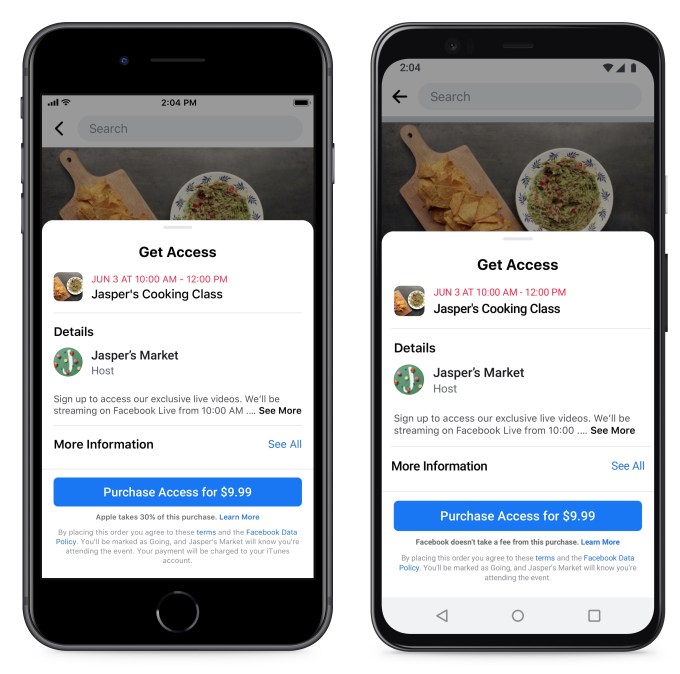
iOS purchase flow on left, Android purchase flow on right

To that end, the post includes screenshots of how the events payment flow will look on iOS and Android. On Android, it says, “Facebook doesn’t take a fee from this purchase,” while on iOS, it says, “Apple takes 30% of this purchase.”

Facebook said this language is included in the app update “which we submitted to Apple today for approval” — suggesting that there’s a possibility that the update won’t be approved.

This comes just about 24 hours after Fortnite was removed from the App Store, after Epic Games introduced direct payments into its hit game. It seemed like Epic was intentionally trying to provoke a fight, with the company quickly announcing a lawsuit against Apple and releasing a short in-game video parodying Apple’s famous 1984 commercial, with Apple cast as the villain. (The game publisher is in a similar battle with Google and Android.)

While Apple’s 30% fee has been around for as long as the App Store, the issue came to the forefront earlier this summer after developer Basecamp got into a public feud with the company over its subscription email app Hey. Apple’s Phil Schiller told us at the time that the controversy was not prompting the company to reconsider any of its rules.

14 Aug 2020

Facebook launches support for paid online events

Businesses will now be able to monetize online events on Facebook, thanks to a new feature that the social network is launching in the United States and 19 other countries today.

In a call with reporters, Head of Facebook App Fidji Sumo said that Facebook’s Events feature was designed for in-person events, but with the COVID-19 pandemic and resulting social distancing orders, the company “really quickly pivoted” to supporting online events.

In fact, Sumo said that in June of this year, live broadcasts on Facebook Pages doubled compared to the same period in 2019.

Sumo also outlined the new feature in a Facebook blog post. Businesses will be able to host larger events through Facebook Live, and the company is also testing the ability to host smaller, more interactive gatherings in Messenger Rooms. The goal is to give business owners the ability to create the event, set the price, promote the event, collect the payment and host the event itself all from one place.

Apparently some of the paid events that  have already been organized during tests with early users include talks, trivia, podcast recordings, boxing matches, cooking classes, meet-and-greets and fitness classes.

Facebook Online Events

iOS purchase flow on left, Android purchase flow on right

“With social distancing mandates still in place, many businesses and creators are bringing their events and services online to connect with existing customers and reach new ones,” Sumo wrote. “People are also relying on live video and interactive experiences more when they can’t come together physically.”

Sumo said Facebook will not be collecting any fees from paid online events for at least the next year year. So on the web and on Android “in countries where we have rolled out Facebook Pay,” businesses should be able to keep 100% of their online events revenue. That won’t, however, be the case on iOS, and Sumo’s blog post includes a surprisingly direct dig at Apple:

We asked Apple to reduce its 30% App Store tax or allow us to offer Facebook Pay so we could absorb all costs for businesses struggling during COVID-19. Unfortunately, they dismissed both our requests and SMBs will only be paid 70% of their hard-earned revenue. Because this is complicated, as long as Facebook is waiving its fees, we will make all fees clear in our products.

To that end, the post also includes an iOS screenshot (“which we submitted to Apple today for approval”) showing that the purchase button will include a small text message saying “Apple takes 30% of this purchase” beneath the purchase button (vs. “Facebook doesn’t take a fee from this purchase” on Android).

14 Aug 2020

Human Capital: A timeline of Uber and Lyft’s fight against AB 5 and Pinterest’s fall from grace

Welcome back to Human Capital, where we look at all things labor and diversity, equity and inclusion. This week, Uber and Lyft’s legal battle against a California law pertaining to independent contractors continued. As of right now, it’s looking like Uber and Lyft are going to temporarily cease operations in California next week if they can’t get their way.

Meanwhile, Pinterest employees reached their breaking point when former COO Françoise Brougher sued Pinterest alleging gender discrimination and wrongful termination. Now, they’re demanding systemic change at the company in light of the latest allegation of discrimination. 


Gig Life


Uber and Lyft say they’ll have to temporarily pause operations in California

A lot happened with Uber and Lyft this week, so let’s break down exactly what transpired. But first, a quick recap of the events leading up Uber threatening to cease operations in California. 

Jan 1, 2020: Assembly Bill 5 becomes law. The bill, first introduced in December 2018, codified the ruling established in Dynamex Operations West, Inc. v Superior Court of Los Angeles. In that case, the court applied the ABC test and decided Dynamex wrongfully classified its workers as independent contractors. According to the ABC test, in order for a hiring entity to legally classify a worker as an independent contractor, it must prove (A) the worker is free from the control and direction of the hiring entity, (B) performs work outside the scope of the entity’s business and (C) is regularly engaged in an “independently established trade, occupation, or business of the same nature as the work performed.”

May 2020: CA Attorney General Xavier Becerra, along with city attorneys from Los Angeles, San Diego and San Francisco, filed a lawsuit asserting Uber and Lyft gain an unfair and unlawful competitive advantage by misclassifying workers as independent contractors.

The suit argues Uber and Lyft are depriving workers the right to minimum wage, overtime, access to paid sick leave, disability insurance and unemployment insurance. The lawsuit, filed in the Superior Court of San Francisco, seeks $2,500 in penalties for each violation, possibly per driver, under the California Unfair Competition Law, and another $2,500 for violations against senior citizens or people with disabilities. 

June 2020: Becerra and others file motion for a preliminary injunction seeking to force Uber and Lyft to immediately classify their drivers as employees.

August 6, 2020: CA Superior Court Judge Ethan P. Schulman hears arguments pertaining to the preliminary injunction. At the hearing, Uber and Lyft maintained that an injunction would require them to restructure their businesses in such a material way that it would prevent them from being able to employ many drivers on either a full-time or part-time basis. Uber and Lyft’s argument, effectively, is that classifying drivers as employees would result in job loss.

“The proposed injunction would cause irreparable injury to Lyft and Uber, and would actually cause massive harm to drivers and harm to riders,” Rohit Singla, counsel for Lyft, said at the hearing.

For example, Lyft estimates it would cost hundreds of millions of dollars simply to process the I-9 forms, which verify employment eligibility. It doesn’t cost anything to file that form, but it would require Uber and Lyft to further invest in their human resources and payroll processes.

August 9, 2020: Judge Schulman grants the preliminary injunction, which goes into effect on August 20, 2020. 

“The Court is under no illusion that implementation of its injunction will be costly,” Judge Schulman wrote in the order. “There can be no question that in order for Defendants to comply with A.B. 5, they will have to change the nature of their business practices in significant ways, such as by hiring human resources staff to hire and manage their driver workforces.”

Meanwhile, Uber and Lyft made clear their respective plans to file emergency appeals

August 12, 2020: Uber CEO Dara Khosrowshahi says Uber will have to temporarily shutdown in California if the court doesn’t overturn the preliminary injunction. Lyft says it, too, will be forced to temporarily cease operations in California.

August 13, 2020: Judge Schulman denies Uber and Lyft’s appeal. Uber says it plans to file another appeal while Lyft says it will seek a further stay from the state’s appellate court. 

Looking ahead

August 20, 2020: Preliminary injunction is set to go into effect and Uber and Lyft will likely be temporarily ceasing operations in California.

November 2020: Californians will vote on Prop 22, a ballot measure majorly funded by Uber, Lyft and DoorDash. Prop 22 aims to keep gig workers classified as independent contractors. The measure, if passed, would make drivers and delivery workers for said companies exempt from a new state law that classifies them as W-2 employees. 

The ballot measure looks to implement an earnings guarantee of at least 120% of minimum wage while on the job, 30 cents per mile for expenses, a healthcare stipend, occupational accident insurance for on-the-job injuries, protection against discrimination and sexual harassment and automobile accident and liability insurance.


Stay Woke


Pinterest’s fall from grace

Back in 2015, Pinterest was known as one of the companies doing some of the best work around diversity, equity and inclusion. That perception changed this year. 

Pinterest was one of the first tech companies to set concrete hiring goals. In 2015, those goals were to increase hiring rates for full-time engineering roles to 30 percent female, increase hiring rates for full-time engineers to 8 percent from underrepresented ethnic backgrounds; increase hiring rates for non-engineering roles to 12 percent from underrepresented backgrounds; and implement a Rooney Rule requirement where at least one person from an underrepresented background and one female candidate is interviewed for every open leadership position.

Pinterest was also one of the first companies to hire a head of diversity and inclusion. In 2016, Pinterest hired Candice Morgan for the role. Morgan left the company earlier this year and joined VC firm GV as its equity, diversity and inclusion partner. Still, Morgan had one of the longest stints at any tech company’s diversity and inclusion department.

In the company’s 2020 diversity report, Pinterest showed it beat all of its hiring goals but what was missing from that report was retention data. When TechCrunch asked in January if they would make the data available, a Pinterest spokesperson said, “unfortunately, we can’t share the retention metrics publicly, but it will continue to be an internal priority.”

Now, transparency about retention data is just one of a handful of demands Pinterest employees have. Two days ago, former Pinterest COO Françoise Brougher sued the company, alleging gender discrimination, retaliation and wrongful termination. Prior to that, Aerica Shimizu Banks and Ifeoma Ozoma, also accused Pinterest of discrimination.

In light of those allegations, Pinterest employees are walking out today to demand change at the company. The walkout is directly in response to recent accusations of racial and gender discrimination at Pinterest. In addition to the walkout, there’s a petition circulating throughout the company demanding systemic change. The change they seek entails full transparency about promotion levels and retention, total compensation package transparency and for the people within two layers of reporting to the CEO to be at least 25% women and 8% underrepresented employees.


Don’t Miss


14 Aug 2020

With a new general partner and without Alexis Ohanian, Initialized Capital garners $230 million for fund five

Initialized Capital, the early-stage venture firm that got its start inside of Y Combinator almost a decade ago and spun out of the organization roughly five years later, has closed its newest fund with $230 million in capital commitments, cofounder Garry Tan announced on Medium earlier today.

The fund, its fifth, brings the assets that the San Francisco firm is managing to $770 million.

Tan also announced that Initialized has a new general partner in Brett Gibson, with whom Tan has partnered with time and again in the past. Specifically, Gibson co-founded with Tan the blog platforms Posthaven and Posterous. He and Tan also later wrote software for Y Combinator, building the organization’s internal software systems.

Initialized has been much in the news recently. We had the chance to talk with Tan just last month for at TechCrunch event organized for our Extra Crunch readers, and we discussed a few of the biggest mistakes that startups tend to make.

This editor also talked back in March with Tan and Alexis Ohanian, the Reddit cofounder and later Y Combinator partner with whom Tan, also a former YC partner, had founded Initialized. The two talked at the time about the importance of founders finding a way to eke out 18 months of runway on the assumption that the pandemic could take a while. While they gave no indication that they’d be parting ways, that’s exactly what happened more recently, with Ohanian deciding to raise his own pre-seed stage fund (reportedly with a $100 million-plus target), and Tan forging ahead with Initialized.

Asked about the development last month, Tan told us that “Alexis isn’t leaving the firm, he’s stepping into a board partner role, so all of the existing portfolio companies are going to continue to have him [involved].” Tan added he has “never seen anyone” identify promising startups when it’s “just an idea and a team and before there’s even a product” . . . “better than Alexis has,” adding that the split is “really about setting each other up for success.”

If there’s more to the story, investors don’t seem to mind, given some of the early returns they are poised to see thanks to early bets on some very well-known companies including the cryptocurrency platform Coinbase and the grocery delivery company Instacart. The firm has also seen the rapid rise of two other companies, the telemedicine startup Ro and the HR systems provider Rippling, both now so-called unicorns.

Even during these uncertain days, Initialized has seemingly remained active, writing follow-on checks to Bodyport, a San Francisco-based digital health company focused on the detection and management of heart disease (it just closed a Series A round), and Truepill, a San Mateo, Ca.-based online pharmacy that’s expanding into telehealth (and recently closed a Series B round.)

Initialized also recently co-led a round for Shelf Engine, a five-year-old, Seattle-based company that optimizes the process of stocking store shelves for supermarkets and groceries.

Initialized closed its fourth fund with $225 million just shy of two years ago.

14 Aug 2020

NASA and SpaceX target October 23 for first operational astronaut launch

NASA and SpaceX have set a specific target date for Crew-1, the first operational crewed mission for SpaceX’s Crew Dragon spacecraft. Crew-1 will carry astronauts Shannon Walker, Victor Oliver, Mike Hopkins and Soichi Noguchi to the International Space Station, and will mark the first regular service mission of the Dragon spacecraft following its certification at the conclusion of its development and testing program.

Crew Dragon’s final major milestone in that process was Demo-2, the mission launched on May 30 with astronauts Bob Behnken and Doug Hurley on board. While Hurley and Behnken completed that mission with a successful return to Earth earlier this month, that was still technically part of the qualification process for Crew Dragon and for SpaceX’s Falcon 9 rocket, in order to certify it for human spaceflight so that it could begin regular mission operations – which kick off with Crew-1.

NASA says that the late October date (it had earlier discussed a late September timeframe as a possibility) in order to allow for the upcoming Soyuz spacecraft traffic from Russia to the ISS, as well as the departure of the current Space Station crew at the end of their current rotation. It’s also still pending a full review of the data and qualification criteria of Crew Dragon and the Demo-2 mission, which definitely appears to have gone pretty much exactly to plan, but which still will be examined under a microscope by NASA and SpaceX staff to ensure that was indeed the case.

If this data review goes well, and Crew-1 flies in October, then Crew-2 should take place next spring, bringing up four more astronauts to relieve the Crew-1 astronauts for another tour of science and Space Station operations.