Year: 2020

14 Aug 2020

Travel startups cry foul over what Google’s doing with their data

As the antitrust drumbeat continues to pound on tech giants, with Reuters reporting comments today from the US Justice Department that it’s moving “full-tilt” on an investigation of platform giants including Google parent Alphabet, startups in Europe’s travel sector are dialling up their allegations of anti-competitive behavior against the search giant.

Google has near complete grip on the search market in Europe, with a regional marketshare in excess of 90% according to Statcounter. Unsurprisingly industry sources say a majority of travel bookings start as a Google search — giving the tech giant huge leverage over the coronavirus-hit sector.

More than half a dozen travel startups in Germany are united in a shared complaint that Google is abusing its search dominance in a number of ways they argue are negatively impacting their businesses.

Complaints we’ve heard from multiple sources in online travel range from Google forcing its own data standards on ad partners to Google unfairly extracting partner data to power its own competing products on the cheap.

Startups are limited in how much detail they can provide about Google’s processes on the record because the company requires advertising partners to sign NDAs to access its ad products. But this week German newspaper Handelsblatt reported on antitrust complaints from a number of local startups — including experience booking platform GetYourGuide and vacation rental search engine HomeToGo — who are accusing the tech giant of stealing content and data.

The group is considering filing a cartel complaint against Google, per its report.

We’ve also heard from multiple sources in the European travel sector that Google has exhibited a pattern of trying to secure the rights to travel partners’ content and data through contracts and service agreements.

One source, who did not wish to be identified for fear of retaliation against their business, told us: “Each travel partner has certain specialities in their business model but overall the strategy of Google has been the same: Grab as much data from your partners and build competing products with that data.”

Not ok, Google

This is now a very familiar complaint against Google. Crowdsourced reviews platform Yelp has been accusing the tech giant of stealing content for years. More recently, Genius got creative with a digital watermark that caught Google redhanded scraping lyrics content from its site which it pays to license (but Google does not). As Lily Allen might put it, it’s really not okay.

Last month’s Congressional antitrust subcommittee hearing kicked off with exactly this accusation too — as chair, David Cicilline, barked at Google and Alphabet CEO, Sundar Pichai: “Why does Google steal content from honest businesses?” Pichai dodged the question by claiming he doesn’t agree with the characterization. But for Google and parent Alphabet there’s no dodging the antitrust drumbeat pounding violently in the company’s backyard.

In Europe, Google’s business already has a clutch of antitrust enforcements against it — starting three years ago, in a case which dated back six years at that point, with a record breaking penalty for anti-competitive behavior in how it operated a product search service called Google Shopping. EU enforcements against Android and AdSense swiftly followed. Google is appealing all three decisions, even as it continues to expand its operations in lucrative verticals like travel.

The Commission’s 2017 finding that Google is dominant in the regional search market carried what lawmakers couch as a “special responsibility” to avoid breaching the bloc’s antitrust rules in any market Google plays in. That finding puts the travel sector squarely in the frame, although not yet under formal probe by EU regulators (although they have opened an active probe of Google’s data collection practices, announced last year).

EU regulators are also examining a range of competition concerns over its proposed acquisition of Fitbit, delaying the merger while they consider whether the deal would further entrench Google’s position in the ad market by giving it access to a trove of Fitbit users’ health data that could be used for increased ad personalization.

But so far, on travel, the Commission has been keeping its powder dry.

Yet for around a decade the tech giant has been building out products that directly compete for travel bookings in growth areas like flight search. More recently it’s added hotels, vacation rentals and experiences — bringing its search tool into direct competition with an increasing range of third party booking platforms which, at least in Europe, have no choice but to advertise on Google’s platform to drive customer acquisition.

One key acquisition underpinning Google’s travel ambitions dates back to 2010 — when it shelled out $700M for ITA, a provider of flight information to airlines, travel agencies and online reservation systems. The same year it also picked up travel guide community, Ruba.

Google beat out a consortium of rivals for ITA, including Microsoft, Kayak, Expedia, and Travelport, who relied upon its data to power their own travel products — and had wanted to prevent Google getting its hands on the data.

Back then travel was already a huge segment of search and online commerce. And it’s continued to grow — worth close to $700BN globally in 2018, per eMarkter (although the coronavirus crisis is likely to impact some recent growth projections, even as the public health crisis accelerates the industry’s transition to digital bookings) — all of which gives Google huge incentive to carve itself a bigger and bigger share of the pie. 

This is what Google is aiming to do by building out ad units that cater to travellers’ searches by offering flights, vacation rentals and trip experiences, searchable without needing to leave Google’s platform. 

Google defends this type of expansion by saying it’s just making life easier for the user by putting sought for information even closer to their search query. But competitors contend the choices it’s making are far more insidious. Simply put, they’re better for Google’s bottom line — and will ultimately result in less choice and innovation for consumers — is the core argument. The key contention is Google is only able to do this because it wields vast monopoly power in search which gives it unfair access to travel rivals’ content and data.

It’s certainly notable that Alphabet hasn’t felt the need to shell out to acquire any of the major travel booking platforms since its ITA acquisition. Instead its market might allows it to repackage and monetize rival travel platforms’ data via an expanding array of its own vertical travel search products. 

One of the German consortia of travel startups with a major beef against Google is Berlin-based HomeToGo. The vacation rentals platform confirmed to TechCrunch it has filed an antitrust complaint against the company with the European Commission.

It told us it’s watched with alarm as Google introduced a new ad unit in search results which promotes a vacation rental search and booking experience — displaying property thumbnails, alongside locations and prices plotted on a map — right from insight Google’s platform.
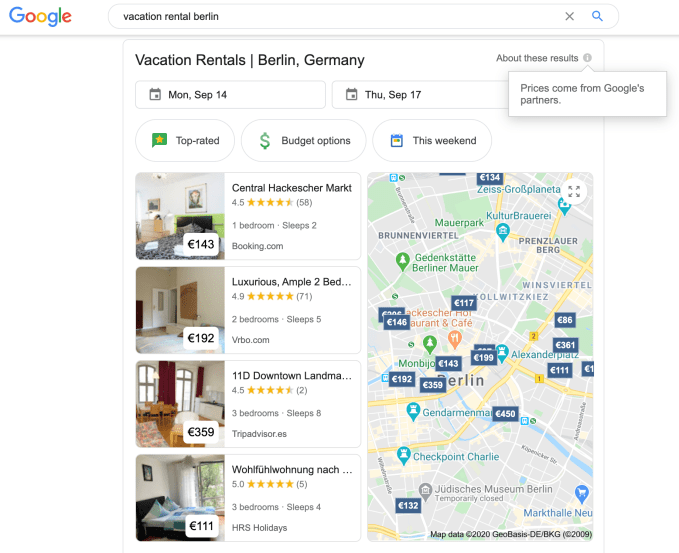
Screengrab showing Google vacation rental ad unit, populated with content from a range of partners

Discussing the complaint, HomeToGo CEO and co-founder, Dr Patrick Andrae, told us: “Due to the monopoly Google has in horizontal search, just by having this kind of access [to the vast majority of European Internet searchers], they’re so top of the funnel that they theoretically can go into any vertical. And with the power of their monopoly they can turn on products there without doing any prior investment in it.

“Anyone else has to work a lot on SEO strategies and these kind of things to slowly go up in the ranking but Google can just snap its fingers and say, basically, tomorrow I want to have a product.”

The complaint is not just that Google has built a competing ad product in vacation rentals but — following what has become a standard colonizing playbook for seemingly any vertical area Google sees is grabbing traffic — its packaging of the competing product is so fully featured and eye-catching that it results in greater prominence for Google’s ad vs organic search results (or indeed paid ad links) where rivals may appear as plain old blue links.

“They create this giant, colorful super CTA [call-to-action], as we call it — this one-box thing — where everything is clickable and leads you into the Google product,” said Andrae. “They explain that it’s better for the user experience but no one ever said that the user wants to have a one-box there from Google. Or why shouldn’t it be a one-box from HomeToGo? Or why shouldn’t it be a one-box in the flight word from Kayak? Or in the hotel world from Trivago? So why is it just the Google product that’s colorful, nice, and showing up?”

Andrae argues that the design of the unit is intended to give the user the impression that “Google has everything there”, on its platform. So, y’know, why go looking elsewhere for a vertical search engine?

He also points out that the special unit is not available to competitors. “You cannot buy it,” he said. “So even if you would like to have this prominent kind of placement you cannot buy that as a third party company. Even if you would like to pay money for it — I’m not talking about being in the product itself, that’s another topic — but just having the same kind of advertisement, because it is what they do — they advertise their own product there for free — and this is our complaint.”

Pay with your data

In 2017, when the Commission slapped Google with the first record-breaking penalty over its search comparison service — finding it had systematically given prominent placement to its own comparison shopping service over and above rival services in organic search results — competition chief Margrethe Vestager disclosed it had also received complaints about Google’s behavior in the travel sector.

Asked about the sector’s concerns now, some three years later, a Commission spokeswoman told us it’s “monitoring the markets concerned” — but declined to comment on any specific gripes.

Here’s another complaint: GetYourGuide, a Berlin based travel startup that’s created a discovery and booking platform for travel tours and experiences, has similar concerns about Google’s designs on travel experience booking — another travel segment the tech giant is moving into via its own eye-catching ad units flogging experiences.

“They want to create experience products now directly on Google search itself, with the aim that ultimately people can book these type of things on Google,” said GetYourGuide CEO and co-founder Johannes Reck. “What Google tries to do now is they try to get [travel startups’] content and our data in order to create new competitive products on Google.”

The startup is unhappy, for example, that a ‘Things to do’ ad product Google shows in its search results doesn’t link to GetYourGuide’s own search page — which would be the equivalent and competing third party product.

“Google will not allow us to link them into our search but only into the details page so the customer sees even less of our brand,” he said. “Or in Maps, for instance, if you go to Eiffel Tower and press to book tickets you don’t see any of GetYourGuide despite us fulfilling that order.”

He also rejects Google’s claim against this sort of complaint that it’s simply ‘doing the right thing for the user’ by not linking them out to the rival platform. “We do know from our data that users convert better and spend more time on our site and have higher engagement rates when we link them into our search and then deeper down into the funnel,” he told TechCrunch. “What Google is saying is not that it serves the user — it serves Google and it serves their profits. Because the deeper down the funnel that you link, the user will either buy or they will bounce back to Google and search for the next product. If you link into searches — if you don’t verticalize as much — then the user will end up in a different ecosystem and might not bounce back to Google.”

“As a partner [of Google] you have limited choice to participate [in its ad products]. You do need to give Google that content and then Google will try to move as many of the customers to them,” Reck added. “I don’t think there ever will be a world where booking.com or Expedia or GetYourGuide will disappear — rather our brands will start to disappear.

“That is something that I think ultimately is bad for the customer and only serves Google, again, because the customer will, in the long run, have no other choice and no other visibility on how he can get to choice than to go through Google because our brands will basically be hidden behind a Google wall. That will turn Google firmly away from what their original mission was… to steer people to the most relevant content on the web… Now they are trying to be completely the opposite; they’re trying to be the Amazon or Alibaba of travel and try to keep and contain people in their ecosystem.”

During the congressional antitrust subcommittee hearing last month Pichai claimed Google faces fierce competition in travel. Again, Reck contends that’s simply not true. “In Europe more than 75% of travellers go to Google to search for travel and all those users are free,” he said. “Everyone else in the travel industry pays Google top dollar… for these queries. Which competition exactly is he referring to?”

“[Pichai] then claimed that they’re not leveraging partners’ content — that’s not accurate. If you look at Google if you want to be in the top results these days you either pay or you give them data so that they can build their own products into search.”

“This dates back ten years now when they acquired ITA software, which is the leading data provider for flights,” Reck added. “They’ve just paved their way into travel. I think their intent is very clear at this point that they have no interest in their partners — or their customers for that matter, who like the choice that’s being offered on Google.”

“What they want to morph into, basically, is to turn Google into the Amazon of travel where everyone else maybe a content provider or a fulfilment agent but the consumer has no choice but to go through Google. I think that is the key intent here. They want to limit consumer choice. And they want to monopolise the space. We don’t want that and we will fight that. And if that means we need to go to the EU Commission to protect our and the customers’ interests then we’ll do that and we’re currently reviewing that option.”

The looming harm for consumers around reduced choice could manifest in poorer customer service, which is an area vertical players tend to focus on — whereas Google, as a platform funnel, does not.

Another German travel startup — Munich-based FlixBus — was also willing to go on the record with concerns about the impact of Google’s market power on the sector, despite not being in the same position as its business is not an aggregator.

Nonetheless, FlixBus Jochen Engert, founder and CEO, called on regional lawmakers to act against what he described as Google’s “systematic abuses” of market dominance.

“We call on the politicians in Germany and the EU to now work for fair competition on the Internet. It must be forbidden that monopolistic companies like Google abuse their market power, especially in times of crisis, and prevent competition for the benefit of the customer due to their dominance,” he told us. “Google systematically abuses its dominant market position to seal off access to customers from competitors and gets away with it time and again. It is only a matter of time before other industries and business models, in addition to travel, hotel and flight bookings, are permanently threatened.

“For FlixMobility [FlixBus’ parent company] as an internationally positioned market leader with its own platform, technology and our unique content, the situation is more relaxed than for smaller start-ups or those which also aggregate content such as Google. Nevertheless, in our opinion Google should be obliged to list and market its own products in search results on an equal footing with comparable offers. Here regulation must not stand by and watch for too long, but must react before Google irretrievably controls customer access and excludes competition.”

GetYourGuide’s Reck expressed hope that German lawmakers might be able to offer more expeditious relief to the sector than the European Commission — whose competition investigations typically grind through the details for years.

“The German government is actually very alert at this point in time,” he said. “They’re currently working on a new competition legislation that they will put in place probably within the next six months. It’s already in the making — and that will also be addressed to exactly that type of behavior of global, quasi-monopolistic platforms crossing the demarcation line, moving into other fields and trying to leverage their monopoly in order to create synergies in adjacent fields and crowd out competition.”

Asked what kind of intervention he would like to see regulators make against Google, Reck suggests its business should be regulated akin to a utility — advocating for controls on data, including around the openness of data, to level the playing field.

Though he also told us he would be supportive of more radical measures, such as breaking Google up. (But, again, he says speed of intervention is of the essence.)

“If you look at all of the data that Google collects, whether that’s consumer reviews, availability from its partners, all of the content from its partners, all of the information that they have through Android, whether that’s geo-specific data, whether that is interests, whether that is contextual information, Google is training their algorithms day and night on this data, no one else can. But we all have to provide data to Google,” he said.

“That’s not a level playing field. We need to think about how we can have a more open data architecture, that obviously is compliant with our data privacy laws but where developers from anywhere can build products based on the Google platform… As a developer in travel it’s currently very hard for me to access any data from Google so I can build better products for consumers. And I think that really needs to change — Google needs to open us for us to create a more vibrant and competitive ecosystem.”

“At a national or EU level we need to have an updated legal code that allows for quick interventions,” Reck added, saying competition enforcement simply can’t carry on at the same pace as for the markets of the past. “Things are moving way too quickly for that. You need to take a completely new approach.

“As Google correctly pointed out consumer prices have fallen but falling consumer prices is the weapon in tech; offering products for free allows you to gain marketshare in order to crowd out competition, which again leaves less choice for the customer so I think we need to think about how we think about tech and platforms in new ways.”

The Commission is currently consulting on whether competition regulators need a new tool to be able to intervene more quickly in digital markets. But there’s more than a trace of irony that its adherence to process means further delay as regulators question whether they need more power to intervene in digital markets to prevent tipping, instead of acting on long-standing complaints of market abuse attached to the 800lb gorilla of Internet search — with its “special responsibility” not to trample on other markets.

Reached for comment on the travel startups’ complaints, a Google spokeswoman sent us this statement:

There are now more ways than ever to find information online, and for travel searches, people can easily choose from an array of specialized sites, like TripAdvisor, Kayak, Expedia and many more. With Google Search, we aim to provide the most helpful and relevant results possible to create the best experience for users around the world and deliver valuable traffic to travel companies.

During the pandemic, we’ve been working hard with our partners in the travel industry to help them protect their businesses and look toward recovery. We launched new tools for airlines so they can better predict consumer demand and plan their routes. For hotels, we expanded our ‘pay per stay’ program globally to shift the risk of cancellation from our partners to us. And we’ve updated our search products so consumers can make informed decisions when planning future travel, further reducing the risk of cancellation.

The company did not respond to our request for a response to claims we heard that it seeks to secure rights to partners’ content and data via contracts and service agreements.

No relief

In another sign of the growing rift between Google and its travel partners in Europe, German startups in the sector banded together to press it for better terms during the coronavirus crisis earlier this year — accusing the tech giant of being inflexible over payments for ads they’d runs before the crisis hit. This meant they were left with a huge hole in their balance sheets after making mass refunds for travellers who could no longer take their planned trip. But the gorilla wasn’t sympathetic, demanding full payment immediately.

Asked what happened after TechCrunch reported on their concerns at the end of April, Reck said Google went silent for a few weeks. But as soon as the travel market started picking up in Germany — and GetYourGuide decided it needed to start advertising on Google again — it reissued the demand for full payment.

GetYourGuide says it was left with no choice but pay, given it needed to be able to run Google ads.

Reck describes the recovery package Google offered after it made the payment as “a Google recovery package” — as it was tied to GetYourGuide spending a large amount on YouTube ads in order to get a small discount.

The offer would recoup only “fraction” of GetYourGuide’s original losses on Google ads during the peak of the COVID-19 crisis, per Reck. “YouTube obviously is not where we lost the money. We lost the money in search where we had high intent customers, Google customers that wanted to come and shop. So that to us was [another] slap in the face,” he added.

14 Aug 2020

Eliminate DevOps waste with Japanese management practices

Across the board, industries need to embrace modern workflows to keep up with the speed of startups. And out of all the various methodologies, I find the “lean methodology” to be the most intriguing of them all. It’s a unique combination of pragmatism and a higher purpose.

Lean methodology descends directly from the Toyota Production Systems (TPS), which is based on a philosophy of eliminating waste to achieve efficiency in processes. It relies heavily on the mindset of “just-in-time,” making only “what is needed when needed, and in the amount needed.” In software development, this means only developing the features your clients need, and only when they need them.

To emphasize the point and stir some creative juices, let’s look at the Japanese concepts of muda, mura and muri, and how this applies to being lean when we are building and shipping software.

Muda, mura and muri

Muda is the “waste” we are working to remove that is directly hurting efficiency. Waste is any activity that doesn’t create value, in the form of the products and services we offer. As every engineer knows, spending half the day in meetings is a painful waste of time.

Mura is “unevenness,” referring to any variance in the process itself or the output generated. In software development, “mura” causes unpredictability that makes it impossible to embrace a “just-in-time” mindset. If the quality of a new upcoming feature is uncertain, then additional time and resources will have to be reserved for quality assurance and bug-fixing efforts. It’s better to know upfront what you are going to get, how long it will take and what the cost will be.

Muri is “overburden,” which happens when we demand the unreasonable from our team, tools and processes. If we want to deliver a specific feature just-in-time, then we must allocate the appropriate time and resources. Giving our engineering teams too many simultaneous tasks, or failing to give them the tools necessary to succeed, will only lead to disappointment in time, quantity, quality or cost.

Forms of waste

Diving deeper into muda — what I consider the cardinal sin of lean methodology — here are the forms of waste we should always be on the lookout for:

  1. Overproduction – Producing more than is needed, or before it is required. Besides unneeded features, we often over-allocate computing resources, especially in non-cloud environments.
14 Aug 2020

Warner Music acquires IMGN, a social media publishing platform, for under $100M

It’s a whole new playing field these days for music labels and publishers, and today one of the big three made an acquisition to help it sharpen up its strategy to better understand what people want to see and hear online today.

Warner Music — which owns labels like Atlantic, Elektra and others and has a huge roster of artists that includes the likes of Madonna, Ed Sheeran and Linkin Park — is acquiring IMGN Media, a Tel Aviv and New York-based startup that builds and tracks viral social media content in categories like e-sports and gaming, ASMR and entertainment.

IMGN used be called Comedy.com. It widened its remit from simply funny stuff and rebranded in 2017, and according to its site has about 3 billion views per month and has some 40 million subscribers to its content, with some 85% of that classified as “Gen Z and millennials.”

The news caps off several weeks of speculation about the startup. In July, reports in the Israeli press emerged that said IMGN was being circled by Snap for about $180 million; and further to that, a source told us that TikTok was also in the frame, looking at the company at around a price tag of $150 million. In the end, the terms of the deal were not disclosed but we understand that the deal was done for just under $100 million.

IMGN was founded in 2015 and had raised about $6 million from a long list of angels and some firms including Rhodium, Dot Capital and Prism Venture Management.

The plan will be to keep IMGN independent of Warner, continuing to develop and analyse viral content across a range of platforms, with founder Barak Shragai staying on to lead the team.

Warner, meanwhile, does not plan to use the platform to simply market its artists, but to tap it for more insights into where people are going online these days, and what they want to see, so that it can better target its own marketing efforts accordingly.

That’s not to say that the two will not work together at all. Warner became acquainted with the startup because it had been a customer of IMGN’s.

Warner has a history both of investing and acquiring startups, depending on its strategic interests. In July, for example, it took part in a Series B round for Canadian audio mastering startup Landr. Further back, it has acquired the likes of music concert listings platform Songkick and pop culture site Uproxx.

“WMG not only offers us greater investment and support, but an entrepreneurial environment to continue growing our business, with the people running our accounts having editorial independence,” said Shragai. “We’re excited to partner with them as we take our company into the future.”

The bigger picture here is that the music industry has evolved well beyond the world of publishing and selling physical media, with people learning about new artists and songs through the radio, TV and magazines.

With the shift to digital platforms, there’s also now a huge plethora of places where people discover and listen to music, and digital platforms themselves — from those focused specifically on audio and music, like Spotify, through to those where music is a side-hustle to continue to capture audience, like Facebook, through to those that are neither but are still huge music platforms, like TikTok — are also getting deeply involved in tracking how tastes are evolving, and where people are going to get their music fix. It’s only natural to see labels looking for ways to have more direct access to those insights themselves, bypassing all those platforms — even as they also work with them (and indeed, to help them negotiate better with those platforms, at the end of the day).

14 Aug 2020

Facebook tests TikTok-style video format on its main app in India

Facebook is going all in on short-form videos. After flirting with the idea in Lasso, a TikTok-clone it tested in select markets, and adding a similar feature to Instagram recently, the company is exploring a new venue for this TikTok-esque experience: The big blue app.

The company confirmed to TechCrunch that it is testing short-form videos in the Facebook app in India, its biggest market by users. In the current avatar, ‘Short Videos’ has a dedicated section within the news feed. On top of it sits the ‘Create’ button, tapping which prompts Facebook Camera to launch, and users can browse through videos by swiping up.

“We’re always testing new creative tools so we can learn about how people want to express themselves. Short form videos are extremely popular and we are looking at new ways to provide this experience for people to connect, create and share on Facebook,” a Facebook spokesperson told TechCrunch.

Matt Navarra, a social media consultant, first revealed the existence of the new test.

The test comes as Facebook continues to cash in on the absence of TikTok, the ByteDance -owned app that was banned by India in late June, in the country. Facebook launched Reels in India last month weeks before launching it to dozens of additional markets. A source familiar with the matter said the daily engagement of Facebook’s services in India has increased by more than 25% since the ban on TikTok.

Scores of local startups, including Twitter-backed ShareChat and Times Internet’s Gaana and MX Player streaming services, have launched standalone apps or integrated features to replicate the social experience TikTok provided to users in recent weeks. The local apps have claimed to have added tens of million of new users during the period.

YouTube has also rolled out a similar feature, still in testing phase, to more users in India in recent weeks.

Image: TechCrunch

The urgency in Facebook’s attempt to court users with short-form videos comes as TikTok is plotting ways to re-enter the market. ByteDance is engaging with Indian conglomerate Reliance Industries to sell stake in TikTok’s local business, TechCrunch reported earlier this week.

14 Aug 2020

Pinterest employees are walking out today in light of discrimination allegations

Pinterest employees are walking out today to demand change at the company. The walkout is directly in response to recent accusations of racial and gender discrimination at Pinterest.

Organizers of the walkout are encouraging employees to post the following message in the #qanda and #pinployees-global channels on Slack: “I am [upset/angry/shocked/unhappy/whatever you’re feeling] about the racial and gender discrimination that has happened at Pinterest, and am leaving work early today. Join me. changeatpinterest.com.”

In addition to the walkout, there’s a petition circulating throughout the company demanding systemic change. The change they seek entails full transparency about promotion levels and retention, total compensation package transparency and for the people within two layers of reporting to the CEO to be at least 25% women and 8% underrepresented employees.

Two days ago, former Pinterest COO Françoise Brougher sued the company, alleging gender discrimination, retaliation and wrongful termination. Prior to that, Aerica Shimizu Banks and Ifeoma Ozoma, also accused Pinterest of discrimination.

“These are not isolated cases,” workers wrote in the petition. “Instead, they are representative of an organizational culture that hurts all Pinterest workers, and keeps us from achieving our mission of bringing everyone the inspiration to create a life they love. We recognize that Pinterest has been a leader in diversity and inclusive hiring, with the diversity goals for new hires. It’s become clear that this is not enough, and that the diversity goals need to apply from the top down, not just the bottom up. Not only will diverse and inclusive leadership prevent discrimination and harassment among workers, it will help us build a product that is relevant on a global scale.”

Beyond the walkout and petition, organizers are asking employees to overlay their company profile picture on Slack with the faces of Ozoma, Banks and Brougher.

“The leadership and employees at Pinterest have a shared goal of building and fostering a company we can all be proud of,” a Pinterest spokesperson told TechCrunch. “We know we have real work to do and recognize that it’s our job to build a diverse, equitable and inclusive environment for everyone. We respect and hear the employees who want to see a clear commitment to action, and we will ensure an open dialogue that leads to progress to make Pinterest the place we all know it can be.”

You can reach this reporter via Signal at 415-516-5243. 

14 Aug 2020

Thirty Madison raises $47 million for its direct to consumer treatments of hair loss, migraines, and indigestion

Thirty Madison, the New York-based startup developing a range of direct to consumer treatments for hair loss, migraines, and chronic indigestion, has raised $47 million in new financing.

After last week’s nearly $19 billion merger between Teladoc and Livongo, remote therapies and virtual care companies are all the rage among the healthcare industry and Thirty Madison’s business is no exception. 

An indicator of just how important these companies are to the future of the healthcare business can be seen in the presence of Johnson & Johnson Innovation – JJDC, Inc. (JJDC) in the latest round for Thirty Madison. 

Existing investors Maveron and Northzone also returned to back the company in a deal led by Polaris Partners. Thirty Madison has raised a total of $70 million so far. 

Founded just three years ago by Steven Gutentag and Demetir Karagas, Thirty Madison expanded from treating hair loss with its Keeps brand in 2018 to migraine treatments in early 2019 with Cove, and launched Evens (the company’s acid reflux treatment service) later that year. 

Thirty Madison has just begun offering urgent care consultations for users on a pay what you will model.

And the company’s founders differentiate Thirty Madison’s business from their better-funded competitors like Hims and Ro by emphasizing that their company provides continuing care after a diagnosis and offers a range of treatment options for the conditions that the company treats. That, coupled with the more narrow focus on a few specific conditions, distinguish Thirty Madison from its peers in the industry.

“Over 59% of Americans suffer from at least one chronic condition, but few resources exist to help them connect the dots of their care,” said Amy Schulman, a partner with Polaris Partners and new director on the Thirty Madison board. 


14 Aug 2020

A beginner’s guide to diversity, equity and inclusion

After Minneapolis police killed George Floyd and the subsequent racial justice uprising, many people in tech shouted from the rooftops that “Black Lives Matter,” despite having subpar representation of Black and Latinx folks at their companies. In some cases, these companies’ proclamations of “Black Lives Matter” felt especially performative in contrast to their respective stances on Trump and selling their technology to law enforcement agencies. 

Still, this has led to an increased focus on diversity, inclusion and equity in the tech industry. If you’re wondering things like, “Where do I find Black and brown talent?” or saying, “I’d invest in Black and Latinx people if I could find them!,” then this is for you. 

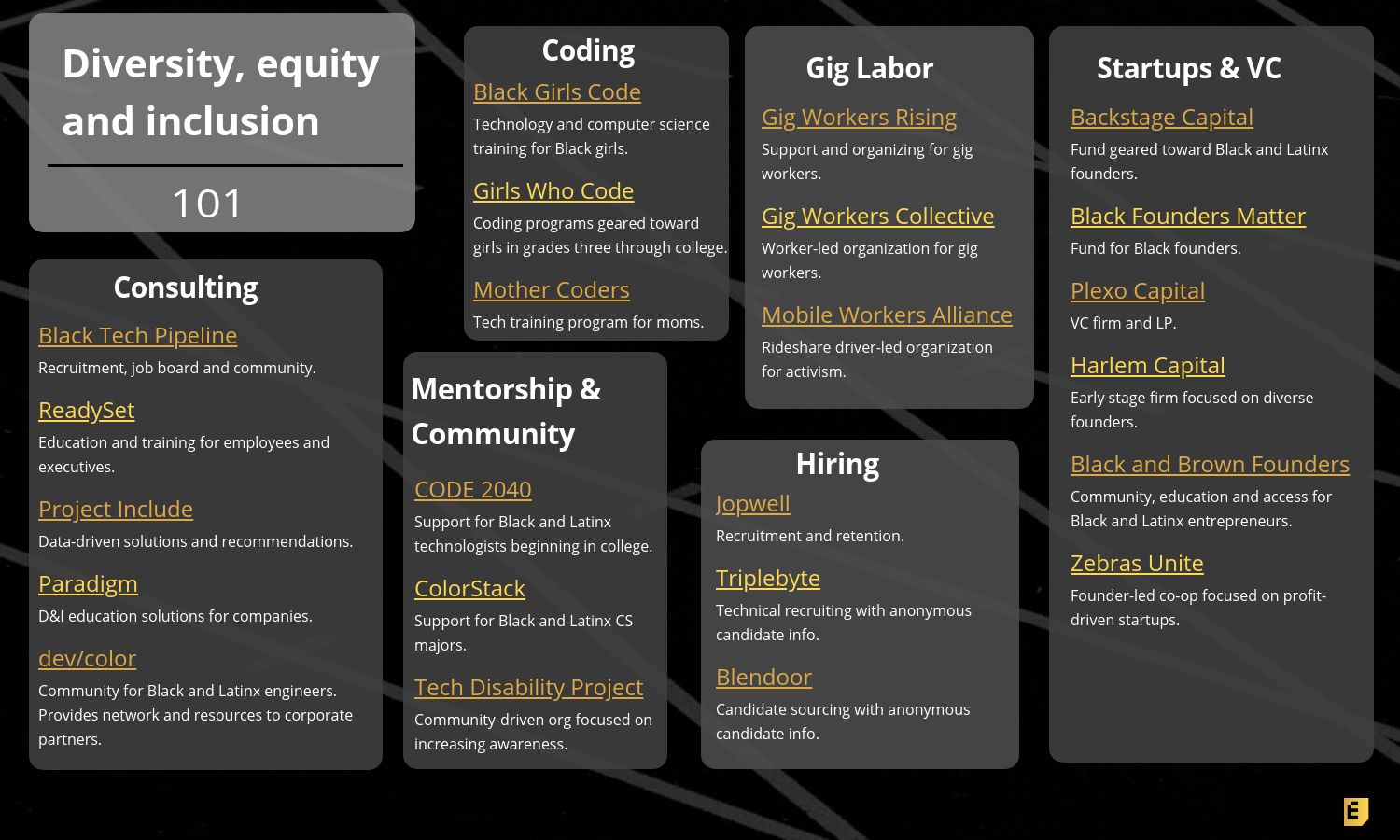
Below, you’ll learn about some of the issues at play, some of the key organizations doing work in this space, and access a glossary of frequently used terms in the realm of diversity, equity and inclusion in tech.


The data


Glossary of terms


Below, you’ll find a list of commonly used terms when talking about diversity, equity and inclusion.

  • Ableism: Discrimination that favors able-bodied people.
  • Accomplice: Someone who uses their privilege to actively advocate for change as it pertains to BIPOC, women, disabled people and so forth. An example of this is a white person who calls out racism in the workplace.
  • Ally: A more passive version of an accomplice. An example of an ally is someone who supports the cause but may not put themselves on the line.
  • Anti-racist: “To be antiracist is to think nothing is behaviorally wrong or right — inferior or superior — with any of the racial groups. Whenever the antiracist sees individuals behaving positively or negatively, the antiracist sees exactly that: individuals behaving positively or negatively, not representatives of whole races. To be antiracist is to deracialize behavior, to remove the tattooed stereotype from every racialized body.” – Ibram X. Kendi
  • BIPOC: Black, Indigenous and people of color. This term is an alternative to simply saying “people of color,” which fails to recognize the unique experiences and hardships of Black (slavery) and Indigenous (genocide) folks in the U.S.
  • Cisgender: Person whose gender matches their sex assigned at birth.
  • Culture fit: Code for “looks like me, thinks like me,” which can lead to homogenous workplaces.
  • Diversity report: An oftentimes yearly report where tech companies show their employee demographic breakdown.
  • Equality: Treating everyone the same, regardless of any structural barriers of discrimination.
  • Equity: Treating people in fair and just ways that take into account systemic discrimination and other structural barriers.
  • Gender nonconforming: People who identify with no specific gender.
  • Imposter syndrome: When individuals doubt their worth and accomplishments and fear being exposed as a fraud.
  • Intersectionality: The concept that people face multi-faceted layers of discrimination as a result of their intersecting identities relating to race, gender, class, sexual orientation, etc. For women and trans people of color, the oppressive institutions of racism, sexism, homophobia and transphobia all come into play and cannot be examined separately.
  • Microaggression: Casual comments, behaviors or actions that are driven by underlying biases about a particular race, gender, sexuality or other characteristic. A classic example of this is telling a Black person, “You’re so articulate!” or, “You’re the whitest Black person I know!” The former suggests its rare for Black people to be articulate while the latter implies that Black person’s behavior doesn’t fit in with society’s stereotypical ideas of Blackness.
  • Performative: Engaging in woke speak without engaging in woke action.
  • Pipeline problem: A misconception that the lack of diversity in tech is a result of too few Black and Latinx people interested in technology.
  • Transgender: Person whose gender identity does not match their sex assigned at birth.
  • Unconscious bias: Also known as implicit biases, these are underlying beliefs people have about certain groups of people that are powered by stereotypes. Over the years, however, some have argued that these types of biases are not all that unconscious.
  • White privilege: The benefits and advantages that people have simply for being white in society. More here.

DE&I Landscape


Diversity, inclusion and equity do not just mean hiring and recruiting Black and brown folks. It touches on all aspects of the tech industry, including venture capital and the gig economy, where many of its workers are Black, Indigenous or people of color.

Common wisdom is that it’s better to start focusing on your startup’s diversity and inclusion efforts sooner rather than later. And by “sooner” we mean now.

Below, you’ll find an overview of the organizations active in this space. Whether you’re looking to beef up your recruiting efforts, implement unconscious bias or allyship trainings, seek mentorship, get funding or connect with other gig workers, there’s something here for you.

This guide is not comprehensive but is designed to serve as a starting point for those not quite knowing where to begin. As for next steps, we recommend getting in touch with any of those organizations featured above that piqued your interest.


Additional reading


14 Aug 2020

A beginner’s guide to diversity, equity and inclusion

After Minneapolis police killed George Floyd and the subsequent racial justice uprising, many people in tech shouted from the rooftops that “Black Lives Matter,” despite having subpar representation of Black and Latinx folks at their companies. In some cases, these companies’ proclamations of “Black Lives Matter” felt especially performative in contrast to their respective stances on Trump and selling their technology to law enforcement agencies. 

Still, this has led to an increased focus on diversity, inclusion and equity in the tech industry. If you’re wondering things like, “Where do I find Black and brown talent?” or saying, “I’d invest in Black and Latinx people if I could find them!,” then this is for you. 

Below, you’ll learn about some of the issues at play, some of the key organizations doing work in this space, and access a glossary of frequently used terms in the realm of diversity, equity and inclusion in tech.


The data


Glossary of terms


Below, you’ll find a list of commonly used terms when talking about diversity, equity and inclusion.

  • Ableism: Discrimination that favors able-bodied people.
  • Accomplice: Someone who uses their privilege to actively advocate for change as it pertains to BIPOC, women, disabled people and so forth. An example of this is a white person who calls out racism in the workplace.
  • Ally: A more passive version of an accomplice. An example of an ally is someone who supports the cause but may not put themselves on the line.
  • Anti-racist: “To be antiracist is to think nothing is behaviorally wrong or right — inferior or superior — with any of the racial groups. Whenever the antiracist sees individuals behaving positively or negatively, the antiracist sees exactly that: individuals behaving positively or negatively, not representatives of whole races. To be antiracist is to deracialize behavior, to remove the tattooed stereotype from every racialized body.” – Ibram X. Kendi
  • BIPOC: Black, Indigenous and people of color. This term is an alternative to simply saying “people of color,” which fails to recognize the unique experiences and hardships of Black (slavery) and Indigenous (genocide) folks in the U.S.
  • Cisgender: Person whose gender matches their sex assigned at birth.
  • Culture fit: Code for “looks like me, thinks like me,” which can lead to homogenous workplaces.
  • Diversity report: An oftentimes yearly report where tech companies show their employee demographic breakdown.
  • Equality: Treating everyone the same, regardless of any structural barriers of discrimination.
  • Equity: Treating people in fair and just ways that take into account systemic discrimination and other structural barriers.
  • Gender nonconforming: People who identify with no specific gender.
  • Imposter syndrome: When individuals doubt their worth and accomplishments and fear being exposed as a fraud.
  • Intersectionality: The concept that people face multi-faceted layers of discrimination as a result of their intersecting identities relating to race, gender, class, sexual orientation, etc. For women and trans people of color, the oppressive institutions of racism, sexism, homophobia and transphobia all come into play and cannot be examined separately.
  • Microaggression: Casual comments, behaviors or actions that are driven by underlying biases about a particular race, gender, sexuality or other characteristic. A classic example of this is telling a Black person, “You’re so articulate!” or, “You’re the whitest Black person I know!” The former suggests its rare for Black people to be articulate while the latter implies that Black person’s behavior doesn’t fit in with society’s stereotypical ideas of Blackness.
  • Performative: Engaging in woke speak without engaging in woke action.
  • Pipeline problem: A misconception that the lack of diversity in tech is a result of too few Black and Latinx people interested in technology.
  • Transgender: Person whose gender identity does not match their sex assigned at birth.
  • Unconscious bias: Also known as implicit biases, these are underlying beliefs people have about certain groups of people that are powered by stereotypes. Over the years, however, some have argued that these types of biases are not all that unconscious.
  • White privilege: The benefits and advantages that people have simply for being white in society. More here.

DE&I Landscape


Diversity, inclusion and equity do not just mean hiring and recruiting Black and brown folks. It touches on all aspects of the tech industry, including venture capital and the gig economy, where many of its workers are Black, Indigenous or people of color.

Common wisdom is that it’s better to start focusing on your startup’s diversity and inclusion efforts sooner rather than later. And by “sooner” we mean now.

Below, you’ll find an overview of the organizations active in this space. Whether you’re looking to beef up your recruiting efforts, implement unconscious bias or allyship trainings, seek mentorship, get funding or connect with other gig workers, there’s something here for you.

This guide is not comprehensive but is designed to serve as a starting point for those not quite knowing where to begin. As for next steps, we recommend getting in touch with any of those organizations featured above that piqued your interest.


Additional reading


14 Aug 2020

Researchers explore sound to help improve robotic perception

Robots primarily rely on two basic senses: vision and touch. But even the latter still has a long ways to go to get up to the speed with the former. Researchers at Carnegie Mellon University are looking to hearing as a potential additional sense to help machines increase their perception of the world around them.

A new experiment from CMU features Rethink Robotics’ Sawyer moving objects inside a metal tray to get a sense of the sounds they make as a roll around, slide and crash into the sides. There are 60 objects in all — including tools, wooden blocks, tennis balls and an apple — with 15,000 “interactions” recorded and cataloged.

The robot, named “Tilt-Bot” by the team, was capable of identifying objects with a 76% success rate, even determining the relatively small material differences between a metal screwdriver and wrench. Using the sound data, the robot was often able to correctly determine the material make up of the objects.

“I think what was really exciting was that when it failed, it would fail on things you expect it to fail on,” CMU assistant professor Oliver Kroemer said in a release tied to the research. “But if it was a different object, such as a block versus a cup, it could figure that out.”

This is still early stages stuff, with the initial results only just having been published, but the researches foresee the potential to harness sound detection as yet another tool in a robot’s sensing arsenal. Among the possibilities is the inclusion of a “cane,” the machines could us to tap an object in order to better determine its material properties.

14 Aug 2020

Edtech exits are increasing, but by how much?

Before the coronavirus made edtech more relevant, companies in the sector were historically likely to see slow, low exits. Despite successful IPOs by 2U, Chegg and Instructure in the United States, public markets are not crowded with edtech companies.

Some of the largest exits in the space include LinkedIn’s scoop of Lynda for a $1.5 billion in cash and stock and TPG’s purchase of Ellucian for $3.5 billion.

But both of those deals happened in 2015. Five years later, edtech is cooler and surging — but is it seeing exits? Are Lynda and Ellucian one-off success stories?

2U’s co-founder and CEO, Chip Paucek, said he is optimistic.

“We are a rare edtech IPO,” he told TechCrunch last week. “For a long time in edtech it was either ‘sell to Pearson or not.’”

Despite the sector’s slow past, Paucek said now is a good time to start an edtech company because the sector “is finally starting to hit its stride” with more back-end infrastructure and demand for online education.

This morning, let’s use some data to paint a picture of the landscape of edtech exits and bring some balance to this stodgy stereotype.

Boot the growth

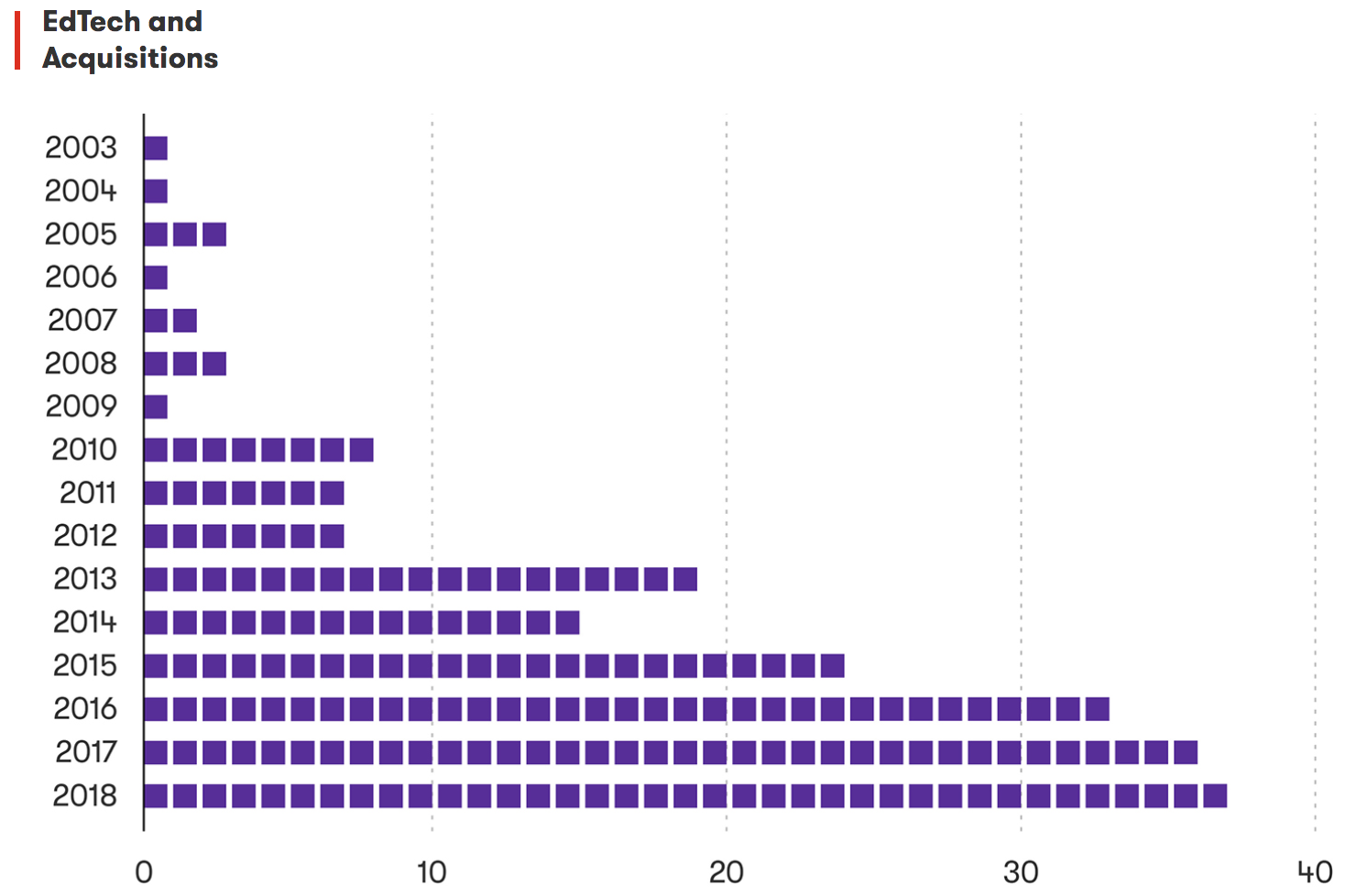
There have been approximately 225 acquisitions in edtech between 2003 and 2018, according to Crunchbase data. RS Components sent me a graph in March to contextualize this timeframe a bit more:

Edtech deals over time. Graph credit: RS Components.