Year: 2020

13 Aug 2020

Apple boots Fortnite from the App Store after Epic adds direct payments

After its creator Epic Games implemented a workaround to duck Apple’s hefty developer fees, Fortnite has vanished from the App Store. The popular game’s disappearing act came the same day that Epic added a new direct payment option for in-game currency on mobile, offering an enticing 20% discount for players who pay the company for its virtual V-Bucks rather handing that money to intermediaries Apple or Google.

“Currently, when using Apple and Google payment options, Apple and Google collect a 30% fee, and the up to 20% price drop does not apply,” Epic wrote in a blog post introducing the new option. “If Apple or Google lower their fees on payments in the future, Epic will pass along the savings to you.”

In a statement to TechCrunch, Apple confirms that it removed Fortnite for taking the “unfortunate step” of violating App Store rules:

“Epic enabled a feature in its app which was not reviewed or approved by Apple, and they did so with the express intent of violating the App Store guidelines regarding in-app payments that apply to every developer who sells digital goods or services.

“Epic has had apps on the App Store for a decade, and have benefited from the App Store ecosystem – including [its] tools, testing, and distribution that Apple provides to all developers. Epic agreed to the App Store terms and guidelines freely and we’re glad they’ve built such a successful business on the App Store. The fact that their business interests now lead them to push for a special arrangement does not change the fact that these guidelines create a level playing field for all developers and make the store safe for all users. We will make every effort to work with Epic to resolve these violations so they can return Fortnite to the App Store.”

Epic Games Founder and CEO Tim Sweeney has attacked Apple repeatedly in recent tweets over the cut it takes on the App Store, calling its decisions deliberately anti-competitive and declaring that Apple has “outlawed the metaverse.”

In making the decision to add direct payments, which it calls “permanent,” Epic was well aware that being removed from Apple’s marketplace was likely in the cards. In adding the payment system anyway, the hit game maker is planting a flag in the recent roiling controversy over Apple’s App Store fees. What happens next in a showdown between Apple and such a prominent software maker is anyone’s guess, but we’ll be following this story as it develops.

13 Aug 2020

Impossible Foods gobbles up another $200 million

Impossible Foods has raised $200 million more for its meat replacements.

The new round was led by Coatue, a technology-focused hedge fund, another New York-based hedge fund, XN, also participated in the round.

Since its launch the company has raised $1.5 billion from investors including Mirae Asset Global Investments, Temasek. The presence of these new public/private investment firms on Impossible Foods’ cap table could mean that the company is readying itself for an initial public offering, but that’s just speculation.

The company said it would use the funding to increase its research and development efforts and work on new products like pork, steak, and milk as well as expand its internationalization efforts and build out its manufacturing capacity.

“The use of animals to make food is the most destructive technology on Earth, a leading driver of climate change and the primary cause of a catastrophic global collapse of wildlife populations and biodiversity,” said the incredibly credentialed Dr. Patrick O. Brown, M.D., Ph.D., CEO and Founder of Impossible Foods, in a statement. “Impossible Foods’ mission is to replace that archaic system by making the most delicious, nutritious and sustainable meats in the world, directly from plants. To do that, Impossible Foods needs to sustain our exponential growth in production and sales, and invest significantly in R&D. Our investors believe in our mission to transform the global food system — and they recognize an extraordinary economic opportunity.”

13 Aug 2020

How to get what you want in a term sheet

One of the most exciting moments in the life of every newly christened founder is the sweet relief of seeing a term sheet come in from an investor. After weeks, perhaps months (but hopefully not years!), of work fundraising and pitching, there is nothing like getting that email with a PDF attached to it laying out the terms and conditions of the VC relationship going forward.

Of course, that rejoicing dampens quickly as all the specific nuances of the deal suddenly come to the forefront. It’s one thing to get the valuation you want, or the amount of capital you are seeking, but what about the setup of the board of directors? What should you do about deal terms that may shape your startup for a decade or more?

The reality of term sheets, as our guest Lior Zorea discusses, is that the terms you agree to early on at a startup tend to be the terms that will carry through for the life of the company. That means getting that first term sheet right is critical for ensuring the financial and capital success of your business.

13 Aug 2020

Instagram wasn’t deleting photos and direct messages off its servers

A security researcher was awarded a $6,000 bug bounty payout after he found Instagram retained photos and private direct messages on its servers long after he deleted them.

Independent security researcher Saugat Pokharel found that when he downloaded his data from Instagram, a feature it launched in 2018 to comply with new European data rules, his downloaded data contained photos and private messages with other users that he had previously deleted.

It’s not uncommon for companies to store freshly deleted data for a time until it can be properly scrubbed from its networks, systems and caches. Instagram said it takes about 90 days for deleted data to be fully erased from its systems.

But Pokharel found that his ostensibly deleted data from more than a year ago was still stored on Instagram’s servers, and could be downloaded using the company’s data download tool.

“Instagram didn’t delete my data even when I deleted them from my end,” he told TechCrunch.

Pokharel reported the bug in October 2019 through Instagram’s bug bounty program. The bug was fixed earlier this month, he said.

A spokesperson for Instagram told TechCrunch: “The researcher reported an issue where someone’s deleted Instagram images and messages would be included in a copy of their information if they used our Download Your Information tool on Instagram. We’ve fixed the issue and have seen no evidence of abuse. We thank the researcher for reporting this issue to us.”

It’s a near-identical issue that Twitter fixed last year, in which users could access long-deleted direct messages — including messages sent to and from suspended and deactivated accounts — using its own data download tool.

13 Aug 2020

Five success factors for behavioral health startups

Telehealth, or remote, tech-enabled healthcare, has existed for years in primary medical care through companies like Teladoc (NYSE: TDOC)Doctors on Demand and MDLIVE.

In recent years, the application of telehealth had rapidly expanded to address specific chronic and behavioral health issues like mental health, weight loss and nutrition, addiction, diabetes and hypertension, etc. These are real and oftentimes very severe issues faced by people all over the world, yet until now have seen little to no use of technology in providing care.

We believe behavioral health is particularly suited to benefit from the digitization trends COVID-19 has accelerated. Previously, we’ve written about the pandemic’s impact on online learning and education, both for K-12 students and adult learners. But behavioral health is another area impacted by the fundamental change in consumers’ behavior today. Below are four reasons we think the time is now for behavioral health startups — followed by five key factors we think characterize successful companies in this area.

Telehealth can significantly lower the cost of care

Traditional behavioral healthcare is cost-prohibitive for most people. In-person therapy costs $100+ per session in the U.S., and many mental health and substance-use providers don’t accept insurance because they don’t get paid enough by insurers.

By contrast, telehealth reduces overhead costs and scales more effectively. Leveraging technology, providers can treat more patients in less time with almost zero marginal costs. Mobile-based communications enable asynchronous care that further helps providers scale. Access to digital content gives patients on-going support without the need for a human on the other side. This is particularly useful in treating behavioral health issues where ongoing support and motivation may be necessary.

Technology unlocks supply in “shadow markets” of providers

Globally, we face an extreme shortage of behavioral health providers. For example, the United States has fewer than 30,000 licensed psychiatrists (translating to <1 for every 10,000 people). Outside of big cities, the problem gets worse: ~50-60% of nonmetro counties have no psychologists or psychiatrists at all.

Even when providers are available, wait times for appointments are notoriously long. This is a huge issue when behavioral health conditions often require timely intervention.

We are seeing new platforms build large networks of certified coaches, licensed psychologists and psychiatrists, and other providers, aggregating supply in what has historically been a scarce and a highly fragmented provider population.

Behavioral/mental health issues are losing their stigma

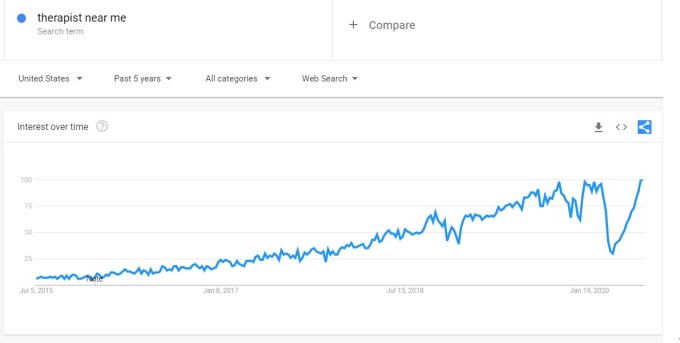
We believe the stigma associated with mental illness and other behavioral health conditions is dissipating. More and more public figures are speaking out about their struggle with anxiety, depression, addiction and other behavioral health issues. Our zeitgeist is shifting fast, and there’s an all-time high in people seeking help as the Google Trends data below demonstrates.

google trends search: "therapist near me," 2015- 2010

Image Credits: Google

Note: The anomalous dip in March/April ’20 was driven by mandatory shelter-in-place due to COVID-19.

Policy and regulations are changing quickly

13 Aug 2020

Starting with Michigan, Sidewalk Infrastructure is looking to build roads specifically for autonomous cars

Sidewalk Infrastructure Partners, which spun out of Alphabet’s Sidewalk Labs to fund and develop the next generation of infrastructure, has taken the covers off of its first big project — the launch of a subsidiary called Cavnue to develop roadways for connected and autonomous vehicles.

Starting in Michigan, Cavnue will be working with partners including Ford, GM, Argo AI, Arrival, BMW, Honda, Toyota, TuSimple and Waymo on standards to develop the physical and digital infrastructure needed to move connected and autonomous cars out of pilot projects and onto America’s highways, freeways, interstates, and city streets.

The starting point for Cavnue is a 40-mile corridor between downtown Detroit and Ann Arbor, Mich. that will be dedicated to autonomous vehicles. Ultimately, Cavnue envisions numerous corridors designed for autonomous shuttles and buses as well as trucks and personal vehicles.

Cavnue will be the master developer of the 40-mile roadway, Michigan Gov. Gretchen Whitmer said Thursday in a joint announcement with Sidewalk Infrastructure Partners.

“The action we’re taking today is good for our families, our businesses, and our economy as a whole. Here in Michigan, the state that put the world on wheels, we are taking the initial steps to build the infrastructure to help us test and deploy the cars of the future,” Whitmer said in a statement. “As we rebuild our roads to ensure every Michigander can drive to work and drop their kids at school safely, we will also continue working to build smart infrastructure to help prepare us for the roads of tomorrow.”

GettyImages 1124381926

Image via Getty Images / petovarga

The Detroit-to-Ann Arbor corridor will include communities along Michigan Avenue and Interstate 94 in Wayne County and Washtenaw County like the University of Michigan, the Detroit Metropolitan Airport and Michigan Central Station. The corridor will also include up to 12 “Opportunity Zones” where communities and small businesses will be able to connect to the industrial, technological and academic hubs of the region, according to the company’s statement.

For the first phase of the project, Cavnue will work with a slew of Michigan state agencies, including the Office of Future Mobility and Electrification and the Michigan Department of Transportation, on a feasibility and design study that is expected to last about two years.

Initial work during the project’s first phase will look at the commercial and technological viability of the roadway’s design. Connected buses and shared mobility vehicles like vans and shuttles will be the first users of the roadway before it is eventually expanded to other types of connected autonomous vehicles, including freight and personal vehicles, according to a statement from Cavnue.

Key partners

In 2018, Bill Ford envisioned a connected corridor similar to the one that Cavnue is proposing to build — envisioning the company’s Corktown innovation hub as an east end node in a circuit that would run along the Ann Arbor to Detroit corridor. Now Ford is a key partner in Cavnue’s project.

However, there are numerous others that Cavnue is also leaning on, including the University of Michigan with its CAV research center and Mcity Test Facility, Transportation Research Institute (UMTRI), and facilities along the proposed corridor as well as the testing facility American Center for Mobility.

“My vision for Michigan Central is to create an open mobility innovation district that solves tomorrow’s transportation challenges and improves mobility access for everyone,” said Ford, the executive chairman of his eponymous car company, in a statement. “Building out a connected corridor cements Michigan as a leader in creating a more connected, autonomous and electrified future. We thank the state for recognizing the community and economic benefits and the importance of creating smart infrastructure across southeast Michigan.”   
GettyImages 846875220

Image Credits: Andrey Suslov / Getty Images

Human error behind the wheel of cars is a leading cause of death around the country and in Michigan 10,000 people have died in fatal automobile crashes over the last decade. Companies like Cavnue’s partners including Ford, GM, Argo AI, Arrival, BMW, Honda, Toyota, TuSimple and Waymo, argue that connected and autonomous vehicles can reduce those fatalities while also cutting the hours commuters spend in traffic.

The sweeping nature of Cavnue’s mission is also an admission of sorts that the commercial deployment of autonomous vehicles is further away than this nascent industry initially thought. Born of a innovation event at Google’s headquarters, the seed for Cavnue comes from the realization that level five autonomy (the fully autonomous vehicles that require no human intervention) are still a concept for futurists, rather than a near-term opportunity.

To justify the billions of dollars of investment required to continue research and development around autonomy, companies need near-term applications. And those applications will require physical infrastructure to work.

For municipalities worried about congestion and the abandonment of light rail systems and other mass transit solutions in the age of COVID-19, these dedicated lanes may provide new sources of revenue for autonomous public transit and a way for companies to test their autonomous systems safely in the context of a much larger pilot project.

One thing that some of the planners envisioned was the use of autonomous shuttles as a replacement for light rail and the potential for a far more dynamic solution. Vehicles could be scaled up and down according to demand and shared routes could speed efficiency and reduce the time it takes to get to a destination, these planners said.

Financing could come from the manufacturers of autonomous systems who would get new testing grounds for their technology and eventually individuals who owned cars with advanced driving systems could pay for access to the lanes using the dead space between public transit vehicles.

Ostensibly, someone could pay $10 to access the road and then put their vehicle into autonomous mode. Public transit and private delivery fleets would be prioritized, and vehicles would have to demonstrate that it has autonomous capabilities to even access the roadways.

Autonomous Vehicle

Image Credit: Getty Images

The new service would depend on a new type of public private partnership based on outcomes that could be measured by the number of public fare rates the new lanes generate. Companies like Cavnue would source the vehicles and build the infrastructure. It would provide the capital expenditures for the roadway and retain the rights to sell access to the autonomous-enabled cars when use permits.

If it works in Michigan, some of the state’s congressional leadership intend to push for the expansion of the plan across the country.

“Michigan is at the forefront of this new frontier in mobility. Our state is home to a dense nexus of automakers, suppliers, engineers, universities and testing facilities that are pioneering advances in transportation that will transform how we get around,” said Michigan Senator Gary Peters. “This announcement is a major step forward towards ensuring Michigan continues to be the center of self-driving car research and development. I’m going to continue working at the federal level to develop a federal framework for the safe deployment of these revolutionary – and live-saving – technologies.”

Not everyone is convinced that the investment makes sense, though. 

“That’s an enormous investment in grey infrastructure. That’s a major infrastructure project,” said one infrastructure expert who declined to be identified because she was not authorized to speak about the project. “That’s something that you’re locking into. You’re locking into that design and locking in to that use case… The dedicated lanes are not something that’s being put forward by transportation advocates. I’ve only heard it from people who work with autonomous vehicles and have a vested interest in seeing their adoption.”


13 Aug 2020

Digital imaging pioneer Russell Kirsch dies at 91

Russell Kirsch, whose research going back to the ’50s underlies the entire field of digital imaging, died earlier this week at the age of 91. It’s hard to overstate the impact of his work, which led to the first digitally scanned photo and the creation of what we now think of as pixels.

Born to Russian and Hungarian immigrant parents in 1929, Kirsch attended NYU, Harvard, and MIT, eventually landing a job at the National Bureau of Standards (later the National Institutes of Science and Technology) that he would keep for the rest of his working life.

Although he researched, coded, and theorized for 50 years and even after his retirement, his most famous accomplishment is no doubt the first scanned digital image — decades before the first digital camera.

The research was being undertaken from the perspective that computers — then of course still room-sized things — could eventually simulate the human mind and perception. Of course, we’re still working on that, but one major step was simulating vision, which Kirsch accomplished in 1957.

An archival image of a computer scientist in 1957 working on the first scanned image.

Kirsch’s colleague R.B. Thomas uses the scanner. Image Credits: NIST

His research group used “a rotating drum and a photomultiplier to sense reflections from a small image mounted on the drum.” In lieu of grid-based sampling of the image a mask was placed on it pierced at intervals to create what amounted to pixels, though that term would not be used for years to come.

By measuring the reflectivity of the part of the image the machine could see and recording the result in a digital register (run by SEAC among the country’s first programmable computers), the system was effectively viewing the world — and by combining several scans at different settings they were able to store and show a grayscale image.

Touchingly, that image was of Kirsch’s three-month-old son Walden. It was 179 by 179 pixels originally and really doesn’t look bad more than 60 years later. Here’s a better version, a high-resolution image of how it would have been displayed:

Image Credits: NIST

This foundational work led directly to the creation of methods, algorithms, and storage techniques for digital images that would inform decades of computer science. Kirsch continued his work on early AI right up until retirement, and even then continued tinkering with his idea of adaptive pixels that would enable much clearer images at lower resolutions. The idea has merit, naturally, though memory and bandwidth aren’t quite the bottlenecks they once were.

Throughout his life Kirsch and his wife, who survives him with their children, were also travelers, climbers, and artists. No doubt his rich life contributed to his important work and vice versa.

Kirsch’s official obituary and guest book are here.

13 Aug 2020

Despite a difficult Q2 2020, Lyft and Uber reiterate profit promises

Lyft is sticking to its previous target to hit quarterly adjusted profitability by the fourth period of 2021, a milestone it says it can achieve even with fewer rides.

The company reiterated its quarterly adjusted profit target timeline — a milestone based on earnings before interest, taxes, depreciation and amortization — during its second-quarter earnings call yesterday. Upholding the target in this uncertain era of COVID-19 is newsworthy on its own. But what caught our attention was Lyft’s claim that it would hit this milestone even at a lower ridership than it had previously targeted.

“We now expect we can achieve adjusted EBITDA profitability with 20% to 25% fewer rides than what was assumed when we initially disclosed this last year,” Lyft CEO Logan Green said during the call.

Quarterly rides will need to be about 5% to 10% above the level achieved in the fourth quarter of 2019, according to CFO Brian Roberts. Lyft had 22.9 million rides in Q4 2019. That means Lyft needs to reach about 25 million rides a quarter to hit that target next year.

The COVID-19 pandemic crushed Lyft’s ridership in the second quarter of 2020, with total rides falling from 21.2 million in the first quarter of the year to about 8.6 million in the second quarter. But Lyft’s executive team said rides continued to recover from the doldrums of this spring and early summer. Ridership will need to continue to recover, but the company insists that measures it has taken will allow it to reach profitability.

13 Aug 2020

Six Toronto VCs discuss COVID-19 and the post-pandemic era

As North America’s fourth-largest city, Toronto is one of the world’s top startup ecosystems.

After spawning companies like Eventbrite and Crowdmark, Ontario’s capital has attracted international talent that complements its homegrown population of entrepreneurs and technical talent.

Six investors we surveyed who work and live in the area said they believe Toronto will continue to thrive after the COVID-19 storm passes. Some of them focus exclusively on the region, while others invest elsewhere as well. As they explained, the city has a lot going for it: It’s diverse, has access to locally trained engineering and business workers, and the area has already fostered many companies that are doing very well.

Investors expect Toronto to remain a fintech hub

Fintech is one of the city’s top industries, and the investors in this survey expect this to continue. Stephanie Choo, head of investments at Portag3 Ventures, said “fintech continues to see massive tailwinds from the fallout from COVID-19 as incumbents struggle to fully digitize their offerings.”

Ameet Shah of Golden Ventures listed fintech as one of Toronto’s key industries. Eva Lau of Two Small Fish Ventures agreed, adding that “blockchain has also been doing well because many blockchain-related technologies or companies were started in Toronto.”

Other investors point to fintech business leaders in Toronto like CEOs Mike Katchen of Wealthsimple, Daniel Eberhard of Koho, Andrew D’Souza and Michele Romanow of Clearbanc and Kirk Simpson of Wave Financial.

Diversity is one of Toronto’s strengths

Nearly all of the surveyed investors cited diversity as a key reason to live and work in Toronto. Probal Lala, chairman of Maple Leaf Angels, says, “Beyond having a vibrant technology ecosystem, Toronto has one of the most diverse communities in North America and is not only a great place to find the intellectual horsepower and funding to build a great global startup, but also the mosaic of social communities that makes it a great place to live and raise a family.”

Choo said the United States’ current battles over immigration could benefit Canada. “Small, nimble teams that need to move fast may still choose to co-locate in person — and many will still want access to amenities that only a large, vibrant and diverse city like Toronto can offer.”

She also pointed to Toronto’s claim of being one of the most diverse cities in the world. “[This] not only makes the city interesting but also very welcoming for those who relocate from elsewhere; a strong startup and tech scene, and, lastly, a vibrant cultural and food scene, especially through the lens of cost-of-living compared to comparable major cities.”

Shopify’s executives are key players in Toronto’s ecosystem

Several VCs listed Shopify executives as local leaders, while others acknowledged the growing unicorn’s impact. Ameet Shah of Golden Ventures says, “Toronto has traditionally been strong in fintech, B2B SaaS, crypto and AI. The explosion of Shopify should also benefit companies focused on e-commerce and supply chain solutions.”

Adam McNamara and Ameet Shah, when asked about local business leaders, both listed Satish Kanwar. Kanwar is GM and VP of Product at Shopify after the company purchased Jet Cooper, a startup co-founded by Kanwar. McNamara also points to Farhan Thawar, Shopify’s VP of Engineering, as a local leader.

Who we spoke to:

  • Probal Lala, chairman, Maple Leaf Angels Capital Corporation
  • Stephanie Choo, head of investments, Portag3 Ventures
  • Adam McNamara, founding partner, Ramen VC
  • Ameet Shah, partner, Golden Ventures
  • Matt Golden, founder and managing partner, mGolden Ventures
  • Eva Lau, founding partner, Two Small Fish Ventures

Probal Lala, Maple Leaf Angels Capital Corporation

How much is local investing even a focus for you now? If you are investing remotely in general now, are you filtering for local founders?

Prior to COVID-19 hitting, a requirement for the majority of my investments was a face-to-face visit with the founding team. For the most part, this meant founders spending time in Toronto. As we primarily invest in seed and pre-seed, this usually meant local founders.

When the pandemic hit, we shifted our process to primarily Zoom meetings (including due diligence) and as a result the mix of founding teams has expanded beyond our typical catchment area (two-hour drive from the city) to a broader base. Investment cycles appear to have slowed a bit due to the remote approach but our reach to founding teams has expanded to a broader base of geographically distributed founding teams (Mostly Canadian although we have recently seen a number of international opportunities).

13 Aug 2020

Mission Bio raises $70 million to help scale its tech for improving the development of targeted cancer therapies

California-based startup Mission Bio has raised a new $70 million Series C funding round, led by Novo Growth and including participating from Soleus Capital and existing investors Mayfield, Cota and Agilent. Mission Bio will use the funding to scale its Tapestri Platform, which uses the company’s work in single-cell multi-omics technology to help optimize clinical trials for targeted, precision cancer therapies.

Mission Bio’s single-cell multi-omics platform is unique in the therapeutic industry. What it allows is the ability to zero in on a single cell, observing both genotype (fully genetic) and phenotype (observable traits influenced by genetics and other factors) impact resulting from use of various therapies during clinical trials. Mission’s Tapestri can detect both DNA and protein changes within the same single cell, which is key in determining effectiveness of targeted therapies because it can help rule out the effect of other factors not under control when analyzing in bulk (ie. across groups of cells).

Founded in 2012 as a spin-out of research work conducted at UCSF, Mission Bio has raised a total of $120 million to date. The company’s tech has been used by a number of large pharmaceutical and therapeutic companies, including Agios, LabCorp and Onconova Therapeutics, as well as at cancer research centers including UCSF, Stanford and the Memorial Sloan Kettering Cancer Center.

In addition to helping with the optimization of clinical trials for treatments of blood cancers and tutors, Mission’s tech can be used to validate genome editing – a large potential market that could see a lot of growth over the next few years with the rise of CRISPR-based therapeutic applications.