Year: 2020

13 Aug 2020

Extra Crunch Live: Join Eric Hippeau for a live Q&A today at 11am PT/2pm ET

While you may have heard this phrase several hundred too many times this year, it remains true: These are unprecedented times.

At least a dozen industries are in a state of flux, and only time (a relatively short amount of time) will tell if they can evolve quickly enough to stay in the game. A few of those industries include media, direct-to-consumer retail, travel and hospitality. With the pace of change up dramatically, it can be difficult to make heads or tails of these respective markets and the broader tech startup landscape.

Luckily, Eric Hippeau, cofounder and managing partner at Lerer Hippeau, is uniquely positioned to answer our most pressing questions, particularly around these industries. We’re very pleased to share with you that Hippeau will be joining us today for an episode of Extra Crunch Live. Extra Crunch members can catch the episode live, and ask their own questions directly to Hippeau, at 11am PT/2pm ET/6pm GMT.

Eric Hippeau served as CEO for the Huffington Post before co-founding Lerer Hippeau . He also served as chairman and CEO at Ziff-Davis, a former top publisher of computer magazines. He sits on the boards of BuzzFeed and Marriott International.

Lerer Hippeau portfolio companies include Axios, BuzzFeed, Genius, Chartbeat and Giphy. And while the firm has experience in media, that doesn’t mean the portfolio is squarely focused on it. Other portfolio companies include Casper, WayUp, Warby Parker, Mirror, HungryRoot, Glossier, Everlane, Brit + Co. and AllBirds, to name just a few.

We’ll chat with Hippeau about the rapidly changing media landscape, how direct-to-consumer companies can survive (and in some cases, capitalize) on the new world ushered in by the coronavirus, and get some pointers on how to pitch Lerer Hippeau for investment.

I’m also curious about Lerer Hippeau’s investment in startup studios (Betaworks and Expa) and to learn which sectors seem most attractive to the firm going into the back half of 2020.

As previously mentioned, Extra Crunch members can ask their own questions during the chat. If you’re not yet an Extra Crunch member, you can sign up right here.

We’re amped to have Hippeau join us and we hope you will, too!

Details:

13 Aug 2020

Omaze raises $30M after expanding beyond celebrity campaigns

Omaze, the startup became famous for its celebrity-centric fundraisers, is announcing that it has raised $30 million in Series B funding.

Some of the company’s best-known campaigns include opportunities to meet Michelle Obama, meet Star Wars cast members and visit the set of “Star Trek Beyond.” (I’ll admit that I thew my hat in the ring for that last one.) But co-founder and CEO Matt Pohlson said that in recent years, the Omaze model has shifted away from “talent campaigns” to include fundraisers offering prizes like an Airstream Caravel or a trip to the Four Seasons resort in Bora Bora.

Pohlson said that he became interested in this model after a campaign combining a chance to meet Daniel Craig and win an Aston Martin, which made him wonder whether the Aston Martin would be a big enough draw on its own. Shortly after that, in 2018, he had a near-death experience during surgery, which he said only strengthened his conviction to move the company in a new direction.

Pohlson recalled the surgeon telling him that he’d flat-lined for four-and-a-half minutes, with extremely low chances for survival, and that he only pulled through because of the “love and optimism” coming from the family members in the room with him.

“Because of the one-in-2-million chance I’m getting, I want to put as much of that out in the world as I can,” he said. “The way we do that is through the money we raise and the optimism we spread. Doing that with talent limits the scalability.”

Plus, by organizing its own campaigns, the Omaze team gets to “pick the causes we’re passionate about,” rather than being limited to the causes that celebrities want to support.

At the same time, Pohlson hastened to add that Omaze would never have been able to move in this direction without the help of stars to attract a big user base, and he said the company continues to pursue talent campaigns as well — they’re just one part of a larger strategy.

With COVID-19, the company had to delay some of its prizes. After all, celebrity meetings and elaborate vacation getaways don’t make a lot of sense right now, but Pohlson said, “People get it.” And overall, he said the pandemic has actually increased interest, giving people “a deeper desire to give back” while also making them “want to dream more than ever.”

The performance of the average Omaze campaign has quadrupled over the past 18 months, Pohlson said, while revenue has increased by 500%.

Omaze previously raised $12 million in Series A funding. The new round was led by FirstMark Capital, with participation from Causeway Media Partners, BDMI, Tusk Ventures, Inherent Group, Gaingels, Penni Thow’s Copper and Guy Oseary. Thow and Celtics owner Wyc Grousbeck are joining the company’s board of directors.

“Omaze is unmatched in their ability to empower world-changing charities as a leader in experiencial giving and social impact,” Thow said in a statement. “As a new member of the Omaze board, I couldn’t be more excited to support their growth as they continue to scale new categories and expand further internationally.”

More about those growth plans: Pohlson said that while Omaze’s expansion started with cars, it recently launched luxury home campaigns. It will use the new funding to expand those campaigns while also adding new campaign categories. He also noted that the company recently launched in the United Kingdom, with plans to expand into Western Europe and Asia.

And although Omaze has already raised more $130 million for charity, Pohlson said that one of his big goals is to make it the first for-profit company to donate $1 billion.

“We want to pave the way for other social entrepreneurs,” he said. “There seems to have this false choice between being able to do good in the world and also having a lot of economic opportunity. Our culture has trouble with people being rewarded for doing good. [At Omaze,] we think that holds back people from doing good.”

13 Aug 2020

The Wear OS fall update promises better performance, simplified pairing and more

Google today announced a few new features Wear OS we can expect from the next over-the-air update, which is slated to arrive this fall.

The focus here, Google says, is on fundamentals and that includes improved performance, for example, with up to 20% speed improvements for app startup times, for example.

The company also said it would improve the pairing process and that we’ll see UI improvements with “more intuitive controls for managing different watch modes and workouts.” What exactly that will look like isn’t clear, though, as Google didn’t provide any details of the changes.

Image Credits: Google

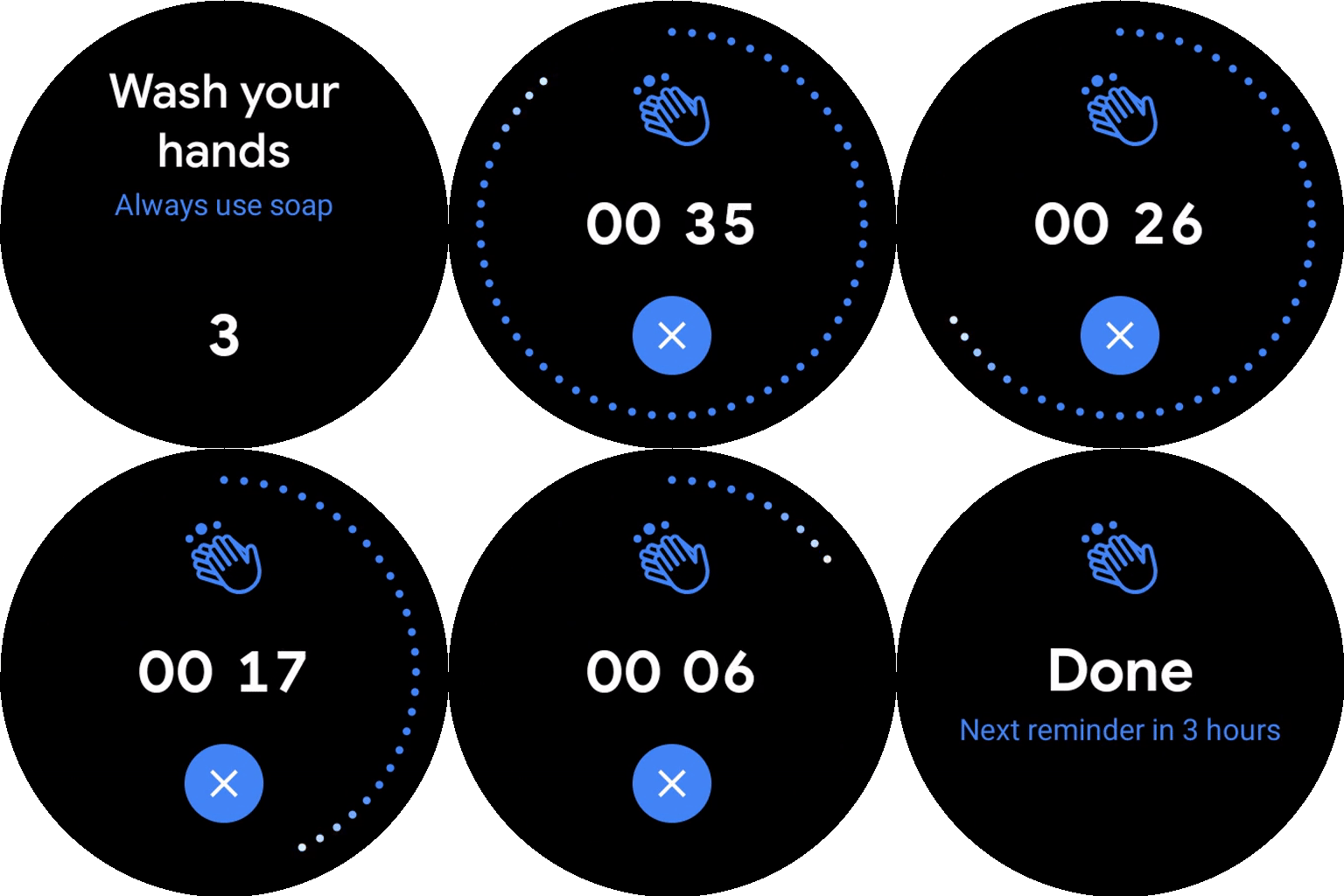
One feature that Google talked about though is a new handwashing timer it is releasing in response to the COVID-19 pandemic. Unlike Apple’s automatic handwashing timer in watchOS, Google’s feature is not hands free and you have to tap a dedicated tile to trigger it, which sadly makes it less likely that users will actually regularly use it (but you’re already singing Happy Birthday twice while you’re washing your hands anyway, right?).

Wear OS is also getting a new weather experience that will be easier to read on the go, provide an hourly forecast and access to local weather alerts.

Image Credits: Google

The Wear OS team notes that it also plans to bring “the best of Android 11” to wearables. For developers, that mostly means being able to use the latest Android developer tools to build their Wear OS apps. What exactly it means for users also remains to be seen.

While we’re still waiting for Google to release its own watch, the company today noted that a number of new watch OEMs have recently signed on Wear OS, including Oppo, Suunto and Xiaomi.

13 Aug 2020

Apple said to soon offer subscription bundles combining multiple of its services

Apple is reportedly getting ready to launch new bundles of its various subscription services, according to Bloomberg. The bundled services packages, said to be potentially called ‘Apple One,’ will include Apple services including Apple Music, Apple Arcade, Apple TV+, Apple News+ and iCloud in a number of different tiered offerings, all for one fee lower that would be lower than subscribing to each individually.

Bloomberg says that these could launch as early as October, which is when the new iPhone is said to be coming to market. Different package options will include one entry-level offering with Apple Music and Apple TV+, alongside an upgrade option that adds Apple Arcade, and other that also includes Apple News+. A higher-priced option will also bundle in extra iCloud storage, according to the report, though Bloomberg also claims that these arrangements and plans could still change prior to launch.

While the final pricing isn’t included in the report, it does say that the aim is to save subscribers between $2 and $5 per month depending on the tier, vs. the standard cost of subscribing to those services currently. All subscriptions would also work with Apple’s existing Family Sharing system, meaning up to six members of a single household can have access through Apple’s existing shared family digital goods infrastructure.

Apple is also said to be planning to continue its strategy of bundling free subscriptions to its services with new hardware purchases – a tactic it used last year with the introduction of Apple TV+, which it offered free for a year to customers who bought recently-released Apple hardware.

Service subscription bundling is move that a lot of Apple observers have been calling for basically ever since Apple started investing more seriously in its service options. The strategy makes a lot of sense, especially in terms of helping Apple boost adoption of its services which aren’t necessarily as popular as some of the others. It also provides a way for the company to begin to build out a more comprehensive and potentially stable recurring revenue business similar to something like Amazon Prime, which is a regular standout success story for Amazon in terms of its fiscal performance.

13 Aug 2020

Apple said to soon offer subscription bundles combining multiple of its services

Apple is reportedly getting ready to launch new bundles of its various subscription services, according to Bloomberg. The bundled services packages, said to be potentially called ‘Apple One,’ will include Apple services including Apple Music, Apple Arcade, Apple TV+, Apple News+ and iCloud in a number of different tiered offerings, all for one fee lower that would be lower than subscribing to each individually.

Bloomberg says that these could launch as early as October, which is when the new iPhone is said to be coming to market. Different package options will include one entry-level offering with Apple Music and Apple TV+, alongside an upgrade option that adds Apple Arcade, and other that also includes Apple News+. A higher-priced option will also bundle in extra iCloud storage, according to the report, though Bloomberg also claims that these arrangements and plans could still change prior to launch.

While the final pricing isn’t included in the report, it does say that the aim is to save subscribers between $2 and $5 per month depending on the tier, vs. the standard cost of subscribing to those services currently. All subscriptions would also work with Apple’s existing Family Sharing system, meaning up to six members of a single household can have access through Apple’s existing shared family digital goods infrastructure.

Apple is also said to be planning to continue its strategy of bundling free subscriptions to its services with new hardware purchases – a tactic it used last year with the introduction of Apple TV+, which it offered free for a year to customers who bought recently-released Apple hardware.

Service subscription bundling is move that a lot of Apple observers have been calling for basically ever since Apple started investing more seriously in its service options. The strategy makes a lot of sense, especially in terms of helping Apple boost adoption of its services which aren’t necessarily as popular as some of the others. It also provides a way for the company to begin to build out a more comprehensive and potentially stable recurring revenue business similar to something like Amazon Prime, which is a regular standout success story for Amazon in terms of its fiscal performance.

13 Aug 2020

TikTok rival Likee reaches 150M monthly users worldwide

As TikTok’s fate remains in flux, its smaller rival Likee has been making waves around the world, garnering 150 million monthly active users as of this June.

That’s according to the earnings report of Chinese internet company Joyy, the owner of Likee. For comparison, TikTok recorded about 200 million daily active users in early 2020, an investor with knowledge told TechCrunch. That means its MAU will be much bigger, and TikTok has seen explosive growth since the COVID-19 outbreak that kept people home. Even as a potential ban and forced sale loom in the U.S., TikTok’s growth has only slid slightly.

Likee has something different to offer, as it allows influencers to easily make money from virtual gifts they receive from fans, The Ken acutely observed (paywalled). TikTok, on the other hand, prioritizes content consumers.

“I do think creators want to be paid and monetization helps,” Adam Blacker, a vice president at app analytics firm Apptopia, told TechCrunch.

Like TikTok, Likee is not immune from scrutiny over apps with Chinese roots. India was Likee’s biggest market before the app was banned from the country alongside TikTok and dozens of other Chinese-owned apps. Likee’s sister app Bigo Live also got shut down by the Indian government.

In its second-largest market, the U.S., Likee is one of TikTok’s fastest-growing rivals. From early July to early August, Likee accumulated 7.25 million downloads, dwarfing Hollywood-backed Triller, TikTok’s old rival Dubsmash and Vine’s sequel Byte, Apptopia found.

Joyy, a Nasdaq-listed company, remains little-known outside its home market. Founded back in 2005, Joyy popularized the phenomenon of virtual gifting in livestreaming through its flagship site YY. Audiences can gift influencers virtual ‘flowers’ and the likes, which they can then convert into cash. YY’s monetization model was so successful that it spawned livestreaming rivals of all sorts. When the market saturated, Joyy turned overseas.

In 2016, Joyy’s founder and chief executive officer Li Xueling started Bigo in Singapore as a separate entity so it would not be subject to the same investor pressure as a public company. Livestreaming app Bigo Live debuted in hope of replicating YY’s success, and when short videos became all the rage, Bigo rolled out Likee. Between June 2019 and June 2020, Likee gained 70 million MAUs around the world.

As of June, Joyy as a whole reached 457 million mobile MAUs, with as many as 91% of them coming from non-China markets. As Bigo became a revenue generator, Joyy consolidated it into the balance sheet after a full acquisition last year.

Bigo’s healthy overseas growth should spell confidence for Joyy. But when Li was asked by local media whether he wanted to fight with TikTok for dominance, he said his company “won’t be able to beat it.” He went on to humbly remark that Zhang Yiming, the founder of TikTok parent ByteDance, “is the most far-sighted person I’ve ever seen.”

13 Aug 2020

TikTok rival Likee reaches 150M monthly users worldwide

As TikTok’s fate remains in flux, its smaller rival Likee has been making waves around the world, garnering 150 million monthly active users as of this June.

That’s according to the earnings report of Chinese internet company Joyy, the owner of Likee. For comparison, TikTok recorded about 200 million daily active users in early 2020, an investor with knowledge told TechCrunch. That means its MAU will be much bigger, and TikTok has seen explosive growth since the COVID-19 outbreak that kept people home. Even as a potential ban and forced sale loom in the U.S., TikTok’s growth has only slid slightly.

Likee has something different to offer, as it allows influencers to easily make money from virtual gifts they receive from fans, The Ken acutely observed (paywalled). TikTok, on the other hand, prioritizes content consumers.

“I do think creators want to be paid and monetization helps,” Adam Blacker, a vice president at app analytics firm Apptopia, told TechCrunch.

Like TikTok, Likee is not immune from scrutiny over apps with Chinese roots. India was Likee’s biggest market before the app was banned from the country alongside TikTok and dozens of other Chinese-owned apps. Likee’s sister app Bigo Live also got shut down by the Indian government.

In its second-largest market, the U.S., Likee is one of TikTok’s fastest-growing rivals. From early July to early August, Likee accumulated 7.25 million downloads, dwarfing Hollywood-backed Triller, TikTok’s old rival Dubsmash and Vine’s sequel Byte, Apptopia found.

Joyy, a Nasdaq-listed company, remains little-known outside its home market. Founded back in 2005, Joyy popularized the phenomenon of virtual gifting in livestreaming through its flagship site YY. Audiences can gift influencers virtual ‘flowers’ and the likes, which they can then convert into cash. YY’s monetization model was so successful that it spawned livestreaming rivals of all sorts. When the market saturated, Joyy turned overseas.

In 2016, Joyy’s founder and chief executive officer Li Xueling started Bigo in Singapore as a separate entity so it would not be subject to the same investor pressure as a public company. Livestreaming app Bigo Live debuted in hope of replicating YY’s success, and when short videos became all the rage, Bigo rolled out Likee. Between June 2019 and June 2020, Likee gained 70 million MAUs around the world.

As of June, Joyy as a whole reached 457 million mobile MAUs, with as many as 91% of them coming from non-China markets. As Bigo became a revenue generator, Joyy consolidated it into the balance sheet after a full acquisition last year.

Bigo’s healthy overseas growth should spell confidence for Joyy. But when Li was asked by local media whether he wanted to fight with TikTok for dominance, he said his company “won’t be able to beat it.” He went on to humbly remark that Zhang Yiming, the founder of TikTok parent ByteDance, “is the most far-sighted person I’ve ever seen.”

13 Aug 2020

Bracing for election day, Facebook rolls out voting resources to U.S. users

Eager to avoid a repeat of its disastrous role as a super-spreader of misinformation during the 2016 election cycle, Facebook is getting its ducks in a row.

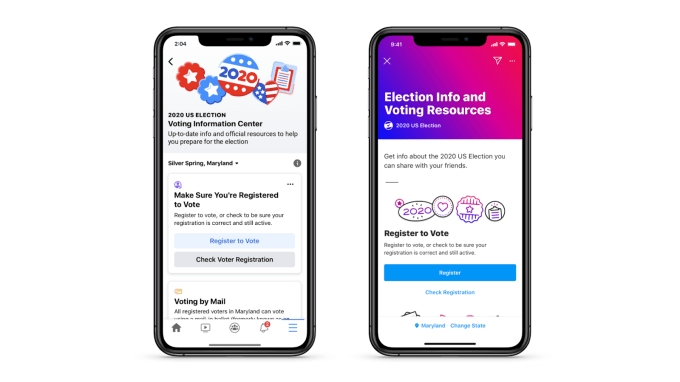
Following an announcement earlier this summer, the company is now launching a voting information hub that will centralize election resources for U.S. users and ideally inoculate at least some of them against the platform’s ongoing misinformation epidemic.

The voting information center will appear in the menu on both Facebook and Instagram. As part of the same effort, Facebook will also target U.S. users with notifications based on location and age, displaying relevant information about voting in their state. The info center will help users check their state-specific vote-by-mail options, request mail-in ballots and provide voting-related deadlines.

Facebook election information center

Facebook is also expanding the labels it uses to attach verified election resources to posts by political figures. The labels will now appear on voting-related posts from all users across its main platform and Instagram, a way for the platform to avoid taking actions against specific political figures while still directing its users toward verified information about U.S. elections.

Along with other facets of its pre-election push, Facebook will roll previously-announced “voting alerts,” a feature that will allow state election officials to communicate election-related updates to users through the platform. “This will be increasingly critical as we get closer to the election, with potential late-breaking changes to the voting process that could impact voters,” Facebook Vice President of Product Management and Social Impact Naomi Gleit wrote in a blog post about the feature. According to the company, voting alerts will only be available to government accounts and not personal pages belonging to state or local election administrators.

The company cites the complexity of conducting state elections in the midst of the pandemic in its decision to launch the info center, which is also modeled after the COVID-19 info center that it created in the early days of the crisis. While the COVID-19 info hub initially appeared at the top of users’ Facebook feeds, it’s now only surfaced in searches related to the virus.

Election night nightmare

Uncomfortable as it is with the idea, Facebook seems to be aware that it could very well become the “arbiter of truth” on election night. With 2020’s unprecedented circumstances leading to a record number of ballots cast through the mail, it’s possible that the election’s outcome could be delayed or otherwise confusing. Without clear cut results, conspiracy theories, opportunism and other forms of misinformation are likely to explode on social platforms — a nightmare scenario that social networks seem to be preemptively dreading.

“A prolonged ballot process has the potential to be exploited in order to sow distrust in the election outcome,” Gleit wrote in Facebook’s post detailing the election tools.

The company was one of nine tech companies that met with federal officials on Wednesday to discuss how they will handle concerns around misinformation on the platforms around election day.

The group of companies now includes Facebook, Google, Reddit, Twitter, Microsoft, Pinterest, Verizon Media, Linkedin and the Wikimedia Foundation. Some of the group’s members had met previously to discuss efforts ahead of U.S. elections, but the expanded coalition of companies formally working with federal officials to prepare for the U.S. election appears to be new.

13 Aug 2020

Tune in tomorrow and watch five startups compete at Pitchers & Pitches

Ever hear the expression, “every master was once a disaster?” Now apply that to developing a well-crafted pitch. It takes practice and honest feedback to make a masterful pitch, and that’s exactly what you’ll get when you participate in our next Pitchers & Pitches. It’s 50 percent competition, 50 percent masterclass and 100 percent free.

Join us tomorrow, August 13, at 4 p.m. ET / 1 p.m. PT as five randomly chosen Digital Startup Alley exhibitors present their rapid-fire pitches to a panel of TC editors and expert VCs. (take a peek at this session’s competitors and judges below).

Get ready to take notes, ask questions — this is an interactive educational event — and apply what you learn to pump up your own 60-second pitch. Here’s another reason to pay close attention to the live pitches; the viewing audience decides which founder throws the best pitch. It’s a competition after all, with a prize and everything.

And it’s a pretty awesome prize if we do say so ourselves. The winner walks away with a consulting session with cela, a company that connects early-stage startups to accelerators and incubators that can help scale their businesses.

Anyone can attend Pitchers & Pitches — and learn valuable tips in the process — but only companies exhibiting in Digital Startup Alley at Disrupt 2020 can compete. If you’d like a shot at competing in our next Pitchers & Pitches event on September 2, purchase a Disrupt Digital Startup Alley Package. You’ll be ready to exhibit and pitch your startup genius to thousands of disrupt attendees from around the world.

Attending Pitchers & Pitches also gives you time to check out the new virtual Disrupt platform before it goes live in September, meet and video network with other P&P attendees and connect with the five pitching founders in their virtual booth in the startup expo.

It’s time to name names — judges are standing by to give their best feedback for this session. The panel consists of two TechCrunch editors — Zack Whittaker and Natasha Mascarhenas and two leading VCs — Sydney Thomas and Curtis Rodgers. When it comes to pitches, this group’s heard ‘em all — the good, the bad and the ugly. Follow their advice and you might just make it into the first category.

And here are the five startups ready to wring every advantage out of tomorrow’s competition.

Myneral Labs

Centrly

Primeclass

CarpeMed

Cirtru

Register here for the next Pitchers & Pitches — tomorrow, August 13 at 4 p.m. ET / 1 p.m. PT. Learn to master your pitch and get ready to make the most of all the opportunities you’ll find at Disrupt 2020.

Is your company interested in sponsoring or exhibiting at Disrupt 2020? Contact our sponsorship sales team by filling out this form.

13 Aug 2020

Stream, whose APIs help product teams build chat and activity feeds fast, just raised a $15 million Series A round

Earlier this year, the founders of Stream,  a five-year-old, 60-person startup with offices in Boulder and Amsterdam, weren’t feeling so great about their prospects. As COVID-19 began its spread in the U.S., some smaller customers of the startup — whose APIs enable product teams to build chat and activity feeds for their applications — began to fold.

“It was really scary when [the virus] initially hit, because a lot of our smaller customers went out of business, which made us worry about what would happen to the larger ones,” recalls Thierry Schellenbach, who started Stream with Tommaso Barbugli, the lead engineer at his last startup.

“One [larger customer] did go bankrupt, which impacted our numbers.” But then a strange thing happened, he says. Companies in education and healthcare and online events and even religious communities began beefing up their online operations, and turning in part to Stream to do it.

Schellenbach understood the impulse  He and Barbugli created Stream to address a pain they felt firsthand at Schellenbach’s first company out of college — a social network that was ultimately acquired for a modest sum by a private equity firm in the Netherlands, says Schellenbach. Though it grew to “millions of users,” he says, its activity feed was routinely failing as the network scaled, given its many moving partners involved, and it took a “ton of engineering resources to keep it working well.” The two knew the world needed more off-the-shelf software and specifically software focused on activity feeds, so they began building it themselves.

But that’s not the only reason the company is gaining traction. Schellenbach attributes Stream’s resiliency in the pandemic to a decision 10 months ago to also begin developing a chat API (after seeing customers trying to build their own atop their activity feeds). Now, not only are schools like Harvard, social media companies like Dubsmash, and the health information site Healthline customers nowbut investors are beginning to take more notice.

Indeed, today the company is announcing it has closed a $15 million Series A round that was led by GGV Capital and included 01 Advisors, Knight, seed round lead investor Arthur Ventures, and other backers, including Datadog CEO Olivier Pomel and GitHub cofounder Tom Preston-Werner. The round brings the company’s total funding to $20.25 million.

It was also raised from many individuals who Schellenbach (based in Boulder), and Barbugli (based in Amsterdam), have never met in person, including the GGV team.

Schellenbach credits GGV for not hewing too closely to old models during these socially distanced days, as did “three or four” VCs with whom he’d spoken and who said he’d have to meet them in San Francisco in order to make a deal happen.

He also credits Stream’s fundraising success to the accelerator program TechStars, which Stream entered when it was just two months old back in 2015. As he explains, his first startup — that social network — was based in the Netherlands, and launching Stream, he and Barbuglihad “no VC connections. So TechStars was important to open up the fundraising side of things.”

Those references have only bred more references — and now, more than ever — it makes a difference, he observes. “We’re lucky,” he says. Stream was introduced to GGV. GGV then introduced the team to Dick Costolo of 01 Advisors.

Meanwhile, for “companies trying to raise a seed round, if you don’t have clear references, right now, it’s tough.”

Photo of Schellenbach and  Barbugli, circa 2015, courtesy of Stream.