Year: 2020

08 Aug 2020

Share Ventures, an LA-based studio for company creation, is MoviePass co-founder Hamet Watt’s next act

Nearly eight years ago, Hamet Watt and Stacy Spikes launched MoviePass, the subscription-based movie ticketing service that captured the minds and dollars of investors and brought thousands of cinephiles a too-good-to-be-true deal for all-you-can watch movie passes.

Watt, who came to MoviePass as an entrepreneur in residence at True Ventures, previously founded the brand and product placement startup NextMedium and also spent time as a board partner at Upfront Ventures. Now, the serial entrepreneur and startup investor is combining his two career paths under the auspices of Share Ventures.

“It’s what I feel like I’ve been put here to do,” says Watt. “I love solving problems with design and entrepreneurship. I wasn’t fully scratching the itch as an investor by itself.”

With $10 million in financing from a slew of investors including Upfront Ventures, Alpha Edison, the general partners and founders of True Ventures, and a Korean family office, Share Ventures will look to launch between two and four companies per year.

Watt says that the new studio will focus on what he calls “human performance”. The businesses will use a blend of technology and human interaction to create services targeting fitness, nutrition, and mental health, according to Watt.

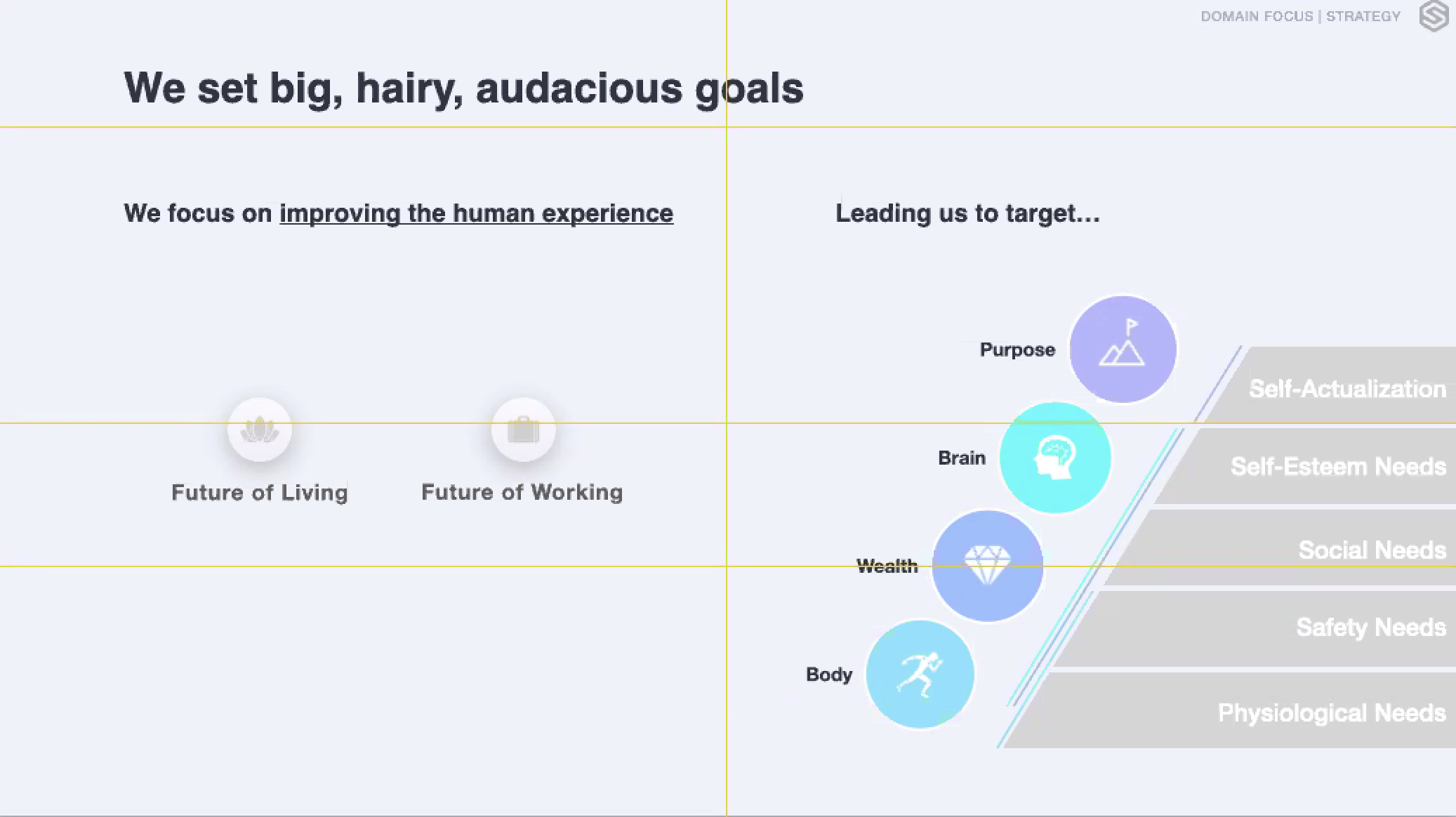
Share Ventures’ initial focus will be on two main areas, the future of living and the future of working. Within those two areas, the company will focus on developing businesses that enable the development of individual purpose, mental and physical enhancement, and personal and professional growth, according to Watt. And

Image Credit: Share Ventures

For Watt, the studio model represents the next iteration of startup investing. “We think the studio is going to lead the way,” he says.

Rather than invest in companies and management teams that are unknown quantities, Watt thinks the studio will be able to create discrete companies much faster in the same way that companies today iterate on new products and services.

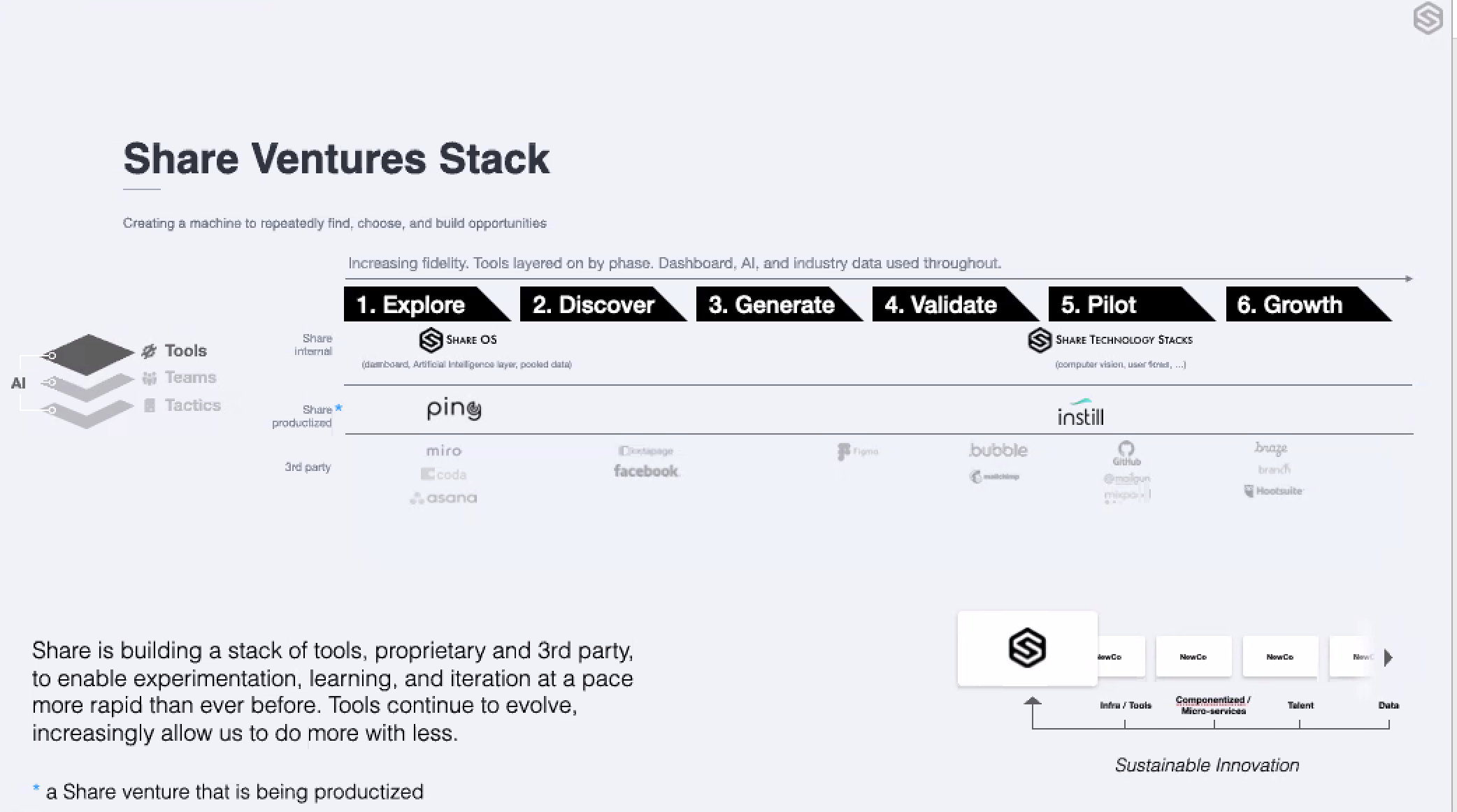
“We have aggregated tools into a company building stack,” says Watt. “These are tools that are usable that third parties have developed and internal tool stacks.”

Image Credit: Share Ventures

Watt says Share Ventures will operate as a holding company with pooled equity shared across the employees at the company. “As we work on portfolio companies and build out dedicated teams, there’s a generous pool to incentivize talent.”

In some ways, the model isn’t that different from Bill Gross’ idealab, the Pasadena, Calif.-based incubator company that’s a few miles up the road from Share Ventures Los Angeles home base. Another inspiration is @Ventures, the dot-com era company that built a number of different portfolio companies. “Our investors are getting founders takes in all the companies that we build,” Watt says.

The company has ten people on staff to help build its first slate of companies.

Watt began talking to investors in 2018 about the idea and spent the bulk of 2019 trying to build out its first few companies.

We run a lot of experiments, we generate a lot of ideas,” Watt says. “The number of shots on goal that we’re taking before we launch a company is significant.”

08 Aug 2020

How I accidentally gatecrashed a startup’s morning meeting

There’s a certain kind of panic that at some point gets us all.

You just got to work but did you leave the oven on at home? The gut-punch “call me ASAP” message from your boss but now they’re not answering their phone. Or that moment you unexpectedly see your camera light flash on your computer and you realize you’re suddenly in a video call with a ton of people you don’t know.

Yes, that last one was me. In my defense it was only slightly my fault.

I got a tip about a new security startup, with fresh funding and an idea that caught my interest. I didn’t have much to go on, so I did what any curious reporter did and started digging around. The startup’s website was splashy, but largely word salad. I couldn’t find basic answers to my simple questions. But the company’s idea still seemed smart. I just wanted to know how the company actually worked.

So I poked the website a little harder.

Reporters use a ton of tools to collect information, monitor changes in websites, check if someone opened their email for comment, and to navigate vast pools of public data. These tools aren’t special, reserved only for card-carrying members of the press, but rather open to anyone who wants to find and report information. One tool I use frequently on the security beat lists all the subdomains on a company’s website. These subdomains are public but deliberately hidden from view, yet you can often find things that you wouldn’t from the website itself.

Bingo! I immediately found the company’s pitch deck. Another subdomain had a ton of documentation on how its product works. A bunch of subdomains didn’t load, and a couple were blocked off for employees only. (It’s also a line in the legal sand. If it’s not public and you’re not allowed in, you’re not allowed to knock down the door.)

I clicked on another subdomain. A page flashed open, an icon in my Mac dock briefly bounced, and the camera light flashed on. Before I could register what was happening, I had joined what appeared to be the company’s morning meeting.

The only saving grace was my webcam cover, a proprietary home-made double layer of masking tape that blocked what looked like half a dozen people from staring back at me and my unkempt, pandemic-driven appearance.

I didn’t stick around to explain myself, but quickly emailed the company to warn of the security lapse. The company had hardcoded their Zoom meeting rooms to a number of subdomains on their company’s website. Anyone who knew the easy-to-guess subdomain — trust me, you could guess it — would immediately launch into one of the company’s standing Zoom meetings. No password required.

By the end of the day, the company had pulled the subdomains offline.

Zoom has seen its share of security issues and forced to change default settings to prevent abuse, largely driven by greater scrutiny of the platform as its usage rocketed since the start of the coronavirus pandemic.

But this wasn’t on Zoom, not this time. This was a company that connected an entirely unprotected Zoom meeting room to a conveniently memorable web address, likely for convenience, but one that could have left lurkers and eavesdroppers in the company’s meetings.

It’s not much to ask to password-protect your Zoom meetings, because next time it probably won’t be me.

07 Aug 2020

Daily Crunch: Trump bans transactions with ByteDance and Tencent

Trump escalates his campaign against Chinese tech companies, Facebook extends work from home until the middle of 2021 and Netflix adds support for Hindi. Here’s your Daily Crunch for August 7, 2020.

The big story: Trump signs orders banning US business with TikTok owner ByteDance and Tencent’s WeChat

Both orders will take effect in 45 days, but its specific impact is unclear since Secretary of Commerce Wilbur Ross will apparently not identify what transactions are covered until then.

This comes after Trump had already said that he was banning TikTok unless the app is sold to an American owner. (Specifically Microsoft, which has acknowledged that it’s in acquisition talks.)

TikTok hit back against the order by saying that it was “issued without any due process” and would risk “undermining global businesses’ trust in the United States’ commitment to the rule of law.”

The tech giants

Facebook extends coronavirus work from home policy until July 2021 — Facebook has joined Google in saying it will allow employees to work from home until the middle of next year as a result of the coronavirus pandemic.

Netflix’s latest effort to make inroads in India: Support for Hindi — Netflix has rolled out support for Hindi, a language spoken by nearly half a billion people in India.

Judge says Uber, Lyft preliminary injunction ruling to come in ‘a matter of days’ — Lyft argued that reclassifying drivers as employees would cause irreparable harm.

Startups, funding and venture capital

The rules of VC are being broken — The latest episode of Equity discusses “rolling funds” and how they could change the VC landscape.

Mashroom raises £4M for its ‘end-to-end’ lettings and property management service — The startup pitches itself as going “beyond the tenant-finding service” to include the entire rental journey.

Wendell Brooks has resigned as president of Intel Capital — Anthony Lin, who has been leading mergers and acquisitions and international investing, will take over on an interim basis.

Advice and analysis from Extra Crunch

How to pick the right Series A investors — It’s important for founders to get to know the people coming onto their board, and Jake Saper of Emergence Capital has some thoughts on how to do that.

IoT and data science will boost foodtech in the post-pandemic era — Three “must-dos” for post-pandemic retail grocers: rely on the data, rely on the biology and rely on the hardware.

Survey: Tell us what you think of Extra Crunch — Like Extra Crunch? Don’t like Extra Crunch? Tell us why!

(Reminder: Extra Crunch is our subscription membership program, which aims to democratize information about startups. You can sign up here.)

Everything else

Civic tech platform Mobilize launches a census hub for the 2020 count’s critical final stretch —The new site, GetOutTheCount.com, will amplify nonprofits’ census efforts and collect them in one place.

Federal judge approves ending consent decrees that prevented movie studios from owning theaters — U.S. District Court Judge Analisa Torres cited the rise of streaming services like Netflix as one of the reasons for her decision.

The Daily Crunch is TechCrunch’s roundup of our biggest and most important stories. If you’d like to get this delivered to your inbox every day at around 3pm Pacific, you can subscribe here.

07 Aug 2020

Extra Crunch members get 20% off an annual Canva Pro plan

Extra Crunch is excited to announce an update to our Partner Perk from design and publishing platform Canva. Starting today, annual and two-year members of Extra Crunch can receive 20% off an annual Canva Pro plan. You must be new to Canva to claim this offer, and reside in the U.S., Canada or U.K. 

Canva empowers users to create social media graphics, presentations, posters and other visual content. Featuring a simple drag-and-drop user interface and a vast library of templates and design ingredients such as fonts, illustrations, stock photography, video and audio content, and the power to include content from the web such as Giphy and Google Maps, anyone can take an idea and create something beautiful. Canva is available on the web, iOS and Android. Learn more about your secret design weapon for social media, print materials and beyond with Canva.  

You can sign up for Extra Crunch and claim this deal here.

Extra Crunch is a membership program from TechCrunch that features how-tos and interviews on company building, intelligence on the most disruptive opportunities for startups, analysis of IPOs, an experience on TechCrunch.com that’s free of banner ads, discounts on TechCrunch events and several partner perks like the one mentioned in this article. We’re democratizing information for startups, and we’d love to have you join our community.

Sign up for Extra Crunch here.

New annual and two-year Extra Crunch members will receive details on how to claim the perk in the welcome email. The welcome email is sent after signing up for Extra Crunch.

If you are already an annual or two-year Extra Crunch member, you will receive an email with the offer at some point over the next 24 hours. If you are currently a monthly Extra Crunch subscriber and want to upgrade to annual in order to claim this deal, head over to the “account” section on TechCrunch.com and click the “upgrade” button.  

This is one of nearly a dozen community perks we’ve launched for annual Extra Crunch members. Other community perks include a 20% discount on TechCrunch events, 90% off an annual DocSend plan and an opportunity to claim $1,000 in AWS credits. For a full list of perks from partners, head here.

If there are other community perks you want to see us add, please let us know by emailing travis@techcrunch.com.

Sign up for an annual Extra Crunch membership today to claim this community perk. You can purchase an annual Extra Crunch membership here.

Disclosure:

This offer is provided as a partnership between TechCrunch and Canva, but it is not an endorsement from the TechCrunch editorial team. TechCrunch’s business operations remain separate to ensure editorial integrity.

07 Aug 2020

Extra Crunch members get 20% off an annual Canva Pro plan

Extra Crunch is excited to announce an update to our Partner Perk from design and publishing platform Canva. Starting today, annual and two-year members of Extra Crunch can receive 20% off an annual Canva Pro plan. You must be new to Canva to claim this offer, and reside in the U.S., Canada or U.K. 

Canva empowers users to create social media graphics, presentations, posters and other visual content. Featuring a simple drag-and-drop user interface and a vast library of templates and design ingredients such as fonts, illustrations, stock photography, video and audio content, and the power to include content from the web such as Giphy and Google Maps, anyone can take an idea and create something beautiful. Canva is available on the web, iOS and Android. Learn more about your secret design weapon for social media, print materials and beyond with Canva.  

You can sign up for Extra Crunch and claim this deal here.

Extra Crunch is a membership program from TechCrunch that features how-tos and interviews on company building, intelligence on the most disruptive opportunities for startups, analysis of IPOs, an experience on TechCrunch.com that’s free of banner ads, discounts on TechCrunch events and several partner perks like the one mentioned in this article. We’re democratizing information for startups, and we’d love to have you join our community.

Sign up for Extra Crunch here.

New annual and two-year Extra Crunch members will receive details on how to claim the perk in the welcome email. The welcome email is sent after signing up for Extra Crunch.

If you are already an annual or two-year Extra Crunch member, you will receive an email with the offer at some point over the next 24 hours. If you are currently a monthly Extra Crunch subscriber and want to upgrade to annual in order to claim this deal, head over to the “account” section on TechCrunch.com and click the “upgrade” button.  

This is one of nearly a dozen community perks we’ve launched for annual Extra Crunch members. Other community perks include a 20% discount on TechCrunch events, 90% off an annual DocSend plan and an opportunity to claim $1,000 in AWS credits. For a full list of perks from partners, head here.

If there are other community perks you want to see us add, please let us know by emailing travis@techcrunch.com.

Sign up for an annual Extra Crunch membership today to claim this community perk. You can purchase an annual Extra Crunch membership here.

Disclosure:

This offer is provided as a partnership between TechCrunch and Canva, but it is not an endorsement from the TechCrunch editorial team. TechCrunch’s business operations remain separate to ensure editorial integrity.

07 Aug 2020

Extra Crunch members get 20% off an annual Canva Pro plan

Extra Crunch is excited to announce an update to our Partner Perk from design and publishing platform Canva. Starting today, annual and two-year members of Extra Crunch can receive 20% off an annual Canva Pro plan. You must be new to Canva to claim this offer, and reside in the U.S., Canada or U.K. 

Canva empowers users to create social media graphics, presentations, posters and other visual content. Featuring a simple drag-and-drop user interface and a vast library of templates and design ingredients such as fonts, illustrations, stock photography, video and audio content, and the power to include content from the web such as Giphy and Google Maps, anyone can take an idea and create something beautiful. Canva is available on the web, iOS and Android. Learn more about your secret design weapon for social media, print materials and beyond with Canva.  

You can sign up for Extra Crunch and claim this deal here.

Extra Crunch is a membership program from TechCrunch that features how-tos and interviews on company building, intelligence on the most disruptive opportunities for startups, analysis of IPOs, an experience on TechCrunch.com that’s free of banner ads, discounts on TechCrunch events and several partner perks like the one mentioned in this article. We’re democratizing information for startups, and we’d love to have you join our community.

Sign up for Extra Crunch here.

New annual and two-year Extra Crunch members will receive details on how to claim the perk in the welcome email. The welcome email is sent after signing up for Extra Crunch.

If you are already an annual or two-year Extra Crunch member, you will receive an email with the offer at some point over the next 24 hours. If you are currently a monthly Extra Crunch subscriber and want to upgrade to annual in order to claim this deal, head over to the “account” section on TechCrunch.com and click the “upgrade” button.  

This is one of nearly a dozen community perks we’ve launched for annual Extra Crunch members. Other community perks include a 20% discount on TechCrunch events, 90% off an annual DocSend plan and an opportunity to claim $1,000 in AWS credits. For a full list of perks from partners, head here.

If there are other community perks you want to see us add, please let us know by emailing travis@techcrunch.com.

Sign up for an annual Extra Crunch membership today to claim this community perk. You can purchase an annual Extra Crunch membership here.

Disclosure:

This offer is provided as a partnership between TechCrunch and Canva, but it is not an endorsement from the TechCrunch editorial team. TechCrunch’s business operations remain separate to ensure editorial integrity.

07 Aug 2020

Samsung Galaxy Tab S7+ hands-on

During an Unpacked event that featured the announcement of five key new devices, the Galaxy Tab S7 didn’t get a ton of love. Understandable, perhaps. It doesn’t quite have the star power of the Note line, nor does it have the novelty of a new foldable or Bluetooth earbuds. Tablets in general just aren’t exciting the way they once were.

But Samsung’s continued to plug away. The company makes a lot of tablets. That’s just kind of its thing. Why make one when you can make a dozen, each with different price points and target audiences? It’s the Galaxy Tab line, however, that’s always been the one to watch, providing a premium slate experience designed to complement its Galaxy handsets.

Image Credits: Brian Heater

In fact, in a world where Android tablets are largely the realm of budget devices, Samsung remains one of the few out there still manufacturing a device that can go head-to-head with the iPad. The latest model brings a number of key features, though the biggest of all isn’t available on the Tab S7+ review unit the company sent along.

The device will be among the first tablets to receive 5G connectivity. Pricing and availability are still forthcoming on that SKU, though, honestly, I don’t imagine a ton of people are going to be demanding cellular connectivity on their tablets as long as so many people continue working from home. When travel finally starts up again, that might be a different story.

That said, the model Samsung sent along just after the Unpacked event is a beast. It’s the specced-up version of the Tab S7+, which starts at $849. The higher tier bumps the RAM up from 6GB to 8GB and the storage from 128GB to 256GB. Add in the bleeding-edge Snapdragon 865+, and you’ve got an extremely capable machine on your hands here.

The design matches the premium specs. Gone is the plasticky design of early models, traded up for a sleek and sturdy glass and aluminum design. It’s a tablet that looks and feels as premium as its price tag indicates. It’s a bit heavy, though, at 1.26 pounds for the 12.4-inch model, versus 1.41 pounds for the 12.9-inch iPad Pro. The truth about these devices is they’re no longer designed to be held up above your face as you lie in bed.

Image Credits: Brian Heater

They are, of course, intended to be real multitasking work/play machines. I should note that I’m writing this as someone who continues to use a laptop for all of his work, but I can certainly appreciate the advances the category has made in recent years. I also know a handful of people who have mostly successfully traded in their work machines for a tablet, be it an Android device, Surface or iPad.

A tablet’s worth as a work machine is, of course, only as good as its case — a statement you can’t reasonably make about most products. Along with the device itself, Samsung has upgraded the case in a couple of nice ways. The typing experience doesn’t quite match a devoted laptop keyboard, but it’s been pretty well refined. The keys have a decent amount of travel and a nice spring for a laptop cover. The leather case also detaches into two pieces, so the back can be used as a stand, without the keyboard present. Of course, the trade-off for this sort of case is the fact that it can’t really be used on one’s lap without things falling and pieces detaching.

It wouldn’t be a Samsung tablet without the S Pen, of course. The peripheral is, thankfully, included. There’s no slot for the stylus (something I keep asking for but never get; life’s hard sometimes), but it does snap magnetically to the top of the device, albeit a bit weakly. Samsung has certainly built up a nice little ecosystem for the input device, and I’m pretty consistently impressed that it’s able to recognize and convert my chicken scratch. Seriously, my already terrible penmanship has only atrophied over time.

Image Credits: Brian Heater

Points, too, for a beautiful OLED display with a 120Hz refresh rate. Depending on what you’re looking to do with it, you might need to toggle that to save on battery life. Both models are pretty solid on that front, with 8,000 and 10,900 mAh, respectively, but the 5G models will no doubt take a hit.

Samsung is really pushing DeX hard — even harder than it has in the past. You can set it to automatically trigger the desktop approximation when you plug in the keyboard. The interface is an attempt to approximate something akin to the Windows desktop experience, but a number of apps still don’t support the interface and overall it still feels clunky. It’s easy to extrapolate a bit and imagine how it will improve things like multitasking, but it doesn’t feel like it’s quite all the way there.

07 Aug 2020

Human Capital: Uber and Lyft’s ongoing battle with the law and a brief history of diversity at Snap

Welcome back to Human Capital (formerly known as Tech at Work) that looks at all-things labor in tech. This week presented Uber and Lyft with a fresh labor lawsuit as a judge heard arguments from Uber, Lyft and lawyers on behalf of the people of California in a separate suit brought forth by California’s attorney general. Meanwhile, Snap recently released its first-ever diversity and inclusion report — something the company had been holding off on doing for years. 

Below, we’ll explore the nuances and the significance of these lawsuits, as well as Snap’s track record with diversity and inclusion. Let’s get it.


Gig life


CA Superior Court Judge Ethan P. Schulman heard arguments regarding a preliminary injunction that seeks to force Uber and Lyft to reclassify their drivers as employees

In May, California Attorney General Xavier Becerra, along with city attorneys from Los Angeles, San Diego and San Francisco sued Uber and Lyft, alleging the companies gain an unfair and unlawful competitive advantage by misclassifying workers as independent contractors. The suit argues Uber and Lyft are depriving workers of the right to minimum wage, overtime, access to paid sick leave, disability insurance and unemployment insurance. In June, plaintiffs filed a preliminary injunction in an attempt to force Uber and Lyft to comply with AB 5 and immediately stop classifying their drivers as independent contractors.

This week, more than 100 people tuned in to the hearing regarding the preliminary injunction. The hearing, held on Zoom, initially was only able to hold just 100 people. But the interest in the case forced the court to increase its webinar capabilities to 500. There hasn’t been a ruling yet, but Judge Schulman said we could expect one likely within a matter of days, rather than weeks.

In the hearing, Schulman expressed how hard it is to determine the impact of a preliminary injunction in this case. For example, how Uber and Lyft would comply with the injunction is unknown, as are the economic effects on drivers, such as their ability to earn income, the hours they would be able to work and their eligibility for state benefits, Schulman said.

“I feel a little bit like I’m being asked to jump into a body of water without really knowing how deep it is, how cold the water is and what’s going to happen when I get in,” he said.

Here are some other key quotes from the hearing:

Rohit Singla, counsel for Lyft

The proposed injunction would cause irreparable injury to Lyft and Uber, and would actually cause massive harm to drivers and harm to riders.

Matthew Goldberg, deputy city attorney for San Francisco

We think the parties have drastically overstated precisely what they would need to do to be in compliance with the law.

The other lawsuits against Uber and Lyft

Earlier in the week, California Labor Commission sued Uber and Lyft in separate lawsuits. The goals of the separate suits are to recover the money that is allegedly owed to these drivers. By classifying drivers as independent contractors rather than employees, both Uber and Lyft have not been required to pay minimum wage, overtime compensation, nor have they been required to offer paid breaks or reimburse drivers for the costs of driving.

What these lawsuits share is a core focus and argument, that Uber and Lyft are misclassifying their drivers as independent contractors and breaking the law. These two companies have been sued many, many times for their labor practices, specifically as they pertain to the classification of their respective drivers as independent contractors. What’s different about the latest string of lawsuits is that they’re coming in light of a new law that went into effect in California earlier this year that is supposed to make it harder for these gig economy companies to classify their workers this way. The lawsuits are also coming from legislative bodies, rather than from drivers themselves. 

This moment has been a long time coming. Uber faced its first high-profile labor lawsuit back in 2013, when Douglas O’Connor and Thomas Colopy sued Uber for classifying them as 1099 independent contractors. Uber settled the lawsuit several years later in 2019 by paying out $20 million to O’Connor and Colopy, as well as the other class members


Stay Woke


Snap finally releases a diversity report

Snap, after declining to release diversity numbers for years, finally decided now was the time to make them public. Before we jump in, let’s take a quick look at Snap’s history with diversity.

2016: Snap came under fire for a couple of filters that many people called out as being racist. The first was a Bob Marley filter that basically enabled some sort of digital blackface. The second time it had to do with a lens that was supposed to be a take on anime characters. Instead, there was an outcry about Snapchat enabling yellowface.

2017: “We fundamentally believe that having a team of diverse backgrounds and voices working together is our best shot at being able to create innovative products that improve the way people live and communicate. There are two things we focus on to achieve this goal. The first—creating a diverse workplace—helps us assemble this team. We convene at the conferences, host the hackathons, and invest in the institutions that bring us amazing diverse talent every year. The second—creating an inclusive workplace—is much harder to get right, but we believe it is required to unleash the potential of having a diverse team. That’s because we believe diversity is about more than numbers. To us, it is really about creating a culture where everyone comes to work knowing that they have a seat at the table and will always be supported both personally and professionally. We started by challenging our management team to set this tone every day with each of their teams, and by investing in inclusion-focused programs ranging from community outreach to internal professional development. We still have a long and difficult road ahead in all of these efforts, but believe they represent one of our biggest opportunities to create a business that is not only successful but also one that we are proud to be a part of” – Snap’s S-1

2018: A former Snap engineer criticized the company for a “toxic” and “sexist” culture. Snap CEO Evan Spiegel later said the letter was “a really good wake-up call for us.”

2019: Snap hired its first head of diversity and inclusion, Oona King. King previously worked at Google as the company’s director of diversity strategy.

June 2020: Spiegel reportedly said in an all-hands meeting the company will not publicly release its numbers. Snap, however, disputed the report, saying it would release that data.

August 2020: Snap releases its first-ever diversity report showing its global workforce is just 32.9% women, while its U.S. workforce is 4.1% Black, 6.8% Latinx and less than 1% Indigenous.
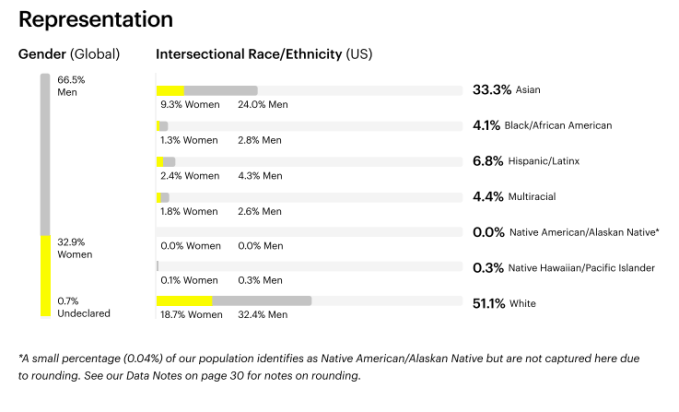
Snap’s numbers are not good but also nothing out of the ordinary for the tech industry. What’s novel about Snap’s report, however, is the intersectional data breakdown. You’ll note that the representation of Black women (1.3%) is lower than the representation of Black men (2.8%). The same goes for all race/ethnicity categories. Across all distinct races, there are more men than women. Again, this is not good but it’s to be expected, unfortunately.


Don’t miss


07 Aug 2020

R&D Roundup: Supercomputer COVID-19 insights, ionic spiderwebs, the whiteness of AI

I see far more research articles than I could possibly write up. This column collects the most interesting of those papers and advances, along with notes on why they may prove important in the world of tech and startups. This week: supercomputers take on COVID-19, beetle backpacks, artificial spiderwebs, the “overwhelming whiteness” of AI and more.

First off, if (like me) you missed this amazing experiment where scientists attached tiny cameras to the backs of beetles, I don’t think I have to explain how cool it is. But you may wonder… why do it? Prolific UW researcher Shyam Gollakota and several graduate students were interested in replicating some aspects of insect vision, specifically how efficient the processing and direction of attention is.

The camera backpack has a narrow field of view and uses a simple mechanism to direct its focus rather than processing a wide-field image at all times, saving energy and better imitating how real animals see. “Vision is so important for communication and for navigation, but it’s extremely challenging to do it at such a small scale. As a result, prior to our work, wireless vision has not been possible for small robots or insects,” said Gollakota. You can watch the critters in action below — and don’t worry, the beetles lived long, happy lives after their backpack-wearing days.

The health and medical community is always making interesting strides in technology, but it’s often pretty niche stuff. These two items from recent weeks are a bit more high-profile.

One is a new study being conducted by UCLA in concert with Apple, which especially with its smartwatch has provided lots of excellent data to, for example, studies of arrhythmia. In this case, doctors are looking at depression and anxiety, which are considerably more difficult to quantify and detect. But by using Apple Watch, iPhone and sleep monitor measurements of activity levels, sleep patterns and so on, a large body of standardized data can be amassed.

07 Aug 2020

Federal judge approves ending consent decrees that prevented movie studios from owning theaters

A federal judge has approved the Department of Justice’s efforts to end the Paramount Consent Decrees — 70-year-old court orders that prevented movie studios from engaging in a variety of anticompetitive behaviors, including ownership of movie theaters.

U.S. District Court Judge Analisa Torres cited the rise of streaming services like Netflix as one of the reasons for her decision:

Motion picture distributors that are not subject to the Decrees have entered the market since the 1940s — most significantly, The Walt Disney Company, the leading movie distributor in 2018 with about $3 billion in domestic box office revenues … Other motion picture distributors not subject to the Decrees include Lionsgate (20 films released in 2018), Focus Features (13 films), Roadside Attractions (12 films), and STX Entertainment (10 films). …None of the internet streaming companies — Netflix, Amazon, Apple and others — that produce and distribute movies are subject to the Decrees. Thus, the remaining Defendants are subject to legal constraints that do not apply to their competitors.

It’s not clear whether this decision will have any impact on the big streaming services. Torres acknowledged the argument that even when the decrees did not apply to a given studio, they “serve as a yardstick of acceptable behavior, exerting a normative effect on industry actors who are not parties to them.”

But it’s hard to imagine anyone in 2020 thinking it’s a good idea to seriously get into the theatrical business. Domestic attendance was on the decline, even before the COVID-19 pandemic forced most theaters to close.

Netflix and Amazon have shown some interest in owning theaters before this. Amazon was reportedly in the running to acquire in the Landmark theater chain a couple years ago, and rumors that it might acquire AMC sent the theater chain’s stock shooting up earlier this year — but no acquisition has been announced, and in the meantime AMC appears to have stabilized its finances.

Netflix, meanwhile, signed a long-term lease for New York City’s Paris Theatre last year, and it may also have been interested in the Egyptian Theatre in Los Angeles. However, these seem less like the first steps in a broader theatrical strategy and more like one-off deals designed to give the streamer access to locations that it can use for fancy premieres and other screenings.

The real impact of the ruling may be in other areas, like the elimination (after a two-year sunset period) of restrictions on block booking and circuit dealing. Without those restrictions, studios could potentially require theaters that want access to a lucrative franchise title to screen their less popular films as well.