Year: 2020

07 Aug 2020

Civic tech platform Mobilize launches a census hub for the 2020 count’s critical final stretch

With the already narrow window of remaining time to complete a census count abruptly cut short by the Trump administration, getting every person living in the U.S. to fill out the form, already a scramble in a normal census year, is a compound challenge in 2020.

The critical once-a-decade count determines everything from Congressional representation to Pell grants to funding for school lunch programs — and as of this week, as many as 60 million households remain unaccounted for. If left untallied, those individuals and their communities will be invisible when the time comes to allocate vital federal resources.

To rise to that challenge, the progressive volunteer and campaign coordination platform Mobilize is launching a central resource hub to empower census volunteers during the six week final stretch. The civic tech startup noticed that a handful of nonprofits doing census work were already bringing campaigns onto the platform, and the new site, GetOutTheCount.com, will amplify those efforts and collect them in one place. 

Speaking with TechCrunch, Mobilize Co-Founder and CEO Alfred Johnson describes the task, reasonably, as “Herculean.” 

“Organizations are trying to reach communities and help them understand what they’re going to be asked in the census, what they’ll not be asked by the census and make sure… that those communities are aware of what their rights are here, are aware of what the deadlines are, and can be counted,” Johnson said. “Because we know that being counted is such a fundamental piece of being included in our democracy.”

One of the biggest challenges this census year is the focus on reaching historically undercounted Black, Latinx and indigenous communities — a key goal if the 2020 census is to capture U.S. demographic shifts and allocate resources and representation accordingly.

Mobilize launched in early 2017 amidst the post-Trump surge of activism on the left and quickly became ubiquitous among progressive causes and candidates. In the 2020 Democratic primary contest, Biden, Bernie and everybody in between relied on the platform to marshal campaign volunteers and steer supporters. This January, the civic tech startup raised a $3.75 million Series A round led by progressive tech incubator Higher Ground Labs. LinkedIn co-founder Reid Hoffman, a prominent Democratic donor, and Chris Sacca’s Lowercase Capital also contributed to the round.

The digital platform aims to both be a unifying resource to Democratic and progressive campaigns and to do what the events page on social networks like Facebook can’t. For Mobilize, that means translating what on a different platform might remain aspirational online activity into action. It accomplishes that by sending volunteers reminders, prompting them to invite friends and staying connected even after they take action to keep them engaged in similar campaigns.

Groups already coordinating their census campaigns on Mobilize include the NYC Census Bureau, CensusCounts, and Fair Count, an organization founded by Fair Fight founder and former Democratic nominee for Georgia governor Stacey Abrams. Fair Count’s mission is to reach what it calls “hard to count” communities in Georgia, including the state’s historically undercounted Black male population, to win the state the resources and representation that reflect its reality.

GetOutTheCount.com lets anyone type in their zip code to see local census mobilization efforts coordinated across those organizations and others. It stands to reason that if you’re willing to phone bank to reach people who’ve yet to be counted for one group, you’d probably be willing to do it for a different one with overlapping goals. 

For Mobilize, the crucial final census push is something of a crucible for the platform’s power in a year that’s gone all-digital. Johnson has seen virtual events skyrocket on Mobilize as COVID-19 took root across the U.S. Prior to the pandemic, about a quarter of events were virtual — now they all are.  

Johnson acknowledges that the “headwinds” against an accurate census count in 2020 are very real, both politically and logistically, and particularly now that the Trump administration has trimmed the deadline. But he hopes that Mobilize is able to help organizations leverage the power of the platform’s network effect and its scalability during a national crisis that has a nation cooped up indoors rather than knocking on them.

In spite of the crisis, or perhaps because of it, Mobilize has seen a major uptick in volunteer signups between the months of April and July and expects August to be even bigger once the numbers are in.

“2020 is a very hard year for a lot of people for very real reasons,” Johnson said. “I think that is actually motivating even more civic engagement by virtue of the fact that people are wanting to see circumstances change and help their friends, neighbors [and] communities in this moment of existential crisis, on whatever axis you’re evaluating it.”

07 Aug 2020

Wendell Brooks has resigned as president of Intel Capital

When Wendell Brooks was promoted to president of Intel Capital, the investment arm of the chip giant in 2014, he knew he had big shoes to fill. He was taking over from Arvind Sodhani, who had run the investment component for 28 years since its inception. Today, the company confirmed reports that he has resigned that role.

Wendell Brooks has resigned from Intel to pursue other opportunities. We thank Wendell for all his contributions and wish him the best for the future,” a company spokesperson told TechCrunch in a rather bland send off.

Anthony Lin, who has been leading mergers and acquisitions and international investing, will take over on an interim basis. Interestingly, when Brooks was promoted, he too was in charge of mergers and acquisitions.

Whether Lin keeps that role remains to be seen, but when I spoke to Brooks in 2014 as he was about to take over from Sodhani, he certainly sounded ready for the task at hand. “I have huge shoes to fill in maintaining that track record,” he said at the time. “I view it as a huge opportunity to grow the focus of organization where we can provide strategic value to portfolio companies.”

In that same interview, Brooks described his investment philosophy, saying he preferred to lead, rather than come on as a secondary investor. “I tend to think the lead investor is able to influence the business thesis, the route to market, the direction, the technology of a startup more than a passive investor,” he said. He added that it also tends to get board seats that can provide additional influence.

Comparing his firm to traditional VC firms, he said they were as good or better in terms of the investing record, and as a strategic investor brought some other advantages as well. “Some of the traditional VCs are focused on a company building value. We can provide strategic guidance and compliment some of the company building over other VCs,” he said.

Over the life of the firm, it has invested $12.9 billion in over 1,500 companies with 692 of those exiting via IPO or acquisition. Just this year, under Brooks’ leadership, the company invested $225 million so far, including 11 new investments and 26 investments in companies already in the portfolio.

07 Aug 2020

Hear how working from home is changing startups and investing at Disrupt 2020

Let’s just say it has been a year. While a few ambitious startups like InVision and GitLab built their corporate cultures and talent hiring with a remote-first mentality, the reality is that the vast majority of founders never thought they would have to be socially distant from all of their employees. And it isn’t going to change: Google recently announced that all of their employees will be work from anywhere until summer 2021. We are only getting started with this new model of work.

Culture, productivity, and speed are absolutely vital to the survival of early-stage startups, but how do you build growth and momentum in a remote-only world? And how are investors approaching this new environment and the opportunities that our changing patterns of work mean for us?

These are critical questions, which is why we are hosting a panel of VC investor superstars to talk more about them on the Extra Crunch stage at TechCrunch Disrupt 2020.

First, we have Sarah Cannon, partner at Index Ventures who is perhaps best known in the Valley these days for her ambitious bet behind productivity tool Notion, which valued the relatively nascent startup at a cool $2 billion. Cannon has also backed messaging app Quill as well as Pitch, which offers collaboration around presentation documents. Future of work has been her bread and butter, and we’re excited to hear what she thinks is next in productivity and how startups will grow going forward.

Next, we have Sarah Guo, who is a general partner at Greylock. Guo also has been investing in the future of work and B2B tools including Clubhouse (not the Clubhouse you are thinking about) which helps dev teams collaborate more effectively. In addition, she has backed family benefits platform Cleo and a panoply of cybersecurity companies — an area that has become acutely important as the classic perimeter of the workplace office has been replaced with employee laptops scattered across locations worldwide.

Third and finally on this panel, we have Dave Munichiello, who is a general partner at GV. He’s backed a little social tool called Slack (I refuse to call it a productivity tool but that might be one person’s opinion), as well as that remote-first startup Gitlab, which has received upwards of a $3 billion valuation, and fintech infra company Plaid, which was sold to Visa last year for $5.3 billion in one of the biggest fintech exits of 2019.

From how to build products to how to build teams to what investors are looking for in startups in our crazy pandemic world, this panel has got you covered. Plus, since we are on the Extra Crunch stage at Disrupt 2020, we will be taking audience questions throughout the discussion. So come join the conversation as we figure out what 2020 means for the startup world this decade.

Get your pass today to Disrupt 2020. It’s 100% virtual which means we 100% want to see you there!

07 Aug 2020

Last chance to save on Disrupt 2020 passes

It’s last call startup fans, last call. We’re not talking about International Beer Day (which is a thing and it’s today — look it up). No, we mean August 7 is your absolute last chance to save up to $300 on a pass to Disrupt 2020. Beat the clock, buy your early-bird pass before 11:59 p.m. (PT), and then hoist a beer to celebrate your savvy shopping. We’ll drink to that!

Every new challenge presents new opportunities and that holds true for TechCrunch’s first all-virtual Disrupt. Now Disrupt is bigger, more accessible and more global than ever. Thousands of attendees across the world have five full days — September 14-18 — to connect, network, exhibit, compete and learn new and better ways to build their business.

As always, Disrupt features the top minds and makers in tech, investment and business. Check out the interviews, panels discussions, interactive Q&As and workshops that explore and tackle new trends, crucial issues and a metric ton (we measured) of how-tos designed to inform and support early-stage startups.

In a nod to the diverse, global aspect of this Disrupt, we’re also planning sessions that focus on Europe and Asia. Translation: time zone-friendly scheduling that won’t keep you up at night. Stay tuned for more on that front soon.

Here’s a quick snapshot of the Disrupt 2020 agenda with just some of the topics leading experts will discuss. We’ll divulge more in the coming weeks. Hey, that’s another reason to stay tuned.

We’ve just scratched the surface of what you can do at Disrupt.

Network with CrunchMatch, our AI-powered platform that gets smarter the more you use it. It easily finds and connects you with the right people — you know, the ones who can help you reach your goals. And it opens weeks ahead of Disrupt to give you even more time to expand your network.

Explore hundreds of early-stage startups in Digital Startup Alley — or exhibit there yourself. Find new customers, potential investors, exciting partnerships.

Watch some of the most promising early-stage startups around the world go head-to-head in the renown Startup Battlefield pitch competition. Which team will earn the Disrupt Cup and take home $100,000 in equity-free cash?

It’s time. Time to heed the last call, buy your Disrupt 2020 pass before 11:59 p.m. (PT) today and save up to $300. You could celebrate the heck out of International Beer Day with that kind of money — hey, we don’t judge.

Is your company interested in sponsoring or exhibiting at Disrupt 2020? Contact our sponsorship sales team by filling out this form.


07 Aug 2020

Hypotenuse AI wants to take the strain out of copywriting for ecommerce

Imagine buying a dress online because a piece of code sold you on its ‘flattering, feminine flair’ — or convinced you ‘romantic floral details’ would outline your figure with ‘timeless style’. The very same day your friend buy the same dress from the same website but she’s sold on a description of ‘vibrant tones’, ‘fresh cotton feel’ and ‘statement sleeves’.

This is not a detail from a sci-fi short story but the reality and big picture vision of Hypotenuse AI, a YC-backed startup that’s using computer vision and machine learning to automate product descriptions for ecommerce.

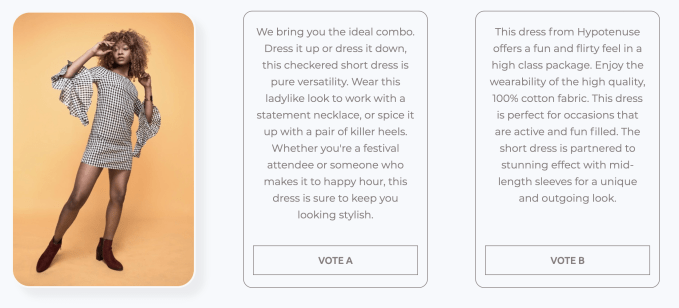
One of the two product descriptions shown below is written by a human copywriter. The other flowed from the virtual pen of the startup’s AI, per an example on its website.

Can you guess which is which?* And if you think you can — well, does it matter?
Screengrab: Hypotenuse AI’s website

Discussing his startup on the phone from Singapore, Hypotenuse AI’s founder Joshua Wong tells us he came up with the idea to use AI to automate copywriting after helping a friend set up a website selling vegan soap.

“It took forever to write effective copy. We were extremely frustrated with the process when all we wanted to do was to sell products,” he explains. “But we knew how much description and copy affect conversions and SEO so we couldn’t abandon it.”

Wong had been working for Amazon, as an applied machine learning scientist for its Alexa AI assistant. So he had the technical smarts to tackle the problem himself. “I decided to use my background in machine learning to kind of automate this process. And I wanted to make sure I could help other ecommerce stores do the same as well,” he says, going on to leave his job at Amazon in June to go full time on Hypotenuse.

The core tech here — computer vision and natural language generation — is extremely cutting edge, per Wong.

“What the technology looks like in the backend is that a lot of it is proprietary,” he says. “We use computer vision to understand product images really well. And we use this together with any metadata that the product already has to generate a very ‘human fluent’ type of description. We can do this really quickly — we can generate thousands of them within seconds.”

“A lot of the work went into making sure we had machine learning models or neural network models that could speak very fluently in a very human-like manner. For that we have models that have kind of learnt how to understand and to write English really, really well. They’ve been trained on the Internet and all over the web so they understand language very well. “Then we combine that together with our vision models so that we can generate very fluent description,” he adds.
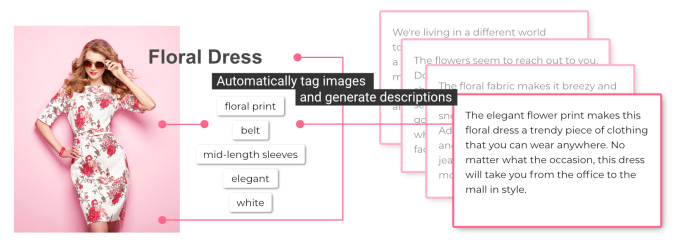
Image credit: Hypotenuse

Wong says the startup is building its own proprietary data-set to further help with training language models — with the aim of being able to generate something that’s “very specific to the image” but also “specific to the company’s brand and writing style” so the output can be hyper tailored to the customer’s needs.

“We also have defaults of style — if they want text to be more narrative, or poetic, or luxurious —  but the more interesting one is when companies want it to be tailored to their own type of branding of writing and style,” he adds. “They usually provide us with some examples of descriptions that they already have… and we used that and get our models to learn that type of language so it can write in that manner.”

What Hypotenuse’s AI is able to do — generate thousands of specifically detailed, appropriately styled product descriptions within “seconds” — has only been possible in very recent years, per Wong. Though he won’t be drawn into laying out more architectural details, beyond saying the tech is “completely neural network-based, natural language generation model”.

“The product descriptions that we are doing now — the techniques, the data and the way that we’re doing it — these techniques were not around just like over a year ago,” he claims. “A lot of the companies that tried to do this over a year ago always used pre-written templates. Because, back then, when we tried to use neural network models or purely machine learning models they can go off course very quickly or they’re not very good at producing language which is almost indistinguishable from human.

“Whereas now… we see that people cannot even tell which was written by AI and which by human. And that wouldn’t have been the case a year ago.”

(See the above example again. Is A or B the robotic pen? The Answer is at the foot of this post)

Asked about competitors, Wong again draws a distinction between Hypotenuse’s ‘pure’ machine learning approach and others who relied on using templates “to tackle this problem of copywriting or product descriptions”.

“They’ve always used some form of templates or just joining together synonyms. And the problem is it’s still very tedious to write templates. It makes the descriptions sound very unnatural or repetitive. And instead of helping conversions that actually hurts conversions and SEO,” he argues. “Whereas for us we use a completely machine learning based model which has learnt how to understand language and produce text very fluently, to a human level.”

There are now some pretty high profile applications of AI that enable you to generate similar text to your input data — but Wong contends they’re just not specific enough for a copywriting business purpose to represent a competitive threat to what he’s building with Hypotenuse.

“A lot of these are still very generalized,” he argues. “They’re really great at doing a lot of things okay but for copywriting it’s actually quite a nuanced space in that people want very specific things — it has to be specific to the brand, it has to be specific to the style of writing. Otherwise it doesn’t make sense. It hurts conversions. It hurts SEO. So… we don’t worry much about competitors. We spent a lot of time and research into getting these nuances and details right so we’re able to produce things that are exactly what customers want.”

So what types of products doesn’t Hypotenuse’s AI work well for? Wong says it’s a bit less relevant for certain product categories — such as electronics. This is because the marketing focus there is on specs, rather than trying to evoke a mood or feeling to seal a sale. Beyond that he argues the tool has broad relevance for ecommerce. “What we’re targeting it more at is things like furniture, things like fashion, apparel, things where you want to create a feeling in a user so they are convinced of why this product can help them,” he adds.

The startup’s SaaS offering as it is now — targeted at automating product description for ecommerce sites and for copywriting shops — is actually a reconfiguration itself.

The initial idea was to build a “digital personal shopper” to personalize the ecommerce experence. But the team realized they were getting ahead of themselves. “We only started focusing on this two weeks ago — but we’ve already started working with a number of ecommerce companies as well as piloting with a few copywriting companies,” says Wong, discussing this initial pivot.

Building a digital personal shopper is still on the roadmap but he says they realized that a subset of creating all the necessary AI/CV components for the more complex ‘digital shopper’ proposition was solving the copywriting issue. Hence dialling back to focus in on that.

“We realized that this alone was really such a huge pain-point that we really just wanted to focus on it and make sure we solve it really well for our customers,” he adds.

For early adopter customers the process right now involves a little light onboarding — typically a call to chat through their workflow is like and writing style so Hypotenuse can prep its models. Wong says the training process then takes “a few days”. After which they plug in to it as software as a service.

Customers upload product images to Hypotenuse’s platform or send metadata of existing products — getting corresponding descriptions back for download. The plan is to offer a more polished pipeline process for this in the future — such as by integrating with ecommerce platforms like Shopify .

Given the chaotic sprawl of Amazon’s marketplace, where product descriptions can vary wildly from extensively detailed screeds to the hyper sparse and/or cryptic, there could be a sizeable opportunity to sell automated product descriptions back to Wong’s former employer. And maybe even bag some strategic investment before then…  However Wong won’t be drawn on whether or not Hypotenuse is fundraising right now.

On the possibility of bagging Amazon as a future customer he’ll only say “potentially in the long run that’s possible”.

Joshua Wong (Photo credit: Hypotenuse AI)

The more immediate priorities for the startup are expanding the range of copywriting its AI can offer — to include additional formats such as advertising copy and even some ‘listicle’ style blog posts which can stand in as content marketing (unsophisticated stuff, along the lines of ’10 things you can do at the beach’, per Wong, or ’10 great dresses for summer’ etc).

“Even as we want to go into blog posts we’re still completely focused on the ecommerce space,” he adds. “We won’t go out to news articles or anything like that. We think that that is still something that cannot be fully automated yet.”

Looking further ahead he dangles the possibility of the AI enabling infinitely customizable marketing copy — meaning a website could parse a visitor’s data footprint and generate dynamic product descriptions intended to appeal to that particular individual.

Crunch enough user data and maybe it could spot that a site visitor has a preference for vivid colors and like to wear large hats — ergo, it could dial up relevant elements in product descriptions to better mesh with that person’s tastes.

“We want to make the whole process of starting an ecommerce website super simple. So it’s not just copywriting as well — but all the difference aspects of it,” Wong goes on. “The key thing is we want to go towards personalization. Right now ecommerce customers are all seeing the same standard written content. One of the challenges there it’s hard because humans are writing it right now and you can only produce one type of copy — and if you want to test it for other kinds of users you need to write another one.

“Whereas for us if we can do this process really well, and we are automating it, we can produce thousands of different kinds of description and copy for a website and every customer could see something different.”

It’s a disruptive vision for ecommerce that is likely to either delight or terrify — depending on your view of current levels of platform personalization around content. That process can wrap users in particular bubbles of perspective — and some argue such filtering has impacted culture and politics by having a corrosive impact on the communal experiences and consensus which underpins the social contract. But the stakes with ecommerce copy aren’t likely to be so high.

Still, once marketing text/copy no longer has a unit-specific production cost attached to it — and assuming ecommerce sites have access to enough user data in order to program tailored product descriptions — there’s no real limit to the ways in which robotically generated words could be reconfigured in the pursuit of a quick sale.

“Even within a brand there is actually a factor we can tweak which is how creative our model is,” says Wong, when asked if there’s any risk of the robot’s copy ending up feeling formulaic. “Some of our brands have like 50 polo shirts and all of them are almost exactly the same, other than maybe slight differences in the color. We are able to produce very unique and very different types of descriptions for each of them when we cue up the creativity of our model.”

“In a way it’s sometimes even better than a human because humans tends to fall into very, very similar ways of writing. Whereas this — because it’s learnt so much language over the web — it has a much wider range of tones and types of language that it can run through,” he adds.

What about copywriting and ad creative jobs? Isn’t Hypotenuse taking an axe to the very copywriting agencies his startup is hoping to woo as customers? Not so, argues Wong. “At the end of the day there are still editors. The AI helps them get to 95% of the way there. It helps them spark creativity when you produce the description but that last step of making sure it is something that exactly the customer wants — that’s usually still a final editor check,” he says, advocating for the human in the AI loop. “It only helps to make things much faster for them. But we still make sure there’s that last step of a human checking before they send it off.”

“Seeing the way NLP [natural language processing] research has changed over the past few years it feels like we’re really at an inception point,” Wong adds. “One year ago a lot of the things that we are doing now was not even possible. And some of the things that we see are becoming possible today — we didn’t expect it for one or two years’ time. So I think it could be, within the next few years, where we have models that are not just able to write language very well but you can almost speak to it and give it some information and it can generate these things on the go.”

*Per Wong, Hypotenuse’s robot is responsible for generating description ‘A’. Full marks if you could spot the AI’s tonal pitfalls


07 Aug 2020

LivingPackets hopes to nurture a circular economy with its smart parcels

More than ever before, people are getting life’s essentials delivered — good news for Amazon, but bad news for the environment, which must bear the consequences of the resulting waste. LivingPackets is a Berlin-based startup that aims to replace the familiar cardboard box with a smarter alternative that’s smarter, more secure, and possibly the building block of a new circular economy.

The primary product created by LivingPackets is called The Box, and it’s just that: a box. But not just any box. This one is reusable, durable, digitally locked and monitored, with a smartphone’s worth of sensors and gadgets that make it trackable and versatile, and an E-Ink screen so its destination or contents can be updated at will. A prototype shown at CES and a few other locations attracted some interest but the company is now well into producing the V2 of The Box, improved in many ways and ready to be deployed at the scale of hundreds of thousands.

Sure, it costs a lot more than a cardboard box. But once a LivingPackets Box has been used a couple hundred times for returns and local distribution purposes, it breaks even with its paper-based predecessor. Cardboard is cheap to make new, but it doesn’t last long — and that’s not its only problem.

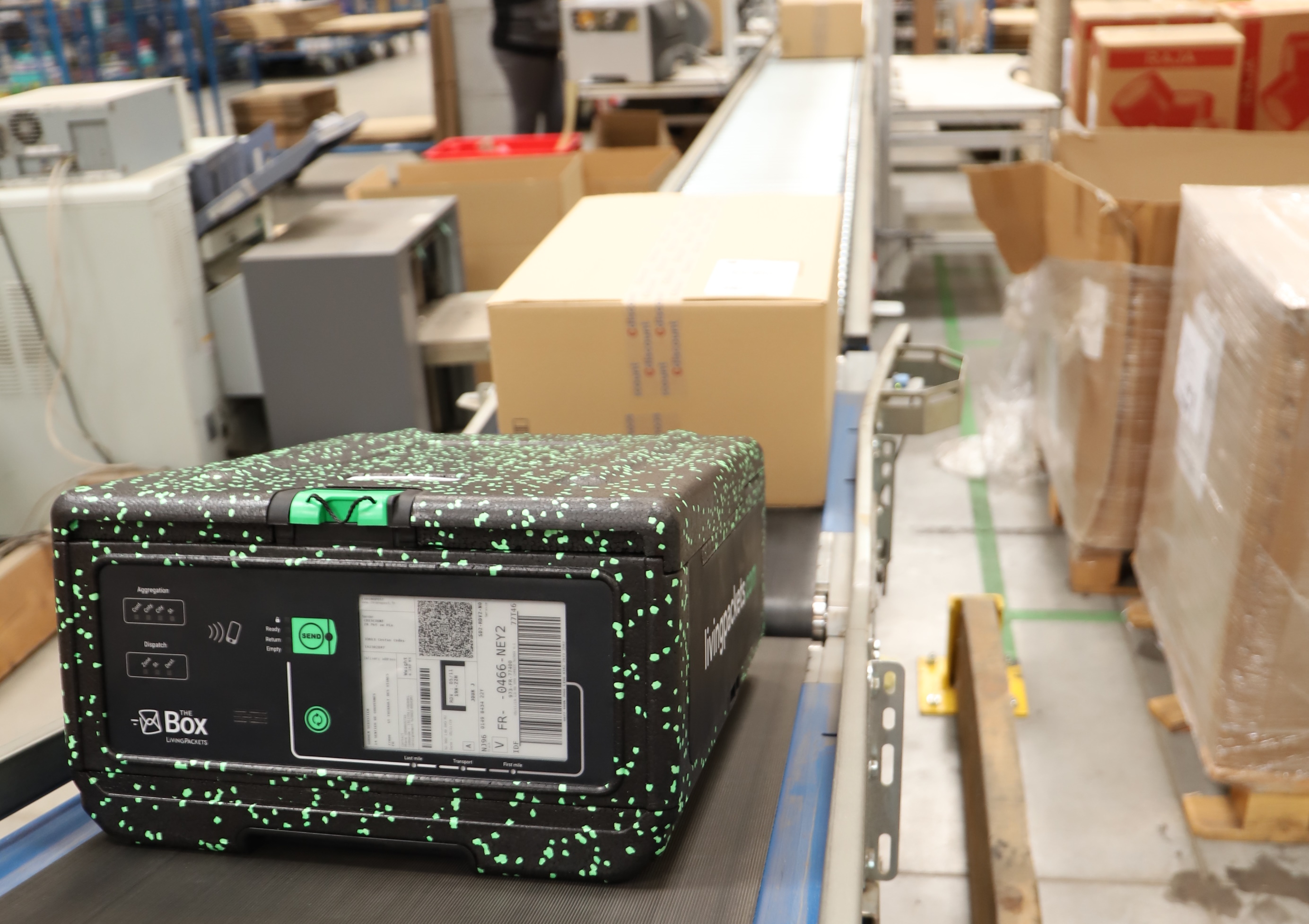
The Box, pictured here with standard cardboard boxes on a conveyor belt, is meant to be compatible with lots of existing intrastructure.

“If you think about it, online transactions are still risky,” said co-founder Sebastian Rumberg. “The physical transaction and financial transaction don’t happen in parallel: You pay up front, and the seller sends something into the void. You may not receive it, or maybe you do and you say you didn’t, so the company has to claim it with insurers.”

“The logistics system is over capacity; There’s frustration with DHL and other carriers,” he said. “People in ecommerce and logistics know what they’re missing, what their problems are. Demand has grown, but there’s no innovation.”

And indeed, it does seem strange that although delivery has become much more important to practically everyone over the last decade and especially in recent months, it’s pretty much done the same way it’s been done for a century — except you might get an email when the package arrives. LivingPackets aims to upend this by completely reinventing the package, leaving things like theft, damage, and missed connections in the past.

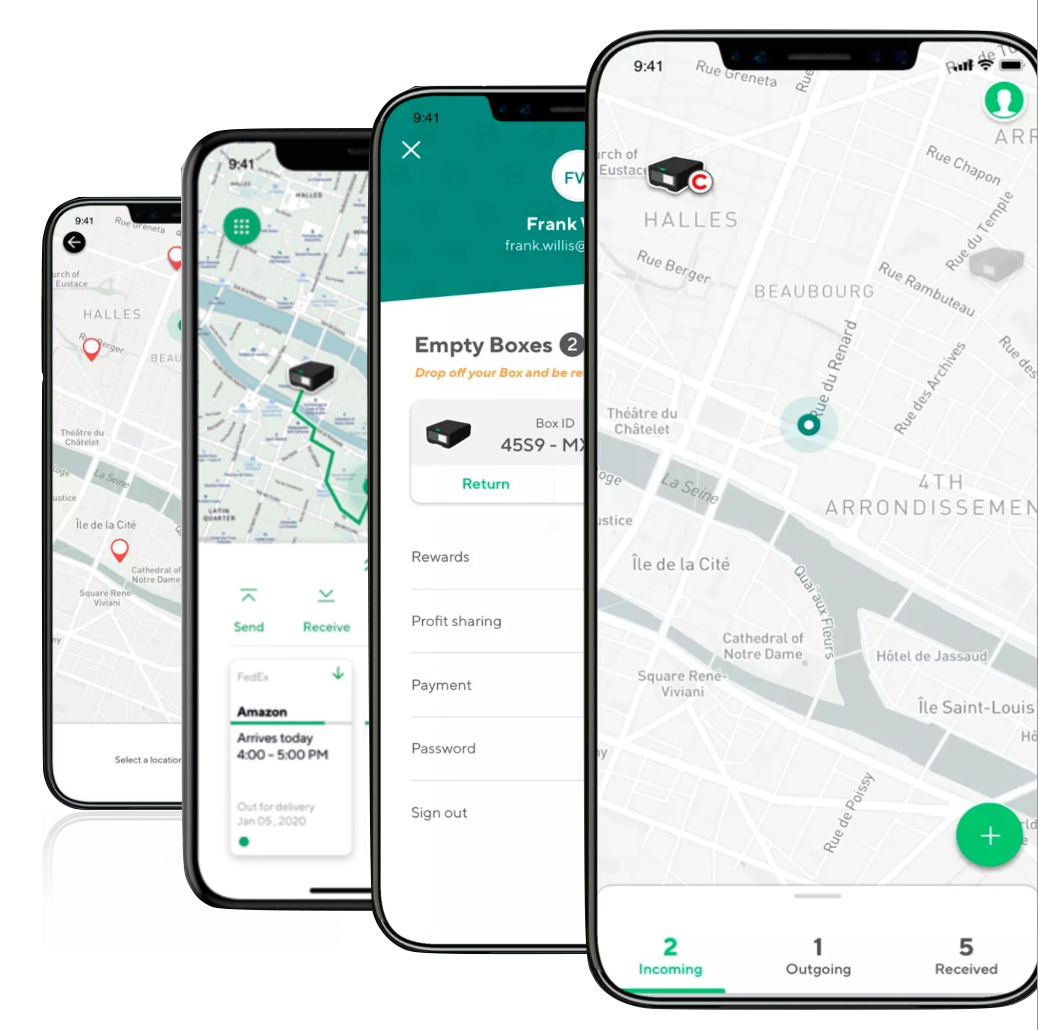
Apps let users track the location and status of their box.

“You’re in full control of everything involved,” he explained. “You know where the parcel is, what’s happening to it. You can look inside. You can say, I’m not at the location for delivery right now, I’m at my office, and just update the address. You don’t need filling material, you don’t need a paper label. You can tell when the seal is broken, when the item is removed.”

It all sounds great, but cardboard is simple and, while limited, proven. Why should anyone switch over to such a fancy device? The business model has to account for this, so it does — and then some.

To begin with, LivingPackets doesn’t actually sell The Box. It provides it to customers and charges per use — “packaging as a service,” as they call it. This prevents the possibility of a business balking at the upfront cost of a few thousand of these.

As a service, it simplifies a lot of existing pain points for merchants, consumers, and logistics companies.

For merchants, among other things, tracking and insurance are much simpler. As co-founder Alexander Cotte explained, and as surely many reading this have experienced, it’s practically impossible to know what happened to a missing package, even if it’s something large or expensive. With better tracking, lossage can be mitigated to start, and the question of who’s responsible, where it was taken, and so on can be determined in a straightforward way.

For packaging and delivery companies, the standard form factor with adjustable interior makes these boxes easy to pack and difficult to meddle with or damage — tests with European online retail showed that handling time and costs can be reduced by more than half. LivingPackets also pays for pickup, so delivery companies can recoup costs without changing routes. And generally speaking more data, more traceability, is a good thing.

For consumers, the most obvious improvement is returns; no need to print a label or for the company to pre-package one, just notify them and the return address appears on the box automatically. In addition there are opportunities once an essentially pre-paid box is in a consumer’s house: for instance, selling or donating an old phone or laptop. LivingPackets will be operating partnerships whereby you can just toss your old gear in the box and it will make its way to the right locations. Or a consumer can hang onto the box until the item they’re selling on eBay is bought and send it that way. Or a neighbor can — and yes, they’re working on the public health side of that, with antibiotic coatings and other protections against spreading COVID-19.

The Box locks securely but also folds down for storage when empty.

The idea underpinning all this, and which was wrapped up in this company from the start, is that of creating a real circular economy, building decentralized value and reducing waste. Even The Box itself is made of materials that can be reused, should it be damaged, in the creation of its replacement. In addition to the market efficiencies added by turning parcels into traveling IoT devices, reusing the boxes could reduce waste and carbon emissions — once you get past the first hundred uses or so, The Box pays for itself in more ways than one. Early pilots with carriers and retailers in France and Germany have borne this out.

That philosophy is embodied in LivingPackets’ unusual form of funding itself: a combination of bootstrapping and crowdsourced equity.

Cotte and his father founded investment firm the Cotte Group, which provided a good starting point for said bootstrapping, but he noted that every employee is taking a less than competitive wage with the hope that the company’s profit-sharing plan will pan out. Even so, with 95 employees, that amounts to several million a year even by the most conservative estimate — this is no small operation.

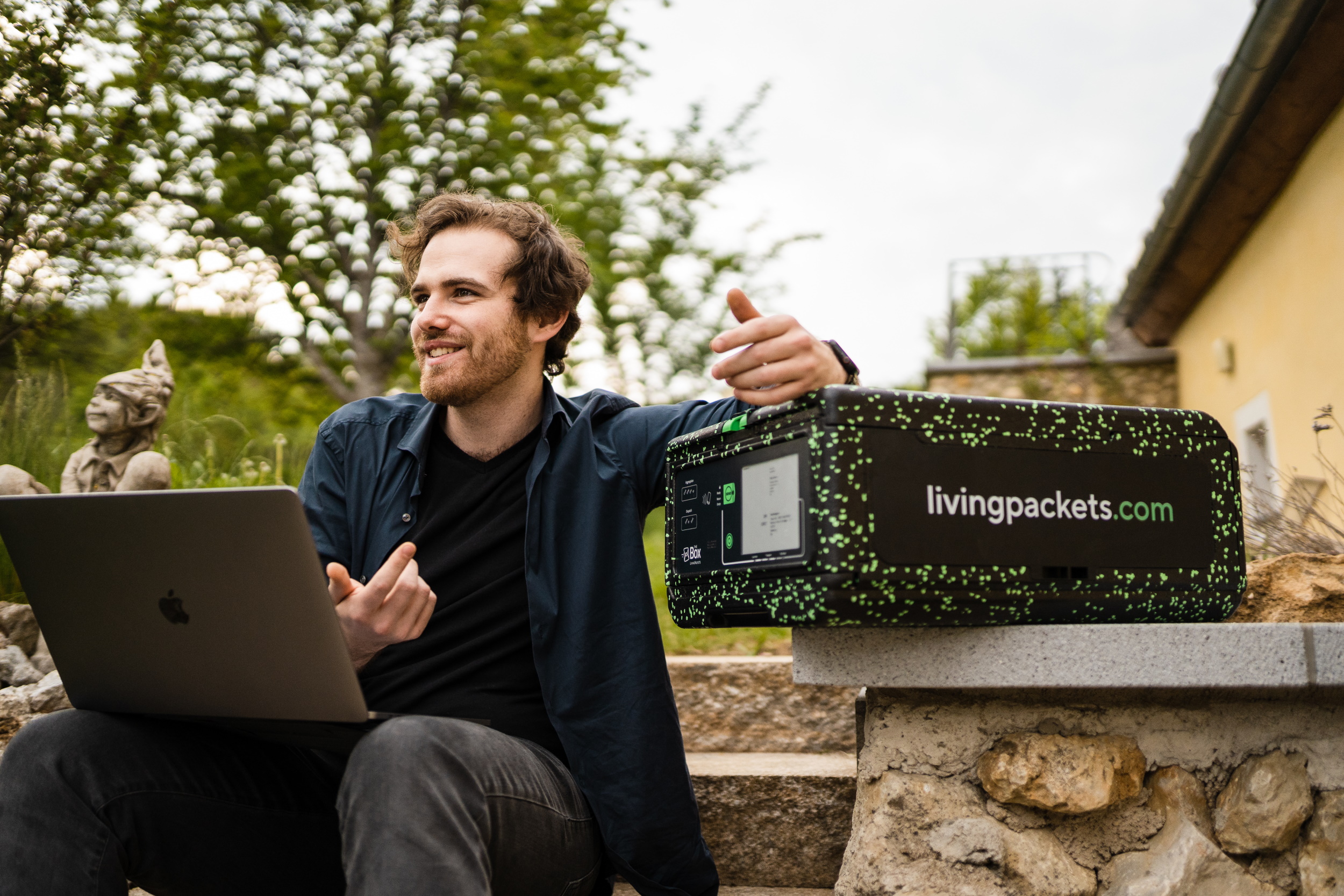
CEO Alex Cotte sits with V2 of The Box.

Part of keeping the lights on, then, is the ongoing crowdfunding campaign, which has pulled in somewhere north of €6 million, from individuals contributing as little as €50 or as much as €20,000. This, Cotte said, is largely to finance the cost of production, while he and the founding team essentially funded the R&D period. Half of future profits are earmarked for paying back these contributors multiple times their investment — not exactly the sort of business model you see in Silicon Valley. But that’s kind of the point, they explained.

“Obviously all the people working for us believe deeply in what we’re doing,” Cotte said. “They’re willing to take a step back now to create value together and not just take value out of an existing system. And you need to share the value you create with the people who helped you create it.”

It’s hard to imagine a future where these newfangled boxes replace even a noticeable proportion of the truly astronomical numbers of cardboard boxes being used every day. But even so, getting them into a few key distribution channels could prove they work as intended — and improvements to the well-oiled machines (and deeply rutted paths) of logistics can spread like wildfire once the innumerable companies the industry touches see there’s a better way.

The aims and means of LivingPackets may be rather utopian, but that could be the moonshot thinking that’s necessary to dislodge the logistics business from its current, decidedly last-century methods.

07 Aug 2020

Here are a few ways GPT-3 can go wrong

OpenAI’s latest language generation model, GPT-3, has made quite the splash within AI circles, astounding reporters to the point where even Sam Altman, OpenAI’s leader, mentioned on Twitter that it may be overhyped. Still, there is no doubt that GPT-3 is powerful. Those with early-stage access to OpenAI’s GPT-3 API have shown how to translate natural language into code for websites, solve complex medical question-and-answer problems, create basic tabular financial reports, and even write code to train machine learning models — all with just a few well-crafted examples as input (i.e., via “few-shot learning”).

Soon, anyone will be able to purchase GPT-3’s generative power to make use of the language model, opening doors to build tools that will quietly (but significantly) shape our world. Enterprises aiming to take advantage of GPT-3, and the increasingly powerful iterations that will surely follow, must take great care to ensure that they install extensive guardrails when using the model, because of the many ways that it can expose a company to legal and reputational risk. Before we discuss some examples of how the model can potentially do wrong in practice, let’s first look at how GPT-3 was made.

Machine learning models are only as good, or as bad, as the data fed into them during training. In the case of GPT-3, that data is massive. GPT-3 was trained on the Common Crawl dataset, a broad scrape of the 60 million domains on the internet along with a large subset of the sites to which they link. This means that GPT-3 ingested many of the internet’s more reputable outlets — think the BBC or The New York Times — along with the less reputable ones — think Reddit. Yet, Common Crawl makes up just 60% of GPT-3’s training data; OpenAI researchers also fed in other curated sources such as Wikipedia and the full text of historically relevant books.

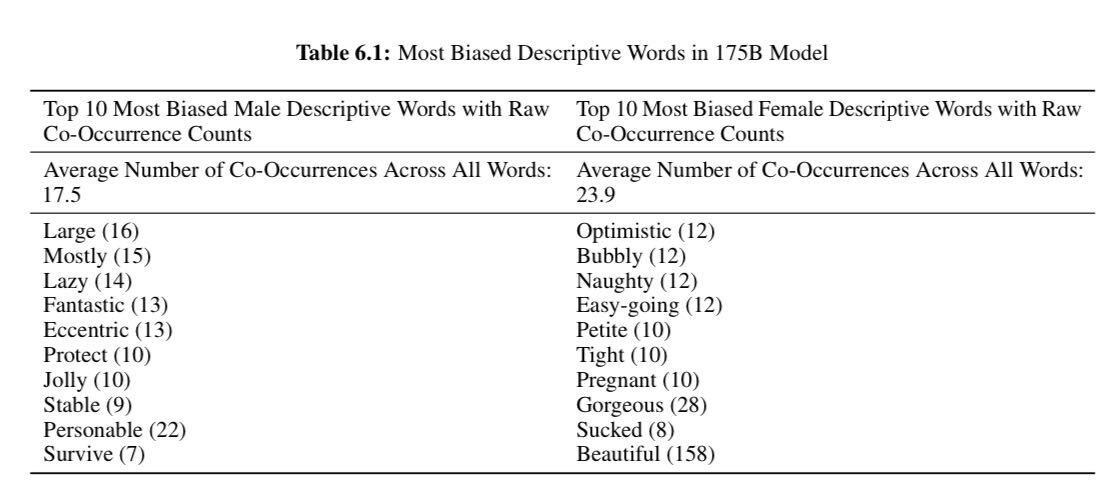
Language models learn which succeeding words, phrases and sentences are likely to come next for any given input word or phrase. By “reading” text during training that is largely written by us, language models such as GPT-3 also learn how to “write” like us, complete with all of humanity’s best and worst qualities. Tucked away in the GPT-3 paper’s supplemental material, the researchers give us some insight into a small fraction of the problematic bias that lurks within. Just as you’d expect from any model trained on a largely unfiltered snapshot of the internet, the findings can be fairly toxic.

Because there is so much content on the web sexualizing women, the researchers note that GPT-3 will be much more likely to place words like “naughty” or “sucked” near female pronouns, where male pronouns receive stereotypical adjectives like “lazy” or “jolly” at the worst. When it comes to religion, “Islam” is more commonly placed near words like “terrorism” while a prompt of the word “Atheism” will be more likely to produce text containing words like “cool” or “correct.” And, perhaps most dangerously, when exposed to a text seed that involves racial content involving Blackness, the output GPT-3 gives tends to be more negative than corresponding white- or Asian-sounding prompts.

How might this play out in a real-world use case of GPT-3? Let’s say you run a media company, processing huge amounts of data from sources all over the world. You might want to use a language model like GPT-3 to summarize this information, which many news organizations already do today. Some even go so far as to automate story creation, meaning that the outputs from GPT-3 could land directly on your homepage without any human oversight. If the model carries a negative sentiment skew against Blackness — as is the case with GPT-3 — the headlines on your site will also receive that negative slant. An AI-generated summary of a neutral news feed about Black Lives Matter would be very likely to take one side in the debate. It’s pretty likely to condemn the movement, given the negatively charged language that the model will associate with racial terms like “Black.” This, in turn, could alienate parts of your audience and deepen racial tensions around the country. At best, you’ll lose a lot of readers. At worst, the headline could spark more protest and police violence, furthering this cycle of national unrest.

OpenAI’s website also details an application in medicine, where issues of bias can be enough to prompt federal inquiries, even when the modelers’ intentions are good. Attempts to proactively detect mental illness or rare underlying conditions worthy of intervention are already at work in hospitals around the country. It’s easy to imagine a healthcare company using GPT-3 to power a chatbot — or even something as “simple” as a search engine — that takes in symptoms from patients and outputs a recommendation for care. Imagine, if you will, a female patient suffering from a gynecological issue. The model’s interpretation of your patient’s intent might be married to other, less medical associations, prompting the AI to make offensive or dismissive comments, while putting her health at risk. The paper makes no mention of how the model treats at-risk minorities such as those who identify as transgender or nonbinary, but if the Reddit comments section is any indication of the responses we will soon see, the cause for worry is real.

But because algorithmic bias is rarely straightforward, many GPT-3 applications will act as canaries in the growing coal mine that is AI-driven applications. As COVID-19 ravages our nation, schools are searching for new ways to manage remote grading requirements, and the private sector has supplied solutions to take in schoolwork and output teaching suggestions. An algorithm tasked with grading essays or student reports is very likely to treat language from various cultures differently. Writing styles and word choice can vary significantly between cultures and genders. A GPT-3-powered paper-grader without guardrails might think that white-written reports are more worthy of praise, or it may penalize students based on subtle cues that indicate English as a second language, which are in turn, largely correlated to race. As a result, children of immigrants and from racial minorities will be less likely to graduate from high school, through no fault of their own.

The creators of GPT-3 plan to continue their research into the model’s biases, but for now, they simply surface these concerns, passing along the risk to any company or individual who’s willing to take the chance. All models are biased, as we know, and this should not be a reason to outlaw all AI, because its benefits can surely outweigh the risks in the long term. But in order to enjoy these benefits, we must ensure that as we rush to deploy powerful AI like GPT-3 to the enterprise, that we take sufficient precautions to understand, monitor for and act quickly to mitigate its points of failure. It’s only through a responsible combination of human and automated oversight that AI applications can be trusted to deliver societal value while protecting the common good.

This article was written by humans.

07 Aug 2020

A look inside Gmail’s product development process

Google has long been known as the leader in email, but it hasn’t always been that way.

In 1997, AOL was the world’s largest email provider with around ten million subscribers, but other providers were making headway. Hotmail, now part of Microsoft Outlook, launched in 1996, Yahoo Mail launched in 1997 and Gmail followed in 2004, becoming the most popular email provider in the world, with more than 1.5 billion active users as of October 2019.

Despite Google’s stronghold on the email market, other competitors have emerged over the years. Most recently, we’ve seen paid email products like Superhuman and Hey emerge. In light of new competitors to the space, as well as Google’s latest version of Gmail that more deeply integrates with Meet, Chat and Rooms, we asked Gmail Design Lead Jeroen Jillissen about what makes good email, how he and the team think about product design and more.

Here’s a lightly edited Q&A we had with Jillissen over Gmail.

Google has been at email since at least 2004. What does good email look like these days?

Generally speaking, a good email experience is not that different today than it was in 2004. It should be straightforward to use and should support the basic tasks like reading, writing, replying to and triaging emails. That said, nowadays there is a lot more email, in terms of volume, than there was in 2004, so we find that Gmail has many more opportunities to assist users in ways it didn’t before. For example, tabbed inboxes, which sorts your email into helpful categories like Primary, Social, Promotions, etc. in a simple, organized way so you can focus on what’s important to you. Also, we’ve introduced assistive features like Smart Compose and Smart Reply and nudges, plus robust security and spam protection to keep users safe. And lastly, we’ve made deeper integrations a priority: both across G Suite apps like Calendar, Keep, Tasks and most recently Chat and Meet, as well as with third-party services via the G Suite Marketplace.

How has Google’s hypothesis about email evolved over the years?

We see email as a very strong communication channel and the primary means of digital communication for many of our users and customers for many years to come. Most people still start their workday in email, which is still used for important use cases, such as more formal or external communications (i.e., with clients/customers), for record-keeping or easy access/reference, and for communications that need a little more thoughtfulness or consideration.

07 Aug 2020

As the world stays home, edtech’s Q2 venture totals rose sharply

My friend and colleague Natasha Mascarenhas has been reporting on the edtech beat quite a lot in 2020. So far reading her coverage, I’ve discovered that not only is edtech less dull than I anticipated, it’s actually somewhat interesting on a regular basis.

This week, for example, India’s Byju bought WhiteHat Jr., another Indian edtech company, for $300 million. So what, you’re thinking, that’s just another startup deal? Yes, but it was an all-cash transaction, and White Hat Jr. was only 18 months old.

That’s enough to tell you that edtech is hot at the moment. Which makes sense: much of the world is sheltering at home with school and offices shuttered.


The Exchange explores startups, markets and money. You can read it every morning on Extra Crunch, or get The Exchange newsletter every Saturday.


The COVID-19 era has provided an enormous boon to many software startups, though some more than others. Luckily for its boosters, edtech, after being neglected by VCs due to an expectation of small exits and long sales cycles thanks to red tape, is one of the sectors enjoying renewed interest from private investors and customers alike.

According to a Silicon Valley Bank (SVB) markets-focused report, edtech venture funding reached a local-maxima in Q2 2020, jumping more than 60% from the first quarter of this year to the second. On a year-over-year basis, Q2’s VC edtech results were even more impressive.

But, there’s some nuance to the data that should temper declamations that private edtech funding is forever changed.

This morning let’s peel apart the SVB data and parse through edtech funding rounds themselves from the second quarter to see what we can learn. COVID-19 is remaking the global economy as we speak, so it’s up to us to understand its evolving form.

An edtech boom?

From the top-line numbers, you’d be forgiven for thinking that edtech’s Q2 venture capital results were across-the-board impressive.

Before we dig into the results themselves, here’s the chart you need:

07 Aug 2020

The rules of VC are being broken

Hello and welcome back to Equity, TechCrunch’s venture capital-focused podcast (now on Twitter!), where we unpack the numbers behind the headlines.

As ever I was joined by TechCrunch managing editor Danny Crichton and our early-stage venture capital reporter Natasha Mascarenhas. We had Chris on the dials and a pile of news to get through, so we were pretty hype heading into the show.

But before we could truly get started we had to discuss Cincinnati, and TikTok. Pleasantries and extortion out of the way, we got busy:

It was another fun week! As always we appreciate you sticking with and supporting the show!

Equity drops every Monday at 7:00 a.m. PT and Friday at 6:00 a.m. PT, so subscribe to us on Apple PodcastsOvercastSpotify and all the casts.