Year: 2020

29 Jul 2020

In antitrust hearing, Zuckerberg admits Facebook has copied its competition

At the House Antitrust Subcommittee hearings this afternoon, Facebook CEO Mark Zuckerberg was directly questioned about his company’s strategy of copying competitors’ app and features, and even threatening to do so as a negotiation tactic amid M&A discussions. In his response, Zuckerberg was forced to admit the obvious: that Facebook, he said, has “certainly adapted features that others have led in.”

However, he denied any characterization claiming Facebook used such tactics in an anti-competitive way — for example, to pressure a company to sell to Facebook instead of trying to compete with it.

In one particular line of questioning between Rep. Pramila Jayapal (D-WA) and Facebook’s CEO, she asked specifically about the company’s billion-dollar acquisition of Instagram in 2012. The M&A deal had been already been brought up repeatedly throughout the hearing as an example of Facebook buying its way into expanded market power.

Jayapal led into the questions around Instagram by first painting a picture of a company where execs agreed that copying from other apps was a viable business strategy.

She specifically referenced emails from 2012 between Zuckerberg and Facebook COO Sheryl Sandberg where the CEO had written that by moving faster, Facebook could “prevent our competitors from getting footholds.” Sandberg had responded that “it is hard not to agree it that is better to do more and move faster, especially if that means you don’t have competitors build products that takes some of our users.” A PM had also chimed in that they would love to see Facebook being “even more aggressive and nimble” in copying competitors, Jayapal noted.
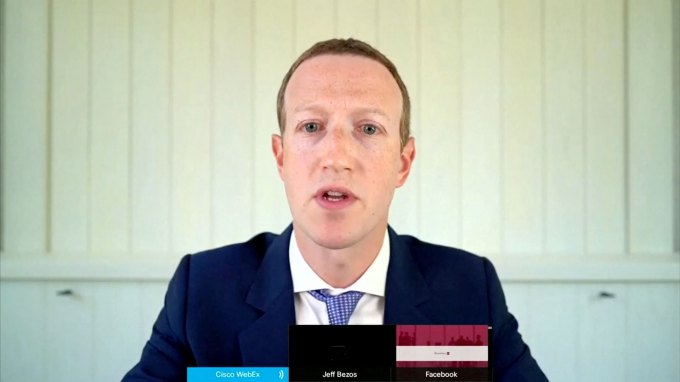
Mark Zuckerberg

Image Credits: TechCrunch/screenshot

The emails had hinted at the birth of Facebook’s strategy around copying its competition, as they detailed meetings between a high-level Facebook employee and the Renren founders as well as Robin Li from China’s Baidu.

The employee had learned of the overall culture of cloning products quickly in the Chinese app market.  Renren had built its own version of Pinterest and Tumblr, the emails said, as well as games, a music product and more. And Tencent QQ had then just released a messaging app similar to the walkie-talkie app Voxer in the U.S. It was pointed out that maybe it was easier to move quickly because these companies were “just copying other people,” the email suggested.

Zuckerberg had forwarded the email to Sandberg, noting “you’ll probably find this interesting and agree.” And she did.

Under questioning, Zuckerberg declined to say how many companies Facebook had copied since the 2012 email exchange, bristling that he didn’t agree with the premise of the question.

“Our job is to make sure that we build the best services for people to connect with all the people they care about. And a lot of that is done by innovating and by building new things…,” he began, before being cut off.

Jayapal then asked if Facebook had ever threatened to clone a product from another company while attempting to acquire it.

“Not that I recall,” Zuckerberg said.

However, it seems Facebook had threatened to use its “Facebook Camera” app against Instagram ahead of the latter’s acquisition, Jayapal noted. In a chat with Instagram co-founder Kevin Systrom, Zuckerberg said Facebook was developing its own photo strategy, and how we engage now will also determine how much we’re partners versus competitors down the line, she explained. In an email chain, Zuckerberg had told Systrom that “at some point, you’ll need to figure out how you actually want to work with us.”

The Instagram founder had also confided in an investor that he felt Zuckerberg’s comments were a threat, Jayapal said, and was concerned that Facebook would go into “destroy mode” if he didn’t sell Instagram.

Zuckerberg didn’t deny the conversation, but disagreed again with the characterization, saying it was clear that this was a space the two companies would compete in.

Jayapal asked also if a similar tactic was used against Snapchat in its attempts to acquire the company.

“I don’t remember those specific conversations,” Zuckerberg responded. “But that was also an area where was very clear that we were going to be building something,” he said.

Jayapal concluded her time by stating that she did believe Facebook was a monopoly because of this and other behavior.

“I think the question again here is when the dominant platform threatens as potential rivals, that should not be a normal business practice. Facebook is a case study, in my opinion, in monopoly power because your company harvests and monetizes our data, and then your company uses that data to spy on competitors, and to copy acquire and kill rivals,” she said.
 

29 Jul 2020

Bezos ‘can’t guarantee’ no anti-competitive activity as Congress catches him flat-footed

At today’s House Judiciary Committee hearing, Amazon CEO Jeff Bezos bungled attempts to assuage concerns that the company poaches ideas from its competitors, taking sustained fire from Rep. Pramila Jayapal (D-WA) and others. Faced with testimony from employees that there is “nobody enforcing” policies, resulting in “a candy shop” of seller data, Bezos admitted to what amounts to ignorance or complicity.

Jayapal’s interrogation was one of precious few substantive exchanges in a hearing dominated by tiresome grandstanding and uninformed or irrelevant lines of questions.

Amazon has been dogged for years with well-substantiated allegations that it uses its bird’s-eye position in online retail, much of which passes through its platform, to spot new products and categories and enter them using that inside information — often taking huge losses to undercut the existing players in the market.

Jayapal — who represents the district in which the company is headquartered and has gone head to head with the company numerous times — began by asking straight out whether Amazon does this (Wording of questions and answers has only been slightly edited for clarity.):

Jayapal: Does Amazon have access and use third party seller data when making business decisions?

Bezos: I can’t answer that question yes or no. I can tell you we have a policy against using seller-specific data to aid our private label business but I can’t guarantee you that that policy has never been violated.

In response, Jayapal cited a recent WSJ report citing multiple instances where Amazon had done just that:

Jayapal: You’re probably aware that an April 2020 report in the Wall Street Journal revealed that your company does access data on third party sellers both by reviewing data on popular individual products and sellers and making tiny categories that allowed your company to categorically access detailed seller information in a supposedly aggregate category do you deny that report?

Bezos: I’m familiar with the Wall Street Journal article you’re talking about. We continue to look into that very carefully, I’m not yet satisfied we’ve gotten to the bottom of it. It’s not as easy to do it as you think because some of the sources in the article are anonymous.

Jayapal: I’ll take that as a you’re not denying that.

“It’s a candy shop, everyone can have access to anything they want.”
Her next move was a damning quote from a former employee that Bezos seemed at a loss to counter.

Jayapal: A former Amazon employee and third party sales an recruitment told this committee, quote, “there’s a rule but there’s nobody enforcing or spot checking. They just say don’t help yourself to the data. It’s a candy shop, everyone can have access to anything they want.” Do category managers have access to non public data about third party products and businesses?

Bezos: Uh, here’s what I can tell you. We do have certain safeguards in place. we train people on the policy, we expect people to follow that policy the same we would with any others. It’s a voluntary policy [in that having such a policy is voluntary, not that it is voluntary to follow that policy, he clarified]. If we found that someone violated it, we would take action against them.

Jayapal: Well, there’s numerous reports and the committee has conducted interviews with former employees that confirm that there are employees that do have access to that data and are using it. If you thought you were actually enforcing these rules, do you think that that’s working? There’s credible reporting that has documented breaches of these rules you’ve put into place, and this committee has interviewed employees that say that these breaches typically occur.

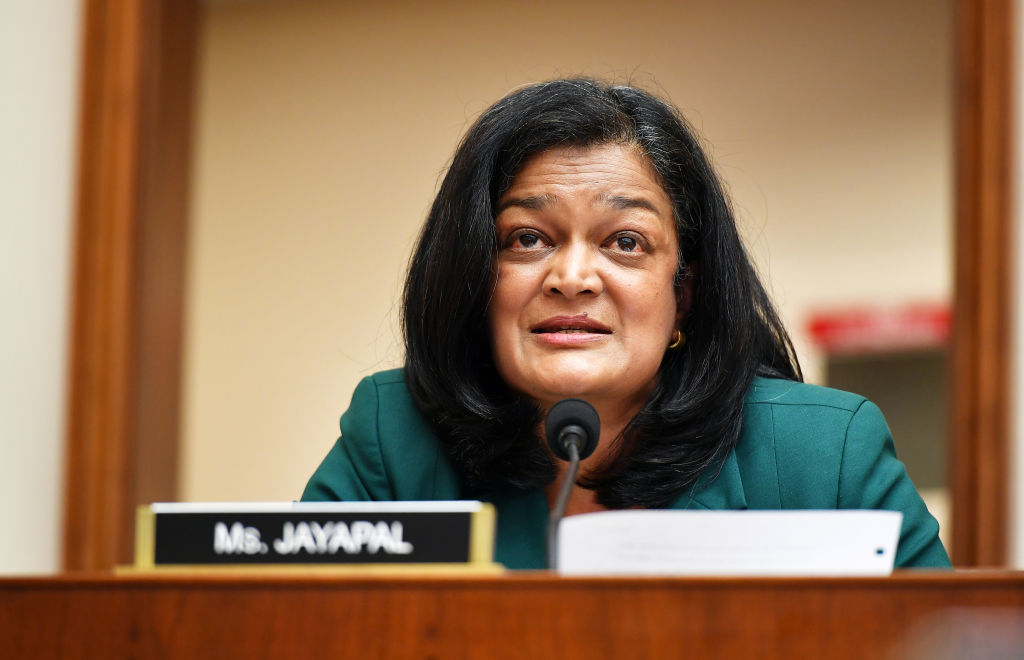
WASHINGTON, DC - JULY 29: Rep. Pramila Jayapal, D-WA, speaks during the House Judiciary Subcommittee hearing on Antitrust, Commercial and Administrative Law on Online Platforms and Market Power in the Rayburn House office Building, July 29, 2020 on Capitol Hill in Washington, DC.

(Photo by Mandel Ngan-Pool/Getty Images)

After confirming that “aggregate” data could be on as little as a single seller under Amazon’s policy, she then began a lengthy presentation of why this was obviously a serious concern for competition:

Jayapal: Interviews with former employees have made it clear that that aggregate data essentially allows access to highly detailed data in those product categories – there’s the example of Fortem, a small business that had no direct competitors, except for Amazon Warehouse Deals, a resale clearance account that only sold 17 units. An Amazon employee accessed a detailed sales report on Fortem’s product with information on how much the company spent on advertising per unit and the cost to ship each trunk. And then Amazon launched its own competing products in October 2019. That’s a major loophole. And I go back to the general counsel’s statement to this committee very clearly that there was no access to this data, that Amazon does not use that data for its own benefit. And I’m now hearing you say, well you’re not so sure that’s going on.

You have access to the entirety of sellers pricing and inventory information, past, present and future, and you dictate the participation of third party sellers on your platform. So you can set the rules of the game for your competitors but not actually follow those rules yourself. Do you think that’s fair to the mom and pop third party bus that are trying to sell on your platform?

Bezos: I appreciate that question and I like it a lot, because I really wanted a chance to address that. I’m very proud of what we’ve done for third party sellers on this platform…

Sensing Bezos was bloviating and/or playing for time, Jayapal cut him off to make her final point:

Jayapal: So you might allow third party sellers onto your platform, but if you’re continuously monitoring the data to make sure that they’re never gonna get big enough that they can compete with you, that is actually the concern that the committee has. The whole goal of this committee’s work is to make sure there are more Amazons, more Apples, more companies that get to innovate and small businesses that get to thrive. That is why we need to regulate these marketplaces, so that no company has a platform so dominant that it is essentially a monopoly.

“Mr. Bezos, did you personally sign off on the plan to raise prices after Amazon eliminated its competition?” “I don’t remember that at all.”
Rep. Jayapal’s questions seemed to open the season on Bezos. Representative Mary Scanlon (D-PA) soon highlighted Amazon’s willingness to lose hundreds of millions of dollars to kneecap the competing Diapers.com:

Scanlon: The price war against Diapers.com worked, and within a few months it was struggling, and so Amazon bought it. After buying your leading competitor here, Amazon cut promotions like Amazon.mom and the steep discounts it used to lure customers away from Diapers.com, and then increase the prices of diapers for new moms and dads. Mr. Bezos, did you personally sign off on the plan to raise prices after Amazon eliminated its competition?

Bezos: I don’t remember that at all.  What I remember is that we matched competitors’ prices and I believe we followed diapers.com. This was 11 years ago so you’re asking a lot of my memory.

Then the Chairman, Rep. David Ciccilline (D-RI), took the opportunity to get some more direct answers on Rep. Jayapal’s line of questions.

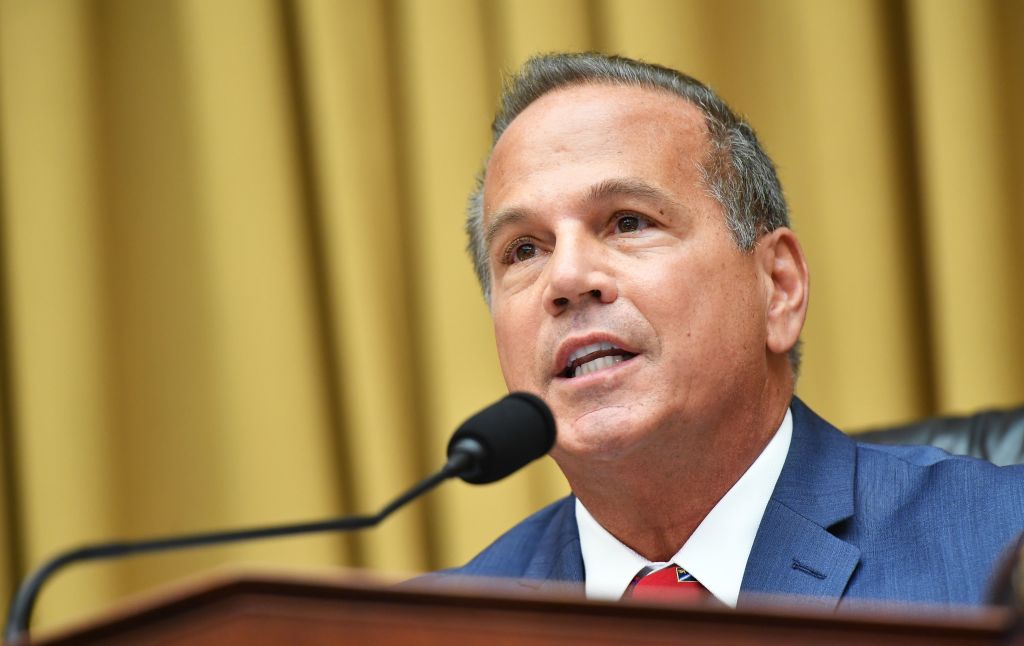
House Judiciary Subcommittee on Antitrust, Commercial and Administrative Law Chair David Cicilline, D-RI, speaks during a hearing on "Online Platforms and Market Power" in the Rayburn House office Building on Capitol Hill in Washington, DC on July 29, 2020. (Photo by MANDEL NGAN/POOL/AFP via Getty Images)

Cicilline: Isn’t it an inherent conflict of interest for Amazon to produce and sell products on its platform that compete directly with third party sellers, particularly when you, Amazon, set the rules of the game?

Bezos: Thank you… no, I don’t believe it is. We have… the consumer is ultimately the one making the decisions about what to buy, what price to buy it at, who to buy it from.

Cicilline: That’s not the question, Mr. Bezos. The question is is there an inherent conflict of interest. …You said you can’t guarantee that the policy of not sharing third party sellers data with Amazon’s own line hasn’t been violated, you can’t be certain. Can you please explain that to me? Can you list examples of when that policy has been violated? Shouldn’t third parties know for sure that data isn’t being shared with your own line of competitors?

Bezos: What think is important to understand is we have a policy against using the individual seller data to compete with our private label products.

Cicilline: You couldn’t assure Ms. Jayapal that that policy isn’t violated routinely!

Bezos: Well, I mean, we are investigating that. I do not want to go beyond what I know right now, but we are as a result of that Wall Street Journal article, we are looking at that very carefully.

The Committee’s questioning of Google’s Sundar Pichai, Facebook’s Mark Zuckerberg, and Apple’s Tim Cook was nowhere near this level, but the Amazon portions were effective — if only to see one of the world’s richest and most powerful people stumbling over his words, unable or unwilling to answer basic questions. Bezos has little experience with these hearings and it showed — no doubt this has been as informative for him as it has been for Congress.

29 Jul 2020

LA’s consumer goods rental service, Joymode, sells to the NYC retail investment firm, XRC Labs

After raising $15 million in financing from one of technology’s most successful global investment firms, the Los Angeles-based consumer goods rental company Joymode is selling itself to an early-stage retail investment firm out of New York, XRC Labs.

Joymode’s founder Joe Fernandez will continue on as an advisor to Joymode as the company moves to pivot its business to focus on retail partnerships.

The relationship with XRC Labs’ Pano Anthos began after a small pilot integration between Joymode and Walmart launched in late 2019. “[It] became obvious that we should go all in on retail partnerships,” according to Fernandez. And as the company cast about for partners to pursue the strategy, Anthos and his firm, XRC, kept being mentioned, Fernandez said.

The precise terms of the deal with XRC Labs were undisclosed, but Joymode will become a wholly owned business of XRC and could potentially return to market to raise additional funds from additional investors, according to Fernandez.

“We could never crack growth at the scale we needed,” said Fernandez of the company’s initial business. “From day one, my belief was Joymode was going to be huge or dead. We grew, but given the cost structure of our business it put a lot of pressure on the business to grow exponentially fast. Everyone loved the idea but the actual growth was slower than we needed it to be.”

Though Joymode wasn’t a success, Fernandez said he can’t fault his investors or his team. “We got to iterate through every possible idea we had. Literally every idea we had was exhausted… We failed and that’s a bummer, but we got a fair shot,” he said.

What remains of the company is an inventory management system on the back end and a service that will allow any retailer to get involved in the rental business going forward.

“Part of the thesis was that by making things available for rental, people would want to do more stuff,” said Fernandez, but what happened was that consumers needed additional reasons to use the company’s service, and there weren’t enough events to drive demand.

“I believe that the inventory management system we made was incredible and it will be a standard for retailers doing rentals going forward,” he said. 

 As the company turned to retailers, the rental option became a way to generate revenue through additional products. “All the accessories that made the event even better,” said Fernandez. “Add-ons, try before you buy, experiential things that are just much more complete in a retail environment.”

At Joymode, the problem was that the company was owning the inventory, which created a high fixed cost. “We never felt confident with the growth in LA to justify the expense of opening in another city,” Fernandez said. “If we had cracked user acquisition in LA we would have rolled it out in a bunch of places.”

Ultimately, Joymode members saved $50 million by using Joymode to rent products rather than buying them. In all, the company acquired 2,000 unique products — from beach and camping equipment to video games, virtual reality headsets to cooking appliances. On a given weekend, roughly 30,000 products would ship from the company’s warehouse to locations across Southern California.

At XRC Labs, a firm launched in 2015 to support the consumer goods and brand space, Joymode will complement an accelerator that raises between $6 million and $9 million every two years and manages a growth fund that could reach $50 million in assets under management.

For Anthos, the best corollary to Joymode’s business could be the rental business at Home Depot. “Home Depot’s rental business is over $1 billion per year,” Anthos said. “There’s going to be this enormous component of our society and for them renting will be not just a more sustainable but reasonable option. They’re going to want to rent because they don’t want to own it.”

Joymode was backed by TenOneTen, Wonder, Struck Ventures, Homebrew and Naspers (now Prosus).

29 Jul 2020

Google’s Sundar Pichai grilled over “destroying anonymity on the Internet”

Google’s Sundar Pichai faced an awkward line of enquiry during today’s House Antitrust Subcommittee hearing related to its 2007 acquisition of adtech platform DoubleClick, and how it went on to renege on an original promise to lawmakers and regulators that it would not (nor could not) merge DoubleClick data with Google account data — automagically doing just that almost a decade later.

By linking Internet users’ browsing data, as harvested via the DoubleClick cookie, to Google accounts it was able to join the dots of user identities, (Gmail) email data, search history, location data and so on (Google already having collapsed the privacy policies of separate products, to join up all that activity) with its users’ wider Internet browsing activity — vastly expanding its ability to profile and target people with behavioral ads.

Agency for Google users to prevent this massive privacy intrusion, there was none.

Rep. Val Demings contended that by combining DoubleClick cookie data and Google account data Google had essentially destroyed user privacy on the Internet. And — importantly, given the domestic antitrust scrutiny the company now faces — that that had only been possible because of the market power Google had amassed.

“When Google proposed the merger alarm bells were raised about the access to data Google would have — specifically the ability to connect a user’s personal identity with their browsing activity,” said Demings, before zooming in to hammer Pichai on another tech giant broken data privacy promise.

“Google… committed to Congress and to the antitrust enforcers that the deal would not reduce user privacy. Google chief’s legal advisor testified before the Senate Antitrust Subcommittee that Google wouldn’t be able to merge this data. Even if it wanted to, given contractual restrictions. But in June of 2016 Google went ahead and merged this data anyway — effectively destroying anonymity on the Internet,” she explained.

Demings then pressed Pichai on whether he personally signed off on the privacy-hostile move, given he became CEO of Google in 2015.


Pichai hesitated before attempting a bland response — only to be interrupted by Demings pressing him again: “Did you sign off on the decision or not?”

“I — I reviewed at a high level all the important decisions we make,” he said, after a micro pause.

He then segwayed in search of more comfortable territory, starting into Google’s usual marketing spiel — about how it “deeply cares about the privacy and security of our users”.

Demings was having none of it. The U-turn had enabled Google to combine a user’s search and browsing history, location data and information from emails stored in Gmail, she said, blasting it “absolutely staggering”.

She then referenced an email from a DoubleClick exec who had told the committee it was “exactly the kind of user reduction in privacy that users’ founders had previously worried would lead to a backlash”.

“‘They were unwavering on the policy due to philosophical reasons. Which is Larry [Page] and Sergey [Brin] fundamentally not wanting users associated with a cross-site cookie. They were also worried about a privacy storm, as well as damage to Google’s brand’,” she said, quoting directly from the email from the unnamed DoubleClick exec.

“So in 2007 Google’s founders feared making this change because they knew it would upset their users — but in 2016 Google didn’t seem to care,” Demings went on, before putting it to Pichai that what had changed between 2007 and 2016 is that Google gained “enormous market power”.

“So while Google had to care about user privacy in 2007 it no longer had to in 2016 — would you agree that what changed was Google gained enormous market power?” she asked.

The Alphabet and Google CEO responded by asking for a chance “to explain” — and then rattling off a list of controls Google offers users so they can try and shrink how it tracks them, further claiming it makes it “very easy” for people to control what it does with their information. (Some EU data regulators have taken a very different view of Google’s ‘transparency’, however.)

“We today make it very easy for users to be in control of their data,” claimed Pichai. “We have simplified their settings, they can turn ads personalization on or off — we have combined most of activity settings into three groupings. We remind users to go do a privacy check up. One billion users have done so.”

Demings, sounding unimpressed, cut him off again — saying: “I am concerned that Google’s bait and switch with DoubleClick is part of a broader pattern where Google buys up companies for the purposes of surveilling Americans and because of Google’s dominance users have no choice but to surrender.”

She went on to contend that “more user data means more money” for Google.

Pichai had a go at denying that — starting an answer with the claim that “in general that’s not true” before Demings repeated the contention: “So you’re saying that more user data does not mean the more money that Google can collect?”

That was easier for Pichai to sidestep. “Most of the data we collect is to help users and provide personalized experiences back”, he shot back, neatly avoiding the key point that the access Google has given itself to people’s data by cross linking their web browsing with Google IDs and product activity enables the tech giant to generate massive profits via targeting them with creepy ads, which in turn makes up the vast majority of Alphabet’s profit.

But with that Demings’ five minutes were up — although the hearing continues. You can tune in here.

29 Jul 2020

Before buying Instagram, Zuckerberg warned employees of ‘battle’ to ‘dislodge’ competitor

In one of the first substantive moments at Wednesday’s major tech hearing, Facebook’s 2012 acquisition of Instagram came under fire, unearthing a few new revelations about the company’s internal thinking at the time.

Alluding to new documents provided to the committee as part of its ongoing year-long antitrust investigation, House Judiciary Committee Chairman Jerry Nadler said emails between Mark Zuckerberg and other Facebook executives at the time tell “a very disturbing story.”

Nadler went on to declare that Facebook’s acquisition of Instagram violated antitrust laws. “If this was an illegal merger at the time of the transaction, why shouldn’t Instagram now be broken off into a separate company?” Nadler asked.

In a video question and answer session on April 6, 2012 — three days before announcing the Instagram acquisition — Zuckerberg describes the threat posed by the social photo sharing app, mentioning Facebook’s own “not awesome” mobile app that users only “tolerate.”

“They’re growing well. We need to dig ourselves out of a hole. The good news is, we’ve been doing that. The bad news is that they are growing really quickly, they have a lot of momentum and it’s kind of going to be tough to dislodge them. We have a hard battle ahead of ourselves there.”

In emails obtained by the committee, Nadler quotes Zuckerberg saying “one thing about startups is you can often acquire them” — and beginning with Instagram, Facebook has certainly done that.

“I’ve always been clear that we viewed instagram as both a competitor and as a complement to our services,” Zuckerberg said Wednesday, defending the company and downplaying Nadler’s critiques.

“At the time, almost no one thought of them as a general social network,” Zuckerberg claimed.

The reality is that Instagram was already wildly popular, with more than 100,000 daily downloads in Apple’s App Store. “At 27 million registered users on iOS alone, Instagram was increasingly positioning itself as a social network in its own right — not just a photo-sharing app,” TechCrunch’s Sarah Perez wrote at the time.

Given the climate of the deal, the House Judiciary chairman threatened that unwinding the merger would be appropriate, even eight years later.

“… Facebook saw Instagram as a powerful threat that could siphon business away from Facebook so rather than compete with it, Facebook bought it,” Nadler said.

“This is exactly the same kind of anticompetitive action that the antitrust laws were designed to prevent.”

29 Jul 2020

Extra Crunch Live: Join our Q&A tomorrow at noon PDT with Y Combinator’s Geoff Ralston

From Airbnb to Zapier, and Coinbase to Instacart, many of the tech world’s most valuable companies spent their earliest days in Y Combinator’s accelerator program.

Steering the ship at Y Combinator today is its president, Geoff Ralston . We’re excited to share that Ralston will be joining us on Extra Crunch Live tomorrow at noon pacific.

Extra Crunch Live is our virtual speaker series, with each session packed with insight and guidance from the top investors, leaders and founders. This live Q&A is exclusive to Extra Crunch members, so be sure to sign up for a membership here.

Ralston took on the YC President role a little over a year ago shortly after Sam Altman stepped away to focus on OpenAI.

In the months since, Y Combinator has had to reimagine much about the way it operates; as the pandemic spread around the world, YC (like many organizations) has had to figure out how to work together while far apart. In the earliest weeks of the pandemic, this meant quickly shifting their otherwise in-person demo day online; later, it meant adapting the entire accelerator program to be completely remote.

While still relatively new to the president seat, Ralston is by no means new to YC. He joined the accelerator as a partner in 2012, and his edtech-focused accelerator Imagine K12 was fully merged into YC’s operations in 2016.

29 Jul 2020

Leverage AI to optimize customer service outcomes

As offices worldwide shift to remote work, our interactions with customers and colleagues have evolved in tandem. Professionals who once relied on face-to-face communication and firm handshakes must now close deals in a world where both are rare. Coworkers we once sat beside every day are now only available over Slack and Zoom, changing the nature of internal communication as well.

While this new reality presents a challenge, the advancement of key technologies allows us to not just adapt, but thrive. We are now on the precipice of the biggest revolution in workplace communication since the invention of the telephone.

It’s not enough to simply accept the new status quo, particularly as the overall economic climate remains tenuous. Artificial intelligence has much to offer in improving the way we speak to one another in the social distance era, and has already seen wide adoption in certain areas. Much of this algorithmic work has gone on behind the scenes of our most-used apps, such as Google Meet’s noise-canceling technology, which uses an AI to mute certain extraneous sounds on video calls. Other advances work in real-time right before our eyes — like Zoom’s myriad virtual backgrounds, or the automatic transcription and translation technology built into most video conferencing apps.

This kind of technology has helped employees realize that, despite the unprecedented shift to remote work, digital conversations do not just strive to recreate the in-person experience — rather, they can improve upon the way we communicate entirely.

It’s estimated that 65% of the workforce will be working remotely within the next five years. With a more hands-on approach to AI — that is, using the technology to actually augment everyday communications — workers can gain insight into concepts, workflows and ideas that would otherwise go unnoticed.

Your customer service experience

Roughly 55% of the data companies collect falls into the category of “dark data”: information that goes completely unused, kept on an internal server until it’s eventually wiped. Any company with a customer service department is invariably growing their stock of dark data with every chat log, email exchange and recorded call.

When a customer phones in with a query or complaint, they’re told early on that their call “may be recorded for quality assurance purposes.” Given how cheap data storage has become, there’s no “maybe” about it. The question is what to do with this data.

29 Jul 2020

The Hummer EV is shaping up to be GM’s electric answer to the Ford Bronco and Tesla Cybertruck

The video below contains the first glimpse at the upcoming electric GMC Hummer. The preview video is short, full of nonsense buzzwords, but still telling. It’s clear GM identified two main competitors against the upcoming Hummer: The Ford Bronco and Tesla Cybertruck.

The Hummer EV was announced pre-COVID 19 during the Super Bowl. At the time, GM promised it would feature a 1,000 HP from the electric powertrain. Since then, little has been released about the upcoming vehicle, though GM maintains it’s still on track for production in the fall of 2021.

The video released today sports a handful of expected features and capabilities. Interestingly enough, these features are on both sides of the motoring spectrum. If categorized, they fall into two groups: on-road thrills and off-roading adventure. The video paints a clear picture GM is targeting the Hummer EV against the Tesla Cybertruck and the Ford Bronco — both vehicles that are getting a lot of attention because of their capabilities and design.

For positioning against the Cybertruck, GM is touting the Hummer EV’s power of 1,000 HP and 11,500 lb-ft (though this number is derived in a different fashion than usual). It’s also saying the massive truck can hit 60 mph in 3 seconds, which is in the same realm as the top sports cars. Lastly, the video teaser stated the Hummer EV has an Adrenaline Mode, which is easy to assume is similar to Tesla’s Ludicrous mode, along with improved self-driving capability.

For the Bronco, GM is showing the Hummer EV’s off-roading features, including a so-called Open Air Infinity Roof and Modular Sky Panels, which is likely similar to the Bronco’s expansive removable roof. Even more, telling is the Crab Mode mentioned in the video. Crab Mode is likely a high-torque rock crawling mode for when bouldering off-road. With the crazy amount of torque available, the Hummer EV will probably be able to crawl up impressive inclines.

Pricing and exact availability have yet to be announced, and the same can be said about the Tesla Cybertruck. And don’t forget about the upcoming electric Ford F-150. There’s a war of the electric pickup coming, and I’m here for it.

29 Jul 2020

Lawmakers argue that big tech will grow even bigger as the pandemic drives people online

In his opening statements, the chairman of Wednesday’s historic tech hearing argued that regulating tech’s most dominant players is vital in the midst of the ongoing pandemic that has driven even more of American life online.

“Prior to the COVID-19 pandemic, these corporations already stood out as titans in our economy,” House Judiciary Antitrust Subcommittee Chair David Cicilline said. “In the wake of COVID-19, however, they are likely to emerge stronger and more powerful than ever before.”

The argument that tech stands to benefit from the COVID-19 crisis is a smart one — and a timely attack that’s difficult to dispute. While many major companies in other industries are struggling, grappling with layoffs or filing for bankruptcy, many of tech’s largest tech companies stand to emerge from the economic storm largely unscathed if not better off.

In his own opening remarks, ranking member Jim Sensenbrenner also argued that because Americans are relying more on online companies than ever before, tech’s power must be examined in light of the pandemic.

“That responsibility comes with increased scrutiny of your dominance in the market,” Sensenbrenner said.

29 Jul 2020

Investment in AI startups slips to three-year low

The fortunes of startups that leverage artificial intelligence have soared dramatically in recent years.

These AI-powered startups have seen quarterly investment totals rise from a few hundred rounds and a few billion dollars each quarter to 1,245 rounds and $17.3 billion in the second and third quarters of 2019, according to data from CB Insights. The rise in dollars chasing AI startups has been huge, demonstrating strong venture capital interest in the cohort.

But in recent quarters, the trend has slowed as VC deals for AI-powered startups fell off.


The Exchange explores startups, markets and money. You can read it every morning on Extra Crunch, or get The Exchange newsletter every Saturday.


A new report from the business-data company looking at the second quarter of venture capital results for global AI startups shows historically strong but declining investing rates for the upstart firms. During a pandemic and widespread recession, this is not a complete surprise; other areas of VC investment have also fallen in recent quarters. This is The Exchange’s second look at quarterly data in the startup category, something partially spurred by our interest in the economics of the startups that make up the group.

The scale of decline is notable, however, as is the national breakdown of VC investment into AI. (The United States is doing better than you probably guessed, if you have only listened to politicians lately.)

Let’s unpack the latest results, determine how investing patterns have changed by stage and examine how different countries compare when it comes to deal and dollar volume for AI-powered startups.

Global declines, US dominance

In the second quarter of 2020, global investment into AI startups fell to 458 deals worth $7.2 billion. According to the CB Insights dataset, the deal volume is the lowest for 12 quarters, or since Q2 2017 when 387 investments into AI startups were worth $4.7 billion.