
Year: 2020

28 Jul 2020

Microsoft’s new Family Safety app offers parental controls across phones, PCs and Xbox

Microsoft’s new screen time and parental controls app, Microsoft Family Safety, is today launching publicly on iOS and Android, following a preview of the experience which had arrived earlier this spring. The app is designed to help parents better understand children’s use of screen time, set limits and create screen time schedules, configure boundaries around web access, and track family members’ location, among other things.

The app competes with other parental control technologies, including those built into iOS and Android — the latter of which is also available as a standalone app, called Family Link. Like its competitors, Microsoft Family Safety will work best for those who have already bought into the company’s own ecosystem of products and services. In Microsoft’s case, that includes Windows 10 PCs and Xbox devices, for example.

Also like many screen time apps, Family Safety displays an activity log of how screen time is being used by kids. It can track the hours spent on devices, including Windows computers, phones, and Xbox, as well as across websites and apps. It can also show the terms kids are searching for online.
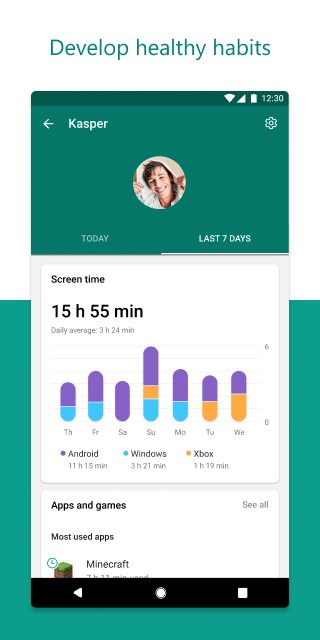
Image Credits: Microsoft

A weekly report is emailed to parents and kids, with the hopes of encouraging discussions around healthy use of screen time. This was already a complicated subject before the pandemic. But now, with kids attending school at home and filling summer downtime with hours in games while parents still try to work without childcare, it’s grown to be even more complicated.

Initially, parents may have just given up on screen time altogether, grateful for anything that allowed them that gave them moments of peace. But with staying at home becoming a new normal, many families are now reconsidering what amount of screen time is healthy and how much is too much.

With the new app, parents can set screen time limits that apply across devices — including Xbox. These limits can be narrowly configured to allow for access to educational apps that facilitate online learning, while limiting other types of screen time — like gaming, for instance. When kids run out of time, they can ask for more and parents can choose whether or not to grant it.

Meanwhile, the web filtering aspects of the new app take advantage of Microsoft’s newer browser, Microsoft Edge across Windows, Xbox, and Android. The app will allow parents to set search filters and block mature content. Other content controls will notify parents if the child tries to download a mature game or app from the Microsoft Store, as well.
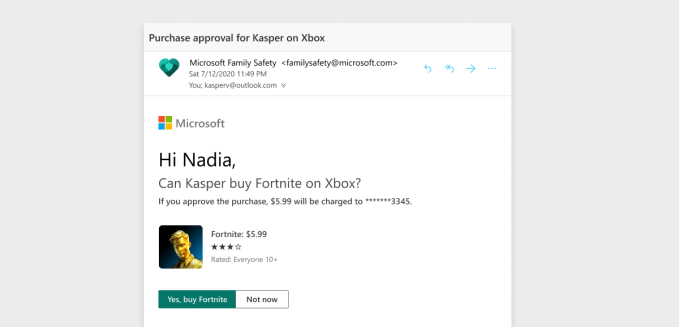
Image Credits: Microsoft


Parents can also control purchases by granting approval to kids’ requests, so there won’t be surprise bills later.

Plus, the app’s built-in location sharing means families can skip downloading additional family locator apps, like Life360, for access to basic location tracking features — like those that show family members on a map and lets you save favorite locations, like “Home.”
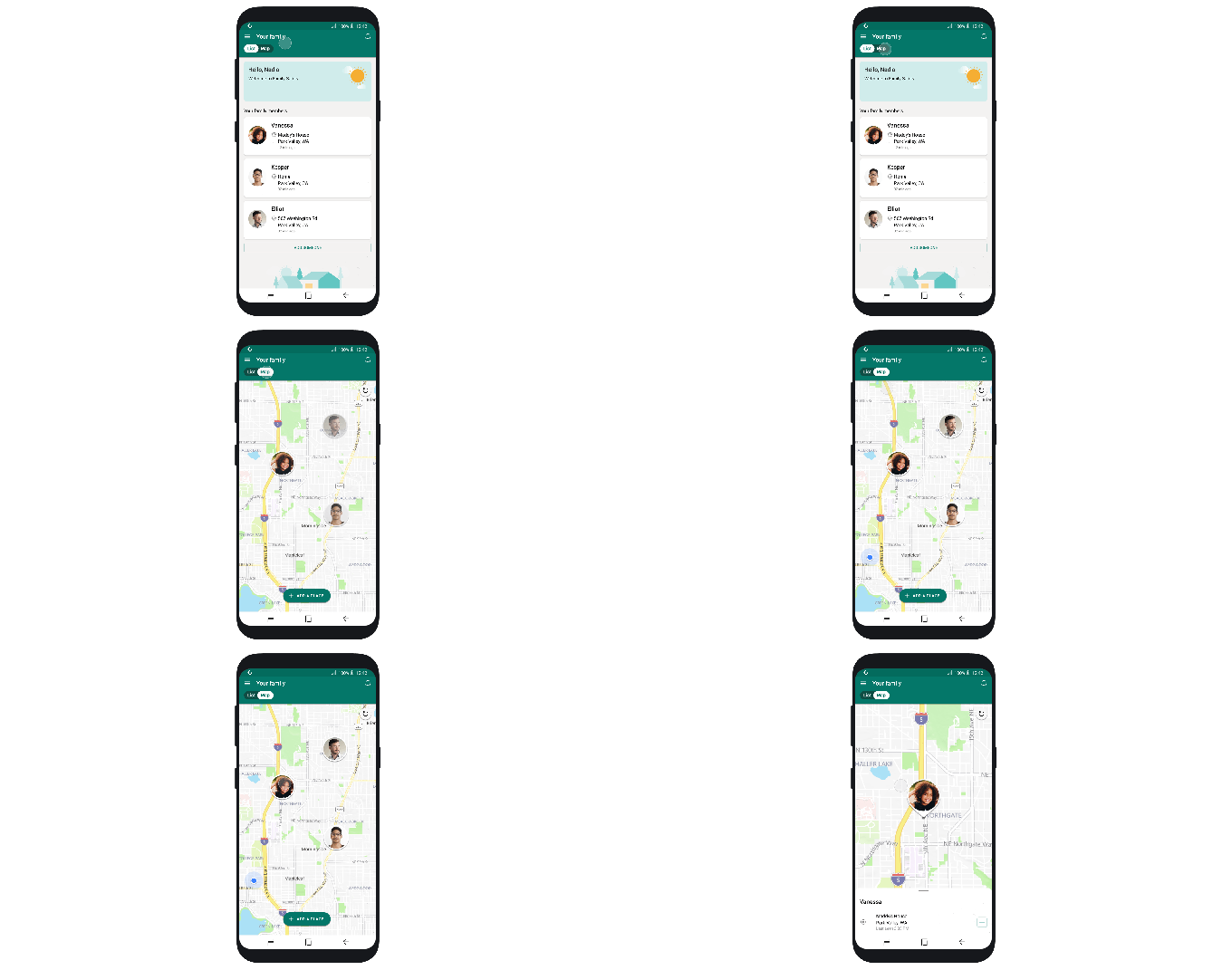
Image Credits: Microsoft

Since its preview period, Microsoft has expanded the app’s capabilities to include a handful of new features, including one that lets you block and unblock specific apps, a location clustering feature, and an expanded set of options for granting more screen time (e.g 15 or 30 mins., 1, 2, or 3 hours, etc.). Accessibility options were also updated and improved, including improved visual contrast for low vision users and additional context for screen readers.

You’ll note, however, that some of Family Safety’s experience don’t fully extend to iOS and Android, like purchase controls and web filtering. On iOS, the app can’t even track screen time usage as Apple makes no API available for this, even after launching its own screen time service and shutting down competing apps.

That’s due to how other platforms have their own operating systems and ecosystems locked down to encourage customers to only buy and use their devices. Unfortunately, that means families that have devices from a variety of vendors — like iPhone users who also game on Xbox, or Android users whose computer is a Mac, for instance — don’t have simple tools that let them manage everything from one place.

Microsoft says it will soon roll out two new features to Family Safety following its launch. These include location alerts and drive safety (e.g. aimed teen drivers),, and will be a part of a paid Microsoft 365 Family Subscription.

The new Family Safety app is rolling out now for iOS and Android as a free download. You may not be able to immediately access the app due to its phased rollout, but should sometime this week.

28 Jul 2020

Alcohol delivery service Drizly confirms data breach

Online alcohol delivery startup Drizly has told customers that it was hit by a data breach.

In an email to customers obtained by TechCrunch, the company said that a hacker “obtained” some customer data. The hacker took customer email addresses, date-of-birth, hashed passwords, and in some cases delivery address, the email read.

Drizly did not say when the hack occurred or how many accounts were affected, but did advise users to change their passwords. We reached out to the company for comment but didn’t immediately hear back.

The company said that no financial data was taken in the breach. But a listing on a dark web marketplace from a well-known seller of stolen data claims otherwise.

The listing was posted in February 2020. (Screenshot: TechCrunch)

The listing, which we are not linking to, claims to have “fresh hacked” [sic] Drizly accounts. The seller did not say when the breach took place, but the listing appears to have been posted on February 13. The listing also did not say how many accounts were for sale. Although no sample of data was offered, the listing claims to have valid Drizly credit cad numbers and users’ order history.

The data is for sale for $14, the listing says. TechCrunch has questions in to the seller.

Drizly has become one of the biggest online alcohol delivery services in the U.S. and Canada, raising over $68 million to date, rivaling Minibar and Delivery.com.


Send tips securely over Signal and WhatsApp to +1 646-755-8849, or email: zack.whittaker@protonmail.com

28 Jul 2020

Alcohol delivery service Drizly confirms data breach

Online alcohol delivery startup Drizly has told customers that it was hit by a data breach.

In an email to customers obtained by TechCrunch, the company said that a hacker “obtained” some customer data. The hacker took customer email addresses, date-of-birth, hashed passwords, and in some cases delivery address, the email read.

Drizly did not say when the hack occurred or how many accounts were affected, but did advise users to change their passwords. We reached out to the company for comment but didn’t immediately hear back.

The company said that no financial data was taken in the breach. But a listing on a dark web marketplace from a well-known seller of stolen data claims otherwise.

The listing was posted in February 2020. (Screenshot: TechCrunch)

The listing, which we are not linking to, claims to have “fresh hacked” [sic] Drizly accounts. The seller did not say when the breach took place, but the listing appears to have been posted on February 13. The listing also did not say how many accounts were for sale. Although no sample of data was offered, the listing claims to have valid Drizly credit cad numbers and users’ order history.

The data is for sale for $14, the listing says. TechCrunch has questions in to the seller.

Drizly has become one of the biggest online alcohol delivery services in the U.S. and Canada, raising over $68 million to date, rivaling Minibar and Delivery.com.


Send tips securely over Signal and WhatsApp to +1 646-755-8849, or email: zack.whittaker@protonmail.com

28 Jul 2020

SAP decision to spin out Qualtrics 20 months after spending $8B surprises industry watchers

When SAP announced it was spinning out Qualtrics on Sunday, a company it bought less than two years ago for an eye-popping $8 billion, it was enough to make your head spin. At the time, then CEO Bill McDermott saw it as a way to bridge the company’s core operational with customer data, while acquiring a cloud company that could help generate recurring revenue for the ERP giant, and maybe give it a dose of innovation along the way.

But Sunday night the company announced it was spinning out the acquisition, giving its $8 billion baby independence, and essentially handing the company back to founder Ryan Smith, who will become the largest individual shareholder when this all over.

It’s not every day you see founders pull in a windfall like $8 billion, get sucked into the belly of the large corporate beast and come out the other side just 20 months later with the cash, independence and CEO as the largest individual stockholder.

While SAP will own a majority of the stock, much like Dell owns a majority of VMware, the company will operate independently and have its own board. It can acquire other firms and make decisions separately from SAP.

We spoke to a few industry analysts to find out what they think about all this, and while the reasoning behind the move involves a lot of complex pieces, it could be as simple as the deal was done under the previous CEO, and the new one was ready to move on from it.

Bold step

It’s certainly unusual for a company like SAP to spend this kind of money, and then turn around so quickly and spin it off. In fact, Brent Leary, principal analyst at CRM Essentials, says that this was a move he didn’t see coming, and it could be related to that fat purchase price. “To me it could mean that SAP didn’t see the synergies of the acquisition panning out as they had envisioned and are looking to recoup some of their investment,” Leary told TechCrunch.

Holger Mueller, an analyst with Constellation Research agreed with Leary’s assessment, but doesn’t think that means the deal failed. “SAP doesn’t lose anything in regards to their […] data and experience vision, as they still retain [controlling interest in Qualtrics] . It also opens the opportunity for Qualtrics to partner with other ERP vendors [and broaden its overall market],” he said.

Jeanne Bliss, founder and president at CustomerBLISS, a company that helps clients deliver better customer experiences sees this as a positive step forward for Qualtrics. “This spin off enables Qualtrics to focus on its core business and prove its ability to provide essential technology executives are searching for to enable speed of decision making, innovation and customization,” she said.

Show me the money

Patrick Moorhead, founder and principal analyst at Moor Insight & Strategy sees the two companies moving towards a VMware/Dell model where SAP removes the direct link between them, which could then make them more attractive to a broader range of customers than perhaps they would have been as part of the SAP family. “The big play here is all financial. With tech stocks up so high, SAP isn’t seeing the value in its stock. I am expecting a VMware kind of alignment with a strategic collaboration agreement,” he said.

Ultimately though, he says the the move reflects a cultural failure on the part of SAP. It simply couldn’t find a way to co-exist with a younger, more nimble company like Qualtrics. “I believe SAP spinning out Qualtrics is a sign that its close connection to create symbiotic value has failed. The original charter was to bring it in to modernize SAP but apparently the “not invented here” attitudes kicked in and doomed integration,” Moorhead said.

That symbiotic connection would have involved McDermott’s vision of combining operational and customer data, but Leary also suggested that since the deal happened under previous the CEO, that perhaps new CEO Christian Klein wants to start with a clean slate and this simply wasn’t his deal.

Qualtrics for the win

In the end, Qualtrics got all that money, gets to IPO after all, and returns to being an independent company selling to a larger potential customer base. All of the analysts we spoke to agreed the news is a win for Qualtrics itself.

Leary says the motivation for the original deal was to give SAP a company that could sell beyond its existing customer base. “It seems like that was the impetus for the acquisition, and the fact that SAP is spinning it off as an IPO 20 months after acquiring Qualtrics gives me the impression that things didn’t come together as expected,” he said.

Mueller also sees nothing but postivies Qualtrics. “It’s a win […] for Qualtrics, which can now deliver what they wanted [from the start], and it’s a win for customers as Qualtrics can run as fast as they want,” he said.

Regardless, the company moves on, and the Qualtrics IPO moves forward, and it’s almost as though Qualtrics gets a do-over with $8 billion in its pocket for its trouble.

28 Jul 2020

Why aren’t Rackspace and BigCommerce worth more?

This week has brought with it two tasty pieces of IPO news — Rackspace’s return to the public markets and BigCommerce’s debut will be far more interesting now that we know what a first-draft valuation for each looks like.

But amidst the numbers is a question worth answering: why aren’t cloud-focused Rackspace and e-commerce-powering BigCommerce worth more?

Using a basic share count and the top end of their initial ranges, Rackspace is targeting a roughly $4.8 billion valuation, and BigCommerce a $1.3 billion price tag. Given that Rackspace had $652.7 million in Q1 2020 revenue and BigCommerce reaped $33.2 million in the same period, we have a puzzle on our hands.

Let me explain. At its IPO price, Rackspace is worth around 2x its current revenue run rate. For a company we associate with the cloud, that feels cheap at first glance. And BigCommerce is targeting a valuation of around a little under 10x its current annual run rate, which feels light compared to its competitor Shopify’s current price/sales ratio of of 66.4x (per YCharts data).

We did some maths to hammer away at what’s going on in each case. The mystery boils down to somewhat mundane margin and growth considerations. Let’s dive into the data, figure out what’s going on and ask ourselves if these companies aren’t heading for a second, higher IPO price range before they formally price and begin trading.

Margins and growth

Let’s unpack Rackspace’s IPO pricing first and BigCommerce’s own set of numbers second.

Rackspace

While Rackspace has a public cloud component, its core business is service-driven, so it isn’t a major cloud platform that competes with Microsoft’s Azure, Google’s GCP or Amazon’s AWS.  This isn’t a diss, mind, but a point of categorization.

The company has three reporting segments:

  • Multicloud Services
  • Apps & Cross Platform
  • OpenStack Public Cloud
28 Jul 2020

GoPro launches a line of bags, water bottles, and a hat because why the hell not

GoPro is now in the merch game with a new line of gear that prominently feature GoPro’s logo. From bags to hats, this gear is priced attractively and has the standard affair of features. But in the end, it’s about the GoPro brand. GoPro, even while struggling to remain relevant as sales drop, cultivated a rich brand identity and this merchandize embodies the GoPro lifestyle.

The line is called “Lifestyle Gear”, and it’s a nice sampling of outdoor gear featuring GoPro’s logo. Right now, there are nine products in the line but it’s easy to see room for expansion.

Outdoor gear is a massive market, and the products launched to by GoPro seem up to par with quality material and features. There are waterproof backpacks, durable duffles, and compact cases for the compact cameras. If done correctly, soft goods often sell with healthy margins, which could be a good win for GoPro.

GoPro has struggled the last few years after storming onto the scene. The stock has been under $10 a share since 2017 though it’s trending upward this year. Over the last few years, the company revamped its product offering several times, and most recently, started branching off into different products including flashlights and now soft goods. Right now, in the second half of 2020, the company sells four cameras, but two are carryovers from 2019.

28 Jul 2020

Disrupt 2020 early-bird savings vanish in just 4 days

Disrupt 2020 doesn’t arrive until September, but the countdown clock to early-bird savings winds to a halt in just four days. Grab this opportunity to attend one of the best tech conferences for all-things startup, cross this task off your to-do list and save up to $300. Simply buy your pass before the offer expires on July 31 at 11:59 p.m. PT.

What can you expect from attending Disrupt 2020? Opportunity and lots of it. It starts with five days of non-stop programming focused on — and delivered by — the people determined to shape the future of technology. This event draws thousands of entrepreneurs, founders, investors, developers and other players across the startup ecosystem and around the world looking to connect, collaborate, invest and drive their businesses forward.

You’ll hear leading voices from the tech, business and investment worlds share their insight and experience from the Main Stage. Folks like pioneering CRISPR researcher Jennifer Doudna, Zoom founder Eric Yuan and Sequoia Capital’s Roelof Botha. That’s just a taste of what’s on tap, and along with the agenda we’re announcing more speakers every week.

Take part in dozens of workshops and smaller breakout sessions that offer in-depth, knowledge-building experiences. Check out the Extra Crunch Stage for information every early-stage startup founder needs to know, like how to pivot in the face of a crisis and how to build a sales team. Engage in interactive Q&As and come away with actionable tips and tricks from experts in marketing, business development and investing.

Our virtual Disrupt platform lets you explore Digital Startup Alley where you’ll find hundreds of early-stage startups showcasing their tech products, platforms and services. Connect with the founders, ask questions, check out their pitch decks and use CrunchMatch, our AI-powered networking platform to schedule 1:1 video meetings.

Digital Startup Alley is also home to the TC Top Picks — a group of outstanding startups representing a range of technologies. They earned this coveted designation in our highly selective pre-conference competition. We’ll announce which companies made the grade this year soon, but take a look at last year’s TC Top Picks.

And of course, you’ll want to watch the cadre of the world’s best startups compete in the Startup Battlefield pitch competition. All of them will receive global investor and media exposure, but only one will win the $100,000, serious bragging rights and the Disrupt Cup. More than 900 companies have competed over the year including Vurb, Trello, Mint, Dropbox, Yammer and Tripit to name just a few.

This is your shot to access every opportunity Disrupt 2020 offers and save up to $300. The early-bird deal ends in just four days at 11:59 p.m. (PT) on July 31. What are you waiting for? Go buy your pass right now.

Is your company interested in sponsoring or exhibiting at Disrupt 2020? Contact our sponsorship sales team by filling out this form.

28 Jul 2020

Sign up to learn more about Startup Alley at an AMA this Thursday

Looking for ways to keep your business moving forward? Exhibiting in Startup Alley at Disrupt 2020 can be one of the smartest investments you’ll ever make. But don’t take our word for it. Instead, register to attend our Ask Me Anything Session (Startup Alley Edition) scheduled for July 30 at 4 p.m. ET/ 1 p.m. PT.

Open to startup founders across the globe, this event is your chance to hear from your peers who showed their stuff in the Alley. They’ve been there, done that — and got a whole lot more than a t-shirt (not that there’s anything wrong with swag). You’ve got questions — they’ve got answers.

This Ask Me Anything session will be live streamed from the TechCrunch LinkedIn page. We will begin with a brief overview of Disrupt and Startup Alley followed by a panel discussion moderated by the Startup Alley team. Panelists include veteran exhibitors Felicia Jackson, inventor and founder of CPRWrap, Khrys Hatch, Capital Program Manager at Launch Tennessee and Luke Heron, Founder and CEO of Testcard — who, as a TC Top Picks select in 2019, got to exhibit in the Startup Alley.

The panelists will share their experiences, the value and opportunities they found in Startup Alley, and how they’re doing one year later. They’ll also offer advice on maximizing your Startup Alley experience and take questions from the virtual audience (that means you).

Our Director of Events, Emma Comeau, will join the AMA session towards the end and give some insight into what the Disrupt community can expect at this year’s conference. She’ll provide some clarity. You’ll get to ask her a few questions.

TechCrunch Ask Me Anything Session (Startup Alley Edition) takes place on July 30 at 4 p.m. ET/ 1 p.m. PT. RSVP on the TechCrunch LinkedIn page for this free event.  Get answers to your burning questions and keep your business moving forward.

Is your company interested in sponsoring or exhibiting at Disrupt 2020? Contact the sponsorship sales team by filling out this form.

28 Jul 2020

VC Garry Tan shares 3 ways founders screw up their startups

There are many painful ways for a startup to fail — including founders who ultimately throw in the towel and turn off the lights.

But assuming a founder intends to keeps moving forward, there are a few pitfalls that Garry Tan has seen during his career as a founder, Y Combinator partner and, lately, co-founder of venture firm Initialized Capital.

During a fun chat during last week’s TechCrunch Early Stage, he ran us through these avoidable mistakes; for those who couldn’t virtually attend, we’re sharing them with you here.

 1. Chasing the wrong problem

This sounds insane, right? How can you be blamed for wanting to solve a problem?

Tan says people choose the wrong problem for a wide variety of reasons: Founders sometimes choose a problem that isn’t problematic for enough people, he said, citing the example of a hypothetical 25-year-old San Francisco-based engineer who may be out of touch with the rest of the country. When founders target the wrong problem, it typically means that the market will be too small for a venture-like return.

28 Jul 2020

Y Combinator Demo Day to remain virtual and will be streamed live

After feedback from the investor and founder communities, Y Combinator is making a change to how it does Demo Days in a remote world. The accelerator announced today that it will keep its two-day Demo Day virtual, but instead of offering pre-recorded pitches on-demand, the entire program will be streamed live.

In an e-mail, Y Combinator said the feedback was that “founders enjoyed the bonding experience involved in prepping for a live demo day and investors like seeing the founder pitch their businesses personally.”

“We’ve decided that a live Demo Day is an important part of founders’ YC experience,” Michael Seibel, Y Combinator’s CEO, wrote in a blog post.

The thirty-first Demo Day will be live over Zoom, splitting the batch between two days. Each company will have one minute to present, with a single-slide summary, description and team bio available on the website for attendees to peruse. If you can’t attend, recordings will be published at the end of the week.

The accelerator told TechCrunch that presentations will kick off at 9 a.m. PST and end at noon, with breaks scheduled throughout the day. Similar to past Demo Days, investors will be able to indicate interest in investing and share contact information with founders through YC Demo Day software.

Startups that deferred Demo Day in years past will present at the upcoming Demo Day. Deferring to present on Demo Day is fairly common and happens when founders are not yet ready to present their startup to the VC and tech press community. In a remote world, some startups may opt for this route until things turn back to normal (if that ever happens, of course).

For founders participating in remote accelerators, a question remains: Is the new format worth the equity? Y Combinator says that the most recent cohort is the first batch to participate in an entirely remote program, run entirely through the COVID-19 lockdown.

Founders recently shared with me the ups and downs of this accelerator season. One founder, Michael Vega-Sanz, recommends that first-time founders attend a physical accelerator instead of a virtual one for the energy it brings.

“If you’re a competitive person, like we were, you’ll see other companies kicking butt, getting praised in front of everybody,” he said. “I know this sounds a bit narcissistic, but we were like, ‘Damn, we really need to pick our game up.’ ” Peer competition might sound insignificant, but founders, much like investors, thrive on FOMO and rivalries.

Y Combinator going live feels like an attempt at bringing excitement and earnestness to the pitch experience. Techstars did a live, virtual demo day earlier in the pandemic, even bringing on Ice-T to congratulate the founders participating through a Cameo.

YC Demo Day will be August 24 and 25.