Year: 2020

24 Jul 2020

Data from Dutch public broadcaster shows the value of ditching creepy ads

For anyone interested in the contested question of how much ‘value’ — or, well, how little — publishers derive from the privacy-hostile practice of tracking web users to behaviorally target them with ads, pro-privacy browser Brave has published some interesting data, obtained (with permission) from the Netherland’s public broadcaster, NPO.

The data shows the NPO grew ad revenue after ditching trackers to target ads in the first half of this year — and did so despite the coronavirus pandemic landing in March and dealing a heavy blow to digital advertising globally (contributing, for example, to Twitter reporting Q2 ad revenues down nearly a quarter).

The context here is that in January the broadcaster switched to serving contextual ads across its various websites, where it has an online video audience of 7.1M per month, and display reach of 5.8M per month.

Brave has published an analysis of six months’ worth of data which shows NPO’s ad revenue increased every month over this period. Year-over-year increases after the broadcaster unplugged the usual morass of background adtech that makes surveillance capitalism ‘function’ are as follows:

  • January: 62%; February 79%; March 27%; April 9%; May 17%; June 17%;

Earlier this month Brave published five months’ worth of the NPO ad revenue data. So this is actually an update on an earlier blog post on the topic. The updated figures from Ster, the NPO’s ad sales house, slightly amend the earlier amounts, revising the reported figures further upwards. So, in short, non-tracking ad revenue bump has been sustained for half a year. Even amid a pandemic.

Now the idea that switching from behavioral to contextual targeting can leads to revenue growth is not a narrative you’ll hear from the ad tracking industry and its big tech backers. Aka the platform giants whose grip on the Internet’s attention economy and the digital infrastructure used for buying and selling targeted ads has helped them to huge profits over the past half decade or so (even as publisher revenues have largely stagnated or declined during this boom period for digital ad spending).

The adtech industry prefers to chainlink tracking and targeting to ad revenue — claiming publisher revenues would tank if content producers were forced to abandon their reader surveillance systems. (Here’s Google’s VP of ad platforms, last year, telling AdExchanger that the impact of tracker blocking on publishers’ programmatic ad revenues could cut CPMs in half, for example.)

Yet it’s not the first time there’s been a report of (surprise!) publisher uplift after ditching ad trackers.

Last year Digiday reported that the New York Times saw its ad revenue rise in Europe after it switched off creepy ads ahead of a major regional regulatory update, shifting over to contextual and geographical targeting.

The NYT does have a certain level of brand cache which not every publisher can claim. Hence the tracking industry counterclaims that its experience isn’t one that can be widely replicated by publishers. So the NPO data is additionally interesting in that it shows revenue uplift for a public broadcaster even across websites that aren’t dominant in their particular category, per Brave’s analysis.

Here’s its chief policy & industry relations officer, Dr Johnny Ryan

NPO and its sales house, Ster, invested in contextual targeting and testing, and produced vast sales increases even with sites that do not appear to dominate their categories. This may be a tribute to Ster’s ability to sell inventory across NPO’s media group as a collective, but this benefit would have applied in 2019 and does not account for the revenue jump in 2020. A publisher does not therefore need to have market dominance to abandon 3rd party tracking and reproduce NPO’s vast revenue increase.

And here’s Ryan’s take on why “legitimate” (i.e. non junk/clickbait) publishers of all sizes should be able to follow the NPO’s example:

Although it is a national broadcast group, NPO websites do not dominate the web traffic rankings in the Netherlands. Only one of NPO’s properties (Nos.nl) ranks in the top 5 in its category in the Netherlands, according to Similar Web. None of the other NPO properties are in the Netherland’s top 100. The other NPO websites for which Similar Web provides a traffic rank estimation (versus other websites in the Netherlands) range from 180th to 5,040th most popular in the Netherlands. NPO properties’ popularity or market position in each content category are not correlated with increases in impressions sold. Country site rank, category site rank, and numbers of page views, vary widely between the properties, whereas the increases in impression sold are all above 83%, with one explicable exception [due to technical difficulties over the tracked period which prevented ads being served against one of its most popular programs].

Brave has its own commercial iron in the fire here, of course, given its approach to monetizing user eyeballs aligns with an anti-tracking marketplace ethos. But that hardly takes away from the NPO’s experience of — surprise! — revenue growth from ditching creepy ads.

Joost Negenman, NPO’s privacy officer, told TechCrunch they had certainly not expected to see ad revenue uplift from making the switch. The decision to move to contextual ads was made mid last year, as a result of the public broadcaster becoming “convinced” the programmatic targeting ad system it was using wasn’t compatible with its “public task”, as he tells it.

“We expected a rather dramatic drop in revenue,” says Negenman, noting that at that time the NPO was only getting a consent rate from users of around 10% for the ad cookies Ster needed for its programmatic ad system — down from 75%+ prior to GDPR (“probably” because its Cookie Consent Module at the time had been based on “implicit instead of explicit consent”; whereas GDPR mandates for consent to be legally valid it must be specific, informed and freely given).

“We also expected a drop because advertisers could completely ignore us when NPO and Ster turned away from this market adtech standard together, at a time when there was no sophisticated alternative in place,” he continues. “This fortunate misjudgment on our side was also fuelled by the strong belief (and preaches) in programmatic ad-solutions by online marketeers and companies.”

Negenman attributes the surprise revenue bounty from selling contextual ads to a couple of factors: Namely the “A-brand” pull of NPO and its affiliate broadcasters, meaning advertisers still wanted to be able to reach their users. And, well, to having the pro-privacy zeitgeist on its side.

“We’re all aware of the growing scrutiny on the adtech business, no explanation needed!” he says.

It’s worth noting the NPO’s switch to contextual ads did require some investment to pull off. The publisher shelled out for technology to enable contextual targeting across its web properties — such as building out descriptive metadata to enable more granular contextual targeting on video content. And the level of investment required to achieve similarly sophisticated contextual ad targeting might not be available to every publisher.

Yet the sustained revenue bump NPO experienced post-switch means it very quickly earned back what it spent — so for publishers that can afford to invest up front in transitioning away from tracking it looks like a very compelling case study.

“It paid for itself within a month or so!” confirms Negenman. “Considering all the money Ster didn’t have to share with Google and other in-betweens. From 1 advertisement Euro, 1 Euro goes to Ster!”

Though he also notes the broadcaster was helped by Dutch law placing an obligation on it to have subtitles for over 90% of its assets — meaning some of the leg work to build out contextual targeting had already been done.

“Subtitles data of course provides valuable descriptive metadata. So those tools where already in place,” he says. “But beside subtitles — that are nowadays easier to automate — standard program information like (sub)genre, titles of actors are of great value as well to add context on a video asset.”

Brave’s Ryan posits that the role of NPO’s sales house is also important to its success with contextual ads. “Smaller publishers may benefit from engaging with reputable sales houses that can aggregate supply as Ster does for NPO’s various properties,” he suggests. “Publishers of all sizes will benefit according to their reputations — unless advertisers and agencies purchase from sales houses with poor reputations.”

Asked whether he believes the switch would work for all publishers, Negenman does not go that far.

“For all A-brands I definitely see this approach working, also news outlets have the perfect (meta)data needed to feed such a system,” he says, arguing there’s a place in the market for both contextual and targeted ads.

“Not all online advertising is the same,” he argues. “A shoe annoyingly following you online is something other than creating (A-)brand awareness. Perhaps the contextual system can start by creating privacy friendly ‘lagoons’ where a person is not tracked or followed by a shoe. There the system gets time to prove its worth in revenue and respect for its audience.”

“For other public broadcasters I believe they have more or less an (moral) obligation to at least start testing contextual ads,” he adds. “The adtech system’s use of personal and behavioral data has become so un-explainable that the GDPR information obligation is almost impossible to meet.”

As we’ve said before, the evidence of viable alternatives to privacy-torching surveillance capitalism is stacking up — even as harms linked to adtech platforms’ exploitation of people’s information keep piling up.

And while contextual ads may not sum to a revenue boom for every type of publisher, the notion that it’s tracking or nothing is clearly bogus.

(You could also make a pretty compelling case that abusive exploitation of people’s data that sustains low grade publishing is not at all a net societal good and so supporting a system that supports bottom feeding clickbait (and massive levels of ad fraud) is simply bad for everyone — other than the bottom feeders… )

Ryan goes so far as to call conventional adtech “a cancer eating at the heart of legitimate publishers”. And having worked inside the beast he’s castigating, via an earlier stint at anti-ad-blocking adtech company called PageFair, his critique is all the more hard hitting.

He’s used his insider knowledge to file a number of complaints with European regulators — most notably against the real-time bidding (RTB) practice programmatic advertising can rely on, drawing in vast quantities of Internet users’ personal information and scattershotting it back out again.

He contends this high velocity trading of personal data can’t possibly be compliant with Europe’s data protection framework — which, conversely, mandates that people’s information be securely handled, not spread around like confetti. (Though he believes RTB can work fine if you strip out personal data and only use it for contextual ads.)

European data protection regulators agree there’s a ‘lawfulness’ problem with current adtech practices. But have so far sat on their hands rather than taking enforcement action, given how widespread the problem is.

(Interestingly, Negenman says they investigated continuing using programmatic RTB but with personal data stripped out. Though, in the event, he says this idea never got past the production stage. “Personally I can imagine a compliant combination,” he notes, adding: “Most importantly, the personal data must not leave the trusted data partner [and be shared with] the advertisers.”)

Turning a tanker clearly takes time. But the more publishers that see not pushing creepy ads on their users as an opportunity to experiment with alternatives, the more chance there will be for the market to shift wholesale for privacy — a shift that can be a huge win for publishers and users alike, as the NPO experience illustrates. And for society more generally. 

Competition regulators, meanwhile, are closing in on big (ad)tech’s market power — and the conflicts of interest that arise from “vertically integrated chain of intermediaries” which work to funnel the lion’s share of digital ad spend into its coffers. So it’s not hard to conceive of an intervention to force market reform by breaking up Google’s business empire — to separate the ‘ad’ bits from its other ‘tech’.

The self-interested forces that underpin surveillance capitalism made their fortunes when no one was really looking at how their methods exploit people’s data. Now, with many more eyes trained on them, they are operating on borrowed time. It’s no longer a question of whether change is coming. The sands are shifting, with platforms themselves now moving to limit access to third party tracking cookies.

Savvy publishers would do well to get out ahead of the next round of platform power moves — and skate to where the puck’s headed.


24 Jul 2020

Entri raises $3.1M to build a vernacular language ‘Udemy for India’

Scores of online learning startups have emerged in India in recent years to serve school-age students. More than 250 million students are enrolled across schools in urban and rural parts of the country.

Whether one is in kindergarten, or preparing to join a college to pursue an undergraduate course, there are several startups offering a plethora of courses at affordable price points to help these students get there.

Byju’s, Unacademy, and Vedantu among other local startups today help tens of millions of students each year gain access to high-profile and established teachers and a repository of study material that many might not have been able to find in an offline setting.

These startups — and legacy educational institutions — are helping students chase some of the most aspirational jobs: Career in engineering, and medicine.

Most of these students, however, will either end up not getting their dream job — or based on their skills and India’s growing unemployment figures, a job altogether.

There are about 400 million people in India, or roughly a third of the country’s population, who are confronting a fundamental challenge: Not able to speak English, and lack other skills that could prove crucial when they apply for a job.

Entri, a startup based in the Southern city of Kochi, is attempting to address this market. The three-year-old startup offers upskilling courses to help people excel at exams that would land them a job with state and federal governments. And it teaches them these courses in the language they are most comfortable with.

Students who dropped out before high-school to those who have already attained graduate-level degrees account for the vast majority of users of Entri,

The startup began its courses in Malayalam, a language spoken by about 50 million people in India and especially popular in South India, explained Mohammed Hisamuddin, co-founder and chief executive of Entri. It has since added its courses in several other languages including Hindi, Telugu, Kannada, and Tamil.

Over the years, Entri has also expanded its course catalog to help people pursuing other kinds of jobs including those in blue-collar category, replicating a model similar to that of San Francisco-headquartered Udemy .

The team at Kochi-based startup Entri. (Photo provided by Entri)

“We soon realized that only about 1.5 to 2% of the people who appear in these exams are able to make the shortlist,” he said. “These exams are very competitive, so many start to explore jobs in the private sector, sometimes even when they already have some low-profile job.”

The startup now offers more than 150 courses, including several languages, accounting, and those that teach popular computer applications such as Microsoft Office. These pre-recorded video courses and quizzes run for 30 to 60 days.

“Starting with the 100 million people who apply for government jobs each year, Entri is expanding the universe of employable candidates by skilling people in their own language — as it should be,” said Arjun Malhotra, a partner at venture firm Good Capital. It’s ridiculous that economic opportunities are bottlenecked because of the medium of learning. Skills bringing employability shouldn’t require people to be proficient in English.

Hisamuddin said Entri has amassed over 3 million users on its platform, up from 1.5 million early this year. About 90,000 of these users are paying subscribers. “We are adding close to 10,000 paying subscribers each month now,” he said in an interview with TechCrunch early this week.

Entri offers about a portion of its courses in certain languages at no charge, but complete access requires a subscription. Paid subscription starts at as low as 300 Indian rupees a year ($4) and goes as high as 10,000 Indian rupees ($133), said Hisamuddin. The most popular subscription tier costs 1,500 Indian rupees ($20).

The startup said this week that it had closed a $3.1 million Pre-Series A financing round, led by Good Capital. Hari TN, head of human resources at online grocery startup BigBasket, and HyperTrack founder Kashyap Deorah also participated in the round.

It plans to deploy the fresh capital into introducing 50 additional courses to its platform and reach more users. Hisamuddin said Entri’s revenues have surged 150% in the last three months and its annual recurring revenue (ARR) has reached $2 million. He aims to scale Entri’s ARR to $5 million by this year.

24 Jul 2020

PlayVS founder Delane Parnell is coming to Disrupt 2020

Gaming has always been one of the world’s most massive niches, but as game-streaming and eSports have drifted to the forefront of mainstream culture, it’s clear that there’s plenty of room left for the industry to expand. One harbinger of this shift has been the widespread adoption of eSports leagues in high schools and colleges across the country, a movement that has pushed online gameplay as just another athletic program schools should be offering.

One of the central catalysts of this change has been Delane Parnell, whose company PlayVS has pushed school districts in the United States to embrace eSports, all while courting venture capitalists to shower the startup with tens of millions in funding.

We’re amped to announce that Parnell is joining us at TechCrunch Disrupt in September to discuss the future of eSports competition and gaming’s continued mainstream drift.

Parnell started PlayVS in 2018, hoping to bring high schools into the fold of eSports competitions. Through an exclusive partnership with the NFHS (the NCAA of high schools), PlayVS enables schools across America to build teams and compete against neighboring schools on its platform.

Last year, the company picked up a $50 million Series C, bringing their total funding to a whopping $96 million. With the COVID-19 pandemic threatening the future of in-person sporting events at school districts, eSports leagues are likely to be less impacted, an outcome which could gather even more momentum for the company’s platform.

Hear how it all got started, and what’s next in the world of online gaming, from Parnell at Disrupt 2020 on September 14-18. Get a front-row seat with your Digital Pro Pass for just $245 or with a Digital Startup Alley Exhibitor Package. Prices increase next week so grab yours today!

24 Jul 2020

Are insurtech startups undervalued?

On the heels of Hippo’s funding round and our exploration of how the private markets appear to be more conservative than public investors at the moment, we’re asking a new question: are a bunch of insurtech startups undervalued?

Hippo — an insurtech startup focused on home insurance — put together a $150 million round at a $1.5 billion post-money valuation after growing its gross written premium to $270 million “in the past 12 months.” At that valuation, and at pre-adjustment premium scale, Hippo is super-cheap compared to Lemonade, another venture-backed insurtech startup that just went public.


The Exchange explores startups, markets and money. You can read it every morning on Extra Crunch, or receive it for free in your inbox. Sign up for The Exchange newsletter, which drops Saturdays starting July 25.


There’s no need to relitigate Hippo’s valuation and how the private markets have valued the firm. But our work yesterday does give us the chance to do some fun math on other players in the neo-insurance space, namely, Root and MetroMile. Using data accrued from financial filings and valuation data from Pitchbook and Crunchbase, we can grok how much the two firms are worth using Hippo’s and Lemonade’s current premium multiples.

If you aren’t familiar, the cohort of startups we’re looking at have raised well over $1 billion as a group; VCs really believe in them. How they are priced then, and how they exit, will help determine the results of many a venture fund.

So, are other players in the startup insurance market cheap at their last private price when compared to Lemonade and Hippo? Did their venture backers overpay? Let’s find out.

Cheap? Expensive?

24 Jul 2020

The 3% gap in no-code

Hello and welcome back to Equity, TechCrunch’s venture capital-focused podcast (now on Twitter!), where we unpack the numbers behind the headlines.

Up top the crew this week was the regular contingent: Danny Crichton, Natasha Mascarenhas, and myself. As a tiny programming note, we’re going back to posting some videos on YouTube in a few weeks, so make sure to peep the TechCrunch channel if that’s your jam.

And we did a special episode on the SPAC boom, if you are into financial arcana. For more on SPAC’s –> here

The Equity crew tried something new this week, namely centering our main conversation around a theme that we’re keeping tabs on: The resilience of tech during the current pandemic-led recession.

Starting with the recent economic news, it’s surprising that tech’s layoffs have slowed to a crawl. And, as we’ve recently seen, there’s still plenty of money flowing into startups, even if there are some dips present on a year-over-year basis. Why are things still pretty good for startups, and pretty good for major tech companies? We have a few ideas, like the acceleration of the digital transformation (more here, and here), and software eating the world. The latter concept, of course, is related to the former.

After that it was time to go through some neat funding rounds from the week, including:

All that and I have a newsletter launching this weekend that if you read, you will automatically be 100% cooler. It’s called the TechCrunch Exchange, and you can snag it for free here.

Equity drops every Monday at 7:00 a.m. PT and Friday at 6:00 a.m. PT, so subscribe to us on Apple PodcastsOvercastSpotify and all the casts.

24 Jul 2020

NASA to fly a football stadium-sized high-altitude balloon to study light from newborn stars

NASA’s latest mission won’t actually reach space – but it will come very close, with a massive observation craft made up of a football stadium-sized high-altitude balloon, along with a special stratospheric telescope instrument that can observe wavelengths of light blocked by Earth’s atmosphere, cast from newly-formed stars.

The mission is called the ‘Astrophysics Stratospheric Telescope for High Spectral Resolution Observations at Submillimeter-wavelengths,’ but shortened to ASTHROS since that’s a mouthful. It is currently set to take off from Antartica in December 2023, and the main payload is an 8.4-foot telescope that will point itself at four primary targets, including two regions in the Milky Way where scientists have observed star formation activity.

That telescope, the largest ever to be flown in this way, will be held aloft by a balloon that will measure roughly 400 feet wide, when fully inflated, with scientists on the ground able to precisely direct the orientation of the business end of the observation instrument. It’s mission will include between two or three full loops around the South Pole, during a period spanning between three and four weeks as it drifts along high-altitude stratospheric winds. After that, the telescope will separate from the balloon and return to Earth slowed by a parachute so that it can potentially be recovered and reflow again in future to perform similar experiments.

While floating a balloon up to the edge of Earth’s atmosphere might sound like more of a relaxed affair than launching a satellite using an explosion-propelled rocket, NASA’s Jet Propulsion Lab engineer Jose Siles said in an agency release that balloon science missions are actually higher-risk than space missions, in part because many elements of them are novel. At the same time, however, they have the potential to provide significant rewards at a reduced cost relative to satellite launches on rockets.

The end goal is for ASTRHOS to create “the first detailed 3D maps of the density, speed and motion of gas” in these regions around newborn stars, in order to help better understand how they can impeded the development of other stars, or encourage the birth of some. This will be helpful in refining existing simulations of the formation and evolution of galaxies, the agency says.

24 Jul 2020

Apple begins assembling iPhone 11 in India

Apple’s contract manufacturing partner Foxconn has started to assemble the current generation of iPhone units — the iPhone 11 lineup — in its plant near southern city of Chennai, a source familiar with the matter told TechCrunch.

A small batch of locally manufactured iPhone 11 units has already shipped to retail stores, but the production yield is currently limited, the person said, requesting anonymity as matters are private. Apple, in general, has ambitions to scale up its local production efforts in India, the person said.

The local production of current iPhone 11 models illustrates Apple’s further commitment to India, the world’s second largest smartphone market, as it explores ways to cut its reliance on China, which produces the vast majority of iPhone models today.

Apple’s contract manufacturing partner Taiwan-based Wistron first began assembling older iPhone models in 2017. But until now, Apple has not been able to have an assembly partner produce the current generation iPhone model in India.

Wistron, which has locally assembled older iPhone SE, iPhone 6s, and iPhone 7 models in the past in its Bangalore plant, currently assembles iPhone XR units in India. Apple discontinued the local production of iPhone SE and iPhone 6s last year, the person said.

Piyush Goyal, India’s Minister of Commerce and Industry, tweeted on Friday that Apple had begun assembling iPhone 11 models in India. Apple did not comment on this story.

Assembling handsets in India enables smartphone vendors — including Apple — to avoid roughly 20% import duty that the Indian government levies on imported electronics products.

Xiaomi, Vivo, Samsung, Oppo, OnePlus, and a range of other smartphone companies, have inked deals with contract manufacturers across India in recent years to produce much of their locally sold smartphones units in the country itself.

Xiaomi, which has been the top smartphone vendor in India since late 2018, said earlier this month that nearly every smartphone it sells in India is produced in the country.

Apple has been exploring ways to ramp up its production in India for years, but the company has struggled to find contract manufacturers that adhered to its safety and quality standards, people familiar with the matter have told TechCrunch.

News outlet The Information reported in March that some of Apple’s other contract manufacturers have attempted to enter — or expand in — India, but have run into regulatory and local laws issues. Pegatron, another assembly partner of Apple, plans to set up a local subsidiary in India and begin operations in the country, according to Bloomberg.

Foxconn, which counts India as one of its biggest markets, plans to invest $1 billion in its operations in the country, Reuters reported earlier this month. New Delhi announced a $6.6 billion plan to attract top smartphone manufacturers in June this year.

Apple plans to launch its online store in India in a few months and open its first brick-and-mortar retail store next year, chief executive Tim Cook announced earlier this year. The online store’s launch in India remains on track despite the pandemic, a person familiar with the matter said.

23 Jul 2020

The Not Company, a maker of plant-based meat and dairy substitutes in Chile, will soon be worth $250M

The Not Company, Latin America’s leading contender in the plant-based meat and dairy substitute market, is about to close on an $85 million round of funding that would value it at $250 million, according to sources familiar with the company’s plans.

The latest round of funding comes on the heels of a series of successes for the Santiago-based business. In the two years since NotCo launched on the global stage, the company has expanded beyond its mayonnaise product into milk, ice cream, and hamburgers. Other products, including a chicken meat substitute are also on the product roadmap, according to people familiar with the company.

NotCo is already selling several products in Chile, Argentina and Latin America’s largest market — Brazil — and has signed a blockbuster deal with Burger King to be the chain’s supplier of plant-based burgers. It’s in this Burger King deal that NotCo’s approach to protein formulation is paying dividends, sources said. The company is responsible for selling 48 sandwiches per store per day in the locations where it’s supplying its products, according to one person familiar with the data. That figure outperforms Impossible Foods per-store sales, the person said.

NotCo is also now selling its burgers in grocery stores in Argentina and Chile. And while the company is not break even yet, sources said that by December 2021 it could be — or potentially even cash flow positive.

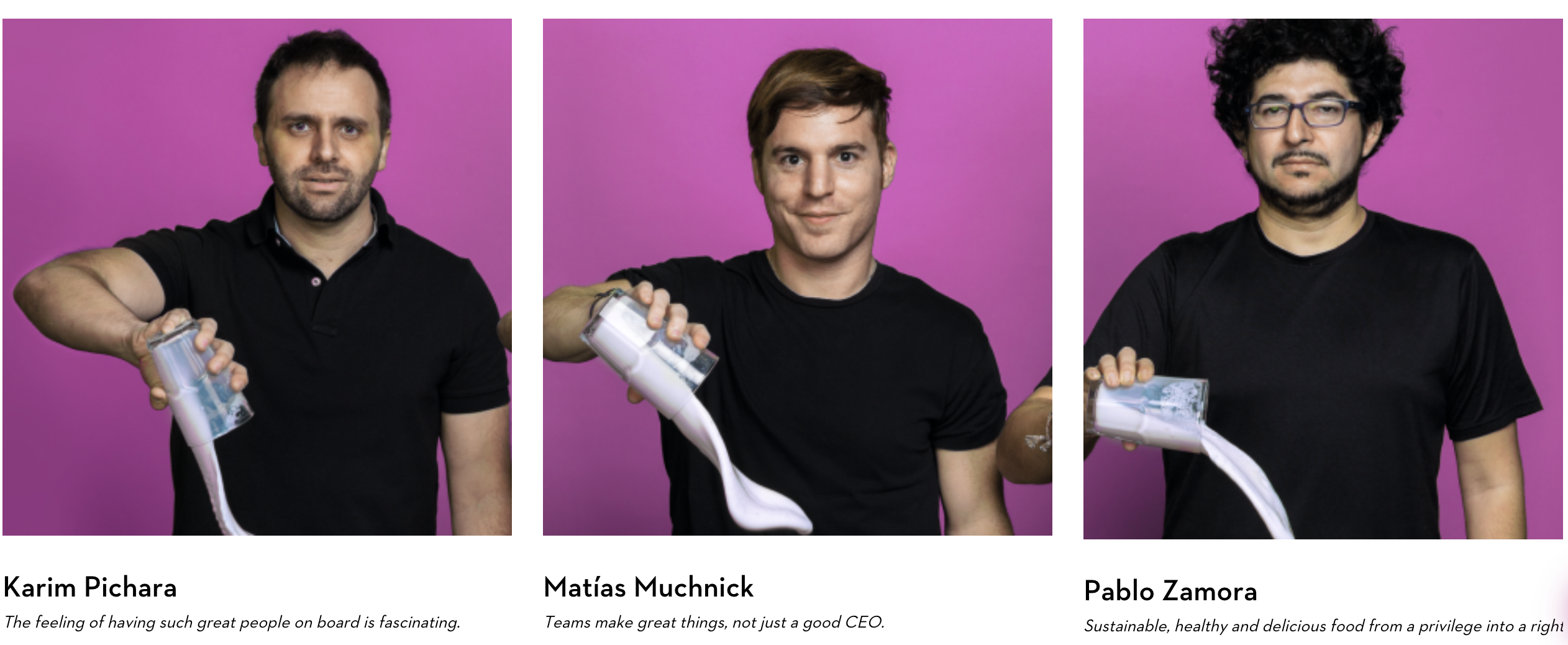
NotCo co-founders Karim Pichara, Matias Muchnick, and Pablo Zamora. Image Credit: The Not Company

With the growth both in sales and its diversification into new products, it’s little wonder that investors have taken note.

Sources said that the consumer brand focused private equity firm L Catterton Partners and the Biz Stone-backed Future Positive were likely investors in the new financing round for the company. Previous investors in NotCo include Bezos Expeditions, the personal investment firm of Amazon founder Jeff Bezos, the London-based CPG investment firm, The Craftory, IndieBio and SOS Ventures.

Alternatives to animal products are a huge (and still growing) category for venture investors. Earlier this month Perfect Day closed on a second tranche of $160 million for that company’s latest round of financing, bringing that company’s total capital raised to $361.5 million, according to Crunchbase. Perfect Day then turned around and launched a consumer food business called the Urgent Company.


These recent rounds confirm our reporting in Extra Crunch about where investors are focusing their time as they try to create a more sustainable future for the food industry. Read more about the path they’re charting.


Meanwhile large food chains continue to experiment with plant-based menu items and push even further afield into cell-based meat using cultures from animals. KFC recently announced that it would be expanding its experiment with Beyond Meat’s chicken substitute in the U.S. — and would also be experimenting with cultured meat in Moscow.

Behind all of this activity is an acknowledgement that consumer tastes are changing, interest in plant-based diets are growing, and animal agriculture is having profound effects on the world’s climate.

As the website ClimateNexus notes, animal agriculture is the second-largest contributor to human-made greenhouse gas emissions after fossil fuels. It’s also a leading cause of deforestation, water and air pollution, and biodiversity loss.

There are 70 billion animals raised annually for human consumption, which occupy one-third of the planet’s land arable and habitable land surface, and consume 16% of the world’s freshwater supply. Reducing meat consumption in the world’s diet could have huge implications for reducing greenhouse gas emissions. If Americans were to replace beef with plant-based substitutes, some studies suggest it would reduce emissions by 1,911 pounds of carbon dioxide.

23 Jul 2020

This startup reworked its privacy-friendly sensors to help battle COVID-19

One little-known home and retail automation startup might seem like an unlikely candidate to help combat the ongoing pandemic. But its founder says its technology can do just that, even if it wasn’t the company’s original plan.

Butlr, a spin-out of the MIT Media Lab, uses a mix of wireless, battery-powered hardware and artificial intelligence to track people’s movements indoors without violating their privacy. The startup uses ceiling-mounted sensors to detect individuals’ body heat to track where a person walks and where they might go next. The use-cases are near-endless. The sensors can turn on mood-lighting or air conditioning when it detects movement, help businesses understand how shoppers navigate their stores, determine the wait-time in the queues at the checkout, and even sound the alarm if it detects a person after-hours.

By using passive infrared sensors to detect only body heat, the sensors don’t know who you are — only where you are and where you’re heading. The tracking stops as soon as you leave the sensor’s range, like when you leave a store.

The technology is in high demand. Butlr says some 200,000 retail stores use its technology, not least because it’s far cheaper than the more privacy-invading — and expensive — alternatives, like surveillance cameras and facial recognition.

But when the pandemic hit, most of those stores closed — as effectively did entire cities and nations — to counter the ongoing threat from of COVID-19. But those stores would have to open again, and so Butlr got back to work.

Butlr’s privacy-friendly body heat sensors don’t know who you are — only where you are. Now the company is retooling its technology to help combat coronavirus. (Image: Butlr)

Butlr’s co-founder Honghao Deng told TechCrunch that it began retooling its technology to help support stores opening again.

The company quickly rolled out new software features — like maximum occupancy and queue management — to help stores with sensors already installed cope with the new but ever-changing laws and guidance that businesses had to comply with.

Deng said that the sensors can make sure no more than the allowed number of people can be in a store at once, and make sure that staff are protected from customers by helping to enforce social distancing rules. Customers can also see live queue data to help them pick a less-crowded time to shop, said Deng.

All these things before a pandemic might have sounded, frankly, a little dull. Fast forward to the middle of a pandemic and you’re probably thankful for all the help — and the technology — you can get.

Butlr tested its new features in China at the height of the pandemic’s rise in February, and later rolled out to its global customers, including in the United States. Deng said Butlr’s technology is already helping customers at furniture store Steelcase, supermarket chain 99 Ranch Market, and the Louvre Museum in Abu Dhabi to help them reopen while minimizing the risk to others.

It’s a pivot that’s paid off. Last month Butlr raised $1.2 million in seed funding, just as the pandemic was reaching its peak in the United States.

Nobody knew a pandemic was coming, not least Deng. And as the pandemic spread, businesses have suffered. If it wasn’t for quick thinking, Butlr might’ve been another startup that succumbed to the pandemic.

Instead, the startup is probably going to help save lives — and without compromising anyone’s privacy.

23 Jul 2020

New York legislature votes to halt facial recognition tech in schools for two years

The state of New York voted this week to pause any implementation of facial recognition technology in schools for two years. The moratorium, approved by the New York Assembly and Senate Wednesday, comes after an upstate school district adopted the technology earlier this year, prompting a lawsuit in June from the New York Civil Liberties Union on behalf of parents. If New York Governor Andrew Cuomo signs the legislation into law, the moratorium would freeze the use of any facial recognition school systems in the state until July 1, 2022.

Earlier this week, a school district in Topeka, Kansas announced that it would employ facial recognition technology at a temperature check kiosk for staff as part of its plan to reopen schools. Unfortunately, such a system would not be capable of preventing asymptomatic spread of the virus—one of COVID-19’s most challenging features.

With the pandemic still ravaging the U.S., the issue of school reopening has become deeply politicized. In a briefing earlier this month, White House press secretary Kayleigh McEnany argued that “science should not stand in the way” of reopenings.

“Facial recognition companies will use any angle they can to market their product to schools—but this one is just absolutely ridiculous,” Fight for the Future Campaign Director Caitlin Seeley George said of the technology’s proposed school implementation in Kansas. “Facial recognition will not stop the spread of COVID-19, and schools shouldn’t buy into this hokum.”

New York’s moratorium was viewed as a major victory by digital privacy advocates, who call into question not only the surveillance technology’s potential concerns for civil liberties but also the tech’s ability to accomplish its stated goals at all. The efficacy of such technology has come under fire repeatedly in studies demonstrating high false positive rates and racial biases coded into the systems themselves.

“We’ve said for years that facial recognition and other biometric surveillance technologies have no place in schools, and this is a monumental leap forward to protect students from this kind of invasive surveillance,” NYCLU Education Policy Center Deputy Director Stefanie Coyle said.

“Schools should be an environment where children can learn and grow, and the presence of a flawed and racially-biased system constantly monitoring students makes that impossible.”