
Year: 2020

23 Jul 2020

HBO Max reached 4.1M subscribers in first month, despite lack of distribution on Roku and Fire TV

HBO Max, the AT&T-owned streaming service that combines HBO with WarnerMedia content, has grown to 4.1 million subscribers, since its launch on May 27. Combined, HBO and HBO Max reached a total of 36.3 million U.S. subscribers by the end of the second quarter, according to statements made by AT&T CEO John Stankey on today’s earnings call. That figure has grown 5% from the 34.6 million subscribers the properties together had at the end of last year.

The 4.1 million figure breaks down as around 3 million retail subscribers and over 1 million were wholesale subscribers who came to the new service via one of AT&T wireless plans, where the service is bundled.

Though it’s still early days for HBO Max, these numbers indicate that the vast majority of traditional HBO customers have not yet tried HBO Max, even though it’s free for them to use. Currently, HBO customers can authenticate with HBO Max using their cable or satellite TV provider account information. HBO Now subscribers, meanwhile, are automatically upgraded to Max across Hulu, mobile apps, select ISPs, and the HBO Now site.

The HBO strategy, from a consumer perspective, has been confusing. HBO is known as premium channel with mostly adult content. This chanel had been distributed across mobile devices as HBO GO for traditional pay TV customers and HBO Now for over-the-top users. With the launch of HBO Max, the goal has been to transform HBO into a broader offering for the whole family, similar to Netflix. To do so, HBO, WarnerMedia and other licensed content was combined under one roof.

AT&T said today that HBO Max customers spent, on average, 70% more time viewing the service on a weekly basis, compared with HBO Now. It also stressed the popularity of its original content, noting that all 6 of its new originals found themselves ranked among the top 25 viewed series on the platform. By August, HBO Max will have 21 new original series on the platform.

But WarnerMedia still wants to distribute “standard” HBO to its larger, existing customer base, and has a number of deals in place to do so across a variety of streaming TV services, like Hulu, and platforms, like Apple TV, in addition to numerous pay TV providers. In addition, HBO is sold as an add-on premium subscription across some platforms, like Amazon and Roku.

That makes it difficult for consumers to understand which version of HBO they can get and where it will work.

That significant challenge is made worse by the fact that WarnerMedia has not yet been able to ink deals for HBO Max with the two top streaming media platform providers in the U.S.: Amazon and Roku, which control 70% of the market. That means consumers who have heard of the new service won’t be able to find the app on these devices.

Stankey addressed this problem today when speaking to investors.

“We’ve tried repeatedly to make HBO Max available to all customers using Amazon Fire devices, including those customers that have purchased HBO via Amazon,” he said. “Unfortunately, Amazon has taken an approach of treating HBO Max and its customers differently than how they’ve chosen to treat other services, and their customers.”

The comments, which notably skip over any mention of Roku, come only days before Amazon CEO Jeff Bezos is set to testify before the House Judiciary Antitrust Subcommittee, along with CEOs from Apple, Google and Facebook, as part of the Committee’s ongoing investigation of potential anti-competitive practices in the digital marketplace.

One area of concern for the Committee is the power and control the tech companies have over their digital marketplaces, where they set terms, ban apps and services from distribution, and take commissions from businesses that compete with their own.

AT&T’s issue with Amazon, in this case, has to do with how it wants to distribute HBO Max across the media platforms. With its shift in strategy, AT&T aims to offer consumers a standalone app, similar to Netflix — as it does now on Apple TV and Android TV. But Amazon and Roku want to also sell subscriptions to HBO Max like they currently do for HBO through the Amazon Prime Video Channels platform and Roku’s Premium Subscription platform on The Roku Channel.

With Roku’s investment in The Roku Channel it’s been distancing itself from being the neutral platform it once was, as it’s now motivated to make deals that benefit its own goals around The Roku Channel’s subscription marketplace, the same as other non-neutral players, like Amazon. This is not a problem unique to HBO Max, either. NBCU’s new streaming service Peacock also failed to offer Roku and Fire TV support at launch, for similar reasons. Unfortunately, the consumer is the one who ultimately loses here as tech giants grapple over not only the dollars, but who will own the customer relationship in the long run.

Without distribution, AT&T’s WarnerMedia could be challenged to meet its goals for HBO Max.

The company, however, claims it’s still on track for 50-55 million HBO Max subscribers in the U.S by 2025. As part of this strategy, WarnerMedia also plans to launch HBO Max internationally and offer a lower-cost, as-supported version of the service sometime next year.
 

23 Jul 2020

Hear how three startups are approaching quantum computing differently at TC Disrupt 2020

Quantum computing is at an interesting point. It’s at the cusp of being mature enough to solve real problems. But like in the early days of personal computers, there are lots of different companies trying different approaches to solving the fundamental physics problems that underly the technology, all while another set of startups is looking ahead and thinking about how to integrate these machines with classical computers — and how to write software for them. At Disrupt 2020 on September 14-18, we will have a panel with D-Wave CEO Alan Baratz, Quantum Machines co-founder and CEO Itamar Sivan and IonQ president and CEO Peter Chapman. The leaders of these three companies are all approaching quantum computing from different angles, yet all with the same goal of making this novel technology mainstream.

D-Wave may just be the best-known quantum computing company thanks to an early start and smart marketing in its early days. Alan Baratz took over as CEO earlier this year after a few years as chief product officer and executive VP of R&D at the company. Under Baratz, D-Wave has continued to build out its technology — and especially its D-Wave quantum cloud service. Leap 2, the latest version of its efforts, launched earlier this year. D-Wave’s technology is also very different from that of many other efforts thanks to its focus on quantum annealing. That drew a lot of skepticism in its early days but it’s now a proven technology and the company is now advancing both its hardware and software platform.

Like Baratz, IonQ’s Peter Chapman isn’t a founder either. Instead, he was the engineering director for Amazon Prime before joining IonQ in 2019. Under his leadership, the company raised a $55 million funding round in late 2019, which the company extended by another $7 million last month. He is also continuing IonQ’s bet on its trapped ion technology, which makes it relatively easy to create qubits and which, the company argues, allows it to focus its efforts on controlling them. This approach also has the advantage that IonQ’s machines are able to run at room temperature, while many of its competitors have to cool their machines to as close to zero Kelvin as possible, which is an engineering challenge in itself, especially as these companies aim to miniaturized their quantum processors.

Quantum Machines plays in a slightly different part of the ecosystem from D-Wave and IonQ. The company, which recently raised $17.5 million in a Series A round, is building a quantum orchestration platform that combines novel custom hardware for controlling quantum processors — because once quantum machines reach a bit more maturity, a standard PC won’t be fast enough to control them — with a matching software platform and its own QUA language for programming quantum algorithms. Quantum Machines is Itamar Sivan’s first startup, which he launched with his co-founders after getting his Ph.D. in condensed matter and material physics at the Weizman Institute of Science.

Come to Disrupt 2020 and hear from these companies and others on September 14-18. Get a front-row seat with your Digital Pro Pass for just $245 or with a Digital Startup Alley Exhibitor Package for $445. Prices are increasing next week, so grab yours today to save up to $300.

23 Jul 2020

What your company can learn from the Bank of England’s resilience proposal

The outages at RBS, TSB and Visa left millions of people unable to deposit their paychecks, pay their bills, acquire new loans and more. As a result, the House of Commons’ Treasury Select Committee (TSC) began an investigation of the U.K. finance industry and found the “current level of financial services IT failures is unacceptable.” Following this, the Bank of England (BoE), Prudential Regulation Authority (PRA) and Financial Conduct Authority (FCA) decided to take action and set a standard for operational resiliency.

While policies can often feel burdensome and detached from reality, these guidelines are reasonable steps that any company across any industry can exercise to improve the resilience of their software systems.

The BoE standard breaks down to these five steps:

  1. Identify critical business services based on those that end users rely on most.
  2. Set a tolerance level for the amount of outage time during an incident that is acceptable for that service, based on what utility the service provides.
  3. Test if the firm is able to stay within that acceptable period of time during real-life scenarios.
  4. Involve management in the reporting and sign-off of these thresholds and tests.
  5. Take action to improve resiliency against the different scenarios where feasible.

Following this process aligns with best practices in architecting resilient systems. Let’s break each of these steps down and discuss how chaos engineering can help.

Identify critical business services

The operational resilience framework recommends focusing on the services that serve external customers. While internal applications are important for productivity, this customer-first mentality is sound advice for determining a starting place for reliability efforts. While it’s ultimately up to the business to weigh the criticality of the different services they offer, the ones necessary to make payments, retrieve payments, investing or insuring against risks are all recommended priorities.

23 Jul 2020

What your company can learn from the Bank of England’s resilience proposal

The outages at RBS, TSB and Visa left millions of people unable to deposit their paychecks, pay their bills, acquire new loans and more. As a result, the House of Commons’ Treasury Select Committee (TSC) began an investigation of the U.K. finance industry and found the “current level of financial services IT failures is unacceptable.” Following this, the Bank of England (BoE), Prudential Regulation Authority (PRA) and Financial Conduct Authority (FCA) decided to take action and set a standard for operational resiliency.

While policies can often feel burdensome and detached from reality, these guidelines are reasonable steps that any company across any industry can exercise to improve the resilience of their software systems.

The BoE standard breaks down to these five steps:

  1. Identify critical business services based on those that end users rely on most.
  2. Set a tolerance level for the amount of outage time during an incident that is acceptable for that service, based on what utility the service provides.
  3. Test if the firm is able to stay within that acceptable period of time during real-life scenarios.
  4. Involve management in the reporting and sign-off of these thresholds and tests.
  5. Take action to improve resiliency against the different scenarios where feasible.

Following this process aligns with best practices in architecting resilient systems. Let’s break each of these steps down and discuss how chaos engineering can help.

Identify critical business services

The operational resilience framework recommends focusing on the services that serve external customers. While internal applications are important for productivity, this customer-first mentality is sound advice for determining a starting place for reliability efforts. While it’s ultimately up to the business to weigh the criticality of the different services they offer, the ones necessary to make payments, retrieve payments, investing or insuring against risks are all recommended priorities.

23 Jul 2020

More evidence of increasing militarization of space as U.S. claims Russia satellite weapon test

The U.S. Space Command has released details about an alleged anti-satellite weapons test it suspects Russian of conducting using an existing probe already on orbit, The Verge reports. The Russian satellite in question is the same one that made headlines back at the beginning of 2020 when it seemed to be tailing an existing orbital U.S. spy satellite. That same spacecraft appears to have deployed some kind of projectile according to Space Command, which monitors objects currently in orbit around Earth.

General John Raymond of U.S. Space Command told the Verge that this represents “further evidence of Russia’s continuing efforts to develop and test space-based systems,” and pursing a strategy that could but U.S. and allied in-space assets at risk.

The militarization of space isn’t new, and parties on all sides have been pursuing development of both offensive and defensive in-space weapons technologies. One of the biggest potential risks lies in weapons that, like this one in theory, could be deployed from satellites to destroy others – potentially disabling key ground communications, intelligence or observation space-based infrastructure that is used to support command and control operations on terrestrial battlegrounds and in the defense or observation of key military assets.

Russia isn’t the only global power unnerving the U.S. when it comes to the militarization of space: An April test by India saw that nation demonstrate a ground-to-orbit anti-satellite missile system, which NASA Administrator denied as being “not compatible with human spaceflight.” India is hardly the first country to demonstrate this kind of capability, however, as the U.S., China and Russian have all performed similar tests.

The growing risk of orbit-to-orbit offensive weapons has had a dramatic effect on how militaries including that of the U.S. has changed its priorities for in-space assets. For instance, the Department of Defense and other U.S. defense and intelligence agencies appear to be shifting focus away from the large, geosynchronous satellites that were massively costly and relatively unique upon which they used to rely, and towards smaller, more nimble satellites that might operate in low Earth orbit and consist of constellations with built-in redundancy. They’ve also been actively funding the development of commercial small-scale launcher startups, which can offer more response orbital launch services even than SpaceX and other existing providers.

While there are obviously many vocal detractors regarding the militarization of space, the fact remains that it’s an area where a number of global superpowers have spent billions, since the potential tactical advantage it provides is immense. Based on the increasing frequency and more public nature of tests like this one, it’s a segment where the U.S. in particular will be only too happy to look for support from the private sector, including technology startups, that can provide creative and advanced solutions.


23 Jul 2020

When choosing a tech stack, look before you leap

When it comes to choosing a tech stack, the decisions you make today could have a cascading impact for years. On one hand you want to be cool and modern, but on the other, you want to build with technology you know — and sometimes getting to market is more important than riding the latest technology wave.

The problem is that your decisions can have consequences that result in technical debt, the concept that as you make one decision, you have to pay a debt of sorts to fix underlying structural problems in the code as the result of those decisions you made early on.

Before you start freaking out, it’s something that happens to every company and is really impossible to avoid — so you make your choices and get your product out the door.

At this week’s TechCrunch Early Stage conference, HappyFunCorp CEO and co-founder Ben Schippers and CTO Jon Evans spoke about choosing the optimal tech stack. The pair have built custom software for companies like Amazon, Samsung, WeWork and AMC, so they know a thing or two about the subject.

What to consider before choosing

Image Credits: HappyFunCorp

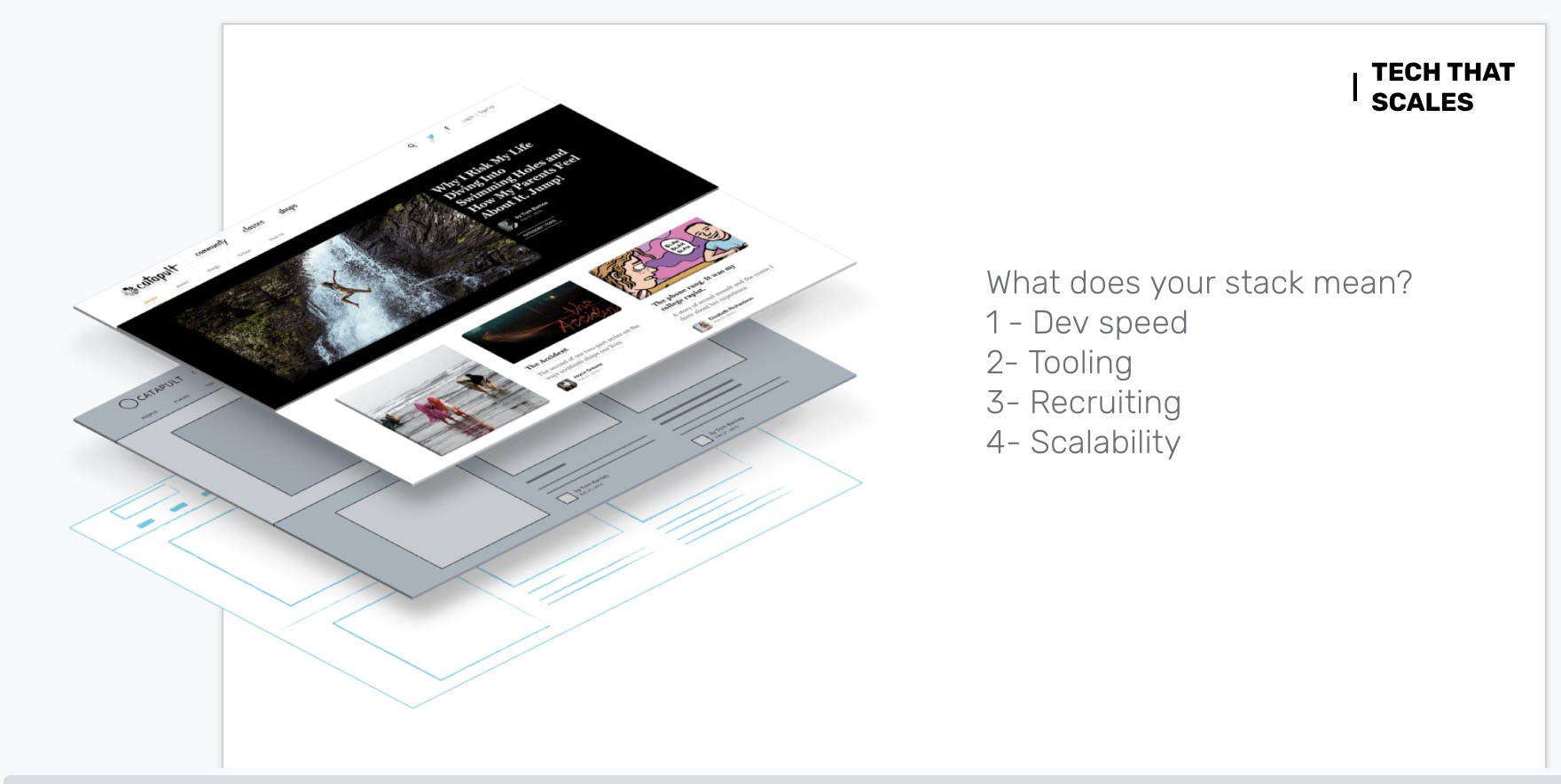
Evans says startups must weigh several key factors when choosing a tech stack, but development speed tops the list. “The single most key thing about your tech stack is speed,” he said. “The right stack will give you the most speed, compared to the alternatives.”

But early choices have other implications. “In the medium- to long-run, you have to be conscious about running up what we call technical debt, which is really the side effects of a spaghetti nest of bad code that is tightly coupled and leads to negative side effects all over the place,” he said.

23 Jul 2020

Tesla takes aim at Rivian in lawsuit alleging trade secret theft, poaching talent

Tesla filed a lawsuit against electric vehicle automaker Rivian and four former employers, on allegations of poaching talent and stealing trade secrets.

Bloomberg was the first to report the lawsuit filed in California Superior Court in Santa Clara.

Tesla alleges in the lawsuit that Rivian recruits Tesla employees and encourages them to take proprietary information as they leave. Tesla claims in the lawsuit that it has discovered an “alarming pattern” among employees who have recently left to join Rivian.

“As Tesla now knows, Rivian instructed one recently departing Tesla emplotee about the types of Tesla confidential information that Rivian needs. Both Rivan and the employee knew full well that taking such information would violate the employee’s non-disclosure obligation to Tesla. Nonetheless, the employee expropriated for Rivian the exact information Rivian sought — highly sensitive, trade secret information that would give Rivian a huge competitive advantage,” the complaint reads.

Tesla named four former employees the lawsuit, but added its investigation continues. The company claims has since identified two more former workers who have gone on to work at Tesla and alleges they “likely misappropriated Tesla trade secret, confidential or proprietary information.

The trade secrets identified in the complaint relate to recruiting practices and other documents related to finding and hiring talent such as salary rates and candidate lists. Other allegedly stolen documents related to manufacturing project management.

Tesla claims that Rivian has hired 178 former employees. About 70 of those employees joined the startup directly from Tesla.

In response, Rivian issued a statement to TechCrunch that calls the allegations baseless.

We admire Tesla for its leadership in resetting expectations of what an electric car can be. Rivian is made up of high-performing, mission-driven teams, and our business model and technology are based on many years of engineering, design and strategy development. This requires the contribution and know-how of thousands of employees from across the technology and automotive spaces. Upon joining Rivian, we require all employees to confirm that they have not, and will not, introduce former employers’ intellectual property into Rivian systems. This suit’s allegations are baseless and run counter to Rivian’s culture, ethos and corporate policies.

Rivian has become the latest company to be sued by Tesla over allegations of stealing trade secrets. Some of these cases, such as its 2017 lawsuit against AV startup Aurora, have been withdrawn altogether or ended in agreements. Others, like its lawsuit filed against Xpeng Motors have persisted. A lawsuit filed against Zoox was settled in April 2020.

Rivian has been ramping up its operations over the past 18 months, including hiring hundreds of people. While the company has existed for about 10 years, it operated quietly in the background until late 2018 when its founder and CEO RJ Scaringe unveiled two vehicles at the LA Auto Show.

Since then, Rivian has become the next EV darling. The company, which recently raised $2.5 billion in new funding, is aiming to become the first to bring an EV pickup truck to market.

Rivian has some high-profile backers, including Amazon, Ford and funds and accounts advised by T. Rowe Price Associates Inc. Amazon is also a customer and has ordered 100,000 electric vans from Rivian.

The automaker is preparing its factory in Normal, Illinois to assemble its R1T electric pickup truck and the R1S SUV, as well as begin to fulfill its order with Amazon to deliver electric vans. All three of these products are expected to come to market — or directly to Amazon, for the van order — in 2021.


23 Jul 2020

Augmented reality startup Mira announces $10M more in funding from Sequoia and others

The last few years haven’t proven too friendly to hardware companies in the augmented reality world. Enterprise-centric efforts like ODG, Daqri and Meta flared out, Magic Leap raised massive amounts of cash only to scale back its dreams this year in the face of looming disaster, and just about every other hardware player has suffered some form of an identity crisis. As someone who covers the space closely, this has led me to keep an eye on companies I’ve covered that seem to have been a bit quiet.

Over the past three years, every few months or so, I’d check in on the AR startup Mira just to see if they had any updates. I met with them in 2017 after they had announced they’d raised funding from Sequoia, notable as one of that firms few public AR/VR investments. Back then, Mira pitched its device as a Google Cardboard for AR, something that could give people a lightweight introduction to the world of augmented reality. They teased both workplace and at-home use cases, but there was an early skew towards approaching developers building consumer apps.


Over on Extra Crunch, read about why the first wave of AR hardware companies died and what the next generation of startups need to do to succeed.


The company has been keeping a pretty low profile since it publicly launched in 2017, they’re finally ready to give some updates.

Mira now tells TechCrunch that they’ve raised about $10 million worth of funding over a few top-ups which the team is collectively deeming as a seed extension round. Sequoia and SF-based Happiness Ventures led these financings, which the startup did not break out the specific terms of. The team has now raised just under $13 million to date. Mira has used this cash to refocus its business and refine its hardware.

By late-2018, the founders had decided on moving their focus solely towards industrial rollouts of their headset.

“As we looked across the across the consumer landscape, as we looked across the industrial landscape, as we looked across government, it became very clear that where that value-driven use case is ripe today is much more in the industrial landscape,” Mira co-founder and COO Matt Stern told TechCrunch in an interview.

Photo via Mira.

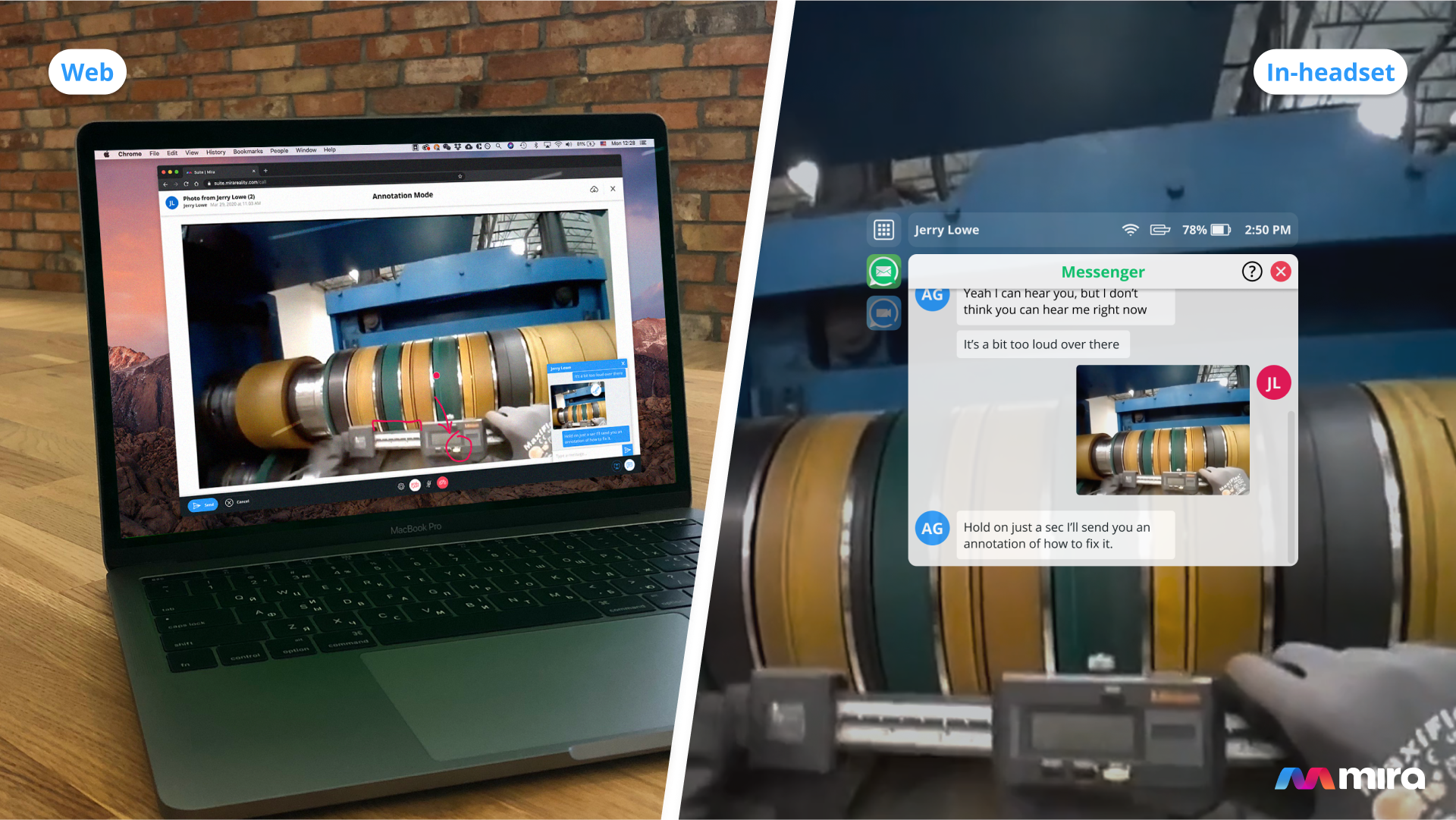
The company’s Prism Pro headset sidesteps the technical complexity that has been a major stumbling block for previous entrants in the space that have struggled with their devices holding up in the field. Mira’s device is about as simple as the task requires, integrating a slot-in design for users to pop in an older-generation iPhone and physically connect it to a head-mounted camera that allows workers to scan items and markers. There are a number of advantages to this type of device. It’s cheaper, it’s simpler to operate and it’s easier to integrate into a company’s enterprise device management structure.

Compared to the experience a worker might get with a HoloLens, there’s a much lower ceiling to the capabilities of these devices.  The Prism Pro hardware eschews what some consider “true AR” capabilities, dumping spatial tracking and mapping, and opting instead to augment your vision with a heads-up display window. The added camera is for scanning items, not generating depth maps so that holograms can be projected onto a space’s geometry, i.e. there are no floating whales to be had here. This isn’t a dramatic rethinking of the future of work so much as it’s a rethinking of form factors already being used, it’s a tablet for your face that you can control with taps and your gaze.

The AR world is still certainly a rough place to be building a startup, but Mira’s founders feel good about where the company has ended up after refocusing on manufacturing, especially within the competitive landscape.

“I can’t confirm this because I don’t work at Magic Leap, but we have literally onboarded more customers to our platform that are using our device every single day than companies like Magic Leap that have raised literally hundreds of times our funding,” CEO Ben Taft tells TechCrunch. “And it’s just been by trying to grow a business in a conservative manner and actually keeping up with the rate of adoption.”

23 Jul 2020

Let’s close the gap and finally pass a federal data privacy law

My college economics professor, Dr. Charles Britton, often said, “There’s no such thing as a free lunch.” The common principle known as TINSTAFL implies that even if something appears to be free, there is always a cost to someone, even if it is not the individual receiving the benefit.

For decades, the ad-supported ecosystem enjoyed much more than a proverbial free lunch. Brands, technology providers, publishers and platforms successfully transformed data provided by individuals into massive revenue gains, creating some of the world’s most profitable corporations. So if TINSTAFL is correct, what is the true cost of monetizing this data? Consumer trust, as it turns out.

Studies overwhelmingly demonstrate that the majority of people believe data collection and data use lack the necessary transparency and control. After a few highly publicized data breaches brought a spotlight on the lack of appropriate governance and regulation, people began to voice concerns that companies had operated with too little oversight for far too long, and unfairly benefited from the data individuals provided.

With increased attention, momentum and legislative activity in multiple individual states, we have never been in a better position to pass a federal data privacy law that can rebalance the system and set standards that rebuild trust with the people providing the data.

Over the last two decades, we’ve seen that individuals benefit from regulated use of data. The competitiveness of the banking markets is partly a result of laws around the collection and use of data for credit decisions. In exchange for data collection and use, individuals now have the ability to go online and get a home loan or buy a car with instant credit. A federal law would strengthen the value exchange and provide rules for companies around the collection and utilization of data, as well as establish consistency and uniformity, which can create a truly national market.

In order to close the gap and pass a law that properly balances the interests of people, society and commerce, the business sector must first unify on the need and the current political reality. Most already agree that a federal law should be preemptive of state laws, and many voices with legitimate differences of opinion have come a long way toward a consensus. Further unification on the following three assertions could help achieve bipartisan support:

A federal law must recognize that one size does not fit all. While some common sense privacy accountability requirements should be universal, a blanket approach for accountability practices is unrealistic. Larger enterprises with significant amounts of data on hand should have stricter requirements than other entities and be required to appoint a Data Ethics Officer and document privacy compliance processes and privacy reviews.

They should be required to regularly perform internal and external audits of data collection and use. These audits should be officer-certified and filed with a regulator. While larger companies are equipped to absorb this burden, smaller businesses should not be forced to forego using the data they need to innovate and thrive by imposing the same standards. Instead, requirements for accountability should be “right-sized,” and based on the amount and type of data collected and its intended use.

A federal law must properly empower the designated regulatory authority. The stated mission of the Federal Trade Commission is to protect American consumers. As the government agency of record for data privacy regulation and enforcement, the FTC has already imposed billions of dollars in penalties for privacy violations. However, in a modern world where every company collects and uses data, the FTC cannot credibly monitor or enforce federal regulation without substantially increasing funding and staffing.

With increased authority, equipped with skilled teams to diligently monitor those companies with the most consumer data, the FTC — with State Attorney Generals designated as back-ups — can hold them accountable by imposing meaningful remedial actions and fines.

A federal law must acknowledge that properly crafted private right-to-action is appropriate and necessary. The earlier points build an effective foundation for the protection of people’s privacy rights, but there will still be situations where a person should have access to the judicial system to seek redress. Certainly, if a business does not honor the data rights of an individual as defined by federal law, people should have the right to bring an action for equitable relief. If a person has suffered actual physical or significant economic harm directly caused by violation of a Federal Data Privacy law, they should be able to bring suit if, after giving notice, the FTC declines to pursue.

Too many leaders have been unwilling to venture toward possible common ground, but public opinion dictates that more must be done, otherwise states, counties, parishes and cities will inevitably continue to act if Congress does not. It is just as certain that those data privacy laws will be inconsistent, creating a patchwork of rules based on geography, leading to unnecessary friction and complexity. Consider how much time is spent sorting through the 50 discrete data breach laws that exist today, an expense that could easily be mitigated with a single national standard.

It is clear that responsible availability of data is critical to fostering innovation. American technology has led the world into this new data-driven era, and it’s time for our laws to catch up.

To drive economic growth and benefit all Americans, we need to properly balance the interests of people, society at-large and business, and pass a data law that levels the playing field and allows American enterprise to continue thinking with data. It should ensure that transparency and accountability are fostered and enforced and help rebuild trust in the system.

Coming together to support the passage of a comprehensive and preemptive federal data privacy law is increasingly important. If not, we are conceding that we’re okay with Americans remaining distrustful of the industry, and that the rest of the world should set the standards for us.

23 Jul 2020

Ann Miura-Ko’s framework for building a startup

As an early-stage investor, Floodgate’s Ann Miura-Ko looks for two breakthroughs in order to invest in a startup: The first happens in the value-seeking stage of a startup’s journey and the second occurs in its growth-seeking phase.

“There are really two stages to building a company,” Miura-Ko said at the TechCrunch Early Stage virtual event earlier this week. “One is what we call value-seeking mode, and this is where you’re really trying to figure out what the company actually looks like, including what’s the product? Who are you selling to? How do you price it? All of these things are still being discovered in the value-seeking mode.”

After founders have answered those questions, they can move into growth-seeking mode, she said. That’s the point when startups are trying to attract as many customers as possible.

Throughout these two distinct stages, Miura-Ko says she looks for the two breakthroughs: the inflection insight and product-market fit.

Inflection insights

The idea of an inflection insight, Miura-Ko said, is a relatively new framework Floodgate is exploring. Often times, she said founders need to ride some massive, exponential curves that allow their businesses to grow sustainably and scale.

These inflections have two parts to it: cause and impact. The causes are generally either technological (cloud, 5G), regulatory (GDPR, AV regulation) or societal (belief or behavior shifts). On the impact side, products and distribution may become cheaper or faster, while also presenting new use cases or customers, she said.

“Or even more interesting, you have something that was impossible that now is possible,” she said. “And that is an exponential impact that you could ride on.”

But simply finding that inflection insight doesn’t mean you should create a business. What founders must do next is determine if the insight is right and nonconsensus.