Year: 2020

21 Jul 2020

Creating a robust churn-reversal system

We’ve aggregated many of the world’s best growth marketers into one community. Twice a month, we ask them to share their most effective growth tactics, and we compile them into this Growth Report.

This is how you stay up-to-date on growth marketing tactics — with advice that’s hard to find elsewhere.

Our community consists of startup founders and heads of growth. You can participate by joining Demand Curve’s marketing training program or its Slack group.

Without further ado, on to our community’s advice.


Creating a robust churn-reversal system

Insights from Matthew Morley of Savvy

Generally, it’s far more efficient to keep a current client than it is to close a new one. You’ll want a system to help you identify which users are at risk of churning. This way, you can proactively reach out to them before they leave.

Start by identifying your high-value customers at risk of churning:

Who is:

  • Spending within the top 10% of time using your app?
  • Has a substantial number of seats of your product?
  • Or, say, has a company size of at least 50 people — reflecting their upselling potential?

But also:

  • Is using the product 30% less in a given month
  • Has submitted at least one non-trivial support ticket in the last month
  • And has their subscription renew in less than 90 days

And so on.

You can stitch this information together from multiple sources like Stripe, Mixpanel, Crunchbase and Intercom. Then, set up an alert to notify your team once someone falls into these buckets.

Then reach out with something personal to win back their enthusiasm. It can be high leverage to get them on the phone to uncover what’s keeping them around.

21 Jul 2020

Is your net worth too closely tied to your company’s success?

Now that I’ve offered an overview to help you think through where concentrated stock sits in your overall plan, let’s take a closer look at why selling can be challenging for some.

In the following section, I reveal the facts of the concentrated stock “get rich” myths that reside in the minds of many first-time concentrated stock owners, and I show why it is prudent to consider greater diversification.

Keep reading to learn more about the benefits of diversification, discover how much company stock is likely too much to hold, and the options you have when it comes to diversifying strategically.

Dangers of concentration

There are several hard facts to keep in mind in contemplating maintaining a concentrated position:

  1. It’s stating the obvious, but not all stocks are AAPL or AMZN. Hendrik Bessembinder published research that found the best performing 4% of listed companies explained the returns for the entire U.S. stock market since 1926. The remaining 96% of stocks collectively matched the performance of U.S. Treasury bills. Since 1926, 58% of stocks have failed to beat one-month Treasury bills over their lifetimes. Forty percent of all Russell 3000 (an index of the 3000 largest publicly traded companies in the U.S.) have lost at least 70% of their value from their peak since 1980.
  2. Despite all this, broad-based equities have returned 9%+ a year, beating most other asset classes, ultimately due to the top 4% of stocks. Although there is no guarantee anyone can single out any of the top 4% going forward, diversification will guarantee you will own the top 4%.
  3. Even if the concentrated stock you own will be another AAPL/AMZN, both stocks have experienced declines of 90%+ at some point throughout their lifetimes. Most investors would not be able to have conviction and stay invested, especially if that concentrated stock was driving the majority of their portfolio returns and net worth. Sometimes catastrophic declines are a function of the industry or existential threats that have little to do with the company itself. Other times, it has everything to do with the company and nothing to do with external factors.

The odds of any new IPO being among the top 4% is just slightly better than hitting your lucky number on the roulette wheel. But is your investment portfolio success and the odds of achieving your long-term financial goals something you want to spin the wheel on?

Benefits of diversification

Excess volatility can harm returns. Note the example below that shows the comparison between a low-volatility diversified portfolio versus a high-volatility concentrated portfolio. Despite the same simple average return, the low-volatility portfolio below materially outperforms the high-volatility portfolio.
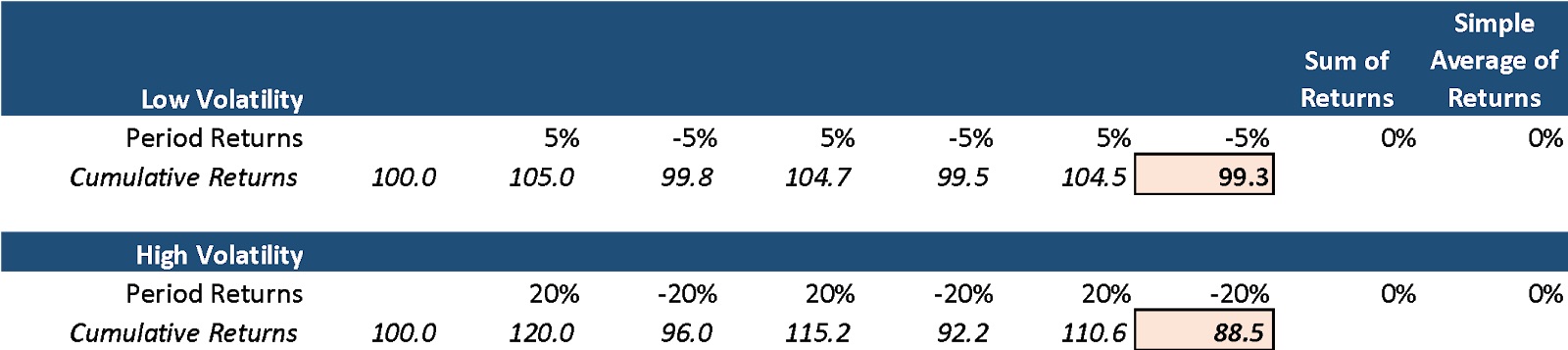
Image Credits: Peyton Carr

Beyond the math, unexpected spikes in volatility can cause significant price declines. Volatility increases the chances that an investor reacts emotionally and makes a poor investment decision. I’ll cover the behavioral finance aspect of this later. Lowering your portfolio volatility can be as simple as increasing your portfolio diversification.

The Russell 3000, an index representing the 3,000 largest U.S.-based publicly traded companies, has lower volatility when compared against 95%+ of all single stocks. So, how much return do you give up for having lower volatility?

According to Northern Trust Research, the 5.96% annualized average return of the Russell 3000 is 0.73% more than the 5.23% return of the median stock. Additionally, owning the Russell 3000, rather than a single stock, eliminates the likelihood of catastrophic loss scenarios — more than 20% of shares averaged a loss of more than 10% per year over a 20-year time frame.

If this establishes that the avoidance of overly concentrated portfolios is important, how much stock is too much? And at what price should you sell?

How much of your company’s stock is too much?

We consider any stock position or exposure greater than 10% of a portfolio to be a concentrated position. There is no hard number, but the appropriate level of concentration is dependent on several factors, such as your liquidity needs, overall portfolio value, the appetite for risk and the longer-term financial plan. However, above 10% and the returns and volatility of that single position can begin to dominate the portfolio, exposing you to high degrees of portfolio volatility.

The company “stock” in your portfolio often is only a fraction of your overall financial exposure to your company. Think about your other sources of possible exposure such as restricted stock, RSUs, options, employee stock purchase programs, 401k, other equity compensation plans, as well as your current and future salary stream tied to the company’s success. In most cases, the prudent path to achieving your financial goals involves a well-diversified portfolio.

What’s stopping you?

Facts aside, maintaining a concentrated position in your company stock is far more tempting than taking a more measured approach. Token examples like Zuckerberg and Bezos tend to outshine the dull rationale of reality, and it’s hard to argue against the possibility of becoming fabulously wealthy by betting on yourself. In other words, your emotions can get the best of you.

But your goals — not your emotions — should be driving your investment strategy and decisions regarding your stock. Your investment portfolio and the company stock(s) within it should be used as tools to achieve those goals.

So first, we’ll take a deep dive into the behavioral psychology that influences our decision-making.

Despite all the evidence, sometimes that little voice remains.

I want to hold the stock.

Why is it so hard to shake? This is a natural human tendency. I get it. We have a strong impetus to rationalize our biases and not believe we are vulnerable to being influenced by them.

Becoming attached to your company is common, since after all, that stock has made you, or has the potential of making you wealthy. More often than not, selling and diversifying is the tough, but more rational decision.

Numerous studies have furnished insights into the correlation between investing and psychology. Many unrecognized psychological barriers and behavioral biases can influence you to hold concentrated stock even when the data shows that you should not.

Understanding these biases can be helpful when deciding what to do with your stock. These behavioral biases are hard to spot and even harder to overcome. However, awareness is the first step. Here are a few more common behavioral biases, see if any apply to you:

Familiarity bias: Familiarity is likely why so many founders are willing to hold concentrated positions in their own company’s stock. It is easy to confuse the familiarity with your own company with the safety in the stock. In the stock market, familiarity and safety are not always related. A great (safe) company sometimes can have a dangerously overvalued stock price, and terrible companies sometimes have terrifically undervalued stock prices. It’s not just about the quality of the company but the relationship between the quality of a company and its stock price that dictates whether a stock is likely to perform well in the future.

Another way this manifests is when a founder has less experience with stock market investing and has only owned their company stock. They may think the market has more risk than their company when in actuality, it is usually safer than holding just their individual position.

Overconfidence: Every investor is exhibiting overconfidence when they hold an overly concentrated position in an individual stock. Founders are likely to believe in their company; after all, it already achieved enough success to IPO. This confidence can be misplaced in the stock. Founders often are reluctant to sell their stock if it has been going up since they believe it will continue to go up. If the stock has sold off, the opposite is true, and they are convinced it will recover. Often, it is challenging for founders to be objective when they are so close to the company. They commonly believe that they have unique information and know the “true” value of the stock.

Anchoring: Some investors will anchor their beliefs to something they experienced in the past. If the price of the concentrated stock is down, investors may anchor their belief that the stock is worth its recent previous higher value and be unwilling to sell. This previous value of the stock is not an indicator of its real value. The real value is the current price where buyers and sellers exchange the stock while incorporating all presently available information.

Endowment effect: Many investors tend to place a higher value on an asset they currently own than if they did not own it at all. It makes it harder to sell. An excellent way to check for the endowment effect is to ask yourself: “If I did not own these shares, would I purchase them today at this price?” If you are not willing to purchase the shares at this price today, it likely means you are only holding onto the shares because of the endowment effect.

A fun spin on this is to look into the IKEA effect study, which demonstrates that people assign more value to something that they made than it is potentially worth.

When framed this way, investors can make more intentional decisions on whether to continue holding concentrated stock or selling. At times, these biases are hard to spot, which is why having a second person, a co-pilot, or an advisor, is helpful.

Take control

Congratulations to those of you with a concentrated stock position in your company; it is hard-earned and likely represents a material wealth. Understand, there is no “right” answer when it comes to managing concentrated stock. Each situation is unique, so it is essential to speak with a professional about options specific to your situation.

It starts with having a financial plan, complete with specific investment goals that you want to achieve. Once you have a clear picture of what you want to accomplish, you can look at the facts in a new light and gain a deeper appreciation for the dangers of holding a concentrated position in company stock versus the benefits of diversification, considering all of the implications and opportunities involved in rational decision-making and investment behavior.

What are my choices if I want to diversify?

Most individuals understand they can simply and directly sell their equity, but there are a variety of other strategies. Some of these opportunities may be far better at minimizing taxes or better at achieving the desired risk or return profile. Some might wonder what the best timing is to sell. I will cover these topics in the final article of the series.


21 Jul 2020

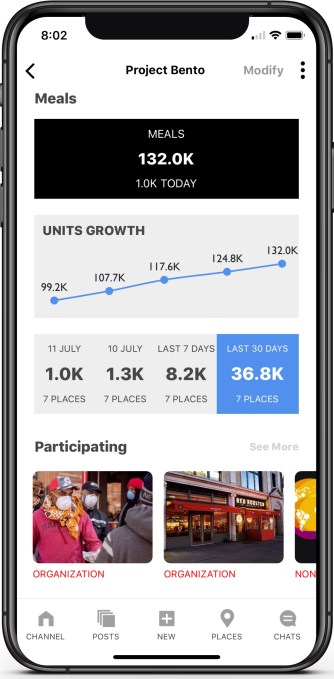
Chef Marcus Samuelsson teams up with Sage Digital to launch Project Bento fundraising platform

In the wake of the COVID-19 pandemic, as well as the ongoing protests for racial justice, people have been looking for different ways to contribute, which in turn has led tech companies to launch new features and campaigns.

And now there’s a new fundraising platform called Project Bento, created by chef and restauranteur Marcus Samuelsson (best known as the chef behind Red Rooster Harlem), Derek Evans (CEO of the Marcus Samuelsson Group) and the team at Sage Digital (a startup creating tools for reviewers, chefs and other experts to publish content and build a following).

Samuelsson told me that he’d already been working with Sage Digital to create a presence on the platform. Then he mentioned Harlem Serves Up, this year version of the annual Harlem EatUp festival — Samuelsson and his team reinvented the event during the pandemic as as a fundraising telethon for nonprofits fighting food insecurity.

But, Samuelsson said that when he surveyed the options available to manage the online fundraising, he wasn’t quite satisfied with any of the available options.

Project Bento

Image Credits: Project Bento

“We were thinking very much about our needs — what were we building, how do we want consumers to utilize it,” he said.

So the Sage Digital team ended up building Project Bento in seven or eight weeks, on top of the startup’s existing platform. Sage CEO Samir Arora said that along with allowing nonprofits to collect funds (without having to pay a platform fee), publish content, promote on social media and track their campaigns, the platform also includes tools for managing sponsorships and matching donors.

The rapid development, Samuelsson said, was a perfect demonstration of “what entrepreneurship is.” Thus far, Project Bento has been used to raise more than $350,000 for Harlem Serves Up, as well as $4.8 million for the Project Bento Fund (which Arora described as a “completely new nonprofit whose purpose is to create matching funds” for campaigns on the platform).

There are several other campaigns live already, as well as links to employee relief fundraisers on other platforms, but Project Bento is also accepting applications from other nonprofits that want to fundraise on the platform. Samuelsson said he wants the website to be a place that can bring many of these campaigns together.

“There are communities not just in Harlem, but across the country, that need a campaign, they need to connect,” Samuelsson said. “[Project Bento] will continue because that need, raising money and connecting a community, will continue.”

21 Jul 2020

US charges two Chinese spies for a global hacking campaign that targeted COVID-19 research

U.S. prosecutors have charged two Chinese nationals, said to be working for China’s state intelligence bureau, for their alleged involvement in a massive global hacking operation that targeted hundreds of companies and governments for more than a decade.

The 11-count indictment, unsealed Tuesday, alleges Li Xiaoyu, 34, and Dong Jiazhi, 33, stole terabytes of data from high-technology companies, around the world — including the United States, the prosecutors said.

More recently, the prosecutors accused the hackers of targeting the networks of several U.S. companies in Maryland, Massachusetts and California developing vaccines and treatments for COVID-19.

The indictment comes just weeks after both the FBI and Homeland Security warned that China was actively trying to steal U.S. research data related to the coronavirus pandemic.

The hackers were first discovered after they targeted a U.S. Department of Energy network in Hanford, Washington, the Justice Department said. The hackers also targeted companies in Australia, South Korea, and several European nations. The hackers used known but unpatched vulnerabilities in widely-used web server software to break into their victims’ networks. By gaining a foothold onto the network, the hackers installed password-stealing software to gain deeper access to their systems. The prosecutors said that the hackers would “frequently” return to the networks — in some cases years later.

According to the indictment, the hackers stole “hundreds of millions of dollars” worth of trade secrets and intellectual property. The prosecutors also allege that the hackers stole data related to military satellite programs, military wireless networks, and high-powered microwave and laser systems from defense contractors.

The hackers are said to have targeted their victims on behalf of China’s intelligence services, but also hacked personal financial gain. Prosecutors said in one case, the hackers “sought to extort cryptocurrency” from a victim company by threatening to publish the victim’s stolen source code online.

John C. Demers., U.S. assistant attorney general for national security, said that the indictments were “concrete examples” of how China used hackers to “rob, replicate, and replace” non-Chinese companies in the global marketplace.

Demers also accused China of providing a safe-haven for the hackers.

“China has now taken its place, alongside Russia, Iran and North Korea, in that shameful club of nations that provide a safe haven for cyber criminals in exchange for those criminals being ‘on call’ to work for the benefit of the state, here to feed the Chinese Communist party’s insatiable hunger for American and other non-Chinese companies’ hard-earned intellectual property, including COVID-19 research,” said Demers.

If prosecuted, the hackers could face more than 35 years in prison. But since the hackers are believed to still be in China, any extraditions to the U.S. are unlikely.

21 Jul 2020

Combining social shopping rewards and personal finance apps, ex-Snap product gurus launch Meemo

After Wisam Dakka and André Madeira left Snap in 2018 the two longtime product developers and coders cast about for a new app to build. 

Looking around they realized there was no financial product that spoke to the generation of consumers they’d spent the last bit of their professional lives working to build for, so they decided it would be their next project.

“Our insight is that an individual’s relationship with money is a delicate and an emotional one. Most financial apps are not adopted by the masses because they are strict, lack empathy, and are unconsciously perceived as judgmental, which is why they are often downloaded and then ignored,” said Madeira, in a statement. 

Their solution, launching today, is Meemo .

It’s a combination of a personal financial monitoring, rewards and gifting, and social shopping app all rolled into one.

“One of the things we learned at snap if you want to reach the masses you need to change how you create an app. It has to be effortlessly,” said Madeira. “It has to be automatic and social as well so we want to build an app that is all of that combined.”

Once a user downloads Meemo and connects their main bank account or credit card to the app, Meemo will give that person insights into their spending history and potential rewards.

For most users, the initial experience will be through a gift card. Gifting, it turns out is what Dakka and Madeira think will be the secret sauce for the company’s growth (although getting people to use something if they’re being given money or free stuff is hardly rocket science).

There’s also the social element which the two men think will be a draw as well. Meemo provides recommendations and social validation from friends by harvesting their buying history and sharing it with you.

Once a user downloads Meemo and has the history of their transactions, the app will surface the places where user’s spend the most money. They can then send gift cards to their friends for their favorite restaurants. The goal, eventually, is to get restaurants to subsidize the gifting portion and have their shoppers act as a direct marketing channel.

Shops won’t be able to see who’s getting the gifts until they come into the store. What Meemo hopes to do is gather a profile of a user’s shopping behavior based on their purchases and offer them discounts to places that they may not frequent as often, but match their consumer profile.

Backing the company are investors including Saama Capital, Greycroft, monashees, and Sierra Ventures along with individual investors Amit Singhal, Hans Tung, and serial entrepreneurs and the co-founders’ colleagues from Google and Snap.

Madeira and Dakka first met working on Google Search and went on to found Snap’s San Francisco office. And the team is rounded out by long-time friends like Robson Araújo and Ranveer Kunal.

“We are very excited to back Dakka and Madeira in their creation of a new age finance app at Meemo that will combine improved financial management with deeper social engagement for today’s generation”, said Ash Lilani, Managing Partner at Saama Capital, in a statement. “With Dakka and Madeira’s past experience of assembling talented teams and building viral products, we believe Meemo has an opportunity to become a leader in this space”. 

The company’s name is taken from a Portuguese word “mimo”, which means an affectionate treat, according to a statement. It’s available to download on iOS and Android.


21 Jul 2020

Microsoft introduces Customer Voice, a real-time customer feedback tool

At Microsoft Inspire today, the company made several Dynamics 365 announcements, including Dynamics 365 Customer Voice, a real-time customer feedback tool that could compete with Qualtrics, the company SAP bought in 2018 for a cool $8 billion.

Microsoft General Manager Brenda Bown says that as more customers move online during the pandemic, it’s more important than ever to capture real-time customer feedback that you can combine with other data to build a more complete picture of the customer that could lead to more successful interactions in the future.

“Customer Voice is a feedback management solution, and it’s designed to empower businesses and organizations to build better products, deliver better experiences to customers, and really build the relationships for the customers with that feedback management tool,” Bown told TechCrunch.

The data gets shared with Microsoft’s customer data platform (CDP), and is built on top of Dynamics 365 and the Power Platform. The latter provides a way to customize the Customer Voice tool to meet the needs of an individual company.

Brent Leary, partner and co-founder at CRM Essentials, says this solves the problem of getting feedback as the interaction is happening. He adds that being able to share that data directly with the CDP makes it even more valuable.

“Customer feedback has to be done as close to the interaction/transaction as possible and as frictionless as possible for it to really work, or else customers won’t give it to you. And then the data has to be integrated into the CDP with all the other data automatically to really be of use. And having a platform to handle both the feedback capture and the data integration optimizes the likelihood of this happening,” Leary said.

The company also announced Dynamics 365 Connected Store, a set of tools designed to help stores manage in-store and curbside traffic, among other things. As the pandemic limits the number of people in a store at one time, using sensors and cameras, Connected Store can help managers understand and manage the number of people inside the store at any given time to help aid in social distancing.

It can also help add a level of automation to curbside pickup, letting an employee know when the customer has pulled up. “It alerts the employee and they can bring out the order for a more seamless and quick pickup. And obviously this scenario is super important today because of [more people wanting] contactless pick up,” Bown said.

Finally, the company announced a fraud protection component. She says that Dynamics 365 Fraud Protection helps protect businesses online or in physical stores from fraudulent activities, which she says is even more important as more transactions are conducted digitally. New capabilities include account protection and loss prevention tooling.

Inspire is the company’s annual partner conference, which is being held virtually this year. Bown says by running it virtually, the company can involve even more partners than a typical in-person conference because companies that couldn’t previously attend because of cost and distance, are able to participate this year.

21 Jul 2020

Sora raises $5.3M to power its HR automation service

Think back to the last time you onboarded at a new job. Was it a mishmash of documents and calendar invites and calls and, generally speaking, a mess?

Probably. That’s likely because onboarding is a process that often depends on disparate, unconnected HR tools. Sora, a startup that today announced $5.3 million in collected fundraising, wants to shake up the HR software world with a low-code service that helps companies connect their tooling and automate their HR processes. The startup might be able to make things like onboarding better for employees and companies alike.

Low-code, no-code

Startups looking to bring low, and no-code tooling to non-engineering teams have become a trend in recent quarters. TechCrunch recently covered a $2.2 million round for no-code text analysis and machine-learning shop MonkeyLearn, for example. There have been hundreds of millions of dollars raised by low, and no-code tools in 2020 alone.

By building tools to assist non-engineers do more, faster without developer help — be it analysis, or visual programming — some technology upstarts are helping non-technical teams do what only technical teams were able to in previous years.

Sora fits into the trend because its service allows non-developers create workflows, to use a term that the startup’s co-founder and CEO Laura Del Beccaro employed when she walked TechCrunch through her company’s product.

The Sora workflows can be built from templates, and employ triggers to fire off various processes (sending emails, pulling in data from other apps and services, that sort of thing), allowing non-engineers to create visual logic flows. The Sora system is “like a no-code workflow builder,” Del Beccaro said in an interview, allowing users to “add tasks where you have to tell someone to do something, and automate the follow up. That’s actually one of our biggest pain point relievers. A lot of HR teams right now are manually tracking people down: Did you set up this laptop yet? Did you set up this new hire launch for these three people?”

Sora CEO Laura Del Beccaro, via the company.

The Sora workflow system is slick in practice, allowing, for example, customization around a single employee. Del Beccaro explained that her startup’s software can do things like ask a manager who a new hire’s work-buddy might be, and then send that person an email later saying that the hire has arrived.

According to Del Beccaro, Sora, wants to help “democratize your [HR] processes.” Today’s HR denizens are too dependent on data analysts for “people analytics reporting” she said, adding that once a company has all its HR “data in one place, which again, is our core offering, you can set up all these automations that you want by yourself, you don’t have to go to IT or engineering.”

And because Sora can handle swapping out different providers as needed, Sora should help HR teams at growing companies lower the “risk of changing systems,” helping them “stay flexible no matter what [their] processes look like.”

It’s a neat tool.

Money

Sora has raised $5.3 million in capital to date, a funding total that includes a pre-Seed round from September, 2018. First Round and Elad Gil led its most recent round, which makes up a majority of its capital raised thus far.

With 11 employees today, Sora has around “25 people on [its] cap table,” the CEO said, telling TechCrunch that it was “pretty important to [her] to have a relatively diverse set of investors.” Del Beccaro provided this publication with a full list, which we’ve included below.

Sticking to the subject of money, after Mixpanel served as an early customer, Sora opened to more customers earlier this year. The CEO said that its customers are on one, or two-year contracts, and charges per-employee, per-month, which seems reasonable. With its new cash, Sora has around 2.5 years of runway she said.

First Round’s Bill Trenchard liked Sora’s approach to building its service, saying in an email that the company was “never interested in scaling for the sake of scaling,” highlighting its work in concert with “a development partner to make sure what they were working on was actually solving real HR pain points before they took it to the market” as evidence of its “thoughtful and intentional” product approach.

Today, thanks to that method, in his view “what’s compelling about Sora is their sales momentum this year after launching” the investor said. The next question for Sora, then, is how fast it can grow now that it has more capital in the bank than it has likely ever had before.

For fun, here’s the full investor list that Del Beccaro provided, which I’m including as it’s rare to get a full cap table:

  • Sarah Adams (Plaid)
  • Shan Aggarwal (Coinbase, Greycroft)
  • Scott Belsky (Adobe)
  • Mathilde Collin (Front)
  • Cooley Investment Fund
  • David Del Beccaro & Arleen Armstrong (Music Choice/Legal)
  • Viviana Faga (Emergence Capital)
  • Avichal Garg (Electric Capital)
  • Elad Gil
  • Kent Goldman (Upside VC)
  • Jonah Greenberger (Bright)
  • Daniel Gross (Pioneer, YC)
  • Charles Hudson (Precursor Ventures)
  • Todd Jackson (First Round Capital)
  • Oliver Jay (Asana)
  • Nimi Katragadda (BoxGroup)
  • Nicky Khurana (Facebook)
  • Brianne Kimmel (Work Life Ventures)
  • David King (Curious Endeavors)
  • Fritz Lanman (ClassPass)
  • Lisa & Mat Lori (Perfect Provenance/New Mountain Capital)
  • Shrav Mehta (SecureFrame)
  • Sean Mendy (Concrete Rose)
  • Jana Messerschmidt (#Angels, Lightspeed)
  • Katie Stanton (#Angels, Color)
  • Erik Torenberg (Village Global)
  • Bill Trenchard (First Round Capital)
  • Jeannette zu Fürstenberg (La Famiglia VC)
21 Jul 2020

Instagram is testing a ‘Personal Fundraiser’ feature

Instagram today announced a new tool for personal fundraisers. The company says it’s beginning a small test of the feature, which will allow users to link directly to a fundraiser from their profile page. The test will initially run in the U.S., U.K. and Ireland on Android, followed by iOS. While users can choose to either start a cause or supporting an existing one, Instagram says all fundraisers will be first vetted to ensure they meet the existing guidelines and rules.

These rules include a list of supported fundraising categories, and detail in which cases a fundraiser would not be approved. The same rules also apply to Facebook fundraisers.

To get started with Personal Fundraisers, users with access to the feature will tap “Edit Profile,” “Add Fundraiser,” followed by “Raise Money.” You’ll then choose a photo, select the fundraiser category, and enter further details to tell the story and encourage donations. When approved, you’ll be able to raise funds for 30 days with the option to extend fundraising just once for 30 more days.

In other words, the feature is meant to support more time-sensitive causes, rather than serve as a replacement for ongoing fundraising efforts.

Donations to the fundraiser itself will be powered by Facebook Pay, which also powers Instagram’s new shopping features. 

In the next several months, Instagram says it will expand the feature to allow users to share their fundraiser in both their Feed and within Stories.

The addition isn’t the only way Instagram is supporting fundraising.

The company had already offered eligible nonprofits and supporters to raise money for charity with Donation Stickers for Stories, and more recently with a Live Donations feature for livestreams. While the company covers fees made to nonprofits, it does charge fees for personal fundraisers based on the country where the creator of the fundraiser is located.

Fundraising has become a popular activity across Facebook’s platforms. Already, users have raised more than $65 million for COVD-19 and racial justice initiatives and causes on Instagram and Facebook combined since January, for example. And in the last 30 days, donations on Instagram have doubled in the U.S.

The test of Personal Fundraisers is rolling out to a small number of users, but Instagram says the plan is to expand the feature in the months ahead.

21 Jul 2020

Bang & Olufsen’s Beoplay E8 Sport offer the best sound in workout-friendly true wireless earbuds

Bang & Olufsen is taking its excellent track record for delivering maximum quality, natural-sounding audio and wrapping it in a sports-oriented package with the Beoplay E8 Sport ($350). These totally wireless earbuds come with a long list of great features, including IP57 water resistance, 30 total hours of battery life including up to seven hours on a single charge, and transparency mode for external audio pass-through.

The basics

The E8 Sport is a new version of the three-generation E8 totally wireless earphone that Bang & Olufsen has produced for a while now. It’s the first in the series to feature sport-specific water and sweat-resistance. That’s not to say you couldn’t probably get away with using the existing E8 headphones for exercise (I definitely have), but the the E8 Sport’s IP57 rating, you can be confident they’ll stand up to a run in the rain or any amount of sweat, since they’re technically able to be fully submerged in shallow water for as long as 30 minutes.

These aren’t for swimming, however; that water resistance gets you durability, as well as the option to quickly run them under water to clean them off if you so desire. It’s basically a peace-of-mind feature, but a welcome one.

The E8 Sport also includes a new more rubberized exterior finish, a charge case that offers just slightly less reserve power (only by around 30 minutes) but that provides USB-C and wireless charging as well as 23 hours of backup battery life on top of the seven contiained in the earbuds themselves.
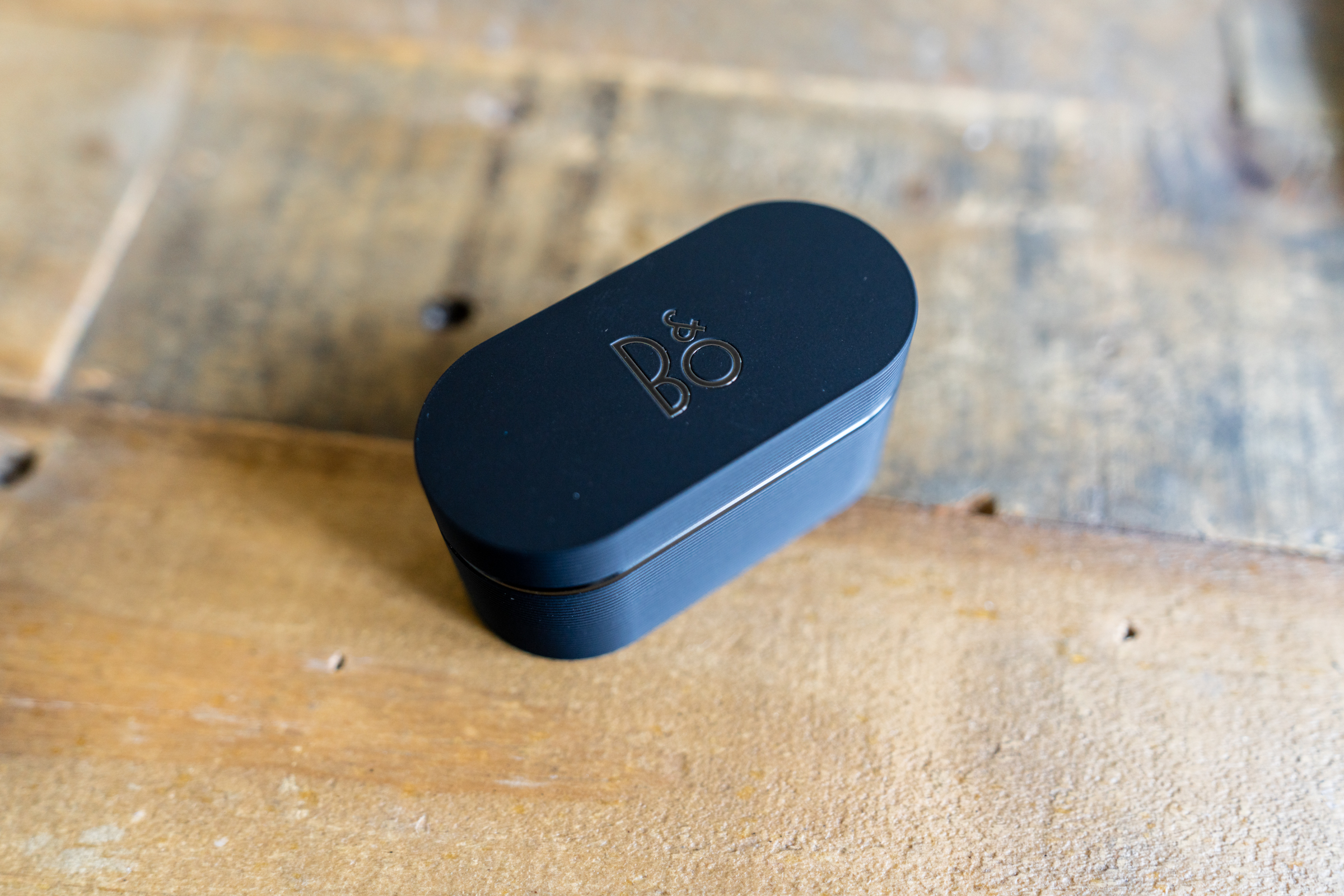
You’ll also get four different sizes of silicone earbuds, as well as one set of Medium Comply memory foam tips, and there are three sets of different sized silicone fins that provide a bit more anchor stability in your ear for when you’re using these while running or doing other vigour exercise. The Beoplay E8 Sport is available in two basic colors, including a pastel turquoise called ‘oxygen blue’ and black. There’s also a new special edition created with partner On, the Swiss running brand, which features a contrast color grand and gray design.

Inside, Bang & Olufsen has used mostly the same internals as you’ll find in the standard, non-sport E8 – which means you can expect the same great sound that B&O is known for.

Design and performance

The E8 Sport is a new approach to design for Bang & Olufsen, featuring a more rugged, rubberized exterior vs. the smooth finish of the E8. The case of the E8 is also finished in leather, but the E8 Sport is likewise rubberized plastic. Both feature narrow ridges in their construction as well, which helps with grip, especially when there’s sweat involved.

Unlike a lot of other sport-specific products, the Beoplay Sport E8 still manages to feel mostly understated and refined, however. The buds themselves are pretty low profile when in the ear, and the black version especially will definitely fly under the radar. The ‘oxygen blue’ version has a little more flare, but still presents softer rather than bold or bright.
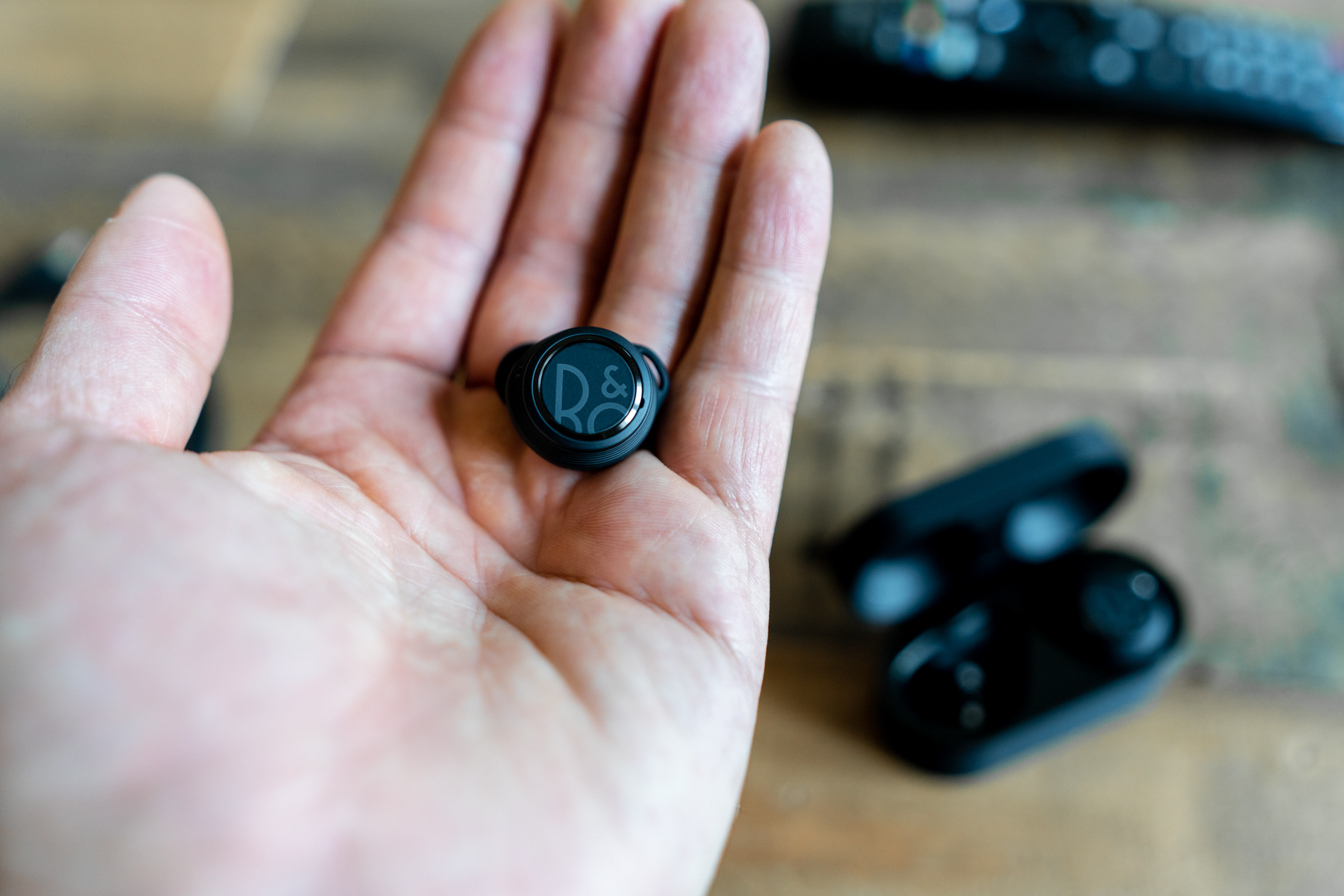
Inlaid on the face of each bud is an aluminum ring, along with the B&O logo overprinted on the touch-sensitive button faces. The overall look definitely distinguishes them from the standard E8, but doesn’t venture so far afield that you’re left wondering whether they were actually made by the same company.

Performance-wise, the E8 Sport lives up to all its promises, providing long-lasting battery life, excellent passive sound isolation, remarkably clarity and sound separation and a super secure fit. I used them in a variety of different situations, including during 30-minute plus runs, and they offered great connection quality and sound throughout. Especially for a set of sport buds, I was really impressed by the sound quality – normally, I find that in this category manufacturers sacrifice quality for muddy bass, but not so with the E8 Sport.

That’s what really makes these great: They’re all-around earbuds that you can use for exercise, in all weather conditions, and for quiet enjoyment at home, too, thanks to their supreme audio quality. If you want one set of wireless earphones that can do it all, without compromises, these are it.

The B&O app allows you to fine-tune the sound profile to your preferences, as well, and you can easily control playback and access the built-in transparency features using the touch-sensitive earbud control surfaces. All of this works whether you’re in the middle of a run or a conference call, and the call quality is excellent, too. In my testing, people I spoke on the phone with said it was a vast improvement over even using the handset held up to my face, and even approached the sound quality of my podcast (where I use pro audio equipment).

Bottom line

The wireless earbud market is very crowded and getting busier all the time, with plenty of options at a variety of price points. Bang & Olufsen has already delivered what I consider to be the best audio quality on the market with their current third-generation E8, and the new E8 Sport provides all that great sound along with awesome durability, too.

21 Jul 2020

The future of work is human

Human Ventures builds and invests in what we call the “human needs economy,” which encompasses products and services that address material human problems — specifically those in the areas of health and wellness, the future of work and community. This spring, our Humans in the Wild cohort program brought together a group of exceptional entrepreneurs, building companies within health and wellness. This fall, we are excited to call upon entrepreneurs who are building companies reimagining the way in which we, as humans, work. Applications are open here.

The human needs economy is the future. Throughout the last few decades, fundamental shifts in technology and human behavior have impacted the nature and life cycle of the “traditional” professional journey — and that disruption has started to shape a new labor economy. The past decade specifically has brought significant technological advancements that help humans work more efficiently, and share and organize information at scale. However, those technological advances are now starting to outpace the human condition, creating a society weary of automation, one that finds individuals searching for their place and purpose in an increasingly competitive and fast-paced labor market.

As COVID-19 saw boardrooms go dark, turning homes into makeshift offices, nascent trends were forced into prominence. Abruptly, the labor force was newly eager for innovative solutions to help them thrive in the new normal. But there is a long way to go before this new normal feels normal. There’s much work to be done to help the human needs economy not just survive this seismic shift, but to use it as an advantage.

Human Ventures has identified four areas of opportunity best positioned to serve the human side of work over the next decade:

If you are building in these areas, we would love to connect with you.

1. New work environments