Year: 2020

15 Jul 2020

Apple News adds new audio features, including a daily briefing, alongside expanded local coverage

Apple News is getting a significant upgrade. The news aggregation app, which ships preinstalled on Apple devices, is introducing several new features for readers and premium subscribers, including audio stories, a daily audio briefing called “Apple News Today,” and expanded local coverage.

The audio briefing is somewhat of a competitor to Alexa’s Flash Briefing, which has become a popular way to catch up on the top news headlines. But in Apple’s case, the briefing is hosted by people, not a virtual assistant. Apple News editors and co-hosts, Shumita Basu and Duarte Geraldino, will guide listeners through the day’s headlines. They will then spend the remainder of the briefing discussing around three or four articles in a more in-depth fashion.
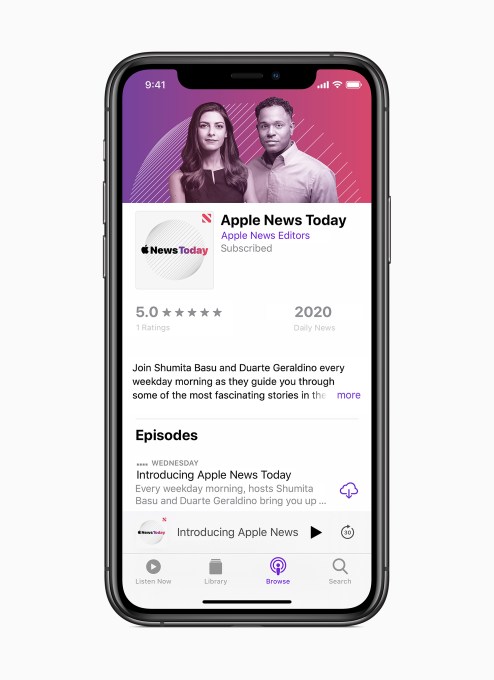
In total, the briefing will run for roughly seven to eight minutes in length and will be accessible to all Apple News readers in the U.S.

A new briefing will arrive every Monday through Friday, and can be played in the Apple News app in the U.S., in Apple Podcasts, or it can be launched using Siri voice commands across Apple devices, including Mac and HomePod.

Another new audio feature, audio stories, is only being made available to Apple News+ subscribers, however.

Starting today, Apple News will produce around 20 new audio stories per week across a range of topics, which are narrated by voice actors. These stories aren’t original content, but will instead be professionally-narrated versions of feature reporting and other long-form pieces published by Essence, Esquire, Fast Company, GQ, New York Magazine, Sports Illustrated, TIME, Vanity Fair, Vogue, Wired, and others, as well as newspapers like  The Wall Street Journal and the Los Angeles Times.


Apple several years ago had partnered with SpokenLayer to bring audio narration to the news, but that effort was focused on enhancing the Apple Podcasts experience. The company says it’s not partnered with SpokenLayer on the new feature for Apple News, but is instead working with voice talent itself and recording these audio stories in its own studios. Apple declined to say how many have been hired to work on audio programming for Apple News, but did confirm it expanded headcount specifically for audio.

The audio stories will be made available to subscribers in the U.S. only. Apple didn’t say if it’s planning to expand the offering to international markets.

To make room for the new audio features, the Apple News app navigation experience has been redesigned. There’s now an “Audio” tab directing users to the new content at the bottom of the news application, in between the “News+” and “Following” tabs at the bottom of the screen. When tapped, users will first see the latest episode of Apple News Today at the top of the screen, following by the new Audio Stories that you’ve added to your Up Next queue. Below that will be a set of personalized recommendations of what to listen to next.

While the tab organizes the new audio programming, users will also be introduced to audio as they’re browsing elsewhere in the app. For example, as you’re scrolling through news stories in the Today tab or reading News+ feeds, a new audio News+ badge will appear next to stories that have narration. You can then click that story to begin the narration without having to change screens. The feature will also allow you to transition back and forth between reading and listening as it will remember where you left off in a longer piece, and begin there when you return.

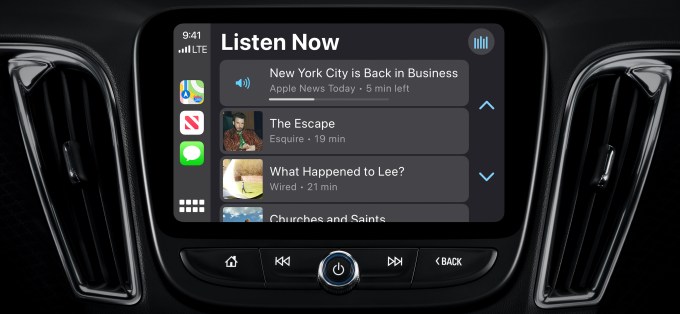
Related to these efforts, CarPlay will support the News app so users can listen to these audio stories and the Apple News Today briefing while driving. Listening progress will also sync between devices, as you move from iPhone to car and back again.
While the big news today is the audio programming coming to Apple News, the app is also today introducing expanded local coverage.

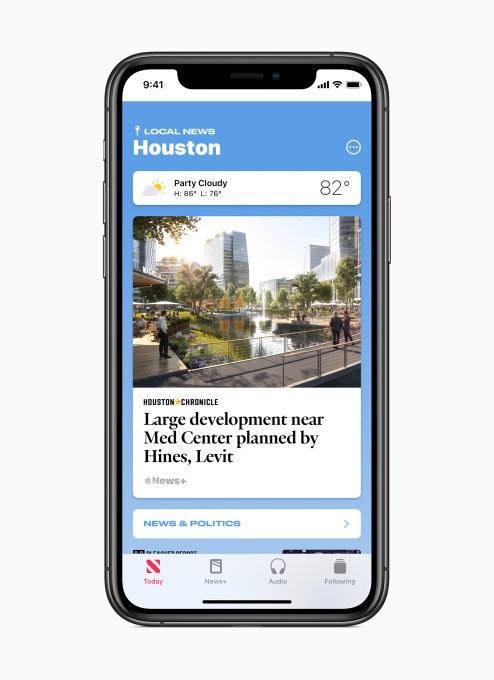
In select markets — San Francisco and the wider Bay Area, New York, L.A., and Houston — Apple News will feature a curated local news experience headed by a local editor. These sections will include a wider range of stories across areas like local weather, politics, sports, dining and restaurants, and other news and will be personalized to each reader. Apple News rival Flipboard recently launched a similar feature to capitalize on the growing demand for local news, particularly amid the coronavirus pandemic where readers need access to their city and state’s reports of the impact of COVID-19 on their daily lives.
Apple News+ also today expanded its selection of local and regional newspapers to now offer access to The Charlotte Observer, The Idaho Statesman, The Kansas City Star, the Miami Herald, The News & Observer (Raleigh, NC), and The State (Columbia, SC), in the U.S. In Canada it added French-language newspaper Le Devoir and will bring on The Globe and Mail later this summer.

While the Apple News platform currently reaches over 125 million monthly active users in the U.S., U.K. Australia, and Canada, the uptake on the News+ subscription has reportedly seen struggles in terms of growing its paid subscriber base. Earlier this year, Apple’s News service business chief, Liz Schimel, who managed relationship with publishers and advertisers, stepped down after the subscription service’s slow start, Bloomberg reported.

Publishers participating in Apple News+ keep 100% of the revenue from ads they sell and can participate in backfill ads that Apple sells, keeping 70% of the revenue. They can also sell their own subscription and receive a cut of Apple News+ revenue, based on engagement.

But not all publishers believe Apple News+ is the best way to grow their business. The New York Times, for example, announced in June it will no longer distribute articles in the Apple News app.

Despite the reports, Apple says it’s pleased with Apple News+ traction. But today’s new features are clearly designed to spark growth for the $9.99 per month paid subscription.

The new Apple News features will come by way of software updates ( iOS 13.6, iPadOS 13.6, or macOS 10.15.6), arriving today.
 

15 Jul 2020

Emergence’s Jason Green thinks some of the tech backlash is justified, but the B2B opportunities still outweigh the challenges

Jason Green, co-founder and partner at Emergence, is one of the leading VCs investing in enterprise startups at the moment. But even with the focus on B2B, many of their companies have become household names — Zoom, Yammer, Box and Salesforce among them.

Now, we’re all living in a climate where everything has been turned upside down. Meetings are virtual, the future economy and collective health of the world are unknowns, and being an investor — or a founder — comes with completely new parameters and rules of engagement.

We sat down with Green for an enlightening hour to talk about the challenges of all that, plus making deals, running a business, and suddenly finding your quiet, B2B name being turned into a verb. It was an interesting conversation, worth a read for enterprise startups and investors, but — similar to how B2B can spill into consumer — equally insightful for many more.

Extra Crunch Live is our new virtual speaker series for Extra Crunch members. Folks can ask their own questions live during the chat, with guests that include Aileen Lee, Kirsten Green, Mark Cuban and many, many more. You can check out the schedule here.

Below, you’ll find a lightly edited transcript of our recent chat with Green.

How is sourcing impacted in the current climate?

Sourcing is not much different. We follow the same due diligence process, so when we make an investment, the whole team basically dives in and does due diligence. So we make manager references and customer calls and spend time with each of the management team having one-on-ones. In some ways, it was better. First of all, we could very easily do breakout rooms with each of the individual management team members and then come back. So there was this dynamism to the meeting that we hadn’t had before. We were able to basically record it and share it with folks that couldn’t participate. So all of us had all the information when we were making the decision together. That was pretty special, actually. So it took a little bit longer, it probably took about 50% longer than we would have done otherwise. But I think actually, now knowing what we’ve done, we could probably compress it back to our normal timeframe. So I think in a lot of ways, we’ve learned like a lot of folks that we can do things remotely that we probably didn’t think were possible before. Hopefully, we’ll see how the investment turns out, but we’re super excited about it.

Are you considering more startups outside the Valley, and how are they viewing their own place outside the Valley?

15 Jul 2020

Substack launches Defender, a program offering legal support to independent writers

In the worlds of journalism and publishing, it’s fairly common for the wealthy to attempt to shut down reporting with legal threats. For those publishing on large platforms with plenty of resources, such challenges can be a massive headache. For independent writers and publishers, on the other hand, the consequences can be far more dire.

Citing an example wherein a politician’s lawyers recently went after a Substack writer over reports of business ties, the popular newsletter platform is announcing the launch of Defender. After some months in a closed pilot with a “handful” of writers, Substack is extending the service to interested parties.

There’s a form now on Substack’s site. To qualify, users must be based in the U.S. and use Substack for professional work. Co-founder/COO Hamish McKenzie says the company has no current commitment to extending the program to free users (though that could certainly change), but it’s using the U.S. program to determine when and where to more broadly expand Defender.

Writers also need to publish work “that may attract unreasonable legal pressure, such as abuses of copyright laws, assaults on first amendment rights, and spurious defamation claims.” Once approved, they’ll need to fill out a second form detailing the specific case for which they need support. Substack will approve users on a case by case basis, as well as which cases it ultimately supports.

The company says it’s willing to cover fees of up to $1 million, though “in exceptional cases, we may cover even more.” Such cases will continue to be fascinating tests of the First Amendment, particularly in an era when Section 230 of the Communications Decency Act has come under strong fire from the president of the United States.

“Important writing holds the powerful to account – and quite often, that’s an arrangement that the powerful would rather not support,” Substack writes. “In some cases, antagonists use threats of legal action in an attempt to stop the work that makes them uncomfortable.”

As de-platforming has increasingly become a part of the social media landscape, eyes will no doubt be on Substack as the service decides which cases it ultimately chooses to cover. From the sound of its description, Defender will largely focus on reportage — though in such a fragmented media landscape, even that can be in the eye of the beholder.

The launch of Defender follows a few months after Substack introduced a $100,000 grant to support independent writers.

15 Jul 2020

Atlassian brings a table view to Trello

Atlassian today announced a number of updates to both its Confluence workspace and its Trello collaboration and project management tool. the focus here, the company says, is on supporting “the next phase of remote work.” Trello alone saw a 73% rise in signups in mid-March 2020, just as companies started shifting to work-from-home, compared to the same time a year ago.

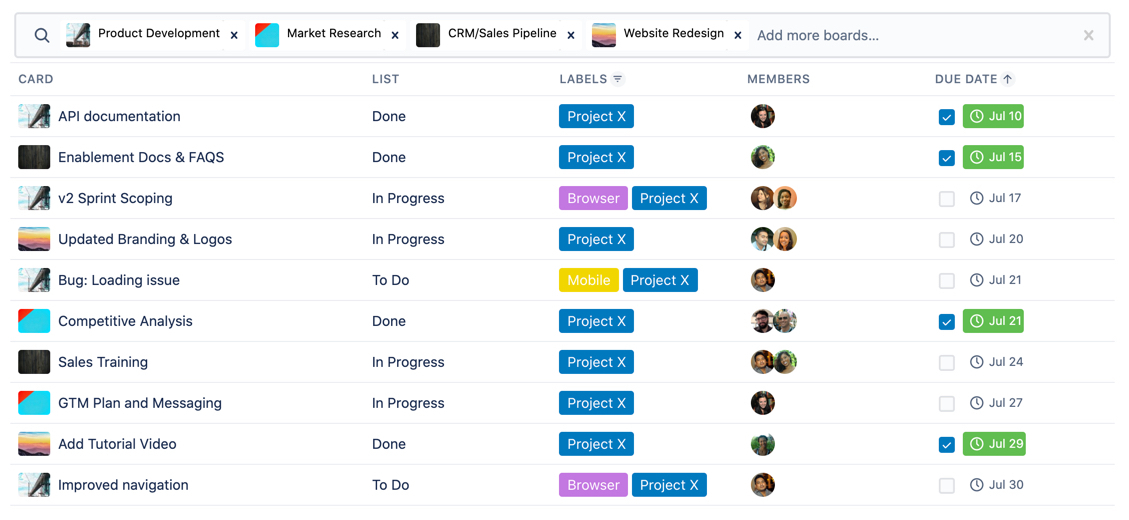
The actual new features are pretty straightforward. The highlight for Trello users is surely the beta version of a table view. This marks the first time the service is giving users this spreadsheet-like overview of what is happening across their various Trello boards. It reminds me quite a bit of Airtable, but what’s maybe more important here than the feature itself is that the Trello team says this is the first of a series of new ways to view data across multiple projects in the application.

Image Credits: Atlassian

As for Confluence, a lot of the new features here are about saving users time (or measuring it). Coming soon, for example, is a bulk content management feature that will allow users to do things like archive multiple pages with a single click, label them or export them, among other things.

Available now are Confluence Smart Links that let you preview content from across the web so that users don’t have to leave their workspace to see important information, as well as real-time feedback on the content in Confluence with the ability to view, create and resolve in-line comments while in the service’s edit mode.

Image Credits: Atlassian

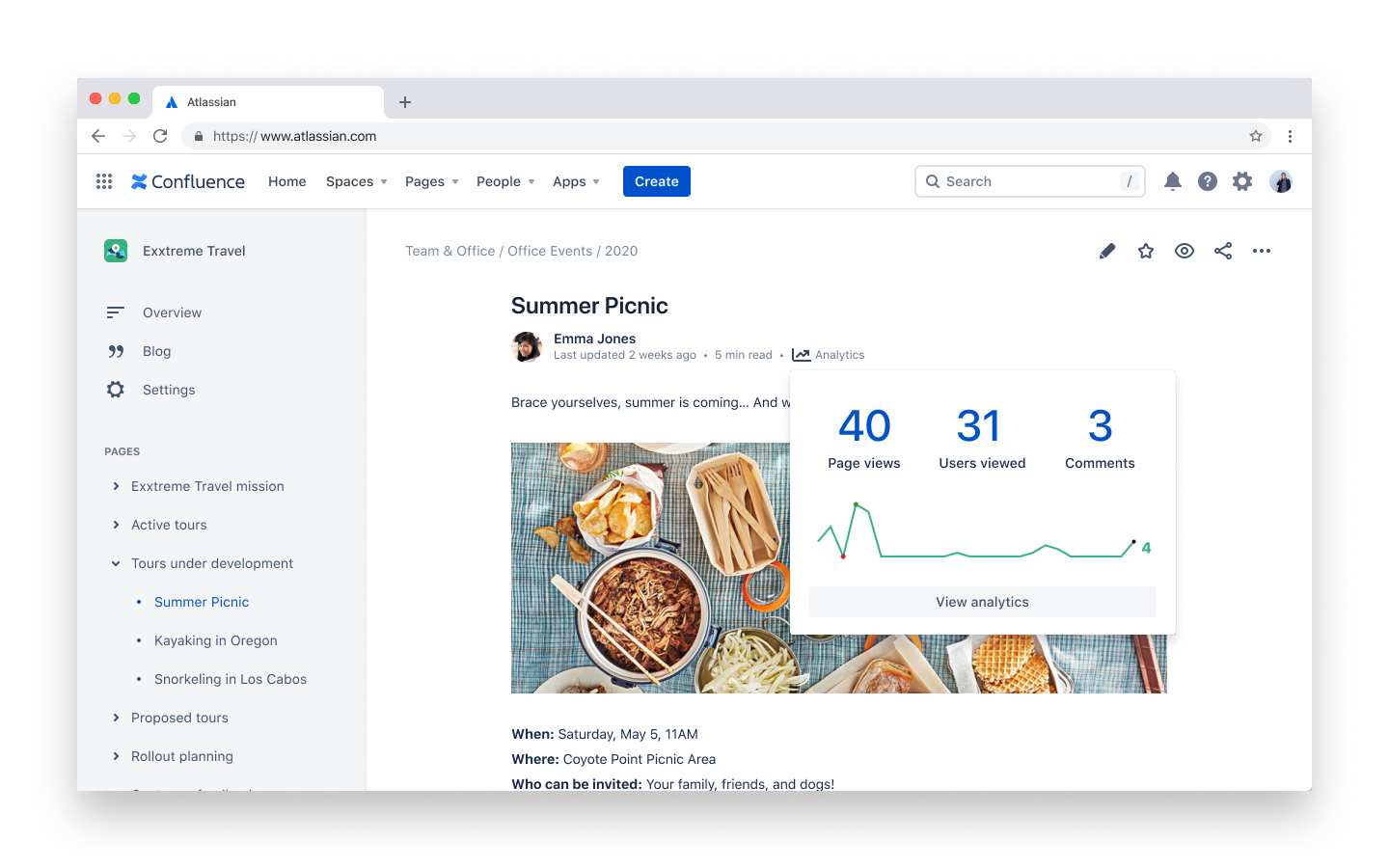
The last new Confluence feature is Page Insights, which is all about metrics. With this, Confluence adds estimated read time to its page view counts, “making it easier to form quick decisions about when and how to consume content in a busy workday. […] This simplifies the mental process of navigating the endless sea of content.” Who still has the time and energy to read all of those long documents, after all?

“Teams around the world were forced into working remotely, but now many organizations are considering a permanent move to a more distributed work environment,” said Pratima Arora, head of Confluence at Atlassian. “With so many work streams across departments and individuals, it becomes impossible to rely on the old system of email chains as a vehicle for planning and managing work. Leaders need to look at whether they have the right work management system to support collaboration across the organization for the longterm.”

15 Jul 2020

Sidekick embraces remote working with always-on teleconferencing hardware

Those forced to acclimate to remote work understand what a pain it can be. Sure, there are certainly benefits to not having to commute into work each day, but among other things, you lose a lot when you eliminate human interaction. Apps like Zoom and Slack have their place, certainly, but none does a particularly good job replicating the in-person work environment.

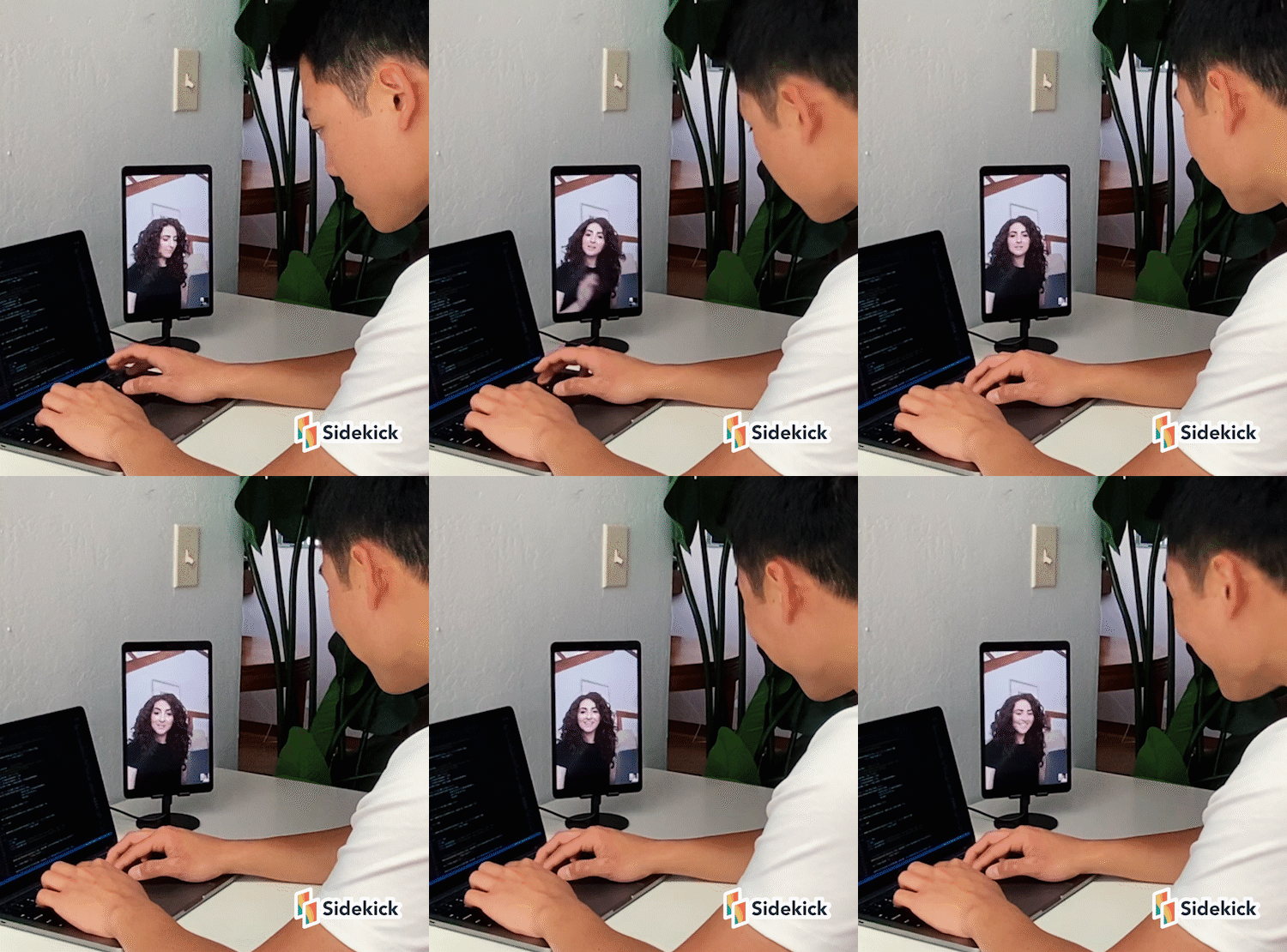
Formed by three ex-Palantir employees and a former Googler, Y Combinator-backed Sidekick has impeccable timing. The startup (which is fittingly remotely split between the Bay Area and New York), has built a hardware solution designed to bring an always-on video connection to the desk of remote workers (which, as it so happens, is most of us non-essentials, these days).

Development of the project began in earnest when the startup set out interviewing 100+ teams to discuss the challenges of remote work.

“We reflected deeply on what’s needed to enable these organic conversations. We came from a background as ICs and managers working on distributed teams at Palantir and Google, where we had all the shiniest collaboration tools at our disposal — Slack, Zoom, Notion, Tandem,” Sidekick writes in a recent blog post. “Despite this entire suite of shiny tools, we would still fly out for a week every month from our home office in NYC to join our remote halves in London — over 20 hours in travel and thousands of dollars in expenses every month.”

Image Credits: Sidekick

Sidekick contends that teleconferencing apps like Zoom create too much friction between the user and creating a kind of virtual open office. The teams the company spoke with suggested that a dedicated hardware device was the way to go here, so Sidekick repurposed an OEMed tablet, forking Android to their purpose. The company’s roadmap involves a proprietary hardware device sporting key aspects like a depth sensor.

For now, however, it’s selling its version of the existing consumer tablet through a hardware-as-a-service plan. Customers will be charged $50 per month, per device.

“They should only pay us as long as we’re delivering that value, and stop paying us if we’re not,” Sidekick told TechCrunch when asked about the subscription method. “We see the hardware as the best way of delivering that, but we believe that what’s most fair is for our users to pay for exactly the continued value we provide — not the hardware itself.”

There’s a physical button that puts the system to sleep, but when it’s on, it’s on. Users can’t turn the camera off and remain in stealth, either. Personally, I’d be hesitant to have an always-on camera sitting in my living room (small, one bedroom New York apartment) with a direct line to my co-workers. One of the things you risk working from home is getting a little too…comfortable, if you will. After a few hours of not interacting, it’s easy to forget that there’s a camera trained on you.

The startup tells TechCrunch that the system isn’t for everyone. “Sidekick is meant for fast-moving teams, often forced into remote work, that truly need to be in the same room to make progress,” the company explains. “Teams like startup founding teams, product leadership, executives/chief-of-staffs and sales.”

There’s probably something to be said for the executives themselves who are looking for an easier way to keep tabs on employees now that they can’t just swing by their cubicle. Sidekick has a purchasing option “for teams of all sizes and setups,” though hopefully the product remains more about collaboration and less about monitoring for most teams.

15 Jul 2020

Researchers develop laser-based underwater WiFi system for sub-sea data networks

A team of researchers working out of the King Abdullah University of Science and Technology (KAUST) have developed a two-way wireless data connection for use underwater. Strong wireless data connections are basically taken for granted in our daily lives, from cell service to home WiFi networks, but it’s actually tremendously challenging to create high-speed wireless connections in a medium like water. That could be very valuable for keeping underwater data centers connected with surface network infrastructure.

KUAST’s researchers approached the challenge using simple, readily available off-the-shelf components, including a Raspberry Pi that acts as the modem. They also built it to be compatible with existing 802.11 wireless standards, so that it can easily connect into the larger global internet for consistent and reliable connections.

The Raspberry Pi provides the compute need to convert the standard wireless signal into one that can be transmitted optically via laser. The signal comes in over the air to a buoy at the ocean’s surface, where the Pi then does the conversion and transmits the information via blue and green lasers, which then beam it down to an optical receiver located underwater, with a maximum practical transfer speed of 2.11 Mbps across a distance of 20 meters (around 66 feet).

The research team managed to use their system to do Skype calls and move files back and forth – but they also burned out the Raspberry Pi using lasers that overwhelmed its capabilities. This could be shored up by swapping in a dedicated optical modem, they said. A bigger problem that exists when using this so-called Aqua-Fi networking tech is dealing with the optical variation that can result underwater from currents and water movement.

To overcome those limitations, the team is considering a number of options, including a two-laser system in which a low-powered one does way finding to plot the course for the more powerful data connection, and can readjust orientation if a connection fails. They could also broaden the receiver with an array of multiple receivers – similar to how MIMO antenna arrays work on modern networking hardware.

15 Jul 2020

Over 2,500 games removed from Apple’s China App Store in early July, as crackdown begins

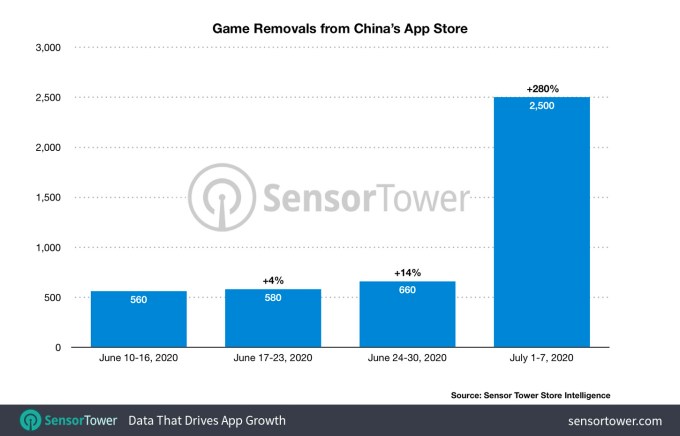
Over 2,500 mobile games have been removed from China’s App Store during the first week of July, according to a new report from app store intelligence firm Sensor Tower. The removals were expected due to a planned crackdown on unlicensed games, but this data is the first to demonstrate the impact on the app economy.

For comparison, the July figure is four times the number of games that were delisted during the first week of April, five times higher than the first week of May, and over four times higher than the first week of June.

The removals have to do with Apple’s new compliance with Chinese gaming regulations.

Apple earlier this year set a deadline of June 30 for app developers to comply with a Chinese law for mobile games, first introduced in 2016. The law requires game developers offering paid downloads or in-app purchases to get a license from one of the country’s censorship bodies, the General Administration of Press and Publication of China.

For years, iPhone game developers had skirted the law by publishing their games then waiting for their license approval. This can be a long and tedious process that could take many months, or longer if there’s a freeze underway — as in 2018. Then, the gaming industry saw a 9-month halt on the issuing of licenses as Chinese regulators reshuffled their duties to clamp down further on games containing pornography, gambling, violence and and any other content deemed inappropriate by Beijing.

Major Android app stores had already enforced the 2016 rule, but Apple’s loophole allowed a mobile gaming industry to thrive on the iPhone platform in China for years.

Apple’s decision was expected to see the removal of thousands of games from the App Store, starting July. Sensor Tower data indicates that came to pass.

However, its data is only able to capture those games that saw enough downloads to rank in the App Store’s charts, including the game subcategory charts.

Out of the 2,500+ games that were pulled, nearly 2,000 (80%) had less than 10,000 downloads since the start of 2012, the firm estimates. Together, the titles had seen a total of 133.4 million lifetime downloads.

Combined, the removed games generated $34.7 million in lifetime gross revenue, with one game accounting for more than $10 million and 6 that earned over $1 million.

Notable removals included Contract Killer Zombies 2 from Glu, Solitaire from Zynga, ASMR Slicing from Crazy Labs, Nonstop Chuck Norris from Flaregames. More recently, Hay Day from Supercell was also taken down.

The changes to the gaming market as well as the coronavirus impact on the app economy have already allowed the U.S. to reclaim the top spot in terms of iOS consumer spend in Q2. According to App Annie, the U.S. saw 30% quarter-over-quarter growth in iOS consumer spend in Q2, besting China.

The longer-term fallout from the removals may show up in Apple’s bottom line, as China has been the most lucrative mobile games market in the world, noted Sensor Tower, including on iOS. In 2019, games on China’s App Store generated an estimated $12.6 billion, or 33.2% of all global games spending on Apple’s marketplace last year, the firm said.

15 Jul 2020

As companies accelerate their digital transitions, employees detail a changed workplace

The U.S.’s COVID-19 caseload continues to set records as major states move to re-shutter their economies in hopes of stemming its spread. For many workers the situation means more time in the home office, and less time in their traditional workplace.

What the world will look like when safety eventually returns is not clear, but it’s becoming plain that the workplace will not revert to its old normal. New data details changed employee sentiment, showing that a good portion of the working world doesn’t want to get back to its pre-COVID commute, and, in many cases, is eyeing a move to a different city or state in the wake of the pandemic and its economic disruptions.


The Exchange explores startups, markets and money. You can read it every morning on Extra Crunch, and now you can receive it in your inbox. Sign up for The Exchange newsletter, which will drop every Saturday starting July 25.


The changing workplace has shifted — accelerated, you could say — demand for all sorts of products and services, from grocery delivery to software. The latter category of tools has seen quickening demand as the world moves to support newly remote workforces, helping keep them both productive and secure.

TechCrunch has covered the accelerating digital transformation — industry slang for companies moving to a more software-and-cloud world — before, noting that investors are making big bets on companies that might benefit from its ramping pace. Thanks to new data from a Twilio-led survey, we have a fresh look at that trend.

Undergirding the digital transformation is how today’s workers are adapting to remote work. If many workers don’t want to stop working from home, the gains that companies serving the digital transformation are seeing could prove permanent. New data from a Qualtrics -led survey may help us understand the new mindset of the domestic, and global worker.

At the union of the two datasets is a lens into the future of not only how many information workers, to borrow an old phrase, will labor in the future, but how they’ll feel about it. So, this morning let’s explore the world through two data-driven lenses, helped as we go with notes from interviews with Qualtrics’ CEO Ryan Smith and Twilio’s Chief Customer Officer, Glenn Weinstein.

What workers want

15 Jul 2020

BeanBon coffee roaster makes roasting at home easy, with customization for advanced coffee lovers

The BeanBon Coffee Roaster is kicking off a crowdfunding campaign for its countertop smart roaster device today, seeking a total of $10,000 over the next month. The BeanBon is already a fully realized product, and I was able to test one out to confirm it matches its creator’s claims – and it does indeed offer a simple, easy way to get into at-home coffee roasting, with minimal expertise and cleanup required.

The basics

The BeanBon is a relatively small countertop device, about the size of your average juicer or drip coffee maker. It has a simple function: roast coffee beans, in small batches designed to be optimized for daily coffee drinking use. The machine itself arrives fully assembled, and is just as approachable in terms of ease of use as your average coffee maker, too.

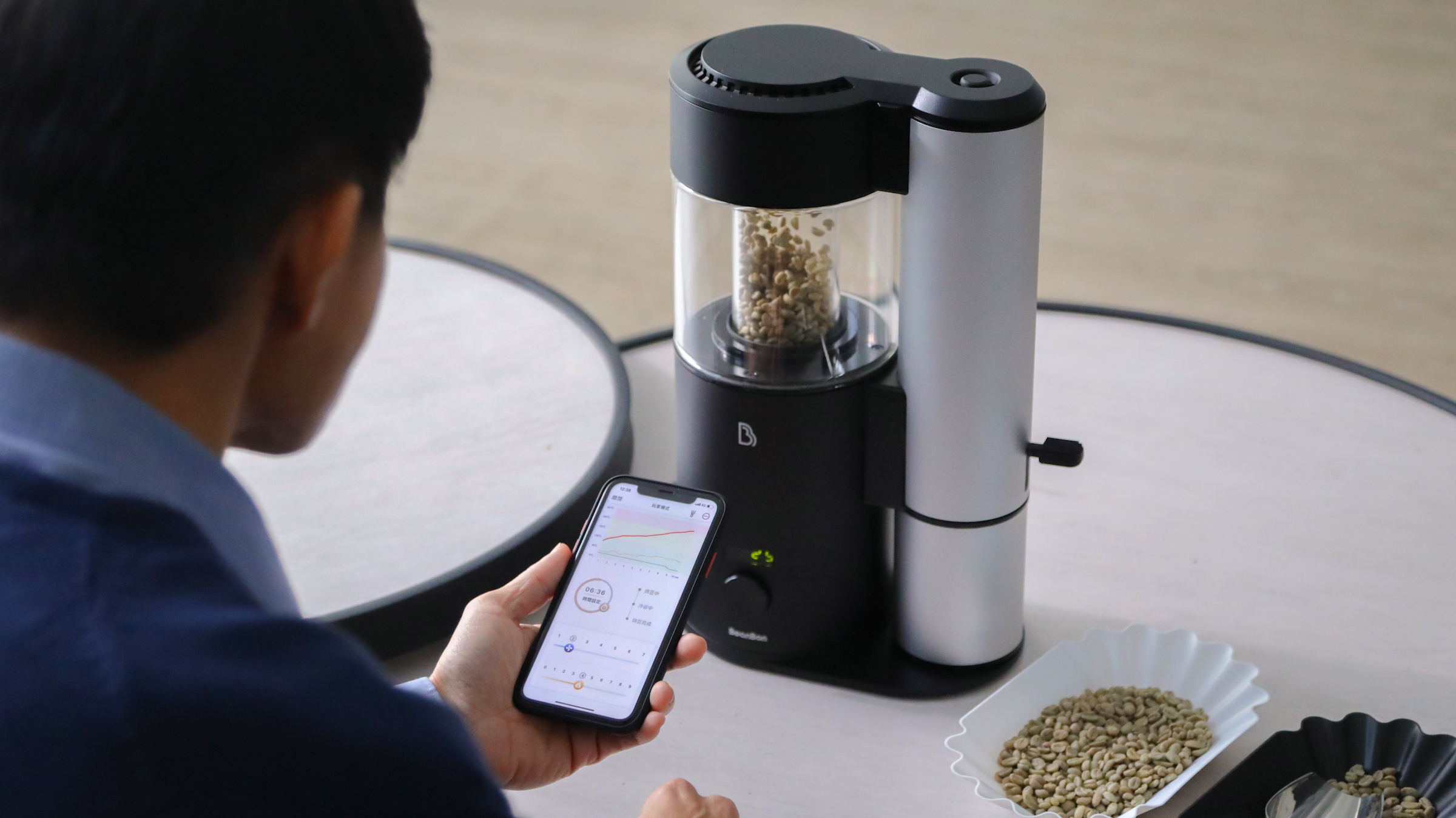
At-home roasting can be accomplished in number of ways, but BeanBon’s whole approach is designed around simplicity and flexibility. Out of the box, you can be roasting beans in no time with no prior experience thanks to its simple manual settings. And if you want to get more in-depth, there’s an app for iOS and Android that lets you tune all the roasting settings to fit your exact tastes and needs.

BeanBon plans to retail its roaster for around $1,000, but is offering it to Early Bird backers at $699 during the Kickstarter campaign.

Design and performance

Image Credits: BeanBon

While the BeanBon I tested out is the product of a tooling sample, rather than the shipping version, it’s still pretty well put-together in terms of fit and finish. The exterior is black anodized aluminium and it feels sturdy and well-constructed. The design is modern but relatively understated, so it won’t look out of place in a modern kitchen atop the counter next to a coffee machine.

Because it’s a pre-release product, the tester version I received shipped in generic packaging and didn’t include any instructions. Luckily, none were required for me to figure out how to use it, and to get started actually roasting the two included packs of green coffee beans in just minutes. The design is clever and simple, and by referencing a promotional video for the BeanBon released in Asia, I was quickly able to get up and running.

Operating the BeanBon is as easy as removing the plastic lid of the machine and pouring beans into the central transparent roasting chamber. Once you turn on the the machine, you then turn the dial to select your roast level (1 to 8, 1 being the lightest) and then press to start. The roast cycle runs automatically, showing you a countdown timer. Once that timer runs down, there’s a cooling cycle that follows, and then you simply press a lever located on the side to drop the roasted beans into a collection bin.

One of the most clever things the BeanBon team has done is implement a fan that comes on automatically when you press this lever, which blows up the chaff (coffee bean shells that crack and shed during roasting) to be collected in an easy-to-clean filter located at the top of the machine while dropping the much heavier beans into the pot. Too much chaff can affect the taste of the coffee, resulting in increased bitterness, and this is a clever way to automate the chaff removal process.

One note about operation: The BeanBon roasting process did set off my condo’s smoke alarms, even though no smoke was visible. It gives off a strong (and very pleasant, if you’re a coffee lover) aroma while working, but this is likely enough to trigger your smoke detectors depending on the space in which you’re using it. Turning on the stove vent and using it near that seemed to solve the problem, as did ensuring I use it with windows open and fans going.

Bottom line

The pre-packaged BeanBon coffee I received had an included recommended roasting level, which also makes it very easy to get started. I wasn’t able to test out the more advanced app-based features, because the software isn’t yet available here, but the manual modes worked exactly as advertised.

Roasting at home, especially with smart features, can be a very expensive affair – BeanBon’s price point at $699 (and $749 after the Early Bird units are gone) is remarkably low for what it can do. Over time, you can definitely realize cost savings from using unroasted beans and doing it yourself – green beans are easier to buy in bulk because they take longer to go bad than do roasted beans. But if you’re thinking about getting into this world, it’s probably better to be motivated by the skill and enjoyment of custom roasts than anything else.

BeanBon does lower the cleanup and skill requirements considerably, however, making at-home roasting pretty approachable. It’s a great way to get started, provided BeanBon meets its production goals and starts shipping these later this year as it plans to do.

15 Jul 2020

Crisp, the platform for demand forecasting the food supply chain, gets $12 million in funding

Crisp, a demand forecasting platform for the food industry, has today announced the close of a $12 million Series A funding round led by FirstMark Capital, with participation from Spring Capital and Swell Capital.

Crisp launched out of beta in January of this year with a product that aimed to give food suppliers and distributors a clearer picture of customer demand at retailers. Before Crisp, these organizations usually had several data scientists compiling data from various sources into an unintelligible spreadsheet, making it difficult to see general demand outlooks, and nearly impossible to spot anomalies.

Not only does this lead to losses in revenue, but it also contributes to a terrible amount of food waste.

Crisp looks to solve this by giving these suppliers and distributors a visualization of their data instantly and in real time. The company has built integrations with a large number of ERP software, ingesting historical data from food brands and combining them with a wide range of other signals around demand drivers, such as seasonality, holidays, price sensitivity, past marketing campaigns, changes in the competitive landscape, and weather that might affect the sale or shipment of ingredients or the product itself.

The end goal is to consolidate data across the industry, from brands to distributors to grocery stores, so that each individual link in the food chain can do a better job of matching their supply with their demand on an individual basis.

Since launching out of beta, Crisp has expanded beyond food brands and suppliers into retail and distributor space. The company has also expanded beyond product and dairy into verticals like beverages, bakery, CPG, flowers, meat and poultry. The startup says its seen an 80 percent increase in the number of customers using the platform since January.

Obviously, the coronavirus pandemic brings its own unique challenges and opportunities to Crisp’s business. On the one hand, grocery store shopping is booming and the supply chain behind it is certainly in need of better data science and demand forecasting as user behavior shifts rapidly. On the other hand, user behavior is shifting rapidly.

With state by state, and sometimes county by county lockdowns and shifts in the restrictions imposed on small businesses, Crisp has had to manually track what’s going on around the country in order to provide clear insights to its customers.

“This period we’re in has increased that willingness to share data and increased collaboration between everybody in the supply chain,” said founder and CEO Are Traasdahl. “We’ve seen a big shift there. Earlier, everyone assumed that everyone else was able to deliver, but now this ability to have a full, top-down visibility across a whole depth of companies, not just the companies next to you in your trading relationships, but being able to unify data and have more insights from multiple steps away from yourself, and get that data in real time been accelerated.”

Crisp currently has 33 employees (with plans to hire on the back of the funding), which is 33 percent women and 15 percent people of color. Half of Crisp’s management team are women.