Year: 2020

15 Jul 2020

New telemedicine service The Cusp rolls out at-home hormone test for women to predict menopause

The Cusp, a newly launched startup offering telemedicine services for women in perimenopause and menopause, is launching an at-home hormone test service that slashes the cost of in-office visits and lab tests.

Women in California can order the test at a cost of $159 for a telemedical consultation and test, versus roughly $500 for having the same test and lab work administered in a clinic, according to the company.

Unlike other, commonly-prescribed hormone tests The Cusp bases its still-to-be-clinically-validated test on new research that a key hormone measurement can help predict the time to menopause. The company is currently working with researchers to help the broader medical community validate these findings. 

Although the test may not be clinically validated, the company said that its use of “menopause specialists” with specific training in issues surrounding perimenopause and menopause can provide a more complete diagnosis of a woman’s current state and what is likely to come next based on both clinical and laboratory data.

“Menopause is very stigmatized and midlife care is a highly underserved market. We launched The Cusp to provide women with a new model of care during this stage of life so women can optimize their health,” said The Cusp, chief executive, Taylor Sittler. “Our focus begins with perimenopause treatment as early care can lead to healthier outcomes.”

The company said that the test is best for women experiencing early signs of perimenopause, typically between the ages of 42 and 50.

“Throughout my career I’ve been focused on the intersection of women’s health, menopause, and breast cancer. It was shocking to me how little information is out there for women, so I worked with national committees helping establish guidelines for managing menopause symptoms and sexual functioning in cancer survivors,” said Dr. Mindy Goldman, Director of the Gynecology Center for Cancer Survivors and At-Risk Women Program at UCSF, and a physician working with The Cusp. “I’m thrilled to be a part of  The Cusp, as we are on the front lines providing women with comprehensive diagnostic tools and personalized care so that menopause can be faced head-on and managed with a multi-pronged approach that can include medical interventions, naturopathic solutions, and/or hormone replacement therapies.”

The company is already providing care to roughly 75 patients already and is growing its membership rapidly. With its recent launch, The Cusp has joined startups like CurieMD, Elektra Health, and Geneve, which are all focused on providing medical services to women in perimenopause and menopause.

To date, the company has raised $4 million from investors including HomeBrew, Village Global and individual investors like Katie Stanton and Megan Pai.

Sittler, a co-founder of Color Genomics, sees an opportunity in applying new diagnostics tests and technology to treating women as they enter menopause.

The Cusp charges an initial $210 for tests and the first three months of care and then an additional monthly fee of $72 per month.

“Being able to provide these personalized solutions that involve proprietary technologies. We would love to get into newer treatments… once we get a few zeros to our member number… there’s an initial advantage that we have in terms of the integration we’ve already done and the advantages that we have,” said Sittler.


15 Jul 2020

LA’s PocketList gives renters better information, faster, about what apartments are available in cities

Nick Dazé, the co-founder and chief executive of the new Los Angeles-based apartment rental services company PocketList likes to say that his company is the first one to put the renter at the core of the platform. 

The company Dazé has built with co-founder Julian Vergel de Dios, has, in fact, flipped the traditional script of relying on landlords and property managers to source information about available rentals and is relying on renters to provide information about the apartments they’re in… and the apartments where they’d like to be. 

PocketList started out as an experiment born out of a lot of trial and error, according to Dazé, but it was around the initial revelation that “renters typically know they’re going to be moving way ahead of time.”

The service, which is available as an app and online, was a business nearly four years in the making. Initially Dazé and Vergel de Dios built a service called Block. “The hypothesis with Block was that a big painpoint for renters was communication between people looking for apartments together,” Dazé said. “We made a tool that was well designed and well built … it was a cross between Slack and Microsoft Excel, but specifically for renters. The biggest problem was that it didn’t have a good business model.”

PocketList co-founders Julian Vergel de Dios and Nick Dazé. Image Credit: PocketList

What started as Block, eventually morphed into PocketList and the two Los Angeles-based founders quickly took the app to market with little fanfare in November. Growing initially by word of mouth, the service allows for an easy sign up where renters fill out a brief description of their apartment — basically letting the community know what it’s like and that it will soon be on the market — and then can search for other apartments in areas they’re interested in.

Rentals typically sit vacant for an average of 26 days every time they turn over, according to PocketList’s internal data. That delay costs landlords as much as $43 billion and puts pressure on supply constrained housing markets, the company said. But using PocketList, renters can leave a place more quickly and owners reduce the time an apartments stands empty to perhaps one week. Currently, the average unit on PocketList is rented 67 days before the landlord is given notice, and 97 days before the unit appears on other listing sites, the company said in a statement. 

For renters, the network provides information about apartments that will be available on the market and a way to query current occupants about potential units. Interested renters can also reach out directly to landlords and property managers via the PocketList app to indicate that they’d be interested in looking at a place. To ensure security no contact information is shared with a property manager until a renter submits an application and last names and images are hidden until the renter applies for an apartment.

On the other side of the equation, landlords and property managers are able to claim properties for free and see feedback from renters about their buildings — and the thoughts renters have of other properties in their area. They also get earlier access to potential tenants once a previous tenant gives notice.

The next features on the product roadmap include descriptions of areas which give potential renters the option to select for the kinds of neighborhood features they want and more tools for landlords like direct application submissions, renter resumes and other landlord response tools.

The company’s rental marketplace already has tens of thousands of units in Los Angeles described on its platform by the renters themselves and will be expanding to San Francisco and San Diego later this year with plans to move into Seattle in 2021 and New York and Chicago later that same year.

Backing the company’s expansion plans and development is a $2.8 million seed round which came from David Sacks’ investment firm, Craft ventures, along with Abstract VC, Wonder Ventures, and Zillow co-founder, and recent Los Angeles returnee, Spencer Rascoff. Other, undisclosed, angel investors also participated in the round.

Still pre-revenue, PocketList plans to make money off of charging property managers and landlords for leads on likely renters for their apartments. Landlords can send outbound messages to potential renters that have expressed interest in a property, said Davé, of one of the company’s planned new services.

“Bringing transparency to real estate has been a nearly 20-year process, and the apartment market is only just getting there,” said Spencer Rascoff, PocketList investor, and founder of dot.LA and Zillow. “PocketList takes transparency to the next level, bringing exclusive ‘pre-market’ inventory into the light, and it’s no surprise that renters have flocked to the service.”

Renters can download the PocketList app for free, rate their current apartment and get access to the listings available on the app. Meanwhile, property managers and landlords have access to a pro version, which has all of the outreach, management and overview features that they’d want, the company said.

“Given the way the current rental market is set up, there’s almost always a gap between when a renter ‘needs to find a place’ and actually ‘rents a place,” continued Dazé. “PocketList breaks the cycle and gets people into homes they love earlier than ever before.”

15 Jul 2020

Sumeru Equity Partners buys majority stake in SocialChorus with $100M investment

SocialChorus, a startup that helps distribute communications internally in a similar way marketers reach customers externally, announced a $100 million investment today led by Sumeru Equity Partners. With this investment, the firm has bought a majority stake in the company. As part of today’s deal, Sumeru will be adding three members to the SocialChorus board.

Sumeru Equity Partners is making a majority investment in the company but also well capitalizing the business for future growth,” Mark Haller, principal at Sumeru told TechCrunch.

The company previously raised $47 million, according to Crunchbase data. Haller says this is not a buyout, so much as a partnership with those previous investors. “We’re seeing continued partnership with existing investors and we’re coming in and making that majority investment, and we’ll also be making another investment in the balance sheet,” he said.

What Sumeru is getting is a company that helps with internal communications using marketing techniques, says company CEO Gary Nakamura. “You can run campaigns with targeting segmentation and all the telemetry back that you need as a leader, as a manager, as an organization to understand how your communications are landing with your workforce,” Nakamura told TechCrunch.

The target is large companies and customers include big names like Ford, Archer Daniels Midland and Boeing. The company reports it has 120 large customers around the world, and the business has been growing at 50% year over year.

While the company is getting this infusion of cash from Sumeru, Nakamura says he will continue to try and manage the company in a thoughtful way, and that means being careful about how they hire beyond the 120 employees the company already has.

“What we have built is a business that doesn’t require a lot of heads to run it. We can maintain a 50% growth rate with financial discipline that we’ve implemented. Historically that is what we’ve been able to do,” he said.

Sumeru Equity Partners is a private equity firm based in San Francisco. It targets mid-market companies, according to the company website and then tries to apply operational efficiency by working with them on areas like product strategy, go-to-market acceleration and organizational development with the goal of building up the company and taking it to exit.

15 Jul 2020

Brave Robot ice cream launches as the first brand from the Perfect Day-backed Urgent Company

The founders of the alternative dairy protein manufacturer, Perfect Day, have joined with a longtime product developer in the dairy industry to create a new sustainably focused consumer food company called the Urgent Company.

Focused on creating sustainable food brands manufactured, packaged and sold in a more environmentally friendly way, the Urgent Company is unveiling its first product — Brave Robot ice cream.

It’s also the first indication of how Perfect Day will deploy some of the massive amounts of money it raised since it closed on its mammoth $300 million funding round led by the Canadian Pension Plan Investment Board with additional commitments from Temasek and Horizons Ventures.

Perfect Day founders Ryan Pandya and Perumal Gandhi first met their Urgent Company co-founder and general manager, Paul Kollessoff, when Kollessoff was performing due diligence on Perfect Day while working for the Irish dairy company Glanbia.

“What I was doing there was actually looking at new business ventures,” said Kollessoff. “I met the guys three years ago when we were doing some flavor work with them.”

The conversation ended there while Pandya and Gandhi built up Perfect Day, but around three months ago the two founders reached back out with idea for a new consumer food company, based on the latest in plant-based, or genetically modified proteins (including their own), that also used the latest in packaging technology, logistics, and other technologies to reduce the entire carbon footprint of a CPG company. 

Image Credit: The Urgent Company

“It’s not that we are trying to create a company that’s going to commercialize Perfect Day proteins,” said Pandya. “There are so many other things across the value chain of food that need to be improved and modernized including all of the things around how a food gets to the consumer.”

So Brave Robot’s commitment to sustainability extends beyond the use of alternative proteins to replace animal husbandry and the particularly ecologically disastrous dairy industry and its cows. “There’s a load of exciting stuff going on in ingredient innovation and packaging innovation,” said Kollessoff.

Those innovations help The Urgent Company not only become more sustainable, but give the company the ability to move products into the market more quickly, according to Kollessoff.

With only eight full-time members of the Urgent Company staff it managed to shepherd its ice cream business from inception to product launch within a three-month timeframe according to Kollessoff.

Co-founders of Perfect Day, Ryan Pandya (L) and Perumal Gandhi (R), showcase the prospective product portfolio fueled by its flora-based dairy protein. Image Credit: Business Wire. 

So Brave Robot will be launching with a direct to consumer pitch for its dairy-replacement pints of ice cream for a $5.99 price point. Initially available to customers in the California region, any number of buyers are talking to the company, Kollessoff said. “We’ll be on store shelves through the next month. Working with a national broker… we will have a direct to consumer platform as well.”

Before anything could happen with bringing a product to commercial scale, Kollessoff said he had to go through a rigorous process of testing the product — with his kids. At one point, there were 400 pints of ice cream in the Kollessoff freezer. He and his team whittled the initial over thirty flavors of ice cream and settled on a core group of eight.

They include: Vanilla, A Lot of Chocolate, Vanilla ‘N Cookies, Buttery Pecan, PB ‘N Fudge, Blueberry Pie, Hazelnut Chocolate Chunk and Raspberry White Truffle.

“We wanted to create something that is bigger and broader in vision that can bring innovation across the board,” said Gandhi of the drive to build another business with a broader scope than Perfect Day. “What Perfect Day is focusing on …we made cow 2.0… we’ve reimagined the cow… [but] we want [The Urgent Company] to use any protein on planet earth.”

Part of the reason why the company is so unfettered is to encourage speedy experimentation for the simple reason that there’s not much time to take the steps needed to slow down — and ideally reverse — climate change.

“You only get so much time on earth… and we wanted to do more… That’s why it’s called the urgent company.. [because] let’s hurry the fuck up world.”

15 Jul 2020

LA’s Kickback is a social shopping app that converts users into marketing channels through cash rewards

Frankie Bernstein, the Venice, Calif.-based serial entrepreneur, knows marketing.

At his last startup, Markett, Bernstein turned college students into brand ambassadors who were paid by the companies they repped for proselytizing about them on campuses.

Now he’s using that knowledge to launch Kickback on iOS and Android. It’s invite-only at this point, but the idea is that it uses company’s marketing budgets to create shopping rewards and incentives for app users. In the same way that Markett turned college students into advocates for apps like Uber and Lyft, Kickback will turn shoppers into brand ambassadors through its app.

In-app referrals and discounts for shopping are nothing new to the e-commerce world. In China, apps like Pinduoduo have turned into billion dollar businesses on the strength of referrals. Indeed, Pinduoduo recently raised $1.1 billion in funding to hit a valuation of nearly $100 billion.

It was only a matter of time before an American company tried to copy its success. Kickback — like most new apps these days — is invite-only.

Once past the waiting list, users get discounts on brands and can earn cash-back rewards when they shop or when they encourage their friends to buy something with the app.

[gallery ids="2016896,2016897,2016898,2016899,2016900"]

So far brands on the app include Walmart, Sam’s Club, Nike, Alo Yoga, Reebok, Away, Planet Blue, Sonos, Winc, Postmates, Casper, Kate Somerville, Lacoste, Columbia. Users get discounts or cash rewards when they shop and earn “kickbacks” when they invite someone to shop using their discount code. Cash rewards can be withdrawn using PayPal, according to a statement.

“Our mission is to take the billions of dollars brands spend on advertising and put that money directly into the pockets of the people,” said Franky Bernstein, Founder and CEO of Kickback, in a statement. “Brands know the most powerful form of marketing is word of mouth. We like to say that people are 100% more likely to go on a first date, watch a movie or, in our case, try a new product or service if a friend tells them about it. People have always loved sharing their favorite products and services with their friends. Now with Kickback, they get paid for it.”

15 Jul 2020

Zoom introduces all-in-one home communications appliance for $599

Zoom has become the de facto standard for online communications during the pandemic, but the company has found that it’s still a struggle for many employees to set up the equipment and the software to run a meeting effectively. The company’s answer is an all-in-one communications appliance with Zoom software ready to roll in a simple touch interface.

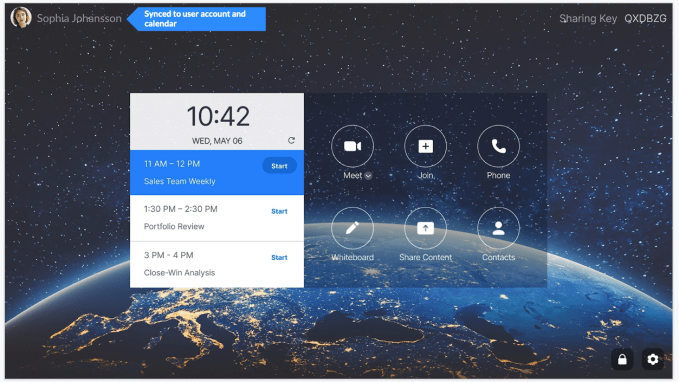
The device dubbed the Zoom for Home – DTEN ME, is being produced by partner DTEN. It consists of a stand-alone 27 inch screen, essentially a large tablet equipped with three wide-angle cameras designed for high-resolution video and 8 microphones. Zoom software is pre-loaded on the device and the interface is designed to provide easy access to popular Zoom features.

Zoom for Home – DTEN ME with screen sharing on. Image Credit: Zoom

Jeff Smith, head of Zoom Rooms, says that the idea is to offer an appliance that you can pull out of the box and it’s ready to use with minimal fuss. “Zoom for Home is an initiative from Zoom that allows any Zoom user to deploy a personal collaboration device for their video meetings, phone calls, interactive whiteboard annotation — all the good stuff that you want to do on Zoom, you can do with a dedicated purpose-built device,” Smith told TechCrunch.

He says this is designed with simplicity in mind, so that you pull it out of the box and launch the interface by entering a pairing code on a website on your laptop or mobile phone. Once the interface appears, you simply touch the function you want such as making a phone call or starting a meeting and it connects automatically.

Image Credits: Zoom

You can link it to your calendar so that all your meetings appear in a sidebar, and you just touch the next meeting to connect. If you need to share your screen it includes ultrasonic pairing between the appliance and your laptop or mobile phone. This works like Bluetooth, but instead of sending out a radio signal, it sends out a sound between 18 and 22 kHz, which most people can’t hear, to connect the two devices, Smith said.

Smith says Zoom will launch with two additional partners including the Neat Bar and the Poly Studio X Series, and could add other partners in the future.

The DTEN appliance will cost $599 and works with an existing Zoom license. The company is taking pre-orders and the devices are expected to ship next month.

15 Jul 2020

Spaceflight Inc. debuts new orbital transfer vehicle for satellite rideshare rocket launches

Seattle-based space ride share service provider Spaceflight Inc. revealed its next-generation orbital transfer vehicle today, the Sherpa-FX. The new spacecraft acts as a deployment spacecraft for combined payloads on rideshare rocket launches – essentially providing last-mile transportation from the point at which the launch vehicle deploys the combined payload, to the actual desired target deployment orbit of each satellite sharing the ride to space.

The Sherpa-FX will fly its debut mission on an upcoming SpaceX rideshare mission, currently set to take off as early as December 2020. The inaugural flight of the Spaceflight orbital transfer vehicle will carry 16 small spacecraft from a number of different companies and organizations, including one for NASA and one for the University of South Florida’s Institute of Applied Engineering.

This is the first spacecraft that has resulted from Spaceflights’ Sherpa-NG program, which is dedicated to developing and deploying next-generation technology for payload deployment and management from the point of primary payload deployment from a contracted launch vehicle from providers like SpaceX . This is a key step in ensuring that rideshare models work for payload operators, since while combining payloads on a single rocket is great for defraying the cost of launch, it’s far from ideal for actually ensuring your spacecraft ends up in the orbit where it’ll actually be operating.

Companies like Rocket Lab, which employs a dedicated rideshare model for its main business, have their own orbital transfer vehicles, as do operators who deploy larger payloads for single customers. Spaceflight’s entire business is predicated on supplying the technology and services necessary to take companies like SpaceX, as well as Rocket Lab, and offer even more flexibility and optimization in terms of supporting a larger number of deployments from a single launch.

Spaceflight, Inc. was acquired earlier this year by Japanese industrial giant Mistui & Co, but continues to operate independently out of its U.S. HQ with the same operational goal in mind.

15 Jul 2020

WeMo, one of Taiwan’s biggest scooter-sharing platforms, gears up for international expansion

Scooters, a common sight on the streets of Taiwan, give commuters an alternative to cars in the country’s densely-populated cities. But they also contribute to pollution and jam-packed parking spaces. Over the past few year, several companies haven taken on the challenge of creating more environmentally-friendly alternatives to traditional gas scooters. Gogoro is probably best-known internationally for its electric SmartScooters, which are now the category’s top-sellers in Taiwan. While less known outside of the country, however, scooter-sharing startup WeMo has grown steadily since launching in 2016. It now has a fleet of more than 7,000 scooters in three of Taiwan’s biggest cities and says users take about one million rides per month.

WeMo recently announced it has raised a multi-million Series A led by AppWorks, making it the Taiwanese venture capital firm’s first smart mobility investment. The funding is being used to expand beyond Taipei City, New Taipei City and Kaohsiung, WeMo’s current markets, with plans to go international, too, launching first in Southeast Asian countries.

In Taiwan, WeMo competes with iRent, a car and scooter rental service, as well as GoShare, the mobility-sharing platform Gogoro launched a year ago.

WeMo co-founder and chief executive officer Jeffrey Wu told TechCrunch that his company differentiates because from the beginning, it has focused on creating smart tech specifically for sharing scooters.

Instead of developing their own electric vehicles, like Gogoro, WeMo partnered with Kymco, one of Taiwan’s largest scooters brands. Each scooter is equipped with an internet-connected black box that was developed in-house by WeMo.

The black boxes enable WeMo to manage its fleet’s batteries, while providing data from rides, including traffic and road quality (for example, it detects when streets are bumpy) that can be shared with policymakers to improve transportation infrastructure. The black boxes also connect with WeMo’s user app, showing where scooters are available, unlocking them and sending alerts about traffic conditions.

WeMo began working on its service in 2015, about a year before launching with an initial fleet of 200 vehicles. Before cofounding WeMo, Wu was a consultant at McKinsey and Company.

“I was going back to my background of being a strategy consultant and at the time, my co-founder and I decided we wanted to do something in Taiwan that was very different from how people had practiced business in the past, because there were a lot of different macro-trends changing the environment,” he said.

“Obviously the shared economy sector was just booming and at the same time, mobile-first technology was beginning to prevail. But we realized that the transportation sector had not changed in a very, very long time, so we thought if we are able to use the sharing economy or pay-as-you-go concept coupled with green vehicles, and provide that on a massive scale to consumers, we could move to a greener, smarter and more convenient form of transportation.”

Wu also sensed a market opportunity because of the number of unused scooters he saw parked on the side of streets day after day. Despite being one of the most common transportation methods in Taiwan, finding parking in major cities is often a hassle, which means many scooters are underutilized.

WeMo fleets are located in parking lots, and scooters can be unlocked through the user app. Rental fees have different tiers, including per minute and hourly rates and monthly plans. The app is available in Chinese and English, to serve local riders as well as tourists. Riders can also now register accounts and rent scooters through LINE, the most widely-used messaging app in Taiwan.

To prepare for expanding into new markets, Wu said part of WeMo’s new funding is being used to expand its research and development center in Taiwan. The company plans to hire up to 100 hardware and software engineers, especially ones who have experience in self-driving technology, vehicle telematics and machine learning. Wu said WeMo’s plan is to be a “mobility-as-a-service” platform, working with partners to launch scooter-sharing services in new markets.

“Over the past five years, people have become used to shared mobility services, but five years ago it wasn’t such a developed space, so we had to come up with the technology and applications,” Wu said. “Now we’re looking at what the future of mobility should look like, and how we use IoT technology to expand outside of transportation and use our data to help users maneuver more easily in their cities.”

15 Jul 2020

Privacy.com, a virtual payment card startup, raises $10.2M in Series A

Virtual card payment startup Privacy.com has raised $10.2 million in a Series A fundraise, the company announced Wednesday.

The round was led by Teamworthy Ventures, with participation from Tusk Venture Partners, Index Ventures, Quiet Capital, Exor Seeds, and Rainfall Ventures.

The startup, if you’re unfamiliar, lets anyone generate virtual and disposable payment card numbers for free, allowing those users to keep their actual credit card number safe while allowing the option to cut off companies from your bank account. In an age of near-constant data breaches and credit card skimmers targeting unsuspecting websites, Privacy.com makes it harder for hackers to get your real credit card details.

It’s a popular idea. In the past three years, Privacy.com has issued 5 million virtual card numbers using its

Privacy.com’s chief executive Bo Jiang told TechCrunch that the new funds will help the company launch its new Card Issuing API — in beta testing for the past year — allowing corporate customers to issue virtual cards and manage expenses for their employees in their own back-end systems.

“We’re the first company that allows developers to see upfront, transparent revenue sharing and sign up and create cards programmatically the same day,” he said.

Privacy.com will primarily serve early-stage enterprise companies, which “traditionally need a lighter weight solution for their online payments,” said Jiang. “It’s an underserved market, because most incumbents focus on the larger enterprise with monthly minimums and long timeframes.”

Jiang also said the round will help the company “hire and ramp up product development at a much faster pace” as part of its push to serve more enterprise customers.

15 Jul 2020

Lemonade launches pet insurance

Lemonade today launched pet insurance, marking its entry into a new vertical of insurance for the first time since it launched its renters/home owners insurance in 2016.

Lemonade CEO Daniel Schreiber told TechCrunch back in February that some 70 percent of Lemonade customers with a home owners or renters policy are also pet owners, and yet between 1 and 2 percent of pet owners in the United States have pet insurance.

It’s a relatively straightforward Venn diagram.

Pet insurance from Lemonade will cost users $12/month, with a 10 percent discount available to existing Lemonade policy holders who choose to bundle their new pet insurance with home/renters insurance. The policy is only available to dog and cat owners — other pets are not covered.

The policy covers blood tests, urinalysis, x-rays, MRIs, labwork, CT scans and ultrasounds, as well as outpatient, specialty and emergency care procedures, along with hospitalization and surgery, according to the Lemonade website. The company also covers medication, including injections and prescription meds. Pet owners can also get an extended Accident and Illness Package that goes beyond the initial coverage of accidental road accidents and poisonings, and a variety illnesses.

Lemonade Pet Insurance comes with an optional wellness package, as well, which provides savings for routine stuff like an annual physical checkup, heartworm tests, fecal tests, annual parasite evaluation tests, Bloodwork, and up to three vaccines. The wellness package also gives pet owners access to medical advice chat and offers reminders and tips to keep their pet healthy.

“Health insurance for pets dates back to over 100 years ago,” Schreiber told TechCrunch in February. “It started with horses in the Netherlands, and the heir to that pet insurance is actually car insurance. Horses were a mode of transportation, and the insurance was meant to protect you if something happened to that mode of transportation. But pets are now members of the family.”

According to Fortune, Americans spent upwards of $75 billion on their pets in 2019.

Insurance policies in general are also quite antiquated, with legal requirements to use language and clauses written decades ago. Lemonade has been trying to launch its Policy 2.0 — a simply worded policy that is open-sourced, allowing anyone to contribute or suggest changes to it — in the United States. Policy 2.0 is currently only available in Europe, but it marks a big change in the way insurance is handled as one of the biggest issues in the industry is that policy holders simply don’t, and in some cases can’t, know what is and is not covered.

This launch comes at a time when Lemonade has just entered the public market, with a big pop in its first day of trading.

Alongside its public offering, Lemonade has raised $480 million in institutional investment from firms like Sequoia, Allianz, and others, with a team of 382 employees globally.

On the US team, 35% of full time employees are people of color; 61% are women. Globally, Lemonade is 49% women; a quarter of the R&D team are women, and the executive team is 33% women. The 8-member board includes one person of color and one woman.