Year: 2020

09 Jul 2020

Creandum backs Amie, a new productivity app from ex-N26 product manager Dennis Müller

Amie, a new productivity app from ex-N26 product manager Dennis Müller, has picked up $1.3 million in pre-seed funding to “kickstart” development and hiring.

Backing 23 year-old Müller is Creandum — the European VC best known for being an early investor in Spotify — along with Tiny.VC and a plethora of angels. They include Laura Grimmelmann (Ex-Accel), Nicolas Kopp (CEO, N26 U.S.), Roland Grenke (Dubsmash co-founder) and Zachary Smith (SVP of product at U.S. challenger bank Chime).

Founded early this year and with a planned launch in early 2021, Berlin-based Amie is developing a productivity app that combines a person’s calendar and to-dos in one place. Previously called coco, it promises to work across all devices, with an interface that “works just like you think”.

“Back in the day, you had a calendar on your office wall, and a to-do list on a notepad,” Müller tells me. “You could take your list with you elsewhere, but not your calendar. Those were digitized instead of rethinking the flow. Most productivity apps solve very specific problems, creating a new one, [and] users need too many tools”.

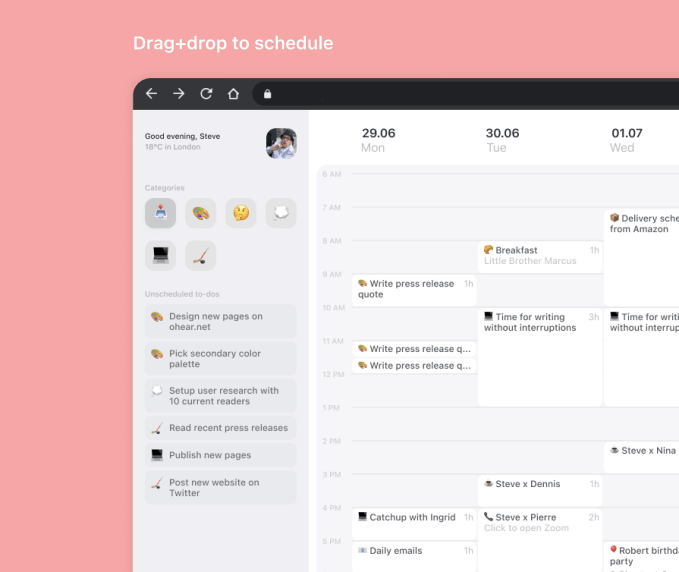
Amie pre-release app screenshot

Müller says Amie is built on the principle that “to-dos, habits and events all take time, and all belong in the same place”. Many people already schedule to-dos and the startup wants offer the fastest way to create to-dos, schedule events, check your calendar “and even jump into Zoom calls”.

As a glimpse of what’s to come, Amie promises to let you drag ‘n’ drop to-dos into your day, or turn links and screenshots into to-dos. “With Amie’s Alfred-like app, you can create an event and invite people in a different timezone, all while other apps are still loading,” says the young company.

More broadly, Amie wants to act as a central workspace, letting you also do things like join video calls, take notes, and do email, without the need to open extra browser tabs and therefore avoid “context switching”.

“Amie will target professionals who are currently using Google Calendar, due to our integration,” adds Müller. “The waitlist already counts thousands of users, who are mostly professionals working in the tech industry e.g. designers, developers, bizdevs, etc”.

09 Jul 2020

Coronavirus impact sends app downloads, usage and consumer spending to record highs in Q2

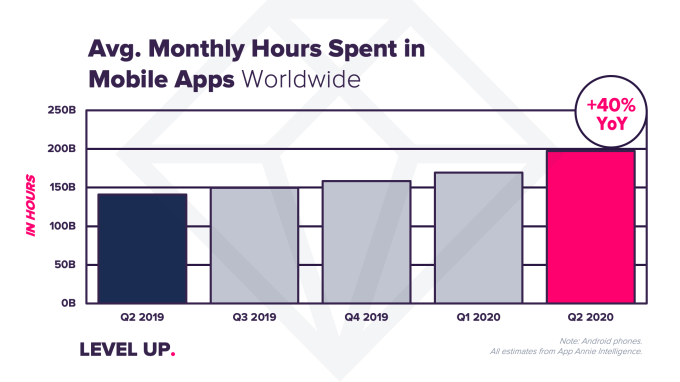
As the world continued to cope with the impact of the coronavirus outbreak, the second quarter of 2020 became the largest yet for mobile app downloads, usage, and consumer spending. According to new data from app store intelligence firm App Annie, mobile app usage grew 40% year-over-year in the second quarter of 2020, even hitting an all-time high of over 200 billion hours during April. Consumer spending in apps, meanwhile, hit a record high of $27 billion in the second quarter. And app downloads reached a high of nearly 35 billion.

The growth in app usage has been fueled by social distancing and lockdown measures, as countries around the world try to quell the spread of the novel coronavirus.

Image Credits:

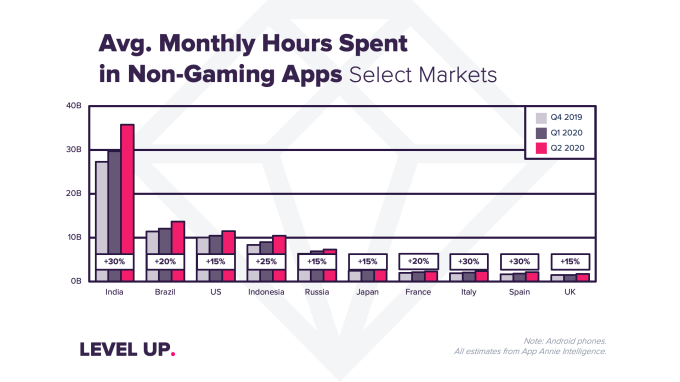
In India, for example, time spent in apps grew 35% in Q2 2020 from Q4 2019. Italy and Indonesia saw growth of 30% and 25%, respectively. In the U.S., time spent in apps grew 15%.

App Annie says that now, the average user is spending 4 hours and 20 minutes per day on their smartphones.

Image Credits: App Annie


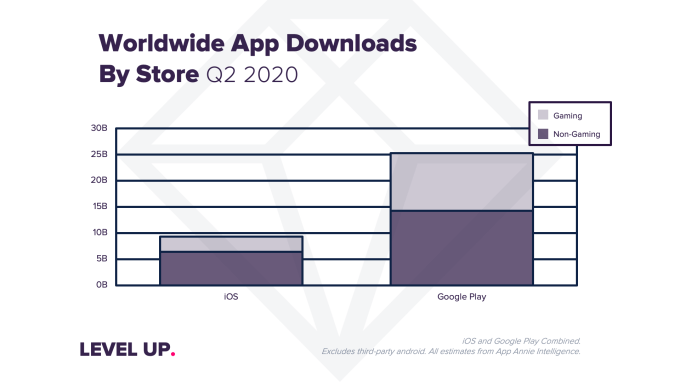
But consumers aren’t just launching apps they already have installed on their phones — they’re also downloading new ones. In the second quarter, consumers downloaded a nearly 35 billion new apps, an all-time high.

Google Play accounted for 25 billion of those downloads, representing 10% year-over-year growth. India and Brazil were the the two largest markets for Google Play in the quarter.

Image Credits: App Annie

iOS downloads grew 20% year-over-year to reach nearly 10 billion. The U.S. and China were iOS’s biggest markets for downloads, but the U.S. and Saudi Arabia saw the most quarter-over-quarter growth. The latter was likely attributed to a nationwide lockdown and school closures, driving app downloads in the country to a all-time high in April and 100% year-over-year growth on iOS.

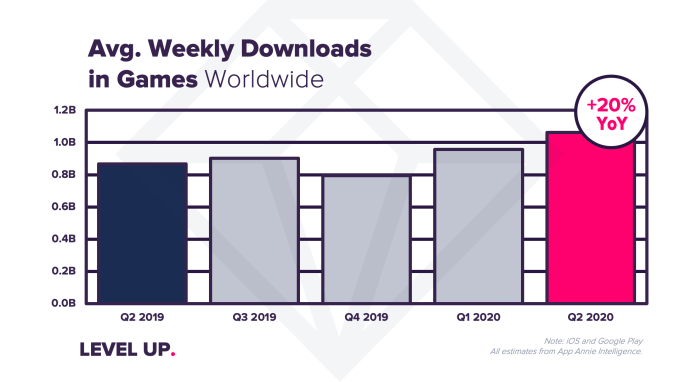
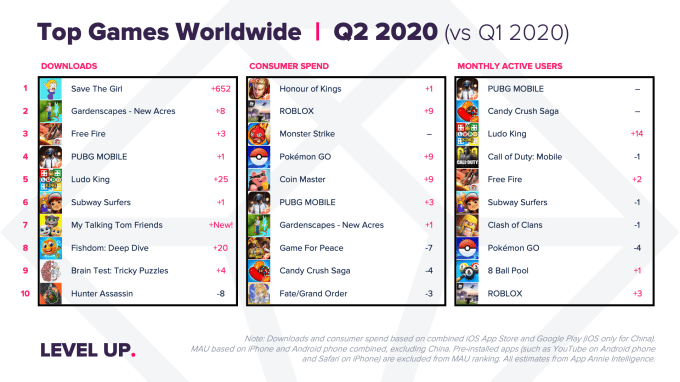
Games were downloaded at record levels in the quarter, App Annie noted, totalling 14 billion games. In the first week of Q2, weekly mobile game downloads broke records at over 1.2 billion, and weekly download levels remained at 1 billion on average throughout the quarter, up 20% year over year.

Image Credits: App Annie

Non-gaming apps represented over half (55%) of the new downloads on Android and 70% of those on iOS.

More specifically, top categories outside of games included “Tools” and “Entertainment” on Google Play and “Photo and Video” and “Entertainment” on iOS. But other categories saw strong growth, including “Business,” “Health & Fitness” and “Education” which saw quarter-over-quarter growth in downloads of 115%, 75% and 50% respectively on Google Play.

On iOS, “Health and Fitness,” “Shopping,” and “Medical” apps saw strong quarter-over-quarter growth of 30%, 25% and 20%, meanwhile.

With record downloads and usage, consumer spending also grew significantly as a result, particularly among streaming video services.

Image Credits:


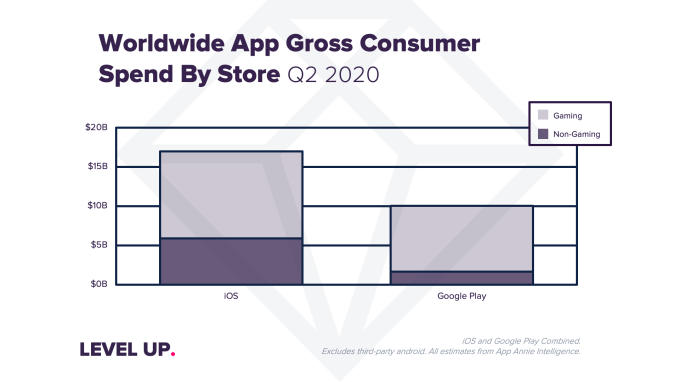
In the second quarter, consumers spent a record $27 billion in apps, up 15% year-over-year to $17 billion on iOS and up 25% to $10 billion on Android.

Games accounted for $19 billion of the spend, up 15% quarter-over-quarter. Google Play saw sizable growth at 25% quarter-over-quarter, which was 2x the growth rate on iOS.

Image Credits: App Annie

Non-gaming apps were 35% of the spend on iOS. The U.S. and China the largest contributors in both games and non-game apps on iOS in the quarter. However, the U.S. notably took back the top position as the largest market for consumer games — a spot previously held by China — with 30% quarter-over-quarter growth in Q2.

Non-games were 15% of the spend on Google Play. The U.S., Japan, and South Korea were the largest markets in both non-games and games alike on Google Play.

Top Google Play categories in addition to “Games” included “Social” and “Entertainment.” Growth in the “Entertainment” category was driven largely by Disney+ and Twitch, App Annie noted.

On iOS, “Entertainment” and “Photo and Video” were the largest categories by consumer spend, in addition to “Games.” Here, TikTok drove growth for the “Photo and Video” category, becoming the No. 1 top grossing app on iOS App Store globally in Q2 2020 thanks to sales of virtual gifts used to tip streamers.

Image Credits: App Annie

While much of the activity taking place on mobile devices during the pandemic is related to having fun — like watching videos or playing games, for example — several of the top apps in the quarter were work-related.

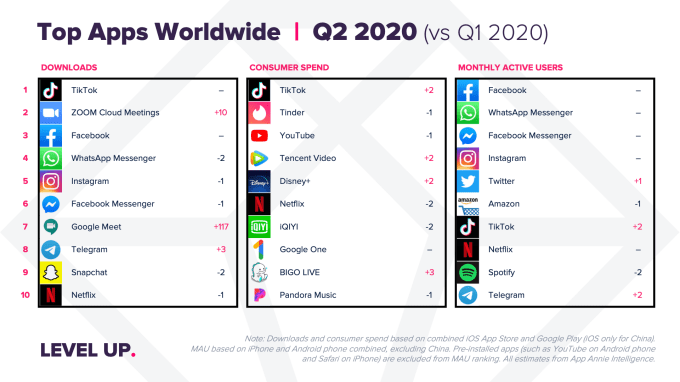
Zoom, for instance, became the No. 2 of most downloaded app globally in Q2 2020.  Google Meet was No. 7.

TikTok, meanwhile, was the top app by downloads and spending, and the No. 7 by monthly active users. That will likely change in the months ahead, due to its ban in India. A proposed U.S. ban has also recently seen TikTok rivals gaining ground. Amid this disruption, local competitors in India have seen increased usage, and elsewhere, competitors like Byte and Likee have surged.


09 Jul 2020

Amazon’s Alexa heads Toni Reid and Rohit Prasad are coming to Disrupt

It’s hard to believe that Alexa was only announced in November 2014. In few than six years, the smart assistant has gone from consumer electronics curiosity to a nearly ubiquitous tech phenomenon. Launched alongside the first Echo device, Alexa has helped definite a new paradigm of voice computing, alongside Apple’s Siri and Google’s Assistant.

According to recent numbers, 29% of U.S. internet users also use a smart speaker. With that demographic Amazon has been utterly dominant, with roughly 70% of all U.S. smart speaker owners using an Echo. Alexa’s reach spread far beyond that, of course, to all manner of smart home devices, laptops, cars, phones, wearables and TVs. We’re excited to announce today that the heads of Amazon’s Alexa team will be joining us at Disrupt this September to discuss the smart assistant’s growth and the future of voice computing.

Toni Reid is the Vice President of Alexa Experience & Echo Devices at Amazon, a company she’s been with for over a decade. She’s being a driving force in Alexa’s dominance of the category. Rohit Prasad is the Vice President and Head Scientist, Alexa Artificial Intelligence. He’s an expert in natural language understanding, machine learning, dialog science and machine reasoning.

Together the pair have been driving forces in Alexa’s growth and domination of the smart assistant category. Hear how it all got started from Reid and Prasad at Disrupt 2020 on September 14-18. Get a front row seat with your Digital Pro Pass for just $245 or with a Digital Startup Alley Exhibitor Package.

09 Jul 2020

As pandemic drags on, interest in automation surges

Today, the U.S. exceeded three million COVID-19 cases and 132,000 deaths. In several states, new hotspots have rolled back plans to reopen businesses. The novel coronavirus has — and will continue — to profoundly impact the way we live and work.

For the moment, that includes a shift in the employment status of many Americans. More than 50 million people have filed for unemployment since mid-March. And while many states have made efforts to reopen businesses and return some sense of normality, these moves have led to a spike in cases and may prolong the pandemic and its ongoing economic impact.

Technology has been a lifeline for many, from food delivery to the 3D printing I highlighted last week, which has worked to address a nation suffering from personal protective equipment shortages. Automation and robotics have also been a constant in conversations around tech’s battle against COVID-19.

Robots don’t get sick, tired or emotionally burnt out, and unlike us, they aren’t walking, talking disease vectors. Automation advocates like to point to the “three Ds” of dull, dirty and dangerous jobs that will eventually be replaced by a robotic workforce, but in the age of COVID-19, nearly any essential job qualifies.

The robotic invasion has already begun in earnest. The service, delivery, health care and sanitation industries in particular have all opened a massive gap over the past several months that automation has been more than happy to roll right through. A recent report from The Brookings Institute notes that automation arrives in the workforce in fits and starts — most notably, during times of economic downturn.

“Robots’ infiltration of the workforce doesn’t occur at a steady, gradual pace. Instead, automation happens in bursts, concentrated especially in bad times such as in the wake of economic shocks, when humans become relatively more expensive as firms’ revenues rapidly decline,” the study found. “At these moments, employers shed less-skilled workers and replace them with technology and higher-skilled workers, which increases labor productivity as a recession tapers off.”

09 Jul 2020

The best WiFi 6 home networking tech to upgrade your setup

Wifi 6 is here – making its way to more and more devices, with a noteworthy inclusion on last year’s flagship iPhone 11 lineup. This next-generation Wifi technology provides faster speeds for transferring data between devices, but more importantly, it also means your system will be better equipped to handle multiple Wifi devices connected at one time, without slowdowns or interruptions – and it can even reduce battery drain in mobile devices.

The number of Wifi 6 routers and mesh systems has definitely improved dramatically since the debut of the iPhone 11, and there are a range of options available at a variety of price points. But for those looking to get the most out of their Wifi 6 setup, two available systems in particular can provide all the power you need, with two different approaches that will appeal to differing user needs.

Orbi AX6000 Mesh WiFi System (starting at $699.99)

Image Credits: Netgear

Netgear’s Orbi lineup is a popular mesh option, and its latest AX6000 series offers WiFi 6 networking in either a 2- or 3-pack configuration. Even the 2-pack is able to cover a home of up to 5,000 square feet, Netgear claims, and it an support up to 2.5G internet connections from an Ethernet connected modem.

The Orbi AX6000 includes Netgear’s X technology, which can optimize streaming and media connections for optimal performance. Both the base unit and the satellite include 4 Gigabit Ethernet LAN ports for hardwired connections, which means you’re less likely to need an Ethernet switch to connect all your gear.

In real-world testing, the AX6000 proved a remarkably reliable and far-reaching mesh system. I tested a 2-device configuration, with one base unit and one satellite, and really saw the advantages of its range. In my testing, I was able to enjoy a consistent and strong Wifi connection with the AX6000 as far as around 500 feet or more outside – useful in the situation where I had it installed in a lake house for reaching all the way down to a dock.

Orbi’s system can be managed from a mobile app, which provides an overview of devices attached, with detailed information available for each. You can pause and resume access for each connected device from the app, and also enable features like a dedicated guest network.

Netgear also offers a service called Armor that provides real-time threat detection and protection on your network. It’s a subscription service, with a limited free trial included when you first set up your Orbi system. In practice, it did seem to effectively detect and block phishing and malware connections, and it’s optional as an ongoing paid add-on.

The real strength of the Orbi system for me was that when I used it with a cellular-based network connection in a relatively remote setting, it dramatically improved performance. That was true even when I used it with my home fibre connection, which is a 1.5Gbps network, but it improved the much less reliable 50Mbps mobile connection so much that it went from relatively unreliable to fully reliable.

Netgear’s offering also offers a level of simplicity in terms of the app and network management that has advantages and downsides, but that is probably much better suited to casual or non-technical users. I found that it lacked some advanced options I was looking for, like the ability to separate 2.4Ghz and 5Ghz networks under separate network SSIDs to more easily connect some smart home devices, but that’s probably not a feature most users want or need.

AmpliFi Alien WiFi 6 Router (starting at $379)

Image Credits: AmpliFi

The AmpliFi Alien router from AmpliFi, which is the consumer arm of commercial networking giant Ubiquiti, offers all the customization that an advanced user could want, on the other hand. The $379 device can act as a standalone tri-band router, or it can pair up with other Alient base stations (a 2-pack is $699) to form a mesh network for greater coverage. Unlike the Orbi option, AmpliFi’s hardware doesn’t have dedicated base station and satellite units, meaning they can be swapped out as needed to set up different networks if you don’t need the mesh capabilities.

AmpliFi’s Alien in testing also offered excellent coverage, and worked extremely well providing access to the full capabilities of my 1.5Gbps finer optic connection. In long-term testing, their reliability has been impeccable in terms of network uptime, and AmpliFi has consistently and reliably pushed updates to improve their performance as well.

Building on their reputation for delivering the best in advanced networking through Ubiquiti, AmpliFi has also equipped the Alien with some impressive hardware specs, including a custom antenna array and a dedicated 2.2 GHz 64-bit quad-core CPU in each base station. That’s more computing power than you’ll find in some mid-range Android smartphones, all committed to the task of continually optimizing your network and device connections for maximum performance.

All that onboard intelligence doesn’t necessarily translate to complexity, however – AmpliFi is meant to be Ubiquiti’s more accessible consumer brand, and it stays true to that with its simple, app-based setup and control. The AmpliFi app is very user-friendly and well designed, and includes all the features you’d expect from a mesh networking system including individual device views and controls, as well as rule creation and full stats reporting. You can also set up guest networking, and configure more advanced features like distinct SSIDs for different frequency networks.

The AmplifFi Alien also has a colorful, high-resolution display that provides at-a-glance information including current network performance, signal strength, and a list of connected devices. Both these menus and the in-app ones can get a little information dense compared to other options like the Orbi, however, which is why I think it’s a much better option for someone more comfortable with tech in general, and networking tech in particular.

The Alien system offers great expandability and flexibility (albeit with a cost since each is $379) and amazing custom control features. It’s definitely the networking solution to beat when it comes to advanced at-home Wifi 6 networking.

Bottom line

More and more Wifi 6 options are coming to market as the technology shows up on more consumer devices, and as mentioned, you can also get them at increasingly affordable prices. But Wifi 6 stands to be an investment that should provide you with many years of networking advantages, with more benefits accruing over time, so it’s likely worth investing money in a top-tier system that will provide future-proof performance.

Both the Netgear Orbi system and the AmpliFi Alien offer terrific performance, easy setup and a host of great features. Orbi’s AX6000 is likely better for those who prefer to set-it-and-forget-it, and who might appreciate the option of setting up threat detection on an ongoing basis. The Alien is better for power users and anyone who wants the ability to change their configuration over time – including potentially splitting up their networking hardware to use in multiple locations.


09 Jul 2020

Freshworks acquires IT orchestration service Flint

Customer engagement company Freshworks today announced that it has acquired Flint, an IT orchestration and cloud management platform based in India. The acquisition will help Freshworks strengthen its Freshservice IT support service by bringing a number of new automation tools to it. Maybe just as importantly, though, it will also bolster Freshworks’ ambitions around cloud management.

Freshworks CPO Prakash Ramamurthy, who joined the company last October, told me that while the company was already looking at expanding its IT services (ITSM) and operations management (ITOM) capabilities before the COVID-19 pandemic hit, having those capabilities has now become even more important given that a lot of these teams are now working remotely.

“If you take ITSM, we allow for customers to create their own workflow for service catalog items and so on and so forth, but we found that there’s a lot of things which were repetitive tasks,” Ramamurthy said. “For example, I lost my password or new employee onboarding, where you need to auto-provision them in the same set of accounts. Flint had integrated with a Freshservice to help automate and orchestrate some of these routine tasks and a lot of customers were using it and there’s a lot of interest in it.”

He noted that while the company was already seeing increased demand for these tools earlier in the year, the pandemic made that need even more obvious. And given that pressing need, Freshworks decided that it would be far easier to acquire an existing company than to build its own solution.

“Even in early January, we felt this was a space where we had to have a time-to-market advantage,” he said. “So acquiring and aggressively integrating it into our product lines seemed to be the most optimal thing to do than take our time to build it — and we are super fortunate that we made placed the right bet because of what has happened since then.”

The acquisition helps Freshworks build out some of its existing services, but Ramamurthy also stressed that it will really help the company build out its operations management capabilities to go from alert management to also automatically solving common IT issues. “We feel there’s natural synergy and [Flint’s] orchestration solution and their connectors come in super handy because they have connectors to all the modern SaaS applications and the top five cloud providers and so on.”

But Flint’s technology will also help Freshworks build out its ability to help its users manage workloads across multiple clouds, an area where it is going to compete with a number of startups and incumbents. Since the company decided that it wants to play in this field, an acquisition also made a lot of sense given how long it would take to build out expertise in this area, too.

“Cloud management is a natural progression for our product line,” Ramamurthy noted. “As more and more customers have a multi-cloud strategy, we want to you give them a single pane of glass for all the work workloads they’re running. And if they wanted to do cost optimization, if you want to build on top of that, we need the basic plumbing to be able to do discovery which is kind of foundational for that.”

Freshworks will integrate Flint’s tools into Freshservice and like offer it as part of its existing tiered pricing structure, with service orchestration likely being the first new capability it will offer.

09 Jul 2020

VCs are cutting checks remotely, but deal volume could be slowing

When COVID-19 began to shutter the United States economy, startups jumped into cost-cutting mode as expectations rose that venture capital was about to get a heck of a lot harder to raise. After all, prior downturns in the broader economy, and tech sector in particular, had taken a bite out of the ability for startups to attract new funds.

PitchBook research shows that, in the wake of the 2008 financial crisis, the amount of money venture capitalists invested fell, with early-stage deal and dollar volume enduring the largest cuts. Late-stage valuations during the same period came under steep pressure. The connection between a slipping economy and a rapidly deteriorating venture capital market, therefore, seems strong.


The Exchange explores startups, markets and money. You can read it every morning on Extra Crunch, and now you can receive it in your inbox. Sign up for The Exchange newsletter, which drops every Friday starting July 24.


The historically-grounded feeling from startups in Q2, as the stock market sold off and unemployment rose, was one of concern: VCs were about to cut their deal pace, and the number of dollars that they were willing to put into each deal would likely fall as well. Throw in the fact that investors would need to shake up their process and do deals remotely, was not confidence inspiring.

We don’t have full Q2 VC numbers yet, so it’s too soon to say that Q2 was worse, or better than expectations. But what we can say, thanks to a new survey from OMERS Ventures, is that VCs moved with reasonable speed to get over the technology and cultural hurdle of remote-dealmaking to keep the checks flowing. Indeed, according to OMERS Ventures’ research, 69% of the VCs it surveyed in June were willing to do fully-remote deals; for startups worried that the venture class was simply going to pack up its checkbook and take an extended vacation, it’s good news.

But the news isn’t all rosy — most VC firms from the 150 in North America and Europe that the venture group surveyed have yet to actually execute a remote deal. And, there’s some indication that overall deal volume could be slowing, perhaps due to “dwindling supply of companies formally going to market,” according to OMERS Ventures’ Damien Steel, a managing partner.

This morning let’s examine which VCs have been the most active, and the least, to find out which types of firms are still investing, and where investors are seeing more deal flow, and less.

Remote deals, fewer deals

Most VCs have decided that remote dealmaking is, at minimum, something that they need to become accustomed to. Only 4% of surveyed VCs said that they would not do remote deals, full-stop. Another 23% said that they were find with remote deals, albeit with some ability to meet entrepreneurs in person.

09 Jul 2020

VCs are cutting checks remotely, but deal volume could be slowing

When COVID-19 began to shutter the United States economy, startups jumped into cost-cutting mode as expectations rose that venture capital was about to get a heck of a lot harder to raise. After all, prior downturns in the broader economy, and tech sector in particular, had taken a bite out of the ability for startups to attract new funds.

PitchBook research shows that, in the wake of the 2008 financial crisis, the amount of money venture capitalists invested fell, with early-stage deal and dollar volume enduring the largest cuts. Late-stage valuations during the same period came under steep pressure. The connection between a slipping economy and a rapidly deteriorating venture capital market, therefore, seems strong.


The Exchange explores startups, markets and money. You can read it every morning on Extra Crunch, and now you can receive it in your inbox. Sign up for The Exchange newsletter, which drops every Friday starting July 24.


The historically-grounded feeling from startups in Q2, as the stock market sold off and unemployment rose, was one of concern: VCs were about to cut their deal pace, and the number of dollars that they were willing to put into each deal would likely fall as well. Throw in the fact that investors would need to shake up their process and do deals remotely, was not confidence inspiring.

We don’t have full Q2 VC numbers yet, so it’s too soon to say that Q2 was worse, or better than expectations. But what we can say, thanks to a new survey from OMERS Ventures, is that VCs moved with reasonable speed to get over the technology and cultural hurdle of remote-dealmaking to keep the checks flowing. Indeed, according to OMERS Ventures’ research, 69% of the VCs it surveyed in June were willing to do fully-remote deals; for startups worried that the venture class was simply going to pack up its checkbook and take an extended vacation, it’s good news.

But the news isn’t all rosy — most VC firms from the 150 in North America and Europe that the venture group surveyed have yet to actually execute a remote deal. And, there’s some indication that overall deal volume could be slowing, perhaps due to “dwindling supply of companies formally going to market,” according to OMERS Ventures’ Damien Steel, a managing partner.

This morning let’s examine which VCs have been the most active, and the least, to find out which types of firms are still investing, and where investors are seeing more deal flow, and less.

Remote deals, fewer deals

Most VCs have decided that remote dealmaking is, at minimum, something that they need to become accustomed to. Only 4% of surveyed VCs said that they would not do remote deals, full-stop. Another 23% said that they were find with remote deals, albeit with some ability to meet entrepreneurs in person.

09 Jul 2020

Coinbase reported to consider late 2020, early 2021 public debut

Coinbase is the latest mega-startup that may approach the public markets. The digital currency exchange company could follow Palantir, which is also nearing its IPO, after the secretive data-focused unicorn announced that it had filed privately.

Earlier today Reuters reported that Coinbase, a popular American-based cryptocurrency trading platform, could pursue a public debut later this year, or early next year. Plans remain fluid, according to the report, which went on to say that the crypto-focused fintech company “has been in talks to hire investment banks and law firms.”

Coinbase declined to comment, telling TechCrunch in an email that it cannot “comment on rumors or speculation.”

Even more, Reuters reported that Coinbase may pursue a direct listing for its shares, instead of a more traditional initial public offering. A direct listing allows a company to begin to trade publicly without formally pricing its equity through a bloc sale as happens in initial public offerings. Direct listings have become more popular as a concept in recent years as private companies became less dependent on IPOs as a fundraising mechanism, and some of Silicon Valley’s elite became disenchanted with what they consider to be regular underpricing of IPOs, forcing companies going public to leave tens, or hundreds of millions of dollars on the table.

Coinbase is perhaps archetypal for the sort of company that might consider a direct listing. It’s wealthy, having raised north of $500 million during its life as a private company, and highly valued. Coinbase’s most recent private financing of $300 million valued it at $8.0 billion, according to Crunchbase data. A high valuation and the possibility of ample cash reserves are what previous direct listings Slack, and Spotify had as well.

Most companies still tack towards the public markets through IPOs, as we’ve see in recent weeks with the traditional debuts of Accolade, Vroom, and others. Yesterday TechCrunch covered initial price ranges for two more IPOs, GoHealth and nCino, each of which have eschewed the direct listing model in favor of raising funds during their exit from the private markets.

Results

How big Coinbase is today is not clear. The company’s financial history is occluded — common with private companies — and a bit uneven. Media reports have pegged its 2017 revenue at around $1 billion, boosted by that year’s crypto-mania. Precisely how Coinbase performed in 2018 is less clear, though other media reports paint the picture of a smaller company.

Regardless of whether Coinbase direct lists or takes on a traditional IPO, we’ll get to see its S-1 filing. That document will provide good insight into the company’s historical financial performance, allowing us to see how Coinbase fared during various crypto-booms and busts.

With public markets at all-time highs and valuations for tech stocks far above historical norms, it’s not surprising that some highly-valued unicorns are gearing up for a run on the public markets. Let’s see how many pull it off.

09 Jul 2020

Coinbase reported to consider late 2020, early 2021 public debut

Coinbase is the latest mega-startup that may approach the public markets. The digital currency exchange company could follow Palantir, which is also nearing its IPO, after the secretive data-focused unicorn announced that it had filed privately.

Earlier today Reuters reported that Coinbase, a popular American-based cryptocurrency trading platform, could pursue a public debut later this year, or early next year. Plans remain fluid, according to the report, which went on to say that the crypto-focused fintech company “has been in talks to hire investment banks and law firms.”

Coinbase declined to comment, telling TechCrunch in an email that it cannot “comment on rumors or speculation.”

Even more, Reuters reported that Coinbase may pursue a direct listing for its shares, instead of a more traditional initial public offering. A direct listing allows a company to begin to trade publicly without formally pricing its equity through a bloc sale as happens in initial public offerings. Direct listings have become more popular as a concept in recent years as private companies became less dependent on IPOs as a fundraising mechanism, and some of Silicon Valley’s elite became disenchanted with what they consider to be regular underpricing of IPOs, forcing companies going public to leave tens, or hundreds of millions of dollars on the table.

Coinbase is perhaps archetypal for the sort of company that might consider a direct listing. It’s wealthy, having raised north of $500 million during its life as a private company, and highly valued. Coinbase’s most recent private financing of $300 million valued it at $8.0 billion, according to Crunchbase data. A high valuation and the possibility of ample cash reserves are what previous direct listings Slack, and Spotify had as well.

Most companies still tack towards the public markets through IPOs, as we’ve see in recent weeks with the traditional debuts of Accolade, Vroom, and others. Yesterday TechCrunch covered initial price ranges for two more IPOs, GoHealth and nCino, each of which have eschewed the direct listing model in favor of raising funds during their exit from the private markets.

Results

How big Coinbase is today is not clear. The company’s financial history is occluded — common with private companies — and a bit uneven. Media reports have pegged its 2017 revenue at around $1 billion, boosted by that year’s crypto-mania. Precisely how Coinbase performed in 2018 is less clear, though other media reports paint the picture of a smaller company.

Regardless of whether Coinbase direct lists or takes on a traditional IPO, we’ll get to see its S-1 filing. That document will provide good insight into the company’s historical financial performance, allowing us to see how Coinbase fared during various crypto-booms and busts.

With public markets at all-time highs and valuations for tech stocks far above historical norms, it’s not surprising that some highly-valued unicorns are gearing up for a run on the public markets. Let’s see how many pull it off.