Year: 2020

30 Jun 2020

Dear Sophie: Is immigration happening? Who can I hire?

Here’s another edition of “Dear Sophie,” the advice column that answers immigration-related questions about working at technology companies.

“Your questions are vital to the spread of knowledge that allows people all over the world to rise above borders and pursue their dreams,” says Sophie Alcorn, a Silicon Valley immigration attorney. “Whether you’re in people ops, a founder or seeking a job in Silicon Valley, I would love to answer your questions in my next column.”

“Dear Sophie” columns are accessible for Extra Crunch subscribers; use promo code ALCORN to purchase a one- or two-year subscription for 50% off.


Dear Sophie:

What is going on with recent USCIS furloughs and Trump’s H-1B ban?

I handle recruitment for several tech companies. Is immigration happening? Who can I hire?

—Frustrated in Fremont

Dear Fremont:

Immigration is still possible and I will explain how below. The administration continues to miss the mark with immigration policy. Trump’s U.S. unemployment “solution” of cutting off the stream of global talent to the U.S. is short-sighted. The administration is shooting America in the foot by walling off the promise of post-COVID economic revitalization and job-creation for Americans through the talent of immigrant entrepreneurs, investors and talent.

USCIS just provided a 30-day furlough notice to more than 70% of its employees. Reporters have been reaching out to me every day requesting stories of affected immigrants and HR professionals; please sign up to share your immigration story with journalists.

30 Jun 2020

To promote diversity, rewire your broken corporate culture

We have a problem. In tech, our companies are not diverse.

This is something we’ve known for a long time, but in an industry where we’ve innovated and solved some of the world’s most challenging problems, we have continued to fail here. I am one of few Black tech CEOs and I too have historically not done as much as I should have to harness the power of diversity in my business. I have been fast at work to change this, but I’ve learned that it requires rewriting the entire playbook.

To better approach the lack of diversity in tech, one-dimensional diversity agendas will not cut it. Company cultures across the board need to be rewired at their core. Change has to happen at every level, from leadership to individual employees — even how a corporation behaves as an entity.

Diversity is advantageous both for employees and the bottom line, but static, siloed diversity programs will not create systemic change. Shifting the company mindset around diversity means creating excitement around our differences, changing the idea that diversity is a zero-sum game and approaching diversity like every other challenge we face.

It can be tempting to introduce a diversity agenda and say you’ve solved the problem. A step beyond this involves diversity and inclusion initiatives that aim to get more people in the door and create support networks within the company walls. It’s not just about meeting D&I standards; the goal is to foster a sense of belonging for all employees.

Everyone should feel that their individuality, sexual orientation, gender and heritage are celebrated within the workplace, not just tolerated. Through diverse viewpoints, ideas can be challenged and made better. Without this level of acceptance and genuine excitement at every level of the organization, diversity initiatives will continue to fall flat.

When thinking about diversity, inclusion and belonging, leaders must consider ways to engage the full group instead of creating support groups for small portions of your staff. True diversity in the workplace requires a holistic approach where the entire team is participating and engaged.

It shouldn’t come as a surprise that on the most basic level, people want to feel seen and appreciated. Personally, I’ve always leaned into diverse cultural experiences. I would go to my friend’s Passover even though I am not Jewish. My friends and other guests didn’t care that I didn’t know what was about to happen — they appreciated that I was there and willing to learn. I’m trying to take this same emotional interaction and apply it to Holler’s culture. We need to look for ways to acknowledge that we are here and ready to learn about experiences other than our own. And remember — we don’t have to have all the answers.

To address this, we’ve recently started to create holidays (or as we call them, Hollerdays) where we as a company will acknowledge and honor the holidays from various heritages, races and religions that our employees celebrate. This is not just a free day off. This is an opportunity for all of us to learn and celebrate cultures outside of our own.

Education is the key element in diversity-focused activities having real impact. We need to create normalcy around educational opportunities. Through education, opportunities to acknowledge and celebrate diverse life experiences begins to be baked into the company culture.

When introducing new educational opportunities, we must show that they are beneficial for everyone, not just catered to minority groups or hosted in order to meet a diversity standard. Corporate diversity can often feel like a box that can be checked by hiring more ethnically diverse candidates or implementing a program to help those individuals assimilate. What’s worse is that anything beyond these initiatives is perceived as special treatment or a chore to the full team. If an educational moment feels like a negative to employees, the outcome will be negative and mass adoption of equitable and inclusive company cultures will be slow.

To introduce new educational programs at Holler, we recently asked one of the BLM founders, Opal Tometi, to speak with our employees in a live Q&A. This was during work hours and highly encouraged, but not required. It was a communal activity where we were able to discuss different perspectives and continue thinking about how we can each do better on an individual level. We created excitement around it and reinforced that these types of discussions are a company priority.

The language we use around diversity also has a hand in creating real change. We need to focus on diversity as a way of lifting the entire ship and creating an equitable society. In tech specifically, team members who can think outside of their own lived experiences have a stronger sense of emotional intelligence. They can build algorithms or projects that address a larger collective — mitigating issues like biased machine learning solutions. They become more competitive as employees.

A community focused on diversity, inclusion, and belonging will have a competitive advantage. Frankly, it’s the morally right thing to do. Business leaders should monitor the execution of diversity and inclusion programs to ensure equity and belonging are a part of the conversation as well.

We as leaders in technology need to treat diversity and inclusion the same way we do any other tech challenge — with agility and openness to iteration. Many companies use agile methodology to yield the best results. To solve complex problems, agile practices encourage adaptability and promote continuous improvement, flexibility, collaboration and high quality. We must do the same for diversity.

With so much pressure to change and do better, it is tempting to implement new policies and say that you are automatically diversity focused. Immediately stating how your company will “fix the problem” is a band-aid approach that often misses the larger task at hand. It also does not involve enough follow through. Rewiring your company culture to be more inclusive and diverse requires continuous effort, a commitment to hearing feedback and evolving as you learn.

As a CEO, I’m trying to understand how each and every person within my company views diversity. Yes, this even includes white males. We need the perspectives of everyone in order to foster a sense of belonging and create company cultures that systematically embrace diverse backgrounds. We all need to be a part of the conversation and willing to grow.

I’m also continuing to speak and listen to other business leaders to hear how they are approaching change. Not a single one of us has the answer, but through sharing ideas and really listening to what is working (and what’s not), we can start to make sustainable change.

Think of diversity as an industry-wide open-source project. We cannot work in silos. Isolation will lead to furthering our fragmented industry and leave us without a standard for how all humans should be treated within the tech community.

Sharing ideas and progress can be intimidating, but it’s okay to fail. The agile methodology promotes the idea of failure as an outcome and empowers iteration. We need to allow companies to miss the mark sometimes, as long as they are trying and iterating. Businesses inevitably won’t get this right every time.

I’ve heard from white male executives that one of their biggest fears is rolling out well-intentioned initiatives and getting “canceled” when it doesn’t work out perfectly. If we do not allow today’s business leaders to make mistakes, we’ll suffocate progress. We need to focus on the good intent and keep moving forward.

We each have to take on the responsibility to make change happen — at a corporate and an individual level. Once we learn to celebrate everyone at our companies for who they truly are, shift the rhetoric away from who wins and who loses in the fight for equity, and evolve our approach to problem solving, we can begin to make systemic changes to our company cultures. The process is only beginning and it is going to take all of us doing our part to fundamentally alter how we approach corporate diversity conversations.

We must take our next steps together.

30 Jun 2020

With advertiser boycott growing, lawmakers press Facebook on white supremacy

In a new letter to Mark Zuckerberg, three Democratic lawmakers pressed the Facebook chief executive for accountability on his company’s role in amplifying white supremacy and allowing violent extremists, like those in “boogaloo” groups, to organize on its platform.

Citing the “long-overdue” national reckoning around racial injustice, Senators Mazie Hirono (D-HI), Mark Warner (D-VA), and Bob Menendez (D-NJ) wrote to Zuckerberg in an effort to highlight the rift Facebook’s stated policies and its track record.

“The United States is going through a long-overdue examination of the systemic racism prevalent in our society. Americans of all races, ages, and backgrounds have bravely taken to the streets to demand equal justice for all,” the senators wrote.

“While Facebook has attempted to publicly align itself with this movement, its failure to address the hate spreading on its platform reveals significant gaps between Facebook’s professed commitment to racial justice and the company’s actions and business interests.”

The letter demands answers to a number of questions, some of which are relatively superficial asks for further commitments from Facebook to enforce its existing rules. But a few hit on something more interesting, calling on Zuckerberg to name the Facebook employee whose job explicitly addresses the spread white supremacy on the platform and asking the company to elaborate on the role that Joel Kaplan, Vice President of Global Public Policy and Facebook’s most prominent conservative voice, played in shaping the company’s approach to extremist content.

The senators also ask if Kaplan influenced Facebook’s puzzling decision to include The Daily Caller, the right-wing new site co-created by Tucker Carlson and linked to white supremacists, as a partner in its fact-checking program.

The senators’ final question includes a thinly-veiled threat to Section 230 of the Communications Decency Act, a law protecting platforms from legal liability for user generated content. Last month, President Trump launched his own attack against the vital legal shield, which makes internet businesses possible and also undergirds the modern social internet as we know it.

The letter from lawmakers come as Facebook faces a fresh wave of scrutiny around its platform policies from the #StopHateforProfit campaign. Launched by a group of civil rights organizations like the Anti-Defamation League, Color of Change and the NAACP, the Facebook advertising boycott has swelled to encompass a surprising array of huge mainstream brands including Coca-Cola, Best Buy, Ford and Verizon. Other brands on board include Adidas, Ben & Jerry’s, Reebok, REI, Patagonia and Vans.

While the unlikely mix of companies likely represents a similarly heterogenous mixture of motivations for temporarily suspending their Facebook ad spending, the initiative does make specific policy demands. On its webpage, the campaign advocates for some specific product changes, calling on Facebook to remove private groups centered on white supremacy and violent conspiracies, disable its recommendation engine for more hate and conspiracy groups and to hire a “C-suite level executive” who specializes in civil rights.

30 Jun 2020

Health class is outdated, so Lessonbee wants to fix it

Sex education in the United States is complicated.

One example: For decades, the United States invested billions into abstinence-only programs. Eventually, schools rejected government funding for these programs and pushed a more comprehensive and medically accurate agenda. Even with progress, schools across the country continue to reckon with a legacy of inaccuracy. And the government is still funding abstinence-only programs.

It’s bad news for students, and for founder of Lessonbee Reva McPollom, a change is long overdue. She can personally vouch for how non-comprehensive education in health classes can isolate students.

As a child, McPollom said she was called a tomboy and felt confused because she identified as a female. There was no lesson teaching the danger of gender stereotypes and norms.

“I felt wrong for liking sports, for wanting to play drums, I felt wrong for everything that I loved or liked or attached myself too as part of my identity,” she said.

The silent suffering, she says, continued through high school: “If you look at my senior yearbook, like I’m not even in it, I just totally erased myself by that point.”

Reva McPollom, the founder of Lessonbee (Image Source: Lessonbee)

After working as a journalist, digital marketer and a software engineer, McPollom returned to her past with a new idea. She founded Lessonbee, a more comprehensive health education curriculum provider to express diverse scenarios in schools. The company’s goal is to help students avoid what she had to go through: missing out on the joy of education and feeling worthy enough to learn.

The company sells a curriculum that covers a range of topics, from sex education to race to mental health, that integrates into existing K-12 school districts as a separate standalone course. The topics themselves then break down into smaller focus areas. For example, with the race unit launching soon Lessonbee will tackle the effects of race and ethnicity on quality of care, maternal health and food insecurity.

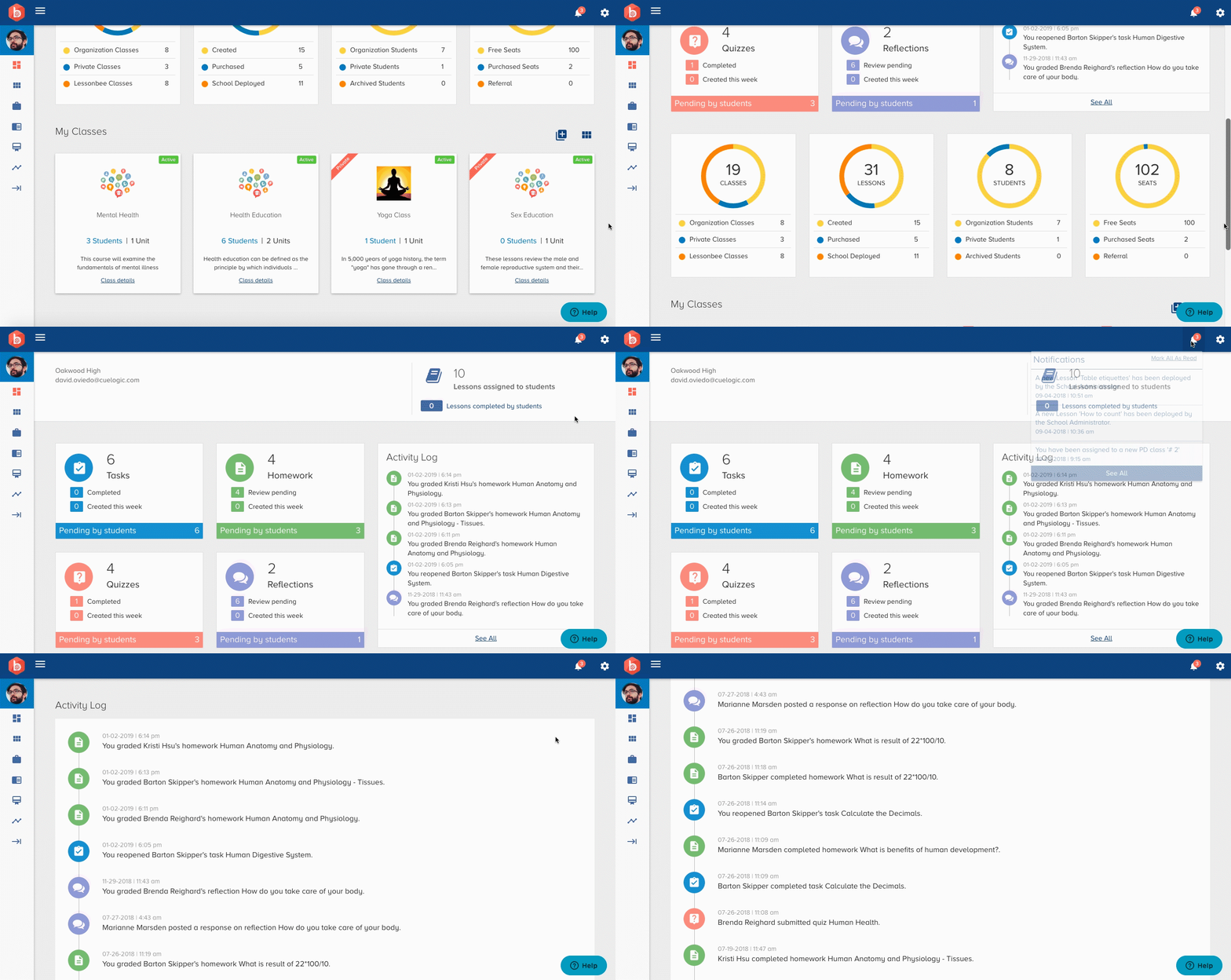
Lessonbee has hundreds of educational videos and interactive lessons created by teachers and the company, updated regularly. Each lesson also comes with a downloadable guide that describes content, objectives and recommendations for homework and quizzes. Lessonbee gives a guide for how to create culturally inclusive education, in line with standards put out by National Health Education and National Sexuality Education.

Image Source: Lessonbee

“It needs to meet all types of kids, regardless of where they’re at,” McPollom said.

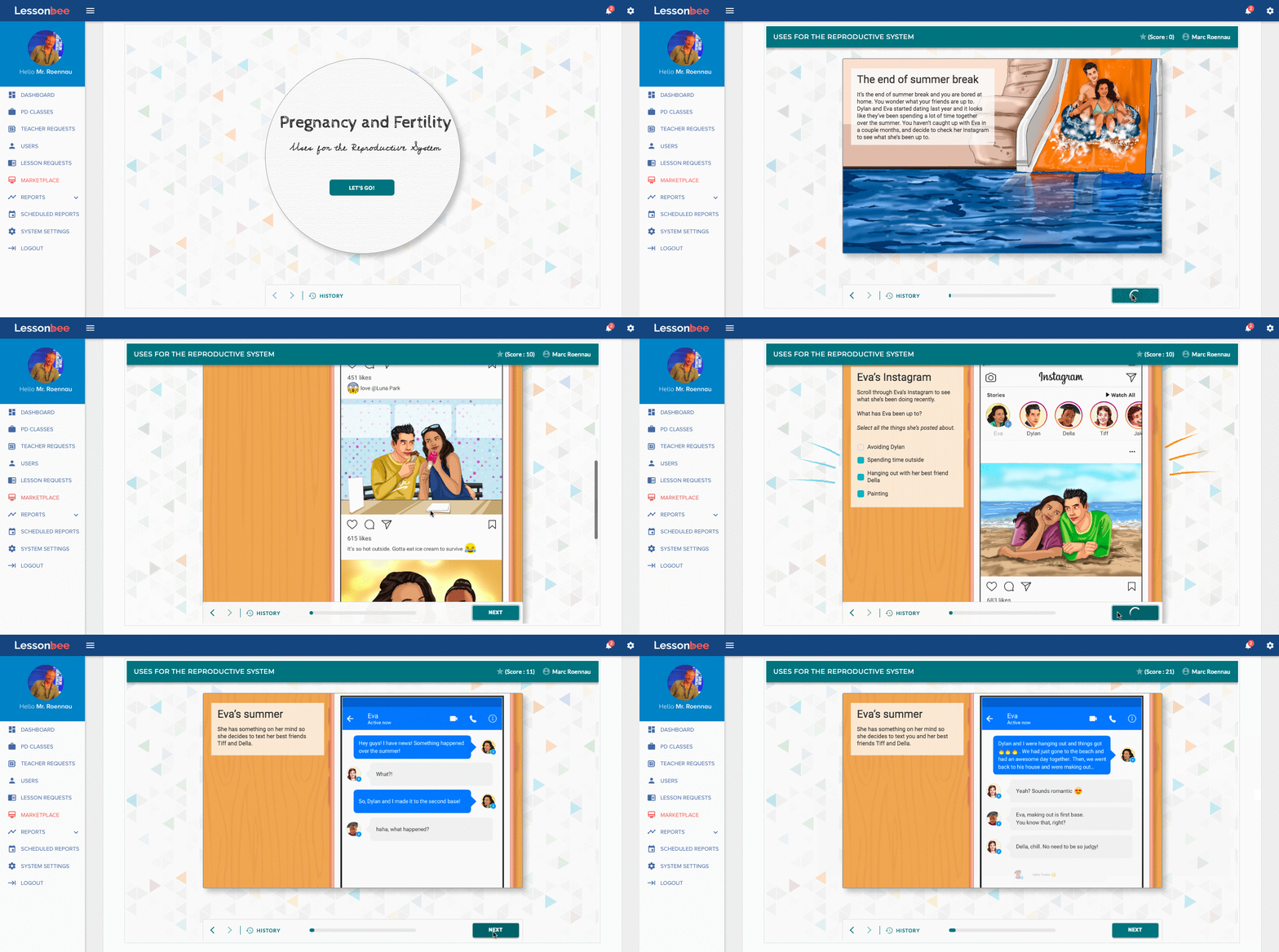
One example scenario in the curriculum includes a student who starts having sex and then misses her period. Learners are then responsible for choosing what to do next, who to talk to and what they should do next time. It’s a “choose your adventure”-style learning experience.

Students can log onto the platform and take self-paced classes on different health units, ranging from sex education to mental health and racism. The lessons are taught through text-message scenarios or gamified situations to make sure students are actively engaging with the content, McPollom tells TechCrunch.

Image Source: Lessonbee

State policy regarding education is often a nightmare of intricacies and politics. This is part of the reason so few startups try to solve it. If Lessonbee were to pull off its goal, it would initiate bigger conversations around racism and health into a kid’s day-to-day.

McPollom is currently pitching the service to school districts, which have tight budgets, and venture capitalists, who say they are open for business. So far, the company has 600 registered schools on its platform.

“It’s a non-core academic subject so it’s the last priority, and there’s just inequity all over the place,” she said. “There’s a mismatch of privacy policies across the United States handled differently and it kind of dictates the quality of health education that you’re going to receive.”

Lessonbee subscription is priced low to be more accessible, starting at $16 per learner annually. Individual courses start at $8 per learner annually.

Today, McPollom announced that she has raised $920,000 in financing.

As for the future, McPollom views her go-to market health class strategy as Lessonbee’s “Trojan horse.” She wants to integrate the culturally diverse curriculum into social studies or science classes, and cover how interconnected the subjects are and their ties to inequity and health.

McPollam says the team is developing an anti-racism course to introduce for the fall in the wake of the recent protests against police brutality. Topics in the anti-racism course include the effect of race and ethnicity on quality of care, ways racism impacts maternal health and structural racism and food insecurity.

“We’re hoping to evolve to this idea of health across the curriculum,” she said. “For health to be effective, for you to actually move the needle, health needs to be holistic.”

30 Jun 2020

NASA sets path for up to six more Artemis Moon exploration missions with SLS booster order

NASA has laid the groundwork for an order of up to six additional SLS solid core booster rockets, from supplier Northrop Grumman, the agency announced this week. The six additional boosters would join the existing three that NASA previously locked in for use on Artemis 1, Artemis 2 and Artemis 3, which includes the targeted 2024 mission that will bring the next American man and the first American woman to the lunar surface.

While this is essentially a long-lead declaration of intent to help partner Northrop Grumman ensure its supply pipeline can supply the additional boosters in a timeline needed by NASA, rather than an actual order for the boosters themselves, it’s still a big step with a potential total contract value of $49.5 million, with initial funding unlocked now. The schedule currently calls for those additional boosters to be delivered sometime before December 31, 2030, to provide some kind of idea about when Artemis missions 4-9 might potentially actually fly.

Solid boosters are used with the SLS (Space Launch System) in pairs, with one on each side flanking the SLS Core stage to provide around 75% of the total thrust power used during the take-off phase of its launch. They essentially take their design from those used during the Space Shuttle program, but with added oomph to help the heavier and larger SLS out of Earth’s atmosphere and into space.

NASA has also been in the process of procuring new RS-25 engines and core stages needed for missions in the Artemis program beyond the initial three, and continues to prepare for Artemis 1, with the rocket assembly process for that at the point where the boosters are nearly ready to stack. Artemis 1 is currently targeting a November 2021 timeframe for launch.

30 Jun 2020

Discord now has a $3.5B valuation and $100M for a sales pitch lighter on the gaming

Discord wants to be more than just a place for gamers, and is now billing itself as the Slack for users’ social lives.

The new pitch, and a new funding round of $100 million at a reported valuation of $3.5 billion, will help the company as it looks to erase its legacy as a home for gamers (and a virtual townhall for white nationalists).

Now, the company has more money at its disposal to monitor its user base and promote the image that the service isn’t just for gamers. “It turns out that, for a lot of you, it wasn’t just about video games anymore,” write co-founders Jason Citron and Stanislav Vishnevskiy in a blog post.

The two men frame their company as “a place designed to hang out and talk in the comfort of your own communities and friends.” Discord, they say, is “a place to have genuine conversations and spend quality time with people, whether catching up, learning something or sharing ideas.”

It hadn’t always been that way. Three years ago, the company tried to boot a number of its most racist users, but their ability to use the platform to disseminate hate speech has stubbornly persisted. Up until mid-2019 white nationalists were comfortable enough using the service to warrant a shoutout from Daily Stormer founder, Andrew Anglin, who urged his fellow travelers to stop using the service.

“Discord is always on and always present among these groups on the far-right,” Joan Donovan, the lead researcher on media manipulation at the Data & Society Research Institute, told Slate. “It’s the place where they do most of the organizing of doxing and harassment campaigns.”

Discord says these users are a small (and dwindling) fraction of a user base that now also includes Black Lives Matter organizers, social media influencers, and, of course, gamers.

There are now more than 100 million active users on the service that spend 4 billion minutes in conversation on 6.7 million active servers, according to a statement from the company.

If anything, Discord’s success is both a function and feature of the rapid rise of social gaming and social media. The company’s servers enabled real time communication across gaming platforms that turned them into the dominant social experience for a generation of players. They also enabled influencers on a variety of social media platforms to have a more direct relationship with their fans.

As Taylor Lorenz noted in her reporting on Discord’s newfound fanbase among social media entrepreneurs and celebrities:

Last March, Ninja, one of the most popular video-game live-streamers in the world, taught Drake how to use Discord while playing Fortnite. YouTube A-listers such as Philip DeFranco, Grace Helbig, and the Try Guys all have their own servers, and subreddits such as those dedicated to discussing The Bachelor and The Real Housewives have their own Discord groups too. More than 200 million people use the service.

“We designed Discord for talking. There’s no endless scrolling, no news feed, and no tracking likes. No algorithms decide what you ‘should’ see. We designed Discord to enable the experience and feelings we wanted to recreate: being together with your community and friends. You’ve made your servers into personal spaces filled with people you invited and set the topics of discussion,” the founders write.

The kinder, gentler Discord belies both the company’s name and its roots. But it is a sign of its efforts to shift the perceptions of investors and woo potential new users to the service.

In addition to its new cash, the company is highlighting a new user experience and added server video so that users can communicate more readily. There are templates available to help users create servers, and the company has increased its voice and video capacity by 200%.

As part of this new focus on product, Discord has launched what it calls a “Safety Center” which clearly defines the company’s rules and regulations and what actions users can take to monitor and manage their use of service for hate speech and abuse.

We will continue to take decisive action against white supremacists, racists, and others who seek to use Discord for evil,” the founders write. 

Danny Rimer, the co-founder of Index Ventures, which led the investor group that invested in Discord’s latest $100 million cash infusion, is an advocate for the company’s expanded vision for itself.

“I believe Discord is the future of platforms because it demonstrates how a responsibly curated site can provide a safe space for people with shared interests,” Rimer wrote in a statement. “Rather than throwing raw content at you, like Facebook, it provides a shared experience for you and your friends. We’ll come to appreciate that Discord does for social conversation what Slack has done for professional conversation.”

The parallels to Slack are interesting and begin with the fact that both companies began their lives as gaming studios before moving to become communications services.

“In France this year, Discord was adopted as the primary app for distance learning after the government’s official service failed. As a result, Discord reached the top ten app downloads in France in March and is still in the top 50 in the US and UK today,” Rimer noted in his explanation of Index’s latest investment. “As Discord plans its next phase of growth, it will become even more inclusive and welcoming for new users and communities and it will continue to be guided by the users that have informed its development from the start.”

30 Jun 2020

U.S. challenger bank Chime launches Credit Builder, a credit card that works more like debit

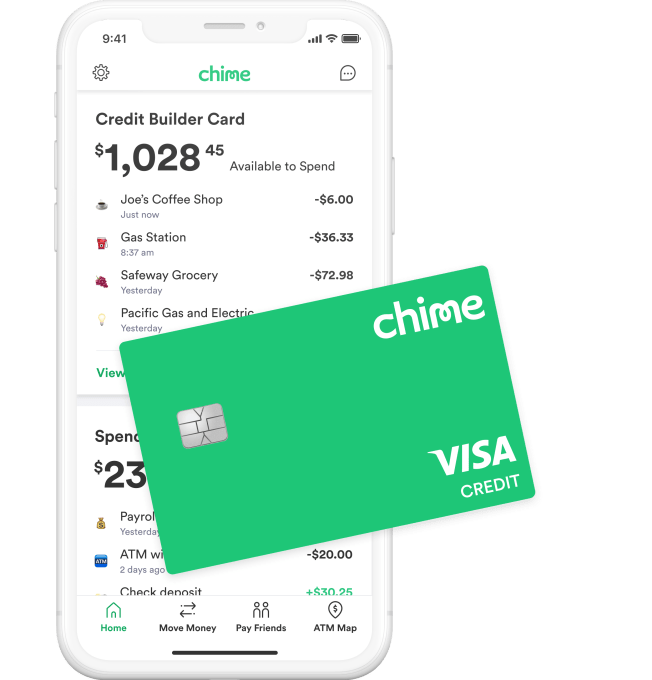
U.S. challenger bank Chime, now valued at $5.8 billion, is entering the credit card market with today’s launch of a new card designed to help consumers build their credit history by way of everyday transactions. With the Chime Credit Builder Visa Credit Card, users can control how much they want to spend by transferring funds to a “Spending Account” and can then charge up to this amount wherever Visa is accepted.

This makes the card feel more like a debit card, as it’s tied to how much cash is in a user’s bank account — rather than a traditional credit card which can allow for overspending.

Chime wanted to develop a new kind of credit card experience due the growing popularity of debit cards in the U.S. In 2018, the U.S. Federal Reserve said debit cards represent 50% of all non-cash transactions, the company noted. And younger consumers, in particular, prefer debit over credit, Chime had reported in the past. In a 2015 survey, Chime found that 67% of millennials prefered debit cards, which they feel are more secure and less likely to get them into debt.

However, relying on debit cards alone means younger consumers aren’t building up their credit history — a decision that will come to matter when it’s time to finance a larger purchase, like a house.

“Americans have embraced debit cards for greater control but this limits their ability to establish or build their credit score,” noted Chime CEO Chris Britt, in a launch announcement. “We created Credit Builder to help our members stay in control and safely build their credit with their everyday purchases,” he said.

Chime’s credit card aims to straddle both worlds, debit and credit, by working to establish good credit while also preventing users from overspending.

To make this work, Chime users first add money to their Chime Spending Account and then charge their everyday purchases — like gas, groceries or subscriptions — using the credit card. At the end of the month, Chime’s Safer Credit Builder feature will automatically pay off the credit card balance from the secured account on time. It then reports the credit card payment to the major credit bureaus, including TransUnion, Experian, and Equifax.

The card also has the appeal of a debit card for its lack of fees. It doesn’t include an annual fee, interest or a minimum security deposit, like many of the secured credit cards it competes with.

The company has been thinking about how to better address the credit building needs of its users for some time. In fall 2018, Chime acquired the credit score improvement service Pinch which had focused on helping young adults build better credit. The startup was best known for a service called PinchRent, which reported on-time rent payments to credit bureaus to help its users increase credit scores.

Chime says it took learnings from Pinch and tapped into the team’s expertise in its creation of Credit Builder.

Chime has been beta testing Credit Builder since June 2019 and the service has grown to reach over 200,000 enrollees. During the test period Credit Builder has helped users increase their credit score by an average of 30 points, Chime says, citing data from Transunion. In addition, it helped 95% of members with no credit history establish a credit score for the first time. Anecdotal reports from its users, like these discussions on Reddit, also appear to support Chime’s statements about the card’s ability to improve their credit.

Today, Chime is opening up access to the waitlist for Credit Builder to all its Chime banking customers and it will roll out the service to more members every week over the summer.

Chime’s mobile banking app is now one of many challenger banks in the U.S. aiming to  address a younger generation’s shift away from big banks with physical branches to modern, mobile and digital banking experiences. Chime, however, is not a bank itself. Instead, banking services provided by The Bancorp Bank or Stride Bank, N.A., Members FDIC. The Credit Builder card is also issued by Stride Bank.

Like many of its rivals, Chime offers free checking accounts, with no overdraft fees, early access to direct deposit paychecks, automatic savings, and more. But Chime has outpaced much of its competition, having raised a $500 million round in late 2019 to value its business at $5.8 billion — a sizable increase from the $1.5 billion valuation it had earlier in 2019. It’s now growing at 4x year-over-year, the company says, and reached 8 million FDIC-insured accounts as of February 2020 according to Bloomberg.

Chime’s Credit Builder launch follows yesterday’s debut of the Apple Card “Path” program, which also helps to tackle the issue of young people who can’t quality for credit. In its case, the program alerts users to ways to improve their creditworthiness, like making payments to secured cards or resolving past due balances. This program, is more educational in nature, however, whereas Chime’s Credit Builder is about actual credit-building through transactions and payments.


30 Jun 2020

YouTube TV hikes price to $64.99 per month following new channel additions

YouTube TV is getting another price hike, making its live TV streaming service less competitive with the cable TV services it aims to replace. The company announced today its service would now cost $64.99 per month, starting today, June 30, for new members. The change will also be reflected on the next billing cycle for current members after June 30.

The bump in pricing is now one of several price increases YouTube TV has seen since its debut, starting with a modest $5 per month bump in 2018, followed by a much more substantial price hike last year to $50 per month.

The increases are due to the rising costs of programming for the streaming TV service as the pay TV industry collapses amid a rise in cord cutting — a trend now accelerating at even a faster pace due to the pandemic.

YouTube TV had announced in May it would soon gain 14 more ViacomCBS channels as part of an expanded distribution deal. This included the addition of new channels like BET, CMT, Comedy Central, MTV, Nickelodeon, Paramount Network, TV Land and VH1 which are today being made available. This brings YouTube TV’s base plan to over 85 channels.

Other channels that were are a part of that same deal — including BET Her, MTV2, MTV Classic, Nick Jr., NickToons, and TeenNick — are due to arrive at a later date, the company noted.

While YouTube TV didn’t announce its plans to raise prices back in May, at this point it’s to be expected whenever a service says it’s adding channels to its core offering.

But for YouTube TV’s some 2 million subscribers, new additions aren’t always welcome.

The original promise of live TV streaming services were smaller lineups, sometimes even a la carte options, for a lower monthly price.

Services like Sling TV, Hulu with Live TV, Philo, and others offer pared down channel selections compared with the hundreds of channels offered by cable and satellite providers. But in the years since their respective launches, they’ve slowly closed the gap with cable by adding more and more channels to base packages and raising prices.

In addition to the ViacomCBS channels, YouTube TV also recently introduced premium add-ons including Cinemax and HBO Max.

Now, instead of wooing consumers on price, YouTube TV focuses on feature set.

For example, YouTube TV announced today a new feature that allows users to jump to various segments within select news programs on the service, starting first on TV screens and coming to mobile in the next several weeks. It also touted its unlimited DVR, dark mode option, “Mark Watched” feature, and redesigned Live Guide with access to TV programming for the week ahead.

“We don’t take these decisions lightly, and realize how hard this is for our members,” YouTube TV’s announcement read, in detailing the price hike.

“That said, this new price reflects the rising cost of content and we also believe it reflects the complete value of YouTube TV, from our breadth of content to the features that are changing how we watch live TV,” wrote YouTube TV VP of Product Management, Christian Oestlien. “YouTube TV is the only streaming service that includes a DVR with unlimited storage space, plus 6 accounts per household each with its own unique recommendations, and 3 concurrent streams. It’s all included in the base cost of YouTube TV, with no contract and no hidden fees,” he said.

The company also noted it was working to develop more flexible models for YouTube TV users, but didn’t offer details on what those are or when they would arrive.

30 Jun 2020

Daily Crunch: Lululemon is acquiring Mirror

Lululemon is paying $500 million to acquire a home fitness startup, India bans TikTok and Amazon Prime Video is the latest streaming service to add a co-viewing experience.

Here’s your Daily Crunch for June 30, 2020.

1. Lululemon set to acquire home fitness startup Mirror for $500M

The deal comes at a time when home workout solutions are in high demand thanks to the COVID-19 pandemic. Even when gyms begin to reopen in different locales, many will likely be wary of returning to a potentially high-risk enclosed space, at least for as long as the virus continues to spread.

Although there’s stiff competition in the category of connected fitness slabs, including Tonal and Tempo, Mirror continues to be the biggest name of the bunch. And the two companies have a relationship dating back to late last year, when Lululemon become an investor in Mirror.

2. TikTok goes down in India, its biggest overseas market

A growing number of internet service providers in India have started to block their subscribers from accessing TikTok a day after the Indian government banned the popular short-video app and 58 other services over security and privacy concerns.

3. Amazon Prime Video introduces ‘Watch Party,’ a social co-viewing experience included with Prime

Amazon is the latest streaming service to roll out built-in support for co-viewing. While the U.S. was sheltering in place under coronavirus lockdowns, a browser extension called Netflix Party went viral. So HBO partnered with the browser extension maker Scener to offer a “virtual theater” experience for co-watching, while Hulu launched its own native Watch Party feature for its “No Ads” subscribers on Hulu.com.

4. After losing Grubhub, Uber reportedly hails Postmates

Uber has reportedly made an offer to buy food delivery service Postmates, according to The New York Times. (The talks are still ongoing and the deal could fall through.)

5. 13 Boston-focused venture capitalists talk green shoots and startup recovery

This is the second half of our Boston investor survey. Looking to the future, we asked: Are investors seeing green shoots? When is a recovery likely to begin? What’s making them feel hopeful in this tenuous era? (Extra Crunch membership required.)

6. Facebook says it will prioritize original reporting and ‘transparent authorship’ in the News Feed

The change comes as a number of high-profile companies have said that they will pull their advertising from Facebook as part of the #StopHateforProfit campaign, organized by civil rights groups as a way to pressure the social network to take stronger steps against hate speech and misinformation.

7. In a significant expansion, Spotify to launch real-time lyrics in 26 markets

Last November, Spotify confirmed it was testing real-time lyrics synced to music in select markets. Today, the company is announcing the launch of its new lyrics feature in 26 worldwide markets across Southeast Asia, India and Latin America.

The Daily Crunch is TechCrunch’s roundup of our biggest and most important stories. If you’d like to get this delivered to your inbox every day at around 9am Pacific, you can subscribe here.

30 Jun 2020

Decrypted: Police leaks, iOS 14 kills ad-tracking, anti-encryption bill

What would the world look like if encryption were outlawed? If three Republican senators get their way, it might just happen.

Under the guise of national security, the Senate Judiciary Committee pushed through a draft bill that would end “warrant-proof” encryption — that is strong, near-impossible to break encryption that lets only the device owner unlock their data and nobody else. Silicon Valley quickly embraced this approach, not least because it cuts even the tech giants out of the loop so that the feds can’t demand they hand over their users’ data.

Except that didn’t happen. The opposite happened. The FBI cried foul, as did the Justice Department, claiming it makes it harder to solve crimes, while conveniently neglecting to mention its vast array of hacking tools that also makes it easier than ever to get the data that prosecutors seek.

Now a legislative fix to the government’s near-nonexistent problem. The bill, if passed, would create a “backdoor mandate” that would force tech companies to build in “backdoors” to let police, with a warrant, access an encrypted device’s photos, messages, files and more. The same would apply to data “in motion” as it traverses the internet, undermining the security that keeps our emails safe and our online banking secure, and effectively banning end-to-end messaging apps like Signal, WhatsApp and Facebook Messenger.

Experts decried the bill, as expected, and as they have done with every other attempt to undermine the security of the internet. Their argument is simple, and mathematically irrefutable: If police can get a backdoor, so can hackers. There’s no secure way to give one access and not the other.

Lawmakers seem set on changing the law of the land, but they can’t change the laws of mathematics.

More on that in this week’s Decrypted.


THE BIG PICTURE

‘BlueLeaks’ dumps data on decades of police files

Hacking collective Anonymous crashed onto the internet a decade ago by publishing reams of secret files and stolen data from governments and corporations. Last week the collective emerged after a long hiatus, returning with a massive trove of data obtained from hundreds of U.S. police departments in an operation dubbed BlueLeaks.

The data was published by Distributed Denial of Secrets, an alternative to WikiLeaks that’s dedicated to publishing files in the public interest. The data contains a decade’s worth of police training materials and other internal law enforcement data, like protest containment strategies, which have come under fire after tactics used against protesters in the wake of George Floyd’s death.