Year: 2020

30 Jun 2020

RIOS comes out of stealth to announce $5M in funding for ‘industry-agnostic’ robotics

Bay Area-based robotics startup RIOS is coming out of stealth today to announce $5 million in funding. The round is being led by Valley Capital Partners and Morpheus Ventures, with participation from a long list of investors, including Grit Ventures, Motus Ventures, MicroVentures, Alumni Ventures Group, Fuji Corporation and NGK Spark Plug Co.

The move comes during a time of increased interest in factory automation. A number of different startups have received massive funding of late, including Berkshire Grey’s massive $263 million raise in January. RIOS’s raise is considerably smaller, of course, but the young company has more to prove.

Even so, investors are clearly eyeing automation with great interest amid an ongoing global pandemic that has both screeched many industries to a halt and led many to look to alternative production elements that remove the human element of virus transmission.

RIOS was founded in 2018, as a spin-out of Stanford University, with help from a number of Xerox PARC engineers. The startup has operated in stealth for the past year and a half while testing its technologies with a select group of partners.

The company’s first product is DX-1, a robot designed for a variety of industrial tasks, including static bin picking and conveyor belt operations. The system is powered by the company’s AI stack, including a perception system and a variety of tactile sensors mounted on the robotic hand.

The plan is to charge a monthly fee for the robotic system that includes a variety of services, including programming, maintenance, monitoring and regular updates.

30 Jun 2020

Global app revenue jumps to $50B in the first half of 2020, in part due to COVID-19 impacts

Consumer spending on mobile apps and app installs grew significantly during the first half of 2020, in part due to the COVID-19 pandemic, according to new data from Sensor Tower. In the first half of the year, consumers spent $50.1 billion worldwide across the App Store and Google Play — a figure that’s up 23.4% from the first half of 2019. Previously, revenue had grown 20% between the first half of 2018 and 2019, for comparison. In addition, first-time app installs were up 26.1% year-over-year in the first half of 2020 to reach 71.5 billion downloads.

Apple’s App Store accounted for 18.3 billion of those downloads, up 22.8% year-over-year, while Google Play delivered 53.2 billion new app installs, up 27.3%.

Image Credits: Sensor Tower

Though Google Play saw far more app installs, Apple’s App Store continued to outpace its rival on consumer spending.

During the first half of the year, the App Store generated $32.8 billion from in-app purchases, subscriptions, and premium apps and games, Sensor Tower estimates. This figure is up 24.7% year-over-year from the $26.3 billion spent during the first half of 2019. It’s also nearly twice the estimated gross revenue on Google Play, which was $17.3 billion, an increase of 21% year-over-year.
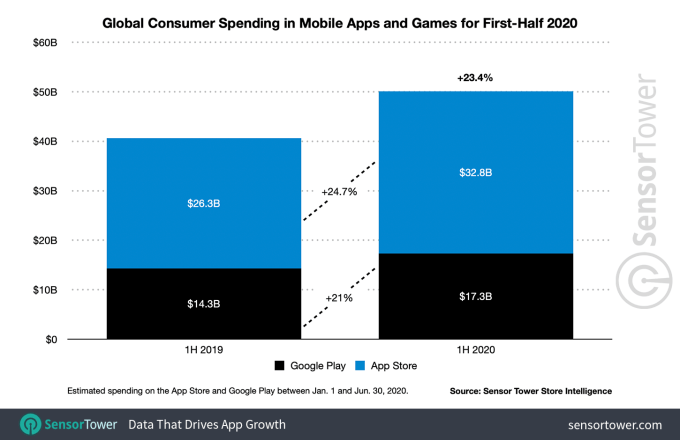
Image Credits: Sensor Tower

The pandemic’s impacts are only somewhat reflected in the top-earning (non-game) apps of the first half of 2020. The biggest earner, for example, was Match’s online dating app Tinder — an app that, one would think, would have dropped out of the top 5 due to social distancing requirements.

During the first half of the year, Tinder generated an estimated $433 million in spending across both app stores, combined. However, this number does represent a decrease of about 19% from the first half of 2019, or $532 million. It’s unclear how much that decline is related to consumers’ changing behavior and spending habits during the pandemic. Though shelter-in-place orders and quarantines kept people indoors and social distancing, social networking apps — and particularly those focused on online communication — have boomed amid lockdowns.

Image Credits: Sensor Tower

Tinder embraced the growing interest in online networking by making its “Passport” feature free. This setting allows users to match with other singles around the world, turning Tinder into more of a social app than one focused on real-world dating. But this change could have also led to a decrease in Tinder’s total revenues for the first half of the year.

The No. 2 top grossing app during the first half of 2020 was YouTube, bringing in an estimated $431 million globally. This was followed by ByteDance’s TikTok with $421 million. The social video app, which includes Douyin in China, had also broken download records during the first half of the year, passing 2 billion total global downloads, Sensor Tower earlier reported.

Tencent Video and Netflix were the No. 4 and No. 5 top grossing apps, respectively.

Meanwhile, consumers stuck at home during the pandemic have been downloading apps and games in greater numbers. During the first half of the year, consumers installed 71.5 billion apps for the first time, up 26.1% from the first half of 2019.
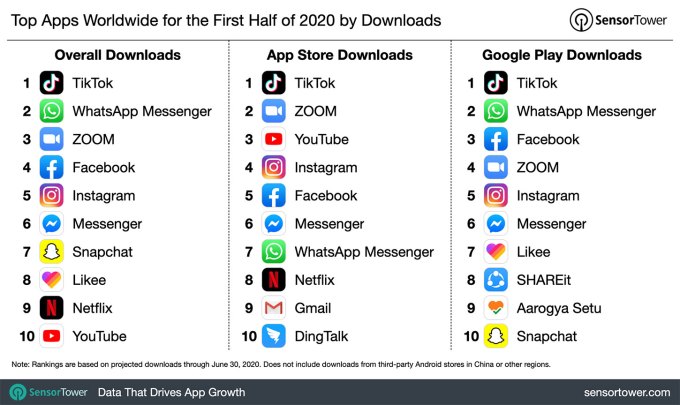
Image Credits: Sensor Tower

TikTok was the most-downloaded app in the first half of the year with 626 million downloads. But its position may look quite different in the second half of year, given the recent changes in India where the government has now banned 59 Chinese apps, including TikTok.

The No. 2 and No. 3 apps were WhatsApp and Zoom, respectively — the latter an indication of the rapid shift to work-from-home and consumers’ embrace of online video conferencing, in general. In addition to WhatsApp, Facebook snagged the No. 4, No. 5, and No. 6 positions in the top 10, with Facebook, Instagram and Messenger, in that order.

Snapchat’s social app was No. 7 and No. 8 was video app Likee, which is similar to TikTok but offers a variety of face effects and filters. Netflix and YouTube rounded out the top 10.

Mobile gaming also saw a boost during the pandemic, with game spending up 21.2% year-over-year to reach an estimated $36.6 billion during the first half of the year, Sensor Tower found. Spending on the App Store grew 22.7% year-over-year to reach $22.2 billion, while Google Play game spending grew 19% to reach $14.4 billion.
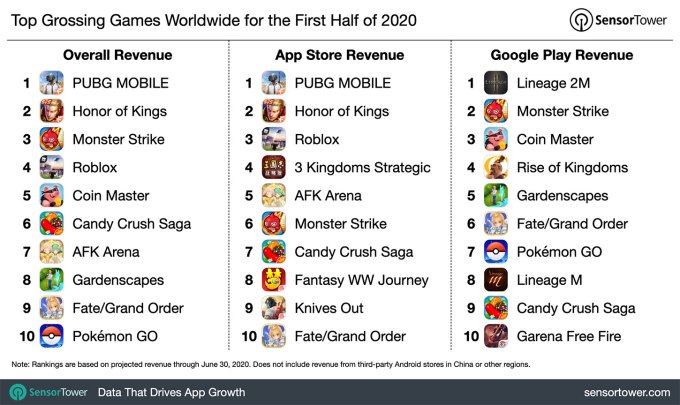
Image Credits: Sensor Tower

Tencent’s PUBG Mobile beat out Honor of Kings as the top-grossing game for the first half of the year. Tencent’s game, which includes its localized versions (Game for Peace and Peacekeeper Elite) generated $1.3 billion across both app stores, not including China’s third-party Android app stores. Honor of Kings, meanwhile, pulled in roughly $1 billion.

The remaining top 10 included, in order, Monster Strike ($632M), Roblox, Coin Master, Candy Crush Saga, AFK Arena, Gardenscapes, Fate/Grand Order, and Pokémon Go. The latter recently adapted to indoor gaming amid government lockdowns.

Roblox, in particular, has been surging due to the pandemic as kids stuck indoors have gone online to play and socialize with friends in its virtual environment. In June, Sensor Tower reported Roblox had surpassed a milestone of $1.5 billion in lifetime player spending, for instance. Coin Master, meanwhile, is approaching the $1 billion lifetime player milestone, the firm found.

In terms of top game installs, PUBG Mobile came out on top here as well, followed by another battle royale title, Garena Free Fire. Ruby Game Studio’s Hunter Assassin, Eyewind Limited’s Brain Out, and Playrix’s Gardenscapes — which many found to be a relaxing distraction during a stressful time — rounded out the top five.

Image Credits: Sensor Tower

Across all of the mobile gaming market, downloads grew 42.5% year-over-year to reach 28.5 billion first-time installs in the first half of 2020. Of those, Google Play downloads grew 46.2% year-over-year to 22.8 billion while App Store downloads grew 29.5% to 5.7 billion.
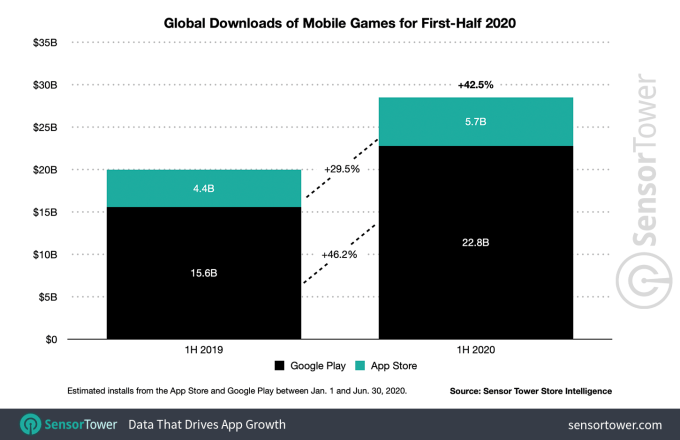
Image Credits: Sensor Tower


COVID-19 impacts more apparent in Q2 

Indications of COVID-19’s impact on the app market can be found among the figures for the first half of the year — like the growth seen by Zoom or social gaming platforms like Roblox, for example. But a closer look at the second quarter of 2020 alone makes the COVID-19 impacts more apparent.

Sensor Tower’s initial projections show consumer spending on apps and games jumped 11% on a quarterly basis from Q1 to Q2, and grew 28.8% year-over-year to reach $26.4 billion worldwide. This is a sizable increase from the 1.4% growth between Q1 2019 and Q2 2019. Downloads were up 12% on a quarterly basis and up 31.7% year-over-year to reach 37.8 billion worldwide. Again, a large increase from the 2.5% growth between Q1 2019 and Q2 2020.


30 Jun 2020

Qualcomm launches its new smartwatch chips

Qualcomm today announced the launch of its new Snapdragon Wear platforms for wearables, the Snapdragon Wear 4100 and 4100+.

Based on a 12nm process technology, these new platforms promise to breathe new life into the Android Wear ecosystem.

One of the first things users will notice is that, compared to the previous generation of Wear 3100 chips, the 4100+ platform will offer support for a far richer ambient mode, which can now show more colors in this energy-efficient mode all while supporting sleep tracking, live complications and adaptive brightness.

Traditionally, in the Android Wear ecosystem, the ambient mode was quite pared down compared to the live mode, but this new platform is going to change that. According to Qualcomm’s data, most smartwatches spent 95% of their time in ambient mode, so that was an obvious feature to improve upon. For its sports mode, the watch falls back to a similar mode, which now features similar capabilities to keep you up to date while you are on a run, for example, and are using various sensors, maps and the GPS.

Image Credits: Qualcomm

As for the actual technology, the 4100+ platform consisted of a main system Cortex A53-powered system on a chip that promises 85% higher performance compared to the previous generation, all while offering 25% longer battery life. The GPU itself is 2.5 times faster than only a generation ago, which should make for a far smoother user experience. Step counting, heart rate monitoring and more is handled by a tiny always-on co-processor, (it measures 5mmx4mm), while a 4G modem provides high-speed connectivity.

Image Credits: Qualcomm

One other major advantage, especially for sport-oriented smartwatches, is improved GPS support with significantly lower power requirements.

For connected smartwatches, Qualcomm promises a 25% improvement in battery life (and these connected watches have traditionally had pretty dismal battery life).

If you really want to conserve battery life, a lot of recent Android Wear watches let you switch to a low-battery mode, which until now meant you only got to see the time. This ‘enhanced watch mode’ is getting a major update on the new 4100+ platform with the addition of step and heart rate support, a battery indicator, alarms and reminders (and yes, you can still see the time and date, too. It’s a watch, after all).

Image Credits: Qualcomm

It’s worth stressing that Qualcomm will launch two variants of the 4100 platform, the 4100+, which features the main system on a chip, the always-on co-processor and the various connectivity chips, as well as the 4100, which will not feature the always-on co-processor.

The first watches to use the new 4100 chips will come from Mobvoi, the makers of the TicWatch line, and imoo, which will launch a kid-centric smartwatch based on the platform.

Image Credits: Qualcomm

30 Jun 2020

US government agency warns of fresh Palo Alto VPN security flaw

The U.S. government is warning that foreign nation-state hackers will “likely attempt” to exploit a new “critical”-rated security vulnerability found in a number of widely used Palo Alto Networks’ network appliances, which if exploited could allow an attacker to break into a company’s network with relative ease.

That’s the warning from US Cyber Command, a division of the Dept. of Defense and former sister-agency to the NSA, which said enterprises should patch their vulnerable devices as soon as possible.

The flaw lies in the software that powers several Palo Alto Networks firewalls and enterprise VPN appliances, which let employees access their corporate network from home — access that is crucial during the pandemic — while keeping unauthorized users out.

Typically employees must enter their corporate username and password, and often a two-factor code. But the flaw could, under certain conditions, let an attacker take control of one of these devices without needing a password, granting them access to the rest of the network.

Palo Alto said that a fix was pushed out in a software update, but enterprises can also switch off SAML — a way of letting a user log in to the network — to mitigate the flaw.

But the clock is ticking on enterprises getting those fixes installed. VPN appliances and firewalls are a huge target for hackers as they can provide unfettered access to a corporate network.

Last year, researchers found flaws in three corporate VPN appliances — including Palo Alto. Although fixes were quickly rolled out, enterprises that were slow to patch found their networks under attack, prompting Homeland Security’s cyber advisory unit to issue an alert. In some cases, hackers used the vulnerability to spread ransomware across the network.

For the time being, Palo Alto says there’s no evidence yet of hackers exploiting this vulnerability. But given the immediate risk to networks, companies should patch as soon as possible.

30 Jun 2020

The Venture Collective launches with a new bet on pre-seed investing

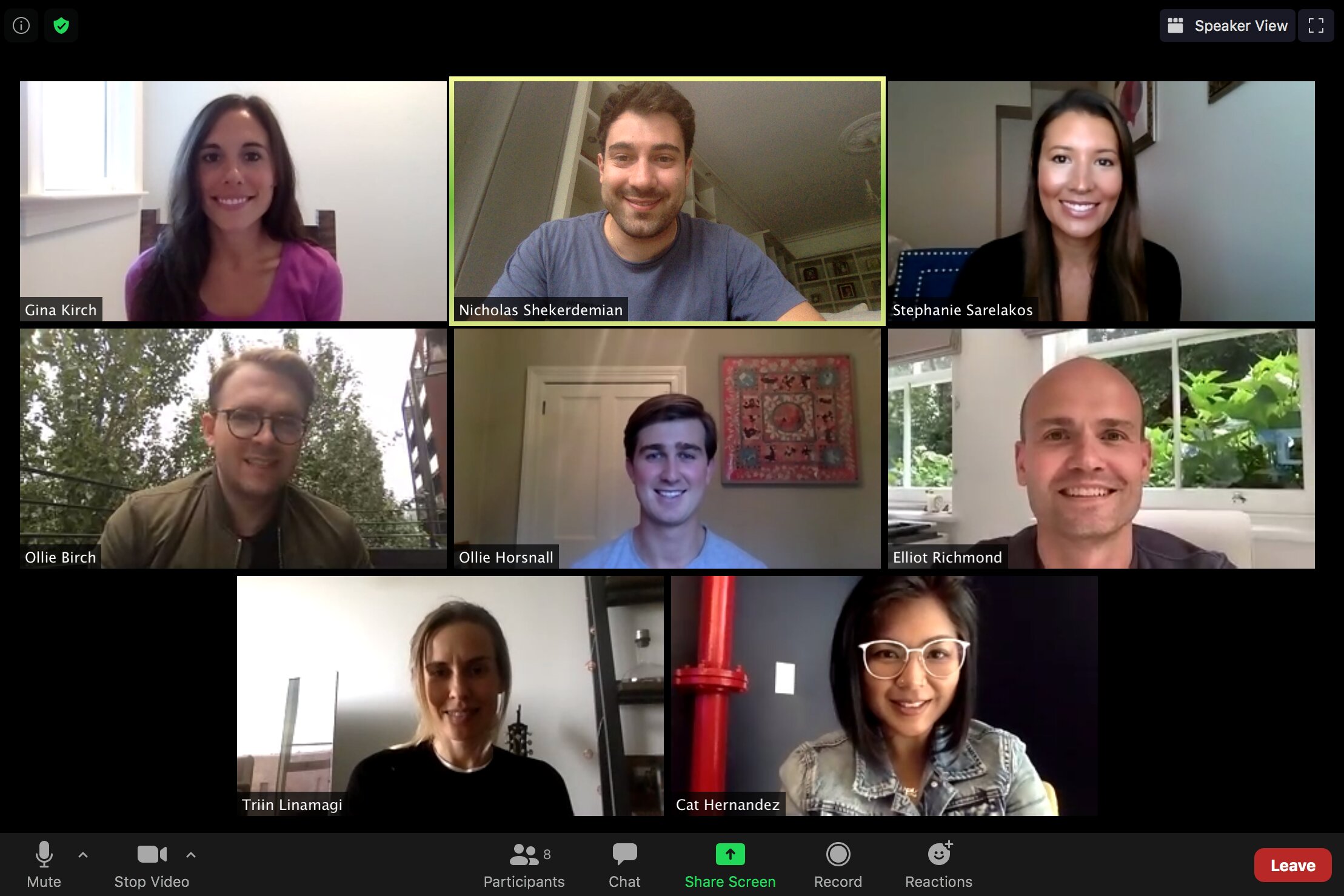
Venture capital has a long way to go when it comes to investing in underrepresented founders in a meaningful way. But according to The Venture Collective’s Cat Hernandez, the issue is too complex to solve by just cutting checks and spending time with entrepreneurs.

“You have to be maniacally focused on solutions,” Hernandez said.

So, Hernandez has teamed up with a number of operators-turned-investors to tackle tech’s diversity problem from a creative angle.

The Venture Collective, based in London and New York, launches today to make access to capital more equal. Fair warning: its experimental structure is knotty, as TVC is part investment vehicle and part management company. But it’s a creative strategy in a deserving sector that tech struggles to make progress within.

The team is stacked with a variety of experience: Founding partner Nick Shekerdemian is a former YC startup founder who launched a diversity recruitment platform, and his co-founder, Gina Kirch, was one of his investors, as well as a former director at BlackRock. Other partners include former Primary Venture Partners investor Cat Hernandez and Elliot Richmond, who invests out of the United Kingdom and previously worked at Moelis & Company.

The team was finalized during COVID-19.

TVC’s funding model has two customer bases: startup founders and family offices.

For startups, the business will invest a $100,000 check into one company per month, with the flexibility to do more. TVC intends to reserve between $1 to $5 million for follow-on rounds.

For family offices, TVC charges an annual fee to serve as intel for what they think are lucrative pre-seed deals in the Valley. If a family office or someone within its network wants to invest, TVC will ultimately deploy an allocated amount of capital. It hopes that total capital commitments will increase over time. 

While TVC says the structure model is in stealth, it is reasonable to compare the structures of these family office investments to the structures of special purpose vehicles. SPVs are investment vehicles that exist outside a fund’s capital allotment and are more spur of the moment, versus traditionally syndicated.

The biggest difference is that SPV structure is centered around deals, but TVC’s structure is centered around a capital allotment, deployed into multiple deals. They essentially act as middlemen between promising startups and family offices.

It’s good news for family offices, as they often take the role of institutional investors, which are decade-long relationships. The problem with lengthy bets is that what was hot in 2010 might not be hot in 2020. TVC’s model lets LPs deploy capital in their interest areas on a year by year basis. So an LP who is newly bullish on remote work (for some wild reason) could get their hands in early deals instead of waiting for the AR/VR fund they invested in years ago to make that move.

Putting all these pieces together, TVC gets more funds by:

  • traditional equity raise
  • annual fee to provide information to its network
  • family office checks
  • portfolio exits

Because of all of these mechanisms, TVC’s total “fund size” will change depending on the week. It’s a unique example of how first-time fund managers are tackling investing in a volatile landscape.

Today TVC launches with an undisclosed amount of equity-based financing. The company declined to share total assets under management.

So a big factor in TVC’s success is if it can convince both founders and family offices that its perspective is worth the set up. TVC’s flexibility can be a blessing, but it also can be risky and unreliable in case family offices pull out. Or if there is an extended recession, for example.

As a sweetener, the company says that it will donate two-thirds of partner time to helping portfolio companies.

But how does this fit into diversity? It all goes back to TVC’s goal to make access to capital more equal.

According to the team, pre-seed to Series A is where most companies fail, but the very funds that back pre-seed are also the most strapped for resources (small fund sizes, fixed management fees). Thus, firms have to selectively pick the companies they think are outliers and spend time with those companies on a more regular basis. This disproportionately impacts underrepresented founders, who might have a slower start due to lack of access to resources.

TVC thinks its strategy will help grow the number of startups that are venture-backable by heavily supporting them through this time, without competing and driving up valuations for only a few outliers.

The company defined underrepresented founders through diversity, geography, age and social background. When asked if they will publicly disclose diversity metrics, TVC said “it wants to be thoughtful about how we hold our investments accountable in the long-term and we are balancing that with a desire to not be prescriptive.”

“We believe that part of our job as early investors is to ensure that this intent is top of mind as the business scales. That can come in many forms — tracking/reporting on diversity metrics being one of them. At its core, this isn’t about window dressing,” the firm told TechCrunch. Generally, TVC is focused on helping more people get funding, and pointed toward financial optionality as the “flywheel we’re playing for.”

In terms of sourcing, TVC is partnering with tech-focused groups in New York and London and will identify talent at the university and college level. It also said it will build relationships with underrepresented operators “at the most prominent tech companies” and co-invest with diversity-focused founders.

TVC also launched a group called “The Collective” that includes diverse founders, operators and investors, who will help as a deal flow channel.

30 Jun 2020

CMU researchers develop a an automatic politeness engine for text-based communications

If you’re a typically terse communicator who could probably benefit from a little more civility in your everyday communications, a new Carnegie Mellon University research project could be the answer. A team at CMU created an automated way to improve the politeness of written requests and communications, which could have a number of potential applications – including eventually providing the basis for a sort of Grammarly but designed for writing tone instead of adherence to grammar rules.

The politeness transfer engine that the CMU research team (including Language Technology Institutes Ph.D student Shrimai Prabhumoye, as well as Master’s students Aman Madaan, Amrith Setlur and Tanmay Parekh) developed is based on similar style transfer mechanisms you may be more familiar with from photography AI projects, where software can apply the style of one photograph to any other. This project used a dataset of half a million emails exchanged by Enron employees, which were made public as part of legal proceedings against the company resulting from its corruption and fraud scandals.

Despite the company’s wrongdoing, many of the emails exchanged between employees were – unsurprisingly, if you’ve ever worked in a large corporation – laden with common niceties and politely formed requests and responses. These proved a good basis form which to train a computational linguistics algorithm that could then be used to take either basic or impolite requests, like ‘Show me last month’s reports,’ and turn that into something with a little more basic human kindness and decency, like ‘Could you please send me the reports from last month?’

It might seem like the task is relatively simple – append a ‘please’ and ‘thank you’ to any phase and you’re mostly there, right? In fact, the researchers say that it actually involved a lot more subtlety, since in fact when we are striving to be polite we do a lot more, like rephrase what’s actually an order to be a request, as in the example above.

The automated method that the CMU team developed works only in North American English, as employed in a formal (ie. workplace) setting for now, and there will be lots of work required in order to localize it since regional and linguistic differences regarding what’s considered polite vary greatly. But even in its current form, it could provide a lot of benefit when used for automated customer service chatbots, for instance, or in autosuggesting text in an email client.

There’s clearly an interest in this from companies who make significant use of automated text suggestions – like Apple, which provided support for this research alongside the Air Force Research Laboratory, the Office of Naval Research, the National Science Foundation and NVIDIA.

30 Jun 2020

Fivetran snares $100M Series C on $1.2B valuation for data connectivity solution

A big problem for companies these days is finding ways to connect to various data sources to their data repositories, and Fivetran is a startup with a solution to solve that very problem. No surprise then that even during a pandemic, the company announced today that it has raised $100 million Series C on a $1.2 billion valuation.

The company didn’t mess around with top flight firms Andreessen Horowitz and General Catalyst leading the investment with participation from existing investors CEAS Investments and Matrix Partners. Today’s money brings the total raised so far to $163 million, according to the company.

Martin Cassado from a16z described the company succinctly in a blog post he wrote after its $44 million Series B in September 2019, which his firm also participated in. “Fivetran is a SaaS service that connects to the critical data sources in an organization, pulls and processes all the data, and then dumps it into a warehouse (e.g., Snowflake, BigQuery or RedShift) for SQL access and further transformations, if needed. If data is the new oil, then Fivetran is the pipes that get it from the source to the refinery,” he wrote.

Writing in a blog post today announcing the new funding, CEO George Fraser added that in spite of current conditions, the company has continued to add customers. “Despite recent economic uncertainty, Fivetran has continued to grow rapidly as customers see the opportunity to reduce their total cost of ownership by adopting our product in place of highly customized, in-house ETL pipelines that require constant maintenance,” he wrote.

In fact, the company reports 75% customer growth over the prior 12 months. It now has over 1100 customers, which is a pretty good benchmark for a Series C company. Customers include Databricks, DocuSign, Forever 21, Square, Udacity and Urban Outfitters, crossing a variety of verticals.

Fivetran hopes to continue to build new data connectors as it expands the reach of its product and to push into new markets, even in the midst of today’s economic climate. With $100 million in the bank, it should have enough runway to ride this out, while expanding where it makes sense.

30 Jun 2020

OnePlus will return to its budget roots with the launch of Nord

Two factors defined OnePlus’s seemingly out-of-nowhere growth in the middle of the last decade: solid specs and a budget price tag. But markets change, and companies must adapt to survive. As someone who’s followed the Chinese smartphone maker since close to the beginning, I can confidently say that it hasn’t wavered from that first part. The second bit, on the other hand, is a bit of a different story.

OnePlus has experienced a bit of a price creep as it’s continued to add features to set itself apart from the competition. In the early days, the smartphone maker was content to wait a generation or two before embracing new tech, for the sake of keeping costs down. But increasingly, it’s come to be pride itself in being among the first first to things like in-screen fingerprint readers and 5G.

Today, however, it’s announcing a bit of a return to its roots with the Nord. The upcoming phone has been the subject of all manner of rumors under a variety of different names in recent months, but OnePlus just confirmed its name and arrival by way of an extended behind-the-scenes documentary on Instagram. Details are pretty slim at the moment, though the company confirmed that it will be priced at under $500.

Cofounder Carl Pei — who discussed the company’s place in the budget market last year at Disrupt last year — noted in the video, “There’s a huge change every two years. Anything can happen. Thousand dollar phones are decreasing in sales.” It’s a pretty well-established phenomenon over the last few years that has led to, among other things, companies like Samsung, Apple and Google to embrace lower-cost device amid stagnant sales figures.

OnePlus’s devices have still remained relatively affordable, compared to the competition, but the addition of the Nord will finds its getting back to where it started from with a line aimed at a wider range of consumers and different markets. More info soon, no doubt.

30 Jun 2020

NexHealth’s founder went from a receptionist at a clinic in the Bronx to $12 million in funding

The summer before Alamin Uddin was set to begin medical school, he worked in a small doctor’s office in the Bronx as a receptionist.

There, dealing with the workflow of managing paper and electronic health records, organizing and scheduling patient’s visits and follow ups, he realized that one of the largest obstacles to quality care for many patients remains the lack of integration of medical records.

In the years since the first electronic medical records laws were passed, the promise of an integrated single source of patient information is still largely illusory.

That’s why Uddin and Waleed Asif, both graduates of City College, founded NexHealth. And why investors were willing to give the pair $12 million to build out their API providing a gateway between patient data in health records from small and medium-sized independent physicians and clinics and developers.

For most small clinics and independent practices, the benefits of opening up EHRs to developers isn’t entirely clear, so NexHealth is proving the use case for them with an initial suite of tools like online scheduling, automated patient communications and payments, the company said.

So far, the company has developed APIs to support around 50 electronic health record integrations, and is managing the caseload for around 10.4 million patients.

Companies like Quip and Doctorlogic are already using the company’s API to integrate with those health records. 

“The need is that developers don’t have the tools they need to innovate in SMB healthcare,” Uddin wrote in an email. “We’re building those tools to help developers rapidly go to market in the SMB healthcare space.”

Backing the company is a collection of super angels including James Beshara of Tilt and Airbnb fame; Joshua Hannah, from Betfair; Rahul Vohra, the founder of Superhuman; Harry Stebbings, from 20minuteVC; AngelList’s Naval Ravikant; Scott Belsky from Adobe and Behance; and Christoph Janz of Point Nine Capital.

The independent healthcare market represents 70 percent of a consumer’s interaction with healthcare and no one is servicing those independent offices, according to Uddin. These are places like dentists, chiropractors, small minute clinics and urgent care facilities or independent health care practitioners.

“We want to enable innovation in the healthcare system,” Uddin said, and he thinks these small businesses are the best place to start.


30 Jun 2020

Facebook says it will prioritize original reporting and ‘transparent authorship’ in the News Feed

Facebook announced this morning that stories with original reporting will get a boost in the News Feed, while publications that don’t clearly credit their editorial staff will be demoted.

The change comes as a number of high-profile companies have said that they will pull their advertising from Facebook as part of the #StopHateforProfit campaign, organized by civil rights groups as a a way to pressure the social network to take stronger steps against hate speech and misinformation.

On Friday, CEO Mark Zuckerberg announced that the company will start labeling — but not removing — “newsworthy” content from politicians and other public figures that violates its content standards. (He also said that content threatening violence or suppressing voter participation will be removed even if it’s posted by a public figure.)

Today’s blog post from VP of Global News Partnerships Campbell Brown and Product Manager Jon Levin doesn’t mention the ad boycott, and it suggests that these changes were developed in consultation with news publishers and academics. But these certainly sound like concrete steps the company can point to as part of its efforts against misinformation.

What gets prioritized in the News Feed has long been a thorny issue for publishers, particularly after a major change in 2016 that prioritized content from friends over content from publishers.

“Most of the news stories people see in News Feed are from sources they or their friends follow, and that won’t change,” Brown and Levin wrote. “When multiple stories are shared by publishers and are available in a person’s News Feed, we will boost the more original one which will help it get more distribution.”

As for “transparent authorship,” Facebook will be looking for article bylines, or for a staff page on the publisher’s website. As Brown and Levin noted, “We’ve found that publishers who do not include this information often lack credibility to readers and produce content with clickbait or ad farms, all content people tell us they don’t want to see on Facebook.”

While these same like smart, straightforward changes (Google announced similar steps last fall), Brown and Levin also warned publishers not to expect “significant changes” in their Facebook traffic, since there are a “variety of signals” that go into how content gets ranked in the News Feed.

Also worth noting: These changes only apply to news content.