Year: 2020

29 Jun 2020

Google brings free product listings to its main Google Search results

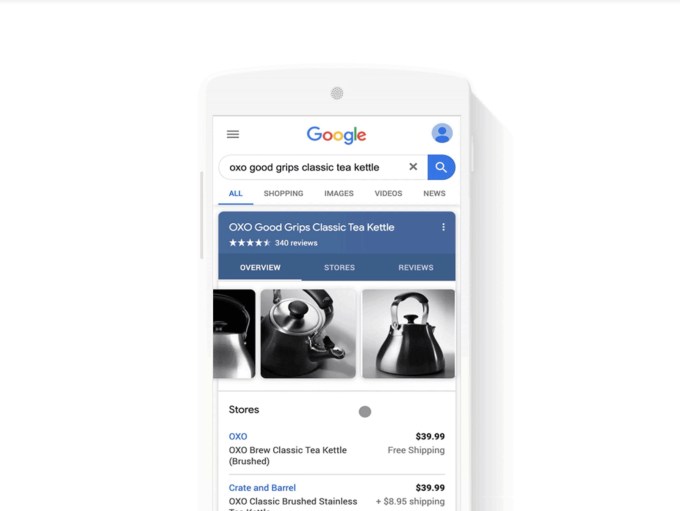
Earlier this year, Google made a significant change to its Shopping search tab in the U.S. to allow the service to primarily feature free product listings selected by Google’s algorithms, instead of paid ads. Building on that change, Google is today introducing a shift to free product listings in the main Google Search results page in the U.S. Before, it would only showcase sponsored links in its “product knowledge panel.”

This panel appears when a Google user searches for a product that has matching listings on e-commerce website. But until now, those links were paid ads. Google says, starting this summer, these panels will instead feature free listings.

This change will roll out first in the U.S. on mobile, followed later by the desktop.

Shopping ads aren’t going away, however. These ads will appear separately at the top of the page, where they’re marked like Google’s other ad units.

Since its shift to free listings in April of this year, Google says it’s seen an average 70% increase in clicks and 130% increase in impressions across both the free listings and ads on the Shopping tab in the U.S. These metrics were based on an experiment looking at the clicks and impressions after the free listings were introduced, compared with a control group. The control group was a certain percentage of Google traffic that had not been moved to the new, free experience.

Image Credits: Google


Google has positioned its shift to free listings as a way to aid businesses struggling to connect with shoppers due to the impacts of the coronavirus pandemic. But the reality is that this change would have had to arrive at some point — pandemic or not — because of Amazon’s threat to Google’s business.

Amazon over the years has been steadily eating away at Google’s key business: search ad revenue. In a report published last fall, before the pandemic hit, analyst firm eMarketer said Google’s share of search ad market revenue would slip from 73% in 2019 to 71% by 2021, as more internet users started their searches for products directly on Amazon.

Now the coronavirus is pushing more consumers to shop online in even greater numbers, much to Amazon’s advantage. The online retailer reported the pandemic helped drive a 26% increase in its first-quarter 2020 revenue, for example. Meanwhile, a new eMarketer forecast estimates that Google ad revenues will drop for the first time this year, falling 5.3% to $39.58 billion due to pandemic impacts on ad spend — particularly the pullback in travel advertiser spending.

Google needed to change its Search service to return more than just paid listings to better compete. Paid listings alone wouldn’t always feature the best match for the user’s search query nor would they show as complete a selection — a problem Amazon’s vast online superstore doesn’t have. But Google’s shift to free listings also incentivizes advertisers to pay for increased visibility. Now, advertisers will need a way to stand out against a larger and more diverse selection of products.

“For many merchants, connecting with customers in a digital environment is still relatively new territory or a smaller part of their business,” notes Google’s, Bill Ready, President of Commerce. “However, consumer preference for online shopping has increased dramatically, and it’s crucial that we help people find all the best options available and help merchants more easily connect with consumers online.”

29 Jun 2020

In effort to fight COVID-19, MIT robot gets to work disinfecting The Greater Boston Food Bank

MIT’s Computer Science and Artificial Intelligence Lab (CSAIL) has put one of its research projects to work providing disinfection services for The Greater Boston Food Bank (GBFB), in an effort to slow the spread and still allow the non-profit to provide services to its patrons. The CSAIL-designed robotic system, which was created in partnership with Ava Robotics, can not only disinfect surfaces that might have come in contact with the novel coronavirus, but also wipe out its aerosolized forms that might be present in the air, the lab says.

CSAIL’s robotic cleaning system goes well beyond your run-of-the-mill Roomba: It employs UV light for a fully automated clean that can be done free of any human oversight, which is key because UV light when used in the strength required for surface and airborne disinfection can be harmful to any people present.

The team behind the design took one of Ava’s telepresence robot, removed the top which normally houses the screen to display a remote operator, and instead replaced it with a UVC light array. Via cameras and sensors, the robot can map an indoor space, and then navigate designed waypoints within that mapped area and disinfect as it goes, keeping track fo the areas it has to disinfect. In operation, after its autonomous mapping exercise, human remote operators showed it the path that people would normally traverse in the space to define priority disinfection zones.

The system is flexible so that it can handle re-mapped routes, which is required because what areas of the GBFB warehouse need to be traversed can change daily as food comes in and food goes out, with stock stored on different shelves. Eventually, the team wants to develop more automated ways for the modified telepresence robots to user their suite of sensors to figure out what areas are priority for disinfection based on foot traffic and changing real-world conditions, but for now, it can easily be manually adjusted to accommodate shifts.

This project focused specifically on use at the GBFB, a priority resource especially during the COVID-19 pandemic, but MIT CSAIL’s researchers envision similar systems being put to use to cover a range of complex spaces that require frequent disinfection, including grocery stores, dorms, schools and airplanes.

29 Jun 2020

Waze gets a big visual update with a focus on driver emotions

Crowdsourced navigation platform Waze, which is owned by Google and yet remains a separate, but intertwined product relative to Google Maps, just got one of its biggest UI and design overhauls ever. The new look is much more colourful, and also foregrounds the ability for individual drivers to share their current emotions with Moods, a set of user-selectable icons (with an initial group of 30) that can reflect how you’re feeling as you’re driving.

Moods may seem like a relatively small user personalization option, but it’s actually a very interesting way for Waze to add another data vector to the crowdsourced info it can gather. In a blog post describing the feature, Waze Head of Creative Jake Shaw talks about the added Mood set, which builds upon the Moods feature previously available in Waze and greatly expands the set of expressible emotions.

“The fundamental idea of Moods has always been the same: to reflect how users feel on the road,” he wrote. “We had a lot of fun exploring the range of emotions people feel out there. A dozen drivers could all feel different in the exact same situation, so we set about capturing as many of those feelings as possible. This was critical to us, because the Moods act as a visual reminder of all of us out there, working together.”

Extending Moods to be more varied and personalized definitely has the advantage of being more visually-appealing, and that could serve to boost its engagement among the Waze user community. They don’t mention this explicitly, but you can imagine that combining this as a sort of sentiment measure along with other crowd-reported navigational details including traffic status, weather conditions, construction and more could ultimately help Waze build a much richer dataset and resulting analyses for use in road planning, transportation infrastructure management and more.

This update also includes a full refresh of all the app’s interfaces, using colored shapes based around a grid system, and new icons for reported road hazards. It’s a big, bright changes, and further helps distinguish Waze’s visual identity from that of its sibling Google Maps, too.

Shaw talk repeatedly about the value of the voice of the community in informing this redesign, and it definitely seems interested in fostering further a sense of participation in that community, as distinct from other transportation and navigation apps. Oddly, this serves as a reminder that Google’s most successful social networking product, with the exception maybe of YouTube depending on how you define it, may well be Waze.

29 Jun 2020

Amazon warehouse workers strike in Germany over COVID-19 conditions

Amazon warehouse workers in Germany are striking for 48 hours this week, to protest conditions that have led to COVID-19 infections among fellow employees. Strikes began today at six warehouses and are set to continue through end of day Tuesday.

The company has drawn international criticism for its decision not to disclose official COVID-19 infection rates among workers, but a representative for Berlin-based labor union Verdi (Vereinte Dienstleistungsgewerkschaft or German United Services Trade Union) says they’re aware of “at least 30 to 40” workers in the Bad Hersfeld factory in Central Germany who have been infected with the virus. 

Other striking factories include Koblenz, Leipzig, Rheinberg and Werne. Germany represents Amazon’s largest non-U.S. market, and is one that has seen its fair share of worker protests. Strikes were planned for Prime Days in both 2018 and 2019. But the COVID-19 pandemic represents a new challenge for the online retail giant.

As it has done with other recent criticism, the company denied suggestions that its working conditions are unsafe and pointed to various COVID-19-related initiatives.

“The majority of our associates does not participate and we see no impact on customer orders. The fact that more than 8,000 of our over 13,000 permanent associates in Germany are with us for more than five years proves that we are a fair employer,” a spokesperson said in a statement to TechCrunch. “Everything the union demands is already in place: Wages at the upper end from what is paid for similar jobs, career opportunities and a safe working environment,. The facts are: By end of June, we will have invested approximately $4 billion worldwide on COVID-related initiatives getting products to customers and keeping employees safe.”

Here in the States, the company has drawn criticism from media and politicians alike for its action on COVID-19, including the firing of multiple workers who have been vocally critical of its policies.

29 Jun 2020

Apple reveals its 2020 Apple Design Award winners

One thing missing from last week’s virtual version of Apple’s annual Worldwide Developers Conference was its ceremony announcing its latest selection of Apple Design Award winners. Today, Apple announced the 2020 award winners, highlighting those it said brought “distinctive new ideas to life” while demonstrating a mastery of Apple technology.

The Design Awards serve as a signal to the development community as a whole what sort of apps and games Apple wants to see. For example, last year, the company celebrated apps that showcased the use of Apple Pencil, CoreML, Metal 2, and other Apple technologies.

This year, Apple has again focused on several apps designed for iPad, particularly photo editors and other design tools that showcase the iPad as a tool for creatives. Meanwhile, a couple of the game winners were selected for their use of spatial audio, in addition to their use of other technologies and their design choices. Not coincidentally, Apple at WWDC20 said it was updating its AirPods Pro with support for spatial audio.

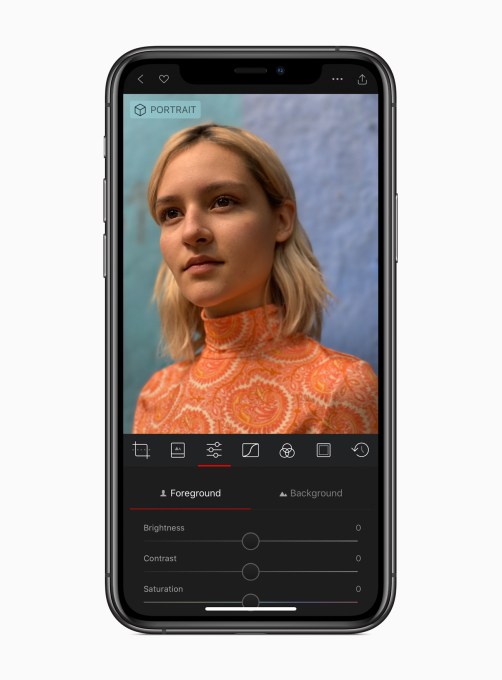
The photo and video editor Darkroom from Bergen Co., which was described as being easy enough for casual and pros to use, was among this year’s app winners. It also leveraged Apple technologies like photo and camera APIs, Home Screen quick actions, contextual menus, and haptics.

Animation app Looom, developed by iorama.studio, won for its playful and creative interface, novel custom controls, and support for Apple technologies like Apple Pencil and Dark Mode.

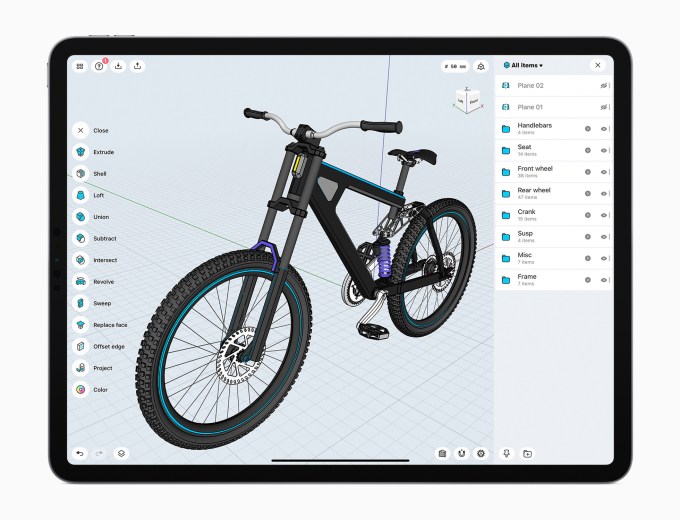
CAD editor Shapr3D, from Shapr3D Zartkoruen Mukodo Reszvenytarsasag, runs on iPad and works with Apple Pencil to allow technical designers to create 3D models. The app uses ARKit and drag and drop, and is soon adding support for the LiDAR Scanner for generating 2D floor plans from 3D photos.

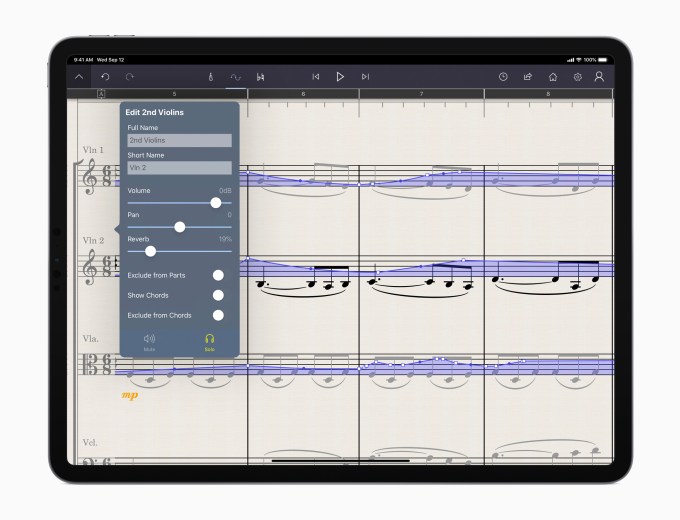
StaffPad, from StaffPad Ltd., turns handwritten musical notations into digital sheet music using Apple Pencil, drag and drop, and Core ML.

Sayonara Wild Hearts from developer Simogo and publisher Annapurna Interactive, had already been dubbed by Apple one of the best games of 2019 last year. The game won a Design Award for its vibrant landscapes, visuals, and motion, as well as its extensive use of Apple technologies including Metal, Game Center, spatial audio, and game controllers.

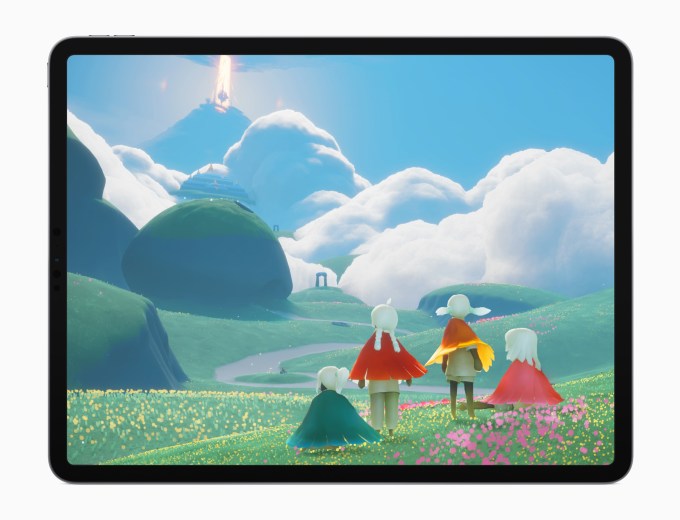
Sky: Children of the Light, from thatgamecompany, also made Apple’s “best of” list last year, and has returned to win the Design Award for multiplayer, social quest game featuring Apple technologies including a custom Metal engine, haptics, Game Center, and spatial audio.

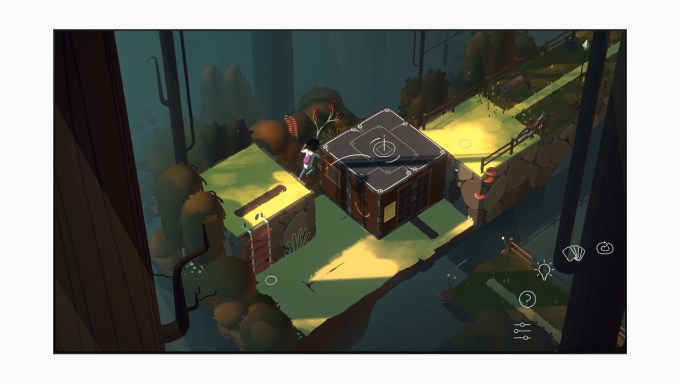
Song of Bloom,” from indie developer Philipp Stollenmayer, is a nonlinear puzzler with stories told in rapidly changing art styles. Apple selected this title, which runs on iPad, for its handcrafted gameplay and design.

“Where Cards Fall,” from developer The Game Band and publisher Snowman, is an adventure game where players build houses of cards to bring memories to life. The game uses Metal, haptics, Game Center, iCloud, and other technologies.

“Every year, app and game developers demonstrate exceptional craftsmanship and we’re honoring the best of the best,” said Ron Okamoto, Apple’s vice president of Worldwide Developer Relations, in an announcement. “Receiving an Apple Design Award is a special and laudable accomplishment. Past honorees have made some of the most noteworthy apps and games of all time. Through their vision, determination, and exacting standards, the winning developers inspire not only their peers in the Apple developer community, but all of us at Apple, too.”


29 Jun 2020

Mobile developer Tru Luv enlists investors to help build a more inclusive alternative to gaming

Developer and programmer Brie Code has worked at the peak of the video game industry – she was responsible for many of the AI systems that powered non-player character (NPC) behavior in the extremely popular Assassin’s Creed series created by Ubisoft. It’s obvious that gaming isn’t for everyone, but Code became more and more interested in why that maxim seemed to play out along predictable gender lines, leading her ultimately to develop and launch #SelfCare through her own independent development studio TRU LUV.

#SelfCare went on to win accolades including a spot of Apple’s App Store Best of 2018 list, and Code and TRU LUV was also the first Canadian startup to attend Apple’s Entrepreneur Camp program. Now, with over 2 million downloads of #SelfCare (without any advertising at all), Code and TRU LUV have brought on a number of investors for their first outside funding including Real Ventures, Evolve Ventures, Bridge Builders Collaborative and Artesian Venture Partners.

I spoke to Code about how she came up with and created #SelfCare, what’s next for TRU LUV, and how the current COVID-19 crisis actually emphasizes the need for an alternative to gaming that serves many similar functions, but for a previously underserved groups of people for whom the challenges and rewards structures of traditional gaming just don’t prove very satisfying.

“I became very, very interested in why video games don’t interest about half of people, including all of my friends,” Code told me. “And at that point, tablets were becoming popular, and everyone had a phone. So if there was something universal about this medium, it should be being more widely adopted, yet I was seeing really clear patterns that it wasn’t. The last time I checked, which was maybe a couple years ago, there were 5 billion mobile users and around 2.2 billion mobile gamers.”

Her curiosity piqued by the discrepancy, especially as an industry insider herself, Code began to do her own research to figure out potential causes of the divide – the reason why games only seemed to consistently appeal to about half of the general computer user population, at best.

“I started doing a lot of focus groups and research and I saw really clear patterns, and I knew that if there is a clear pattern, there must be an explanation,” Code said. “What I discovered after I read Sheri Grainer Ray’s book Gender Inclusive Game Design, which she wrote in 2004, in a chapter on stimulation was how, and these are admittedly gross generalizations, but men tend to be stimulated by the sense of danger and things flashing on screen. And women, in her research, tended to be stimulated by something mentioned called a mutually-beneficial outcome to a socially significant situation. That’s when you help an NPC and they help you, for instance. In some way, that’s more significant, in the rules of the world than just the score going up.”

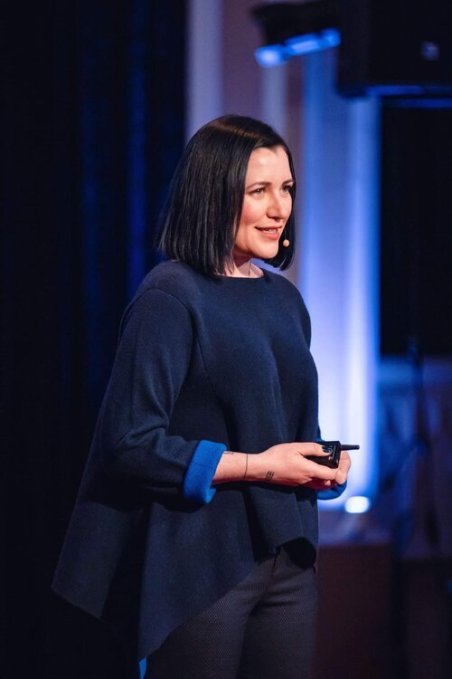
TRU LUV founder and CEO Brie Code

Code then dug in further, using consumer research and further study, and found a potential cause behind this divide that then provided a way forward for developing a new alternative to a traditional gaming paradigm that might prove more appealing to the large group of people who weren’t served by what the industry has traditionally produced.

“I started to read about the psychology of stimulation, and from there I was reading about the psychology of defense, and I found a very simple and clear explanation for this divide, which is that there are two human stress responses,” she said. “One of them, which is much more commonly known, is called the ‘fight-or-flight’ response. When we experience the fight-or-flight response, in the face of challenge or pressure or danger, you have adrenaline released in your body, and that makes you instinctively want to win. So what a game designer does is create these situations of challeng,e and then give you opportunities to win and that leverages the fight-or-flight response to stress: That’s the gamification curve. But there is another human stress response discovered at the UCLA Social Cognitive Neuroscience lab in 2000, By Dr. Shelly Taylor and her colleagues. It’s very prevalent, probably about half of stress responses that humans experience, and it’s called tend-and-befriend.”

Instead of generating an adrenaline surge, it releases oxytocin in the brain, and instead of seeking a victory over a rival, people who experience this want to take care of those who are more vulnerable, connect with friends and allies, and find mutually beneficial solutions to problems jointly faced. Seeking to generate that kind fo response led to what Code and TRU LUV call AI companions, a gaming alternative that is non-zero sum and based on the tend-and-befriend principal. Code’s background as an AI programmer working on some of the most sophisticated virtual character interactions available in modern games obviously came in handy here.

Code thought she might be on to something, but didn’t anticipate the level of #SelfCare’s success, which included 500,00 downloads in just six weeks, and more than 2 million today. And most of the feedback she received from users backed up her hypotheses about what the experience provided, and what users were looking for an an alternative to a mobile gaming experience.

Fast forward to now, and TRU LUV is growing its team, and focused on iterating and developing new products to capitalize on the clear vein of interest they’ve tapped among that underserved half of mobile users. Code and her team have brought on investors whose views and portfolios align with their product vision and company ethos, including Evolve Ventures which has backed a number of socially progressive ventures, and whose managing director Julius Mokrauer actually teaches a course on the subject at Columbia Business School.

#SelfCare was already showing a promising new path forward for mobile experience development before COVID-19 struck, but the product and TRU LUV are focused on “resilience and psychological development,” so it proved well-suited to a market in which mobile users were looking for ways to make sustained isolation more pleasant. Obviously we’re just at the beginning of feeling whatever impacts come out of the COVID-19 crisis, but it seems reasonable to expect that different kinds of mobile apps that trigger responses more aligned with personal well-being will be sought after.

Code says that COVID-19 hasn’t really changed TRU LUV’s vision or approach, but that it has led to the team moving more quickly on in-progress feature production, and on some parts of their roadmap, including building social features that allow players to connect with one another as well as with virtual companions.

“We want to move our production forward a bit faster than planned in order to respond to the need,” Code said.”Also we’re looking at being able to create social experiences a little bit earlier than planned, and also to attend to the need of people to be able to connect, above and beyond people who connect through video games.”

29 Jun 2020

Equity Monday: Scandal, one IPO, and the Indian startup market

Hello and welcome back to Equity, TechCrunch’s venture capital-focused podcast where we unpack the numbers behind the headlines. This is Equity Monday, our week-starting primer,  in which we go over the latest, look to the week ahead, talk about some neat funding rounds, and dig into the latest on the health of the startup market.

Don’t forget that you can follow Equity on Twitter, and, as explained in the show, you can sign up for Alex’s new TechCrunch newsletter “The Exchange” here.

Ok, let’s get into what we talked about this morning:

  • The Rothenberg VC scandal is moving towards what feels like a conclusion, with the Department of Justice filing criminal charges against its founder. As TechCrunch reported, “the U.S. Department of Justice has brought two criminal wire fraud charges against him, charges that he made two false statements to a bank, and money laundering charges, all of which could result in a very long time in prison depending on how things play out.”
  • Q2 is coming to a close this week, and many American companies are taking Friday off. Expect news to slow into the end of the week.
  • But, this week, South Korean gaming company DoubleDown Interactive is looking to raise $200 million by going public this week in the United States. That’s going to be exciting to watch.
  • Instead of picking individual funding rounds, we covered some notes on the Indian startup market. LiveMint, Times of India, and Entrackr all covered recent venture data, showing a booming India edtech market amidst a weaker VC landscape. If it turns out that rest of the world’s VC scenes are in similar straits, we could be entering something similar to a VC recession.
  • Finally, Bloomberg’s Joe Weisenthal is writing about how the stock market actually is tracking the economy. This is counter to the cliche that the stock market isn’t the economy. But his argument helps explain something about the startup market that has stuck out for a while, namely why did startup layoffs drop sharply and churn decline quickly in Q2? Well, maybe things got better?

And that’s Equity for today. We’re back Friday morning!

Equity drops every Friday at 6:00 a.m. PT, so subscribe to us on Apple PodcastsOvercastSpotify and all the casts.

29 Jun 2020

Medtech assessor Elektra Labs is offering free evaluations of COVID-19 biosensors to doctors

As COVID-19 cases in the US continue to spike and doctors and researchers try to marshal any and all technological resources to help patients, understand the disease, and fight off the spread of the epidemic, one startup that monitors and evaluates medical device technology is offering its services for free so doctors can understand the tools at their disposal.

San Francisco-based Elektra Labs was co-founded by a former official at the Food and Drug Administration and a Harvard-trained physician working at Massachusetts General Hospital, to provide clear and accurate assessments of the security, validity, and viability of new biosensors coming to market.

The company said that it will now make its assessments of medical devices that are pitching symptom monitoring technologies for COVID-19 available for free to clinicians and researchers.

As the number of infected people in the US reaches 2.5 million and the nightmare scenario that health experts warned about becomes a reality with capacity in hospitals overwhelmed by sick patients, the healthcare industry is turning to digital services like telemedicine not because they want to, but because they must.

“The ability to reliably assess patients’ vital signs remotely is a powerful way to improve the utility of telemedicine,” said Elektra Labs co-founder Dr. Sofia Warner, who has been treating COVID-19 patients on the front line at Massachusetts General Hospital, in a statement. “Having a sense of what connected sensors are validated for which measurements is important for providers to know.” 

Digital monitoring and technology tools aren’t just for treating patients. The pharmaceutical industry is using the same tech to help with clinical trials to test new drugs and treatments since in-person trials have ground to a halt.

“Many pharmaceutical companies running large, critical, and expensive clinical trials are quickly working to adapt their studies to maintain progress and keep patients safe amid the pandemic,” said Ariel Stern, PhD, faculty at the Harvard-MIT Center for Regulatory Sciences, in a statement. “These companies are racing to determine which products are not only safe and effective, but also easy for study participants to deploy at home.”

Elektra Labs has developed what amounts to a nutrition label for objective measures around the validation, usability, utility, security and data governance components of connected sensor and it actually published the methodology behind its scoring framework in Nature Digital Medicine earlier this year. 

Backed by venture capital firms including Founder Collective, Boost VC, Lux Capital, Maverick Ventures, Village Global and Arkitekt Ventures, the early stage startup has already found a welcome reception among pharmaceutical companies and researchers.

“Technology has moved faster than our ability to safeguard ourselves,” said Elektra Labs CEO Andy Coravos. “I co-founded Elektra to make it easier and safer to care for people at home, and never has this been more important than during the COVID-19 crisis. I’m thrilled to donate use of the Atlas platform to those working to treat patients and innovate in healthcare throughout the pandemic.”

Unlike Apple’s initiative to label apps in the app store based on the way they use and reuse personal data, Elektra Labs’ scoring and ranking information won’t be available to everyone.

Instead the data will be available only to clinicians moving to virtual care, researchers organizing decentralized clinical trials and public health officials examining tools for population health monitoring.

The idea is to enable doctors and researchers to determine which biometric monitoring tools they might use to supplement video visits or track patients in a study actually are safe and effective for patients to use at home.


29 Jun 2020

Exclusive: Survey finds startups drifting away from offices, post COVID-19

Early-stage startups are confident of re-opening their offices in the wake of the COVID-19 within the next 6 months. But: there will be changes.

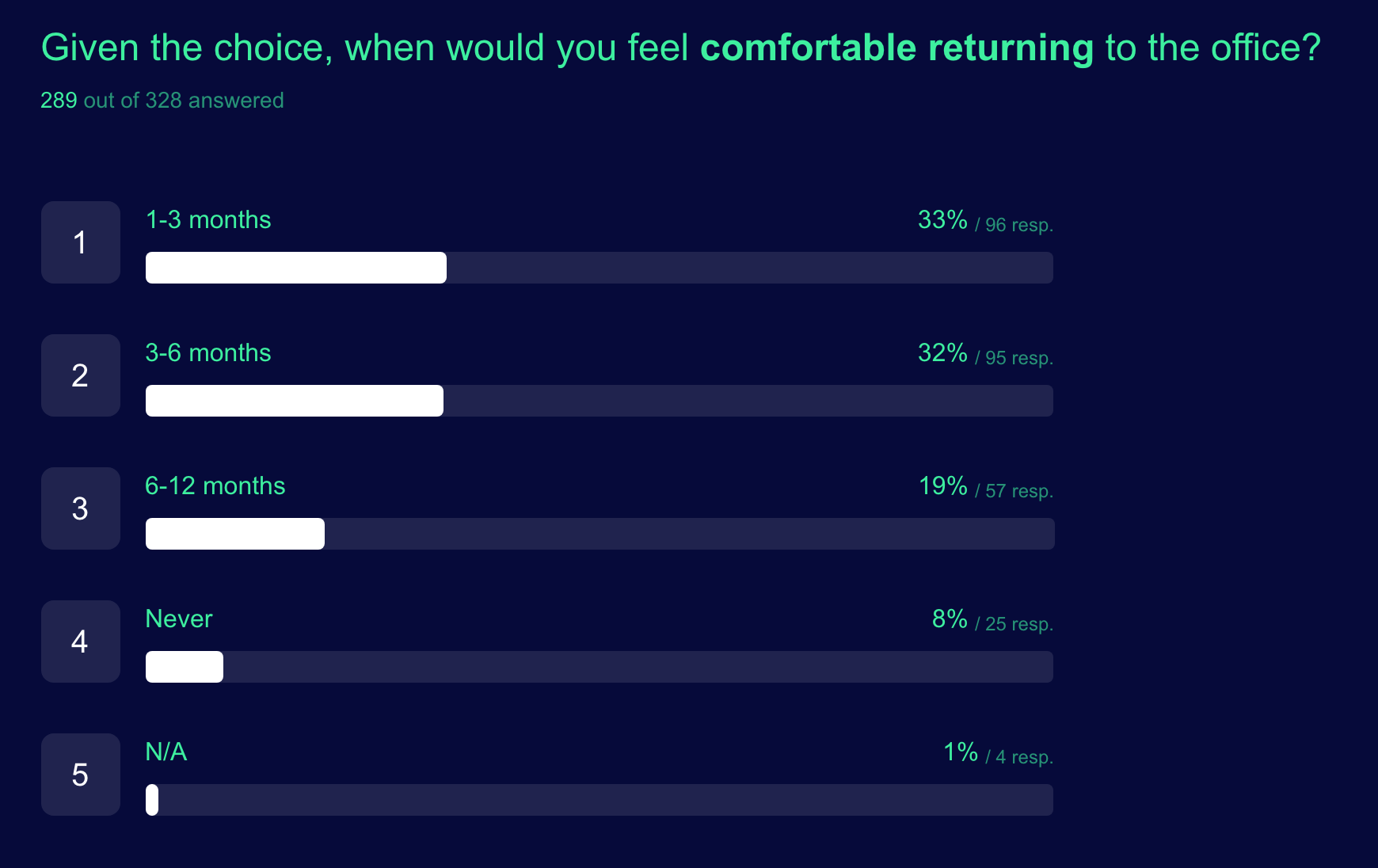
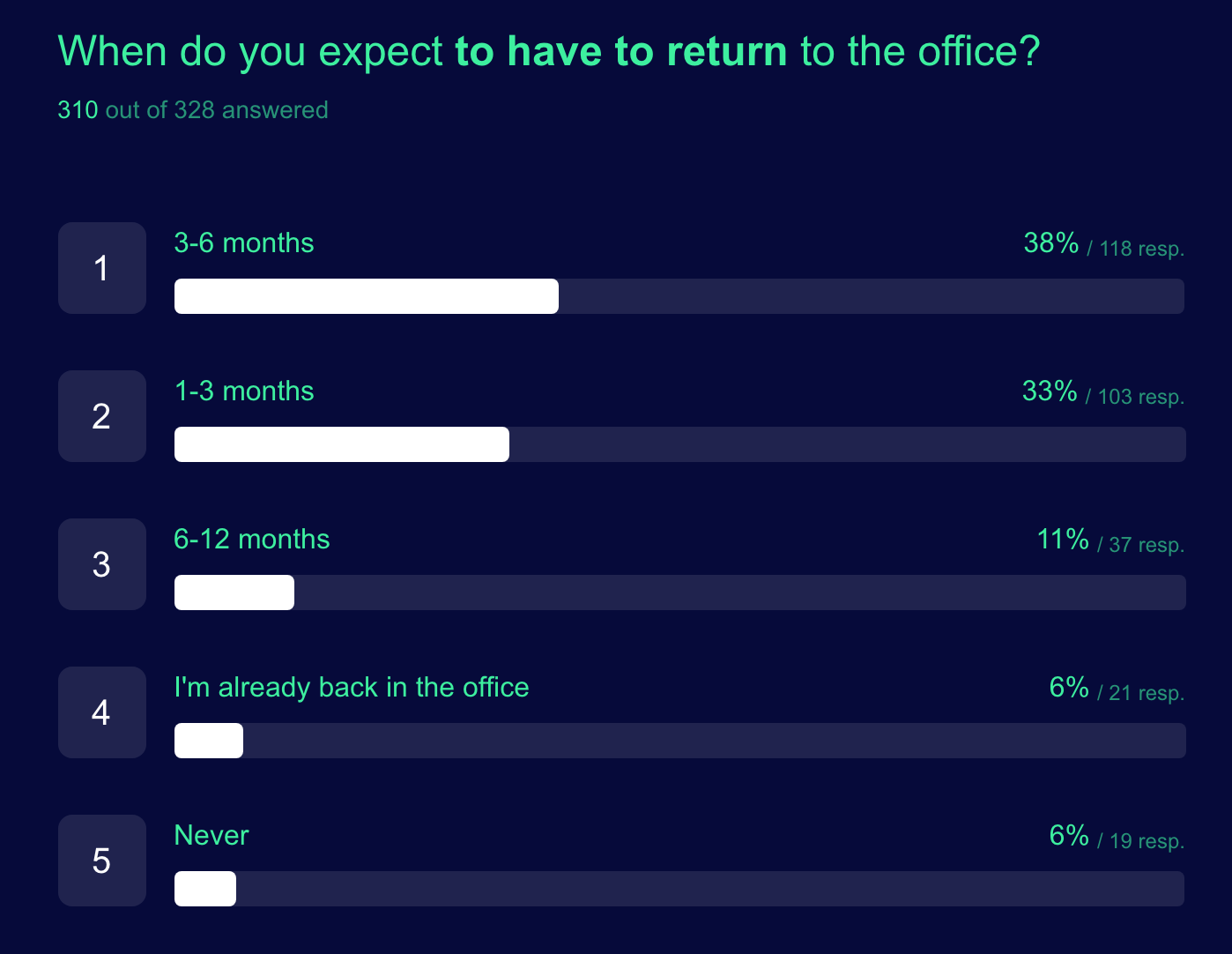
An exclusive survey compiled by Founders Forum, with TechCrunch, found 63% of those surveyed said they would only re-open in either 1-3 months or 3-6 months – even if the government advises that it is safe to do so before then. A minority have re-opened their offices, while 10% have closed their office permanently.

However, there will clearly be long-term impact on the model of office working, with a majority of those surveyed saying they would now move to either a flexible remote working model (some with permanent offices, some without), but only a small number plan a ‘normal’ return to work. A very small number plan to go fully ‘remote’. Many cited the continuing benefits of face-to-face interaction when trying to build the team culture so crucial with early-stage companies.

Massive office closures during pandemic
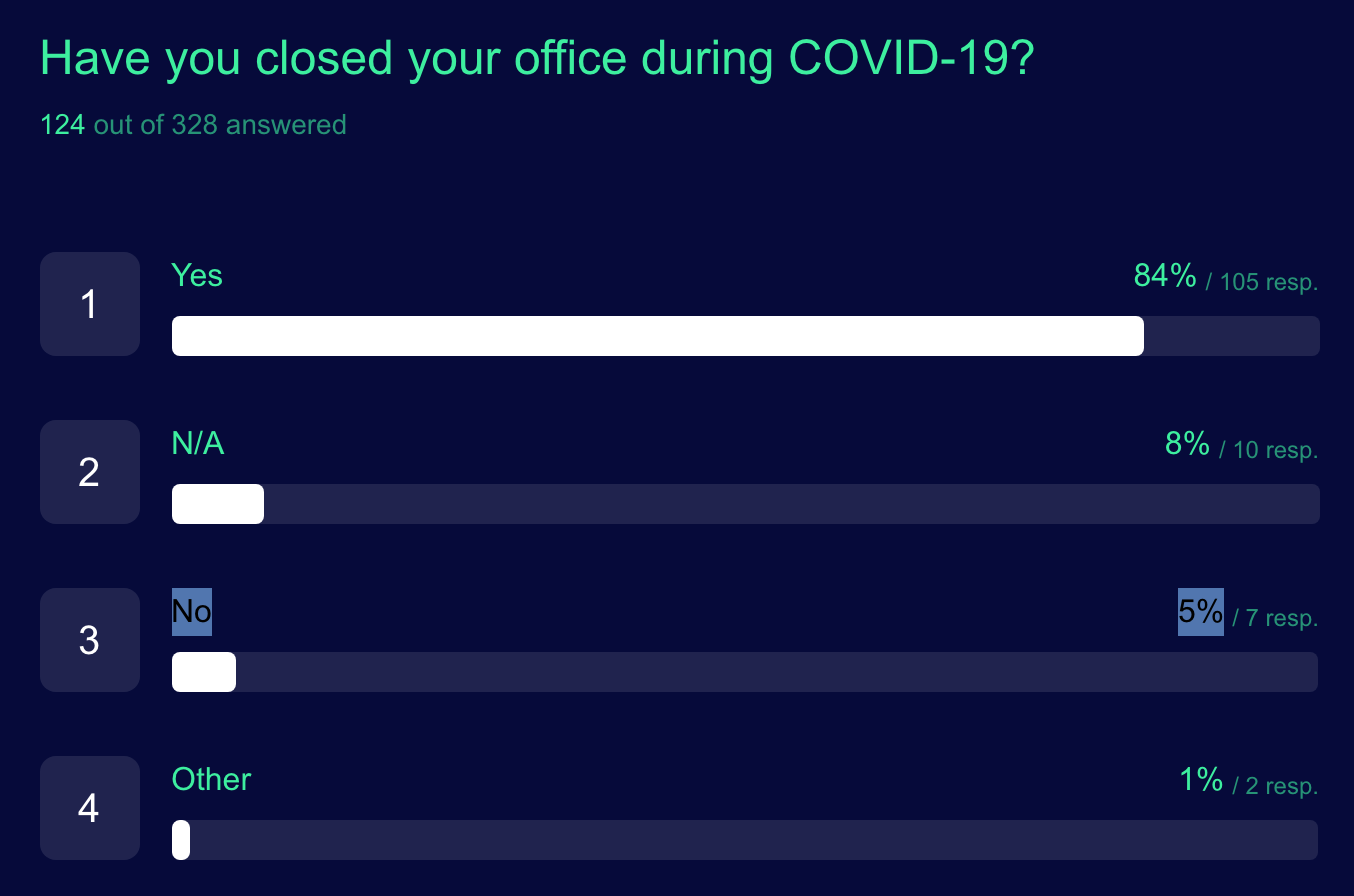
Of the 349 that answered the survey 84% said they had closed their office during the COVID-19 pandemic; 5% said they had not; and 8% said it was not applicable (i.e. no office to close). The majority of those answering were at Seed or Pre-seed stage, with a minority past Series A stage.
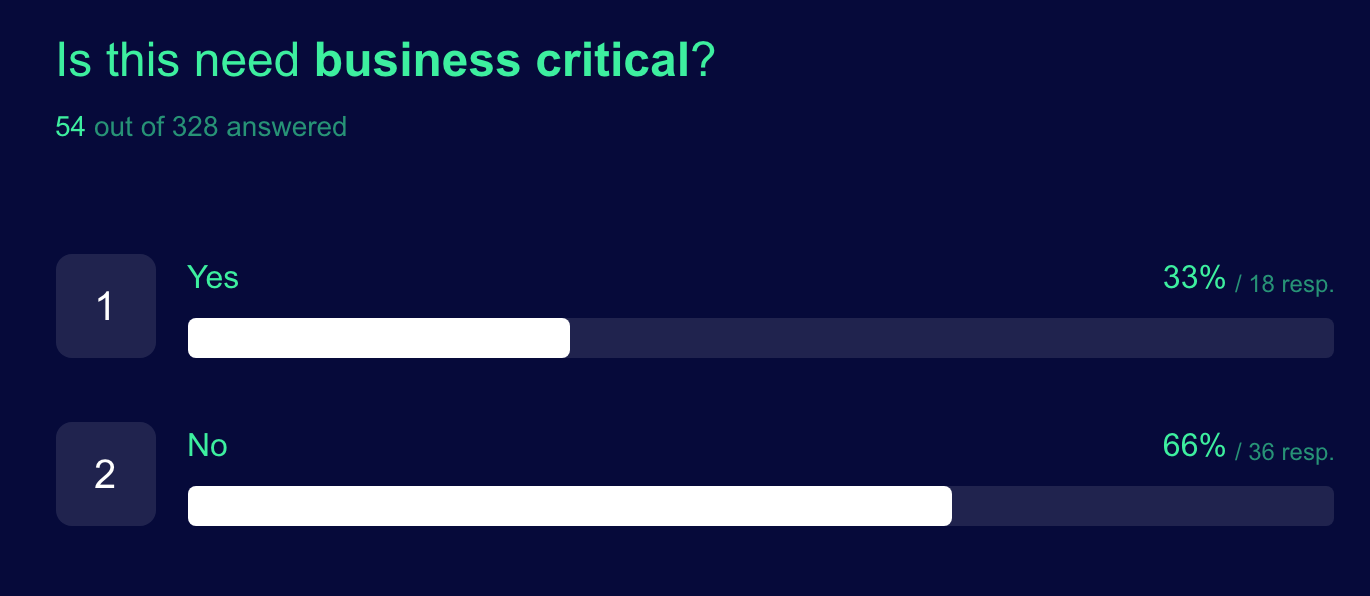
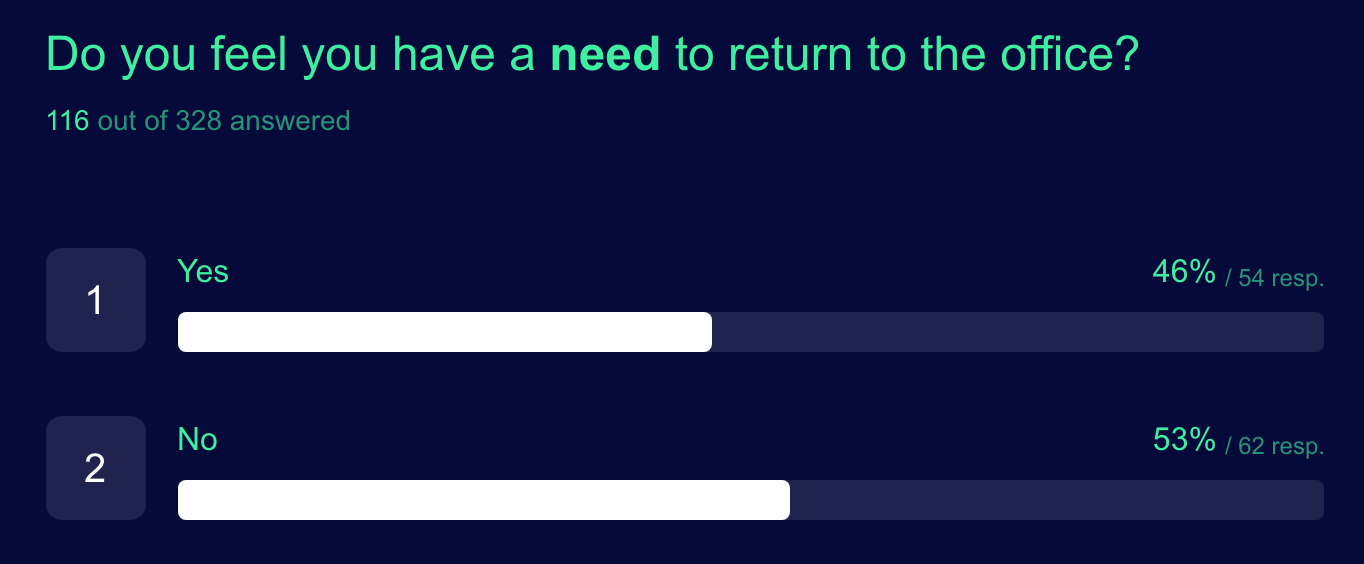
Crucially, a clear majority of respondents (66%) said the need to return to the office was not ‘business critical’, while 33% thought it was. Right now, startups are closely divided over feeling the need to return to the office, with 46% saying they did feel a need, while 53% said they did not.
The survey was launched by TechCrunch and UK non-profit Founders Forum in order to assess how startups will work in the future, in the wake of the global COVID-19 pandemic’s impact on office working and the shift to ‘Work From Home’ policies. Of the 349 answers, 61% were from the UK, 20% from the US, and the rest from other countries.

“Missing the power of face to face problem solving and building teams”

Founders Forum’s Brent Hoberman, who initiated the study, commented on the results: “The results prove both that early-stage tech founders are adaptable and that entrepreneurship is one of the best-suited professions to remote work. The majority of early-stage founders haven’t seen productivity take a hit during this period, but it remains to be seen what happens to creative output, team culture and training over the longer term. Furthermore, there are clearly opportunities for new types of even more flexible shared social workspaces with a vast majority of those surveyed still seeing value in face-to-face interaction.”

Remote working ups productivity, but impacts culture
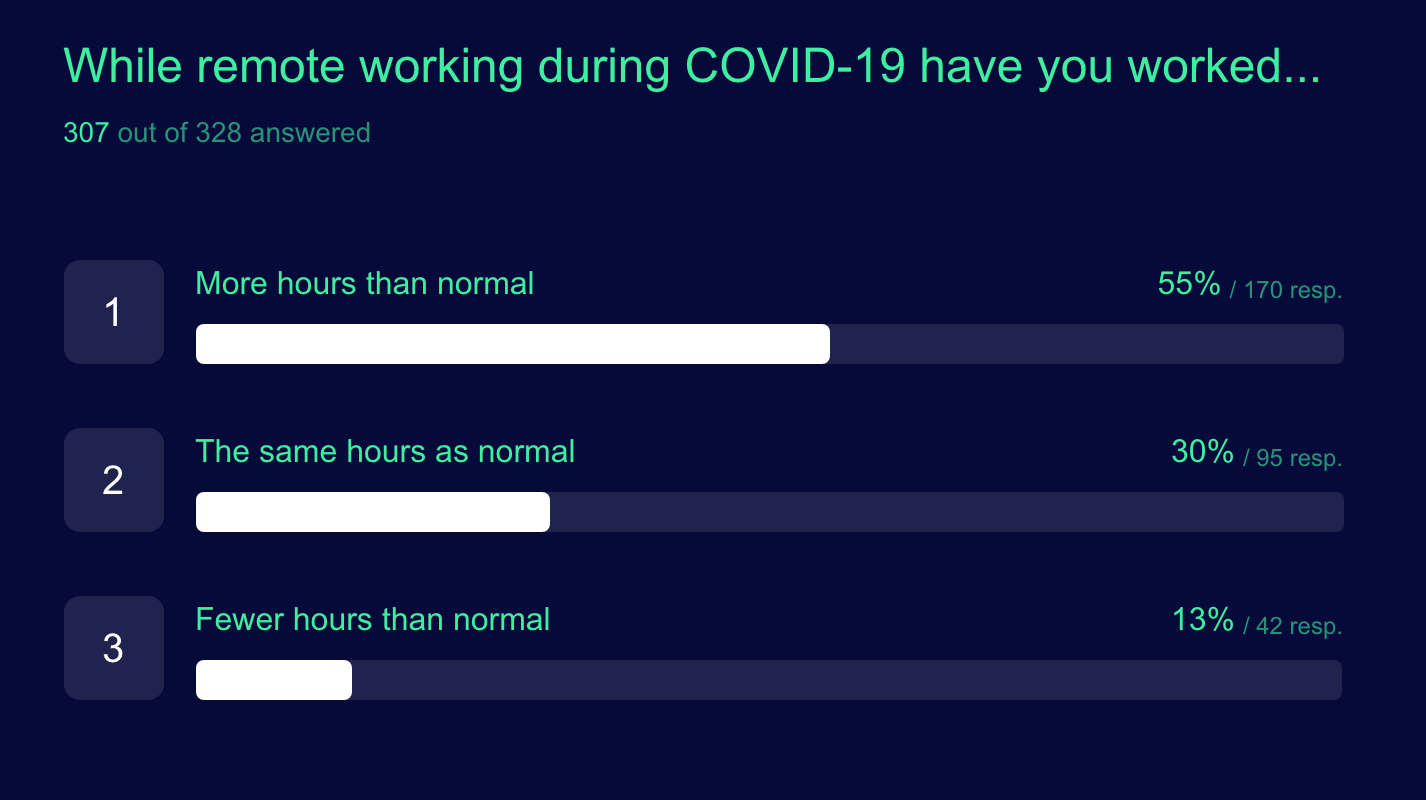
Remote working during COVID-19 appears not to have impacted output, with 55% of startups saying they had worked more than normal; 30% the same hours, and 13% fewer hours.
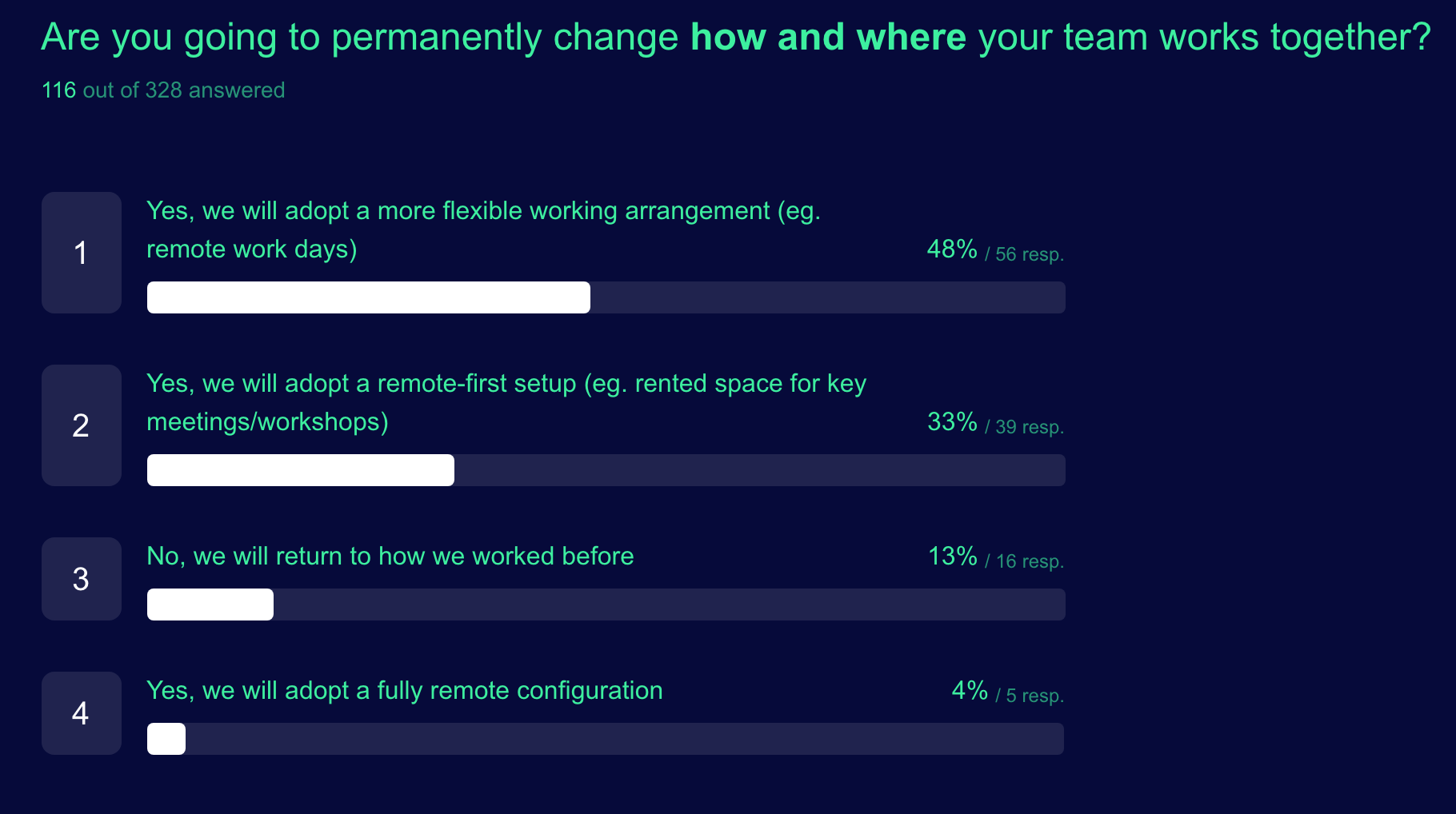
In answer to the question: “Are you going to permanently change how and where your team works together?”: 48% said they would adopt a more flexible working arrangement (e.g. remote work days); 33% will adopt a remote-first setup (e.g. rented space for key meetings/workshops); 13% plan a normal return to work; and just 4% will adopt a fully remote configuration.
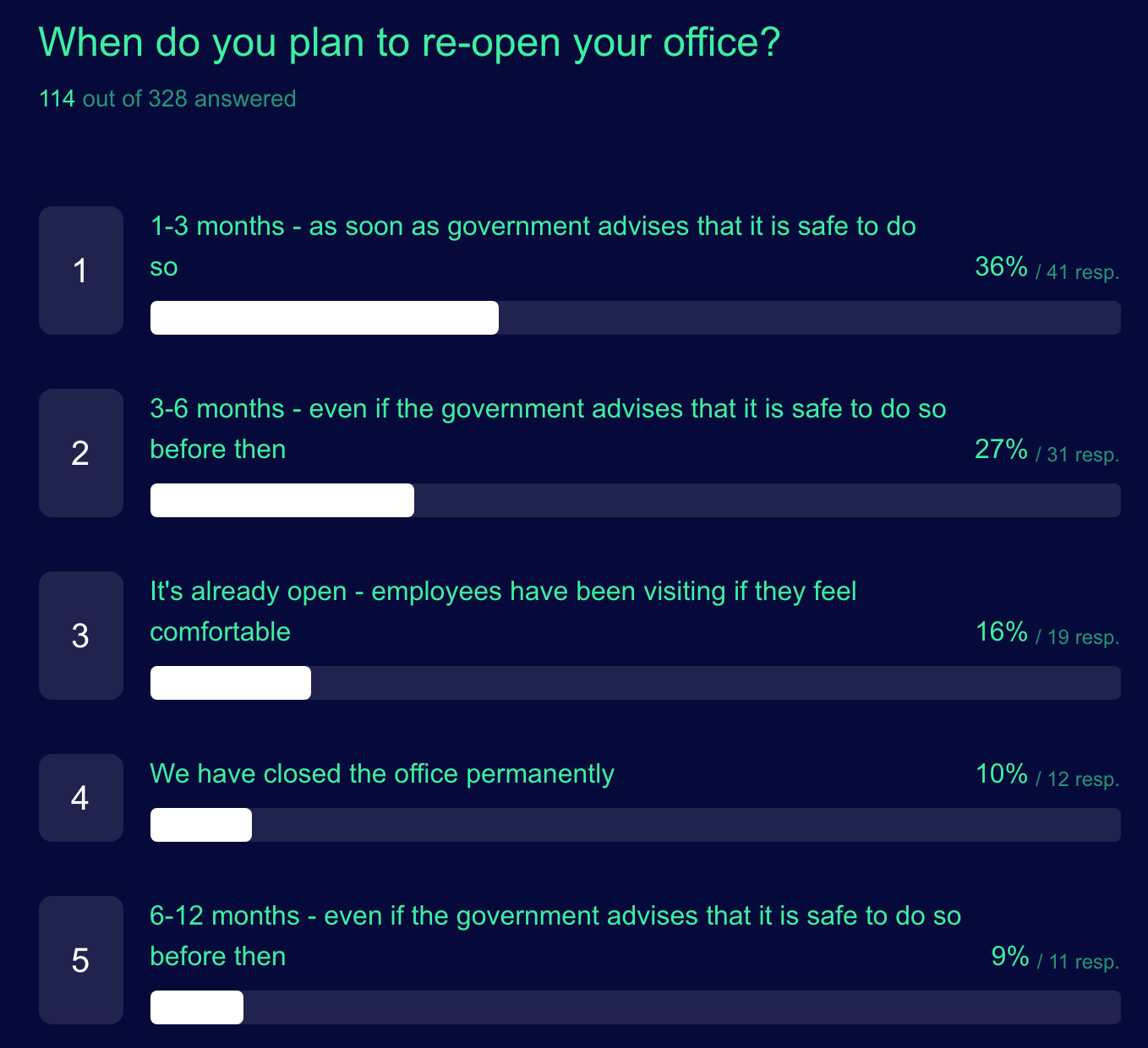
In terms of plans to re-open offices, 36% planned to re-open in 1-3 months “as soon as government advises that it is safe to do so”; 27% in 3-6 months “even if the government advises that it is safe to do so before then”; 16% answered “It’s already open – employees have been visiting if they feel comfortable”; 10% said “We have closed the office permanently”; and 9% said they planned to re-open in 6-12 months “even if the government advises that it is safe to do so before then”.
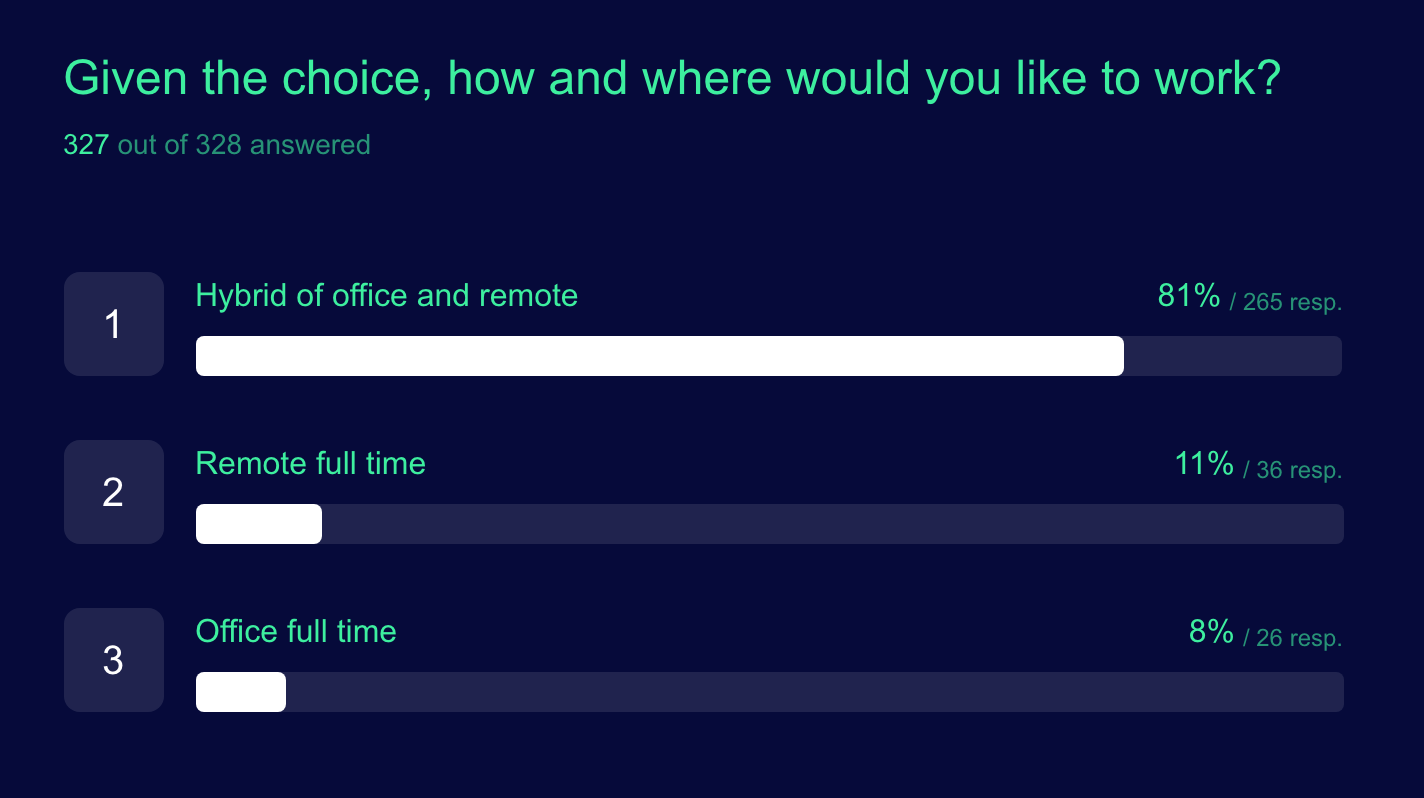
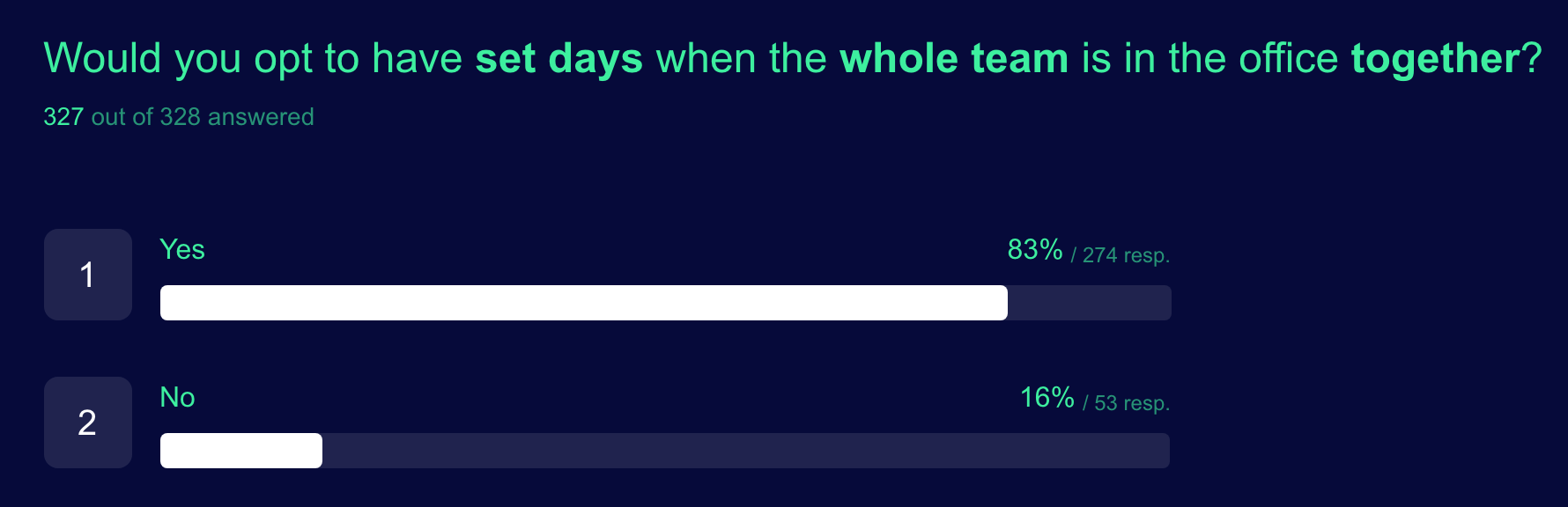
Given a full choice in the matter, 81% of those surveyed said they would prefer a hybrid of office and remote work, with only 11% wanting to go remote full time and 8% returning to an office full time. And 83% wanted to have set days when the whole team is in the office together.
Commenting on why they thought re-opening an office – in some form – was business-critical, comments from respondents included:

• “My employees are looking to return to work given wanting space from home confinement”

• “Need for top management sessions where in-person is much more productive than remote video calls”

• “Missing the power of face to face problem solving and building teams”

• “Ability to support early-career employees and bring on new ones”

• “I believe either fully remote or fully in-person setups are effective. A halfway house is ineffective.”

• “Too difficult to achieve the cross-pollination and high-velocity communication needed at our early stage.”

• “Culture. Younger team members can’t work from home all the time (shared accommodation). Some parents need the office to focus”

• “We’re a biotech company and need to work from our labs”

• “We do order fulfillment from our warehouse.”

• “Team members ask for it as they cannot stand anymore working alone in their apartment”
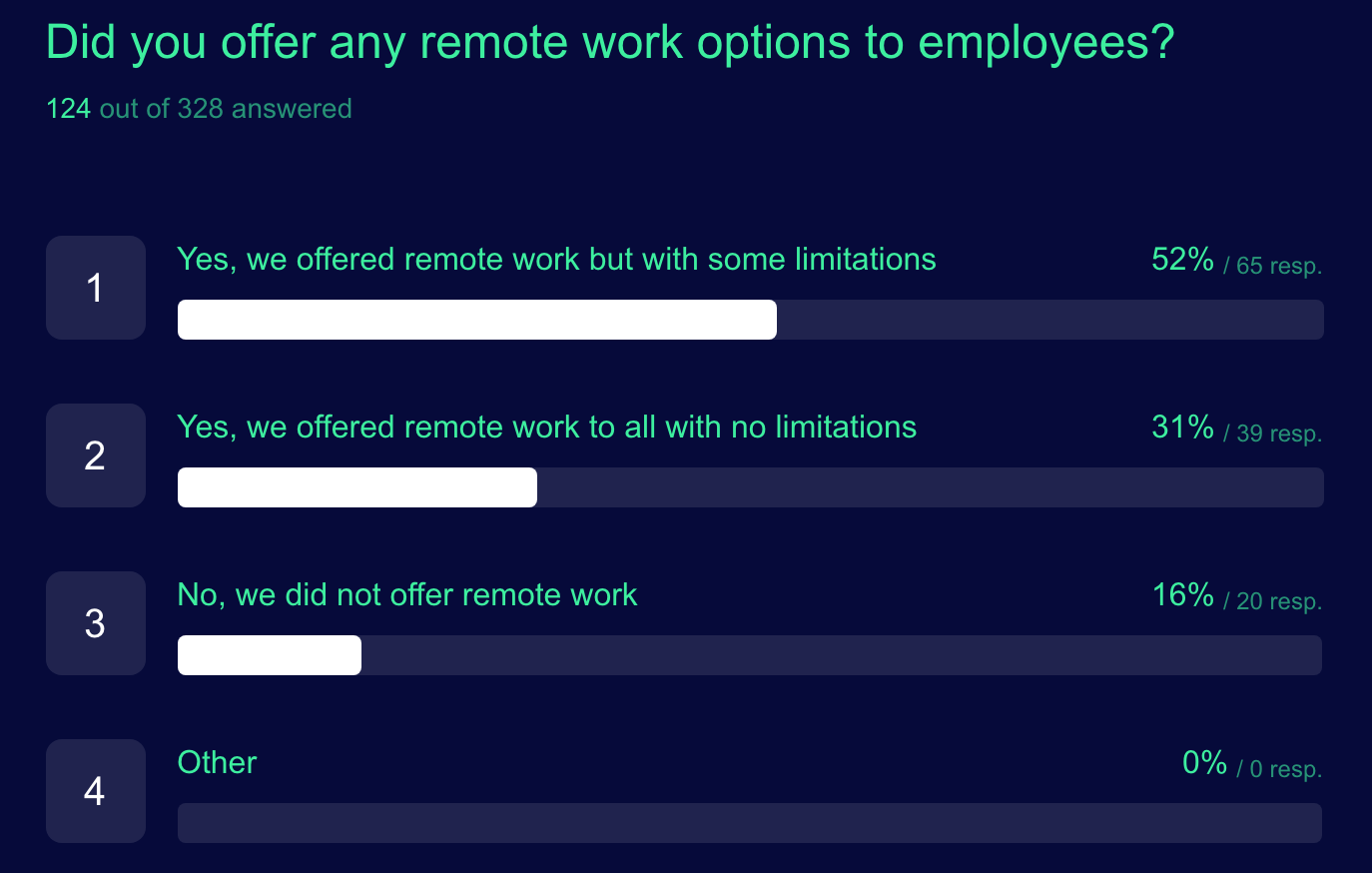
Most startups are offering remote work options either to ‘some’ employees (52%) or to all employees (31%). Some 16% offered no remote working at all, especially in areas like BioTech where remote working from a lab is not possible.
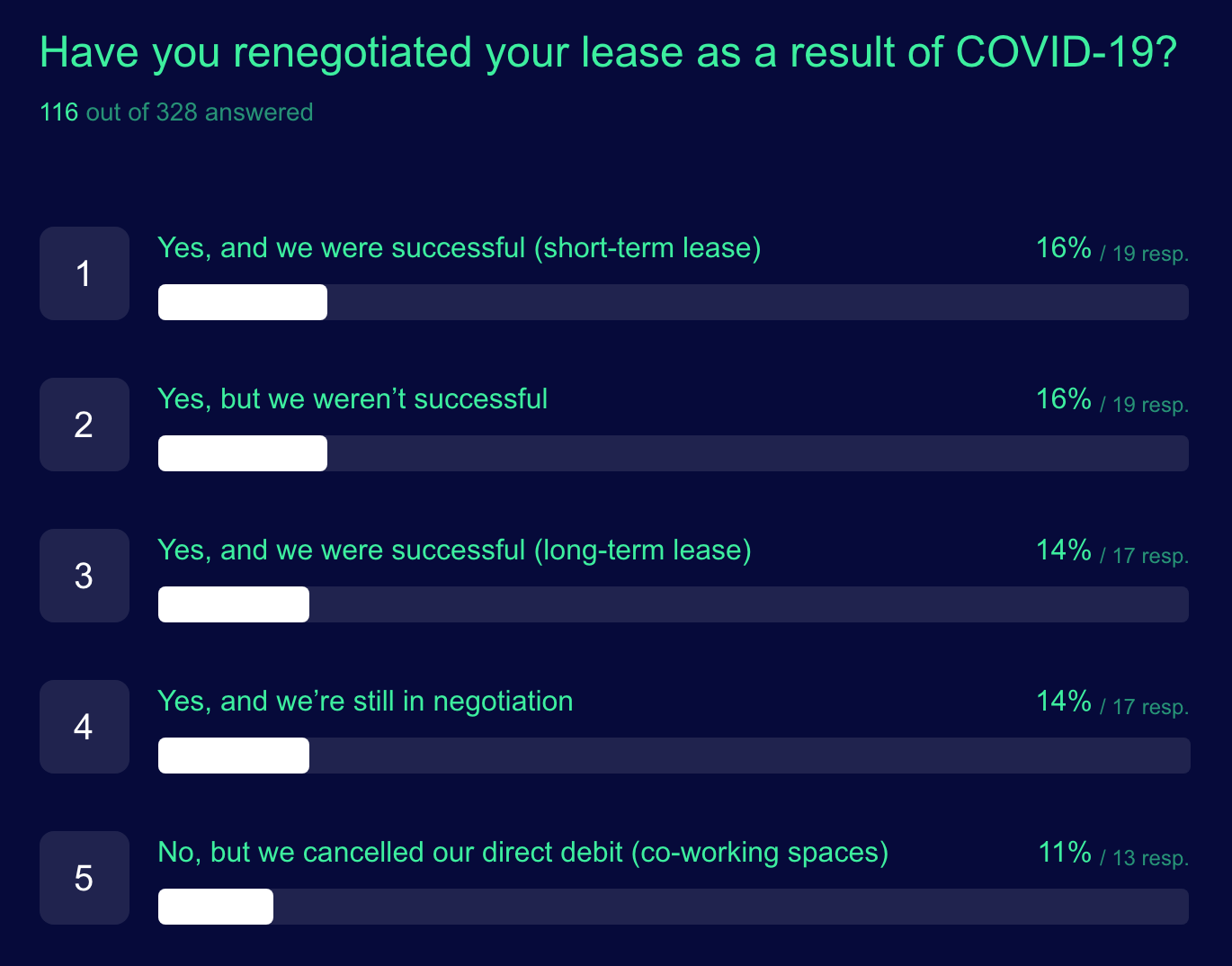
Office spaces still adapting
There were mixed results when startups were asked if they had renegotiated their lease as a result of COVID-19, with 16% of those on a short lease saying they had and were successful, but 16% saying they had, but had not been able to renegotiate. Some 14% on a long lease were successful in the renegotiation, 14% said they were still in negotiation and 11% had canceled the membership of their co-working space.
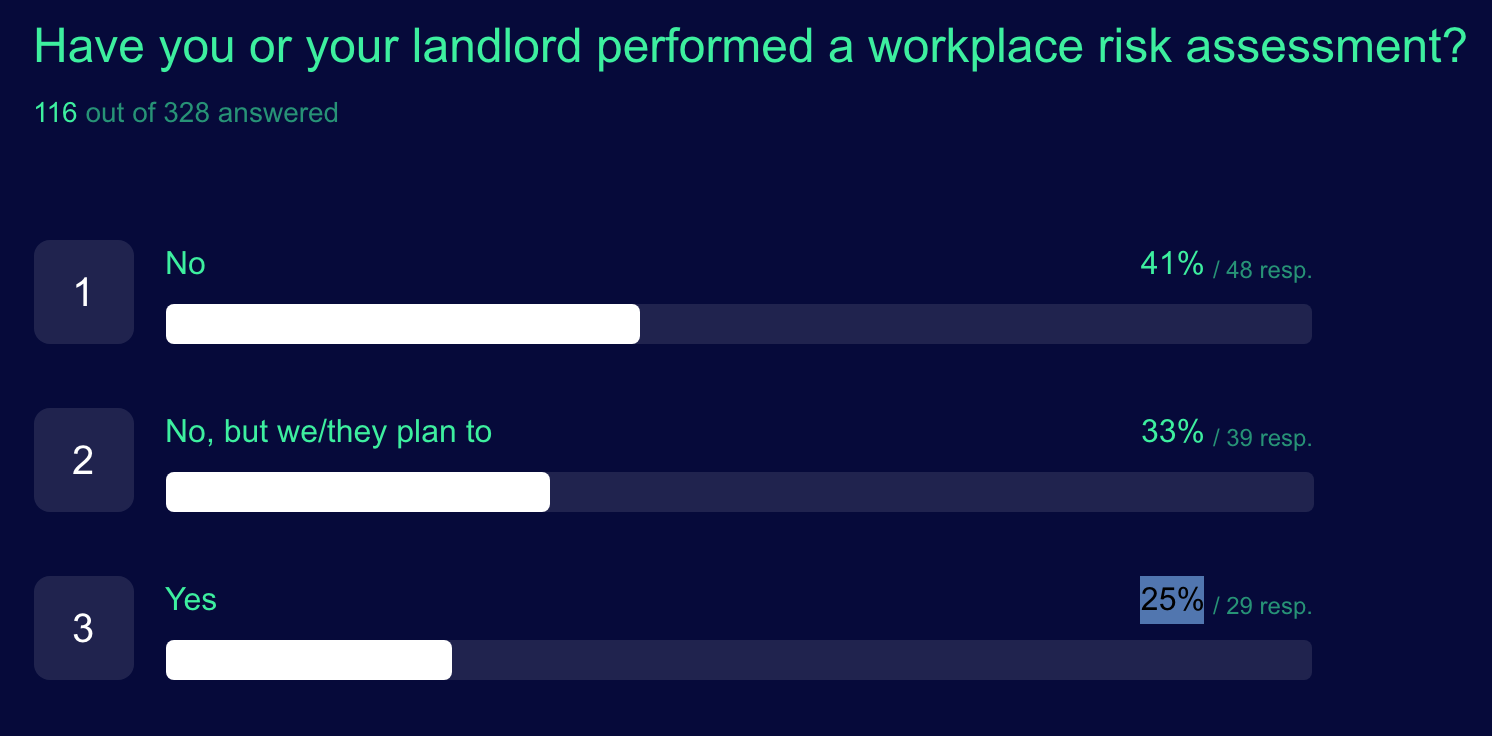
Some 41% of startups or their landlords had not performed a workplace risk assessment, 25% had, while 33% still planned to.
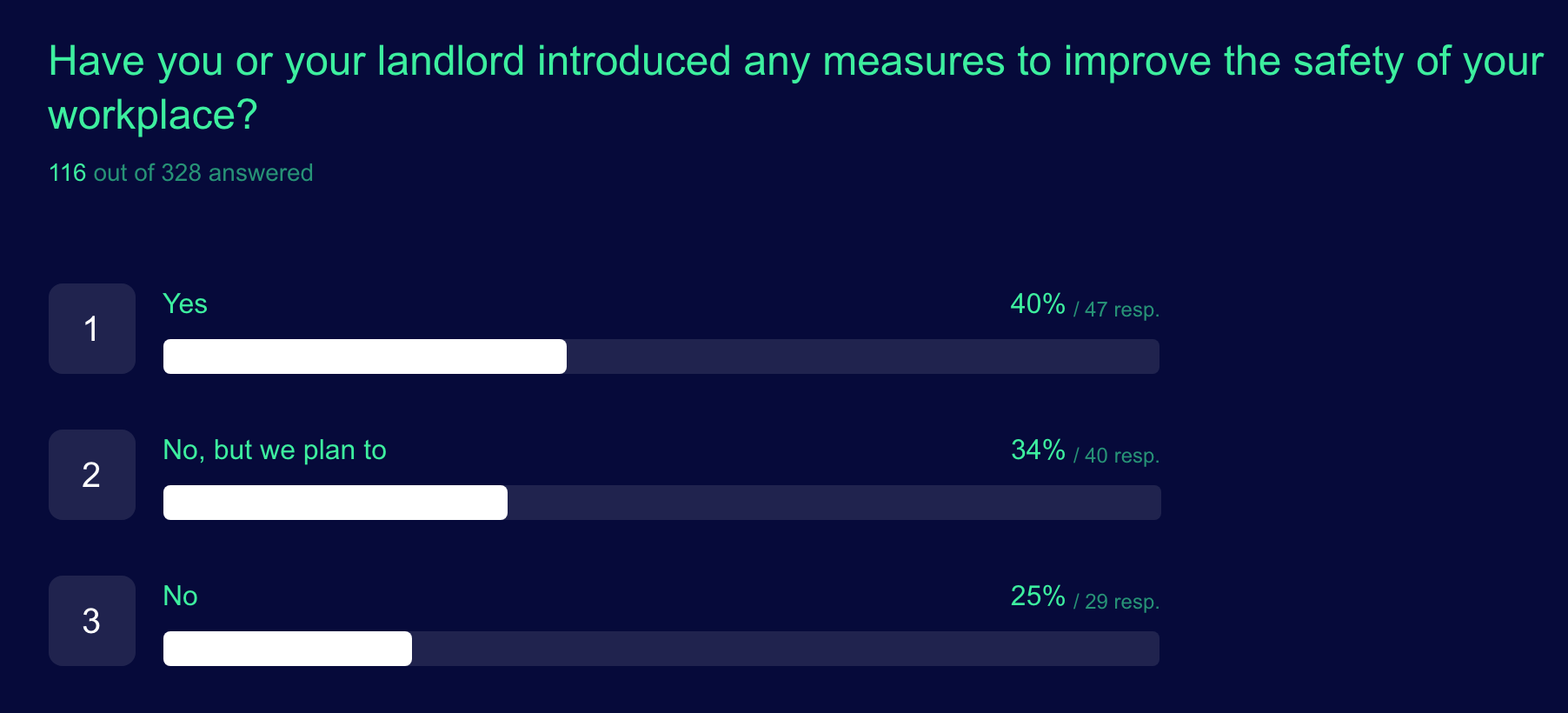
Offices appear to be responding well, with either 40% having already introduced measures to improve the safety of workplaces or 34% planning to, while 25% had not, probably because they do not have an office or use co-working spaces.
Most people (58%) said they felt the work they perform remotely is “trusted and respected equally to the work I perform in the workplace”. Most (50%) said their home setup was “ok, but not ideal.”

WFH impacts working practices
When asked “What remote productivity tools or processes have become your secret weapon during COVID-19?” notable answers included:

• Miro, trello, zoom, Asana, Airtable, Slack, Microsoft Teams (among many others)

• “Two screens.”

• “Dedicated office space at home”

• “Routine. Shutting off at 5.30pm and going for a run/walk”

• “Saying hello and prioritizing chit chat on video calls every time, even though we all have work to do, observing social graciousness remotely is even more important. “

• “Company instituted “Summer Fridays” urging to not work after 1pm on Fridays – less pressure to be “always-on””

• “Being able to step away and recharge through engaging with the family when needed during the day.”

• “Old school phone calls”
Mental health impact 
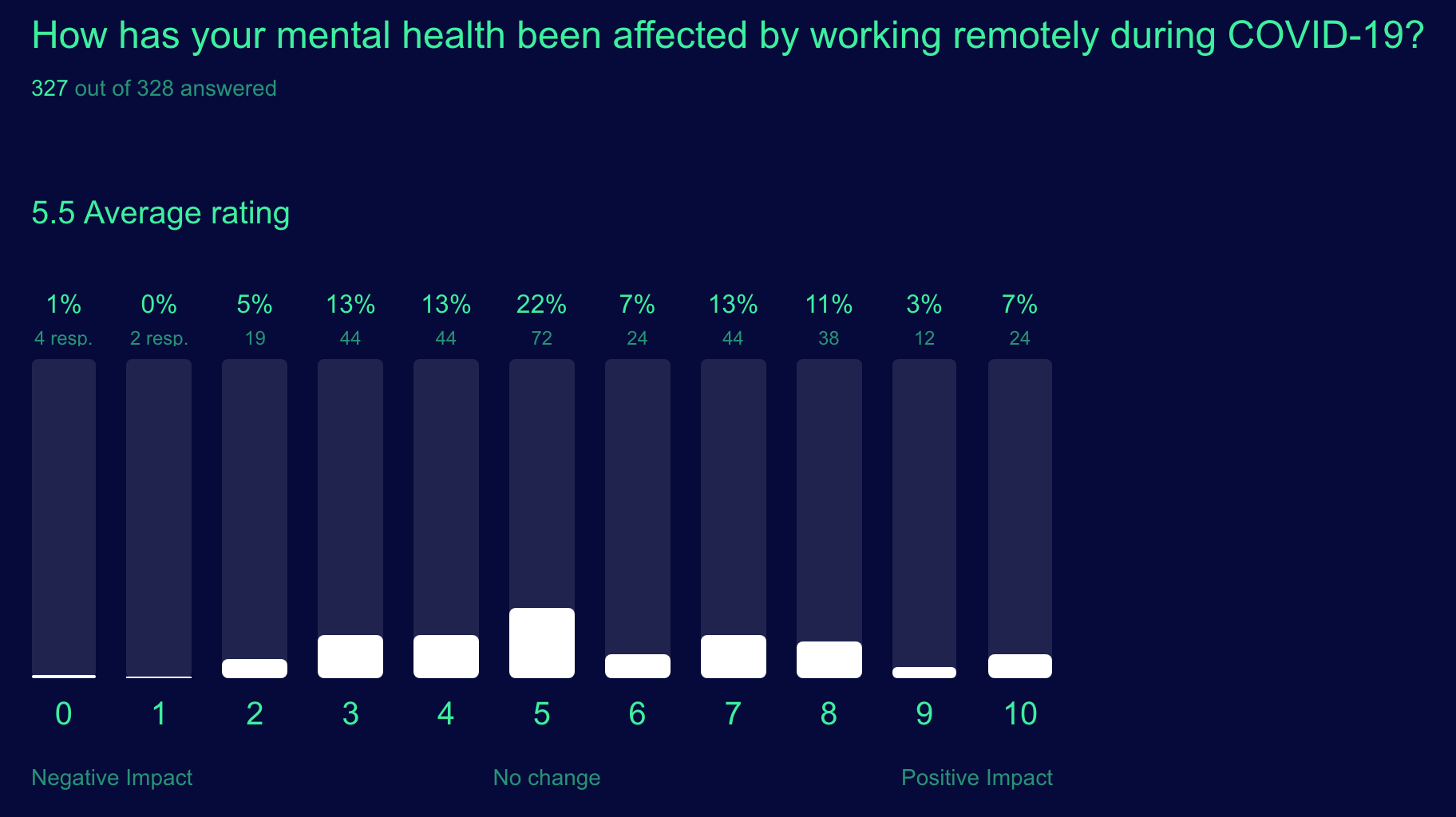
Almost 80% said there had been no significant change to their mental health as a result of working remotely during COVID-19, with a slim number experiencing either a negative impact or positive.


29 Jun 2020

Facebook expands its fan subscription program

Facebook is expanding the availability of the tools it offers to help game streamers and other online creators make money.

The social network first launched fan subscriptions in early 2018, giving a small group of creators in the United States and the United Kingdom the ability to charge their fans a $4.99 monthly fee for exclusive content and a fan badge for their profiles.

Participation in the subscription program was limited until today. In a blog post, Facebook now says that any creator in Australia, Brazil, Canada, Mexico, Thailand, United Kingdom and United States that meets the subscription eligibility criteria (having 10,000 followers or more than 250 return viewers, and either 50,000 post engagements or 180,000 watch minutes in the last 60 days, as well as abiding by Facebook’s general monetization policies) should be able to sign up to participate.

The company monetizes these subscriptions by taking up to 30% of subscription revenue. (It only collects revenue on subscribers acquired after January 1, 2020.)

Facebook subscriptions

Image Credits: Facebook

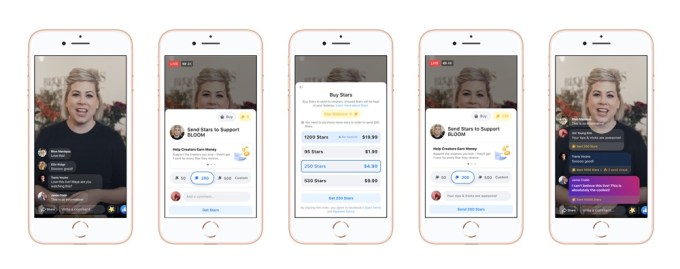
Facebook is also expanding the availability of Stars, a virtual currency that fans can use to tip their favorite creators. Creators in Australia, Canada, Columbia, India, Indonesia, Italy, Spain, Germany, France, Malaysia, Mexico, New Zealand, Peru, Philippines, Taiwan, Thailand, United Kingdom and the United States can now participate.

“We’re seeing the traditional notion of a creator evolve as comedians, artists, fitness instructors, athletes, small businesses and sports organizations use video and online events to connect with their audience,” wrote Product Marketing Director Yoav Arnstein, Product Marketing Director and Head of Creator & Publisher Experience Jeff Birkeland. “To better support our partners, we’re improving the tools that help creators earn money and manage their presence on Facebook.”

Beyond subscriptions and virtual currencies, the company says it’s giving creators new ways to make money through advertising, including image and post-roll ads in short-form videos (60 to 180 seconds), as well as ads in live videos.

Lastly, Facebook says it’s improving the Creator Studio tool with features like Comment Insights (which show how comments on posts can affect engagement and audience size) and the ability to log in using Instagram credentials.