
Year: 2020

25 Jun 2020

Candidate Labs wants to be modern talent agency for techies

In the first few minutes of pitching his new company, Candidate Labs, Jonathan Downey admitted that he’s operating in a market that is “done to death”: recruitment technology. But Downey, whose previous startup Airware shut down after burning $118 million, remains optimistic because of a little company named Zoom.

“There were lots and lots of videoconferencing companies and yet everybody’s experience was really bad,” he said. “It just took [Zoom] coming along and getting just a few more things right that totally transformed” videoconferencing.

Zoom lesson in mind, Candidate Labs launched today as a modern talent agency, after operating in stealth for the past seven months. The company also announced today that it has raised $5 million in seed funding. Investors in the round include SignalFire, Leah Solivan of Fuel Capital, BoxGroup, Lattice CEO Jack Altman and the founders of Opendoor, Eric Wu and Ian Wong.

Candidate Labs connects a data platform with 100 million professionals to its database of 60,000 jobs. Then it creates short lists of talent recommendations that clients can then screen and interview.

Jonathan Downey, CEO and co-founder of Candidate Labs (Image Credits: Candidate Labs)

Its competitive edge is not in its access to data, but rather the technology it lays atop it. Downey said that Candidate Labs uses “human in the loop” machine learning, similar to Stitch Fix, which combines data and human judgement to better recommend style guides.

Candidate Labs leverages a big data set to get a product that is quality, not quantity. Using machine learning, Candidate Labs might extract a 25-person candidate list to help companies fill a singular role. Then a seasoned recruiter will look over the list to see the quality of the candidates, pull in personal judgement and create a final list. Once a client sees the list, Candidate Labs will see who it chooses to interview and then digest that feedback. Over time, humans and machines will get better at recommendations.

In an industry like recruitment, which has a lot of messy and unstructured data, human in the loop machine learning makes sense. There needs to be a two-pronged approach to hiring people, one that speeds up the bits that are purely logistical, but gives room for humans to make a correction if needed.

Candidate Labs’ big sell is that it connects sales and marketing professionals to jobs at a fraction of the time of normal recruitment tools. In over half of cases to date, Candidate Labs has introduced employers to candidates that are eventually hired within seven days. More than 50% of the talent it has placed has been diverse talent, according to Downey.

Leah Solivan, a general partner of Fuel Capital, invested in Candidate Labs in mid-2019 and said Candidate Labs’ launch compass is at a “critical inflection point for talent within the startup ecosystem.”

“During the best of times, candidates tend to rely largely on limited insights and a handful of network referrals to make a critical life decision with long-term consequences,” she said. “Their next role.”

Downey is a customer of his COO and co-founder, Michael Zhang, who founded custom menswear service Trumaker .

“Candidate Labs is a recruiting firm that we wish we had been able to work with in building our own companies,” Downey said.

Along with the financing, Candidate Labs is announcing a job search tool. Sales and marketing professionals, among the most impacted by pandemic-related job losses, can use search filters to look for job openings. In early April, a ton of new tools were launched to help support those without jobs secure their next gig.
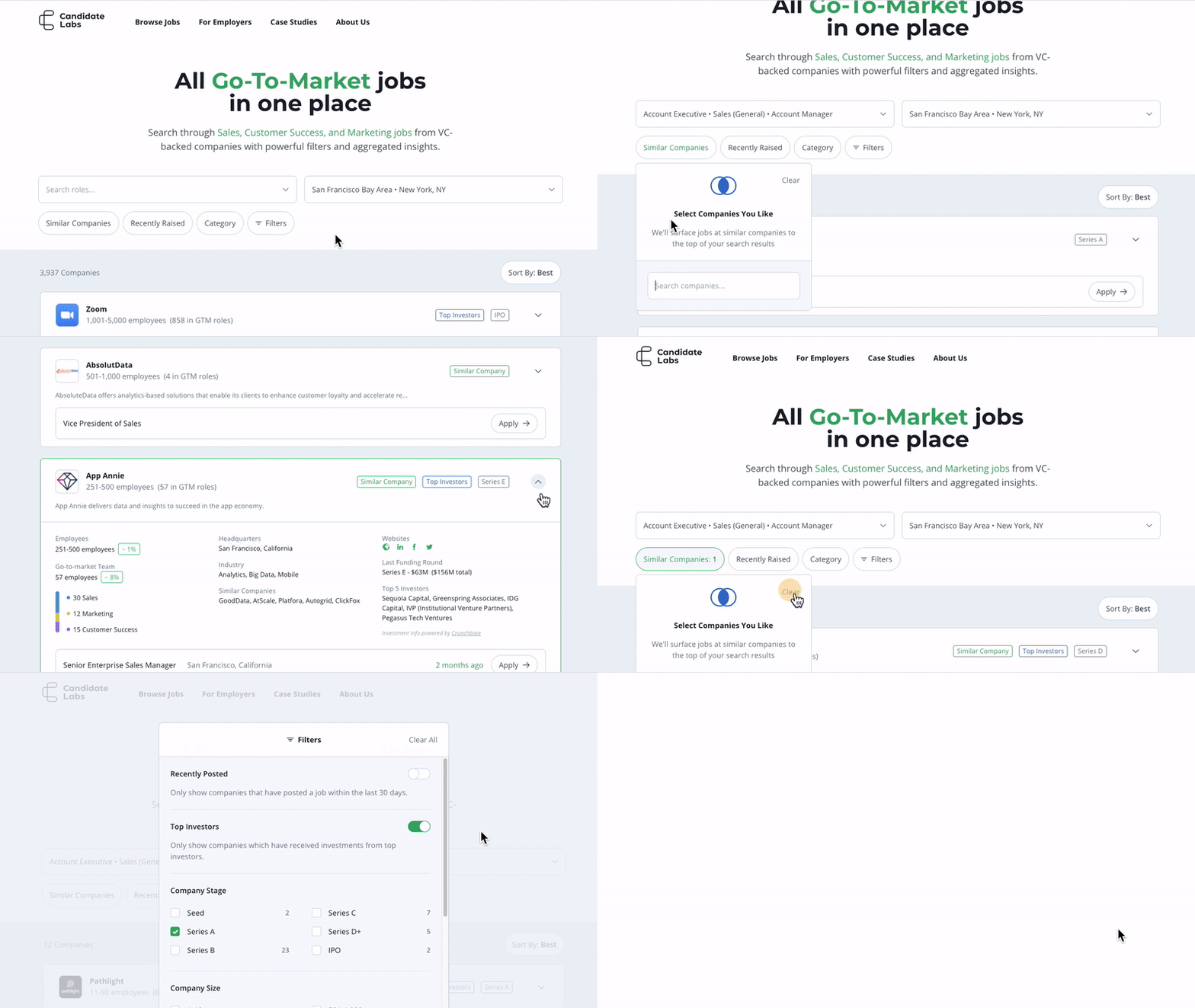
 

According to Downey, the tool will help Candidate Labs work directly with people within what is now a saturated job market.

25 Jun 2020

SevenRooms raises $50M to double down on reservations, ordering and other tools for hospitality businesses

Restaurants, hotels and other public venues where we spend leisure and business time have started to reopen in many parts of the world after a period of going dark to try to slow down the spread of the coronavirus pandemic. Now, a startup called SevenRooms, which builds software to help those venues with their guest management is announcing a growth round of $50 million — to double down on providing tools for venues that now have to handle a whole new layer of management to implement social distancing and more.

The funding, a Series B, is coming from a single investor, Providence Strategic Growth, the company tells me. SevenRooms has some notable backers on its cap table already: Amazon (who invested via its Alexa Fund and directly), Comcast (via Comcast Ventures) and BoxGroup, along with a number of individuals.

The company has now raised about $75 million in total and it’s not disclosing its valuation, but CEO Joel Montaniel (who co-founded the company with Allison Page, CPO; and Kinesh Patel, CTO) said in an interview that it’s a significant upround. (PitchBook estimates that its previous valuation was a modest $28 million.)

SevenRooms serves restaurants, hotels and other venues, although food service establishments account for about 95% of its business in terms of customers and revenues. Another new opportunity has emerged out of the need for a lot of other in-person venues, like shops, needing to consider how to implement reservations to help with social distancing.

Today, it counts a number of large chains, including 70% of the restaurants along the Las Vegas Strip (because MGM is a customer), among its users. In all some 500 million bookings globally have been made through its software since it was founded in 2011, and other customers include Bloomin’ Brands, Mandarin Oriental Hotel Group, Wolfgang Puck, Michael Mina, D&D London, Corbin & King, Jumeirah Group, Black Sheep Restaurants, Zuma, and Topgolf.

Montaniel described the last three months of business as something like a “tale of two cities” — a reference to the Charles Dickens novel, which starts out with the famous line, “It was the best of times, it was the worst of times…”

In the context of SevenRooms, that has played out as a big drop in its mainstay business, which was focused around reservations, customer loyalty and other services sold as white label services directly to the venues (or the operators, as Montaniel calls them) who in turn customised them for their customers, and created experiences across multiple platforms, including their own sites and apps, as well as Google Maps.

“It’s been really tough to see the industry go through the pandemic,” he said. “A lot of operators closed doors overnight. It created a lot of challenges for businesses.”

On the other side of the issue, necessity has been the mother of invention for SevenRooms and its customers. The company has built out a new tool for letting its customers take online orders for delivery — something it had been planning to launch later in the year but decided to launch earlier, given the state of things. It’s sold with a licensing fee, with no commission to SevenRooms, and links in with SevenRooms’ marketing and loyalty tools, and it has done well, so much so that Montaniel said it and the longer-term customer relationships it’s building offset the drop in its other business.

“Delivery and pickup grew like crazy,” Montaniel said. And like some of the other “digital transformation” we’ve seen where retailers have accelerated their e-commerce strategies simply to stay in business, he believes that the switches and packages they we were proud to generate tens of thousands per month of savings. 

There are a lot of companies that have built out tools to serve the hospitality industry, and specifically to help with bookings, with some of the bigger names including OpenTable and Yelp. Montaniel believes that SevenRooms stands out because of its focus primarily on its operators, rather than providing a business in being the interface between operators and their customers, and on how it views its role in not just helping perform functions but expanding the wider business, by way of data that it can use to help grow customer loyalty and help people who are regulars feel like it.

There remain a lot of potential competitors who are also sometimes partners. Google, and Google Maps, is perhaps the most obvious, although these days Montaniel says Google Maps and the entry point it gives to discovering restaurants is a great boost to its business.

“Google is a company that every company in the world thinks about and talks about in their strategy sessions,” he said. “But there are others too. Big companies always can be competition: they do so many things so well, and they are a team away and a cash infusion away from competing with you, and those who don’t think they are are rivals are not thinking big enough.”

All the same, there are also two potential allies in SevenRooms’ corner that make this bet a little more interesting.

Amazon’s Alexa Fund is about strategic investments: SevenRooms used the backing to build out an Alexa integration into its white-label tools. But there are other ways in which that connection might potentially develop. The company has dabbled in travel services (including bookings) in the past, via Amazon Destinations, and although that was short-lived, the company continues to serve a number of hospitality and travel businesses via AWS, and frankly you can’t really count Amazon out of any vertical with an online component, which is to say, you can’t really count Amazon out of any vertical at all.

Meanwhile, Comcast has been making a number of investments into the kinds of services that it could potentially resell as part of larger business connectivity packages, which includes a focus on local businesses, spelling out another opportunity for how SevenRooms might expand.

Interestingly, SevenRooms is already close to profitability, and it didn’t need this funding — in contrast to a lot of other startups that have found it hard to make ends meet in these difficult months. Montaniel said that it raised because it had a list of “seven things we wanted to do, and without the extra cash we could only do three of them,” without elaborating on what those product features will be.

It’s a big area, though, and now that so much activity has been cut off for so many of us, we’re only now starting to realise how critical it can be, one reason why investors were interested.

“SevenRooms is a category-defining company that provides a vital solution to hospitality operators worldwide,” said Adam Marcus, Managing Director at PSG. “Joel and the talented SevenRooms management team have built the only vertically-integrated solution in the hospitality industry, which has enabled them to scale into a global powerhouse. SevenRooms is uniquely positioned, and we are excited to partner with the team to support their next phase of growth.”

25 Jun 2020

Partners at Sequoia, GGV, General Catalyst and Greylock join Valence’s VC initiative for Black founders

The new, Los Angeles-based online professional network for Black talent, Valence, has launched a new initiative called the Valence Funding Network to link Black entrepreneurs with top partners at firms including Accel, Sequoia, GGV, First Round Capital, Bessemer Ventures, Greylock, Upfrton Ventures, and Collab Capital.

“For years, Black entrepreneurs have been told that Silicon Valley is a meritocracy, but at the same time most haven’t had access to the top networks, the warm introductions, and the mentorship that underpin lasting success in tech. Valence is upending this completely by bringing the top VCs to compete for the best Black entrepreneurs.”  said Valence co-founder, Kobie Fuller, who also works as a general partner at Upfront Ventures. “We want to even the playing field with the goal of exponentially growing the number of Black-owned startups that get funded.”

Founded in November 2019, Valence is a still-small professional network that provides opportunities for Black entrepreneurs and professionals to connect with peers and mentors. So far, the company has a user base of around eight thousand members, but is growing rapidly, according to Fuller.

That growth may be boosted by the new initiative with investors. Through the Valence Funding Network Black founders and would-be founders have the opportunity to receive direct pitch coaching and mentorship from general partners and partners at some of the nation’s top venture firms. In all, the 26 firms who have committed to working with the Funding Network represent over $60 billion in assets under management.

Some of the participating firms and investors include:

  • 645 Ventures — Nnamdi Okike
  • Accel — Rich Wong
  • Base10 — Ade Ajao
  • Bessemer — Elliott Robinson
  • Capital G — Gene Frantz
  • Collab Capital — Jewel Burks
  • Concrete Rose — Sean Mendy
  • Defy Partners — Neil Sequiera
  • Equal Ventures — Richard Kerby
  • First Round — Josh Kopelman
  • Forerunner — Brian O’Malley
  • Foundry — Brad Feld
  • General Catalyst — Peter Boyce
  • GGV — Hans Tung
  • Greylock — Sarah Guo
  • High Alpha — Scott Dorsey
  • Lightspeed — Mercedes Bent
  • Lux — Deena Shakir
  • Outlander — Paige Craig
  • Precursor — Charles Hudson
  • Redpoint — Annie Kadavy
  • Sequoia — Jess Lee
  • Sinai Ventures — Jordan Fudge
  • Spark Capital — Nabeel Hyatt
  • Techsquare Labs — Paul Judge
  • Union Square — Rebecca Kaden
  • Upfront — Kobie Fuller

As Valence noted in a press release, Black founders have been historically disenfranchised by the venture capital community. Only 1 percent of venture-funded startup founders are Black and the company believes that this underrepresentation contributes to America’s racial wealth gap, which sees roughly 13 percent of the United States population, holding less than 3 percent of the nation’s total wealth. It’s Valence’s mission to change this that statistic. 

Along with its new venture capital initiative, the company has also named a new chief executive officer, Guy Primus, the former chief executive of the Virtual Reality Company, an LA-based VR production studio. Primus also serves on the board of trustees of Southern California Public Radio, where he leads the strategic planning committee and is past chairman of the advisory board at Georgia Tech’s top-ranked school of Industrial and systems engineering. 

“Facilitating success in the innovation economy is key to Valence’s mission. By creating the Valence Funding Network, we are eliminating one of the most formidable structural obstacles to success—the access to venture investors.” said Guy Primus, Valence’s new CEO. “Our mission has come into focus even more clearly. This moment in America is an urgent one and I feel called to help bring the Valence mission to life. 2020 has showcased how important it is for Black professionals to have as many financial and professional resources as possible. 

25 Jun 2020

Zoom founder and CEO Eric Yuan will speak at Disrupt 2020

The coronavirus pandemic has bruised and battered many technology startups, but it has also boosted a small few. One such company is Zoom, which has shouldered the task of keeping us connected to one another in the midst of remote work and social distancing.

So, of course, we’re absolutely thrilled to have the chance to chat with Zoom founder and CEO Eric Yuan at Disrupt 2020 online.

Yuan moved to Silicon Valley in 1997 after being rejected for a work visa nine times. He got a job at WebEx and, upon the company’s acquisition by Cisco, became VP of Engineering at the company. He pitched an idea for a mobile-friendly video conferencing system that was rejected by his higher-ups.

And thus, Zoom was born.

Zoom launched in 2011 and quickly became one of the biggest teleconferencing platforms in the world, competing with the likes of Google and Cisco. The company has investors like Emergence, Horizon Ventures, and Sequoia, and ultimately filed to go public in 2019.

With some of the most reliable video conferencing software on the market, a tiered pricing structure that’s friendly to average users and massive enterprises alike, and a lively ecosystem of apps and bots on the Zoom App Marketplace, Zoom was well poised to be a public company. In fact, Zoom popped 81 percent in its first day of trading on the Nasdaq, garnering a valuation of $16 billion at the time.

But few could have prepared the company for the explosive growth it would see in 2020.

The coronavirus pandemic necessitated access to a reliable and user-friendly video conferencing software for everyone, not just companies moving to remote work. People used Zoom for family dinners, cocktail hours with friends, first dates, and religious gatherings.

In fact, Zoom reported 300 million daily active participants in April.

But that growth led to increased scrutiny of the business and the product. The company was beset by security issues and had to pause product innovation to focus its energy on resolving those issues.

We’ll talk to Yuan about the growing pains the company went through, his plans for Zoom’s future, the acceleration in changing user behavior, and more.

It’ll be a conversation you won’t want to miss.

Disrupt 2020 runs from September 14 to September 18, and the show will be completely virtual. That means it’s easier than ever to attend and engage with the show. There are just a few Digital Pro Passes left at the $245 price – once they are gone, prices will increase. Discounts are available for current students and non-profit/government employees. Or if you are a founder you can exhibit and be able to generate leads even before the event kicks off at your virtual booth for $445. Get your tickets today.

25 Jun 2020

Breaking down the specs of a successful video ad

Picture the drive to work you used to make every day before the COVID-19 pandemic struck — the same route, the same time and the same old billboards on the side of the freeway. Your drive to work isn’t about discovering new products or services, so in theory, you wouldn’t care about the dental offices, lawyers or whatever else that billboard is promoting.

But when there comes a day when your tooth aches and your insurance no longer covers your old provider, you might end up calling the number on that billboard after seeing it hundreds of times. That’s the billboard effect.

Digital marketing has largely left billboards in the dust, making it far easier to reach any of the billions of people online. But that doesn’t mean brands should be ignoring the principles that made billboards work in the first place.

Over the last five years, I’ve helped clients implement those principles by running video ads and have, for instance, helped a family lawyer in Joliet, Illinois book 130 phone calls with $1,000 in advertising spend with the strategy. Here’s how it works from start to finish.

The key to optimizing phone calls: Don’t link your website

While many brands already see the value in video marketing, most still don’t know how to go about making an effective video without having to hire an expensive video production company. Remember, the video doesn’t have to be a high-production project; it just has to get the message across to the right audience and give people a way to learn more.

Videos generally have three components:

25 Jun 2020

Pinewood Atlanta Studios outlines safety measures as it prepares to restart movie and TV production

Frank Patterson, president and CEO of Pinewood Atlanta Studios, said that in March, his studio was “utterly full” with two major films and three streaming shows in production. (Pinewood doesn’t disclose what’s currently shooting on its 1 million-plus square feet of studio and office space, but past films made at the Atlanta studio include “Ant-Man and the Wasp” and “Avengers: Endgame.”)

Of course, that all came to a halt due to the COVID-19 pandemic. And in the months since, industry groups — including a task force with members from a variety of Hollywood guilds and unions— have been putting together guidelines for how production can resume safely, with recommendations on everything from meal times (which should be staggered, with individually wrapped food) to crowd scenes (which should be minimized).

Patterson said he’s been working with the guilds and the studios to figure out Pinewood Atlanta’s reopening. At the same time, he said he didn’t want to simply “follow along,” but also to develop plans and safety measures of his own.

“To be honest, we were nervous that there was no known roadmap here,” he said. “Nobody has dealt with this in the movie business before.”

Today, the studio is announcing new safety measures that fall into three broad categories — security, facilities improvements and best practices and protocols. Patteron said that on the security front, Pinewood Atlanta was already “one of the most studio lots in the world” (after all, Marvel is very protective of its secrets), but it’s now upgraded everything including its badging systems, and it will be limiting access to only essential cast and crew.

Pinewood Atlanta Studios

Image Credits: Pinewood Atlanta Studios

In order to test everyone entering its facilities, Pinewood Atlanta is also partnering with BioIQ, which will be providing the testing kits and overseeing the testing process.

On the facilities side, Patterson said improvements include “obvious things” like protective equipment and handwashing stations, but also technology created by Synexis that pumps dry hydrogen peroxide into the air to reduce viruses and other germs in the air. A similar solution was already been used by the Tampa Bay Rays to disinfect the air in their clubhouse.

“What this does is, it inejcts dry hydrogen peroxide into the air,” Patterson said. “If you sneeze — this is how it works for [Major League Baseball] — if you sneeze, it kills it instantly on contact.”

Along with the new facilities, there will be a broader array of best practices — like using smaller sets and crews — that Pinewood will be working with the production teams to implement.

None of this, of course, can reduce the risk of disease to zero. As Patterson put it, when his team started investigating possible technologies, “We want to find out: What is the best solution? Well it turns out, there is no such thing.” Instead, they tried to answer the question: “What is the best we can do to keep people as safe as possible?”

And it sounds like movie and TV studios preparing to resume production, particularly as movie theaters reopen and streaming services eagerly await new content. Patterson predicted that construction of new sets could begin in July, with actual shooting resuming in mid-August.

“There’s no doubt that for all our planning, [production is] going take longer,” Patterson said. “In the process, it’s going to cost more money. There’s no choice on this. We have to keep people safe.”

25 Jun 2020

Extra Crunch Live: Join Alexa von Tobel for a live Q&A today at 2pm ET/11am PT

Entrepreneurs-turned-investors are in a truly unique position in the tech world, with experience on both sides of the table and unique insights into how businesses should operate and grow.

Alexa von Tobel takes that breadth of experience and those unique insights to a new level, as a founder who has pretty much exclusively started her ventures in the midst of a recession. So it should come as no surprise that we’re absolutely amped to be sitting down (virtually, of course) with von Tobel for an episode of Extra Crunch Live today at 11am PT/2pm ET. (Full details after the jump.)

LearnVest was founded by von Tobel in 2006, just before the crash of ’08, and was poised to grow voraciously due to the economic landscape of the time. The personal finance platform raised a total of $72 million over the following years and was ultimately acquired by Northwestern Mutual Life Insurance in 2015.

In 2019, von Tobel launched Inspired Capital, a $200 million early-stage firm that has invested in Chief, Finix, SnackPass and Rho Business Banking.

And here we are, in the midst of yet another recession with some 30 million people out of a job due primarily to the coronavirus pandemic.

Von Tobel says that, in times of economic uncertainty like these, startups have a real opportunity to disrupt and accelerate.

We’ll chat with von Tobel about how she’s advising her portfolio companies right now, the biggest lessons she’s learned throughout her career, her thoughts on how tech can improve diversity and inclusion efforts in the wake of the murder of George Floyd, and which trends and sectors she’s most interested in pursuing right now.

Extra Crunch members will be able to ask their own questions during the conversation, so if you’re not already an Extra Crunch member, make sure you do that before we go live.

von Tobel joins a stellar group of speakers on Extra Crunch Live, including Sequoia’s Roelof Botha, Eventbrite’s Julia Hartz, BLCK VC’s Sydney Sykes, Superhuman’s Rahul Vohra, Cowboy VC’s Aileen Lee and Ted Wang, and Plaid’s Zach Perret.

You can check out the complete library of episodes here.

We look forward to seeing you in the chat!

Details:

25 Jun 2020

NASA, ESA and JAXA team up on Earth observation dashboard for monitoring the impact of COVID-19

NASA is working with two other of its largest global space agency partners, the European Space Agency (ESA) and the Japan Aerospace Exploration Agency (JAXA) on a combined effort to collect satellite-based Earth observation data and provide it via a dashboard in order to help monitor the impacts of COVID-19. The dashboard combines data collected by Earth observation satellites operated by each of the agencies, which monitor photographic, air quality, temperature, climate and other indicators.

The COVID-19 Earth Observation Data provides views into changes globally in water quality, climate change, economic activity and also agriculture. It’s intended to provide policymakers, health authorities, city planners and others with key information that they can use to study both short- and long-term impacts of the ongoing global COVID-19 crisis, which is definitely changing the way that cities and the people within them work and live.

The agencies involved in the project formed a project for the purposes of building this in April, so it came together rather quickly for a cross-agency, international collaboration. Data so far indicates significant changes, including positive environmental ones around air and water quality due to decreased activity – but also significant slowdowns in key economic activity including shipping activity in ports, the number of cars in shopping mall parking lots, and more.

While the project is specifically intended to provide data around COVID-19 and its impacts, and the current plan only includes the pandemic within its scope, on a call discussing the initiative, ESA Director of Earth Observation Programmes Josef Aschbacher said that the agencies are already considering whether to extend he dashboard beyond the scope of COVID-19 since it could be useful in addressing any number of global-scale problems that we collectively face.

25 Jun 2020

NASA seeks crowdsourced help designing a better Moon toilet

NASA is getting ready for its Artemis program, which seeks to return Americans to the Moon and help establish a permanent presence for humans on the lunar surface, with a new crowdsourcing competition launched in partnership with HeroX, seeking designs for a better way for astronauts to pee and poo on the Moon. Specifically, the competition seeks “innovative designs for fully capable, low mass toilets that can be used both in space and on the Moon.”

The challenge is open to anyone in the “global community of innovators,” and will span eight weeks, with up to $35,000 in prizes available to the competitors winners. Surprisingly, this isn’t actually the first time that NASA has enlisted the power of the crowd, and HeroX’s crowdsourcing platform, to come up with innovative technology around human waste management: its Space Poop challenge from 2016 garnered a lot of attention and awarded a total of $30,000 to three winners.

That competition focused on designing a system specifically for use by fully space-suited astronauts, which is quite different from the toilet designs sought for this challenge, which will be able to be used by astronauts when they’re out of their big, bulky EVA suits during the trip to the Moon within the Artemis landers that astronauts will be using to return to the lunar surface. NASA notes that while the agency already has microgravity toilets that work perfectly well in use on the International Space Station, the low gravity conditions of the Moon will require different designs, and also the nature of the trip to the Moon mean that they’ll be looking for smaller, more power efficient designs – since when you’re launching a self-contained spaceship, every ounce and every watt of power used matters a great deal.

NASA isn’t fully relying on the crowd to come up with unique and innovative space toilet designs, of course. It’s already working on miniaturization of existing versions in-house. But the agency wants to open this up to outside academics, researchers, designers and engineers because they’re hoping that fresh perspective from outside the aerospace industry can help them see potential solutions that otherwise wouldn’t have occurred to people used to working in the field.

25 Jun 2020

Hopin raises $40M Series A as its virtual events business accelerates

This morning Hopin, a London-based startup building virtual events technology, announced that it has raised a $40 million Series A led by IVP. According to the company, Salesforce’s corporate venture arm Salesforce Ventures also took part in the round, as did a number of its prior investors, including Slack’s venture capital group the Slack Fund, European venture groups Seedcamp and Northzone, and US-based Accel.

The round comes after Hopin had raised relatively modest capital before, including a $6.5 million round in February of this year.

Hopin is busy scaling. The company has seen its employee base grow from eight to sixty this year, and targets 200 by the end of 2020, according to CEO Johnny Boufarhat. The firm is staffing up as usage of its technology expands, with the “number of monthly attendees of events” hosted using its technology growing from 16,000 in March — when COVID-19 lockdowns were accelerating — to 175,000 in May, according to the company.

That’s the sort of growth that venture capitalists flock to, checkbooks in hand. Even better, Hopin’s current marketing costs are around zero, as there’s simply more groups that want to host events on the company’s platform than it can handle.

Why does a virtual event technology provider have a bottleneck? “Hopin is a venue,” Boufarhat told TechCrunch in an interview, meaning that its customers need support to make sure things go well when they use the software. If a piece of business technology hiccups for a few minutes, Boufarhat explained, citing CRM as an example, it’s not the end of the world. If a Hopin instance has issues, he explained, 1,000 people could be impacted, causing them to judge both the hosting group and his company.

Hopin’s technology allows events to recreate the traditional in-person conference, online. This includes features that allow hosts to have digital equivalents of real-world event locations and activities, like expo centers, various stages, and networking capabilities. This mirroring of an IRL get-together, online, could make digital events more attractive to attendees who have become accustomed to a certain method of congregating.

A history of growth

Hopin first raised money in October of 2019, during a period of rapid expansion. According to Boufarhat, his startup was seeing about 60% growth, month-to-month. At that time the company was operating with reduced entry, only accepting a portion of market demand. After the October round was complete, the business kept growing, allowing it to collect more data on its product and how it was used.

That information led to its February, 2020 Seed round. Back then the company was seeing revenue scale roughly along with expenses, allowing it to be “nearly profitable” during the period, according to its CEO. For venture capitalists, seeing a company with more demand than it can handle grow, while also not losing much — if any — money is attractive.

Hopin’s quick round in early 2020 then was not a surprise. The same confluence of factors, including usage growth and revenue expansion, are also what came together for its most-recent Series A.

COVID-19 was an accelerant for Hopin, it appears. As the pandemic spread, the company realized that companies were going to switch from in-person events to webinars, which, in its view, aren’t great. So, it moved to make Hopin more available, earlier, than planned.

Now with more money than it has had to-date, Hopin can likely accelerate its hiring, and onboard more clients than before. That means more virtual events, and more revenue for the company. It will be interesting to see how the company’s gross margins shape up over time, and what percent of the events that it helps host recur. If the margins are good, and events periodic, the firm could argue for a SaaS multiple long-term.

Ahead

Looking towards the future, it will be interesting to see how the company approaches the realm of digital worlds, and if there’s space in its current model for more VR-style experiences. And there are other questions in the distance, including what happens when a vaccine is eventually found for COVID-19? Do events go back to normal, or do they wind up splitting the IRL-online divide, giving Hopin and similar companies a place in conferences for good?

Firms like Teeoh and even Eventbrite also want a piece the virtual event market, so Hopin won’t have a walkover. That said, there’s little indication yet that virtual event hosting will be a single-winner category. Given the sheer TAM of the events world, there’s probably room for several.

How quickly Hopin raises again should give us our next signal regarding the pace of its growth. More when we have it.