Year: 2020

25 Jun 2020

When will California’s retail foot traffic return to normal?

Looking only at the data for the first two months of 2020, you might have been tempted to declare — and not without good reason — that it was shaping up to be a banner year for brick-and-mortar retailers. In the last week of February, national in-store traffic was up 3.5% compared to the previous year. California’s walk-in numbers were just a hair below the 2019 figures during that same period, hovering in the 97%-99% range. The U.S. had experienced 23 consecutive quarters of GDP growth, one of the longest such periods in modern history. It felt to many like there was nothing that could cool down America’s red-hot economy.

And then, beginning in early March, the bottom fell out. As the novel coronavirus outbreak proliferated across the country and around the world (and as state and local governments wrestled with how to control it), foot traffic dropped precipitously across the board. By the end of the month, nationwide retail walk-ins were at a paltry 27.1% of the previous year’s figures. California didn’t fare much better, with foot traffic falling to 30.3% at month’s end. Furthermore, both California and the U.S. as a whole hit foot traffic low points in mid-April, with walk-ins at a mere 26.1% and 25.2%, respectively.

One particularly interesting insight we’ve gleaned from our data is that this steep decline in retail foot traffic began well before most states had issued shelter-in-place orders. For context, only eight states had implemented quarantine orders by March 23, and yet nationwide walk-ins had already dropped by 59.7% from the level they were just two weeks prior. California experienced a nearly identical drop of 58.8% in that same span.

This early decline was likely due (at least in part) to the fact that some of the earliest states to issue shelter-in-place orders were also among the most populous. In addition to California (#1 in terms of population), New York (#4), Illinois (#6) and Ohio (#7) were also among the first eight states to close down. However, that explanation does not tell the full story. Consumer concerns about sanitation and safety almost certainly played a role as well.

So what does all this information tell us? When can we expect consumer foot traffic to get back to a level we could consider normal in California?

September 19. Let’s dig into the data.

Elaine Brubacher, a 79-year-old retiree living in Southern California, has explicitly altered her shopping habits during the pandemic. Prior to the spread of COVID-19, she would generally go shopping twice a week. Now, she says simply, “I don’t go out.” Brubacher has limited her shopping trips to once every ten days, and even then, only for the necessities. “I’m not doing any shopping other than what is absolutely necessary — the grocery store or the pharmacy. I’m not comfortable with “general shopping.”
25 Jun 2020

Just 48 hours left to save on TC Early Stage tickets

Calling all early-stage startup founders. You have a mere 48 hours left to save on your ticket to engage with leading experts at TC Early Stage 2020 on July 21-22. No one’s born knowing how to build a successful startup, and this online event provides the essential building blocks you need to flatten your learning curve. Prices increase tomorrow, June 26 at 11:59 p.m. (PT). Beat the deadline and buy your pass today.

We’ve tapped leading experts, gurus, maestros and mavens across the startup ecosystem for two days of workshops designed to give you actionable tips and advice on everything a startup founder needs to know. We’re talking information you can apply to your startup now; at the time you need it most.

You can choose from more than 50 presentations that address topics vital to startup success — from fundraising, tech stack and growth marketing to term sheet construction, recruitment, product management and PR. Hear from the experts and ask them questions — each session offers plenty of interaction.

Each session can accommodate about 100 people. If you have questions you want to ask in a given session, sign up quickly because seats are available on a first come, first serve basis. As a ticket holder you’ll have exclusive, on-demand access to all the session videos after the event.

Pro tip: If you run into a schedule conflict, you can drop a breakout session and choose another one.

Here’s a taste of what’s on offer at Early Stage 2020 — be sure to check out all the breakout sessions.

  • How to get into Y Combinator: The seed-stage venture firm has come to form its own startup economy over the years, with its network of companies and founders interconnecting across the tech industry and beyond. Find out how Y Combinator works today, and how you can become a part of it, in this discussion with head of admissions Dalton Caldwell.
  • How to craft your pitch deck: Talk through the nuts and bolts of what makes a great deck (or not) with Amy Saper, Partner at Accel as she goes through your submitted pitches live on stage. You can submit your pitchdeck to be reviewed here.
  • Security for start-ups: When starting your company, engineering teams are small and the priority is growth. Most people would like to protect their users, but don’t know how to do that with limited resources. How should we think about security for startups? Hear how serial security entrepreneur Elissa Shevinsky has built secure startups from the ground up and what other startups learn from her years of experience.

Tune in to TC Early Stage on July 21-22, squash your learning curve and keep your business moving forward. You have 48 hours left to save some dough. Buy your ticket before the price goes up on June 26 at 11:59 p.m. (PT).

Is your company interested in sponsoring the TC Early Stage? Contact our sponsorship sales team by filling out this form.

25 Jun 2020

Apple will let you port Google Chrome extensions to Safari

Apple unveiled macOS 11 Big Sur earlier this week and talked about some of the improvements for Safari. In addition to native extensions, Apple is adding support for web extensions. It’s going to make it much easier to port an existing extension from Chrome, Firefox or Edge.

The company shared more details about how it’s going to work in a WWDC session. Safari already supports extensions, but if you’re using Safari, you know that there aren’t a ton of extensions out there.

On iOS and macOS, you can install content blockers and apps that feature a share extension. Content blockers let you provide a list of content to block when you load web pages, such as trackers and ads.

Share extensions let you add features in the share menu in Safari. For instance, Pocket or Instapaper take advantage of share extensions to run JavaScript on a web page and return the result to the app.

On macOS, developers can also take advantage of app extensions. 1Password uses that to integrate its password manager with Safari.

“These are great if you’re a native app developer already familiar with Swift or Objective-C,” Safari engineer Ellie Epskamp-Hunt said.

Other browsers have taken a different approach. They leverage web technologies, such as JavaScript, HTML and CSS. That’s why Apple is adding another type of extension with Safari Web Extensions.

Like other Safari extensions, web extensions designed for Safari are packaged with native apps. It means that developers will submit extensions to the App Store. Users will download an app that comes with an extension. The app doesn’t have to do anything, it can just be a place holder.

Apple is shipping an extension converter to let you port your extension quickly. When you run it, it’ll tell you if everything is going to work as expected. You can then package it in an Xcode project, sign it and submit it to the App Store.

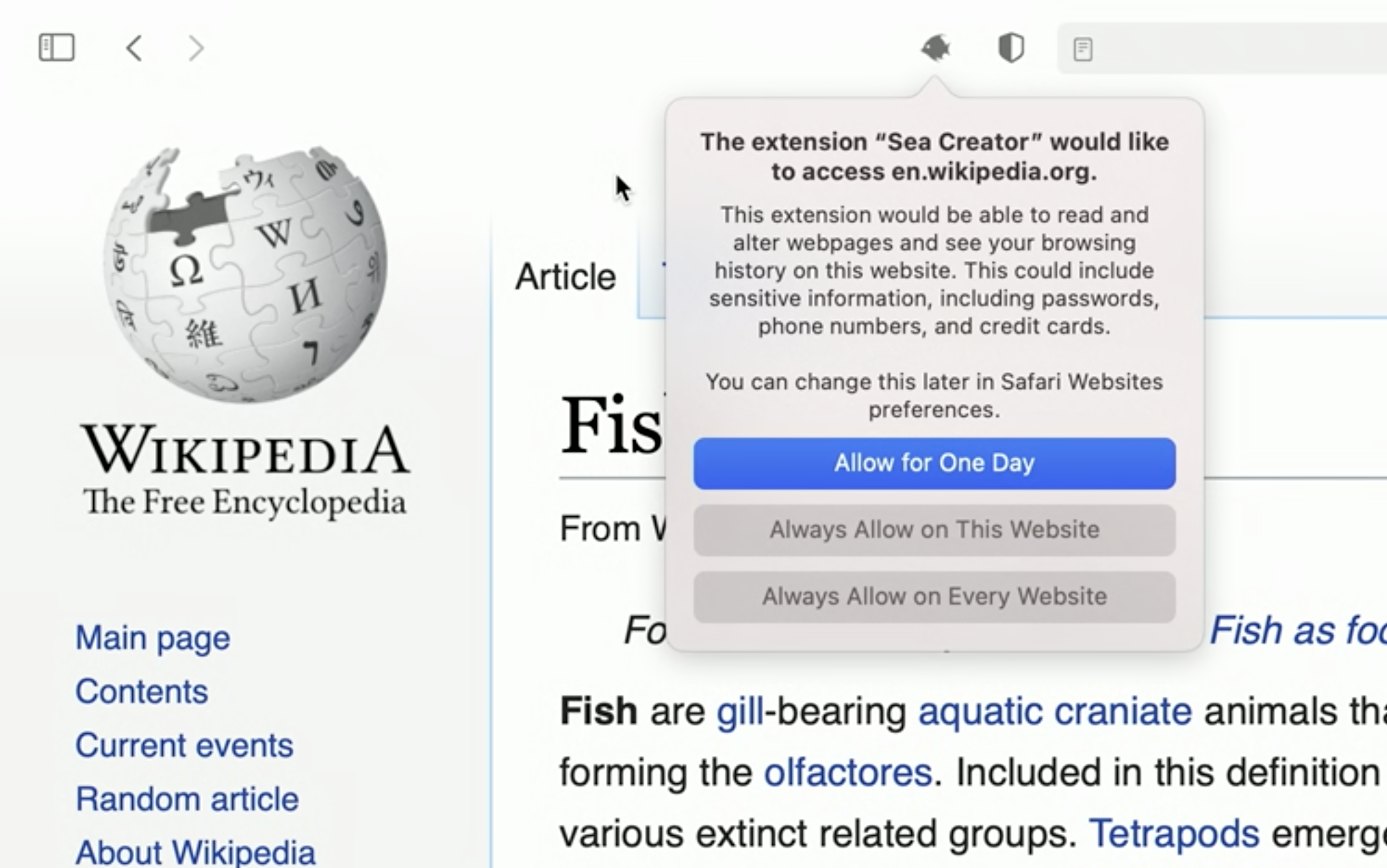
Some extensions require a ton of permissions. They can essentially view all web pages you visit. That’s why Apple lets you restrict extensions to some websites, or just the active tab. You can also choose to activate an extension for a day so that it doesn’t remain active forever.

The user will get a warning sign the first time an extension tries to access a site and there will be a big warning banner in Safari settings before you activate an extension that can access all your browsing data.

This change could potentially mean that there will be a lot more extensions for Safari in the future. Many Chrome users don’t want to leave Chrome because they can’t find the same extensions. If developers choose to port their extensions to Safari, Apple could convince more users to switch to Safari.

25 Jun 2020

Apple is bringing Face ID and Touch ID to the web with Safari 14

Apple’s Face ID and Touch ID have made it easier for users to log into their mobile devices like iPhones and iPads and on some Macs offering the Touch ID button. Now Apple is bringing Face ID and Touch ID to the web. At the company’s virtual Worldwide Developers Conference this week, Apple introduced a way for web developers to add support for Face ID and Touch ID to their websites, allowing Safari users to log in without having to enter their username and password.

In a WWDC session aimed at web developers, the company showed off the new functionality which Apple touted would provide a “frictionless experience” for users.

Similar to how Face ID and Touch ID work today in iOS apps, web developers who choose to implement the new technology could prompt their users to choose a biometric authentication method the next time they visit their website.

The technology was built via the Web Authentication (WebAuthn) API which allows developers to build authentication via the FIDO2 specification, developed by the FIDO Alliance. It will be made available starting with Safari 14 for macOS and iOS, the organization said.

As CNET explains, Apple isn’t the first to use the browser technology — it’s already available in Firefox, Chrome and Microsoft Edge, for example.

Apple’s adoption, however, could push forward the larger biometrics movement. This in part, is due to Apple’s way of making complicated technology consumer-friendly and taking on the work of user education. Apple also has a sizable community of developers who get excited to roll out Apple’s latest technology.

The new system will be, by default, multi-factor in nature.

Apple’s platform authenticator uses the secure enclave of the iPhone or iPad to provide the private keys, and guarantees they can’t leave the device. It also verifies the user by either their fingerprint or facial recognition. That makes it multi-factor, as it combines something you have — the iPhone — with something you are — your biometrics information.

A report by Biometric Update also noted the WWDC session revealed Apple built its own attestation service, which is an optional service for those with higher security needs — like a bank. Because this technology can sometimes be used to violate privacy, Apple built its own version where it generates a unique attestation certificate for each credential. This prevents websites from tracking users across the web. This service isn’t immediately available, but will be soon.

Apple joined the FiDO Alliance earlier this year, signaling its intention to work towards a way to replace passwords with trusted devices and biometrics. It has also patented a way to use Face ID on a Mac, but this hasn’t launched.

25 Jun 2020

Google will start paying publishers to provide content for a ‘new news experience’

Google announced today that it’s working on a “new news experience” that will launch later this year, for which it will pay publishers to license their content.

Axios broke the news, with Google’s Brad Bender offering more details in a blog post, in which he said the project will first launch on Google News and Discover, and will “help participating publishers monetize their content through an enhanced storytelling experience that lets people go deeper into more complex stories, stay informed and be exposed to a world of different issues and interests.”

The extent to which the large internet platforms generally — and Google specifically — pay publishers has often been a contentious topic. Both Facebook and Google have bankrolled sizable news initiatives that combine directing funding for journalism with new products, research and partnerships. However, some publishers and regulators have also pressed Google to pay for including snippets of news content in search results.

“While we’ve previously funded high-quality content, this program is a significant step forward in how we will support the creation of this kind of journalism,” Bender said. “To start, we have signed partnerships with local and national publications in Germany, Australia and Brazil.”

The blog post mentions Germany’s Spiegel Group, Australia’s InQueensland and InDaily and Brazil’s Diarios Associados as some of the participating publishers. Apparently Google is also offering to pay publishers to provide free access to otherwise paywalled content.

“We are always keen to explore innovative ways to attract readers to our high-quality content,” says Spiegel Group Managing Director Stefan Ottlitz in a statement. “This interesting new partnership with Google will allow us to curate an experience that will bring our award-winning editorial voice into play, broaden our outreach and provide trusted news in a compelling way across Google products.”

25 Jun 2020

Facebook will show users a pop-up warning before they share an outdated story

Facebook announced Thursday that it would introduce a notification screen warning users if they try to share content that’s more than 90 days old. They’ll be given the choice to “go back” or to click through if they’d still like to share the story knowing that it isn’t fresh.

Facebook acknowledged that old stories shared out of their original context play a role in spreading misinformation, a fact that the social media company said “news publishers in particular” have expressed concern about old stories being recirculated as though they’re breaking news.

“Over the past several months, our internal research found that the timeliness of an article is an important piece of context that helps people decide what to read, trust and share,” Facebook Vice President of Feed and Stories John Hegeman wrote on the company’s blog.

Image via Facebook

The notification screen is an outgrowth of other kinds of notifications the company has experimented with recently. Last year, Instagram introduced a pop-up notification to discourage its users from sharing offensive or abusive comments with a similar set of options, allowing them to click through or go back. The company said that its initial results with the experiment showed promise in shaping users toward better behavior.

In a blog post announcing the new feature, Facebook said that it is now considering other kinds of notification screens to reduce misinformation, including pop-ups for posts about COVID-19 that would provide context about source links and steer users toward public health resources.

25 Jun 2020

As the IPO market warms, Accolade targets billion-dollar debut

As the IPO market heats up, one offering slipped beneath our radar. This morning, then, we’ll catch up on Accolade’s initial public offering and what its proposed pricing may tell us about the state of the IPO market.


The Exchange is a daily look at startups and the private markets for Extra Crunch subscribers; use code EXCHANGE to get full access and take 25% off your subscription.


Catching everyone back up, Accolade sells its service to employers who in turn offer it to their employees; the company’s tech provides a portal for individuals to “better understand, navigate and utilize the health care system and their workplace benefits,” Accolade states in its S-1 filings.

The firm goes on to point out that the U.S. health care system is complex, which puts “significant strain on consumers.” Correct. Its solution? To help “consumers make better, data-driven health care and benefits-related decisions” through its service by selling a “platform to support and influence consumer decision-making that is built on a foundation of mission-driven people and purpose-built technology.”



Yeah.

Regardless of that verbiage, Accolade’s business has proven sufficiently attractive to allow the firm to file to go public in late February, around when Procore filed. Both companies delayed their offerings, but Procore raised more private capital, a $150 million round that values it at around $5 billion. Accolade, to our knowledge, did not raise more funds. So, its IPO is back on and today we have its pricing interval.

Let’s unpack its pricing range, write some notes on its recent financial results and try to figure out how ambitious Accolade is being in terms of its expected valuation as it counts down to trading publicly.

Accolade’s S-1/A

According to Accolade’s June 24th S-1/A, the company expects a $19 to $21 per-share IPO price range. The company intends to sell 8.75 million shares in its debut, not counting a 1,312,500 share greenshoe option offered to its underwriters. Discounting the extra shares, Accolade would raise between $166.3 million to $183.8 million in its debut; inclusive of greenshoe shares, the total fundraise grows to a range of $191.2 million to $211.3 million.

25 Jun 2020

Atmos wants to make building a house a one-click effort

Homebuilding is not for the faint of heart, particularly those who want to build something custom. Selecting the right architect and designer, the myriad of contractors, the complexity of building codes and siting, the regulatory approvals from local authorities. It’s a full-time job — and you don’t even have a roof built over your head.

Atmos wants to massively simplify homebuilding, and in the process, democratize customization to more and more homeowners.

The startup, which is in the current Y Combinator batch, wants to take both the big decisions and the sundries of construction and combine them onto one platform where selecting a design and moving forward is as simple as clicking through a Shopify shopping cart.

It’s a vision that has already piqued the attention of investors. The company disclosed that it has already raised $2 million according to CEO and co-founder Nick Donahue from Sam Altman, former YC president and now head of OpenAI, and Adam Nash, former president and CEO of Wealthfront, along with a bunch of other angels.

It’s also a vision that is a radical turn from where Atmos was before, which was centered in virtual reality.

Donahue comes from a line of homebuilders — his father built home subdivisions as a profession — but his interests initially turned toward the virtual. He dropped out of college after realizing process engineering wasn’t all that exciting (who can blame him?) and headed out to the Valley, where he built projects like “a Burning Man art installation and [an] open-source VR headset.” That headset attracted the attention of angels, who funded its development.

The concept at the heart of the headset was around what the team dubbed the “spatial web.” Donahue explained that the idea was that “the concept of the web would one day flow from the 2D into the 3D and that physical spaces would function more like websites.” The headset he was developing would act as a sort of “browser” to navigate these spaces.

Of course, the limitations around VR hit his company as much as the rest of the industry, including limits on computation performance to build these 3D environments and the lack of scaling in the sector so far.

The thinking around changing physical spaces though got Donahue pondering about what the future of the home would look like. “We think the next kind of wave of this is going to be an introduction to compute,” he said, arguing that “every home will have like a brain to it.” Homes will be digital, controllable, and customizable, and that will revolutionize the definition of the home that has remained stagnant for generations.

The big vision for Atmos going forward then is to capture that trend, but for today at least, the company is focused on making housing customization easier.

To use the platform, a user inputs the location for a new home and a floorplan for the site, and Atmos will find builders that best match the plan and coordinate the rest of the tasks to get the home built. It’s targeting homes in the $400,000-800,000 range, and its focus cities are Raleigh-Durham, Charlotte, Atlanta, Denver, and Austin.

It’s very much early stages for the company — Donahue says that the company has its first few projects underway in the Raleigh-Durham area and is working to partner and scale up with larger homebuilders.

Photo by KentWeakley via Getty Images.

Will it work? That’s the big question with anything that touches construction. Customization is great — everyone loves to have their own pad — but the traditional challenge for construction is that the only way to bring down the cost of housing is to make it as uniform as possible. That’s why you get “cookie-cutter” subdivisions and rows of identical apartment buildings — the sameness allows a builder to find scale: work crews can move from one lot to the next in synchronicity saving labor costs and time while building materials can be bought in bulk to save costs.

With better technology and some controls, Atmos might be able to find synergies between its customers, particularly if it gets market penetration in individual cities. Yet, I find the longer-term vision ultimately more compelling for the company: redefining the home may not have made much sense three months ago, but as more people work from home and connect with virtual worlds, how should our homes be redesigned to accommodate these activities? If Atmos can find an answer, it is sitting on a gold mine.

Atmos team pic (minus two). Photo via Atmos.

In addition to Altman and Nash, Mark Goldberg, JLL Spark, Shrug Capital, Daniel Gross’ Pioneer, Venture Hacks, Yuri Sagalov, Brian Norgard and others participated in the company’s angel/seed round.

25 Jun 2020

A domestic violence prevention app backed by Dr. Phil exposed victims’ distress recordings

Back in 2013, Robin McGraw, wife of U.S. television personality Dr. Phil, launched an app to help domestic violence victims covertly signal for distress. It was quickly heralded as a potential lifesaver for those in harm’s way.

Aspire News, which claims over 300,000 downloads, is disguised to look like an innocuous news reading app that domestic violence victims can use to alert friends and family to abuse or danger. When a victim taps the top bar of the app three times, the app can alert trusted contacts with a prewritten message, a prerecorded voice note, and the victim’s precise location by text message to indicate that they need help or are in danger.

But a security lapse meant that those uploaded voice recordings were left exposed on an unprotected cloud server for anyone to access.

Security researchers Noam Rotem and Ran Locar found the exposed recordings and reported the incident. The database was pulled offline shortly after. Rotem and Locar shared their findings exclusively with TechCrunch.

The cloud server contained over 4,000 recordings, dating back to September 2017. The recordings varied in length and nature, but some contained personally identifiable information, such as their name, address and phone number, information which could be relayed to the emergency services.

At least one recording we listened to explicitly stated the name of the victim’s abuser.

Given the sensitivity of the data, we did not reach out to app users for fear that it would compromise their safety.

Instead, we confirmed that the data belonged to Aspire by downloading the app and recording a short voice snippet in the app. When we triggered the alert, we received a text message with a web address to the recording file stored on the cloud server. That means anyone who received a similar link to a recording file could have easily found other recordings simply by shortening the full link.

We asked the foundation run by the McGraws, When Georgia Smiled, how long the cloud server was exposed and if it had plans to inform users of the security lapse, but a representative for the foundation did not comment.

A spokesperson for CBS, which airs Dr. Phil, did not respond to a request for comment.

If you or someone you know needs help, the National Domestic Violence Hotline (1-800-799-7233) provides 24/7 free, confidential support to victims of domestic abuse and violence. If you are in an emergency situation, call 911.

25 Jun 2020

Salesforce announces a new mobile collaboration tool for sales called Anywhere

Even before the pandemic pushed most employees to work from home, sales people often worked outside of the office. Salesforce introduced a new tool today at the Trailheadx Conference called Salesforce Anywhere that’s designed to let teams collaborate and share data wherever they happen to be.

Salesforce VP of product, Michael Machado says that the company began thinking about the themes of working from anywhere pre-COVID. “We were really thinking across the board what a mobile experience would be for the end users that’s extremely opinionated, really focuses on the jobs to be done and is optimized for what workers need and how that user experience can be transformed,” Machado explained.

As the pandemic took hold and the company saw how important collaboration was becoming in a digital context, the idea of an app like this took on a new sense of urgency. “When COVID happened, it really added fuel to the fire as we looked around the market and saw that this is a huge need with our customers going through a major transformation, and we wanted to be there to support them in Salesforce with kind of a native experience,” he said.

The idea is to move beyond the database and help surface the information that matters most to individual sales people based on their pipelines. “So we’re going to provide real time alerts so users are able to subscribe to their own alerts that they want to be notified about, whether it’s based on a list they use or a report that they work off of [in Salesforce], but also at the granularity of a single field in Salesforce,” he said.

Employees can then share information across a team, and have chats related to that information. While there are other chat tools out there, Machado says that this tool is focused on sharing Salesforce data, rather than being general purpose like Slack or other business chat tool.

Image Credit: Salesforce


Salesforce sees this as another way to remove the complexity of working in CRM. It’s not a secret that sales people don’t love entering customer information into CRM tools, so the company is attempting to leverage that information to make it worth their while. If the tool isn’t creating a layer of work just for record keeping’s sake, but actually taking advantage of that information to give the sales person key information about his or her pipeline when it matters most, that makes the record keeping piece more attractive. Being able to share and communicate around that information is another advantage.

This also creates a new collaboration layer that is increasingly essential with workers spread out and working from home. Even when we return to some semblance of normal, sales people on the road can use Anywhere to collaborate, communicate and stay on top of their tasks.

The new tool will be available in Beta in July. The company expects to make it generally available some time in the fourth quarter this year.