Year: 2020

25 Jun 2020

iOS 14 lets deaf users set alerts for important sounds, among other clever accessibility perks

The latest version of iOS adds a few smart features intended for use by people with hearing and vision impairments, but some of which may be helpful to just about anybody.

The most compelling new feature is perhaps Sound Recognition, which creates a notification whenever the phone detects one of a long list of common noises that users might want to be aware of. Sirens, dog barks, smoke alarms, car horns, doorbells, running water, appliance beeps — the list is pretty extensive. A company called Furenexo made a device that did this years ago, but it’s nice to have it built in.

Users can have notifications go to their Apple Watch as well, in case they don’t always want to be checking their phone to check if the oven has gotten up to temperature. Apple is working on adding more people and animal sounds as well, so the system has room to grow.

The utility of this feature for hearing-impaired folks is obvious, but it’s also nice for anyone who gets lost in their music or podcast and forgets they let the dog out or are expecting a package.

Also new in the audio department is what Apple is calling a “personal audiogram,” which amounts to a custom EQ setting based on how well you hear different frequencies. It’s not a medical tool — this isn’t for diagnosing hearing loss or anything — but a handful of audio tests can tell whether certain frequencies need to be boosted or dampened. Unfortunately the feature only works, for some reason, with Apple-branded headphones.

Real Time Text conversations is an accessibility standard that basically sends text chat over voice call protocols, allowing seamless conversations and access to emergency services for nonverbal people. It’s been supported by iPhones for some time, but now users don’t need to be in the calling app for it to work — do a call while you play a game or watch a video, and the conversation will appear in notifications.

A last feature intended for use by the hearing impaired is an under-the-hood change to group FaceTime calls. Normally the video automatically switches to whoever is speaking — but of course sign language is silent, so the video won’t focus on them. Until iOS 14 anyway, in which the phone will recognize the motions as sign language (though not any specific signs) and duly switch the view to that participant.

VoiceOver makeover

Apple’s accessibility features for those with low or no vision are solid, but there’s always room to grow. VoiceOver, the smart screen-reading feature that’s been around for more than a decade now, has been enhanced with a machine learning model that can recognize more interface items, even if they haven’t been properly labeled, and in third party apps and content too. This is making its way to the desktop as well, but not quite yet.

iOS’s descriptive chops have also been upgraded, and by analyzing a photo’s contents it can now relate them in a richer way. For instance, instead of saying “two people sitting,” it might say,  “two people sitting at a bar having a drink,” or instead of “dog in a field,” “a golden retriever playing in field on a sunny day.” Well, I’m not 100 percent sure it can get the breed right, but you get the idea.

The Magnifier and Rotor controls have been beefed up as well, and large chunks of Braille text will now auto-pan.

Developers with vision impairments will be happy to hear that Swift and Xcode have received lots of new VoiceOver options, as well as making sure common tasks like code completion and navigation are accessible.

Back tappin’

The “back tap” is a feature new to Apple devices but familiar to Android users, who have seen things like it on Pixel phones and other devices. It enables users to tap the back of the phone two or three times to activate a shortcut — super handy for invoking the screen reader while your other hand is holding the dog’s leash or a cup of tea.

As you can imagine the feature is useful to just about anyone, since you can customize it to perform all sorts of shortcuts or tasks. Unfortunately the feature is for now limited to phones with FaceID — which leaves iPhone 8 and SE users, among others, out in the cold. It’s hard to imagine that there is no secret tap-detection hardware involved — it’s almost certain that it uses accelerometers that have been in iPhones since the very beginning.

Apple is no stranger to holding certain features hostage for no particular reason, such as the notification expansions that aren’t possible a brand-new phone like the SE. But doing so with a feature intended for accessibility is unusual. The company did not count out the possibility that the back tap would make its way to button-bearing devices, but would not commit to the idea either. Hopefully this useful feature will be more widely available soon, but only time will tell.


25 Jun 2020

Amazon really just renamed a Seattle stadium ‘Climate Pledge Arena’

As perennial front runner for the title of probably-the-most-evil tech company, Amazon has a long way to go to rehabilitate its image as a take-no-prisoners, industry-consolidating wealth machine.

In a bold effort to do so, the company announced today that it would buy the rights to Seattle’s KeyArena, an aging stadium currently under redevelopment in the city. Amazon founder and CEO Jeff Bezos boasts that the stadium will “be the first net zero carbon certified arena in the world.”

“Instead of calling it Amazon Arena, we’re naming it Climate Pledge Arena as a regular reminder of the urgent need for climate action,” Jeff Bezos wrote on Instagram.

Other regular reminders for urgent climate action include the company’s own employees walking out to protest its lack of accountability on climate issues, its ongoing courtship with oil and gas companies and the sheer amount of times in a single day we see Amazon delivery vans dropping packages off on the same block.

Addressing its record of climate indifference, Amazon announced a $2 billion investment in sustainable efforts to reduce the company’s massive carbon footprint earlier this week as part of the same climate-friendly PR blitz.

Bezos himself announced in February that he would invest $10 billion of his personal wealth in a fund to address climate change, which is probably the least you can do when you’ve amassed an amount of wealth that’s incomprehensible to any normal person at the expense of workers, the environment and whatever else got in the way.

25 Jun 2020

Aclima and Google release a new air quality data set for researchers to investigate California pollution

As part of the Collision from Home conference, Aclima chief executive Davida Herzl released a new dataset made in conjunction with Google for free to the scientific community.

The data is the culmination of four years of data collection and aggregation resulting in 42 million air quality measurements throughout the state of California.

The company’s sensing and analytics tools were integrated into Google Street View vehicles, which measured air pollutant and greenhouse gas levels in the San Francisco Bay Area, Los Angeles, and the California Central Valley over the course of the joint venture.

The vehicles collected data on carbon dioxide, ozone, nitrogen dioxide, nitric oxide, methane, black carbon and fine particulate pollutants. The two companies said that the release of the dataset should support research into fields that can be advanced by air pollution and greenhouse gas data measurement.

Selections of the data were used by researchers from the University of Texas, Austin, and the Environmental Defense Fund for a 2017 paper that pollution can vary by five to eight times between city blocks. In 2018 the EDF and Kaiser Permanente released a study linking street level pollution n Oakland to higher incidences of heart disease and finally in 2020 a subset of the Aclima data was used to estimate the environmental benefits of congestion pricing.

Now, with this complete California air quality dataset to researchers, Aclima and Google are doubling down on their thesis that measuring and analyzing street-level air quality is essential to revealing and reducing the emissions that both damage health and change the climate, the company said.

25 Jun 2020

Lemonade targets down-round pricing in impending IPO

Earlier today, insurtech unicorn Lemonade filed an S-1/A, providing context into how the former startup may price its IPO and what the company may be worth when it begins to trade.

According to its new filing, Lemonade expects its IPO to price at $23 to $26 per share. As the company intends to sell 11 million shares in its debut, the rental and home insurance-focused unicorn would raise between $253 million and $286 million at those prices.

Counting an additional 1.65 million shares that it will make available to its underwriting banks, the company’s fundraise grows to $291 million to $328.9 million. Including shares offered to underwriters, Lemonade’s implied valuation given its IPO price range runs from $1.30 billion to $1.47 billion.

That’s the news. Now, is that expected valuation interval strong, and, if not, what might it portend for other insurtech startups? Let’s talk about it.

Not great, not terrible

TechCrunch is speaking with the CEOs of Hippo (homeowner’s insurance) and Root (car insurance) later today, so we’ll get their notes in quick order regarding how Lemonade’s IPO is shaping up, and if they are surprised by its pricing targets.

But even without external commentary, the pricing range that Lemonade is at least initially targeting is not terribly impressive. That said, it’s stronger than I anticipated.

25 Jun 2020

Even amid the pandemic, this newly funded travel startup is tackling the stodgy timeshare market

The world is rife with me-too startups, which makes it all the more refreshing when a founder comes along that manages to find a broken market that’s hiding in plain sight.

That’s what Mike Kennedy appears to be doing with Koala, a young outfit determined to update the stodgy world of property time-share management, wherein people acquire points or otherwise pay for a unit at a timeshare resort that they intend to regularly use or swap or rent out (or all three).

It’s a big and growing market. According to data published last year by EY, the U.S. timeshare industry grew nearly 7% between 2017 and 2018 to hit $10.2 billion in sales volume.

It’s a market that Kennedy became acquainted with first-hand as a sales executive at the Hilton Club in New York, which, at least in 2018, was among 1,580 timeshare resorts up and running, representing approximately 204,100 units, most of them with two bedrooms or more.

Despite this growth, timeshares don’t jump to travelers’ minds as readily as hotel rooms or Airbnb stays, and therein lies the opportunity.

Part of the problem, as Kennedy see it, is that timeshares are harder to rent out than they should be. If a timeshare owner wants to reserve a week outside of the week that he or she purchased, for example, that person has to go through an antiquated exchange system like RCI (owned by Wyndam) or Interval International (owned by Marriott). Kennedy, who spent 10 years with Hilton, says he saw a number of his customers grow frustrated over time with their inability to better control their units’ usage.

25 Jun 2020

Even amid the pandemic, this newly funded travel startup is tackling the stodgy timeshare market

The world is rife with me-too startups, which makes it all the more refreshing when a founder comes along that manages to find a broken market that’s hiding in plain sight.

That’s what Mike Kennedy appears to be doing with Koala, a young outfit determined to update the stodgy world of property time-share management, wherein people acquire points or otherwise pay for a unit at a timeshare resort that they intend to regularly use or swap or rent out (or all three).

It’s a big and growing market. According to data published last year by EY, the U.S. timeshare industry grew nearly 7% between 2017 and 2018 to hit $10.2 billion in sales volume.

It’s a market that Kennedy became acquainted with first-hand as a sales executive at the Hilton Club in New York, which, at least in 2018, was among 1,580 timeshare resorts up and running, representing approximately 204,100 units, most of them with two bedrooms or more.

Despite this growth, timeshares don’t jump to travelers’ minds as readily as hotel rooms or Airbnb stays, and therein lies the opportunity.

Part of the problem, as Kennedy see it, is that timeshares are harder to rent out than they should be. If a timeshare owner wants to reserve a week outside of the week that he or she purchased, for example, that person has to go through an antiquated exchange system like RCI (owned by Wyndam) or Interval International (owned by Marriott). Kennedy, who spent 10 years with Hilton, says he saw a number of his customers grow frustrated over time with their inability to better control their units’ usage.

25 Jun 2020

Google finally brings group calling to the Nest Hub Max

Video chat has long been one of the chief selling points of smart screens like the Amazon Echo Show and Google’s Nest Hub Max (the regular Hub is still lacking a camera, mind). But until today, the latter only offered users the option for one-on-one calls. That’s all well and good for the most part, but as so many of us have found ourselves cut off from our friends and families, group chat has become something of a lifeline.

That’s meant big business for conferencing apps like Zoom. Once almost exclusively the domain of business meetings, these sorts of services have become increasingly popular for casual chats. Google has, no doubt, spotted potential, and today announced that it’s finally bringing group chats to the Hub Max through Duo.

The new feature allows for chats of up to 32 and utilizes the smart screen’s auto-framing capabilities (similar to those found in Facebook’s competing displays) to keep the subject in the picture. It also will be arriving on a number of third-party Google-ready smart screens, including those by LG, JBL and Lenovo. The feature requires the user to create a group on Duo through a connected mobile app. Once that’s done, it can be triggered via voice.

There’s a more professionally focused element to this as well. These companies have long explored the potential of smart screens in the workplace, but now that home is the office for so many, it makes sense to offer business meetings on these products. Those enrolled in the G Suite with Google Assistant beta program will be able to join business meetings through Google Meet.

That feature is rolling out in coming weeks.

25 Jun 2020

Daily Crunch: SoftBank founder leaves Alibaba board

SoftBank and Alibaba seem to be pulling apart, Amazon launches a no-code app builder and a new congressional bill takes a different approach to online protections.

Here’s your Daily Crunch for June 25, 2020.

1. Masayoshi Son resigns from board of Alibaba; defends SoftBank Group’s investment strategy

SoftBank Group founder Masayoshi Son said he’s leaving the board of Jack Ma’s Chinese e-commerce giant Alibaba Group, a month after Ma left the board of SoftBank.

Son said he sees the move as “graduating” from the board of his most successful investment to date. He then swiftly moved to defend the Japanese group’s investment strategy, which has become the subject of scrutiny and public mockery.

2. AWS launches Amazon Honeycode, a no-code mobile and web app builder

Honeycode is supposed to make it easy for anyone to build their own applications using a web-based, drag-and-drop builder.

3. PACT Act takes on internet platform content rules with ‘a scalpel rather than a jackhammer’

The PACT Act is a new bipartisan effort to reform Section 230, the crucial liability shield that enables internet platforms to exist, approaching the law’s shortcomings “with a scalpel rather than a jackhammer,” said Senator Brian Schatz (D-HI). It’s being proposed as an alternative to the EARN IT Act and President Trump’s executive order attacking Section 230.

4. SevenRooms raises $50M to double down on reservations, ordering and other tools for hospitality businesses

SevenRooms serves restaurants, hotels and other venues, although food service establishments account for about 95% of its business. Another new opportunity has emerged as shops and other in-person venues are looking at reservations to help with social distancing.

5. 5 VCs agree: COVID-19 reshaped adtech and martech

We last surveyed VCs about their advertising and marketing investment strategies back in January in a completely different world, before the coronavirus pandemic began to wreak havoc on the global economy. To find out how the landscape looks now, we’ve compiled updated answers from two investors who participated in the previous survey and brought in three new perspectives. (Extra Crunch membership required.)

6. New York City could have an e-scooter pilot program by March

The New York City Council is expected to vote on a bill that will require the New York Department of Transportation to create a pilot program for the operation of shared electric scooters in the city.

7. NASA seeks crowdsourced help designing a better moon toilet

The competition seeks “innovative designs for fully capable, low-mass toilets that can be used both in space and on the Moon.” It’s not the first time that NASA has enlisted the power of the crowd, and HeroX’s crowdsourcing platform, to come up with innovative technology around human waste management.

The Daily Crunch is TechCrunch’s roundup of our biggest and most important stories. If you’d like to get this delivered to your inbox every day at around 9am Pacific, you can subscribe here.

25 Jun 2020

Mophie is selling an $80 wireless-charging UV phone sanitizer

The best possible time to launch a UV phone sanitizer would have been about five months ago. The second best possible time, however, is right now. When the COVID-19 pandemic really started hitting the global community in earnest, there was a run on these once fairly niche products from companies with names like PhoneSoap.

In fact, available models started selling out all over the place, when many people began to recognize for the first time just how much of a disease vector the smartphone could truly be. All of that in mind, the category is a pretty logical next step for the many accessory brands underneath the Zagg umbrella.

Today Mophie and InvisibleShield launched their takes on the category. The products are priced at $80 and $60, respectively, with the key differentiator here being the inclusion of a 10W wireless charging pad. Though that’s actually on the lid of the product. Meaning you can use it to charge the handset only once it’s out of the disinfecting bed.

Both sanitize phones up to 6.9 inches, using UV-C light, promising to kill up to 99.9% of bacteria. It’s certainly worth noting that, like PhoneSoap, these brands are not making claims that their products can kill the novel coronavirus. The jury is still out on their efficacy on that front. In fact, COVID-19 is conspicuously absent from the press material. And even with one of these, I’d still strongly recommend carrying around a pack of antibacterial wipes, if you can still find any.

Both products are available now, through their respective sites.

25 Jun 2020

Apple Maps to tell you refine location by scanning the skyline

With iOS 14, Apple is going to update Apple Maps with some important new features, such as cycling directions, electric vehicle routing and curated guides. But the app is also going to learn one neat trick.

In dense areas where you can’t get a precise location, Apple Maps will prompt you to raise your phone and scan buildings across the street to refine your location.

As you may have guessed, this feature is based on Look Around, a Google Street View-inspired feature that lets you… look around as if you were walking down the street. It’s a bit more refined than Street View as everything is in 3D so you can notice the foreground and the background.

Look Around is only available in a handful of U.S. cities for now, such as San Francisco, New York, Chicago, Washington, DC, Las Vegas, etc. But the company is still expanding it with Seattle coming on Monday and major Japanese cities this fall. Some areas that are only accessible on foot will also be available in the future.

When you scan the skyline to refine your location, Apple doesn’t send any data to its servers. Matching is done on your device.

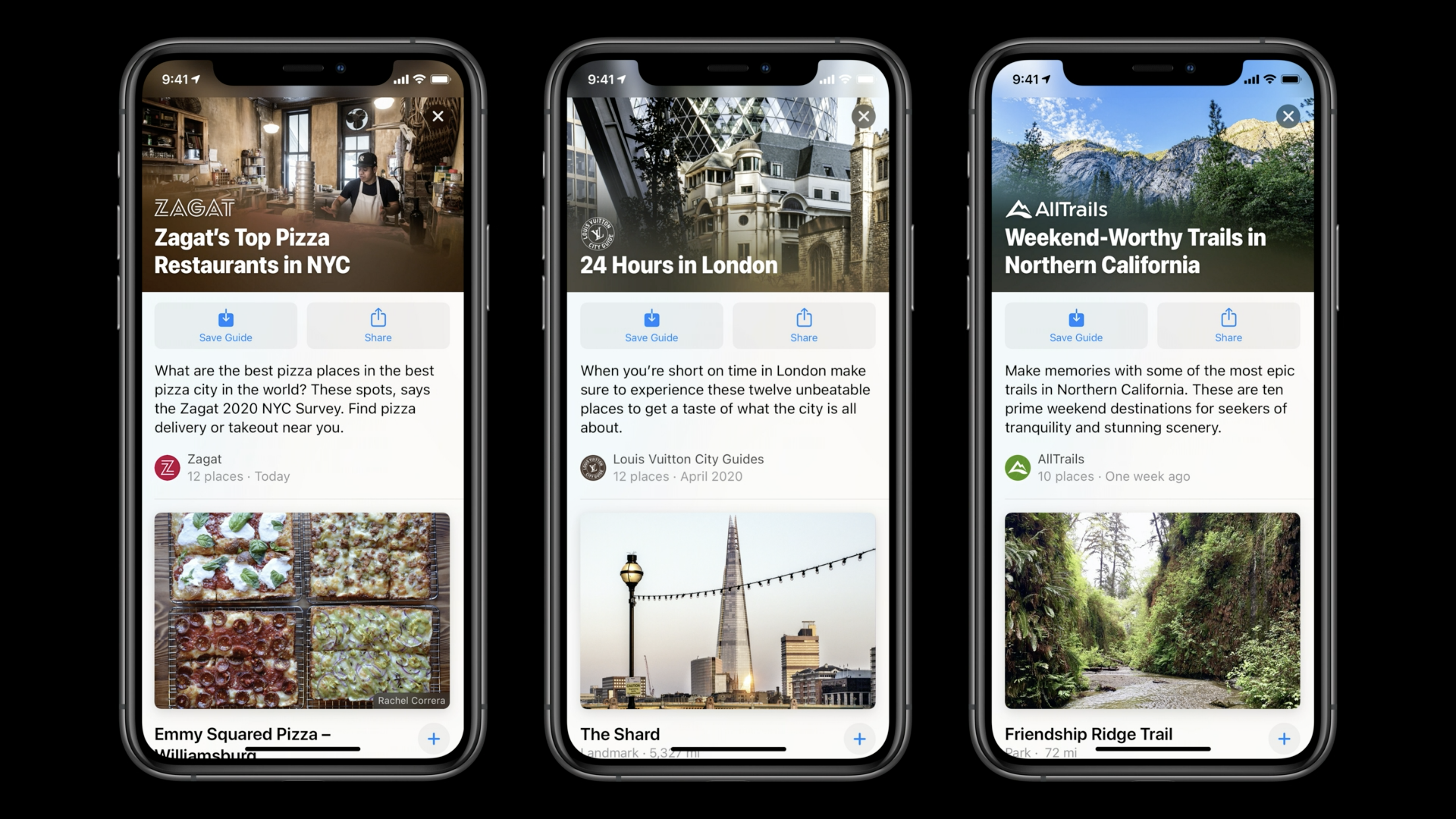
When it comes to guides, Apple has partnered with AllTrails, Lonely Planet, The Infatuation, Washington Post, Louis Vuitton and others to add curated lists of places to Apple Maps. When you tap on the search bar and scroll down on the search card, you can see guides of nearby places.

When you open a guide, you can see all the places on the map or you can browse the guide itself to see those places in a list view. You can share places and save them in a user-made guide — Apple calls it a collection in the current version of Apple Maps.

You can also save a curated guide altogether if you want to check it out regularly. Places get automatically updated.

Image Credits: Apple

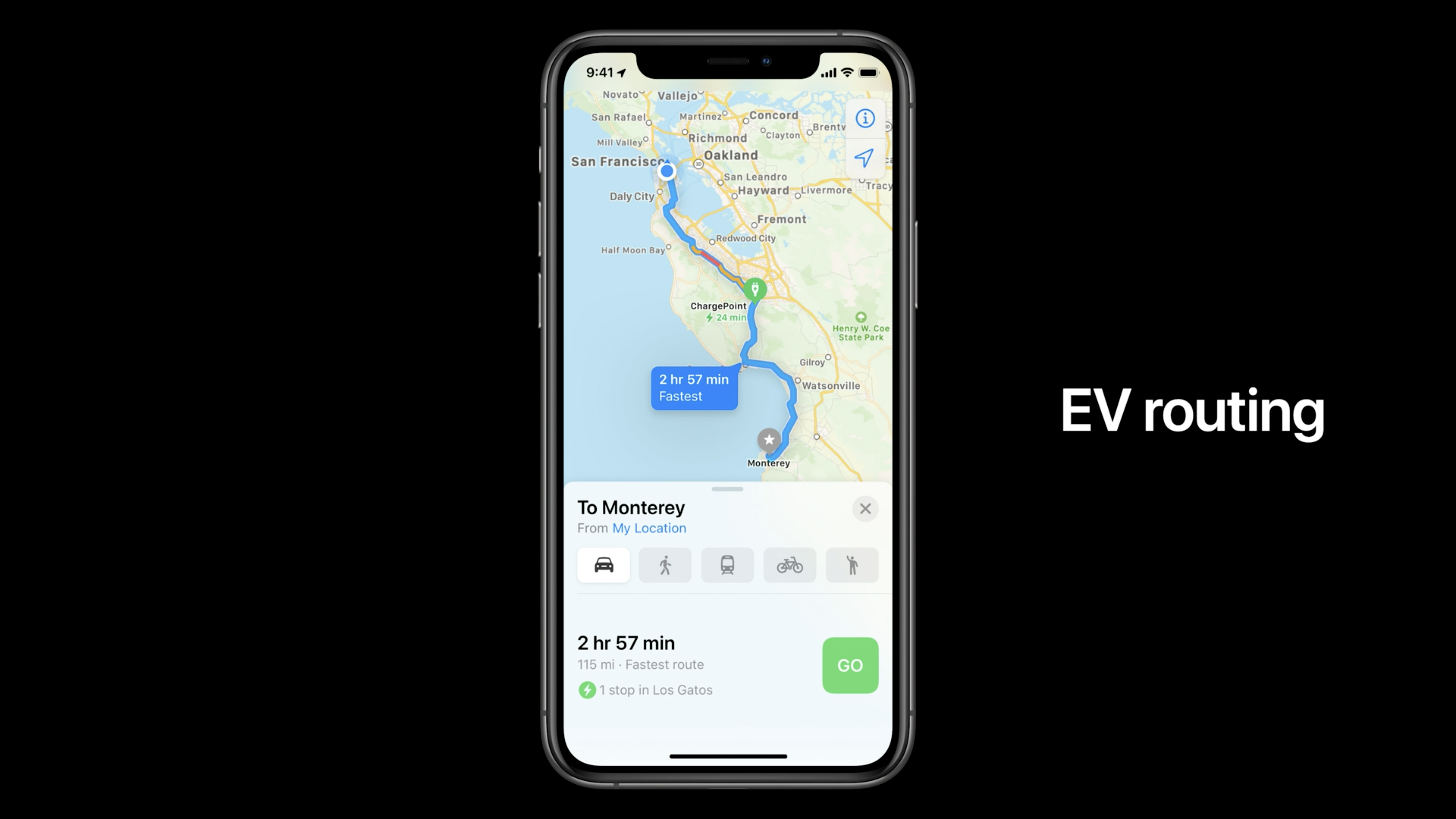
As for EV routing, Apple Maps will let add your car, name it and choose a charger type — Apple has partnered with BMW and Ford for now. When you’re planning a route, you can now select the car you’re going to be using. If you select your electric car, Apple Maps will add charging spots on the way. You can tap on spots to see if they are free or paid and the connector type.

Waze users will also be happy to learn that Apple Maps will be able to warn you if you’re exceeding the speed limit. You can also view speed and red light cameras on the map.

In some cities with congestion zones and license plate access, you’ll be able to add your license plate. The information is kept on the device. It’ll refine directions for those cities.

Image Credits: Apple

Finally, my favorite new feature is cycling directions. It’s only going to be available in New York City, Los Angeles, San Francisco, Shanghai and Beijing at first. Apple ticks all the right boxes, such as taking into consideration cycling paths and elevation. Turn-by-turn directions look slightly different from driving directions with a different framing and a more vertical view.

Google Maps also features cycling directions, but they suck. I can’t wait to try it out to see whether cycling directions actually make sense in Apple Maps. The new version of Apple Maps will ship with iOS 14 this fall.

Image Credits: Apple