Year: 2020

30 May 2020

Toyota’s first plug-in hybrid RAV4 Prime priced a skosh under $40,000

When Toyota unveiled the 2021 Toyota RAV4 Prime in November, the vehicle garnered a lot of attention because it achieved two seemingly conflicting goals. It was Toyota’s most fuel efficient and one of its most powerful vehicles.

Now, it’s getting praise for managing a base price under $40,000. Toyota said Friday that the standard trim of the plug-in vehicle, the RAV4 Prime SE, will start at $39,220,  a price that includes the mandatory $1,120 destination charge.

This plug-in RAV4 will have an all-wheel drive, sport-tuned suspension. When in pure EV mode it has a manufacturer-estimated 42 miles of range — putting it ahead of other plug-in SUVs. Toyota said it has a also has up to a manufacturer-estimated 94 combined miles per gallon equivalent. We’re still waiting on official EPA estimates.

The vehicle has a tuned 2.5-liter, four-cylinder gasoline engine and when combined with the electric motors will deliver 302 horsepower and be able to travel from 0 to 60 miles per hour in a projected 5.8 seconds.

The plug-in RAV4 will be offered in two variants. Toyota equips all of its RAV4 models with its standard active safety systems that includes a pre-collision system with pedestrian detection, full-speed range dynamic radar cruise  control, lane departure alert with steering assist, automatic high beams, lane tracing assist and road sign assist.

The cheaper SE comes standard with some notable features like 18-inch painted and machined alloy wheels, heated front seats, a power liftgate, a 3-kilowatt onboard charger and a 8-inch touchscreen along with Amazon Alexa integration and Android Auto and Apple CarPlay compatibility. Some advanced driver assistance features such as blind spot monitor with rear cross traffic alert also comes standard.

There is a weather and moonroof package for an additional $1,665 upgrade, that adds extras like a heated steering wheel, heated rear outboard seats and rain-sensing windshield wipers with de-icer function.

The pricier XSE trim starts at $42,545 (with the destination price included) and offers more luxury touches such as a two-tone exterior paint scheme pairing a black roof with select colors, 19-inch two-tone alloy wheels, paddle shifters, wireless phone charger and a 9-inch touchscreen. There are several other upgrades, of course, including one for the multimedia system that adds dynamic navigation and a JBL speaker system. The daddy of upgrades on the XSE costs $5,760 and covers weather, audio and premium features including a heads-up display, panoramic moonroof, digital rearview mirror, surround-view cameras and four-door keyless entry.

The vehicle is expected to show up at dealerships this summer.

30 May 2020

Zuckerberg explains why Facebook won’t take action on Trump’s recent posts

In a statement posted to Facebook late Friday afternoon, Mark Zuckerberg offered up an explanation of why his company did not contextualize or remove posts from the accounts associated with President Donald Trump that appeared to incite violence against American citizens.

“We looked very closely at the post that discussed the protests in Minnesota to evaluate whether it violated our policies,” Zuckerberg wrote. “Our policy around incitement of violence allows discussion around state use of force, although I think today’s situation raises important questions about what potential limits of that discussion should be.”

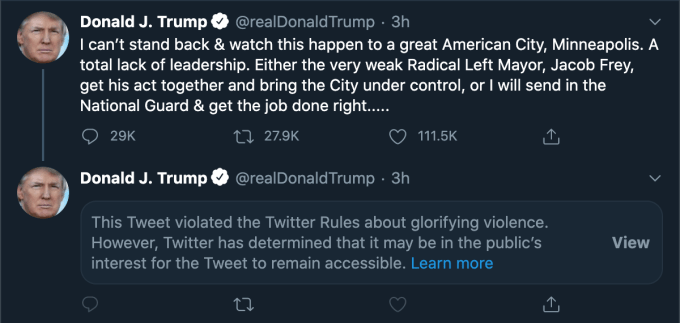
Facebook’s position stands in sharp contrast to recent decisions made by Twitter, with the approval of its chief executive, Jack Dorsey, to screen a tweet from the President on Thursday night using a “public interest notice” that indicated the tweet violated its rules glorifying violence. The public interest notice replaces the substance of what Trump wrote, meaning a user has to actively click through to view the offending tweet.

Critics excoriated Facebook and its CEO for its decision to take a hands off approach to the dissemination of misinformation and potential incitements to violence published by accounts associated with the President and the White House. Some of the criticism has even come from among the company’s employees.

“I have to say I am finding the contortions we have to go through incredibly hard to stomach,” one employee, quoted by The Verge, wrote in a comment on Facebook’s internal message board. “All this points to a very high risk of a violent escalation and civil unrest in November and if we fail the test case here, history will not judge us kindly.”

Zuckerberg defended Facebook’s position saying that it would not take any action on the posts from the President because “we think people need to know if the government is planning to deploy force.”

Facebook’s chief executive also drew a sharp contrast between Facebook’s response to the controversy and that of Twitter, which has provided a fact check for one of the President’s tweets and hidden Thursday’s tweet behind a warning label for violating its policies on violence.

“Unlike Twitter, we do not have a policy of putting a warning in front of posts that may incite violence because we believe that if a post incites violence, it should be removed regardless of whether it is newsworthy, even if it comes from a politician,” wrote Zuckerberg.

Twitter explained its decision in a statement. “This Tweet violates our policies regarding the glorification of violence based on the historical context of the last line, its connection to violence, and the risk it could inspire similar actions today,” the company said.

Twitter Comms

✔@TwitterComms

We have placed a public interest notice on this Tweet from @realdonaldtrump. https://twitter.com/realDonaldTrump/status/1266231100780744704 

Donald J. Trump

✔@realDonaldTrump

Replying to @realDonaldTrump

….These THUGS are dishonoring the memory of George Floyd, and I won’t let that happen. Just spoke to Governor Tim Walz and told him that the Military is with him all the way. Any difficulty and we will assume control but, when the looting starts, the shooting starts. Thank you!

“We’ve taken action in the interest of preventing others from being inspired to commit violent acts, but have kept the Tweet on Twitter because it is important that the public still be able to see the Tweet given its relevance to ongoing matters of public importance,” the Twitter statement continued.

Perhaps, as Zuckerberg suggests, Facebook will have an opportunity to provide some answers to the questions around what the limits should be around allowing the state discussion of incitements to violence. For now, the company’s response only begs more questions.

A link to the full post from Zuckerberg follows below:

This has been an incredibly tough week after a string of tough weeks. The killing of George Floyd showed yet again that…

Posted by Mark Zuckerberg on Friday, May 29, 2020

29 May 2020

As wildfire season approaches, AI could pinpoint risky regions using satellite imagery

The U.S. has suffered from devastating wildfires over the last few years as global temperatures rise and weather patterns change, making the otherwise natural phenomenon especially unpredictable and severe. To help out, Stanford researchers have found a way to track and predict dry, at-risk areas using machine learning and satellite imagery.

Currently the way forests and scrublands are tested for susceptibility to wildfires is by manually collecting branches and foliage and testing their water content. It’s accurate and reliable, but obviously also quite labor intensive and difficult to scale.

Fortunately, other sources of data have recently become available. The European Space Agency’s Sentinel and Landsat satellites have amassed a trove of imagery of the Earth’s surface that, when carefully analyzed, could provide a secondary source for assessing wildfire risk — and one no one has to risk getting splinters for.

This isn’t the first attempt to make this kind of observation from orbital imagery, but previous efforts relied heavily on visual measurements that are “extremely site-specific,” meaning the analysis method differs greatly depending on the location. No splinters, but still hard to scale. The advance leveraged by the Stanford team is the Sentinel satellites’ “synthetic aperture radar,” which can pierce the forest canopy and image the surface below.

“One of our big breakthroughs was to look at a newer set of satellites that are using much longer wavelengths, which allows the observations to be sensitive to water much deeper into the forest canopy and be directly representative of the fuel moisture content,” said senior author of the paper, Stanford ecoydrologist Alexandra Konings, in a news release.

The team fed this new imagery, collected regularly since 2016, to a machine learning model along with the manual measurements made by the U.S. Forest Service. This lets the model “learn” what particular features of the imagery correlate with the ground-truth measurements.

They then tested the resulting AI agent (the term is employed loosely) by having it make predictions based on old data for which they already knew the answers. It was accurate, but most so in scrublands, one of the most common biomes of the American west and also one of the most susceptible to wildfires.

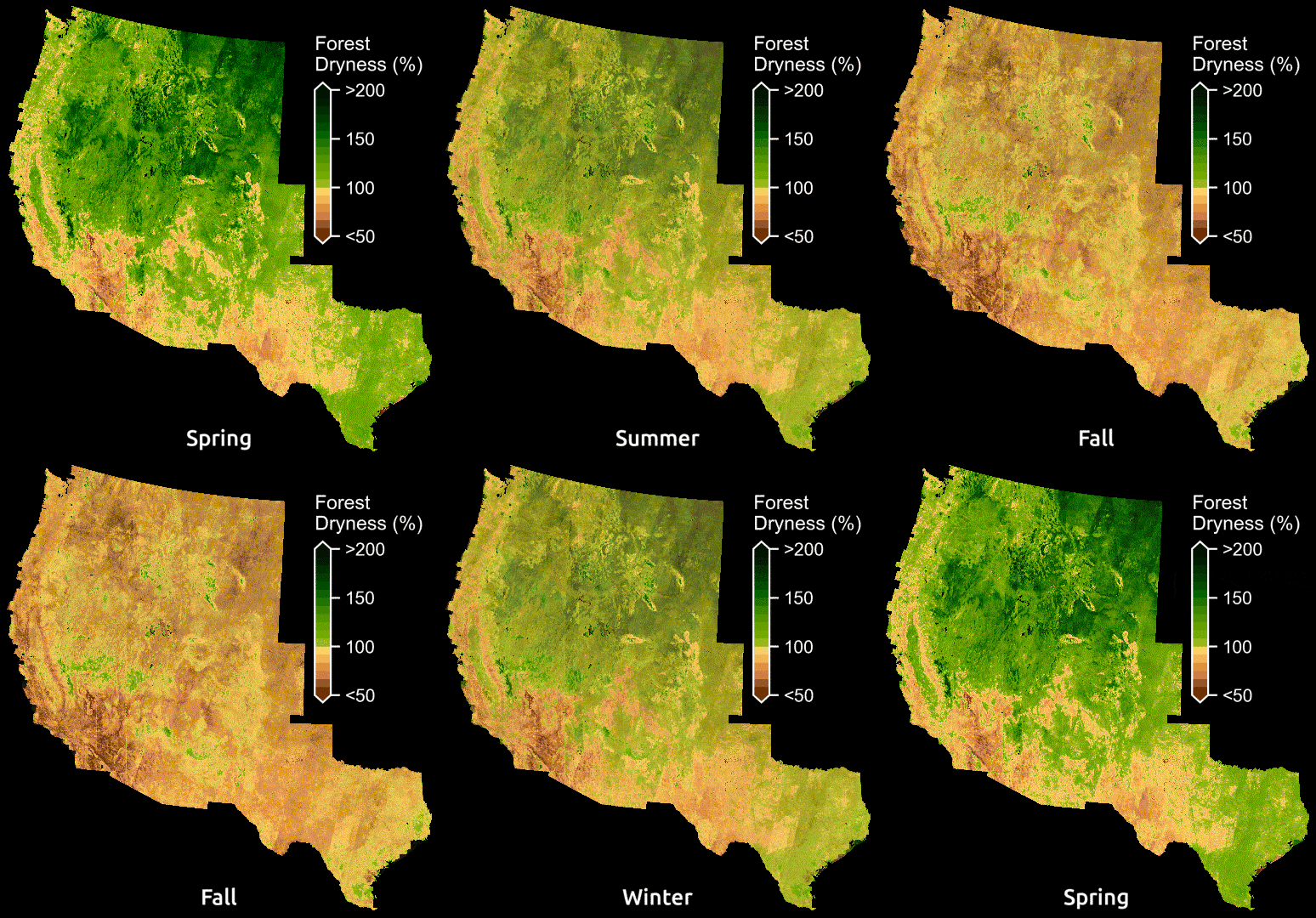
You can see the results of the project in this interactive map showing the model’s prediction of dryness at different periods all over the western part of the country. That’s not so much for firefighters as a validation of the approach — but the same model, given up to date data, can make predictions about the upcoming wildfire season that could help the authorities make more informed decisions about controlled burns, danger areas, and safety warnings.

The researchers’ work was published in the journal Remote Sensing of Environment.

29 May 2020

As wildfire season approaches, AI could pinpoint risky regions using satellite imagery

The U.S. has suffered from devastating wildfires over the last few years as global temperatures rise and weather patterns change, making the otherwise natural phenomenon especially unpredictable and severe. To help out, Stanford researchers have found a way to track and predict dry, at-risk areas using machine learning and satellite imagery.

Currently the way forests and scrublands are tested for susceptibility to wildfires is by manually collecting branches and foliage and testing their water content. It’s accurate and reliable, but obviously also quite labor intensive and difficult to scale.

Fortunately, other sources of data have recently become available. The European Space Agency’s Sentinel and Landsat satellites have amassed a trove of imagery of the Earth’s surface that, when carefully analyzed, could provide a secondary source for assessing wildfire risk — and one no one has to risk getting splinters for.

This isn’t the first attempt to make this kind of observation from orbital imagery, but previous efforts relied heavily on visual measurements that are “extremely site-specific,” meaning the analysis method differs greatly depending on the location. No splinters, but still hard to scale. The advance leveraged by the Stanford team is the Sentinel satellites’ “synthetic aperture radar,” which can pierce the forest canopy and image the surface below.

“One of our big breakthroughs was to look at a newer set of satellites that are using much longer wavelengths, which allows the observations to be sensitive to water much deeper into the forest canopy and be directly representative of the fuel moisture content,” said senior author of the paper, Stanford ecoydrologist Alexandra Konings, in a news release.

The team fed this new imagery, collected regularly since 2016, to a machine learning model along with the manual measurements made by the U.S. Forest Service. This lets the model “learn” what particular features of the imagery correlate with the ground-truth measurements.

They then tested the resulting AI agent (the term is employed loosely) by having it make predictions based on old data for which they already knew the answers. It was accurate, but most so in scrublands, one of the most common biomes of the American west and also one of the most susceptible to wildfires.

You can see the results of the project in this interactive map showing the model’s prediction of dryness at different periods all over the western part of the country. That’s not so much for firefighters as a validation of the approach — but the same model, given up to date data, can make predictions about the upcoming wildfire season that could help the authorities make more informed decisions about controlled burns, danger areas, and safety warnings.

The researchers’ work was published in the journal Remote Sensing of Environment.

29 May 2020

Brex, the credit card for startups, cuts staff amid restructuring

Brex, last valued at $2.6 billion, is restructuring its credit card for startups business and cut 62 staff members, the co-founders Pedro Franceschi and Henrique Dubugras said in a blog post.

“Today we’re restructuring the company to better align our priorities with this new reality, while simultaneously accelerating our product vision. With that, I have some very sad news to share. 62 people will be leaving Brex today,” the post reads.

The cuts come as Brex’s customer base itself is struggling to stay afloat amid COVID-19: high-growth startups. The trickle-down to Brex’s core business, which depends on its customers spending money, was thus expected.

Brex has already cut some customer credit limits to mitigate some of the exposure risk, The Information reported, and Dubugras confirmed. Customers say the credit limit cuts came without warning or notice.

Additionally, the company, launched in Brazil and graduated from Y Combinator, raised $150 million recently.

When TechCrunch talked to Dubugras about the latest fundraise, the co-founder said the capital was offensive, rather than defensive.

“I’m glad this round came together, but if it hadn’t, we would’ve been fine,” he said last week. “The capital is so we can play offensive while everyone else plays defensive.”

In the blog post, the co-founders wrote to former staffers.

“Please continue dreaming big and don’t lose the ambition that attracted you to Brex. Don’t let anything, not even a global pandemic, take that away from you. I wish we could give each one of you a hug, so instead I’ll end this message like I’d do it in Portuguese. Abraços, Pedro and Henrique.”

Those laid off will be provided with eight weeks of severance, their computer and equipment, and Brex will dedicate a part of its recruiting team to help find new opportunities for ex-staffers. Additionally, Brex is making adjustments to the equity cliff and has extended healthcare benefits through the end of 2020.

Brex has amassed $465 million in venture capital funding to date.

29 May 2020

Sony will show off the first PlayStation 5 games on June 4th

Sony has been dishing out details on the PlayStation 5 piece-by-piece, rather than dropping all of the details at one big mega event. First came word of the Holiday 2020 release window. Then came an overview of the specs — like that it’ll have a super fast solid state drive by default. Most recently, they showed off the controller. (The divvied up approach makes sense, really; with the ongoing pandemic preventing events like E3 and GDC from happening… why wouldn’t Sony work on their own schedule and make every aspect its own mini-spectacle?)

The next glimpse they give, it seems, will be of the first games coming to the console.

This morning Sony announced that they’ll be hosting a live-streamed event on June 4th at 1pm Pacific. In a blog post about the event, Sony Interactive CEO Jim Ryan clarifies the focus:

We’ve shared technical specifications and shown you the new DualSense wireless controller. But what is a launch without games?

That’s why I’m excited to share that we will soon give you a first look at the games you’ll be playing after PlayStation 5 launches this holiday.

Ryan also notes that the event should last roughly an hour, but doesn’t suggest how many different games that’ll cover.

In a video that managed to pull in millions of views, Epic Games recently gave a first look at its upcoming Unreal Engine 5 running on pre-release PS5 hardware. Given that video’s success, I’d imagine that Sony is pretty dang eager to keep the early looks coming.

Will we finally see the console hardware itself? That’s still unclear. Seeing as they’ve pieced just about everything else out, though, I’d bet they’re saving that one for an event a bit closer to launch.

29 May 2020

Sony will show off the first PlayStation 5 games on June 4th

Sony has been dishing out details on the PlayStation 5 piece-by-piece, rather than dropping all of the details at one big mega event. First came word of the Holiday 2020 release window. Then came an overview of the specs — like that it’ll have a super fast solid state drive by default. Most recently, they showed off the controller. (The divvied up approach makes sense, really; with the ongoing pandemic preventing events like E3 and GDC from happening… why wouldn’t Sony work on their own schedule and make every aspect its own mini-spectacle?)

The next glimpse they give, it seems, will be of the first games coming to the console.

This morning Sony announced that they’ll be hosting a live-streamed event on June 4th at 1pm Pacific. In a blog post about the event, Sony Interactive CEO Jim Ryan clarifies the focus:

We’ve shared technical specifications and shown you the new DualSense wireless controller. But what is a launch without games?

That’s why I’m excited to share that we will soon give you a first look at the games you’ll be playing after PlayStation 5 launches this holiday.

Ryan also notes that the event should last roughly an hour, but doesn’t suggest how many different games that’ll cover.

In a video that managed to pull in millions of views, Epic Games recently gave a first look at its upcoming Unreal Engine 5 running on pre-release PS5 hardware. Given that video’s success, I’d imagine that Sony is pretty dang eager to keep the early looks coming.

Will we finally see the console hardware itself? That’s still unclear. Seeing as they’ve pieced just about everything else out, though, I’d bet they’re saving that one for an event a bit closer to launch.

29 May 2020

Jeremy Conrad left his own VC firm to start a company, and investors like what he’s building

When this editor first met Jeremy Conrad, it was in 2014, at the 8,000-square-foot former fish factory that was home to Lemnos, a hardware-focused venture firm that Conrad had cofounded three years earlier.

Conrad —  who as a mechanical engineering undergrad at MIT worked on self driving cars, drones and satellites — was still excited about investing in hardware startups, having just closed a small new fund even while hardware was very unfashionable. One investment his team had made around that time was in Airware, a company that made subscription-based software for drones and attracted meaningful buzz and $118 million in venture funding before abruptly shutting down in 2018.

For his part, Conrad had already moved on, deciding in late 2017 that one of the many nascent teams that was camping out at Lemnos was on to a big idea relating the future of construction. Conrad didn’t have a background in real estate per se or even an earlier interest in the industry. But the “more I learned about it — not dissimilar to when I started Lemnos — It felt like there was a gap in the market, an opportunity that people were missing,” says Conrad from his home in San Francisco, where he has hunkered down throughout the COVID-19 crisis.

Enter Quartz, Conrad’s now 1.5-year-old, 14-person company, which quietly announced $7.75 million in Series A funding earlier this month, led by Baseline Ventures, with Felicis Ventures, Lemnos and Bloomberg Beta also participating.

What it’s selling to real estate developers, project managers and construction supervisors is really two things, which is safety and information. Using off-the-shelf hardware components that are reassembled in San Francisco and hardened (meaning secured to reduce vulnerabilities), the company incorporates its machine-learning software into this camera-based platform, then mounts the system onto cranes a construction sites. From there, the system streams 4K live feeds of what’s happening on the ground, while also making sense of the action.

Say dozens of concrete pouring trucks are expected on a construction site. The cameras, with their persistent view, can convey through a dashboard system whether and when the trucks have arrived and how many, says Conrad. It can determine how many people on are on a job site, and whether other deliveries have been made, even if not with a high degree of specificity. “We can’t say [to project managers] that 1,000 screws were delivered, but we can let them know whether the boxes they were expecting were delivered and where they were left,” he explains.

It’s an especially appealing proposition in the age of coronavirus, as the technology can help convey information that’s happening at a site that’s been shut down, or even how closely employees are gathered. Conrad says the technology also saves on time by providing information to those who might not otherwise be able to access it. Think of the developer who is on the 50th floor of the skyscraper he or she is building, or even the crane operator who is perhaps moving a two-ton object and has to rely on someone on the ground to deliver directions but can enjoy far more visibility with the aid of a multi-camera set-up.

Quartz, which today operates in California but is embarking on a nationwide rollout, was largely inspired by what Conrad was seeing in the world of self-driving. From sensors to self-perception systems, he knew the technologies would be even easier to deploy at construction sites, and he believed it could make them safer, too. Indeed, like cars, construction sites are astonishingly dangerous. According to the Occupational Safety and Health Administration, of the worker fatalities in private industry in 2018, more than 20% were in construction.

Conrad also saw an opportunity to take on established companies like Trimble, a 42-year-old, publicly traded, Sunnyvale, Ca.-based company that sells a portfolio of tools to the construction industry and charges top dollar for them, too. (Quartz is currently charging $2,000 per month per construction site for its series of cameras, their installation, a livestream and “lookback” data, though this may well rise at its adds additional features.)

It’s a big enough opportunity in fact, that Quartz is not alone in chasing it. Last summer, for example, Versatile, an Israeli-based startup with offices in San Francisco and New York City, raised $5.5 million in seed funding from Germany’s Robert Bosch Venture Capital and several other investors for a very similar platform,  though it uses sensors mounted under the hook of a crane to provide information about what’s happening. Construction Dive, a media property that’s dedicated to the industry, highlights many other, similar and competitive startups in the space, too.

Still, Quartz has Conrad, who isn’t just any founding CEO. Not only does he have that background in engineering, but having founded a venture firm and spent years as an investor may serve him well, too. He thinks a lot about the payback period on its hardware, for example.

Unlike a lot of founders, he also says he loves the fundraising process. “I get the highest quality feedback from some of the smartest people I know, which really helps focus your vision,” says Conrad, who says that Quartz, which operates in California today, is now embarking on a nationwide rollout.

“When you talk with great VCs, they ask great questions. For me, it’s best free consulting you can get.”


29 May 2020

4 views on the future of retail and the shopping experience

The global spread of COVID-19 and resulting orders to shelter in place have hit retailers hard.

As the pandemic drags on, temporary halts are becoming permanent closures, whether it’s the coffee shop next door, an historic bar, or a well-known lifestyle brand.

But while the present is largely bleak, preparing for the future has retailers adopting technologies faster than ever. Their resilience and innovation means retail will look and fee different when the world reopens.

We gathered four views on the future of retail from the TechCrunch team:

  • Natasha Mascarenhas says retailers will need to find new ways to sell aspirational products — and what was once cringe might now be considered innovative.
  • Devin Coldewey sees businesses adopting a slew of creative digital services to prepare for the future and empower them without Amazon’s platform.
  • Greg Kumparak thinks the delivery and curbside pickup trends will move from pandemic-essentials to everyday occurrences. He thinks that retailers will need to find new ways to appeal to consumers in a “shopping-by-proxy” world.
  • Lucas Matney views a revitalized interest in technology around the checkout process, as retailers look for ways to make the purchasing experience more seamless (and less high-touch).

Alexa, how do I look?

Natasha Mascarenhas

29 May 2020

SpaceX’s Starship SN4 launch vehicle prototype explodes after static engine fire test

SpaceX had just conducted yet another static fire test of the Raptor engine in its Starship SN4 prototype launch vehicle on Friday when the test vehicle exploded on the test stand. This was the fourth static fire test of this engine on this prototype, so it’s unclear what went wrong vs. other static fire attempts.

This was a test in the development of Starship, a new spacecraft that SpaceX has been developing in Boca Chica, Florida. Eventually, the company hopes to use it to replace its Falcon 9 and Falcon Heavy rocket, but Starship is still very early in its development phase, whereas those vehicles are flight-proven, multiple times over.

SpaceX had just secured FAA approval to fly its Starship prototype for short, suborbital test flights earlier this week. The goal was to fly this SN4 prototype for short distances following static fire testing, but that clearly won’t be possible now, as the vehicle appears to have been completely destroyed in the explosion following Friday’s test, as you can see below in the stream from NASASpaceflight.com.

The explosion occurred around 1:49 PM local time in Texas, roughly two minutes after it had completed its engine test fire. We’ve reached out to SpaceX to find out more about the cause of today’s incident, and whether anyone was potentially hurt in the explosion. SpaceX typically takes plenty of safety precautions when running these tests, including ensuring the area is well clear of any personnel or other individuals.

This isn’t the first time one of SpaceX’s Starship prototypes has met a catastrophic end; a couple of previous test vehicles succumbed to pressure testing while being put through their paces. This is why space companies test frequently and stress test vehicles during development – to ensure that the final operational vehicles are incredibly safe and reliable when they need to be.

SpaceX is already working on additional prototypes, including assembling SN5 nearby in Boa Chica, so it’s likely to resume its testing program quickly once it can clear the test stand and move in the newest prototype. This is a completely separate endeavor from SpaceX’s work on the Commercial Crew program, so that historic first test launch with astronauts on board should proceed either Saturday or Sunday as planned, depending on weather.