Year: 2020

27 May 2020

Rise Gardens raises seed funding for an indoor hydroponic gardening system

You don’t need a green thumb and a big backyard to grow baskets of fresh produce. In fact, according to Chicago-based Rise Gardens, you probably just need a bookshelf’s worth of space in your living room and an app.

Rise Gardens, an indoor hydroponic gardening system, has raised $2.6 million in seed funding for home-grown produce. The financing was led by True Ventures .

Rise Gardens sells a hardware and software indoor planting system. Customers receive a home garden kit and can assemble the system, which looks like a piece of furniture, in 45 minutes. Then, users can input Rise-provided plant pods in each row of the system to grow produce of their choice, from butter lettuce to tomatoes and arugula. The “garden” comes in three sizes, which Rise Gardens details as “matching the dimensions of an entryway table, a credenza and a shelf.”

Rise Gardens’ in-home plant system

Rise can offer this flexible solution thanks to hydroponics, a scientific method that grows plants using nutrients and water, rather than soil and sunlight. The planting system includes specific features to optimize growth. For example, Rise provides a meter for users to check the pH of the water.

From a software perspective, Rise has an app that tracks how often a user should water their plants. It also sells a subscription-based offering that brings new “seed pods” and nutrients to customers on a monthly basis.

While the system is intentionally designed to resemble furniture one would already have in the home, according to founder Hank Adams, it has a use beyond aesthetics.

The company uses vertical farming to produce food all on a vertical plane, and created a system that is both self-sustainable and flexible. In Rise’s case, it means that the user can grow root vegetables on one shelf, tomatoes and lettuce on the other.

Looking at Rise’s venture-backed competition, the concept of vertical farming isn’t new. It helps people bring more produce to fruition while staying conservative on space, because it builds up instead of out. Plus, the indoor system lets you grow year-round, instead of relying on Mother Nature.

Infarm closed a $100 million Series B in June for vertical farming tech targeted toward restaurants and grocery stores. Plenty has raised hundreds of millions for indoor farming technology. Other companies that have their eyes on indoor farming systems are AeroFarms, BrightFarms, Bowery Farming and Freight Farms.

But from a consumer angle, which is where Rise is coming from, the competition isn’t as fierce, claims founder Adams. He says that most solutions that exist in the market right now for consumers stick to growing a few herbs.

Avalow, for example, has built a self-watering, sub-irrigation-based and raised planter bed to help consumers grow herbs from the comfort of their homes.

Adams says that Rise wants to be a more wholesome solution.

“Our system was built to grow a lot of volume of food,” he said. “We didn’t want to grow something that was an overtly and purely visual interest.” He claims that Rise can grow a head of lettuce in 22 to 25 days.

Since shelter-in-place orders began, Adams claims that sales have increased 750% and Rise has sold 6,000 seeds per week in the last two months, which represents more than 1,500 pounds of produce. But he says this uptick in usage isn’t due to people avoiding the grocery stores, necessarily.

“We’re not telling you that you never have to go to a grocery store again after your system is a month old,” he said. “You will, but it does have an impact” on the total amount of groceries you buy.

So Rise is selling to someone who wants to supplement their food intake, not replace it with their own indoor farming setup. The hardware itself is more luxury than modest: Rise Gardens starts selling at $550. Adams claims that the system will pay for itself (in produce) after 16 months of usage.

So while an indoor farming system might not yet be a casual household appliance found next to the toaster, Adams finds hope for his currently luxurious company by peering at the past.

“In the past century there was a lack of appliances that felt like luxuries at the time, like dishwashers,” he said. “But now you can’t imagine living without a dishwasher or washing machine.”

A hopeful side effect of this pandemic is that nutrition will be more of a conversation, and priority, in all of our lives. With new cash, Rise Gardens is betting that that conversation around food sourcing will turn into action.


27 May 2020

Facebook launches Collab, a mix-and-match app for making collaborative music videos

Facebook’s internal R&D group, NPE Team, is rolling out yet another new app today called Collab after having just launched a new group audio calling app, CatchUp, on Tuesday. With Collab, the focus has now returned to video, and specifically, the concept of watching, mixing, and matching original videos together, beginning with music.

In Collab, creators can either record their own musical arrangement or swipe to discover arrangements to build a composition, or a “collab.” While there are some elements of TikTok’s duets in this idea, the difference is that all videos posted to Collab can be mixed and matched with others. TikTok, meanwhile, allows creators to control who can duet with them.

In addition, Collab is only designed for making original music videos for the time being, which sets it apart from other video apps — including TikTok, Dubsmash, Triller, and more which have users creating content to the music from popular songs available via an in-app catalog.

Though focused on music, you don’t necessarily have to be a gifted musician to publish to Collab. You could participate by doing something simple — like banging on a child’s xylophone, beating a tambourine, pulling on a roll of tape, tapping a glass bottle, or even just tapping their foot. Musicians could then use that video alongside their own content to build their “collab.”

The collabs can only be up to 15 seconds in length, as this is not intended to be a professional music-making platform, but rather one that’s used for fun and experimentation.

Once users have created a collab, they can publish it for others to watch in the app’s feed or to further remix. However, the underlying music itself cannot be remixed — only the videos. The resulting collab can also be published to other social media platforms, including Instagram, Facebook Stories, and more.

There are a number of existing apps that allow users to collaborate with others on music, including by mixing sounds, making recordings, and arranging compositions. But these tend to be digital audio workstation (DAW) software programs, or at least those aimed at semi-professional to professional musicians. Spotify’s Soundtrap is one example. BandLab, Endless, Bandpass, Kompoz, are a few others. Vampr, meanwhile, helps musicians discover new collaborators. Collab, meanwhile, is more open to mainstream users — including those who play music for fun or are just fans of music in general.

Facebook says it’s been working on Collab for a few months, but hurried the launch in light of so many people being sheltered in place around the world due to the coronavirus pandemic.

“Digital spaces can connect us when we can’t be together in person, and Collab is a new way to create together,” a Facebook company spokesperson said about the launch.

However, the app itself is not ready to rapidly scale, which is why it’s being released today as an invite-only beta.

The company notes there’s still work that needs to be done to polish the app’s experience, but the team will be iterating on the product and responding to user feedback going forward. More people will be able to join Collab as invites roll out in batches. Access to the waitlist is here.

Collab is the latest in a series of releases from Facebook’s R&D group, NPE Team, which so far has launched a small handful of apps, including meme creator Whale, conversational app Bump, music app Aux, video app Hobbi, couples app Tuned, Apple Watch app Kit, and just yesterday, group calling app CatchUp. (Bump has since shut down.)

Prior to CatchUp, apps were launched with little fanfare but now Facebook is publically announcing their debuts and answering questions. That’s a change in strategy for the team, and one that could point Facebook’s desire to capitalize on users’ hunger for new social and entertainment experiences while stuck at home due to the COVID-19 outbreak.

Collab is available as an invite-only beta on iOS in the U.S. and Canada.

27 May 2020

Smart home company Savant set to acquire GE Lighting

Massachusetts-based smart home company Savant Systems this morning announced a deal to require GE Lighting. The division has existed as part of General Electric since 1911, with its origins reaching back even further to Thomas Edison’s work in the space.

Today’s GE Lighting portfolio still largely revolves around bulbs, with some push into more modern corners of the category, including LEDs. It’s also the home to C by GE, a series of smart home products, including bulbs, plugs, switches and color strips that are intended to compete directly with lines like the Philips Hue.

That latter part of the portfolio, at least, makes sense for Savant, a much younger company formed in 2005. Savant will also retain the clout of the GE name, with a longterm licensing agreement attached to the deal. That’s a key part of the agreement, given how much more instantly recognizable the older brand is. The company says the division will retain its Cleveland headquarters, with its 700 employees now falling under the Savant banner.

As for GE, the sell off is a part of a broader shift in focus away from consumer products.  “Today’s transaction is another important step in the transformation of GE into a more focused industrial company,” GE CEO H. Lawrence Culp, Jr. said in a release tied to the news. “Our GE Lighting colleagues will join a fast-growing leader in home automation that shares their passion for bringing the future to light.”

Financial details have not been disclosed.

27 May 2020

Extra Crunch Live: Join Initialized’s Alexis Ohanian and Garry Tan for a live Q&A on Tuesday at 2pm EDT/11am PDT

Extra Crunch Live is on fire, and the hits keep rolling! Next week, we’ll sit down with Initialized’s Alexis Ohanian and Garry Tan. You can catch the chat live on Tuesday, June 2 at 2 p.m. EDT/11 a.m. PDT.

Alexis Ohanian is the founder and former CEO of Reddit, and his investment portfolio includes Flexport, Ro and Papa. Garry Tan has invested in Instacart and Coinbase, to name a couple, and also has a background in entrepreneurship, having founded Posterous and Posthaven. Previously, Tan was a partner at Y Combinator for four years.

For those of you who aren’t caught up, Extra Crunch Live is a virtual speaker series that connects Extra Crunch members with the brightest minds in tech and VC where the audience has a chance to ask direct questions.

We’ll talk to Ohanian and Tan about how they’re advising their portfolio companies through the pandemic. Which startups should hunker and conserve cash, and which ones should sprint and advance? Is there a middle ground, and if so, what does it look like?

We’ll also discuss their outlook on economic recovery and opportunities that allow entrepreneurs to capitalize on the speed at which the world is changing. Which sectors are piquing their interest? Is Initialized going to invest aggressively in this ecosystem or be more risk-averse than usual? What’s it like doing deals over Zoom or Google Meet?

Extra Crunch members are encouraged to drop their questions in the Q&A chat for Ohanian and Tan. We’ll get to as many of them as possible, so please click here to join.

You can find the full details for our discussion below the break.

In the coming weeks, we’ll be chatting with GGV’s Hans Tung, Eventbrite’s Julia Hartz, Superhuman’s Rahul Vohra and Plaid’s Zach Perret. You can check out the full schedule here. Members also have access to the complete backlog of Extra Crunch Live episodes, which include chats with Kirsten Green, Roelof Botha, Mark Cuban and Aileen Lee.

See you there!

27 May 2020

Toro snags $4M seed investment to monitor data quality

Toro’s founders started at Uber helping monitor the data quality in the company’s vast data catalogs, and they wanted to put that experience to work for a more general audience. Today, the company announced a $4 million seed round.

The round was co-led by Costanoa Ventures and Point72 Ventures with help from a number of individual investors.

Company co-founder and CEO Kyle Kirwin says the startup wanted to bring the kind of automated monitoring we have in applications performance monitoring products to data. Instead of getting an alert when the application is performing poorly, you would get an alert that there is an issue with the data.

“We’re building a monitoring platform that helps data teams find problems in their data content before that gets into dashboards and machine learning models and other places where problems in the data could cause a lot of damage,” Kirwin told TechCrunch.

When it comes to data, there are specific kinds of issues a product like Toro would be looking at. It might be a figure that falls outside of a specific dollar range that could be indicative of fraud, or it could be simply a mistake in how the data was labeled that is different from previous ways that could break a model.

The founders learned the lessons they use to build Toro while working on the data team at Uber. They had helped build tools there to find these kinds of problems, but in a way that was highly specific to Uber. When they started Toro, they needed to build a more general purpose tool.

The product works by understanding what it’s looking at in terms of data, and what the normal thresholds are for a particular type of data. Anything that falls outside of the threshold for a particular data point would trigger an alert, and the data team would need to go to work to fix the problem.

Casey Aylward, vice president at Costanoa Ventures likes the pedigree of this team and the problem it’s trying to solve. “Despite its importance, data quality has remained a challenge for many enterprise companies,” he said in a statement. He added, “[The co-founders] deep experience building several of Uber’s internal data tools makes them uniquely qualified to build the best solution.”

The company has been at this for just over a year and have been keeping it lean with 4 employees including the two co-founders, but they do have plans to add a couple of data scientists in the coming year as they continue to build out the product.

27 May 2020

After Twitter fact-check, Trump threatens to regulate or close down social media platforms

Once again, Trump has doubled down. Following the addition of a fact-checking warning label added to his tweet about mail-in ballots, Trump took to the platform yet again to denounce it. In what may be his strongest words to date against a service that has largely given him free rein to this point, the President suggested that social media services would have to be regulated or shut down. Republicans have long held that social media sites harbor an anti-conservative bias. 

“Republicans feel that Social Media Platforms totally silence conservatives voices,” he tweeted. “We will strongly regulate, or close them down, before we can ever allow this to happen. We saw what they attempted to do, and failed, in 2016.”

That last bit appears to be a reference to the role platforms like Twitter and Facebook played in the 2016 election. Trump then went on to reassert earlier claims about mail-in ballots, accusing a push for easy access to voting amid a pandemic of being a “free for all on cheating, forgery and the theft.”

It was precisely those claims that earned him a Twitter fact-checking label in the first place. As of this writing, however, no such label has been added to the new tweet sent a little after 7AM ET this morning. It’s been a busy couple of days for Trump on his favored social media platform, following the long holiday weekend. Last night he accused the service of “stifling free speech,” in spite of Twitter’s long-standing reluctance to either delete tweets or ban Trump over perceived TOS violations.

This morning the President took to Twitter to once again tie a cable news morning host to an old conspiracy theory about his late-wife host and declare “Obamagate” worse than Watergate.

27 May 2020

HBO Max launches today, here’s what you need to know

HBO Max, the HBO -plus-other-stuff streaming service from WarnerMedia, is finally here.

At $14.99 per month, the service — initially available to subscribers in the United States — is more expensive than competing offerings like Netflix and Disney+. But from another angle, it’s still a pretty sweet deal, since you’re getting HBO, plus a whole bunch of extra content, for the exact same price as an HBO subscription. (WarnerMedia couldn’t go lower than $15 per month without undercutting HBO pricing and violating its agreements with cable providers.)

So if it’s the same price as HBO and includes most of the same content, why launch a new service at all? As executives at WarnerMedia and its corporate parent AT&T have made clear, they’re hoping compete with players like Netflix. That means building a broader audience than HBO — though they’re also trying to leverage HBO’s reputation for prestige TV and its early success with streaming — and expanding globally. It will also probably involve introducing cheaper, ad-supported plans in the future.

The big question is whether WarnerMedia has successfully translated these corporate imperatives into a compelling offering for consumers. There’s certainly a rich library of content — WarnerMedia says HBO Max is launching with 10,000 hours of movies and TV, including existing shows like “Friends,” “The Big Bang Theory,” the new version of “Doctor Who,” “Rick and Morty,” “The Boondocks,” “The Bachelor,” “Sesame Street,” “The Fresh Prince of Bel-Air,” “Batwoman,” “Nancy Drew,” “Katy Keene,” “Doom Patrol,” “The O.C.,” “Pretty Little Liars” and “Anthony Bourdain: Parts Unknown.”

The lineup includes newer movies like “Crazy Rich Asians,” “A Star is Born,” “Aquaman” and “Joker,” as well as classics like “Casablanca,” “The Wizard of Oz,” “The Matrix,” “The Goonies,” “When Harry Met Sally,” “The Lord of the Rings,” “Citizen Kane,” and “Gremlins.” HBO Max will also offer titles from the Criterion Collection and the full library of Studio Ghibli films.

And if you’re a superhero fan, it’s got every DC film from the last decade, including “Wonder Woman,” “Justice League” (plus director Zack Snyder’s cut of the film, scheduled for release next year) and every Batman and Superman movie from the last 40 years.

When it comes to original content, things get a little bit sparser, particularly when you distinguish between HBO originals and HBO Max originals (though regular subscribers may not care about the difference). On the Max side, originals available at launch include a kids reality TV series called “Craftopia,” a new set of “Looney Tunes” cartoons, “The Not Too Late Show With Elmo,” another reality show called “Legendary,” a romantic comedy anthology series starring Anna Kendrick called “Love Life” and a music industry documentary called “On the Record.”

Screen Shot 2019 10 29 at 7.53.19 PM

Image Credits: WarnerMedia

There’s more original programming scheduled for later this year, including a “Friends” reunion special (they’re waiting on a time when it’s safe to shoot in-person), new seasons of “Doom Patrol” and “Search Party,” and “Raised by Wolves,” a new science fiction series executive produced and directed by Ridley Scott.

Of course,this launch is happening as the COVID-19 pandemic has created new challenges for many streaming services. Viewership and subscriptions are up (at least for services designed to be watched in the living room)— no surprise, with movie theaters closed, people stuck at home and professional sports on hold — to the point that many streamers have had to reduce their quality in some regions.

At the same time, the pandemic has largely shut down film and TV production around the world, with no clear date for when it can resume. That means the release date for many HBO Max originals — not just the “Friends” reunion but also new “Adventure Time” specials, reboots of “Gossip Girl” and “Grease,” a “Dune” series spinning off from the big-screen adaptation due out later this year, a new “Green Lantern” series and more — remain uncertain.

So how do you get the app? Subscribers to HBO’s standalone streaming service HBO Now should be able to update their app to HBO Max today. The app is currently available for a range of devices including Android phones and tablets, Android TV, Apple TV, Chromebooks, Chromecasts, iPhones, iPads, PlayStation 4, Samsung TV and Xbox One — but not yet for Roku of Fire TV.

WarnerMedia says the service should also be available to HBO subscribers through partners like AT&T, Cox, DirecTV, Hulu, Optimum, Spectrum, Verizon Fios and YouTube TV at no additional cost — there’s a whole section on the HBO Max website about how to sign up.

And if you aren’t already a subscriber, you can sign up for a free seven-day rial on the HBO Max website.

27 May 2020

Census raises $4.3M seed to put product info in cloud data warehouses to work

Companies spend inordinate amounts of time and money building data warehouses and moving data from enterprise applications. But once they get the data in, how do they get specific information like product data back out and distribute it to business operations, who can use it to better understand customers? That’s where Census comes in. It builds a layer on top of the data warehouse that makes it easy for the data team to distribute product data it where it’s needed.

The company announced a $4.3 million seed today, although it closed last year while they were still building the product. That round was led by Andreessen Horowitz with help from SV Angel and a number of angel investors.

Census CEO Boris Jabes says the company was founded to solve this problem of data distribution from a cloud data warehouse. He says for starters they are concentrating on product data.

“The product is designed to sync data directly from cloud data warehouses like Snowflake, BigQuery and Redshift […] and the main reason we did that was people really needed to get access to this kind of product data and all this data that’s locked in all their systems and take advantage of it,” Jabes explained.

He says that the first step is to make the product data sitting in the data warehouse actionable for the organization. They are working with data teams at early customers to remove the complexity of getting that data out of the warehouse and putting it to work in a more automated fashion.

They do this by creating a unified schema that sits on top of the data in the warehouse and makes it easier to distribute it to the teams that need it inside the organization. It essentially acts as a middleware layer on top of the warehouse that you can take advantage of without having to write code to decide where data might be most useful.

David Ulevitch, who led the investment at a16z says that removing this manual part of the process is highly valuable. “For years, organizations have had to do the frustrating task of manually syncing data between dozens of apps. This friction is especially painful now that data has become critical to every team in a business, from product to sales. Census sets a new standard for how product-led SaaS companies can operationalize data,” he said in a statement.

Jabes understands these are difficult times for every business, and especially an early stage startup, but he says they are focusing on an aspect of the business that potential customers need.

“We’ve seen companies actually spending time trying to tackle some of these data problems […] so I’m still optimistic,” he says.

27 May 2020

Kentik raises $23.5M for its network intelligence platform

Kentik, the company once known as CloudHelix, today announced that it has raised a $23.5 million growth funding round led by Vistara Capital Partners, with existing investors August Capital, Third Point Ventures, DCVC, and Tahoma Ventures also participating. With this round, Kentik has now raised a total of $61.7 million.

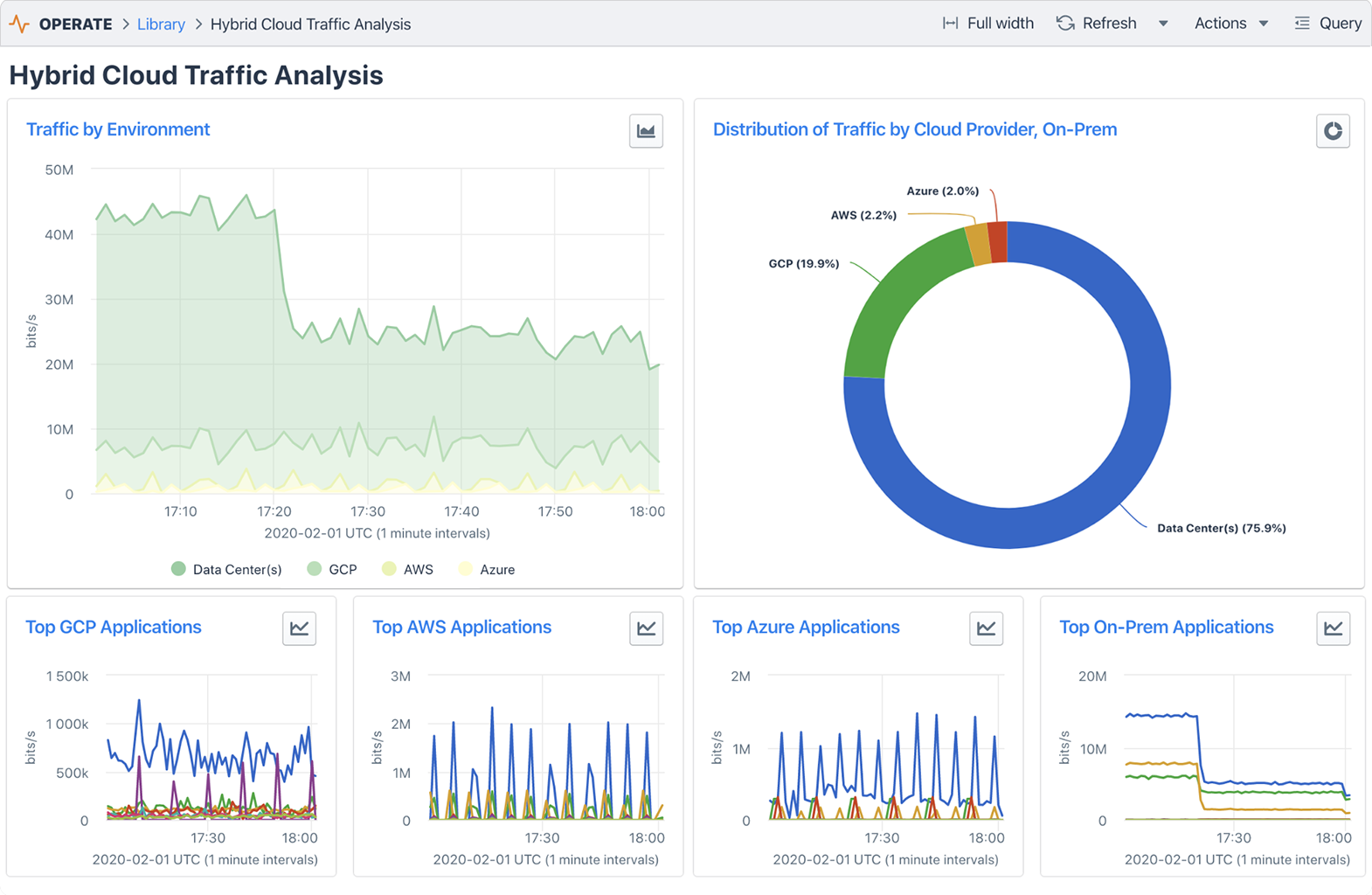
The company’s platform allows enterprises to monitor their networks, no matter whether that’s over the Internet, inside their own data centers or in public clouds.

“The world has become even more internet-centric, and we are seeing growth in traffic levels, product engagement, and revenue across both our enterprise and service provider customers,” said Avi Freedman, the co-founder and CEO of Kentik when I asked him why he was raising a round now. “We’ve seen an increased pace of adoption of the kind of hybrid and internet-centric architectures that Kentik is built for and thought it was a great time to increase investment, especially in product, as well as go-to-market and partner expansion to support market demand.”

Freedman says the company has been growing 100% compounded year-over-year since it launched in 2015 and now has customers in 25 countries. These include leading enterprises, SaaS companies, content providers, gaming companies, content providers, and cloud and communication service providers, he tells me. Current customers include the likes of IBM, Zoom, Dropbox, eBay, Cisco and GoDaddy.

The company says it will use the new funding to invest in its product and for go-to-market investments.

One notable fact about this new round is that it is a combination of equity and growth debt. Why growth debt? “Growth debt is an attractive option for startups with the right scale and strong unit economics, especially with the changes to capital markets in response to current economic conditions,” said Freedman. “Another element that makes long-term debt attractive is that unlike equity financing, long-term debt limits dilution for everyone, but especially benefits our employees who hold common stock.” That, it’s worth noting, is also something that lead investor Vistara Capital has made one of the core tenants of its investment philosophy. “Since Kentik is now at a scale where we have enough data on the business fundamentals to be able to make growth investments using debt while still being able to repay it over time, it made sense to us and our investors,” noted Freedman.

27 May 2020

ICE used ‘stingray’ cell phone snooping tech hundreds of times since 2017

Newly released documents show U.S. immigration authorities have used a secretive cell phone snooping technology hundreds of times across the U.S. in the past three years.

The documents, obtained through a public records lawsuit by the American Civil Liberties Union and seen by TechCrunch, show that U.S. Immigration and Customs Enforcement (ICE) deployed cell site simulators — known as stingrays — at least 466 times between 2017 and 2019, which led to dozens of arrests and apprehensions. Previously obtained figures showed ICE used stingrays over 1,885 times over a four year period between 2013 and 2017.

The documents say that stingrays were not deployed for civil immigration investigations, like removals or deportations.

Although the numbers offer a rare insight into how often ICE uses this secretive and controversial technology, the documents don’t say how many Americans also had their phones inadvertently ensnared by these surveillance devices.

“We are all harmed by government practices that violate the Constitution and undermine civil liberties,” said Alexia Ramirez, a fellow with the ACLU’s Speech, Privacy, and Technology Project. “ICE’s use of cell site simulators affects all people, regardless of their immigration status.”

“When cell site simulators search for an individual, they necessarily also sweep in sensitive, private information about innocent bystanders,” said Ramirez. “This is part of the reason courts have said there are serious Fourth Amendment concerns with this technology.”

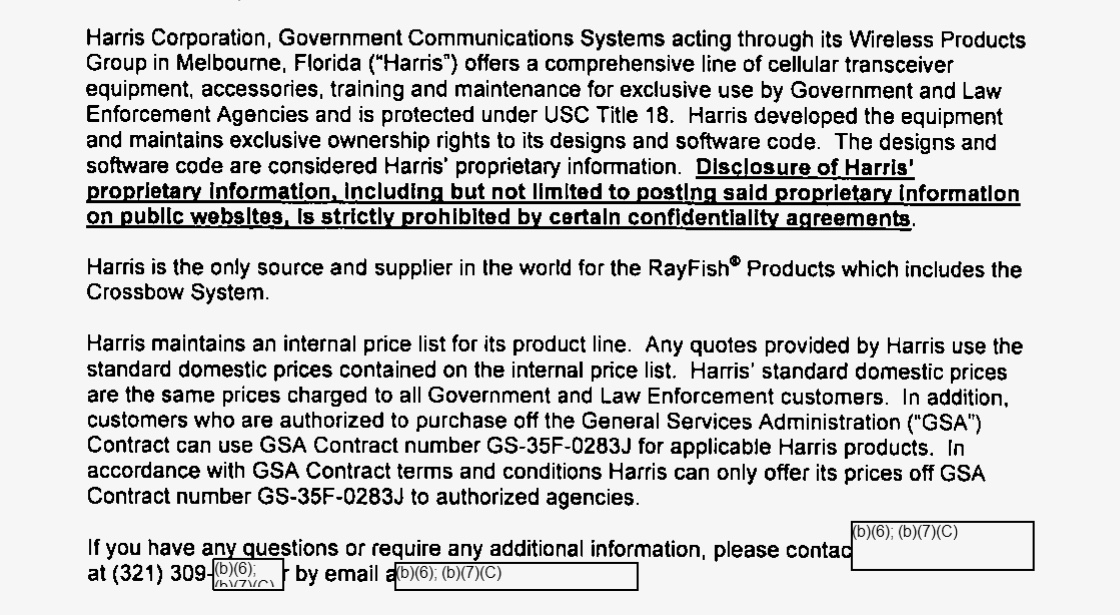
A letter from Harris Corp., which builds cell-site simulators — known as “stingrays,” describing the non-disclosure terms for its Crossbow cell site simulator. (Source: ACLU)

Stingrays impersonate cell towers and capture the calls, messages, location and in some cases data of every cell phone in their range. Developed by Harris Corp., stingrays are sold exclusively to law enforcement. But their purchase and use are covered under strict non-disclosure agreements that prevent police from discussing how the technology works. These agreements are notoriously prohibitive; prosecutors have dropped court cases rather than disclose details about the stingrays.

The newly released documents are heavily redacted documents and offer little more about what we know of how stingrays work. One document did, however, reveal for the first time the existence of Harris’ most recent stingray, Crossbow. An email from 2012 refers to Crossbow as the “latest, most technologically up-to-date version of a Stingray system.”

But the civil liberties group said its public records lawsuit is not over. Customs and Border Protection (CBP) has not yet turned over any documents sought by the ACLU, despite spending $2.5 million on buying at least 33 stingrays, according to a 2016 congressional oversight report.

“We are deeply skeptical of CBP’s assertion that they do not possess records about cell site simulators,” said Ramirez. “Given public information, the agency’s claim just doesn’t pass the sniff test.”

CBP has until June 12 to respond to the ACLU’s latest motion.

When reached, a spokesperson for CBP was unable to comment by our deadline. ICE did not respond to a request for comment.