
Year: 2020

27 May 2020

Google expands tools to help businesses impacted by COVID-19

Google is rolling out a series of updates aimed at helping local businesses adapt to the COVID-19 pandemic while continuing to serve their customers across Google Maps and Search. Since the outbreak, Google has made it possible for businesses to communicate to customers things like their revised operating hours or temporary closures, among other things. Now, it’s adding and expanding a set of features that will allow businesses to support themselves, including those focused on gift card sales, fundraising or by marketing their virtual services. Restaurants will also be able to point to their preferred delivery partners, so customers can choose to order through the third-party the business recommends.

That latter item addresses what’s been a particularly sore point for restaurant owners amid the pandemic. Already, restaurants found food delivery apps’ large commission fees difficult to swallow. Now, these apps are profiting from the industry’s collapse as the pandemic rages on.
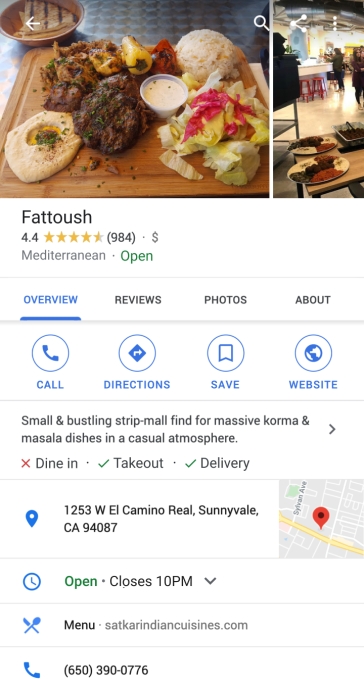
 

While Google’s update won’t allow restaurants to avoid these commissions, businesses will at least soon be able to communicate which delivery app they’d prefer customers to use — and it will likely be the one offering the lowest fee.

Google also says it has expanded the set of delivery partners it works with across the U.S., Germany, India, Australia and Canada. This makes it possible for Google Maps users to order delivery from more than 25,000 new restaurants and has already pushed users’ food order requests to over half a million per week.

In addition, Google is expanding a recently launched product that will allow businesses to sell gift cards to support themselves during government shutdowns and slower customer traffic after re-opening. Google says businesses were already promoting their gift card links on their profiles, in many cases.

Customers will be able to donate to favorite businesses directly from Google Search in more markets. To make this possible, Google partnered with PayPal and GoFundMe for businesses that opt in to use this feature.
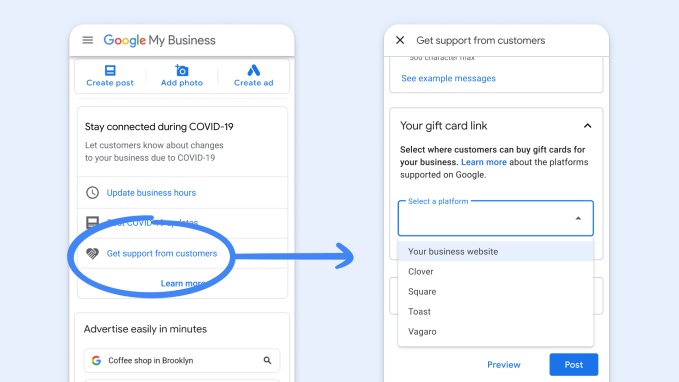
Google began by allowing merchants in six countries to add support links for donations and gift cards, including the U.S., Canada, United Kingdom, Ireland, Australia and New Zealand. Now 18 more countries will gain the feature, including Italy, Spain, Japan and others.

Merchants will be able to promote a link that directs users to purchase their gift cards either on their own business website or through supported partners like Square, Toast, Vagaro and Clover. This feature will roll out first with merchants in the U.S., Canada, U.K., Ireland, Australia and New Zealand before expanding to 18 more countries over the summer.

Another change aims to address the broader way the pandemic is impacting in-person businesses. Instead of shutting down entirely, many have chosen to pivot and go virtual. Restaurants have turned themselves into virtual kitchens, for example. Yoga studios have begun streaming classes online.

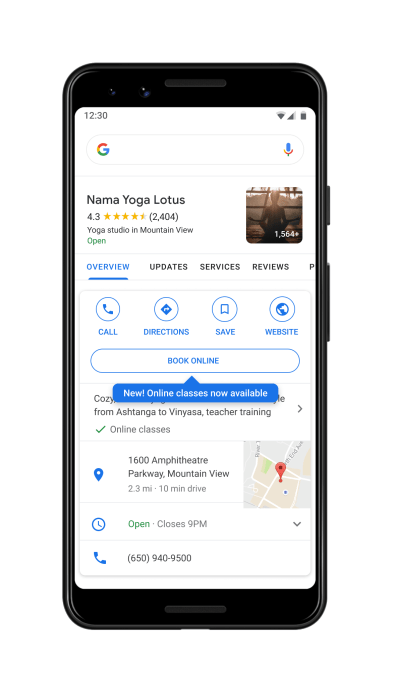
In the next few weeks, merchants who are verified through Google My Business will be able to alert their customers that they’re operating in a new capacity by adding to their profiles attributes like “online classes,” “online appointments” and “online estimates.” These will display in both Search and Maps, Google says.

Related to this, Google is expanding its Reserve with Google appointment-setting program to help merchants offer easy online appointment bookings that customers can book directly from a Business Profile, then add to their own Google Calendar. Today, Google’s program integrates with more than 100 partners for online bookings. It’s now adding Booksy, Regis, WellnessLiving and Zooty.Google’s ability to connect customers with local businesses has a sizable impact, especially in light of the coronavirus pandemic, which has resulted in a surge of new traffic across Google Maps and Search alike. 
For example, Google said it has seen a 260% increase in worldwide search interest in terms like “takeout near me” since February, before reaching an all-time high in April. Global search interest for the phrase “how to help small businesses” reached an all-time high in March 2020, up 700+% from what Google saw in February. And over a million businesses have shared COVID-19 posts on their profiles since March, resulting in millions of clicks to merchants’ websites every week.

Unfortunately, despite the rapid pace of the updates on Google’s part they still may have arrived too late for some businesses. Google saw more temporary and permanent business closures in March and April 2020 than it saw during all of 2019. Economists are now projecting that more than 100,000 small businesses in the U.S. have closed permanently since the pandemic escalated in March.

“The pace of change is really pretty staggering” said Jen Fitzpatrick, SVP, Google Maps.

It’s hard to quantify how much Google could have helped here had it moved even faster, but it’s worth noting that other sizable social networks, including Facebook, Yelp, Instagram and Nextdoor, have already rolled out new features focused on helping businesses sell their gift cards and/or link to fundraising efforts.

Google’s updates, meanwhile, are rolling out in the days, weeks and months ahead, depending on the feature in question and the merchant’s geographic location. By then, the businesses that have survived government lockdowns are those that likely found alternative ways to reach customers and fundraise without Google’s help.

Google knows how critical its tools are, at least.

“There’s a new survey that was recently conducted by the Connected Commerce Council, and what they heard was that nearly 1 in 3 small businesses say that without digital tools they would have had to close all or part of their business,” Fitzpatrick noted. “So digital is suddenly even more at the forefront in terms of how small businesses are looking to operate and help them survive.”


27 May 2020

LeverEdge wants to get you and your friends a volume discount on student loans

Student loans are both a trillion-dollar debt category and also one of the most popular mini-verticals out there in fintech startup investing right now. There are dozens if not hundreds of companies in the space, and they all mostly do one of two things: either they help students think through their student loan options before choosing one (acting as a financial advisor to avoid mistakes) or they help students after they finish school figure out how to optimize their repayments or acquire loan forgiveness.

And so when I heard the pitch for LeverEdge, I was intrigued, because it really doesn’t fit either bucket.

Rather than approaching each user individually and trying to optimize their own financial decision independently, LeverEdge proposes helping students band together as a group and negotiate reduced student loan rates by essentially acting as a collective bargaining unit with banks.

For founders Chris Abkarians and Nikhil Agarwal, the idea came as they were entering Harvard Business School.

The two connected with some other HBS students through online new admit groups on Facebook and came up with the idea of trying to work together to lower their interest rates. The annual cost of attendance at HBS is $111,102 right now (annually!), so multiplied by two for the two-year MBA and you are looking at potentially massive cost savings if you can lower your interest rate.

There was just one problem: banks loved the idea, but no one knew how to actually negotiate interest rates at individual branches. As Agarwal explained, “So after work we would try to leave at a reasonable time to get to the bank branch before it closes and then pitch the branch manager on this. They were super excited, but then they’d be like, well, I don’t know what to do with this, I can’t change interest rates for you.”

So Abkarians started sending cold emails to bank CEOs with the same proposition, and also got a positive response, but was told that he would need much more volume to make a negotiated deal worthwhile for banks. At the time, the two only had 50 to 70 people working together, but they spread the option around more heavily with their classmates and students at other business schools and eventually got to 700 students with $26 million in loan volume over the next 10 days.

With that scale, the two were able to negotiate a competitive rate with a bank that saved each student an average of $15,000 in fees over the full life of their loans according to their calculations.

They did all this entirely virtually too. Abkarians and Agarwal eventually met for the first time in person at Harvard in the fall, still with a whirl of excitement over what had transpired over the summer. They started asking for feedback from their users about the process, and Agarwal said:

The number one negative feedback we got was you closed the deal on July 26, [but] I couldn’t use it because my tuition due date was before that day. And then every other piece of feedback — even for this haphazardly run group — was incredibly amazing. And that really convinced us [… that] we owe it to our members and really the future generation of classes to make this a thing.

LeverEdge is taking that one-off experience and systemizing it for more students in more contexts. The startup, which was officially founded in May 2018, targets the private student loan market outside of federal programs typical for most undergrads. That loan market typically has higher (and sometimes dramatically higher) interest rates than traditional federal student loans, and lenders also has the flexibility to negotiate interest rates unlike with federal loans.

Today, LeverEdge has more than 15,000 students on its platform and has financed $100 million in student loans according to the startup. It also raised a $2.5 million seed round led by NFX along with Global Founders Capital and founders from fintech companies Earnest and SoFi.

The company spends most of the year aggregating students for the next school year, and then “we spend around two months in this auction process between different lenders,” Abkarians said. The company currently has nine employees, and “our staff is focused on partnership building,” he said.

The new version of a startup team photo. LeverEdge Team, photo via LeverEdge

As for business model, LeverEdge takes a pre-set referral fee from lenders upfront for each tranche of loans that they negotiate between students and the lender. That fee is “non-negotiable” according to Agarwal, and all lenders participating in the auction agree to pay it if they have the winning bid. The company varies the fee based on the loans that are grouped together (Agarwal said that, for example, refinance loans have a lower referral fee than other student loans). He believes this approach ensures that LeverEdge always has the right incentives to get the best prices for students.

Importantly, no student is obligated to take the final loan as negotiated by LeverEdge. But, if the company is doing its job, then the offered loan should be competitive with any alternative loan on the market. “We still encourage people to compare it against other things and if they find anything that is better than what we’ve found to please just let us know. No one has yet,“ said Abkarians.

The big question now is what will happen this coming school year given COVID-19. On one hand, students may avoid campuses knowing that schools are moving heavily toward virtual classes due to social distancing policies. On the other hand, economic recessions and greater concerns around costs may lead more students to seek out cheaper student financing options: exactly the customers that LeverEdge wants to find.

Overall, it’s an interesting play on the student loan space and one of the more interesting fintech startups I have seen in some time.

27 May 2020

Babylon Health leads a $30M Series B in US health kiosk operator, Higi

UK-based AI chatbot Babylon Health — which last year raised $550M at a $2BN+ valuation — has led a $30M Series B in US-based Higi, which owns and operates 10,000+ FDA-cleared health kiosks.

Higi, which was founded back in 2012 per Crunchbase, has built out a nationwide network of “health stations” located at retail locations such as groceries and pharmacies within 5 miles of 73% of the US population, where users can check their blood pressure, pulse, weight and BMI for free.

It also offers apps for users to track health measurements and input fitness data — giving it access to rich data streams that can inform healthcare workflows for its partners.

Its privacy policy notes that it may combine users personal data with other sources of their data it obtains, and may ‘anonymize and aggregate’ user data to use the health information for any purpose — illustrating why a data-hungry AI startup like Babylon sees valuable strategic potential in making an investment as it seeks to build out its own US business.

Higi says its kiosks have been used by 62M people in North America to date, conducting more than 372M biometric tests. Babylon’s investment in the company will go on supporting the expansion and “enhancement” of this network, including further development of digital capabilities, assessments and programs, the pair said today.

Babylon is not disclosing the size of its strategic investment in Higi’s Series B. Existing investors from the latter’s Series A also participated, including 7Wire Ventures, Flare Capital Partners, Jumpstart Capital, Rush University Medical Center for Health and William Wrigley Jr.

A spokeswoman for Babylon said it’s the first official US investment it has made but said it’s hopeful that “more strategic investments and partnerships” will follow to help extend its reach in the US.

“By offering a bundled care solution that combines Babylon’s symptom checking and remote digital health tools with Higi’s consumer reach and assessment capabilities, the companies will together be able to offer a more end-to-end solution to meet the needs of payers, providers and retailers on the front lines of care delivery,” the pair said in a press release.

“Higi’s Smart Health Stations are already located in thousands of towns across North America, and by integrating Babylon’s digital first healthcare services into Higi’s station experience, we can make the healthcare services that people need that much more accessible and affordable across North America,” said Babylon CEO and founder Dr Ali Parsa in a statement.

He goes on to talk up the tie-up as supporting “the everyday support of a person’s health and wellbeing” — claiming it places “greater emphasis on prevention and tackling issues earlier [by] helping millions of people proactively tend to their health and connect them to the information and medical support they need”.

“With Babylon as one of our investors and strategic partners, we are beautifully positioned to drive real change in the delivery of primary care across the U.S.,” added Higi CEO Jeff Bennett in another supporting statement. “Our commitment is to provide consumers, anywhere they might be in, with smart medical tools like unique diagnostics to support their health and wellbeing.

“Our partnership with Babylon broadens our clinical capabilities and ability to support consumers with acute medical problems or those with chronic conditions like hypertension, diabetes, and obesity, thereby allowing us to better meet the needs of payors, retailers and health systems. The U.S. healthcare system has many virtues, but it is simply too expensive and hard for consumers to access care. Together, we will get patients to the right care, faster and far less expensively.”

Babylon begun a push into the US market this year, launching officially on January 1. Currently it provides access to “healthcare services” via its app to members of certain health plans in Missouri, New York and California. Earlier this month, for example, it partnered with Mount Sinai Health Partners to offer an insurance-covered telehealth option for New Yorkers which includes video consultations with physicians.

Last month, Business Insider reported that Babylon had furloughed 5% of its staff in response to the coronavirus pandemic, tapping into a scheme which sees the UK government covering up to 80% of the pay of furloughed workers.

27 May 2020

Babylon Health leads a $30M Series B in US health kiosk operator, Higi

UK-based AI chatbot Babylon Health — which last year raised $550M at a $2BN+ valuation — has led a $30M Series B in US-based Higi, which owns and operates 10,000+ FDA-cleared health kiosks.

Higi, which was founded back in 2012 per Crunchbase, has built out a nationwide network of “health stations” located at retail locations such as groceries and pharmacies within 5 miles of 73% of the US population, where users can check their blood pressure, pulse, weight and BMI for free.

It also offers apps for users to track health measurements and input fitness data — giving it access to rich data streams that can inform healthcare workflows for its partners.

Its privacy policy notes that it may combine users personal data with other sources of their data it obtains, and may ‘anonymize and aggregate’ user data to use the health information for any purpose — illustrating why a data-hungry AI startup like Babylon sees valuable strategic potential in making an investment as it seeks to build out its own US business.

Higi says its kiosks have been used by 62M people in North America to date, conducting more than 372M biometric tests. Babylon’s investment in the company will go on supporting the expansion and “enhancement” of this network, including further development of digital capabilities, assessments and programs, the pair said today.

Babylon is not disclosing the size of its strategic investment in Higi’s Series B. Existing investors from the latter’s Series A also participated, including 7Wire Ventures, Flare Capital Partners, Jumpstart Capital, Rush University Medical Center for Health and William Wrigley Jr.

A spokeswoman for Babylon said it’s the first official US investment it has made but said it’s hopeful that “more strategic investments and partnerships” will follow to help extend its reach in the US.

“By offering a bundled care solution that combines Babylon’s symptom checking and remote digital health tools with Higi’s consumer reach and assessment capabilities, the companies will together be able to offer a more end-to-end solution to meet the needs of payers, providers and retailers on the front lines of care delivery,” the pair said in a press release.

“Higi’s Smart Health Stations are already located in thousands of towns across North America, and by integrating Babylon’s digital first healthcare services into Higi’s station experience, we can make the healthcare services that people need that much more accessible and affordable across North America,” said Babylon CEO and founder Dr Ali Parsa in a statement.

He goes on to talk up the tie-up as supporting “the everyday support of a person’s health and wellbeing” — claiming it places “greater emphasis on prevention and tackling issues earlier [by] helping millions of people proactively tend to their health and connect them to the information and medical support they need”.

“With Babylon as one of our investors and strategic partners, we are beautifully positioned to drive real change in the delivery of primary care across the U.S.,” added Higi CEO Jeff Bennett in another supporting statement. “Our commitment is to provide consumers, anywhere they might be in, with smart medical tools like unique diagnostics to support their health and wellbeing.

“Our partnership with Babylon broadens our clinical capabilities and ability to support consumers with acute medical problems or those with chronic conditions like hypertension, diabetes, and obesity, thereby allowing us to better meet the needs of payors, retailers and health systems. The U.S. healthcare system has many virtues, but it is simply too expensive and hard for consumers to access care. Together, we will get patients to the right care, faster and far less expensively.”

Babylon begun a push into the US market this year, launching officially on January 1. Currently it provides access to “healthcare services” via its app to members of certain health plans in Missouri, New York and California. Earlier this month, for example, it partnered with Mount Sinai Health Partners to offer an insurance-covered telehealth option for New Yorkers which includes video consultations with physicians.

Last month, Business Insider reported that Babylon had furloughed 5% of its staff in response to the coronavirus pandemic, tapping into a scheme which sees the UK government covering up to 80% of the pay of furloughed workers.

27 May 2020

Apple begins offering Macs with custom configurations in India

Apple is finally giving customers in India the ability to order customized versions of iMac, MacBook Air, Mac Mini and other Mac computers.

The Cupertino-giant has started to offer a full-range of the Mac portfolio with configure-to-order (CTO) or build-to-order (BTO) option in India, allowing customers in the country to request specific custom needs such as additional memory or storage when they purchase a computer.

Customers in India, a key overseas market for American technology giants, have long requested this feature, which Apple offers in several regions. Prior to this, Apple only offered select variants of its Mac computers in India and gave no option to customers to ask for specific upgrades.

Those interested can get in touch with their local Apple Authorized Reseller to discuss the various upgrade options, pricing information, and place the order. The options are also listed on Apple India website.

Apple is currently committing to deliver customized computers in four to five weeks from the time of order.

“This is a very huge deal,” said Mumbai-based Preshit Deorukhkar. “Previously, there was no real way to get a built-to-order or configure-to-order Mac in India. So you were stuck with the base models — say a Mac Mini or 13″ MacBook Pro with 8GB of RAM. Now that the company is officially offering this, you get the computer you want and the standard warranty on it.”

The new move comes as Apple prepares to launch its online store in India this year and open its first brick-and-mortar retail store next year, as chief executive Tim Cook revealed earlier this year.

The company is still on track to launch its online store in India this year despite the coronavirus outbreak, a person familiar with the matter told TechCrunch.

27 May 2020

Apple begins offering Macs with custom configurations in India

Apple is finally giving customers in India the ability to order customized versions of iMac, MacBook Air, Mac Mini and other Mac computers.

The Cupertino-giant has started to offer a full-range of the Mac portfolio with configure-to-order (CTO) or build-to-order (BTO) option in India, allowing customers in the country to request specific custom needs such as additional memory or storage when they purchase a computer.

Customers in India, a key overseas market for American technology giants, have long requested this feature, which Apple offers in several regions. Prior to this, Apple only offered select variants of its Mac computers in India and gave no option to customers to ask for specific upgrades.

Those interested can get in touch with their local Apple Authorized Reseller to discuss the various upgrade options, pricing information, and place the order. The options are also listed on Apple India website.

Apple is currently committing to deliver customized computers in four to five weeks from the time of order.

“This is a very huge deal,” said Mumbai-based Preshit Deorukhkar. “Previously, there was no real way to get a built-to-order or configure-to-order Mac in India. So you were stuck with the base models — say a Mac Mini or 13″ MacBook Pro with 8GB of RAM. Now that the company is officially offering this, you get the computer you want and the standard warranty on it.”

The new move comes as Apple prepares to launch its online store in India this year and open its first brick-and-mortar retail store next year, as chief executive Tim Cook revealed earlier this year.

The company is still on track to launch its online store in India this year despite the coronavirus outbreak, a person familiar with the matter told TechCrunch.

27 May 2020

Virgin Orbit provides more details about what went right with its first launch demo

Virgin Orbit performed a demonstration of its full launch system on Monday, and while it didn’t go quite as planned, with the mission cut short just a few seconds after Virgin’s LauncherOne separated from its Cosmic Girl carrier aircraft, the company says it still learned a lot – and a lot went right, too.

Spaceflight is tough stuff, and it’s actually pretty common for a new spacecraft to not quite get everything right on its first time out. SpaceX took four tries with its original Falcon 1 rocket to make it to space, for instance. Test flights are tests for a reason, and Virgin Orbit notes that it actually did ace a lot of the aspects of the test, including launch vehicle release, the controlled drop after that release point, igniting the rocket on LauncherOne and even the first couple of seconds of powered flight after that – all of which it says proves out the viability of its launch model.

Virgin also says it was able to collect good data from “hundreds of channels and sensors” during the launch, which is another reason why companies test systems to begin with. That was the main purpose of Monday’s launch, and that should help them go back to work on ensuring that the part of the mission that didn’t go so well doesn’t happen again. So far, Virgin Orbit knows that around 9 seconds into its flight, the booster engine on LauncherOne extinguished due to a malfunction, causing the rocket to fall harmlessly into the ocean. They don’t yet know the cause of that malfunction, but say they are “confident” that they have enough data to eventually figure out the cause.

Meanwhile, Virgin Orbit says that this test did prove a number of important things about its approach to launching spacecraft. First, that its mobile, flexible ground operating system that can launch outside of U.S. federal ranges works as designed. Second, that its autonomous flight safety system works as designed to protect the safety of the general public. Also, this is the first time that CosmicGirl and LauncherOne have flown with liquid oxygen fuel on board, so this is a verification that its fuel containment system works. And, as mentioned, the LauncherOne release and initial flight matched simulations perfectly, so Virgin Orbit knows that part of the system is well-designed.

There’s still a lot of work to be done before the company can make a second orbital launch attempt, but luckily it already has a robust rocket-building pipeline in place. Virgin Orbit isn’t yet saying when exactly we can expect a second launch test to occur, and I wouldn’t expect it to before it determines the root cause of the malfunction it encountered, but it might not take as long as you think.

27 May 2020

SpaceX’s first astronaut launch is scrubbed due to weather – next attempt set for Saturday

UPDATE: SpaceX and NASA made the call to scrub the launch today since there were a couple of weather issues that prevented the attempt from taking place. The next window for the launch is Saturday, May 30 at 3:22 PM EDT (12:22 PM PDT).

SpaceX is set to mark a huge milestone in its own company history, with a first-ever crewed spaceflight set to take off from Cape Canaveral in Florida later today. The mission is Commercial Crew Demo-2, the culmination of its Crew Dragon human spacecraft development program, which will carry NASA astronauts Doug Hurley and Bob Behnken to the International Space Station.

The launch is currently set to take off from Kennedy Space Center at 4:33 p.m. EDT (1:33 p.m. PDT), though that’ll depend on weather conditions. Those haven’t been looking too favorable over the past few days, but SpaceX and NASA have said they could make the call as late as around 45 minutes prior to the planned launch time about whether to delay. If today’s attempt is scrubbed, there are backup opportunities on the schedule for May 30 and May 31.

This will be the first-ever crewed spaceflight for SpaceX, and it will also make history as the first U.S.-based human rocket launch since the end of the Space Shuttle program in 2011. NASA undertook the Commercial Crew program in 2010 to seek public-private partnerships to return its launch capabilities, eventually selecting both SpaceX and Boeing to design and develop spacecraft rated for human flight. SpaceX is the first from this program to make a crewed launch attempt.

The Demo-2 mission is essentially the final test phase of Crew Dragon, after which it and Falcon 9, the rocket that carries it to orbit, will be certified for regular operational use by NASA. That means it will begin offering regular transportation services for astronaut crew to and from the International Space Station, joining Russia’s Soyuz as a means to travel to the orbital science platform.

Meanwhile, SpaceX has already begun plans to also offer berths on Crew Dragon to private citizens and potentially commercial scientists and other passengers. That’s part of the reason behind the Commercial Crew program to begin with – NASA was seeking to lower the cost of transportation for its astronauts to space by making seats available to other paying customers to offset launch and flight expenses.

27 May 2020

Voi hires former Bird UK chief to bring e-scooters to British streets

With the U.K. government set to accelerate trials of e-scooter rentals in a bid to reduce crowding on public transport and support social distancing during the coronavirus crisis, Europe’s e-scooter companies are gearing up to be ready.

The latest move sees Sweden-headquartered Voi Technology recruit Richard Corbett to head up its U.K., Ireland and Benelux operations. Corbett joins from rival Bird, where he spent two years as the U.S. company’s U.K. and Ireland chief, as well as helping to launch e-scooter rentals in Netherlands.

This side of the pond, Corbett was best known for launching e-scooters on private land at Queen Elizabeth Park in East London, which was a major site for the London 2012 Summer Olympics. It has since become home to a ‘tech hub’, housing a number of tech and media-focused businesses and related organisations, along with co-working spaces, a large conference space, and various Olympic-standard sports facilities.

“Richard Corbett joins Voi immediately as head of the Swedish company’s UK, Ireland and Benelux operations, as the UK government prepares to change the law to finally allow e-scooters to be ridden on roads and cyclepaths,” explains Voi, adding that he’ll be responsible for leading Voi’s push into the UK, where it expects to see at least 50,000 rides per day by the end of 2020 in London.

Explains Fredrik Hjelm, CEO and co-founder of Voi Technology, in a statement: “Out of this terrible pandemic, there is an opportunity to reinvent the way that we travel around cities so that we can cut congestion and pollution for good. Now more than ever a collaborative approach to mobility is needed and we need to make sure that there are good non-polluting options available, that suit all abilities and pockets. There is a huge unmet demand for e-scooters in U.K. towns and cities and Voi will work closely with local authorities and other transport operators to provide new mobility choices”.

Out of genuine curiosity, I asked Corbett what he has been doing over the last two years, considering how limited Bird’s U.K. launch was.

“The Olympic Park was the UK’s very first ‘e-scooter showroom’, where stakeholders across no. 10, DfT, DEFRA, DHSC, cities, transport authorities and transport groups could test ride an e-scooter and develop an informed opinion about this new mode of transport,” he told me. “This trial was essential to get us to where we are today”.

To that end, one of Corbett’s first tasks is to continue building out the U.K. team, and working closely with U.K. local authorities and transport operators to bring e-scooter rentals to the U.K. cities that could benefit most.

“I’m really proud to have been part of the team who led the conversations to make e-scooters a priority and I firmly believe that they will be a solution to the U.K.’s pollution and transport issues, not just a fun way to get around,” he says. “I’m also really excited to be getting back to this campaign and in particular with Voi, which is a European company which really understands how people move around older cities like London. We share the same values and are passionate about creating better cities for people to live in.”

Meanwhile, it has been a challenging time for Voi, along with other e-scooter rental companies, including Lime, Bird, Tier and others, as many countries entered lockdown and demand for scooter rides plummeted. This forced Voi to pause operations in the majority of cities it operates in, with only a handful of its largest cities being serviced.

Since then, lockdowns across Europe have started to lift, and Voi says it has been putting more e-scooters back on the streets of various European cities, including in France and Germany. Throughout the pandemic, it also maintained service in key cities in Sweden, Norway and Denmark, in part to help key workers get around and to assist charities supporting people during the on-going crisis.

27 May 2020

Coinbase to acquire Tagomi to improve institutional trading offering

Cryptocurrency exchange company Coinbase has announced plans to acquire Tagomi, an advanced cryptocurrency brokerage platform specifically targeted at professionals and institutional investors. Terms of the deal are undisclosed and the acquisition is still pending regulatory approval.

While Coinbase is a well-known name for retail investors who are just getting started in the cryptocurrency space and want to buy some bitcoins, the company has been ramping up its offering for professional investors.

The main Coinbase.com interface remains relatively simple to understand, but the company is adding more features to Coinbase Pro, its exchange platform for professionals and crypto enthusiasts. You can access more complicated orders on Coinbase Pro, such as margin trading.

A couple of years ago, Coinbase also added another tier with Coinbase Prime. In addition to market data and trading strategies, the company wants to add more features for institutional investors, such as algorithmic trading, API and third-party platform support. According to the site, those features “will be rolled out over the coming months.”

Tagomi will expand the offering for those institutional investors. Eventually, Coinbase wants to provide an experience that works more or less like Wall Street-level trading experience in equities and FX markets. In particular, Tagomi lets you access 14 different exchanges from your Tagomi account, which greatly improves the liquidity of your orders.

Coinbase also runs Coinbase Custody, a service that helps you store large amounts of cryptocurrencies with segregated cold storage, insurance, staking and regulation from the New York Department of Financial Services. You can access an over-the-counter trading desk from Coinbase Custody as well.

Tagomi has attracted well-known clients, such as Paradigm, Pantera, Bitwise and Muticoin. The startup had raised $28 million from Founders Fund, Collaborative Fund, Elad Gil, Digital Currency Group and others.