Year: 2020

26 May 2020

Daniel Abt fired from Audi’s Formula E team for using pro sim driver in virtual race

Audi fired Daniel Abt from its Formula E racing team after learning he had a professional sim driver race for him during a virtual competition called the “Race at Home Challenge” held over the weekend.

The automaker said in a statement via Formula E that Abt had been suspended from Audi Sport “with immediate effect.” However, it appears the consequences are more serious and final. Abt said in a video message published Tuesday on YouTube that Audi had dropped him from the team.

“Today I was informed in a conversation with Audi that our ways will split from now on,” Abt said, according to a translation of the video message. “We won’t be racing together in Formula E anymore and the cooperation has ended. It is a pain which I have never felt in this way in my life.”

The 14-minute video was meant to explain the incident that occurred May 23 during the virtual competition, Abt said. He claims that it was all meant as a joke, which he intended to publicize after the race.

Abt tapped 18-year-old pro sim driver Lorenz Hoerzing to take his spot in the fifth round of Formula E’s online sim racing series. Unlike the real Formula E race series, this was meant to entertain fans and raise funds for UNICEF.

Hoerzing came in third in the race. Questions were raised almost immediately following the virtual event when Abt didn’t appear on the post-race interview.

Abt explained, via translation of the video, the plan.

“We had a conversation and the idea came up that it would be a funny move if a Sim racer basically drove for me, to show the other, real drivers, what he is capable of and use the chance to drive against them,” Abt said. “We wanted to document it and create a funny story for the fans with it.”

Abt later added that it was never his intention to “get a result and keep quiet about it later on just to make me look better.”

Abt has also been fined €10,000, which will be sent to the charity.

You can watch the entire statement here.

26 May 2020

Twitter adds a warning label fact-checking Trump’s false voting claims

On the heels of a furor over his tweets accusing MSNBC host Joe Scarborough of murder, Twitter has quietly begun to fact-check the president.

A new warning label encouraging Twitter users to “Get the facts about mail-in ballots” appeared on a series of tweets in which the president baselessly claimed ballots received through mail-in voting methods are “fraudulent.”

In a statement to TechCrunch, a Twitter spokesperson said the pair of tweets from the president “contain potentially misleading information about voting processes and have been labeled to provide additional context around mail-in ballots.”

“This decision is in line with the approach we shared earlier this month,” the spokesperson said, linking to the company’s recent blog post on its misinformation policies.

Trump has railed against vote-by-mail efforts in recent weeks, in spite of the consensus view by experts that voting through the mail is a safe process—so safe that it’s already widely used for absentee ballots and relied upon in five states that use mail-in ballots as their primary method for voting.

Clicking through the new prompt from Twitter brings users to a fact-checking page highlighting a CNN story debunking the president’s false claims. The page also offers a summary with bullet points providing useful context for the misleading tweets, including the fact that vote-by-mail is already widely in use around the country.

26 May 2020

YouTube says that an error caused comments critical of China’s government to auto-delete

YouTube responded to reports that it is automatically deleting comments criticizing the Chinese government on Tuesday, explaining that the seeming censorship is actually an error in its automated moderation systems.

As the Verge reported, comments on the platform using the Chinese phrases for “communist bandit” or “50-cent party“—two terms tied to criticisms of the Chinese Communist Party were taken down almost instantly, even if those comments were positive. The latter term (五毛 or “wumao dang) refers to China’s censorship efforts, particularly the idea that online commenters are paid to deflect criticism for the government.

Oculus and Anduril founder Palmer Luckey drew attention to the phenomenon on Monday.

In a statement, a YouTube spokesperson told TechCrunch that the auto-deletions were a result of “an error in our enforcement systems” that the company is looking into.

“Users can report suspected issues to troubleshoot errors and help us make product improvements,” the spokesperson said.

According to YouTube, the situation is an accidental side effect of the platform’s comment moderation system, which is designed to filter out hate speech, harassment and spam. The company didn’t offer further insight as to how the terms wound up flagged by its automated systems.

With the vast majority of their workforces out of the office, major tech platforms have leaned more heavily on AI moderation methods in recent months, even as they acknowledged that less human oversight would likely lead to more instances of content mistakenly being taken down.

26 May 2020

A few late additions to the $100M ARR club, and what we might call it

The $100 million ARR club is a collection of private companies that have reached the revenue threshold. Originally, I posited the idea as a way to reclaim what the unicorn moniker once signified, a rare company that was of exceptional value.

As the unicorn club has grown to hundreds and hundreds of members, the tag has lost nearly all of its cachet. Not every unicorn has $100 million in revenue, let alone annual recurring revenue. And even more, not every company that is generating top line at a pace of $100 million each year is a unicorn.

By focusing more on revenue (ARR being the popular modern measurement), we’ve limited ourselves to far fewer companies to care about.

Catching you up, our current list of private companies that are at $100 million ARR or greater include GitLab, Egnyte, Asana, WalkMe, Druva, Braze, and O’Reilly. Today we can add a few more names to the mix.

In response to our prior work, Sisense noted that it passed the $100 million ARR mark earlier this year. Then there’s the case of Lemonade which we need to explore more at a later date (I’m looking into the larger insurtech market, especially as it relates to the financial performance of companies like Lemonade, Root Insurance, and MetroMile). Lemonade mostly fits our criteria, but if we want to count premiums as ARR is still something I’m working on.

But more important for us today is what to call these $100 million ARR companies? There have been a few suggestions.

Club names

The most common names proffered for members of the $100 million ARR club are

26 May 2020

A few late additions to the $100M ARR club, and what we might call it

The $100 million ARR club is a collection of private companies that have reached the revenue threshold. Originally, I posited the idea as a way to reclaim what the unicorn moniker once signified, a rare company that was of exceptional value.

As the unicorn club has grown to hundreds and hundreds of members, the tag has lost nearly all of its cachet. Not every unicorn has $100 million in revenue, let alone annual recurring revenue. And even more, not every company that is generating top line at a pace of $100 million each year is a unicorn.

By focusing more on revenue (ARR being the popular modern measurement), we’ve limited ourselves to far fewer companies to care about.

Catching you up, our current list of private companies that are at $100 million ARR or greater include GitLab, Egnyte, Asana, WalkMe, Druva, Braze, and O’Reilly. Today we can add a few more names to the mix.

In response to our prior work, Sisense noted that it passed the $100 million ARR mark earlier this year. Then there’s the case of Lemonade which we need to explore more at a later date (I’m looking into the larger insurtech market, especially as it relates to the financial performance of companies like Lemonade, Root Insurance, and MetroMile). Lemonade mostly fits our criteria, but if we want to count premiums as ARR is still something I’m working on.

But more important for us today is what to call these $100 million ARR companies? There have been a few suggestions.

Club names

The most common names proffered for members of the $100 million ARR club are

26 May 2020

What should startup founders know before negotiating with corporate VCs?

Corporate venture capitalists (CVCs) are booming in the startup space as large companies look to take advantage of the fast-paced innovation and original thinking that entrepreneurs offer.

For startups, taking funding from CVCs can come with many benefits, including new opportunities for marketing, partnerships and sales channels. Still, no founder should consider a corporate investor “just another VC.” CVCs come with their own set of priorities, strategic objectives and rules.

When it comes to choosing a CVC with which to enter negotiations, the most important step is doing your own diligence beforehand. An entrepreneur’s goal is to find the perfect match to partner with and guide you as you grow your business. So before you start discussing terms, you’ll want to understand what’s driving the CVC’s interest in venture investing.

While traditional VCs are purely financially driven, CVCs can be in the venture game for a variety of reasons, including finding new technology that might generate marketplace demand for their products. An example is Amazon’s Alexa fund, which invested into emerging companies that drive use and adoption of Alexa. Alternatively, a CVC’s parent company may be looking to invest in tech that will help them operate their own products more efficiently, such as Comcast Ventures investing in DocuSign.

As a rule of thumb, the bigger CVC funds like GV and Comcast tend to be financially driven, meaning they’ll be approaching negotiations through a financial lens. As such, the negotiating process more closely resembles an institutional fund. You as a founder have to do the work to figure out what’s driving your CVC — is this a customer acquisition or distribution opportunity? Or are they seeking to find a source of knowledge transfer and/or bring new tech into their parent company?

“Before negotiating, always look at a CVC’s existing portfolio,” says Rick Prostko, managing director at Comcast Ventures. “Have they made a lot of investments, at what stage, and with whom? From this information you’ll see the strategic thinking of the CVC, and you can determine how best to position yourself when you begin negotiations.”

26 May 2020

What should startup founders know before negotiating with corporate VCs?

Corporate venture capitalists (CVCs) are booming in the startup space as large companies look to take advantage of the fast-paced innovation and original thinking that entrepreneurs offer.

For startups, taking funding from CVCs can come with many benefits, including new opportunities for marketing, partnerships and sales channels. Still, no founder should consider a corporate investor “just another VC.” CVCs come with their own set of priorities, strategic objectives and rules.

When it comes to choosing a CVC with which to enter negotiations, the most important step is doing your own diligence beforehand. An entrepreneur’s goal is to find the perfect match to partner with and guide you as you grow your business. So before you start discussing terms, you’ll want to understand what’s driving the CVC’s interest in venture investing.

While traditional VCs are purely financially driven, CVCs can be in the venture game for a variety of reasons, including finding new technology that might generate marketplace demand for their products. An example is Amazon’s Alexa fund, which invested into emerging companies that drive use and adoption of Alexa. Alternatively, a CVC’s parent company may be looking to invest in tech that will help them operate their own products more efficiently, such as Comcast Ventures investing in DocuSign.

As a rule of thumb, the bigger CVC funds like GV and Comcast tend to be financially driven, meaning they’ll be approaching negotiations through a financial lens. As such, the negotiating process more closely resembles an institutional fund. You as a founder have to do the work to figure out what’s driving your CVC — is this a customer acquisition or distribution opportunity? Or are they seeking to find a source of knowledge transfer and/or bring new tech into their parent company?

“Before negotiating, always look at a CVC’s existing portfolio,” says Rick Prostko, managing director at Comcast Ventures. “Have they made a lot of investments, at what stage, and with whom? From this information you’ll see the strategic thinking of the CVC, and you can determine how best to position yourself when you begin negotiations.”

26 May 2020

How to approach (and work with) the 3 types of corporate VCs

Corporate venture capital (CVC) is booming, with more than $50 billion of CVC capital deployed in 2018. The rise in capital expenditures by CVCs between 2013 and 2018 was an impressive 400%, according to Corporate Venturing Research Data. There are currently more than a hundred active CVC investors, and some sources suggest that almost half of all venture rounds include a strategic investor.

This rise has been driven by two factors: 1) the tech landscape is moving at a faster pace and bigger companies know they need to innovate quicker to meet market demand; and 2) the number of startups seeking CVC capital is growing as founders look beyond traditional venture funds to help grow their businesses.

Kruze Consulting and Goodwin have worked with hundreds of startups through the funding process, including those working with CVCs. Together, the two firms and their principals have decades of experience advising founders during and after their capital raises.

To help startups navigate CVC transactions, we’ve created a guide to working with CVCs. In this segment, we’ll discuss the types of CVCs, the best way to approach each type and the key things to keep in mind during initial discussions.

The three types of corporate VCs

Roughly put, CVCs fall into three categories:
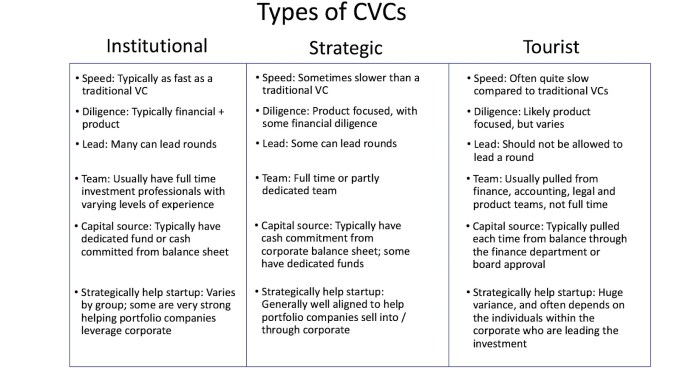
  1. The corporate version of an institutional venture platform, meaning that they look to leverage their parent company’s strategic assets with the goal of scaling their portfolio and driving real revenue. As Grant Allen, general partner at SE Ventures, the CVC arm of Schneider Electric, says, “this type of CVC looks just like a pure financial VC, except with a big company behind them, and the ability to open up real channel revenue.”
  2. Strategically-minded CVCs are not driven exclusively by returns, but also value innovation. These CVCs are looking for outsourced ways to stay on the leading edge and to learn about new technology that might benefit their parent corporation. This category likely still cares about returns, but their view on ROI is more nuanced than a traditional investor.
  3. So-called “tourists” often are made up of brand new and relatively inexperienced venture arms of companies that have done very few deals and haven’t had time to develop a strong process or dealflow strategy.

As the realm of CVCs becomes increasingly professionalized, more and more CVCs fall into the first category. For entrepreneurs seeking CVC investors, those in the institutional or strategic category can provide tremendous value — though it’s important that a startup know which type of CVC they’re speaking to, and have clear objectives going in that align with the CVC’s goals and strengths.

Determining which type of CVC you’re dealing with

Before engaging with a CVC, or any potential investor for that matter, the most important step is to do your research. Who is the individual you’re meeting with? What’s his/her background and what deals has he/she done with this venture group? These are Must Knows before walking into the initial meeting.

Once you’re in early discussions, ask the CVC whether he or she has carry in the fund and whether the venture arm is autonomous. The answers to these questions will help you clarify whether you’re dealing with institutional versus strategic CVCs.

“With corporate-backed venture funds, it’s really key up front to know who you’re talking to,” says Allen. “It’s dangerous to call all groups that are nontraditional investors ‘CVCs’ since some are far more serious than others. Most have some degree of strategic mandate but many are increasingly investing for financial gain.”

The next question is: Are you dealing with a financially driven CVC or a strategically driven one? From a founder’s standpoint, you’ll need to know whether you’re meeting with an investor who views deals through the lens of, “I’m looking for a great team, huge market and a chance to bring in funding and connections to make a business as strong as it can be” or, “I’m looking for a solution/product/platform that I can bring into my company or use to expose my company to a brand new marketplace or technology.”

Once again, the way to determine which type of CVC you’re dealing with is to ask the right questions. In the first meeting, ask about their investment process, how investments are made and whether strategic business unit sponsorship is required for a given deal. The answers will tell you whether the CVC falls into Group 1 or 2, and you’ll be in a strong position to then make choices about whether this potential investor is right for you.

“Look for someone who will understand your business, meet with you and decide that there’s something beyond just capital that will form the basis for that relationship,” says Rick Prostko, managing director at Comcast Ventures. “In today’s venture market, founders want money AND value. Seek out a CVC who has valuable experience to provide, and look for someone who’s been an operator in this segment previously or who has valuable insight and experience to offer.”

What you need to know before you engage with a CVC

Once you’ve done your initial diligence, developed a relationship and determined that a CVC could be a strong investor in your business, there are important factors to be aware of as you move into the next stage of discussions. These include:

Expect deeper product and technical diligence. CVCs can call on technical, product and market experts within their corporation during the due diligence process. As such, their level of product diligence is typically more rigorous than traditional VCs. Be prepared for some grilling by subject matter experts. On the flip side, this diligence process provides you with exposure to potential customers and partners inside the corporation, so use this time to your advantage.

Be aware that you’re going to share confidential information with a large company. “CVCs know that you’re only as good as your reputation,” says Eric Budin, director at Touchdown Ventures . “As such, there are very few examples of CVCs abusing confidential information, because news of it would get around so quickly.”

Still, for a founder, the goal is to be thoughtful and strategic with what you share, and to determine whether the CVC is truly interested in doing a deal before you hand over financial, technical and competitive information. It’s possible that commercial teams at the CVC sponsor could gain unfair advantage from seeing your information, or use their CVC to gain valuable intel on the competition.

On the other hand, sharing your intel could be a fantastic way to get in front of an internal team at the parent company. The key is to think carefully about what you are being asked to share and with whom, and set ground rules with the CVC before they begin diligence.

“It’s important to understand how the corporate fund is structured and how they handle any information that’s shared,” says Prostko. “It might be in your interest to loop in a business unit [within the parent company] that could benefit from learning about your business. On the flip side, if the CVC is a potential competitor, you’ll want to be more careful about what you reveal.”

There will be a risk of regime change. Large companies operate like, well, large companies. People leave, management changes happen and priorities shift. At the outset, ask questions such as: Who will support your company if the commercial manager leading your investment leaves? What will happen to the CVC if the person leading the venture arm is fired? Will they do their pro-rata if the person leading your deal is gone? What happens to any commercial relationships that you might be working on? It’s important to have a keen understanding of internal dynamics before you enter the relationship.

“In general, the more successful a firm is, the more likely the CVC will stick around,” says Allen. “Be sure to look at the individual’s history at the firm, how long he or she has been there, and whether he or she has jumped from fund to fund. If the investing partner has come out of the corporate ‘mother ship,’ and lacks any credible venture experience, buyer beware.”

The CVC may be subject to regulatory rules. Depending on the industry, government regulations may impact how your deal is structured. Banks, for example, are subject to rules that can restrict the percentage of voting stock they can own. Foreign investors may need to comply with CFIUS regulations if your company provides certain specified technologies. Generally, the CVCs will understand the regulations that apply to them. They may not, however, bring them up until late in the process, which could lead to delays.

Commercial transactions with the corporate arm can slow things down. Purely strategic CVCs (Group 2) often require a commercial transaction to happen in connection with a venture deal. The process involved in these transactions often takes longer than the financing process, which can cause issues if the CVC is a key (but not sole) investor in the round. If you’re dealing with a Group 2 CVC, discuss this issue ahead of time to see if you can decouple the two transactions and close the investment prior to inking the commercial deal.

The best way to think about CVC investment

CVCs offer a wealth of capital, human resources and corporate partnerships for startups. But whether you choose to take CVC capital or not, you can benefit from merely approaching CVCs if you have business units operating in either the same space or a tangential space. An initial meeting both gives you an opportunity to do a sales pitch and offers the CVC a chance to vet a product or team and gain some deal insight. For founders, you gain a powerful sales opportunity that might have otherwise taken months or years to obtain.

“Even if you’re told ‘no’ by a CVC, the meeting could result in a good business relationship that could turn into a sales opportunity for you in the near future,” says Prostko.

The WRONG way to think about approaching CVC investors is something along the lines of, “I can’t raise what I want from financial VCs so I’ll go to CVCs as my second choice, since they’re more likely to say ‘yes’ and/or give me better terms.” This attitude will shut doors and cut you off from valuable partners, capital and opportunities to strategically grow your business.

Above all, stay informed as you choose whom to bring in as a partner. Ultimately, it’s your business and the responsibility to ensure that you bring in the right capital partners lies with you.


26 May 2020

How to approach (and work with) the 3 types of corporate VCs

Corporate venture capital (CVC) is booming, with more than $50 billion of CVC capital deployed in 2018. The rise in capital expenditures by CVCs between 2013 and 2018 was an impressive 400%, according to Corporate Venturing Research Data. There are currently more than a hundred active CVC investors, and some sources suggest that almost half of all venture rounds include a strategic investor.

This rise has been driven by two factors: 1) the tech landscape is moving at a faster pace and bigger companies know they need to innovate quicker to meet market demand; and 2) the number of startups seeking CVC capital is growing as founders look beyond traditional venture funds to help grow their businesses.

Kruze Consulting and Goodwin have worked with hundreds of startups through the funding process, including those working with CVCs. Together, the two firms and their principals have decades of experience advising founders during and after their capital raises.

To help startups navigate CVC transactions, we’ve created a guide to working with CVCs. In this segment, we’ll discuss the types of CVCs, the best way to approach each type and the key things to keep in mind during initial discussions.

The three types of corporate VCs

Roughly put, CVCs fall into three categories:

  1. The corporate version of an institutional venture platform, meaning that they look to leverage their parent company’s strategic assets with the goal of scaling their portfolio and driving real revenue. As Grant Allen, general partner at SE Ventures, the CVC arm of Schneider Electric, says, “this type of CVC looks just like a pure financial VC, except with a big company behind them, and the ability to open up real channel revenue.”
  2. Strategically-minded CVCs are not driven exclusively by returns, but also value innovation. These CVCs are looking for outsourced ways to stay on the leading edge and to learn about new technology that might benefit their parent corporation. This category likely still cares about returns, but their view on ROI is more nuanced than a traditional investor.
  3. So-called “tourists” often are made up of brand new and relatively inexperienced venture arms of companies that have done very few deals and haven’t had time to develop a strong process or dealflow strategy.

As the realm of CVCs becomes increasingly professionalized, more and more CVCs fall into the first category. For entrepreneurs seeking CVC investors, those in the institutional or strategic category can provide tremendous value — though it’s important that a startup know which type of CVC they’re speaking to, and have clear objectives going in that align with the CVC’s goals and strengths.

Determining which type of CVC you’re dealing with

Before engaging with a CVC, or any potential investor for that matter, the most important step is to do your research. Who is the individual you’re meeting with? What’s his/her background and what deals has he/she done with this venture group? These are Must Knows before walking into the initial meeting.

Once you’re in early discussions, ask the CVC whether he or she has carry in the fund and whether the venture arm is autonomous. The answers to these questions will help you clarify whether you’re dealing with institutional versus strategic CVCs.

“With corporate-backed venture funds, it’s really key up front to know who you’re talking to,” says Allen. “It’s dangerous to call all groups that are nontraditional investors ‘CVCs’ since some are far more serious than others. Most have some degree of strategic mandate but many are increasingly investing for financial gain.”

The next question is: Are you dealing with a financially driven CVC or a strategically driven one? From a founder’s standpoint, you’ll need to know whether you’re meeting with an investor who views deals through the lens of, “I’m looking for a great team, huge market and a chance to bring in funding and connections to make a business as strong as it can be” or, “I’m looking for a solution/product/platform that I can bring into my company or use to expose my company to a brand new marketplace or technology.”

Once again, the way to determine which type of CVC you’re dealing with is to ask the right questions. In the first meeting, ask about their investment process, how investments are made and whether strategic business unit sponsorship is required for a given deal. The answers will tell you whether the CVC falls into Group 1 or 2, and you’ll be in a strong position to then make choices about whether this potential investor is right for you.

“Look for someone who will understand your business, meet with you and decide that there’s something beyond just capital that will form the basis for that relationship,” says Rick Prostko, managing director at Comcast Ventures. “In today’s venture market, founders want money AND value. Seek out a CVC who has valuable experience to provide, and look for someone who’s been an operator in this segment previously or who has valuable insight and experience to offer.”

What you need to know before you engage with a CVC

Once you’ve done your initial diligence, developed a relationship and determined that a CVC could be a strong investor in your business, there are important factors to be aware of as you move into the next stage of discussions. These include:

Expect deeper product and technical diligence. CVCs can call on technical, product and market experts within their corporation during the due diligence process. As such, their level of product diligence is typically more rigorous than traditional VCs. Be prepared for some grilling by subject matter experts. On the flip side, this diligence process provides you with exposure to potential customers and partners inside the corporation, so use this time to your advantage.

Be aware that you’re going to share confidential information with a large company. “CVCs know that you’re only as good as your reputation,” says Eric Budin, director at Touchdown Ventures . “As such, there are very few examples of CVCs abusing confidential information, because news of it would get around so quickly.”

Still, for a founder, the goal is to be thoughtful and strategic with what you share, and to determine whether the CVC is truly interested in doing a deal before you hand over financial, technical and competitive information. It’s possible that commercial teams at the CVC sponsor could gain unfair advantage from seeing your information, or use their CVC to gain valuable intel on the competition.

On the other hand, sharing your intel could be a fantastic way to get in front of an internal team at the parent company. The key is to think carefully about what you are being asked to share and with whom, and set ground rules with the CVC before they begin diligence.

“It’s important to understand how the corporate fund is structured and how they handle any information that’s shared,” says Prostko. “It might be in your interest to loop in a business unit [within the parent company] that could benefit from learning about your business. On the flip side, if the CVC is a potential competitor, you’ll want to be more careful about what you reveal.”

There will be a risk of regime change. Large companies operate like, well, large companies. People leave, management changes happen and priorities shift. At the outset, ask questions such as: Who will support your company if the commercial manager leading your investment leaves? What will happen to the CVC if the person leading the venture arm is fired? Will they do their pro-rata if the person leading your deal is gone? What happens to any commercial relationships that you might be working on? It’s important to have a keen understanding of internal dynamics before you enter the relationship.

“In general, the more successful a firm is, the more likely the CVC will stick around,” says Allen. “Be sure to look at the individual’s history at the firm, how long he or she has been there, and whether he or she has jumped from fund to fund. If the investing partner has come out of the corporate ‘mother ship,’ and lacks any credible venture experience, buyer beware.”

The CVC may be subject to regulatory rules. Depending on the industry, government regulations may impact how your deal is structured. Banks, for example, are subject to rules that can restrict the percentage of voting stock they can own. Foreign investors may need to comply with CFIUS regulations if your company provides certain specified technologies. Generally, the CVCs will understand the regulations that apply to them. They may not, however, bring them up until late in the process, which could lead to delays.

Commercial transactions with the corporate arm can slow things down. Purely strategic CVCs (Group 2) often require a commercial transaction to happen in connection with a venture deal. The process involved in these transactions often takes longer than the financing process, which can cause issues if the CVC is a key (but not sole) investor in the round. If you’re dealing with a Group 2 CVC, discuss this issue ahead of time to see if you can decouple the two transactions and close the investment prior to inking the commercial deal.

The best way to think about CVC investment

CVCs offer a wealth of capital, human resources and corporate partnerships for startups. But whether you choose to take CVC capital or not, you can benefit from merely approaching CVCs if you have business units operating in either the same space or a tangential space. An initial meeting both gives you an opportunity to do a sales pitch and offers the CVC a chance to vet a product or team and gain some deal insight. For founders, you gain a powerful sales opportunity that might have otherwise taken months or years to obtain.

“Even if you’re told ‘no’ by a CVC, the meeting could result in a good business relationship that could turn into a sales opportunity for you in the near future,” says Prostko.

The WRONG way to think about approaching CVC investors is something along the lines of, “I can’t raise what I want from financial VCs so I’ll go to CVCs as my second choice, since they’re more likely to say ‘yes’ and/or give me better terms.” This attitude will shut doors and cut you off from valuable partners, capital and opportunities to strategically grow your business.

Above all, stay informed as you choose whom to bring in as a partner. Ultimately, it’s your business and the responsibility to ensure that you bring in the right capital partners lies with you.

26 May 2020

Why localized compensation in a work-anywhere world isn’t so simple

Last Thursday, Mark Zuckerberg told Facebook’s 48,000 employees that he expects upwards of 50% of the company will be working remotely within 10 years. After outlining many of the advantages that remote work confers — including to “potentially spread more economic opportunity around the country and potentially around the world” — he added that those who choose to move to other places in the U.S. or elsewhere will be paid based on where they live.

“We’ll localize everybody’s comp on January 1,” Zuckerberg said. “They can do whatever they want through the rest of the year, but by the end of the year they should either come back to the Bay Area or they need to tell us where they are.”

Facebook isn’t pioneering something entirely new. The concept of localized compensation has been around for some time, and it’s used by tech companies like GitHub that have primarily distributed workforces. Still, questions about whether it’s fair to pay employees based on their location are sure to grow as more outfits adopt remote-work policies.

Despite Facebook’s uncharacteristic transparency about its thinking, not everyone thinks the tactic makes sense.

One longtime Bay Area recruiter who typically focuses on executive searches calls “disparate pay for the same work” a “dangerous place to be.” Explains the recruiter, Jon Holman, “Even if you invoke the geographic disparity arithmetic based almost entirely on housing costs, what if a new openness to telecommuting means that more women or people of color can aspire to some of these jobs? Are you going to pay them less than the mostly white and Asian-American engineers in the Bay Area? I doubt it.”