Year: 2020

26 May 2020

Sony’s ZV-1 compact camera zooms in on vloggers

Sony has taken aim at the suddenly enormous market of people who want to self-produce high-quality video with a minimum of setup. Its ZV-1 mutates the versatile RX100 series into a selfie video machine, and it could be the all-in-one solution many a vlogger has been searching for.

The new camera is very much based on the highly successful and acclaimed RX100, which over the years has grown in both price and capabilities but remains something the user is behind, rather than in front of. The ZV-1 rethinks the camera for people who need to work the other way round.

The 1″, 20-megapixel sensor and 24-70mm equivalent, F/1.8-2.8 lens are borrowed from the RX100, meaning image quality should be excellent (though vloggers may want a wider angle lens). But the camera has been customized with an eye to selfie-style operation.

That means the electronic viewfinder is gone, but there’s now a fully articulating touchscreen display. A powerful new microphone array takes up a large portion of the camera’s top plate, and the ZV-1 comes with a wind baffle or deadcat that attaches to the top hot shoe, giving the camera a flamboyant look.

Image Credits: Sony

A huge new dedicated record button is placed for perfect operation by a left hand holding the camera from the front, and the zoom dial should be thumbable from there as well. A new “background defocus mode” uses the widest possible aperture, naturally narrowing the depth of field with no need for all the AI rigmarole found on smartphones — and it’s smart enough to switch focus to the product a vlogger is being paid to promote when they hold it up close.

All told this could be a convincing works-out-of-the-box solution for people who may be juggling a panoply of hardware from multiple generations to get the same thing done. The proven RX100 image quality and reliability combined with ergonomic tweaks to make it more selfie-friendly might entice people thinking of putting together more complex setups.

At $800, or $750 if you order in the next month, it’s certainly more expensive than an entry-level setup but probably cheaper (and definitely easier) than getting a mirrorless, lens, mic, and other accessories you might need to match it.


26 May 2020

Twitter plans to expand its misinformation labels—but will they apply to Trump?

President Trump is again testing Twitter’s stomach for misinformation flowing from its most prominent users.

In a flurry of recent tweets, Trump floated conspiracy theories about the death of Lori Klausutis, an intern for former congressman Joe Scarborough who was found dead in his Florida office in 2001—a freak accident a medical examiner reported resulted from a fall stemming from an undiagnosed heart condition. Scarborough, a political commentator and host of MSNBC’s Morning Joe, is a prominent Trump critic and a frequent target for the president’s political ire.

The medical evaluation and lack of any evidence suggesting something nefarious in the former intern’s death has not been enough to discourage Trump from revisiting the topic frequently in recent days.

“When will they open a Cold Case on the Psycho Joe Scarborough matter in Florida. Did he get away with murder?” Trump tweeted in mid-May. A week later, Trump encouraged his followers to “Keep digging, use forensic geniuses!” on the long-closed case.

In a statement provided to TechCrunch, Twitter expressed that the company is “deeply sorry about the pain these statements, and the attention they are drawing, are causing the family.”

“We’ve been working to expand existing product features and policies so we can more effectively address things like this going forward, and we hope to have those changes in place shortly,” a Twitter spokesperson said.

When asked for clarity about what product and policy changes the company was referring to, Twitter pointed us to its blog post on the labels the company introduced to flag “synthetic and manipulated media” and more recently COVID-19 misinformation. The company indicated that it plans to expand the use of misinformation labels outside of those existing categories.

Twitter will not apply a label or warning to Trump’s recent wave of Scarborough conspiracy tweets, but the suggestion here is that future labels could be used to mitigate harm in situations like this one. Whether that means labeling unfounded accusations of criminality or labeling that kind of claim when made by the president of the United States remains to be seen.

In March, Twitter gave a video shared by White House social media director Dan Scavino and retweeted by Trump its “manipulated content” label—a rare action against the president’s account. The misleadingly edited video showed presumptive Democratic nominee Joe Biden calling to re-elect Trump.

According to the blog post Twitter pointed us to, the company previously said it will add new labels to “provide context around different types of unverified claims and rumors as needed.”

Even within existing categories—COVID-19 misinformation and manipulated media—Twitter has so far been reluctant to apply labels to high profiles accounts like that of the president, a frequent purveyor of online misinformation.

Twitter also recently introduced a system of warnings that hide a tweet, requiring the user to click through to view it. The tweets that are hidden behind warnings “[depend] on the propensity for harm and type of misleading information” they contain.

Trump’s renewed interest in promoting the baseless conspiracy theory prompted the young woman’s widower T.J. Klausutis to write a letter to Twitter CEO Jack Dorsey requesting that the president’s tweets be removed.

In the letter, Klausutis told Dorsey he views protecting his late wife’s memory as part of his marital obligation, even in her death. “My request is simple: Please delete these tweets,” Klausutis wrote.

“An ordinary user like me would be banished from the platform for such a tweet but I am only asking that these tweets be removed.”

26 May 2020

Light-weight ‘banking via messaging’ services are getting Gen-Z buzz

More evidence that Gen-Z is switching to chat platforms for just about everything, including banking emerges today in the news that Zelf, a FinTech startup offering neobank-style services, is generating buzz amongst Gen-Zers in Spain and France. Its ability for users to interact solely via messaging has seen the startup hit over 260,000 pre-card orders since its launch in early April, according to the company which is specifically targeting Gen-Z.

They are not alone. Other players in the ‘banking services via a messaging’ space include Kotak Mahindra Bank in India (on WhatsApp) and ICICI in WhatsApp (India). However, neither of these can do actual provisioning of the card and addition to Apple Pay and Google Pay in the messengers, which is what Zelf can do.

With Zelf, users get an account and a virtual card via their Facebook Messenger, WhatsApp, Viber and Telegram accounts. For offline and online purchases Zelf supports Apple Pay and Google Pay. This lightweight onboarding means card issuance takes less than 30 seconds via a Passport or national ID. Users then get a virtual Mastercard debit card available in their favorite messenger app. Operating inside the EU’s “Single Euro Payments Area” means it’s pretty easy for the startup to scale its offering to other countries.

Part of the reason Zelf is confident it can scale is that it has signed a deal with Treezor, a Banking-as-a-Service platform based in France. Treezor is a fintech, registered with the ACPR, and was acquired in 2019 by the Société Générale group.

Elliot Goykhman, founder and CEO of ZELF tells me: “With 84% of screen time taken by 5 apps, mostly messengers, we make sending and receiving money as easy as sending a message. Instant notifications, voice commands instead of buttons, simple invoicing and QR codes are some of the messenger banking features that will simplify the financial routine and bring money matters to the default apps of today – the messengers.” It will also soon work in Discord and Telegram, he says.

The business model for Zelf will come from interchange fees, premium account fees and – towards the end of this year – from loans, credit cards, and voice memo-activated invoices.

26 May 2020

Niantic to begin collecting 3D visual data from Pokémon Go players

Niantic, the game developer behind Pokémon GO, has raised $470 million — most recently at a $4 billion valuation — largely on the promise that it can translate the mainstream success of a breakout mobile game into a full-fledged augmented reality platform that can rival efforts by Facebook and Apple.

Today, Niantic shared that it will begin further leveraging Pokémon Go players to bolster its 3D data collection, allowing users to share videos of real-world PokéStop and Gym locations that Niantic will crowdsource to create rich 3D maps.

“A machine-readable, 3-D map of a place gives devices (such as current mobile phones and future headsets) a better understanding of the depth and the complexities of the real world,” a Niantic blog post regarding the announcement reads.

The move is likely to be the subject of privacy concerns as Niantic collects and sophisticatedly interprets rich user data. Confining the data collection to locations specifically designated as a PokéStop and Gym will allow Niantic to minimize the chances they are collecting visual data from private locations like inside someone’s home. The feature will be opt-in for players, at least initially. Data uploaded to Niantic’s servers will also be anonymized and visual data including faces and license plates will be blurred automatically, the company says.

This announcement comes just two months after Niantic’s acquisition of AR startup 6D.ai, which had professed to be building out a crowdsourced 3D map of the world.

As Niantic pushes 3D data collection to more of its users, the company likely hopes to give itself a key data advantage in its race to build out an augmented reality developer platform. In addition to its own game titles, the studio has also slowly been building out its Niantic Real World Platform which allows augmented reality developers to leverage its AR tech to create their own games and software.

Niantic faces steep competition from Apple’s ARKit platform and Facebook’s nascent Spark AR platform to court developer attention. Niantic’s key platform advantage could rely on supplying developers with access to a network of 3D data maps which would allow them to create larger, more ambitious AR projects, while likely allowing users of those projects to also send visual data back to Niantic, further strengthening said platform.

Niantic will rolling out its 3D data collection feature in June to Pokémon Go users ranked above Level 40 and will push it to others soon thereafter.

26 May 2020

Daily Crunch: SpaceX’s first astronaut launch is a ‘go’

SpaceX is giving astronauts a lift to the International Space Station, a new jailbreak can unlock any iPhone and a startup raises $250 million to reduce food waste.

Here’s your Daily Crunch for May 26, 2020.

1. NASA and SpaceX confirm SpaceX’s first ever astronaut launch is a ‘go’

SpaceX’s Falcon 9 and Crew Dragon spacecraft are now set to fly with NASA astronauts Doug Hurley and Bob Behnken onboard, making a trip to the International Space Station. Both the agency and SpaceX announced yesterday that they have officially passed the final flight readiness review, meaning everything is now a ‘go’ for launch.

The only remaining major hurdle is the weather, which is currently looking around 40% favorable for a launch attempt on schedule for Wednesday, May 27 at 4:33 PM EDT.

2. Hackers release a new jailbreak that unlocks every iPhone

Details of the vulnerability that the hackers used to build the jailbreak aren’t known, but it’s not expected to last forever. Just as jailbreakers work to find a way in, Apple works fast to patch the flaws and close the jailbreak.

3. Preventing food waste nets Apeel $250 million from Singapore’s government, Oprah and Katy Perry

Over the past eight years, Apeel Sciences has grown from a humble startup launched with a $100,000 grant from the Gates Foundation to a giant, globe-spanning company. What’s drawn these financiers and the fabulously famous to invest is the technology that Apeel has developed that promises to keep food fresh for longer periods on store shelves.

4. China set to launch Mars probe and rover mission in July

China’s space program will launch a Mars mission in July, according to its current plans. This will include deploying an orbital probe to study the red planet, and a robotic, remotely controlled rover for surface exploration.

5. Steve Case and Clara Sieg on how the COVID-19 crisis differs from the dot-com bust

Case is the former CEO of AOL turned VC, while Clara Sieg is a Stanford-educated VC heading up Revolution’s Silicon Valley office. Throughout an hour-long chat with Extra Crunch, they touched on numerous subjects, including how diverse founders can take advantage during this downturn and how remote work may lead to growth outside Silicon Valley. (Extra Crunch membership required.)

6. Bluecore raises $50M for its first-party, AI-based marketing automation tools

Bluecore is a marketing technology firm that uses data gained from direct marketing like email, social media and site activity, combining that data with machine learning to make better predictions about who might want to buy what.

7. This week’s TechCrunch podcasts

The latest full-length episode of Equity discusses the new social app Clubhouse, while the morning headline roundup looks at a bunch of remote work fundings. Over at Original Content, we review Netflix’s interactive “Kimmy Schmidt” special.

(Our embeddable podcast player seems to be having issues, but you should still be able to listen on Apple Podcasts, Spotify or your player of choice.)

The Daily Crunch is TechCrunch’s roundup of our biggest and most important stories. If you’d like to get this delivered to your inbox every day at around 9am Pacific, you can subscribe here.

26 May 2020

BlaBlaCar partners with scooter startup Voi to launch new BlaBla Ride app

Long-distance ride sharing startup BlaBlaCar announced that it is expanding to scooter sharing. But the company isn’t going to operate its own fleet of scooters. Instead, BlaBlaCar is partnering with Voi, a European e-scooter service that has raised $136 million over multiple rounds.

Voi operates in dozens of European cities including Paris, Marseille and Lyon. Over the next few weeks, Voi scooters will feature three different brands — Voi, BlaBlaCar and BlaBla Ride.

Existing Voi members will still be able to use the Voi app. But BlaBlaCar also plans to launch its own app, BlaBla Ride. Existing BlaBlaCar users will be able to log in with their BlaBlaCar accounts.

According to AFP, BlaBlaCar says it isn’t a financial transaction — it’s just a partnership that could benefit users of both platforms.

BlaBlaCar has launched several new services over the past couple of years. It has acquired Ouibus and rebranded it to BlaBlaBus. It operates a carpooling marketplace for daily commutes between your home and your workplace called BlaBlaLines.

Interestingly, unlike Grab, Gojek and Uber, BlaBlaCar isn’t building a super app to access several different services. BlaBlaLines is still a separate app for instance. It creates some friction for users that could be interested in multiple services.

The company thinks BlaBla Ride could be a great solution for the last mile of your ride. A bus or carpooling driver could drop you off in the city center and you could then unlock a scooter to reach your destination.

26 May 2020

You can now surf in Microsoft’s Edge browser

Browser developers love to add small Easter Eggs to their apps to help you while away the hours when your Interent is down, for example. Chrome has long had the Dino game, that you can start from the ‘No internet’ error screen, for example. With its surf game, Microsoft’s Edge team built something similar into its pre-release channels earlier this year and as the company announced today, it’s now also available in the stable channel, too.

Just type in ‘edge://surf’ into your URL bar and you’re off to the races. The surf game is an endless scroller where you try to avoid obstacles, other surfers and the occasional attention-starved kraken. It’s more fun than the Dino game and also a bit more fully-featured. There are different game modes (endless, time trial, zig zag) and you can play with keyboard, mouse, touch or gamepad. If you like your games even more casual, there is a reduced speed mode and there is a high visibility mode for those with visual impairments.

After almost a year in public preview, the Edge team launched its first stable version earlier this year and only last week, Microsoft announced a slew of new features at its virtual Build developer conference. Even during its preview period, Edge was already a capable browser, though it lacked any killer features — unless being a very good Chromium-based browser made by Microsoft was really what you were always looking for. That’s slowly changing now, as the team is now building out the Edge feature set. The surf game isn’t exactly a killer feature, but it does help set the overall vibe for the browser and shows that Microsoft is looking to go beyond the basics now.

26 May 2020

SpaceX signs testing agreement with U.S. Army for use of Starlink network

SpaceX has signed a new agreement with the U.S. Army that will see that defense serve test SpaceX’s forthcoming Starlink satellite-based broadband network over the course of three years to evaluate its usefulness in serving their needs. The R&D agreement, as first reported by SpaceNews, is a fairly standard agreement ahead of any actual commercial procurement deal for the U.S. military.

SpaceX’s Starlink network, which is still in development and which is set to go live for select customers in the U.S. and Canada later this year according to the company, aims to provide low-latency, high-speed internet connectivity globally using low Earth orbit small satellites. Its network is designed specifically to address the needs of customers located in hard-to-reach and underserved areas, with network connectivity that the company hopes will be better and more reliable than existing satellite-based connections, which rely on geostationary satellites located much further away from Earth.

The Army will be looking at finding out what kind of investment it needs to make in ground station infrastructure and integrating SpaceX’s network connectivity with its existing systems, SpaceNews report. Provided there are not big show stoppers there, SpaceX’s solution could address a lot of the challenges the military faces with connectivity no matter where they’re operating. Obviously, they don’t always find themselves working in places with high population density and easily accessible ground network infrastructure.

There are other ways in which Starlink’s operating model doesn’t fit with the Army’s needs, including its reliance on ground stations, which may or may not be accessible to the Army in whatever operating theater they happen to currently be in. Still, it’s very possible that Starlink could meet the needs of some of its operations and not others, but provide big improvements in those areas where it does work.

Starlink launches are set to continue at a regular pace throughout the year as SpaceX continues to build out its many hundred-satellite network. The more satellites that SpaceX has on orbit, the greater its geographic reach, and the less likely its network is to encounter interruptions in service, since each satellite hands off the connection from one to another as they orbit the Earth.

26 May 2020

France’s data protection watchdog reviews contact-tracing app StopCovid

France's data protection watchdog CNIL has released its second review of StopCovid, the contact-tracing app backed by the French government. The CNIL says there’s no major issue with the technical implementation and legal framework around StopCovid, with some caveats.

France isn’t relying on Apple and Google’s contact-tracing API. Instead, a group of research institutes and private companies have worked on a separate solution.

At the heart of StopCovid, there’s a centralized contact-tracing protocol called ROBERT. It relies on a central server to assign a permanent ID and generate ephemeral IDs attached to this permanent ID. Your phone collects the ephemeral IDs of other app users around you. When somebody is diagnosed COVID-19-positive, the server receives all the ephemeral IDs associated with people with whom they’ve interacted. If one or several of your ephemeral IDs get flagged, you receive a notification.

ROBERT has been a controversial topic as it isn’t an anonymous system — it relies on pseydonymization. It means that you have to trust your government that it isn’t collecting too much information and it doesn’t plan to put names on permanent IDs.

But the CNIL says that ROBERT focuses on exposed users instead of users who are diagnosed COVID-19-positive — it is “a choice that protects the privacy of those persons,” the agency says. The CNIL also says that ROBERT tries to minimize data collection as much as possible.

Inria released a small portion of the source code that is going to power StopCovid a couple of weeks ago. The research institute originally said that some parts wouldn’t be open-sourced. The CNIL contested this decision and Inria has now reversed its stance and the government promises that everything will be released, eventually.

The StopCovid development team is also launching a bug bounty program in partnership with YesWeHack following recommendations from France’s national cybersecurity agency (ANSSI).

On the legal front, the draft decree excludes data aggregation in general. For instance, the government won’t be able to generate a heat map based on StopCovid data — StopCovid doesn’t collect your location anyway.

The CNIL says that the government promises that there won’t be any negative consequence if you’re not using StopCovid, nor any privilege if you’re using it. The government also promises that you’ll be able to delete pseudonymized data from the server. All of this is still ‘to be confirmed’ with the final decree.

Finally, the CNIL recommends some changes when it comes to informing users about data collection and data retention — it’s hard to understand what happens with your data right now. There should be some specific wording for underage people and their parents as well.

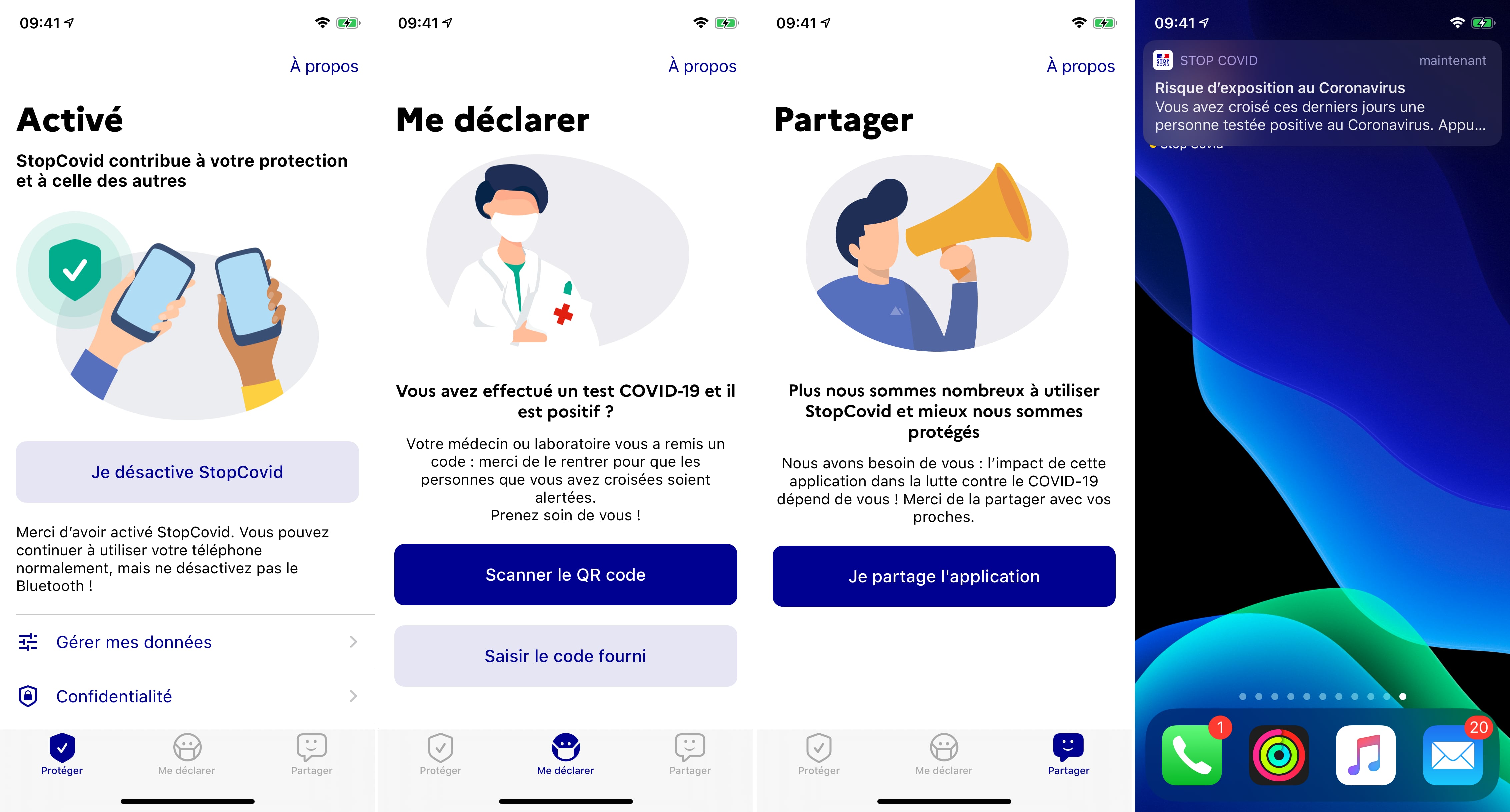
In other news, the government has sent me some screenshots of the app. Here’s what it looks like on iOS:

France’s digital minister, Cédric O, will be in front of parliament members tomorrow to debate the pros and cons of StopCovid. It’s going to be interesting to see whether the French government has managed to convince parliament members that a contact-tracing app is useful to fight the spread of COVID-19.

26 May 2020

Dear Sophie: Can I work in the US on a dependent spouse visa?

Here’s another edition of “Dear Sophie,” the advice column that answers immigration-related questions about working at technology companies.

“Your questions are vital to the spread of knowledge that allows people all over the world to rise above borders and pursue their dreams,” says Sophie Alcorn, a Silicon Valley immigration attorney. “Whether you’re in people ops, a founder or seeking a job in Silicon Valley, I would love to answer your questions in my next column.”

“Dear Sophie” columns are accessible for Extra Crunch subscribers; use promo code ALCORN to purchase a one- or two-year subscription for 50% off.


Dear Sophie:

My spouse’s startup is transferring her to the U.S. to help set up an office there. Will I be able to go with her and work in the U.S.? How long will it take for me to get a work permit? How long will we be able to stay?

— Hopeful in Hyderabad


Dear Hopeful:

Congratulations on starting an exciting new adventure with your family. U.S. immigration law allows visa holders to bring their spouse and dependent children with them to the U.S. and you can check out this podcast on the topic. Dependent children are defined as children who are under the age of 21 and unmarried. Whether or not the spouse can get a work permit, which is called an Employment Authorization Document (EAD), depends on which dependent visa the spouse receives.