
Month: March 2021

03 Mar 2021

Microsoft launches ‘Group Transcribe,’ a transcription and translation app for in-person meetings

A new project from Microsoft’s in-house incubator, Microsoft Garage, introduces a different take on meeting transcriptions. While today there are a number of real-time transcription apps to use on your phone — like Otter.ai or Google’s Recorder app for Pixel devices, for example — Microsoft’s new Group Transcribe app reimagines meeting transcriptions as a more collaborative process, where everyone simultaneously records the meeting on their own device for higher accuracy. It also offers real-time translation for languages spoken in over 80 distinct locales.

To use the app, one person would first initiate the meeting in their own device. They can then invite the other meeting attendees to join the session via Bluetooth, a scannable QR code or by sharing a link. After the other participants join the session and the meeting begins, each person will see the transcript appear in real-time on their own device.
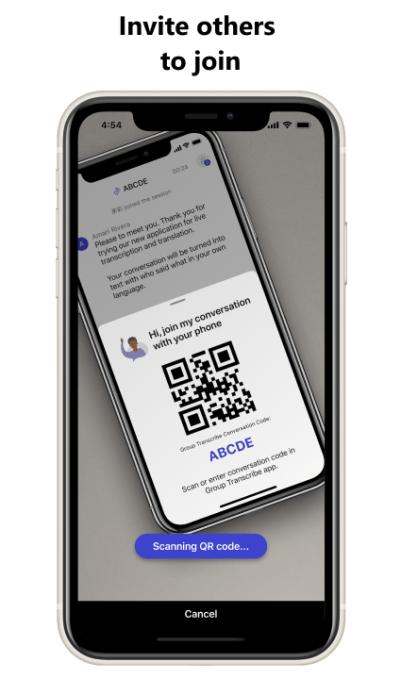
Image Credits: Microsoft

The app, which is powered by A.I. speech and language technology, is able to transcribe with higher accuracy and speaker attribution based on the volume of the speaker captured by the microphone of each phone being used in the meeting.

By comparing the level of a person’s voice volume, the cloud service attempts to determine which device is closest to the speaker and the language preferences of that speaker. This means speakers are also accurately labeled in the app, which can be a challenge for other transcription apps where only one person is recording.

In addition, if meeting participants want to speak in their own language, the app can provide the translation to others’ devices in their own language.

Image Credits: Microsoft

Microsoft says the app is designed with accessibility in mind, as it makes it easier for people who are deaf, hard of hearing, and non-native speakers to more fully participate in meetings by following along through the live transcriptions and translations.

The project itself was built by Microsoft employees who collectively speak over a dozen different languages and dialects.

“This can be a fantastic tool for communication. What I would love to see is for this to break down barriers for people speaking across multiple languages,” said Franklin Munoz, Principal Development Lead, when introducing the project.

Like most cloud-based transcription services, the app should not be used for highly confidential meetings. However, Microsoft has built granular data and privacy controls that allow users to decide if or when they want to share their conversation data.
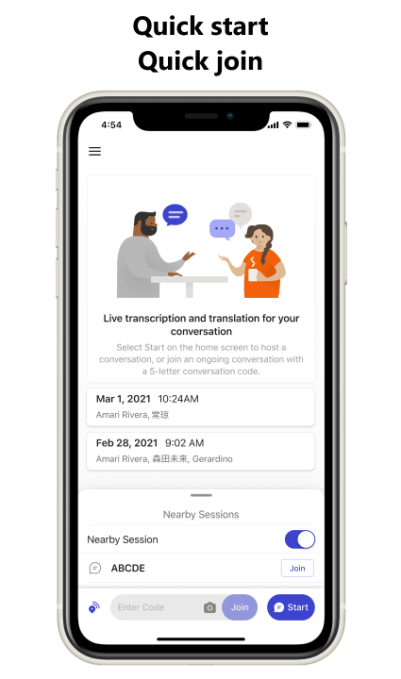
Image Credits: Microsoft

To work, the audio and text input data collected is sent to Microsoft’s online speech recognitions and translation technologies — though with a randomly generated identifier, not your real name.

While Microsoft doesn’t save the meeting transcripts and recordings itself after the fact — they’re saved on your device — the app does encourage participants to “contribute” their meetings recordings to Microsoft so it can improve the service.

This allows Microsoft to retain the audio and speech recognition-generated text transcriptions when all meeting participants agree to opt in for that session. By reviewing the data, Microsoft aims to improve its speech recognition and speaker attribution capabilities over time, it says. The user data will then be accessed under NDA by both Microsoft employees and contractors from other companies who work for Microsoft, but won’t include any of the speakers’ account credentials.

Reviewers will also only have access to randomized snippets of audio, not full recordings. And Microsoft says it “de-identifies” meeting recordings by removing long strings of numbers that could represent things like credit card numbers or phone numbers, for example. Users can delete their previously shared recordings at any time, but otherwise they’re retained for up to 2 years on encrypted servers, the company says.

Because there’s not a way for a business, at an admin level, to configure or block the “contribution” setting for all users, people should carefully weigh the advantages and risks of such a service. It’s also a Microsoft Garage project, meaning it’s meant to be more experimental and could be shuttered at any time.

Currently, the Group Transcribe app is available on iOS only.

 

03 Mar 2021

Clari revenue forecasting platform snags $150M investment and triples valuation to $1.6B

Clari, the revenue operations platform that helps companies predict revenue outcomes, announced $150 million Series E today on a $1.6 billion valuation, a number that more than triples its 2019 Series D valuation of $500 million.

Silver Lake led the latest investment with participation from B Capital Group and existing investors Sequoia Capital, Bain Capital Ventures, Sapphire Ventures, Madrona Ventures, Thomvest and Tenaya Capital. The company reports it has now raised a total of $285 million.

While COVID made 2020 trying for everyone, a company with a product that allows executive teams to understand and predict revenue at a granular level was obviously going to be in demand, and Clari saw a lot of interest over the last year.

“It was a surreal year for us, given the momentum we had and all of the tough news we saw going on around us. For us, the usage metrics were just off the charts, as people need visibility and predictability and control over their revenue forecasts,” company co-founder and CEO Andy Byrne told me.

While Byrne didn’t want to discuss revenue specifics, he did point out that he beat the revenue plan he submitted to his board by 110%. He said the performance has led to a lot of inbound investor interest in the company.

“That’s why we’ve had such great investor interest is that [VCs] were hearing in the investment community about how transformative Clarity has been […] just giving companies what we call revenue confidence, being able to go and understand where you’re going to be and to accurately predict the impact the pandemic is going to have on your trajectory, good or bad,” Byrne explained.

To this point, the company has been working with sales and marketing teams, but Byrne says that the company is expanding the scope of the product to bring that same predictability to other parts of an organization.

Clari has mostly focused on technology companies with customers like HPE, Workday and Adobe, but it has plans to expand beyond that vertical. In fact, one of the ways Byrne plans to put today’s investment to work is to push into other verticals, which could also benefit from this kind of revenue visibility.

The company is up 300 employees with plans to double that number by the end of 2020. Byrne says he is building a positive work culture and points to recently being recognized as one of the best places to work by Inc., Bay Area News Group, #GirlsClub and Built In. He says they have made progress when it comes to diversity hirings across a number dimensions, but admits there is still work to be done.

“We actually specifically [established] a commission around diversity and inclusion that has board level [backing] that we’re running to continue to do better work there. Having said that, we still recognize that we’re not too dissimilar to a lot of companies where we feel like there’s so much more that we need to do,” he said.

At this point in the company’s evolution with plenty of money in the bank and a healthy valuation, Byrne did not shy away from the IPO question, although as you would imagine, he wasn’t ready to discuss specifics.

“I would say the answer is unequivocally yes, and we’re building toward this. […] We don’t have a timeframe upon which we know where we’re going to go public, but the next goal is to get to the IPO starting line,” he said.

03 Mar 2021

TC Sessions: Justice 2021 kicks off today — join the conversation

Today’s the day we roll up our collective sleeves, engage in vital conversations about diversity, inclusion and equity in tech — and continue the important work of building a better industry for everyone.

TC Sessions: Justice 2021 features an impressive agenda packed with interactive presentations, breakout sessions and panel discussions with some of the tech world’s brightest innovators, leaders and worker-activists. These folks are in the trenches, changing the world and creating exciting business opportunities. That’s a win-win.

Last-minute decision maker? No problem. Join the conversation here.

You’ll also have time to network and connect with attendees around the world, enjoy startup presentations and even meet some of the early-stage companies in our TC Include founder cohort.

We’re got an incredibly deep bench of talented experts and visionaries ready to take the virtual stage. Here are just a few of the panels and people you simply don’t want to miss.

Finding the Next Unicorn: Arlan Hamilton, the founder and managing partner of Backstage Capital, has raised more than $12 million to back 150 companies led by underrepresented founders. In this session, Hamilton will discuss how she vets the biggest opportunities in investment, and how to disrupt in a positive way.

Identifying and Dismantling Tech’s Deep Systems of Bias: Nearly every popular technology or service has within it systems of bias or exclusion, ignored by the privileged but obvious to the groups affected. How should these systems be exposed and documented, and how can we set about eliminating them and preventing more from appearing in the future? AI for the People’s Mutale Nkonde, disability rights lawyer Haben Girma, and author of Algorithms of Oppression Safiya Umoja Noble discuss a more inclusive future.

Founders in Focus: We sit down with the founders poised to be the next big disruptors in this industry. Here we chat with Tracy Chou of Block Party, which works to protect people from abuse and harassment online.

The Role of Online Hate and Where Social Media Goes From Here: Toxic culture, deadly conspiracies and organized hate have exploded online in recent years. We’ll discuss how much responsibility social networks have in the rise of these phenomena and how to build healthy online communities that make society better, not worse. Naj Austin (Somewhere Good & Ethel\’s Club), Jesse Lehrich (Accountable Tech) and Rashad Robinson (Color of Change)

Meeting of the Minds: Diversity and inclusion as an idea has been on the agenda of tech companies for years now. But the industry still lacks true inclusion, despite best efforts put forth by heads of diversity, equity and inclusion at these companies. We’ll seek to better understand what’s standing in the way of progress and what it’s going to take to achieve real change. Sandra Altine (Facebook), Wade Davis (Netflix) and Bo Young Lee (Uber)

TC Sessions: Justice 2021 kicks off today. Join your colleagues, learn, connect, and discover new ways and opportunities to build stronger startups and a more just tech industry for all people.

03 Mar 2021

International VC firm Presight Capital raises $350M second fund

Presight Capital has closed its $350 million second fund only a year and a half after it announced an $80 million first fund. In fact, General Partner Christian Angermayer told me that the fund was raised in just a few weeks, and that it shot past the initial goal of $250 million.

Presight is the international venture arm of Angermayer’s family office Apeiron Investment Group, which has more than $2.5 billion in assets under management. When I spoke to him about Presight’s first fund, he emphasized the firm’s ability to help U.S. startups expand into Europe while navigating the regulatory landscape.

Angermayer told me the strategy remains the same for the second, and he pointed to a couple other key elements to the Presight approach. For one thing, there’s the firm’s co-investing approach: “Sometimes we’re co-leading [the round], but there’s always a partner we work with.” And although Presight has a relatively small investment team — besides Angermayer, there’s General Partner Fabian Hansen and Principal Philipp Schreiber — portfolio companies also have access to the larger Apeiron team (20 full-time employees) and network.

Hansen said that Presight remains sector agnostic in its investments, with a particular interest in biotech and deeptech. It’s already had some big successes in these fields, with an early investment in AI-powered drug discovery platform AbCellera leading to an IPO and Compass Pathways (a company that has patented a synthetic version of psilocybin to treat depression) also going public.

Fabian Hansen

Fabian Hansen

In a LinkedIn post published last fall, Angermayer argued that biotech will be the biggest sector over the next 10 to 20 years, and that the key metric in this field is quality-adjusted life years — the idea being that a year of life at perfect health is worth 1 QALY, death is zero, while life without perfect health is somewhere in between (or could even have a value below zero).

“And here’s the real conclusion: The big winners – besides everyone benefitting from these advances – will be the companies who are PRODUCING QALYs: biotech companies,” Angermayer wrote. And he is open about the fact that he has a personal motive in this: “Put simply, I want to live forever! And in perfect health! And it is my sincere belief that we will achieve the means to do this within the next 20-30 years.”

Hansen added that there’s a “whole generation” of executives at biotech firms who are launching new startups as they realize, “I can start my own company, it’s not that expensive to try out new things, I can raise a venture round.”

According to a source with knowledge of the firm, limited partners in Presight Fund Two include AbCellera founder and CEO Carl Hansen, former Goldman Sachs CFO Martin Chavez, Uma Thurman, Founders Forum co-founder Brent Hoberman, Point72 and the family offices of XING founder Lars Inrich, Nicole Junkermann, Louis Bacon, Alan Howard and Mike Novogratz. Plus, Angermayer himself invested $60 million.

03 Mar 2021

Have a startup in Miami? Apply to pitch at TechCrunch’s Miami virtual meetup

TechCrunch is coming to Miami — virtually, at least. On March 11, TechCrunch is hosting a small online event with local venture capitalists, founders, and those curious about the growing ecosystem. There will also be a small pitch-off event where Florida-based startups have three minutes to pitch their companies to Florida-based VCs.

Everyone is welcome to attend the event, but we’re looking for startups based in the Miami region to pitch at this event. TechCrunch has a long history of hosting small pitch-offs and we’re excited to revive this tradition despite the need to do it virtually.

Not in Miami? No worries. We’re spinning up similar events in other regions too. Spoiler: Detroit/Ann Arbor and Pittsburgh are next.

Qualifications

  • Early stage startup (Series A or earlier)
  • Startups based in the Miami region will be given priority
  • Pitch decks are highly recommended
  • Apply for the pitch-off here

The event is online and free, but space is limited. Register early. We hope you can make it.

03 Mar 2021

$100 million for mealworms

Hello and welcome back to Equity, TechCrunch’s venture capital-focused podcast, where we unpack the numberhttps://twitter.com/cgates123s behind the headlines.

This is our Wednesday show, where we niche down and focus on a single topic, or theme. This week we’re talking agtech, a surprisingly cool bit of the technology startup world. But Chris and Danny and Natasha and Alex were not alone in their quest to take a look into agtech, we brought alone TechCrunch climate editor Jon Shieber for the ride.

With his help we got through a number of pretty damn interesting things, including:

And that’s that! We’re back on Friday with our long-form, newsy episode. Thanks to everyone checking out our newest show. Oh, and don’t forget about TechCrunch Early Stage and TechCrunch Justice. They are going to rock.

Equity drops every Monday at 7:00 a.m. PST, Wednesday, and Friday morning at 7:00 a.m. PST, so subscribe to us on Apple PodcastsOvercastSpotify and all the casts.

03 Mar 2021

Google says it won’t adopt new tracking tech after phasing out cookies

While we’ve written about attempts to build alternatives to cookies that track users across websites, Google says it won’t be going down that route.

The search giant had already announced that it will be phasing out support for third-party cookies in its Chrome browser, but today it went further, with David Temkin (Google’s director of product management for ads privacy and trust) writing in a blog post that “once third-party cookies are phased out, we will not build alternate identifiers to track individuals as they browse across the web, nor will we use them in our products.”

“We realize this means other providers may offer a level of user identity for ad tracking across the web that we will not — like [personally identifiable information] graphs based on people’s email addresses,” Temkin continued. “We don’t believe these solutions will meet rising consumer expectations for privacy, nor will they stand up to rapidly evolving regulatory restrictions, and therefore aren’t a sustainable long term investment.”

This doesn’t mean ads won’t be targeted at all. Instead, he argued that thanks to “advances in aggregation, anonymization, on-device processing and other privacy-preserving technologies,” it’s no longer necessary to “track individual consumers across the web to get the performance benefits of digital advertising.”

As an example, Temkin pointed to a new approach being tested by Google called Federated Learning of Cohorts (FLoC), which allows ads to be targeted at large groups of users based on common interests. He said Google will begin testing FLoCs with advertisers in the second quarter of this year.

It’s worth noting, however, that the Electronic Frontier Foundation has described FLoCs as “the opposite of privacy-preserving technology” and compared them to a “behavioral credit score.”

And while cookies seem to be on the way out across the industry, the U.K.’s Competition and Markets Authority is currently investigating Google’s cookie plan over antitrust concerns, with critics suggesting that Google is using privacy as an excuse to increase its market power. (A similar criticism has been leveled against Apple over upcoming privacy changes in iOS.)

03 Mar 2021

Yugabyte announces $48M Series C as cloud native database makes enterprise push

As demand for cloud native applications is growing, Yugabyte, makers of the cloud native, open source YugabyteDB database are seeing a corresponding rise in demand for their products, especially with large enterprise customers. Today, the company announced a $48 million Series C financing round to help build on that momentum.

Lightspeed Venture Partners led the round with participation from Greenspring Associates, Dell Technologies Capital, Wipro Ventures and 8VC. Today’s round comes on the heels of the startup’s $30 million Series B last June, and brings the total raised to $103 million, according to the company.

Kannan Muthukkaruppan, Yugabyte co-founder and president, says the startup saw a marked increase in interest in both the open source and commercial offerings in 2020 as the pandemic pushed many companies to the cloud faster than they might have gone otherwise, something many startup founders have pointed out to me.

“The distributed SQL space is definitely heating up, and if anything over the last six months almost in every vector in terms of enterprise customers — from Fortune 500 companies across financial, retail, ISP or telcos — are putting Yugabyte in production to be the system of record database to meet some of their business critical services needs,” Muthukkaruppan told me.

In addition, he’s seeing a similar rise in the level of interest from the open source version of the product.”Similarly, the groundswell on the community and the open source adoption has been phenomenal. Our Slack [open source] user community quadrupled in 2020,” he said.

That kind of momentum led to the increased investor interest, says co-founder and CTO Karthik Ranganathan. “Some of the primary reasons to go and even ask for funding was that we realized we could accelerate some of this stuff, and we couldn’t do that with the original $30 million we had raised,” he said. The original thinking was to do a secondary raise in the $15-20 million, but multiple investors expressed interest in participating, and it ended up being a $48 million round when all was said and done.

Former Pivotal president Bill Cook came on board as CEO at the same time they were announcing their last funding round in June and brought some enterprise chops to the table. It was his job to figure out how to expand the market opportunity with larger high-value enterprise clients. “And so the last six or seven months has been about that, dealing with enterprise clients on one hand and then this emerging developer led cloud offering as well,” Cook said.

The company has a three tier offering that includes the open source YugabyteDB. Then there is a fully managed cloud version called Yugabyte Cloud, and finally there is a self-managed cloud version of the database called Yugabyte Platform. The latter is especially attractive to large enterprise customers, who want to be in the cloud, but still want to maintain control of their data and infrastructure, and so choose to manage the cloud installation themselves.

The company started last year with 50 employees, doubled that to this point, and now expects to reach 200 by the end of this year. As they add employees, the leadership team is cognizant of the importance of building a diverse and inclusive workforce, while recognizing the challenges in doing so.

“It’s work in progress as always. We’ve added diversity candidates right along the whole spectrum as we’ve grown but from my perspective it’s never sufficient, and we just need to keep pushing on it hard, and I think as a leadership team we recognize that,” Cook said.

The three leaders of the company have been working together remotely now since the announcement in June, and had only met briefly in person prior to the pandemic shutting down offices, but they say that it has gone smoothly. And while they would obviously like to meet in person again when the time is right, the momentum the company is experiencing shows that things are moving in the right direction, regardless of where they are getting their work done.

03 Mar 2021

$1.3M in grants go towards making the web’s open source infrastructure more equitable

Open source software is at the core of… well, practically everything online. But while much of it is diligently maintained in some ways, in others it doesn’t receive the kind of scrutiny that something so foundational ought to. $1.3 million worth of grants were announced today, split among 13 projects looking to ensure open source software and development is being done equitably, sustainably, and responsibly.

The research projects will look into a number of questions about the way open source digital infrastructure is being used, maintained, and otherwise affected. For instance, many municipalities rely on and create this sort of infrastructure constantly as the need for government software solutions grows, but what are the processes by which this is done? Which approaches or frameworks succeed, and why?

And what about the private companies that contribute to major open-source projects, often without consulting one another — how do they communicate and share priorities and dependencies? How could that be improved, and with what costs and benefits?

These and other questions aren’t the type that any single organization or local government is likely to take on spontaneously, and of course the costs of such studies aren’t trivial. But they were deemed interesting enough (and possibly likely to generate new approaches and products) by a team of experts who sorted through about 250 applications over the last year.

The grantmaking operation is funded and organized by the Ford Foundation, Alfred P. Sloan Foundation, Open Society Foundations, Omidyar Network, and the Mozilla Open Source Support Program in collaboration with the Open Collective Foundation.

“There’s a dearth of funding for looking at the needs and potential applications of free and open source infrastructure. The public interest issues behind open source have been the missing piece,” said Michael Brennan, who’s leading the grant program at the Ford Foundation.

“The president of the foundation [Darren Walker] once said, ‘a just society relies on a just Internet,’ ” he quoted. “So our question is how do we create that just Internet? How do we create and sustain an equitable Internet that serves everyone equally? We actually have a lot more questions than answers, and few people are funding research into those questions.”

Even finding the right questions is part of the question, of course, but in basic research that’s expected. Early work in a field can seem frustratingly general or inconclusive because it’s as much about establishing the scope and general direction of the work as it is about suggesting actual courses of action.

“The final portfolio wasn’t just about the ‘objectively best’ ones, but how do we find a diversity of approaches and ideas, and tackle different aspects of this work, and also be representative of the diverse and global nature of the project?” Brennan said. “This year we also accepted proposals for both research and implementation. We want to see that the research is informing the building of that equitable and sustainable infrastructure.”

You can read the full research abstracts here, but these are the short versions, with the proposer’s name:

  • How are COVID data infrastructures created and transformed by builders and maintainers from the open source community? – Megan Finn (University of Washington, University of Texas, Northeastern University)
  • How is digital infrastructure a critical response to fight climate change? – Narrira Lemos de Souza
  • How do perceptions of unfairness when contributing to an open source project affect the sustainability of critical open source digital infrastructure projects? – Atul Pokharel (NYU)
  • Supporting projects to implement research-informed best practices at the time of need on governance, sustainability, and inclusion. – Danielle Robinson (Code for Science & Society)
  • Assessing Partnerships for Municipal Digital Infrastructure – Anthony Townsend (Cornell Tech)
  • Implement recommendations for funders of open source infrastructure with guides, programming, and models – Eileen Wagner, Molly Wilson, Julia Kloiber, Elisa Lindinger, and Georgia Bullen (Simply Secure & Superrr)
  • How we can build a “Creative Commons” for API terms of Service, as a contract to automatically read, control and enforce APIs Terms of service between infrastructure and applications? – Mehdi Medjaoui (APIdays, LesMainteneurs, Inno3)
  • Indian case study of governance, implementation, and private sector role of open source infrastructure projects – ​Digital Asia Hub
  • Will cross-company visibility into shared free and open source dependencies lead to cross-company collaboration and efforts to sustain shared dependencies? – ​Duane O’Brien
  • How do open source tools contribute towards creating a multilingual internet? – Anushah Hossain (UC Berkeley)
  • How digital infrastructure projects could embrace cooperatives as a sustainable model for working – ​Jorge Benet (Cooperativa Tierra Común)
  • How do technical decision-makers assess the security ramifications of open source software components before adopting them in their projects and where can systemic interventions to the FOSS ecosystem be targeted to collectively improve its security? – Divyank Katira (Centre for Internet & Society in Bangalore)
  • How can African participation in the development, maintenance, and application of the global open source digital infrastructure be enhanced? – Alex Comninos (Research ICT Africa (RIA) and the University of Cape Town)

The projects will receive their grants soon, and later in the year (or whenever they’re ready) the organizers will coordinate some kind of event at which they can present their results. Brennan made it clear that the funders take no stake in the projects and aren’t retaining or publishing the research themselves; they’re just coordinating and offering support where it makes sense.

$1.3 million is an interesting number. For some, it’s peanuts. A startup might burn through that cash in a month or two. But in an academic context, a hundred grand can be the difference between work getting done or being abandoned. The hope is that small injections at the base layer produce a better environment for the type of support the Ford Foundation and others provide as part of their other philanthropic and grantmaking efforts.

03 Mar 2021

Deliverr scores $170M to bring fast delivery to every e-commerce vendor

At a time when e-commerce is exploding due in large part to the pandemic, a business that helps any online merchant ship goods to a consumer in one or two days is going to be in demand. Deliverr is a startup that fits that bill, and today the company announced a $170 million financing round.

The round breaks down to $135 million Series D financing led by Coatue. The remaining $35 million comes in the form of a convertible note led by Brookfield Technology Partners. Existing investors Activant Capital, 8VC and GLP participated in both parts of the investment. In less than four years, the company has raced from from rounds A to D, raising $240 million along the way.

Deliverr co-founder and CEO Michael Krakaris says it has been a rapid rise, but that his business requires a lot of capital. “It has been this really kind of crazy journey, and we’ve been growing very fast, but also this space is very capital intensive, and it’s a winner-take-all market where you gain efficiency at scale. You know scale is what makes your model highly defensible in this space,” Krakaris told me.

The way Deliverr works is it uses software to determine how to get goods to warehouses in parts of the country where they are needed. It then uses these warehouses’ fulfillment departments to help pick and pack the order. The software then finds the fastest and cheapest delivery method and it gets shipped to customers with a two-day delivery guarantee. They are also ramping a next-day delivery product to expand the business.

Deliverr doesn’t actually own any warehouses. It rents out space, and part of the challenge of building this business is establishing relationships with those warehouses and working out a business arrangement, one that is still evolving as the company grows. “A year ago, I would have said we typically wanted to be 5-10% of a warehouse’s business. There are cases now where we are 100% of these warehouses’ businesses. We’ve grown to that level,” he explained.

Krakaris says that the pandemic raised major challenges for the company. Just setting up a relationship with new warehouses could require driving long distances because getting on a plane would mean quarantining when they landed. In some instances there were shortages of items. In others, COVID would shut down all of the warehouses in a given region, forcing the executive team to make a set of business adjustments on the fly, but this constant crisis mentality also helped them learn how to shift resources quickly, a lesson that is highly useful in this business.

The company started 2020 with 50 people and have added 100 employees since. They plan to double that this year, although that is variable depending on how the year goes. He say that another challenge is that he has done this hiring during COVID, and has never met a majority of his workers.

“You know, I’ve never met more than half the company in person, but I’m try to be as open as I can and learn about everyone, and we hold events to try and get to know everybody, but obviously it’s not like being together in person,” he said.
