Month: March 2021

02 Mar 2021

Six tips for SaaS founders who don’t want VC money

Over the past decade, venture capital has become synonymous with entrepreneurship. Founders from around the world arrive in Silicon Valley with visions of record-setting A rounds and billion-dollar valuations. But what if you don’t have unicorn dreams – or you don’t want to pursue VC money?

Bootstrapping a SaaS company is not only possible – I believe it’s a saner, more sustainable way to build and scale a business. To be clear, bootstrapping isn’t always easy. It requires patience and focus, but the freedom to create a meaningful product, on your terms, is worth more than even the biggest VC check.

I started my company, JotForm, in 2006. We’ve grown steadily from a simple web tool into a product that serves more than 8 million users – without taking a dime in outside funding. We’re profitable in an industry with big-name competitors like Google.

Most importantly, I still love this company and its mission, and I want the same for my fellow entrepreneurs. If you’re a SaaS founder who’s wary of VC funding, here are my best bootstrapping tips.

Keep your day job

Success stories from founders who leap blindly into business without resources or relevant experience are compelling, but they’re the exception, not the rule. Working inside another organization can build your skills, your network, and even inspire great product ideas.

After finishing college with a computer science degree, I worked as a developer for a New York media company. The editors always needed custom web forms, which were tedious and time-consuming to build. I kept thinking, “There has to be a better way.”

That daily frustration led me to start JotForm – but I didn’t leave my job right away. I stayed with the media firm for five years and worked on my product on the side. By the time I was ready to go all-in, I had the confidence, experience and savings I needed.

Many of the world’s biggest companies began as side projects, including Twitter, Craigslist, Slack, Instagram, Trello, and a little venture called Apple. If your day job doesn’t pay enough to fund the early stages of your business, consider a side gig or consulting work. There are so many ways to set yourself up for success without the pressure of VC cash or selling a chunk of your business.

Know you’re not alone

The exact numbers shift every year, but data compiled by Fundable show that only 0.05 percent of U.S. startups are backed by VCs. Another 0.91 percent are funded by angel investors. The vast majority, at 57 percent, are funded by credit and personal loans, while 38 percent get funding from friends and family.

It may feel like most founders raise multi-million-dollar rounds, but that’s simply not the case. It’s also good to remember that securing VC money is complicated and time-consuming. You can spend months taking meetings and presenting the perfect deck – and still leave empty-handed. Be patient and stick to your own path.

Measure profits, not popularity

SaaS founders often emphasize vanity metrics, like user acquisitions and total downloads. These numbers can measure short-term popularity, but they don’t reveal how users and customers feel about your product – or your long-term potential.

02 Mar 2021

Retail Zipline raises $30M as it helps retailers adapt to the pandemic

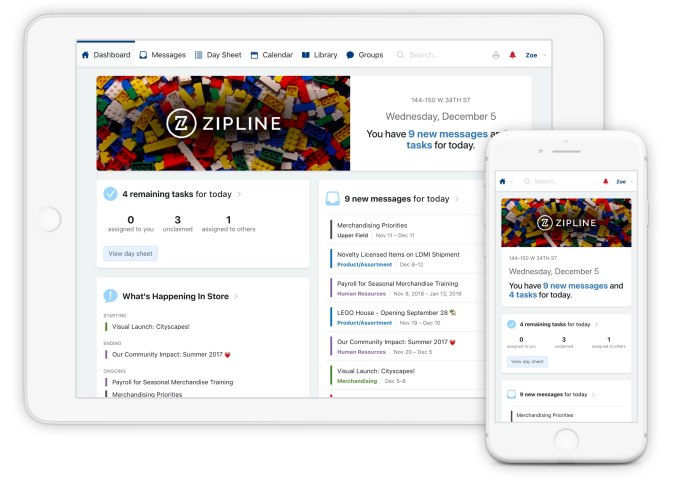
When I first wrote about Retail Zipline in 2019, the startup was focused on building a communication platform that would help corporate decision-makers in retail communicate with individual stores. As you’d probably guess, the startup saw some changes in 2020.

“When COVID first hit, you might think a company that’s primarily focused on retail would be in trouble,” said co-founder and CTO Jeremy Baker. “But it turns out that a product that helps retailers communicate critical information when everything is changing is no longer a nice to have.”

In other words, where Retail Zipline might previously have been used for coordinating sales and promotions, it suddenly became a channel for managing things like health and safety protocols and communicating about furloughs and closures.

Co-founder and CEO Melissa Wong said the platform supports both engagement (a company executives sending a message to retail associates) and execution (translating a broader corporate strategy into an in-store experience). While you might think that execution was the only thing that mattered in the middle of a pandemic, Wong argued that the engagement side was also essential, particularly when employees felt they were putting themselves at risk.

“The engagement part means that we can explain to a retail employee what we’re doing to protect you during this crisis, and your role as part of this company and this brand,” she said.

Retail Zipline screenshot

Image Credits: Retail Zipline

She added that the company has doubled its customer baes during the pandemic and seen revenue increase 2.5x. Retailers using the platform include Sephora, AEO, L.L.Bean, Gap, Hy-Vee, Lush Cosmetics, BevMo, LL Flooring, Cole Haan, The LEGO Group, TOMS and Torrid.

The pandemic also spurred dramatic growth in e-commerce, but Wong (who previously worked on the corporate side of Gap and Old Navy) suggested that this won’t eliminate the need for physical stores. Instead, it just means they’ll have to live up to the long-standing “omni-channel promise,” where they serve as both a store and a distribution center for online orders.

“Retail will become more complex,” she said. “We will enable them to meet those complexities.”

Today, Retail Zipline is announcing that it has raised $30 million in Series B funding. The round was led by real estate-focused firm Fifth Wall, with partner Dan Wenhold joining the board of directors. Emergence Capital, Ridge Ventures, Hillsven Capital, Veeva co-founder Matt Wallach and the Fisher Family Fund also participated.

The company has now raised more than $39 million, according to Crunchbase.

In a blog post, Fifth Wall wrote:

The Fifth Wall network is rich with opportunities for Zipline to explore potential partnerships among our retail-focused partners and portfolio companies. However, we believe retail to be just the beginning for Zipline as we envision the product appealing to many Built World industries. The opportunity for Zipline within real estate could lie with organizations whose HQ office must communicate daily with field operations workers, such as more traditional brokers with a geographic focus (e.g., CBRE, Cushman & Wakefield), leasing agents within multifamily and SFR (e.g., Equity Residential, Greystar), or construction site workers.


02 Mar 2021

Amazon’s GameOn app, a platform for sharing mobile gaming clips, launches on iOS,

Mobile gaming hasn’t seen the same demand for streaming content in the past as desktop has, but Amazon sees a market there to extend Twitch’s dominance. After launching on Android back in November, the company’s mobile streaming centric app has just launched on Apple’s App Store.

The app lets users record short clips (anywhere from 30 seconds to 5 minutes of content) of gameplay from a variety of titles that support screen recording capture. Users can screen record these clips directly into the GameOn library at which point they can add commentary or additional edits before publishing to the GameOn platform or sharing links to the platform on other sites.

The GameOn platform is interestingly fully disconnected from Twitch with separate branding and different channels. Amazon has been partnering with streamers to wholly focus on mobile gaming while promoting challenges unique to the app.

Developers have been increasingly vigilant about brining more full-featured ports of desktop titles to mobile though the lack of sophisticated controls has made this a challenge. As gaming platforms aim to bring cloud streaming networks to iOS there could end up being more demand for shot-on-mobile content and titles that users control with a gamepad, but this will depend on whether the App Store grows more amenable to these platforms over time.

02 Mar 2021

West Tenth’s app encourages women to start home businesses, not join MLMs

A new digital marketplace called West Tenth, now backed by $1.5 million in seed funding, wants to give women a platform to start and grow their home-based businesses. Through its mobile app, women can promote their business to others in the local community, then field inquiries and requests through the app’s integrated messaging platform, as well as finalize transactions through in-app payments.

The startup was co-founded by Lyn Johnson and Sara Sparhawk, who met when they both worked in finance. Johnson remained in finance, but Sparhawk later moved on to work at Amazon.

Johnson explains that her experience led her to better understand the economic inequality of women in the U.S., where they only own 32 cents to every dollar in financial assets than men own. A large driver of this is that women leave the workforce, often to raise children, which results in years where they don’t have earnings.

“We’re really good as a society at supporting women on the way of out of the workforce to care for their kids, but really terrible at supporting them on the way back in,” Johnson says. “Women know this, and as an alternative to employment that just seems to fail them, they’re starting businesses in droves.”

Image Credits: West Tenth

With West Tenth, the goal is to encourage this sort of entrepreneurship — and more broadly, to help women understand that the many of the talents they’ve developed at home are, in fact, potential businesses.

This includes opportunities like home-based bakers and cooks, photographers, home organizers or designers, home florists, baby sleep consultants, party planning and event services, crafting classes, fitness training, homemade goods, and more.

The company notes that the app isn’t necessarily closed to men, but the current market for U.S. home businesses favors women as they’re more often the partner who chooses to leave work to raise children. However, there are some men on its platform.

Though today many of these entrepreneurs market their home businesses on Facebook, they’re missing opportunities to reach customers if they’re not heavily involved in local groups and responding to requests for recommendations. West Tenth instead centralizes local businesses in one place to make discovery easier.

Image Credits: West Tenth


In the app, customers can browse and shop local businesses, filtering by category via buttons at the top of the screen. The results are sorted by distance and offer photos, description, and the starting price for the goods or services offered. Through integrated messaging, users can reach out directly for a quote or more information. Customers can also complete their purchases through the app’s Stripe payments integration. West Tenth takes a 9.5% commission on these sales.

Another key aspect to West Tenth is its education component, The Foundry.

Through a $100 per quarter subscription membership (or $350 per year), business owners will be able to attend bi-monthly events, including classes focused on the fundamentals of setting up home-based businesses, marketing, customer acquisition, and other topics. These classes will also be available à la carte at around $30 apiece, for those who want to pay per session.

In addition, attendees will hear from guest speakers who have experience in the home-based business market, and they’ll be able join mastermind networking groups to exchange ideas with their peers.

Image Credits: West Tenth

This system of combining education and networking with business ownership could potentially help more women become home-based business entrepreneurs instead of joining multi-level marketing (MLM) companies, as is common.

“When we started this, we recognized that MLMs are one of the few kind of industries that’s focused on this demographic of women who’ve left the workforce — which is a huge, untapped talent pool in the U.S.,” notes Johnson. “But they’re really predatory. Only the top 1% of sellers distributors really make money and the rest lose money. And they lose their social capital, as well. What we’re really interested in doing is becoming an alternative to MLMs in many respects,” she adds.

Not surprisingly, MLMs aren’t allowed on the West Tenth platform.

Image Credits: West Tenth

The startup, which completed Kansas City TechStars last summer, has now raised $1.5 million in seed funding to get its platform off the ground. The round was led by Better Ventures along with Stand Together Ventures Lab, Kapital Partners,The Community Fund, Backstage Capital, Wedbush Ventures, and Gaingels.

The funds will be used to develop the product and grow its user base. In time, West Tenth aims to build out product features to better highlight local businesses. This includes shopping elements that will let you see what friends are buying and video demonstrations, among other things.

Since 2019, West Tenth has grown its footprint from just 20 businesses on the app to now over 600, largely in suburban L.A. and Salt Lake City. It’s now aiming to target growth in Phoenix, Boise, and Northern California.

Image Credits: West Tenth

The timing for West Tenth’s expansion is coming on the tail end of the COVID-19 crisis, where things have only gotten worse for women’s traditional employment.

School and daycare closures combined with job losses that greatly impacted women’s roles have now driven more women out of the workforce compared with men. And according to McKinsey, women accounted for nearly 56% of workforce exits since the start of the pandemic, despite making up just 48% of the workforce. This COVID-driven “shecession,” as some have dubbed it, is also disproportionately impacting women of color, studies have found.

“We’ve seen 5 million women exit the workforce — some because they were laid off or furloughed, and a huge chunk because they’re opting out because the caregiving responsibilities just became overwhelming,” says Johnson.

“The thing is when women leave the workforce for caregiving reasons — for some reason we really discount that and we make it even harder for them to return to work. So I think over the next 18 to 24 months, we’ll see a big surge in economic activity in the home with women trying to bring in additional sources of income by running a business from the home,” she says.

The West Tenth app is available on both iOS and Android.

02 Mar 2021

Amazon issues rare apology in India over drama series

Amazon on Tuesday issued a rare apology to users in India for an original political drama series over allegations that a few scenes in the nine-part mini series hurt religious sentiments of some people in the key overseas market.

The series, called “Tandav,” has faced criticism from some people in India — including a few members of the ruling Bhartiya Janata Party — over its depiction of Hindu gods and goddesses.

In a message titled, “Amazon Prime Video Apologizes,” the American e-commerce group said it “deeply regrets that viewers considered certain scenes to be objectionable” and that it had either edited those scenes or removed them altogether from the show after hearing concerns from viewers.

“We respect our viewers’ diverse beliefs and apologize unconditionally to anyone who felt hurt by these scenes. Our teams follow company content evaluation processes, which we acknowledge need to be constantly updated to better serve our audiences. We will continue to develop entertaining content with partners, while complying with the laws of India and respecting the diversity of culture and beliefs of our audiences.”

The show, which stars several top Bollywood actors including Saif Ali Khan, premiered in mid-January and immediately prompted controversy and criminal complaints. Things have escalated in recent weeks as several high-profile executives of Amazon Prime Video have been questioned by the authority.

Prime Video has amassed millions of subscribers in India, where it competes with Disney’s Hotstar, Netflix, Times Internet’s MX Player, and dozens more streaming services. Amazon has grown more aggressive with Prime Video in India in recent months. It recently introduced an even cheaper subscription tier and secured rights for streaming some cricket matches.

Amazon’s rare apology today comes days after New Delhi announced new rules for on-demand video streaming services and social media firms.

Until now Amazon Prime Video and other streaming services have operated in India without having to worry too much about the nature of their content. But that’s changing, according to the new rules.

“The category classification of a content will take into account the potentially offensive impact of a film on matters such as caste, race, gender, religion, disability or sexuality that may arise in a wide range of works, and the classification decision will take account of the strength or impact of their inclusion,” the new rules state.

As we wrote recently, the controversy surrounding the political drama and the new rules from India for streaming services are only few of the challenges that Amazon is facing in India, where it has committed to deploy over $6.5 billion.

Last month, an influential India trader group that represents tens of millions of brick-and-mortar retailers called New Delhi to ban Amazon in the country after an investigation by Reuters claimed that the American e-commerce group had given preferential treatment to a small group of sellers in India, publicly misrepresented its ties with those sellers and used them to circumvent foreign investment rules in the country.

02 Mar 2021

Epic is buying ‘Fall Guys’ developer, Mediatonic

Fortnite maker Epic today announced plans to acquire Tonic Games Group, most notably the publisher behind the fellow massive battle royale hit title, Fall Guys: Ultimate Knockout. Tonic Games Group is the parent company for the Irregular Corporation, Fortitude Games and Fall Guys developer, Mediatonic.

“It’s no secret that Epic is invested in building the metaverse and Tonic Games shares this goal,” Epic founder and CEO Tim Sweeney said in a release tied to the news. “As Epic works to build this virtual future, we need great creative talent who know how to build powerful games, content and experiences.”

Epic notes in its announcement post that gameplay for the popular title won’t change under the new ownership. As with Fornite, the company says it’s investing in cross platform play for the title, which is currently available on the PlayStation and PC with Nintendo Switch and Xbox arriving in the near future.

Developing…

02 Mar 2021

SkyMul’s drones secure rebar on the fly to speed up construction

There are many jobs in the construction industry that fall under the “dull, dirty, and dangerous” category said to be ripe for automation — but only a few can actually be taken on with today’s technology. One such job is the crucial but repetitive task of rebar tying, which a startup called SkyMul is aiming to completely automate using fleets of drones.

Unless you’ve put together reinforced concrete at some point in your life, you may not know what rebar tying is. The steel rebar that provides strength to concrete floors, walls, and other structures is held in place during the pouring process by tying it to the other rebar where the rods cross. For a good-size building or bridge this can easily be thousands of ties — and the process is generally done manually.

Rodbusters (as rebar tying specialists are called, or so I’m told) are masters of the art of looping a short length of plastic or wire around an intersection between two pieces of rebar, then twisting and tying it tightly so that the rods are secured in multiple directions. It must be done precisely and efficiently, and so it is — but it’s backbreaking, repetitive work. Though any professional must feel pride in what they do, I doubt anyone cherishes the chronic pain they get from doing that task thousands of times in an hour. As you might expect, rodbusters have high injury rates and develop chronic issues.

Automation of rebar tying is tricky because it happens in so many different circumstances. A prominent semi-robotic solution is the TyBot, which is a sort of rail-mounted gantry that suspends itself over the surface — but while this makes sense for a bridge, it makes far less for the 20th floor of an office building.

Animated image of a drone floating over rebar and tying it together at intersections.

Image Credits: SkyMul

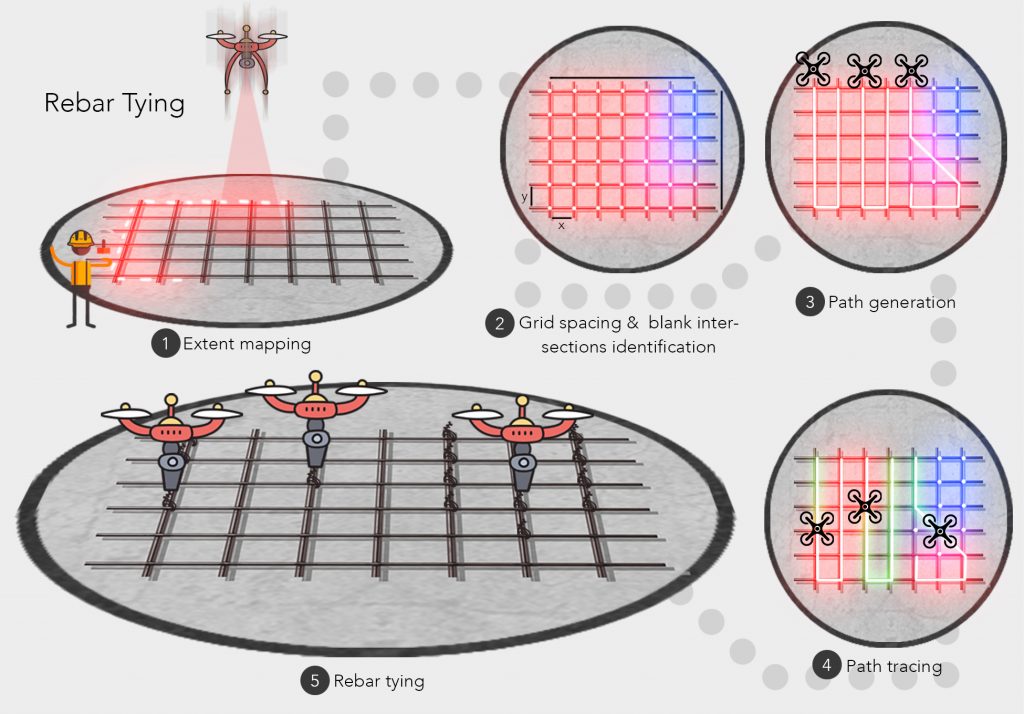
Enter SkyMul, a startup still in the very early stages but with a compelling pitch: rebar tying done by a fleet of drones. When you consider that the tying process doesn’t involve too much force, and that computer vision has gotten more than good enough to locate the spots that need work… it starts sounding kind of obvious.

CEO and co-founder Eohan George said that they evaluated a number of different robotic solutions but that drones are the only ones that make sense. The only legged robots with the dexterity to pick their way through the rebar are too expensive, and treads and wheels are too likely to move the unsecured rebar.

Diagram showing how SkyMul's drones map an area of rebar then divide it up for tying.

Image Credits: SkyMul

Here’s how the company’s SkyTy system works. First, a mapper drone flies over the site to mark the boundaries and then, in an automated closer flyover, to build a map of the rebar itself and where the ties will need to go. This map is then double-checked by the rodbuster technician running the show, which George said only takes about a minute per thousand square feet of rebar (though that adds up quickly).

Then the tying drones are released, as many as needed or wanted. Each one moves from spot to spot, hovering and descending until its tying tool (much like those used by human rodbusters) spans the rebar intersection; the tie is wrapped, twisted, and the drone is off to the next spot. They need their batteries swapped every 25 minutes, which means they generally have time to put down 70-80 ties; right now each drone does one tie every 20 seconds, which is in line with humans, who can do it faster but generally go at about that speed or slower, according to numbers George cited.

It’s difficult to estimate the cost savings and value of the work SkyTy does, because the value of the labor varies widely. In some places rodbusters are earning north of $80/hour, meaning the draw of automation is in cost savings. But in other markets the pay is less than a third of that, which compounded with the injury risk makes rodbusters a scarce quantity — so the value is in availability and reliability. Drone-based tying seems to offer value one way or the other, but that means the business model is somewhat in flux as SkyMul figures out what makes the most sense. Generally contractors at one level or another would lease and eventually own their own drones, though other methods are being looked into.

Animated image of a computer-generated grid overlaid on images of rebar.

Image Credits: SkyMul

The system offers value-add services as well, for instance the precise map of the rebar generated at the beginning, which can be archived and used later for maintenance, quality assurance, comparison with plans, and other purposes. Once a contractor is convinced it’s as good or better than the manually-produced ones currently used, this could save hours, turning a 3-day job into a 2-day job or otherwise simplifying logistics.

The plan at the company is to first offer SkyTy as an option for bridge construction, which is a simpler environment than a multi-story building for the drones. The market there is on the order of $30-40 million per year for rebar tying services, providing an easier path to the more complex deployments.

SkyMul is looking for funding, having spun out of Georgia Tech and going through Comcast-NBC accelerator The Farm and then being granted a National Science Foundation SBIR Phase I award (with hopes for a Phase II). They have demonstrated the system but have yet to enter into any pilot programs — there are partnerships in the works but the construction business isn’t a nimble one and a drone-based solution isn’t trivial to swap in for human rodbusters on short notice. But once a few projects are under its belt the company seems likely to find serious traction among forward-thinking contractors.

02 Mar 2021

Microsoft debuts its AR/VR meetings platform Mesh

Today, at a special AR/VR focused event held inside its virtual reality community platform Altspace, Microsoft showcased a new product aiming to provide their AR HoloLens platform and VR Windows Mixed Reality platform with a shared platform for meetings.

The app is called Microsoft Mesh and it gives users a cross AR/VR meeting space to interact with other users and 3D content, handling all of technical hard parts of sharing spatial multi-player experiences over the web. Like Microsoft’s other AR/VR apps, the sell seems to be less in the software than it is in enabling developers to tap into one more specialization of Azure, building their own software that builds on the capabilities. The company announced that AltspaceVR will now be Mesh-enabled.

In the company’s presentation, they swung for the fences in showcasing potential use cases, bringing in James Cameron, the co-founder of Cirque du Soleil and Pokémon Go developer Niantic.

Microsoft’s HoloLens platform has always been at its most impressive when it comes to viewers in a shared space looking at the same digital content in the same room that’s invisible to everyone else. Inside Mesh, other users are represented as cartoonish avatars, a design break that has plagued countless other AR/VR apps and platforms. Microsoft says the hope is to one day beam a user’s 3D photo-realistic presence into the app but that will assuredly require the commoditization of some complex camera hardware.

The company showcased a concept video of Mesh, which seems to be a few years further ahead in several places than the current software is.

Mesh isn’t offering any capabilities that are terribly unique to the spatial computing world — it’s all pretty standard faire in terms of bells and whistles — the distinguishing factor is the breadth of access, something once the unique distinguishing feature of the AltspaceVR platform back in the day. Mesh can be accessed on the HoloLens 2, many VR headsets, phones, tablets, and PCs, providing a window into the futuristic platform for even desktop users.

The software is available in preview now on HoloLens 2 alongside its AltspaceVR integration.


02 Mar 2021

Airbyte raises $5.2M for its open-source data integration platform

Airbyte, an open-source data integration platform, today announced that it has raised a $5.2 million seed funding round led by Accel. Other investors include YCombinator, 8VC, Segment co-founder Calvin French-Owen, former Cloudera GM Charles Zedlewski, LiveRamp and Safegraph CEO Auren Hoffman, Datavant CEO Travis May and Alain Rossmann, the president of Machinify.

The company was co-founded by Michel Tricot, the former director of engineering and head of integrations at LiverRamp and RideOS, and John Lafleur, a serial entrepreneur who focuses on developer tools and B2B services. The last startup he co-founded was Anaxi.

Image Credits: Airbyte

In its early days, the team was actually working on a slightly different project that focused on data connectivity for marketing companies. The founders were accepted into Y Combinator and built out their application, but once the COVID pandemic hit, a lot of the companies that had placed early bets on Airbyte’s original project faced budget freezes and layoffs.

“At that point, we decided to go into deeper data integration and that’s how we started the Airbyte project and product as we know it today,” Tricot explained.

Today’s Airbyte is geared toward data engineering, without the specific industry focus of its early incarnation, but it offers both a graphical UI for building connectors, as well as APIs for developers to hook into.

As Tricot noted, a lot of companies start out by building their own data connectors — and that tends to work alright at first. But the real complexity is in maintaining them. “You have zero control over how they behave,” he noted. “So either they’re going to fail, or they’re going to change something. The cost of data integration is in the maintenance.”

Even for a company that specializes in building these connectors, the complexity will quickly outpace its ability to keep up, so the team decided on building Airbyte as an open-source company. The team also argues that while there are companies like Fivetran that focus on data integration, a lot of customers end up with use cases that aren’t supported by Airbyte’s closed-source competitors and that they had to build themselves from the ground up.

“Our mission with Airbyte is really to become the standard to replicate data,” Lafleur said. “To do that, we will open-source every feature that addresses the need of the individual contributor, so all the connectors.” He also noted that Airbyte will exclusively focus on its open-source tools until it raises a Series A round — likely early next year.

To monetize its service, Airbyte plans to use an open core model, where all of the features that address the needs of a company (think enterprise features like data quality, privacy, user management, etc.) will be licensed. The team is also looking at white-labeling its containerized connectors to others.

Currently, about 600 companies use Airbyte’s connectors — up from 250 a year ago. Its users include the likes of Safegraph, Dribbble, Mercato, GraniteRock, Agridigital and Cart.com.

The company plans to use the new funding to double its team from about 12 people to 25 by the end of the year. Right now, the company’s focus is on establishing its user base, and then it plans to start monetizing that — and raise more funding — next year.


02 Mar 2021

Silicon Valley’s myths and realities of existential risk

Existential risk has been on many of our minds the past year. Sales of survival goods from food kits to nuclear-proof bunkers are way up, we doomscroll on Twitter all day, and it seems like there isn’t a week that goes by where civilizational collapse isn’t at least a possibility on the agenda.

Yet, if you hang out in tech circles long enough, there remains an astonishing divergence between the realities of existential risk and the speculative nature this subject tends to push us towards.

In Silicon Valley, the fun topics here are scenarios like custom-designed pathogens that assassinate individuals or the entire human population constructed in a small biolab by an irascible bio PhD (throw in CRISPR as an acronym to make it sound interesting). Coronal mass ejections or some sort of electromagnetic bomb comes up frequently, events that could knock out all power as we know it. You’ll also frequently run into some sort of hacking scenario where all the chips in the world are vulnerable to the same line of code (perhaps inspired in the vein of Meltdown or Spectre).

These scenarios are fun and imaginative, and it’s a great Zoom drinking game in an otherwise “what do you do for a living” conversation.

What the last year has shown, however, is that we have a very bad cognitive bias here where we think about the speculative dangers far too much and the mundane civilizational dangers far too little.

COVID-19 is the too-obvious example, a global pandemic that has been predicted in some form or another for literally decades. But it’s hardly the only “boring” disaster that’s befallen us. The failure last month of much of Texas’ energy grid knocked out power for days for millions of people at some of the coldest temperatures experienced locally — no electromagnetic bomb required. California’s wildfire season has expanded, leading to lives lost, wide-scale power outages, billions of dollars in damages and that iconic orange air — no Hollywood special effects required. A “software issue” led to a swath of the East Coast losing the internet in January, while a lone bomber in Nashville knocked out much of the telecommunications in that metropolitan area over the Christmas holidays.

Here, then, is the divergence: we have had forms of civilizational collapse, but so far, they’ve been limited in duration and limited in scope. We didn’t all lose power: just Texas last month and California last year. We didn’t all lose internet: just the East Coast and Nashville at different times. We didn’t lose civilization, we just had a pandemic that has forced much of the world to regularly shut down schools and stores to limit viral spread. It’s almost like a disaster doesn’t count if Netflix still operates for 10% of the population.

So we have folks talking about artificial general intelligence and the singularity and fleeing to Mars, when the immediate reality is that there are thousands of dams under incredible strain where millions of people could perish in the coming years if a number of these fail. Not just fail hypothetically, but fail as predicted when these structures reach the end of their usable lives and become increasingly vulnerable to collapse.

What’s strange is how much we as people have begun to cognitively route around these quotidian catastrophes. AWS outages that used to elicit extreme opprobrium a few years ago are now a snow day from Zoom calls. Power outages are just the new normal. Pandemics — well, why bother wearing a mask at this point anyway, even as variants start to threaten the recovery we all expect? As one colleague put it me, just buy a battery-powered radio — you know you’ll need it here soon, as if we should just expect to lose connectivity at any time.

The solutionism that makes Silicon Valley an entrepreneurial spectacle never seems to migrate over to the solvable world of most daily existential threats. Power grid failures are preventable. The internet was supposed to be designed to route around damage, not be based in a couple of central data centers and exchanges where one rogue patch or saboteur brings down the global GDP. Health care systems are capable of managing outbreaks — we know the playbook, if only we could execute on one.

Perhaps more frustrating than the lack of resilience and planning, which use precisely the sort of analytical skills that the Valley loves, is the sheer lack of action during these catastrophes. If the last year has shown us anything, it’s the complete lethargy from government to organizations to everyday citizens, all of which are apparently completely unprepared to do anything if disaster strikes.

Now, I don’t want to cast aspersions on the crowdsourced projects that sprung out of COVID-19 to direct people to hospitals, or to track data, or to guide people to finding vaccines today or finding masks in the early, hectic days. These projects are important despite their fumbles, and represent a fresh and flourishing civil society. It’s key though not to assume that keyboard actions can somehow compensate entirely for a lack of action in the field. The tech industry loves to code up a web app to solve all problems, when most disasters really and truly can’t be responded to with Python code.

Within the tech community, the one exception I have been able to find is Google co-founder Sergey Brin, who seems to have put his time and resources behind building out global capacity for disaster response with an organization called Global Support and Development, which Mark Harris described at length in a piece last year. Per his article:

For the past five years, GSD has been quietly using high-tech systems to rapidly deliver humanitarian assistance during high-profile disasters, including the COVID-19 pandemic. These range from drones and super-yachts to a gigantic new airship that the outfit apparently hopes will make it easier to get aid supplies into disaster zones.

We need more of this, and stat.

Existential risk has always been at the heart of the tech industry. From a radio broadcast of The War of the Worlds and the Manhattan Project to AI and cybernetics in the 1960s, cyberpunk and climate punk and all the other punks in the 80s, continuing right up to artificial general intelligence and the singularity today, we’ve always known that the technological progress we make could have massive consequences for the world as we know it.

Yet, it’s time to turn our attention away from the crazy and speculative and future, and more toward the chaos and challenges facing our world right now, using tools that we have available to us today. Most of our major challenges aren’t just solvable, they’re eminently solvable if we put the time into them. But that requires us to actively thwart our cognitive bias away from the scary and improbable to the mundane and normal — the boring events that almost certainly will actually kill us in the end.