Month: March 2021

15 Mar 2021

Volkswagen will bring 240 gigawatt hours of battery production capacity to Europe by 2030

Volkswagen AG is gearing up to seize the top spot as the world’s largest electric vehicle manufacturer with plans announced Monday to have six 40 Gigawatt hour (GWh) battery cell production plants in operation in Europe by 2030.

To get there, the automaker put in a 10-year, $14 billion order with Swedish battery manufacturer Northvolt – and that’s only one of the six planned factories. A second plant in Germany will commence production in 2025.

The company also announced serious investments in charging infrastructure across China, Europe and the United States. It aims to grow its fast-charging network in Europe to 18,000 stations with its partner IONITY, 17,000 charging points in China through its joint venture CAMS New Energy Technology, and to increase the number of fast-charging stations in the United States by 3,500.

The company’s first dedicated battery event, a clear nod to Tesla’s Battery Day, also included a deep dive into novel battery chemistries that will reduce costs by up to 50%. The cell also paves the way for the transition to a solid-state battery cell, which the company anticipates for the middle of the decade. VW has made significant investments in solid-state battery manufacturer QuantumScape.

Volkswagen’s new Unified Premium Battery platform will be rolled out in 2023 and will be used across 80 percent of its EV models. The first to contain the new battery, the Audi Artemis, will be rolled out in 2024.

Scania AB, VW’s brand of heavy-duty trucks and busses, also has plans to increase its share of EVs. Departing from other major heavy-duty players that have opted for hydrogen fuel cells, company representatives on Monday said that it is unequivocally possible to electrify the heavy-duty transportation sector.

Looking to the battery’s end-of-life, VW said it will be able to recycle up to 95% of the battery through a process called hydrometallury.

15 Mar 2021

Equity Monday: Stripe’s epic new valuation, Deliveroo’s IPO, and WeWork numbers

Hello and welcome back to Equity, TechCrunch’s venture capital-focused podcast where we unpack the numbers behind the headlines.

This is Equity Monday, our weekly kickoff that tracks the latest private market news, talks about the coming week, digs into some recent funding rounds and mulls over a larger theme or narrative from the private markets. You can follow the show on Twitter here and myself here — and make sure to check out Friday’s news-roundup with Danny and Natasha that included some neat notes on search startups. And their chances against Google.

So, what did we chat about this morning? Here’s the rough rundown:

Extra Crunch Live this week is Emmalyn Shaw from Flourish Ventures and Adam Roseman from Steady. That’s March 17th at 12 p.m. PDT and 3 p.m. EDT. See you there!

Equity drops every Monday at 7:00 a.m. PST, Wednesday, and Friday at 6:00 AM PST, so subscribe to us on Apple PodcastsOvercastSpotify and all the casts!

15 Mar 2021

Julia Collins and Sarah Kunst outline how to build a fundraising process

Julia Collins is the first Black woman to co-found a venture-backed unicorn. So it should come as no surprise that investors lined up to bet on her latest venture, Planet FWD.

Investor Sarah Kunst says Collins’ branding skills are on par with Supreme, the ubiquitous lifestyle brand.

“The thing that Supreme has done incredibly well is the same thing I think some very exceptional founders like Julia can do very well, which is to build a brand that stands for something,” said Kunst. “Smart people know that the best time to get aligned with a great brand is at the drop. A Supreme shirt that costs $100 bucks in the store will cost $1,000 online. So, as an investor, I am just a kid on the street corner flipping sportswear.”

Kunst and Collins met well before Collins even had a clear idea for Planet FWD, but the duo knew they wanted to work together in the future. Kunst essentially told Collins that, whatever she was planning to do next, Kunst wanted to invest in it, sight unseen.

Kunst said Collins’ ability to “see around the corner” with Zume gave her the confidence to proceed. When Zume launched, there were a lot of naysayers, recalls Kunst.

“Now, you look at where the world is and there are multibillion dollar companies in the space,” she said. “Some of the most successful entrepreneurs in the world, like Travis Kalanick, are leaning into ghost kitchens, which are just less efficiently delivered versions of Zume Pizza robots. To quote Wayne Gretzky, because I’m from the Midwest and therefore care about hockey a tiny bit, you want to skate to where the puck is going.”

The two formed a friendship and eventually, Collins started building out Planet FWD and prepping to raise. By then, the foundation was there. Kunst got in on Planet FWD’s seed round.

Fundraising is a process

Collins says one of the biggest lessons she learned from her time at Zume was to limit distractions and focus on one thing at a time.

“I felt this disorientation at times, and it was hard to navigate,” she said, noting that she not only was starting a company but also settling into the Bay Area. “Now, it’s much easier for me to cut through a lot of noise and focus on a single conversation, a single product’s development, a single thing that I need to get done.”

In that same vein, Collins has learned to be incredibly deliberate when it comes to fundraising. It’s also worth noting that she’s raised some $400 million+ in the last five years.

15 Mar 2021

India’s CRED in talks to raise $200 million at $2 billion valuation

Bangalore’s fintech startup ecosystem is inching closer to delivering a new unicorn: CRED.

Two-year-old CRED is in advanced stages of talks to raise about $200 million at about $2 billion valuation, three sources familiar with the matter told TechCrunch. The new funding round, like this January’s Series C, will be largely financed by existing investors, the sources said, requesting anonymity as talks are private. The round is expected to close within a month, one of them said.

CRED, founded by Kunal Shah, has become one of the most talked-about startups in India, in part because of the pace at which its valuation has soared.

Backed by high-profile investors including DST Global, Sequoia Capital India, Tiger Global, Ribbit Capital, and General Catalyst, CRED was valued at $806 million when it closed its Series C round in January this year and $450 million in August 2019. (TechCrunch also scooped the Series C round of CRED.)

If the new deal goes through, CRED will be the fastest startup in the world’s second largest internet market to attain a $2 billion valuation. Prior to the upcoming Series D round, CRED had raised about $228 million.

Reached by TechCrunch early last week, CRED declined to comment. Sequoia Capital India didn’t immediately respond to a request for comment.

The Indian startup operates an eponymous app that rewards customers for paying their credit card bills on time and offers deals from online brands such as Starbucks, Nykaa, and Vahdam Teas. It had over 5.9 million customers as of January — or about 20% of the credit card holder population in the country.

The startup, unlike most others in India, doesn’t focus on the usual TAM of India — hundreds of millions of users of the world’s second most populated nation — and instead caters to some of the most premium audiences.

“India has 57 million credit cards (vs 830 million debit cards) [that] largely serves the high-end market. The credit card industry is largely concentrated with the top 4 banks (HDFC, SBI, ICICI and Axis) controlling about 70% of the total market. This space is extremely profitable for these banks – as evident from the SBI Cards IPO,” analysts at Bank of America wrote in a recent report to clients.

“Very few starts-ups like CRED are focusing on this high-end base and [have] taken a platform-based approach (acquire customers now and look for monetization later). Credit card in India remains an aspirational product. The under penetration would likely ensure continued strong growth in coming years. Overtime, the form-factor may evolve (i.e. move from plastic card to virtual card), but the inherent demand for credit is expected to grow,” they added.
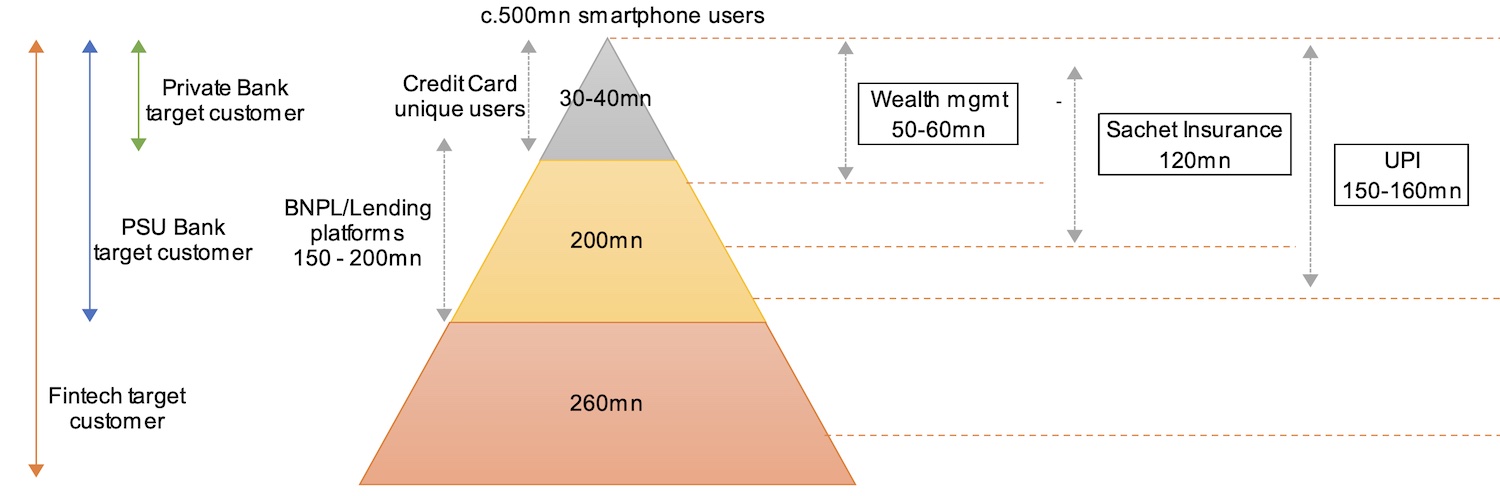
Consumer segmentation and addressable market for fintech firms in India (BofA Research)

CRED says it is trying to help customers improve their financial behavior. An individual needs a credit score of at least 750 to join CRED. In a recent newsletter to customers, CRED said the median credit score of its customers was 830 and at “any given point in time” more than 375,000 individuals are on the app’s waiting list, many of whom have demonstrably improved their score to join CRED.

“It’s easy to be responsible when you’re empowered. 80% CRED Protect members got visibility on extra interest charges and avoided late payment fees by tracking their dues on CRED. Ignorance is not always bliss. CRED members detected additional charges worth over ₹145 Crores [$20.1 million] on their statements. CRED members avoided over ₹43.5 Crores [$6 million] worth of late payment fees,” it wrote in the newsletter.

“With the help of regular bill payment reminders, and a seamless credit card management experience; 160,000 CRED members improved their credit scores last month. CRED members know it pays to be good as they earned cash-back worth ₹12 Crores [$1.65 million] by paying their bills on time. There’s always something to look forward to on CRED. Our members got access to over 750 new rewards and products.”

The startup makes money by cross-selling financing products — for which it has a revenue-sharing arrangement with banks and other financial institutions — and levies a similar cut from merchants who are on the platform, Shah, who is also one of the most prolific angel investors in India, told TechCrunch in an interview in January this year.


15 Mar 2021

With 1v1Me, anyone can gamble on their ability to crush an opponent in player vs. player games

Anthony Geranio has played video games for the past thirteen years. The 26 year-old first time founder of 1v1Me, a new company that lets anyone gamble on their ability to win in a player vs. player game, tried to make it as a professional gamer, but when that didn’t work, he turned to the tech industry.

Geranio and his co-founder Alex Emmanuel bounced between companies like TextNow, Skillshare, and Grailed to combine both of their passions — gaming and entrepreneurship into a new company.

“The reason I got into programming was because I wanted to be my own boss one day,” Geranio said. And even though he was making $200,000 a year working at mission driven companies like SkillShare, Geranio said he still wasn’t fulfilled.

The COVID-19 pandemic finally convinced Geranio and Emmanuel to take the plunge. All of Geranio’s friends had started lockdown whiling away the hours by playing poker online for money. Then poker turned into Call of Duty, which turned into Madden, which became whatever else the kids play these days (my gaming days ended with Mortal Kombat II).

Geranio then went to OnDeck and, after graduating, began knocking on investors’ doors. The company managed to raise over $2 million from investors including On Deck, Erik Torenberg at Village Global, Turner Novak at GeltVC, Niv Dror at Shrug, SterlingVC, Ali Hamed at Crossbeam, Cody Hock and Cole Hock from UpNorth, Lightshed Ventures and BettorCapital. Notable angels also wanted in on the action including Justin Waldron, Brud founder Trevor McFedries, Ian Borthwick, Albert Cheng, Stephen Sikes and Anthony Pompliano.

The company is launching its app on the app store with an invite only approach, with the first invites going to content creators who already play games like Call of Duty. The longterm goal is to create content creators around wagering. “We’re trying to create a network where wagering is the engagement tool,” said Geranio.

For now, the company is only supporting bets on games like Call of Duty and Fortnite. The service acts as a marketplace which exchanges contact information on a PlayStation or Xbox. To win a wager, competitors have to link their bank accounts, settle on an amount, and 1v1Me puts that money in escrow. Gamers stream their game on Twitch and 1v1Me monitors the game to determine the winner. Once the competition is over, the winner gets the money transferred to their account.

The company is launching with gamers like  NoisyButters (who invested as well), LunchtimeRLaw, and Vonniezugz.

To juice signups and invites, which can either be obtained through a creator or by following the company on Twitter where 1v1Me will give codes away, the company is also hosting a $500 challenge to whichever competitor wins the most games at the end of the week.

“When I worked at YouTube, I met many gaming creators that desired to entertain their fans and hone their skills, but it can be a struggle to make significant money along the way,” said Albert Cheng, Co-lead of Socially Financed and Director of Product at Duolingo. “1v1 is the most promising platform for esports gamers to make a living, and I’m thrilled to back them on their journey.”

15 Mar 2021

Zeller, a fintech founded by Square alumni, raises $25M AUD Series A led by Lee Fixel’s Addition

A photo of Dominic Yap, chief operating officer and co-founder, and Ben Pfisterer, chief executive officer and co-founder of Zeller

Dominic Yap, chief operating officer and co-founder, and Ben Pfisterer, chief executive officer and co-founder of Zeller

Zeller, a payment and financial services startup founded by former Square executives, quietly raised a $25 million AUD (about $19.4 million USD) Series A last year, it announced today. The funding was led by Addition, the investment firm founded by former Tiger Global partner Lee Fixel, and included participation from returning investors Square Peg and Apex Capital. The Melbourne-based company said this is one of Australia’s largest pre-launch Series A rounds ever.

The startup previously raised a $6.3 million AUD (USD $4.9 million) seed round in June 2020. Zeller was was founded last year by Ben Pfisterer, Square’s former Asia Pacific and Australia head, and Dominic Yap, its strategy and growth lead. It has made 38 new hires over the past six months, growing its team to 50 people.

The funding will be used to grow Zeller’s product development and engineering capabilities, marketing and sales, and customer support teams as it prepares for its launch. A date hasn’t been set yet, but chief executive officer Pfisterer told TechCrunch it is “imminent.”

Zeller will offer a fully-integrated payments and financial services solution designed for small- to medium-sized businesses that currently rely on multiple providers for their payment terminals, point of sale systems, e-commerce payments, transaction accounts and credit cards. Zeller’s software is combined with a payment terminal, transaction account and business Mastercard, and intended to make it easier for businesses to accept and send payments, access funds and manage their finances. Zeller will have no lock-in contracts and one low fee for card payments.

“We don’t underestimate the challenges that come with scaling a new brand in an area dominated by entrenched banking incumbents, yet the opportunity is incredibly exciting,” said Pfisterer. “The industry experience our team has built up over the years means that we are well aware of the pain points business owners face when getting set up with a new banking or financial services provider.”

He added that despite the growth of e-commerce, about two-thirds of transactions are still processed in person. Zeller’s “sweet spot” is currently businesses that process up to $10 million AUD annually, mostly in face-to-face transactions.

“They may be sole traders or employ a team, may operate across one or multiple locations and come from a variety of verticals including retail, hospitality, fixed or mobile services, events, trades and many more,” said Pfisterer. He estimated that Zeller’s market opportunity in Australia includes just under 1.5 million merchants, and it is also designed to be scalable into other markets.

Other payment and financial services companies in Australia include Square, eWAY, PayPal, Ayden and Stripe.

Pfisterer said eWAY, Stripe and Adyen tend to focus on e-commerce payment processing, “yet this is just one element of what business owners need to manage their cash flow.” Most still need to accept in-person payments, which means going to a traditional bank for a merchant terminal and account. On the other hand, PayPal and Square focus mainly on micro-merchants. “The growing pains kick in when a business starts to expand and demands a wider variety of services.”

Zeller already has plans to introduce new payment and financial services products, and integrations with tools like point-of-sale and accounting software, to scale up with businesses as they grow, he added.

15 Mar 2021

Swedish battery manufacturer Northvolt receives a $14 billion order from VW

Northvolt, the Swedish battery manufacturer which raised $1 billion in financing from investors led by Goldman Sachs and Volkswagen back in 2019, has signed a massive $14 billion battery order with VW for the next 10 years.

The big buy clears up some questions about where Volkswagen will be getting the batteries for its huge push into electric vehicles, which will see the automaker reach production capacity of 1.5 million electric vehicles by 2025.

The deal will not only see Northvolt become the strategic lead supplier for battery cells for Volkswagen Group in Europe, but will also involve the German automaker increasing its equity ownership of Northvolt.

As part of the partnership agreement, Northvolt’s gigafactory in Sweden will be expanded and Northvolt agreed to sell its joint venture share in Salzgitter, Germany to Volkswagen as the car maker looks to build up its battery manufacturing efforts across Europe, the companies said.

The agreement between Northvolt and VW brings the Swedish battery maker’s total contracts to $27 billion in the two years since it raised its big $1 billion cash haul.

“Volkswagen is a key investor, customer and partner on the journey ahead and we will continue to work hard with the goal of providing them with the greenest battery on the planet as they rapidly expand their fleet of electric vehicles,” said Peter Carlsson, the co-founder and chief executive of Northvolt, in a statement.

Northvolt’s other partners and customers include ABB, BMW Group, Scania, Siemens, Vattenfall, and Vestas. Together these firms comprise some of the largest manufacturers in Europe.

Back in 2019, the company said that its cell manufacturing capacity could hit 16 Gigawatt hours and that it had sold its capacity to the tune of $13 billion through 2030. That means that the Volkswagen deal will eat up a significant portion of expanded product lines.

Founded Carlsson, a former executive at Tesla, Northvolt’s battery business was intended to leapfrog the European Union into direct competition with Asia’s largest battery manufacturers — Samsung, LG Chem, and CATL.

Back when the company first announced its $1 billion investment round, Carlsson had said that Northvolt would need to build up to150 gigawatt hours of capacity to hit targets for. 2030 electric vehicle sales.

The plant in Sweden is expected to hit at least 32 gigawatt hours of production thanks, in part to backing by the Swedish pension fund firms AMF and Folksam and IKEA-linked IMAS Foundation, in addition to the big financial partners Volkswagen and Goldman Sachs.

Northvolt has had a busy few months. Earlier in March the company announced the acquisition of the Silicon Valley-based startup company Cuberg.

That acquisition gave Northvolt a foothold in the U.S. and established the company’s advanced technology center.

The acquisition also gives Northvolt a window into the newest battery chemistry that’s being touted as a savior for the industry — lithium metal batteries.

Cuberg spun out of Stanford University back in 2015 to commercialize what the company called its next-generation battery combining a liquid electrolyte with a lithium metal anode. The company’s customers include Boeing, BETA Technologies, Ampaire, and VoltAero and it was backed by Boeing HorizonX Ventures, Activate.org, the California Energy Commission, the Department of Energy and the TomKat Center at Stanford.

Cuberg’s cells deliver 70 percent increased range and capacity versus comparable lithium ion cells designed for electric aviation applications. The two companies hope that they can apply the technology to Northvolt’s automotive and industrial product portfolio with the ambition to industrialize cells in 2025 that exceed 1,000 Wh/L, while meeting the full spectrum of automotive customer requirements, according to a statement.

“The Cuberg team has shown exceptional ability to develop world-class technology, proven results and an outstanding customer base in a lean and efficient organization,” said Peter Carlsson, CEO and Co-Founder, Northvolt in a statement. “Combining these strengths with the capabilities and technology of Northvolt allows us to make significant improvements in both performance and safety while driving down cost even further for next-generation battery cells. This is critical for accelerating the shift to fully electric vehicles and responding to the needs of the leading automotive companies within a relevant time frame.”


15 Mar 2021

Curran Biotech’s new nanocoating could prevent indoor transmission of COVID-19

A new nanocoating from Curran Biotech could dramatically improve air filtration to prevent the spread of COVID-19 indoors.

Their Capture Coating technology acts as a supplement to any household or commercial HVAC system by bonding to the filter fibers, giving them greater hydrophobic properties. This combined effect prevents virus-carrying droplets from traveling through the filter fibers, which, without the treatment, only prevent some viral transmission.

“’Capture Coating’ is designed to mitigate and significantly decrease viral transmission of COVID-19 through specified air filtration media by forming a breathable, flexible, non-leaching, water-repellent barrier against aqueous respiratory droplets that act as virion carriers that can potentially be recirculated through conventional air-filters,” wrote Curran Biotech founder and University of Houston physics professor Shay Curran in an email. Despite the molecular complexity of the coating, the product itself can simply be sprayed onto an HVAC system’s filter.

This new droplet-targeting coating is an improvement over current filtration methods, which typically only target dry molecules. Not only do those methods often have at least some potential of viral droplet transmission, but current solutions to improve them aren’t always energy efficient.

“In the world where energy management is very important, that means recycling the same air in the building with the risk of cross contamination,” wrote Curran. “Taking outside air is one way to dilute the air, but that means we also lose a huge amount in terms of energy, and still don’t solve the problem of taking the virus away from places where people congregate.”

Indoor air ventilation remains an important tool in mitigating the spread of COVID-19 across schools, small businesses, and other public buildings, but updating old HVAC systems to the recommended CDC standards can be costly. Curran hopes that his company’s approach can help address this issue, as the Capture Coating requires only a simple spray, rather than a completely new system of filters. “That really means for a few dollars when used on a standard issue MERV8, you can have huge indoor protection and stop its spread throughout the building,” he wrote.

Because of the nature of the nanocoating, Curran’s technology can help prevent viral droplet transmission long after the end of the COVID-19 pandemic. The hydrophobic qualities of the coating prevent respiratory droplets from actions like sneezing or coughing from passing through the filter, while the HVAC system itself retains its normal capabilities for dry molecule filtration. With the Capture Coating, common droplet-transmitting viruses like the flu or cold will also be filtered out of circulation.

Similarly, the nanocoating would work in preventing transmission of any variant of the COVID-19 virus, as all of those variants also undergo droplet transmission. “It does not mean we get away from taking precautions such as hand washing, wearing masks etc, but it does mean we can work indoors far more safely,” wrote Curran.

So far, Curran Biotech’s Capture Coating technology is in use in 11 states, and will soon be announcing partnerships with distributors and filter companies to directly provide consumers with coated filters. Curran wrote that the company has also had successful trials of the technology in New York City, and hopes to expand use of the product even further across businesses and institutions around the country.


Early Stage is the premier ‘how-to’ event for startup entrepreneurs and investors. You’ll hear first-hand how some of the most successful founders and VCs build their businesses, raise money and manage their portfolios. We’ll cover every aspect of company-building: Fundraising, recruiting, sales, product market fit, PR, marketing and brand building. Each session also has audience participation built-in – there’s ample time included for audience questions and discussion. Use code “TCARTICLE at checkout to get 20 percent off tickets right here.

15 Mar 2021

DeepSee.ai raises $22.6M Series A for its AI-centric process automation platform

DeepSee.ai, a startup that helps enterprises use AI to automate line-of-business problems, today announced that it has raised a $22.6 million Series A funding round led by led by ForgePoint Capital. Previous investors AllegisCyber Capital and Signal Peak Ventures also participated in this round, which brings the Salt Lake City-based company’s total funding to date to $30.7 million.

The company argues that it offers enterprises a different take on process automation. The industry buzzword these days is ‘robotic process automation,’ but DeepSee.ai argues that what it does is different. I describe its system as ‘knowledge process automation’ (KPA). The company itself defines this as a system that “mines unstructured data, operationalizes AI-powered insights, and automates results into real-time action for the enterprise.” But the company also argues that today’s bots focus on basic task automation that doesn’t offer the kind of deeper insights that sophisticated machine learning models can bring to the table. The company also stresses that it doesn’t aim to replace knowledge workers but help them leverage AI to turn the plethora of data that businesses now collect into actionable insights.

Image Credits: DeepSee.ai

“Executives are telling me they need business outcomes and not science projects,” writes DeepSee.ai CEO Steve Shillingford. “And today, the burgeoning frustration with most AI-centric deployments in large-scale enterprises is they look great in theory but largely fail in production. We think that’s because right now the current ‘AI approach’ lacks a holistic business context relevance. It’s unthinking, rigid, and without the contextual input of subject-matter experts on the ground. We founded DeepSee to bridge the gap between powerful technology and line-of-business, with adaptable solutions that empower our customers to operationalize AI-powered automation – delivering faster, better, and cheaper results for our users.”

To help businesses get started with the platform, DeepSee.ai offers three core tools. There’s DeepSee Assembler, which ingests unstructured data and gets it ready for labeling, model review and analysis. Then, DeepSee Atlas can use this data to train AI models that can understand a company’s business processes and help subject-matter experts define templates, rules and logic for automating a company’s internal processes. The third tool, DeepSee Advisor, meanwhile focuses on using text analysis to help companies better understand and evaluate their business processes.

Currently, the company’s focus is on providing these tools for insurance companies, the public sector and capital markets. In the insurance space, use cases include fraud detection, claims prediction and processing, and using large amounts of unstructured data to identify patterns in agent audits, for example.

That’s a relatively limited number of industries for a startup to operate in, but the company says it will use its new funding to accelerate product development and expand to new verticals.

“Using KPA, line-of-business executives can bridge data science and enterprise outcomes, operationalize AI/ML-powered automation at scale, and use predictive insights in real time to grow revenue, reduce cost, and mitigate risk,” said Sean Cunningham, Managing Director of ForgePoint Capital. “As a leading cybersecurity investor, ForgePoint sees the daily security challenges around insider threat, data visibility, and compliance. This investment in DeepSee accelerates the ability to reduce risk with business automation and delivers much-needed AI transparency required by customers for implementation.”

15 Mar 2021

ElevateBio raises $525M to advance its cell and gene therapy technologies

ElevateBio, one of the leading biotech companies focused on gene-based therapies has raised a massive $525 million Series C round of financing, more than doubling the company’s $193 million Series B funding which closed last year. This new funding comes from existing investor Matrix Capital Management, and also adds new investors SoftBank and Fidelity Management & Research Company, and will be used to help the company expand its R&D and manufacturing capabilities, as well as continue to spin out new companies and partnerships based on its research.

Cambridge, Mass-based ElevateBio was founded to bridge the world of academic research and development of cell and gene therapies with that of commercialization and production-scale manufacturing. The startup identified a need for more efficient means of brining to market the ample, promising science that was being done in developing therapeutics that leverage cellular and genetic editing, particularly in treatment of severe and chronic illness. Its business model focuses on both developing and commercializing its own therapies, and also working through long-term partnerships with academic research institutions and other therapeutics biotech companies to bring their own technologies to market.

To this end, ElevateBio is in the business of frequent spin-out company creation, with the new entities each focused on a specific therapeutic. The company has announced three such companies to date, including AlloVir (in partnership with Baylor College of Medicine), HighPassBio (a venture with gene-editing company Fred Hutchinson) and Life Edit Therapeutics (in partnership with AgBiome). There are additional spin-outs in the works, too, according to ElevateBio, but they are not being disclosed publicly yet.

As you might expect, ElevateBio seems to have benefited from the increased appetite for biotech investment stemming from the global pandemic and its impacts. ElevateBio’s AlloVir spin-out is actually working on a T cell therapy candidate for addressing COVID-19, which is potentially effective in eliminating cells infected with SARS-CoV-2 in a patient to slow the spread of the disease and reduce its severity.